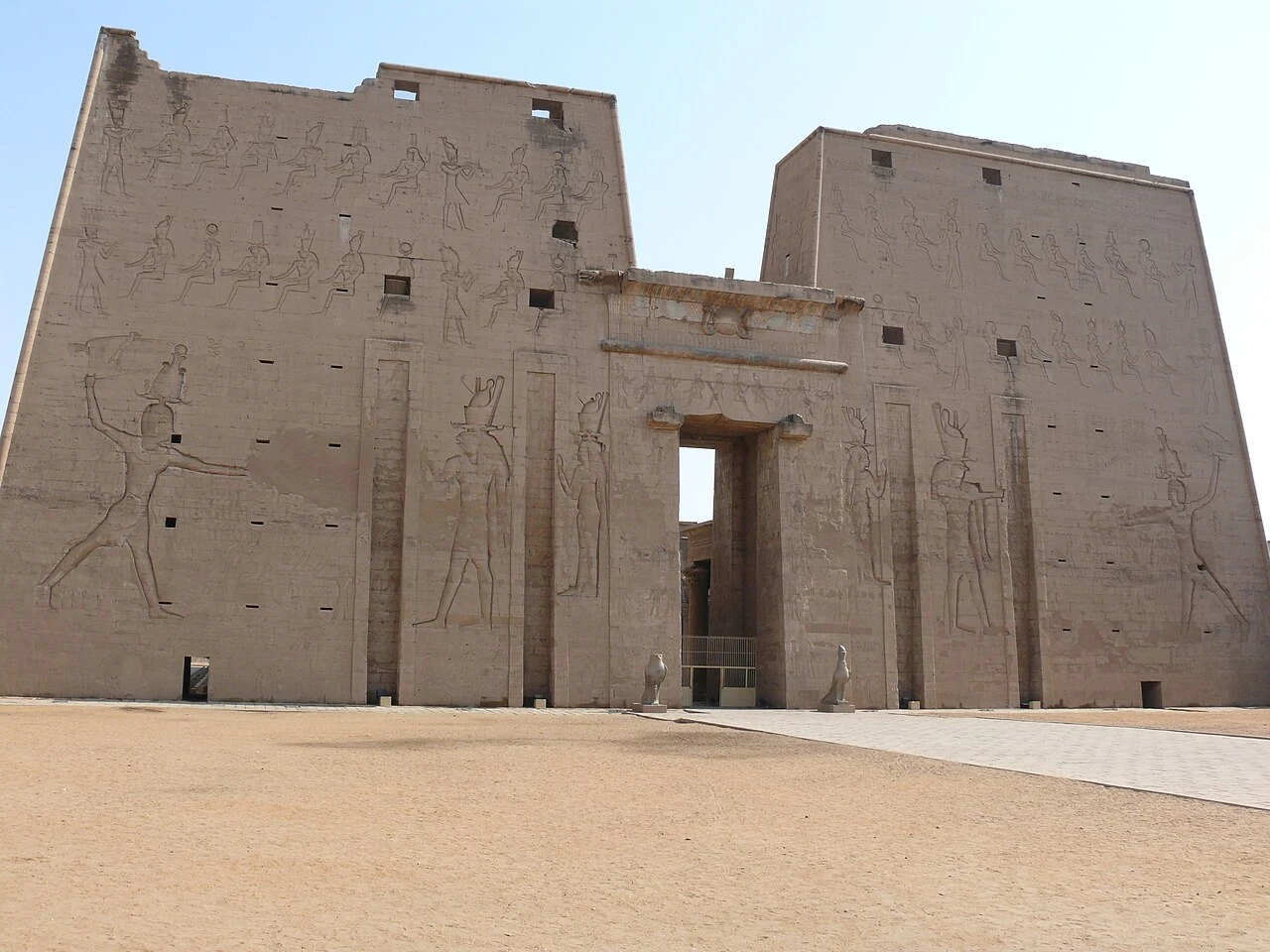
Stanza · Audio guide
Temple of EdfuAudio guide
A place to remember. A story to take with you.
The Temple of Edfu is a remarkably well-preserved ancient Egyptian temple located on the west bank of the Nile. It was constructed during the Ptolemaic Kingdom between 237 and 57 BC.
Download Stanza, then search for “Temple of Edfu”.
About the tour
One guide. Your kind of visit.
The Temple of Edfu is a remarkably well-preserved ancient Egyptian temple located on the west bank of the Nile. It was constructed during the Ptolemaic Kingdom between 237 and 57 BC.
Ready when you are.
- 01Get the free Stanza app.
iOS & Android
- 02Find your guide.
“Temple of Edfu”
- 03Download before you go.
Works offline
Audio guide / 13 narrated stops
Inside the guide
Get to know a few of the stories before you go. Open a stop to read more.
01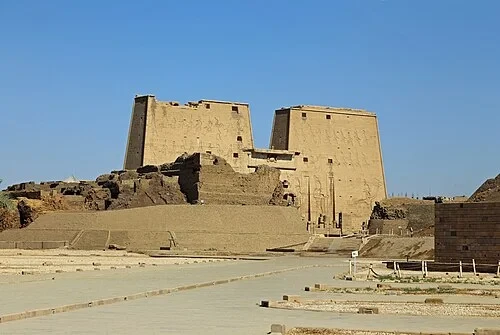 Entrance Plaza and the Ancient CityEdfu Temple and Mud-Brick Ruins
Welcome to the Temple of Edfu, one of the most complete ancient structures remaining in Egypt. Measuring approximately 79 meters in length and 76 meters in width, this grand complex represents the height of Ptolemaic architecture. Construction of the monument began on August 23, 237 BC, under the reign of Ptolemy III Euergetes, and spanned nearly 180 years before finally reaching completion in 57 BC during the rule of Ptolemy XII Auletes. In the surrounding landscape, mounds of crumbling mud-brick structures stand in stark contrast to the towering stone walls of the temple itself. The earthy ruins represent the remnants of Apollinopolis Magna, the ancient provincial capital city that once bustled with life around the sacred precinct. Over the centuries, the domestic quarters of the town grew so large that they eventually spilled over and covered the temple itself, protecting it for future generations. Today, these domestic remains offer historians invaluable insights into the daily lives of the ancient citizens who lived, worked, and worshipped in the shadow of this great sacred complex.
Marc Ryckaert · CC BY-SA 4.0
02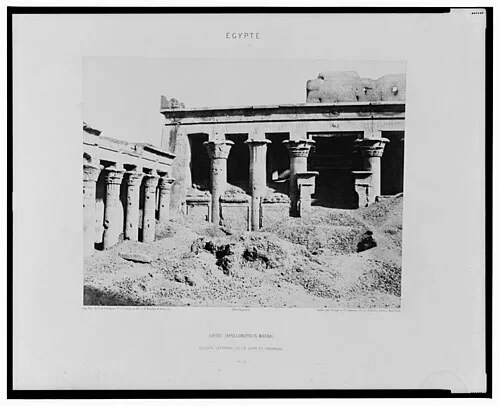 Entrance Plaza and the Ancient CityThe Buried Colonnade
Centuries of shifting desert sands and annual Nile floods gradually enveloped the Temple of Edfu, burying it under a twelve-meter-deep blanket of silt. The protective layer kept the architectural elements remarkably secure from the elements and human destruction for nearly two thousand years. An early photograph taken by Félix Teynard in the 1850s documents the state of the ruins before systematic clearing began, revealing sand drifts reaching almost to the tops of the heavy stone columns. In 1860, French archaeologist Auguste Mariette initiated a massive campaign to reclaim the ancient sanctuary. Workers cleared away hundreds of tons of compacted earth and debris to expose the buried halls. Mariette also had to dismantle an entire local village that had established homes directly on the flat stone slabs of the temple roof over generations. Through such laborious clearance, the beautifully preserved columns, inscriptions, and reliefs finally emerged back into the sunlight, offering an unparalleled view of Ptolemaic temple design.
Teynard, Félix, photographer · Public domain
03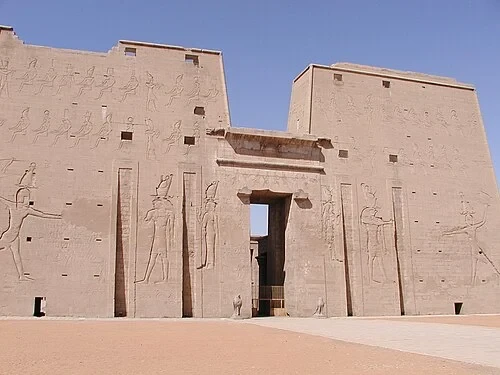 The First Pylon GatewayThe First Pylon Gateway
Twin towers of the massive entrance pylon dominate the approach to the temple complex. Rising to a height of thirty-six meters, this monumental gateway functioned as a critical boundary in ancient Egyptian cosmology, separating the chaotic outside world from the purified, sacred zone of the inner sanctuary. On the flat exterior walls, four deep vertical grooves are cut directly into the stone facade. The recesses were engineered to secure giant cedar flagstaffs, which would have flown bright, colorful banners visible from great distances. Visitors in antiquity crossed this threshold with great reverence, passing between the towers into the open courtyard. The sheer scale of the gateway was intended to dwarf the individual, instilling a sense of awe before they entered the domains of the gods.
Listen in the appPhoto: Néfermaât · CC BY-SA 2.5
04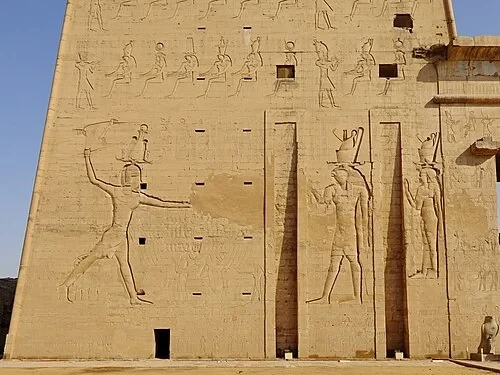 The First Pylon GatewayRelief of the Pharaoh Smiting Enemies
Carved directly into the stone face of the entrance pylon, a giant relief shows Ptolemy XII Auletes raising a ceremonial mace to strike a group of bound captives held by their hair. The pharaoh presents this act of triumph directly to the falcon-headed god Horus and the protective goddess Hathor. While the image conveys a traditional message of military might, it also carries a deep political subtext. The Ptolemaic rulers were ethnically Greek, descending from Alexander the Great's general, Ptolemy I. To consolidate their power and gain acceptance among the native population, the foreign rulers adopted traditional Egyptian artistic styles, hieroglyphs, and religious iconography. By depicting themselves in the guise of ancient pharaohs performing sacred duties, the Ptolemaic kings legitimized their dynasty and maintained the stability of their empire.
Listen in the appOlaf Tausch · CC BY 3.0
05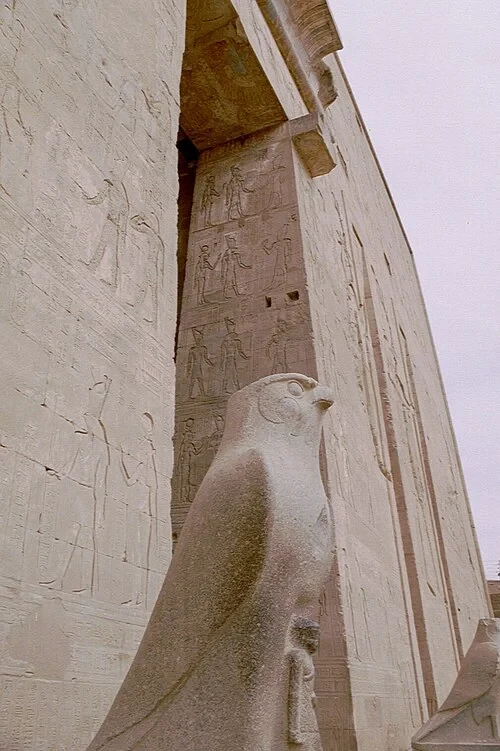 The Court of OfferingsFalcon Statue of Horus
Crafted from dark black granite, a magnificent sculpture of the sky god Horus stands guard outside the entrance. Depicted as a powerful falcon, the deity wears the double crown that signifies sovereign rule over the unified lands of Upper and Lower Egypt. Horus held a central position in the Egyptian pantheon as the divine protector of the pharaoh, and the living king was revered as his physical incarnation on earth. The temple served as the primary cult center for Horus, making this statue a highly significant depiction of the local patron deity. The crisp, clean lines of the carving highlight the bird's smooth plumage, sharp beak, and alert eyes, projecting an aura of quiet strength and vigilance over the temple threshold.
Listen in the appPhoto: Néfermaât · CC BY-SA 2.5
06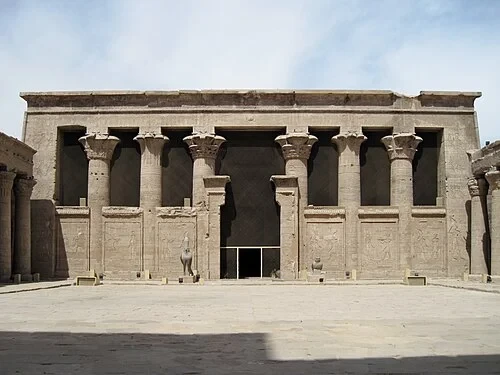 The Court of OfferingsThe Pronaos Colonnade
The facade of the Pronaos, or outer hypostyle hall, features a distinctive architectural element of the Ptolemaic era: stone screen walls that span the gaps between the front columns. The half-height walls were designed to allow natural sunlight to filter into the hall while simultaneously blocking the view of sacred rituals from the uninitiated public standing in the open courtyard. Looking up, the column capitals display a remarkable variety of botanical forms, showcasing composite patterns inspired by palm fronds and papyrus blossoms. Unlike the uniform designs of earlier kingdoms, late Egyptian architects embraced decorative diversity, ensuring that no two adjacent columns looked exactly alike. The playful variation in stone carvings mimics the natural diversity of the Nile's riverbanks, creating a transition from the bright, open courtyard to the dark, mysterious chambers hidden deeper within the temple complex.
Listen in the appOlaf Tausch · CC BY 3.0
07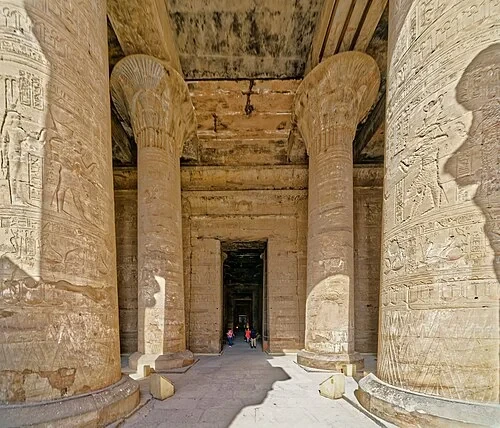 The Great Hypostyle HallThe Great Hypostyle Hall
Twelve monumental columns support the soaring roof of the outer hypostyle hall, creating a dense stone forest. The specific layout of this chamber was designed to represent the primeval swamp of the Egyptian creation myth, the watery chaos from which the first mound of earth arose. The columns themselves are shaped to resemble giant papyrus reeds, rising from the floor toward a ceiling that symbolized the heavens. Every square inch of the column shafts is covered in detailed low-relief carvings, depicting the pharaoh presenting ritual offerings to various deities. Light from small, high window slits illuminates these figures, casting deep shadows that would have enhanced the mystical atmosphere during daily rituals. The stone marshland served as a transitional space, preparing priests as they moved from the outer world toward the absolute quiet of the inner sanctuary.
Listen in the appPhoto: Holger Uwe Schmitt · CC BY-SA 4.0
08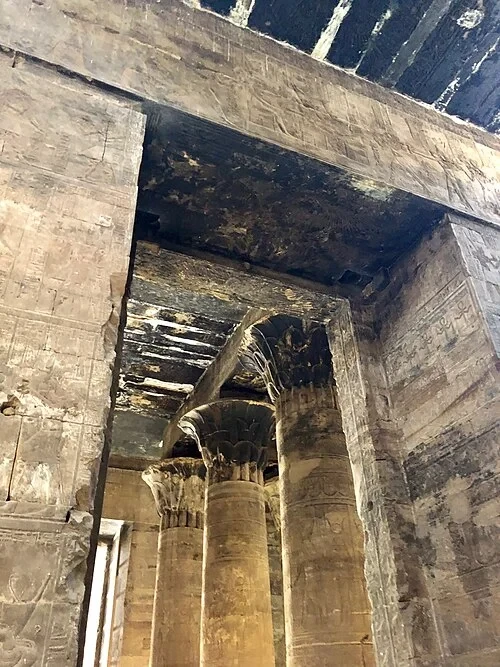 The Great Hypostyle HallThe Soot-Blackened Ceiling
The ceiling of the inner chambers is heavily blackened by centuries of soot, marking a dramatic shift in the temple's history. Following Roman Emperor Theodosius the First's decree in 391 AD banning all non-Christian worship, the ancient temple was officially abandoned. In the centuries that followed, early Christian monks, local squatters, and villagers moved into the empty stone halls, using the durable structure as shelter, communal kitchens, and workshops. The dark residue coating the roof slabs is the accumulated smoke from their daily cooking and heating fires. Looking closely at the walls, many of the reliefs show signs of deliberate damage. Early Christian iconoclasts systematically chipped away the faces, hands, and feet of the ancient Egyptian gods to neutralize what they viewed as pagan imagery. Such modifications tell a story of religious transformation, where the grand ritual space of Horus was repurposed for the practical needs of daily survival.
Listen in the appWarren LeMay from Cullowhee, NC, United States · CC0
09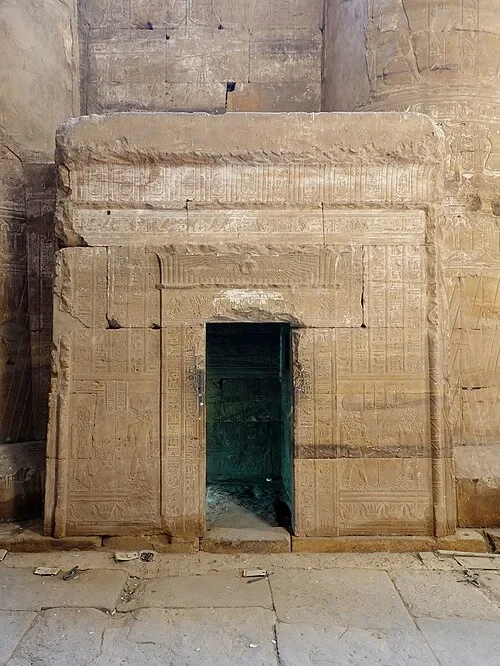 The Temple Library and the Victory ReliefsThe Temple Library Doorway
An ornamental doorway leads into a small chamber known to ancient priests as the House of Papyrus, which served as the temple library. The stone walls surrounding this entrance are completely covered in columns of meticulously carved hieroglyphic texts. Rather than decorative poetry, these inscriptions served a highly practical administrative purpose, acting as a permanent, stone-carved inventory of the scrolls kept inside the room. The texts catalog the titles, subjects, and authors of the various ritual manuscripts, magical texts, and administrative documents that the priests consulted during their daily duties. Although the fragile papyrus scrolls themselves disintegrated long ago, this stone index survives, giving modern scholars a fascinating glimpse into the intellectual life and scholarly organization of the Ptolemaic priesthood who once managed this archive.
Listen in the appOlaf Tausch · CC BY 3.0
10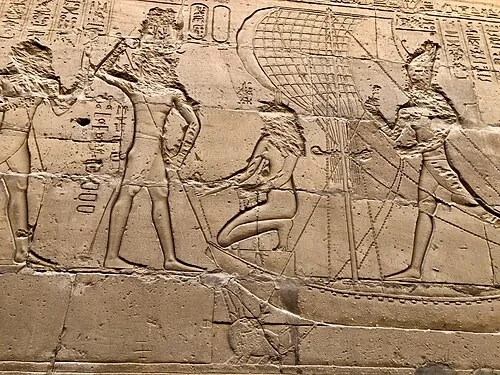 The Temple Library and the Victory ReliefsRelief of the Victory of Horus
On the inner walls of the temple, a dramatic relief captures the climax of the mythological battle between the sky god Horus and his uncle Seth, the embodiment of chaos and disorder. Horus stands firmly aboard a sacred papyrus boat, raising a long harpoon to pierce a small, stylized hippopotamus lurking beneath the vessel. In ancient Egyptian belief, the hippopotamus was a feared animal capable of destroying crops and boats, making it a fitting symbol for Seth's destructive nature. The scene is part of a larger narrative cycle recording the Sacred Drama, a ritual play performed annually by Edfu's priests. By reenacting this myth through performances, the temple staff believed they were actively helping to maintain maat, the cosmic balance of order over the forces of darkness and chaos.
Listen in the appMarie Thérèse Hébert & Jean Robert Thibault from Québec, Canada · CC BY-SA 2.0
Temple of Edfu
Frequently asked questions
How much does the guide cost?
Free app download. Listed guide price: $3.99. Guide price shown in the app. Audio guide only. Venue admission is separate.
Can I listen without internet?
Yes. Download the guide’s audio, images, and maps in the app before your visit. Your downloaded content is then available offline.
Can I listen in my language?
Stanza supports 15 languages. Check the app for the languages available for this guide.
Do I need to follow a schedule?
No. This is a self-guided experience. Choose your stops, pause whenever you like, and return to a story at your own pace.
At your own pace
Explore Temple of Edfu.
Download Stanza, then search for “Temple of Edfu”.
Free app download · Guide price shown in the app
Keep exploring
Nearby audio guides
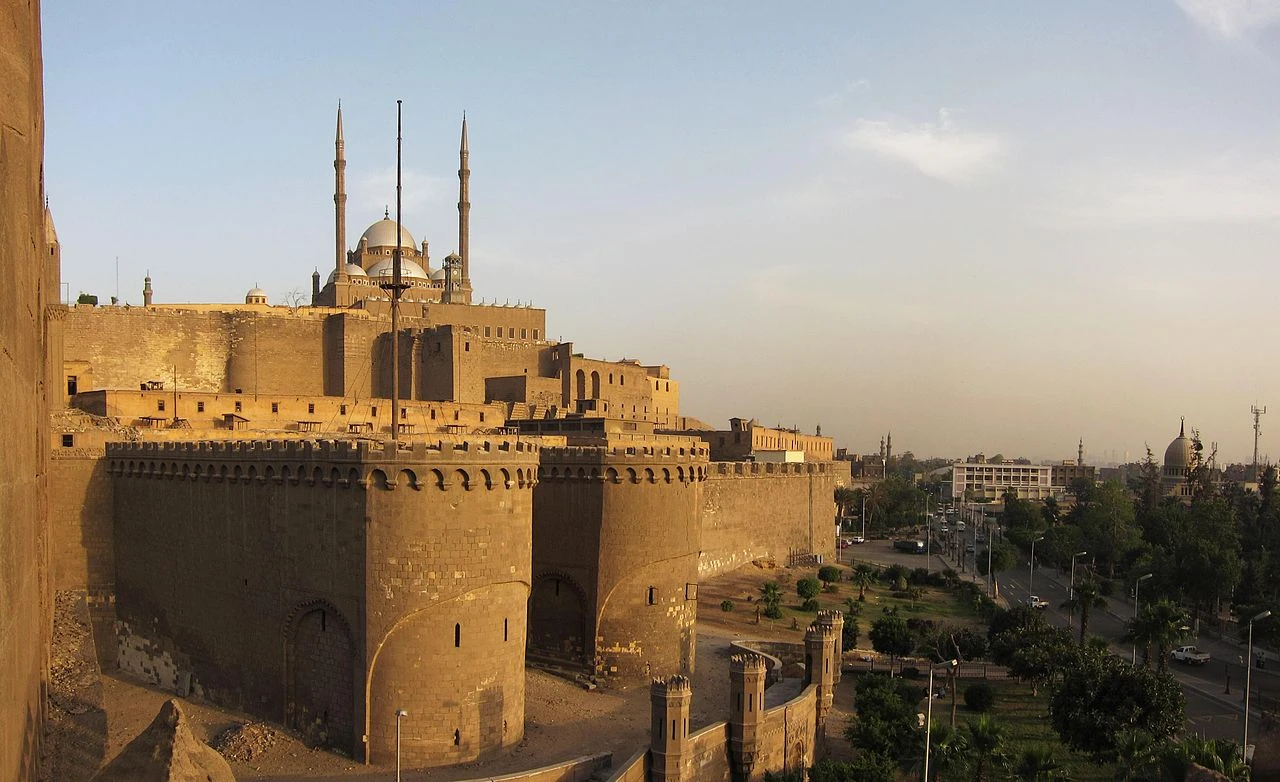
Cairo
Cairo Citadel
Content & sources
Ahmed Al.Badawy from Cairo, Egypt · CC BY-SA 2.0

Alexandria
Citadel of Qaitbay
Content & sources
Ahnaf Saber · CC BY 3.0
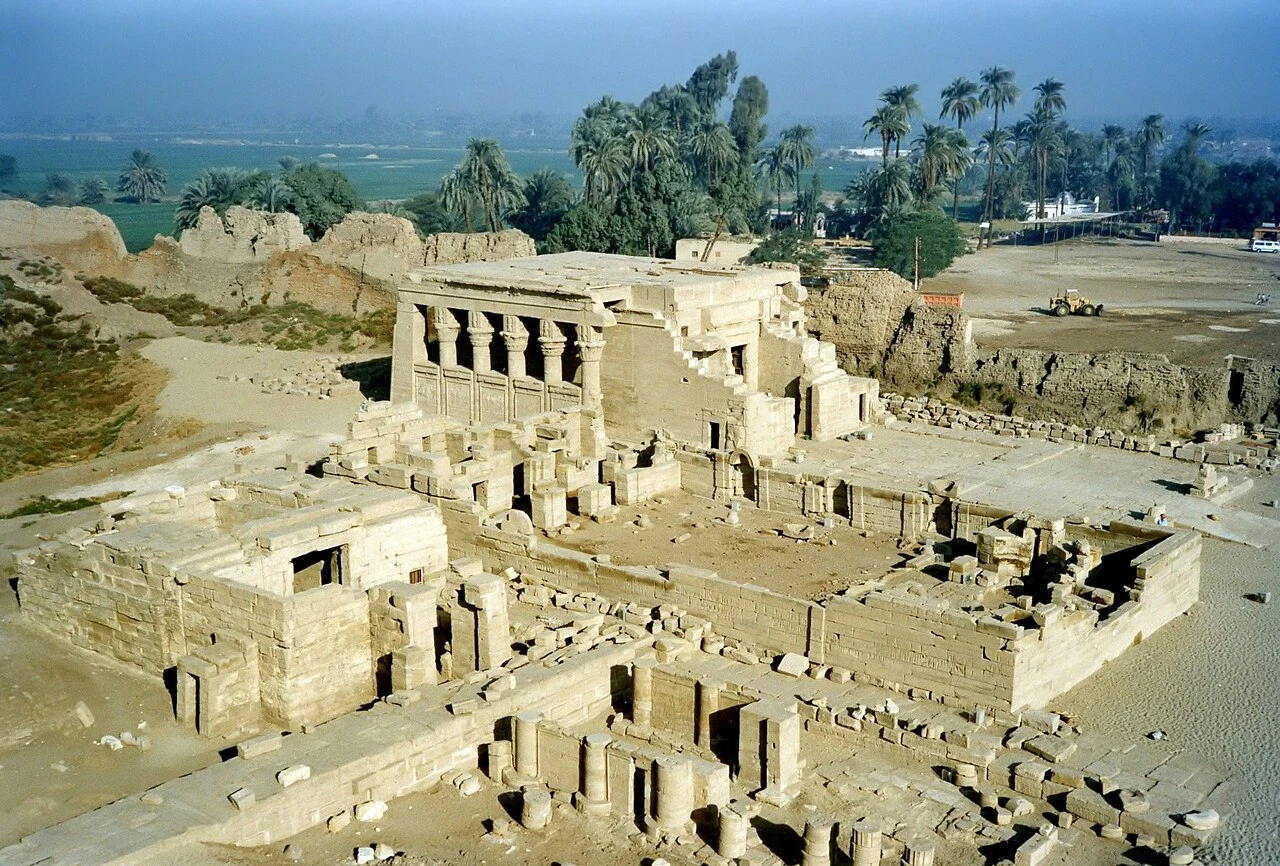
Dendera
Dendera Temple complex
Content & sources
Bernard Gagnon · CC BY-SA 3.0
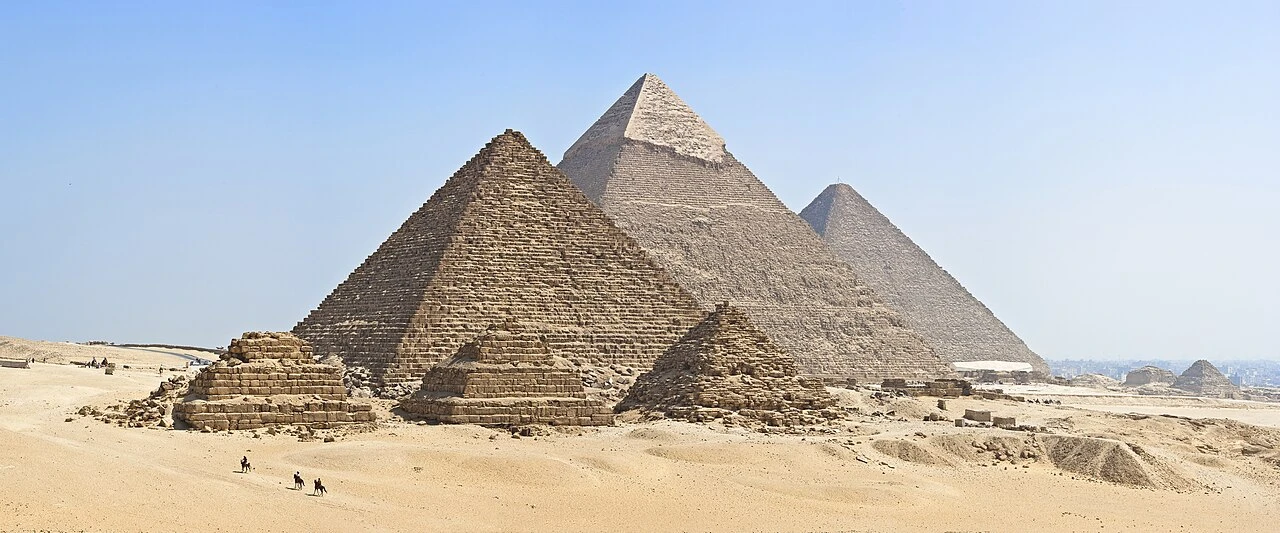
Giza
Giza pyramid complex
Content & sources
KennyOMG · CC BY-SA 4.0