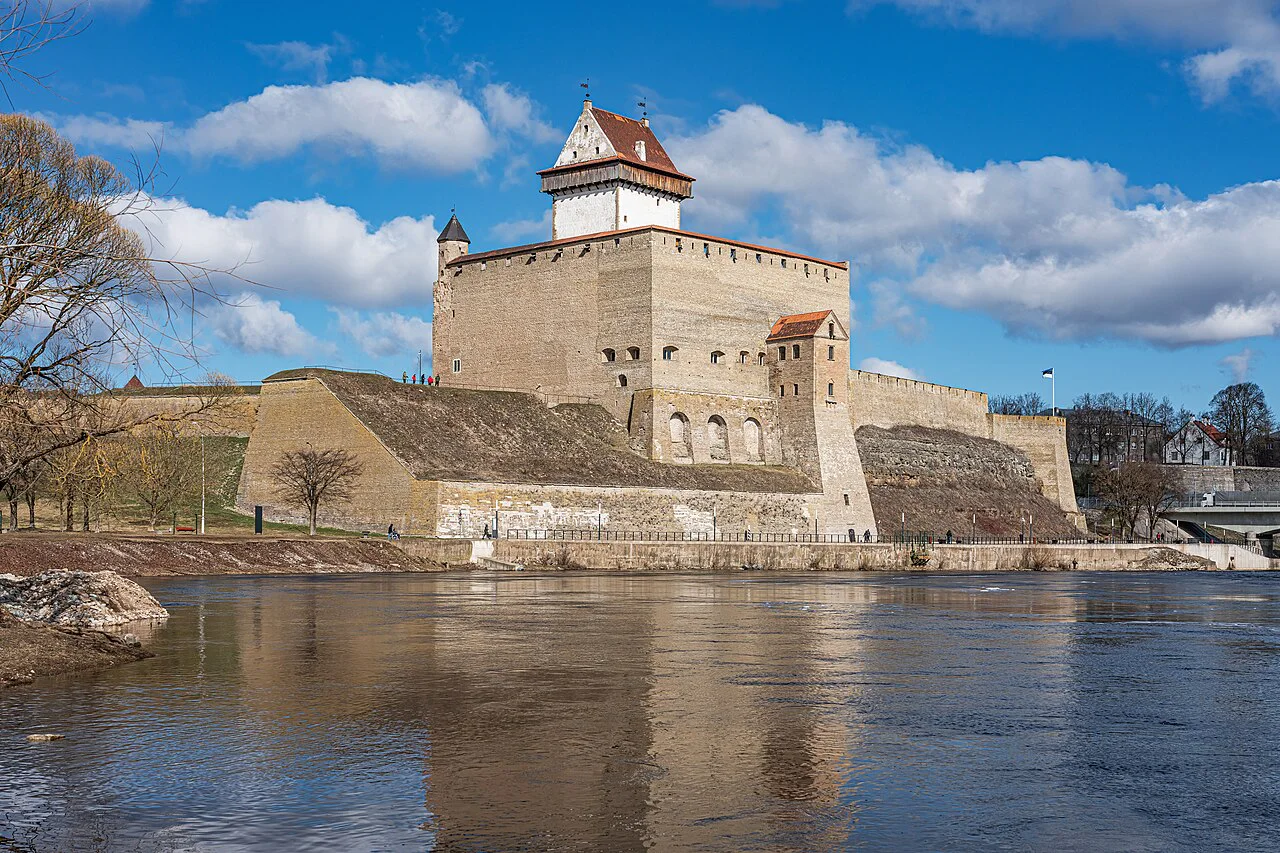
Stanza · Audio guide
Hermann Castle Audio Guide
A place to remember. A story to take with you.
Hermann Castle is a medieval castle located in Narva, Estonia. It was established around 1256 and served as a significant fortification under the Danish Realm and the Teutonic Order.
Download Stanza, then search for “Hermann Castle”.
About the tour
One guide. Your kind of visit.
Hermann Castle is a medieval castle located in Narva, Estonia. It was established around 1256 and served as a significant fortification under the Danish Realm and the Teutonic Order.
Ready when you are.
- 01Get the free Stanza app.
iOS & Android
- 02Find your guide.
“Hermann Castle”
- 03Download before you go.
Works offline
Audio guide / 15 narrated stops
Inside the guide
Get to know a few of the stories before you go. Open a stop to read more.
01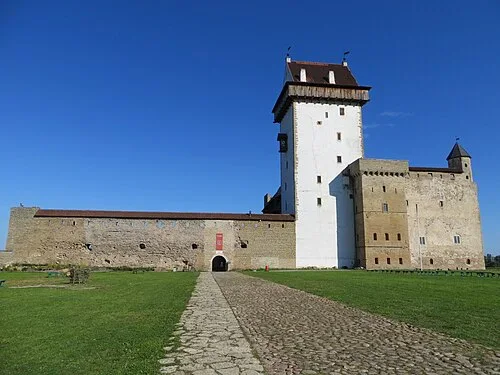 Western Forecourt and Castle Gate
Arrival at Hermann Castle
Welcome to Hermann Castle, on the river that now divides Estonia from Russia. This stronghold was first mentioned in writing in 1256, when the land belonged to the kings of Denmark. Denmark had conquered northern Estonia in the thirteenth century and planted a wooden border post here. The spot was no accident. The Narva river met an old road here, and whoever held the crossing held the frontier. Around the year 1300 the Danes rebuilt it in stone, as a compact castellum with sides about forty metres long. A square tower rose at its northwestern corner, the ancestor of the tall white keep that dominates the view now. For the next five hundred years this was a border fortress, passing from Danish to Livonian, then Swedish, then Russian hands. The cobbled approach and the long grey walls you see are the work of all of them.
KalervoK · CC0
02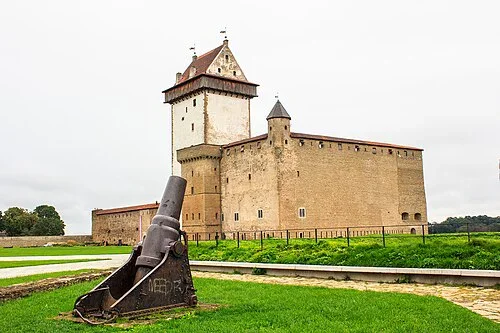 Western Forecourt and Castle Gate
The Eastertide Attack of 1342
The old cannon on the grass sets the tone for this frontier. Its story is violent. In 1294 a troop of the Novgorod prince burned the castle down once already. The second blow came on the first of April, 1342. Russian forces broke into the castle while mass was being held, killed the townspeople who had taken refuge there, and burned castle and town again. The Danes rebuilt quickly, because they could not afford a gap on the frontier. On the twenty-fifth of July, 1345, King Valdemar the Fourth confirmed Narva's Lübeck town rights. Lübeck rights meant the town could govern its own trade and law, a privilege that helped a shattered town recover. Some think Narva may have held such rights even earlier, under King Valdemar the Third, but the 1345 confirmation is the grant that stands in the record.
KalervoK · CC0
03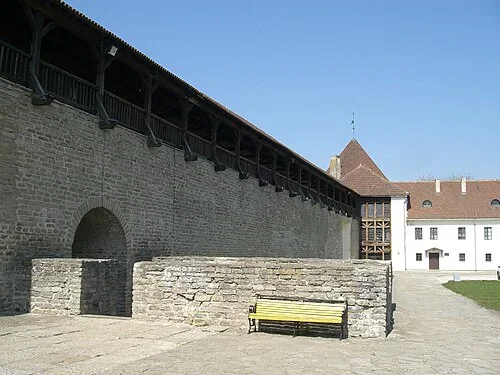 Convent House Inner Courtyard
The Convent House of the Livonian Order
This is the heart the Danish castellum became. In August 1346 Valdemar the Fourth sold northern Estonia, Narva included, to the Livonian Order, a branch of the Teutonic Knights. The Order rebuilt the compact stronghold into what they called a convent house, part monastery, part barracks, home to knight-brethren who lived by monastic rule. The castle has kept that ground plan to this day: massive wings around a central courtyard. On the river side the builders added a small outwork tower called a dansker, the kind that guarded the castle's well. A second dansker went up against the west wall. The wings were linked by a covered timber gallery running around the courtyard, like the dark wooden walkway carried on posts along this wall. In bad weather the brethren could cross the whole castle without stepping outside.
Listen in the appPhoto: Chmee2 · CC BY-SA 3.0
04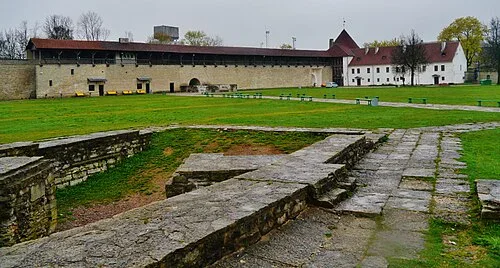 Convent House Inner Courtyard
The Western Forecourt
The great courtyard beside the convent house has changed jobs many times. A small forecourt existed on the north side from the early fourteenth century. In the middle of that century a much larger one was added here, on the west. Its purpose was shelter. Under Danish rule the town of Narva had no wall of its own, so in wartime the citizens were allowed to hide inside this forecourt. Later the Order adapted wall towers into round cannon platforms, called rondels, and two of them stand reconstructed at the corners of this western court. In Swedish times the court held an arsenal, since taken down. In the 1850s the Russian garrison built a sauna here, and in the 1860s it housed a church arranged inside a riding manège. Few courtyards have led such varied lives.
Listen in the appPhoto: Zairon · CC BY-SA 4.0
05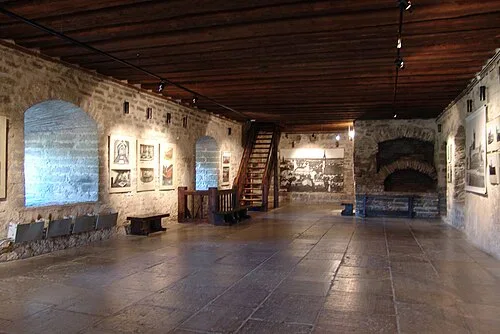 Convent House Museum Galleries
The Castle Museum and the Rescue of Narva's Records
This long vaulted hall, stone walls below and dark timber overhead, is the museum of the castle. It holds a story about losing memory and getting it back. In the early nineteenth century the castle's administrative archive was sold to a local herring merchant. The parchment documents ended up as wrapping paper for salted fish. What survived of Narva's written past did so by luck. The building itself fared better. Renovation lasting eight years was finished in June 2024, at a cost of nearly six million euros. The first stage reopened the convent house with a renewed permanent exhibition, and the second repaired the main courtyard and conserved the castle walls. The museum is run by the Narva Museum, and this hall is part of its galleries.
Listen in the appPhoto: Ad Meskens · CC BY-SA 4.0
06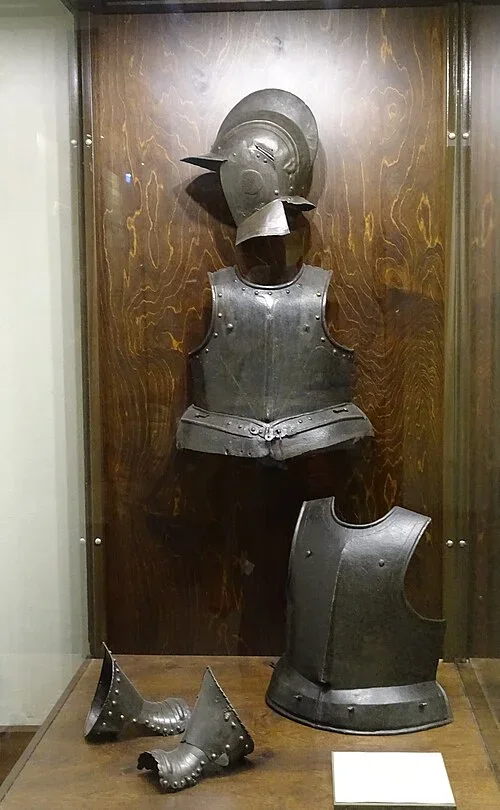 Convent House Museum Galleries
Arms and the Livonian War
The plate armour and helmet in this case belong to the world of garrison warfare this castle knew well. On the first of April, 1558, bombardment of Narva began from Ivangorod, across the river. On the eleventh of May a great fire broke out in the town. Russian troops used the chaos to storm the town, but the castle held out. The defenders negotiated an agreement, and they were allowed to leave freely. From 1558 to 1581 the castle belonged to the Muscovite tsar. Then, on the sixth of September, 1581, Swedish forces under Pontus De la Gardie took Narva and seized the castle, in what was called the Twenty-five Years' War. The armour here is shown as a window onto that soldiering world, not as a relic of these particular battles.
Listen in the appPhoto: Ad Meskens · CC BY-SA 4.0
07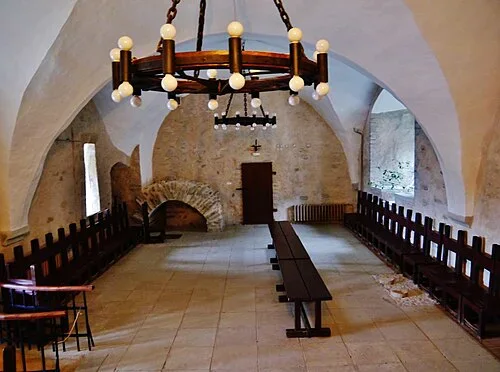 The Refectory and Governor's Hall
The Refectory and the Governor's Residence
The vaulted ceiling, the long benches and the wheel-shaped chandelier all fit a communal hall, and that is what this room was. In a convent house of the Livonian Order, the west wing held the refectory, the shared dining hall of a monastic-military community. The brethren ate in silence while a reader spoke from a lectern, in houses of this kind. Under Swedish rule the room changed ranks entirely. It was converted into the residence of the vice-governor, the castle's new master. To make it liveable, new large window openings were cut through the thick medieval walls. Those generous embrasures are the visible sign of the change, from a hall built for knights to a home built for an official.
Listen in the appPhoto: Zairon · CC BY-SA 4.0
08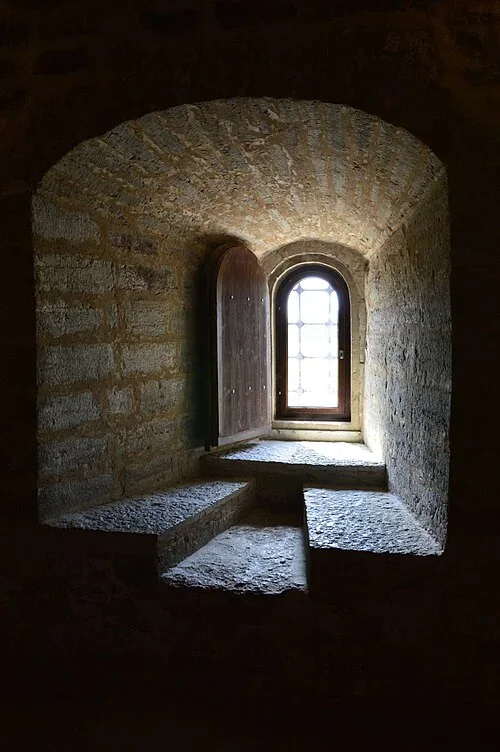 The Refectory and Governor's Hall
Sweden's Administrative Seat
A deep stone window seat like this one, with its wooden shutter and arched opening, shows how rooms here were built for people who lived inside the walls. From 1642 the castle held real administrative power. That year Narva became the centre of its own governor-generalate of Ingermanland, separate from the province of Livonia. Erik Karlsson Gyllenstierna was appointed governor-general in Narva in that same year. Governors and vice-governors of the province resided in the castle from then on. The peace of Stolbovo in 1617 had given Sweden Ingermanland, and the frontier province needed a capital with a fortress at its heart. For the rest of the century, orders for the eastern provinces went out from rooms like this one.
Listen in the appIvo Kruusamägi · CC BY-SA 4.0
09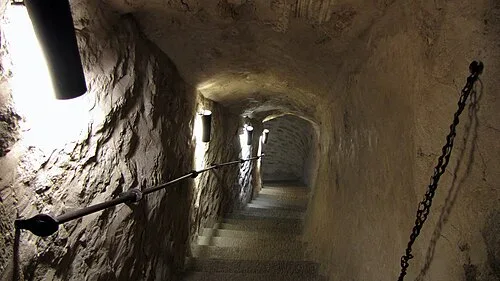 Tall Hermann Tower Staircase and Keep
Climbing Tall Hermann
The stairs tell you what kind of tower this is. They are steep and narrow, cut through stone that thickens as it rises. Tall Hermann is the keep, the strongest point of the castle and its last line of defense. If every wall fell, the defenders fell back here. It was also the castle's main observation point, with its eyes over the river and the land around. The keep as it stands was completed by the Livonian Order. Every turn of the staircase is work of that rebuilding, and the masonry gets no lighter as you go.
Listen in the appPhoto: Chmee2 · CC BY-SA 3.0
10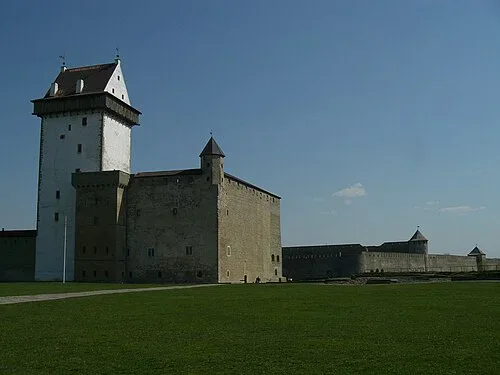 Tall Hermann Tower Staircase and Keep
Tall Hermann: Explosion and Repair
The white tower against the blue sky has been broken and mended more than once. In 1593, under Swedish rule, gunpowder stored in Tall Hermann exploded and gutted the tower's interior. The damage was serious enough that the repair came slowly. Only in 1638 was the tower finally repaired and reinforced. The keep's next great mending came under another flag. In the mid-nineteenth century the castle was restored to the designs of the military engineer Modest Rezvoi. The Crimean War interrupted that work before it was finished. Danish stone, Swedish repairs, Russian restoration: the tower carries all three.
Listen in the appPhoto: Chmee2 · CC BY-SA 3.0
- 11
The Ivangorod Standoff
The view across the river to Ivangorod, built by Muscovy in 1492, and the tower-raising duel it started.
- 12
The View Over the Medieval Town
The lost town wall below: a kilometre of stone, four iron-clad gates, and its demolition ordered in 1777.
- 13
The Northern Courtyard (Põhjaõu)
The Northern Yard, rebuilt in 2007 to imitate a seventeenth-century artisan quarter of Swedish-era Narva.
- 14
Bastion Fortuna and the Swedish Bastion Ring
The Swedish bastion ring: eight planned, six built, each named for a virtue — and Fortuna among the best preserved.
- 15
The Swedish Lion
The Swedish Lion, Narva's fall in 1704, and a border that never stopped being a border.
Hermann Castle
Frequently asked questions
How much does the guide cost?
Free app download. Listed guide price: $1.99. Guide price shown in the app. Audio guide only. Venue admission is separate.
Can I listen without internet?
Yes. Download the guide’s audio, images, and maps in the app before your visit. Your downloaded content is then available offline.
Can I listen in my language?
This audio guide is available in 15 languages, including English.
Do I need to follow a schedule?
No. This is a self-guided experience. Choose your stops, pause whenever you like, and return to a story at your own pace.
At your own pace
Explore Hermann Castle.
Download Stanza, then search for “Hermann Castle”.
Free app download · Guide price shown in the app
Keep exploring
Audio guides — Estonia
Tallinn
St. Olaf's Church, Tallinn
Content & sources
Olga Itenberg · CC BY 2.0
Tallinn
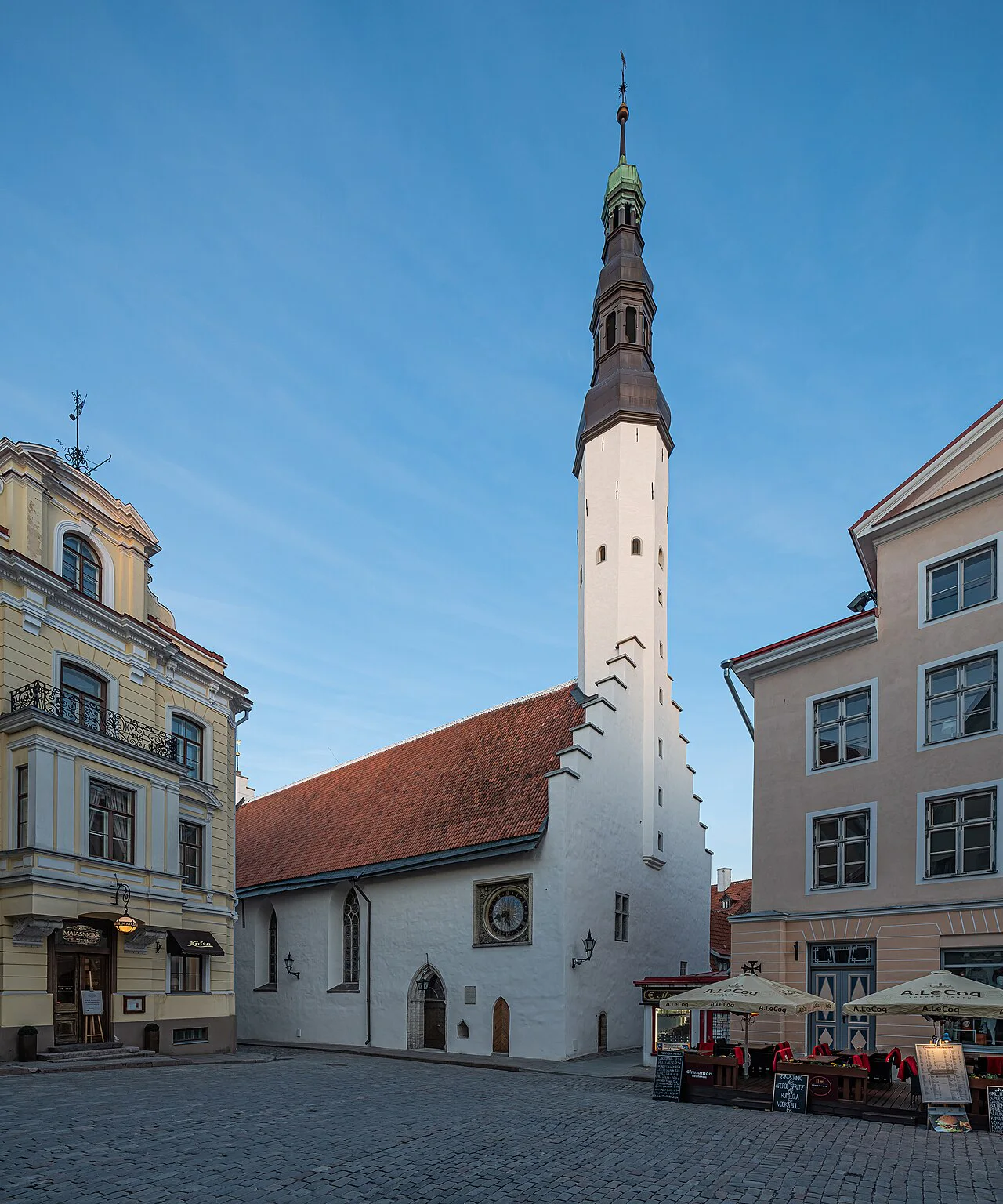
Church of the Holy Spirit, Tallinn
Content & sources
Photo: A.Savin · FAL
Tallinn
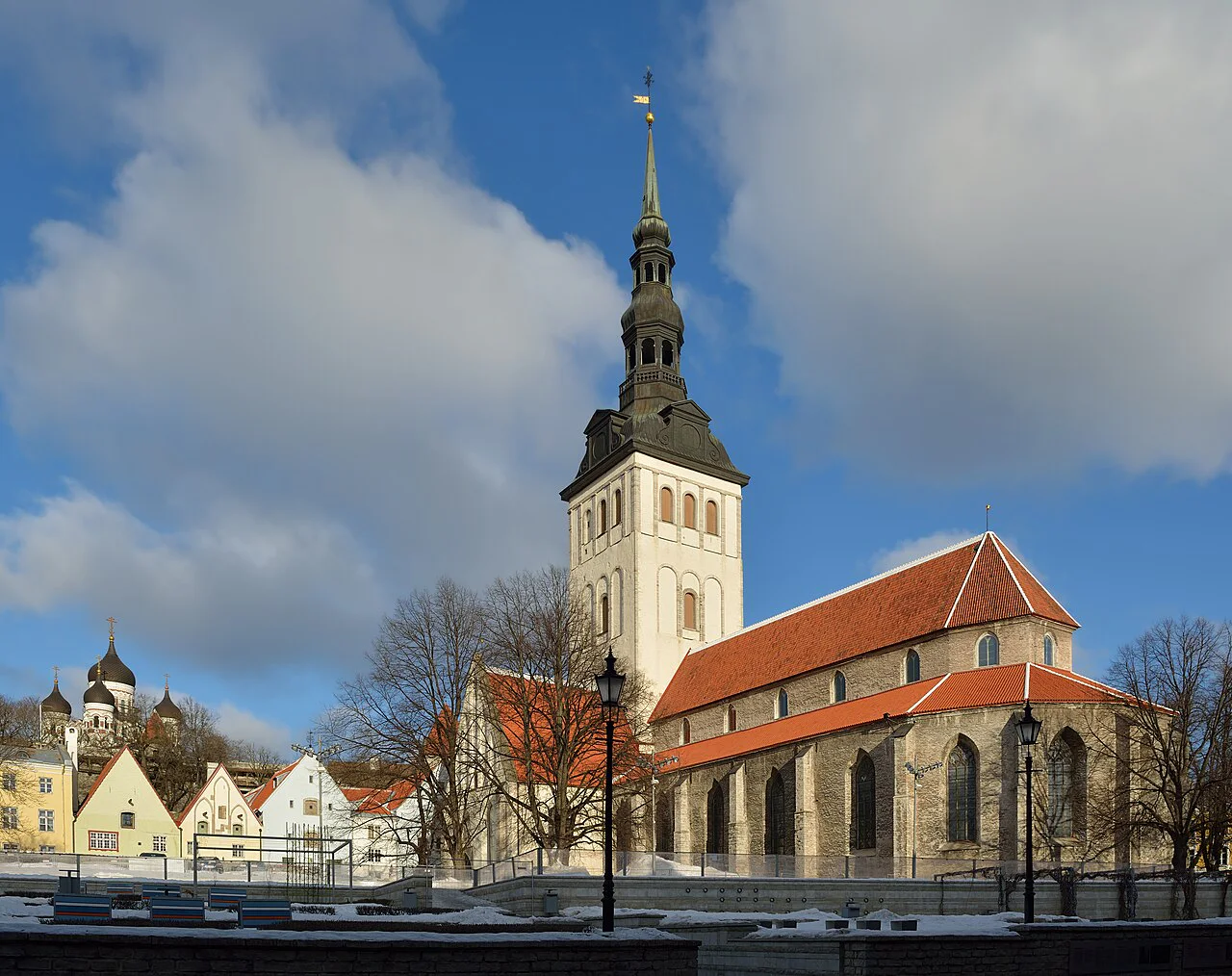
St. Nicholas Church, Tallinn
Content & sources
Ivar Leidus · CC BY-SA 3.0 ee
Kuressaare
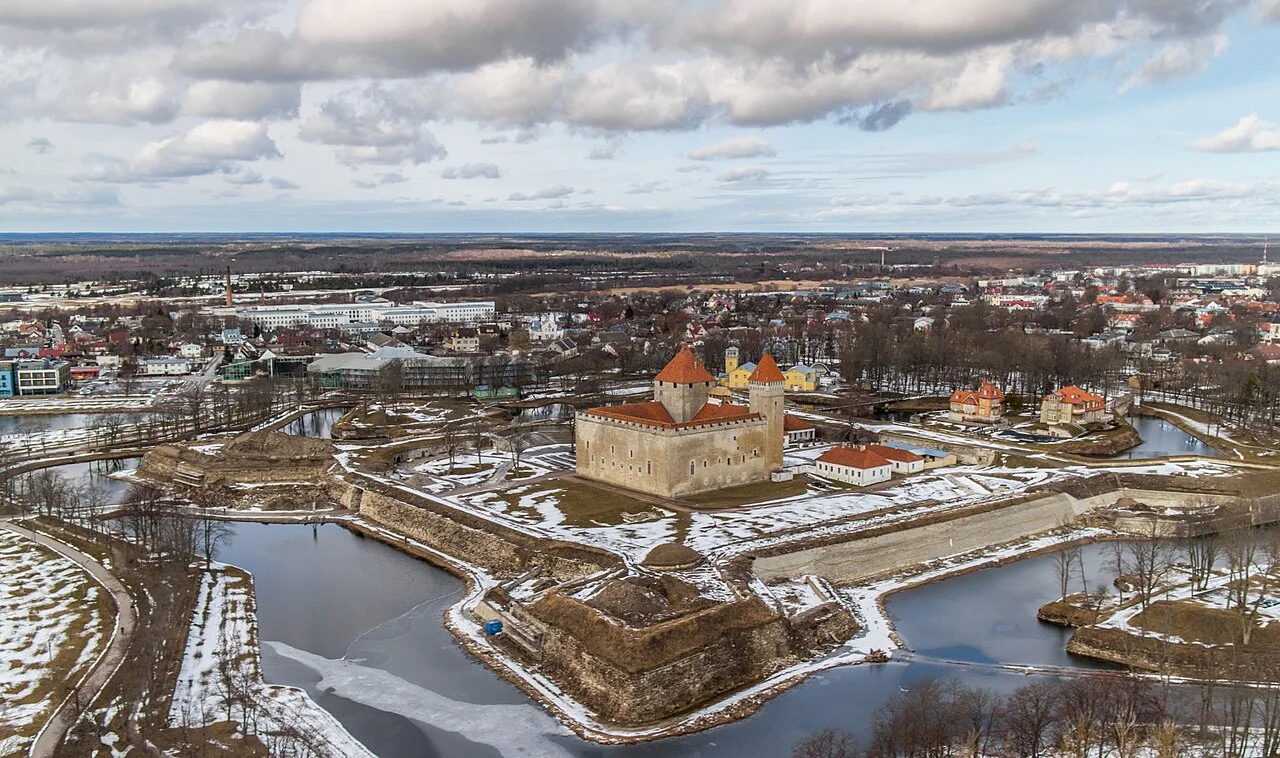
Kuressaare Castle
Content & sources
Photo: Hiiumaamudeliklubi · CC BY-SA 3.0 ee
Savonlinna
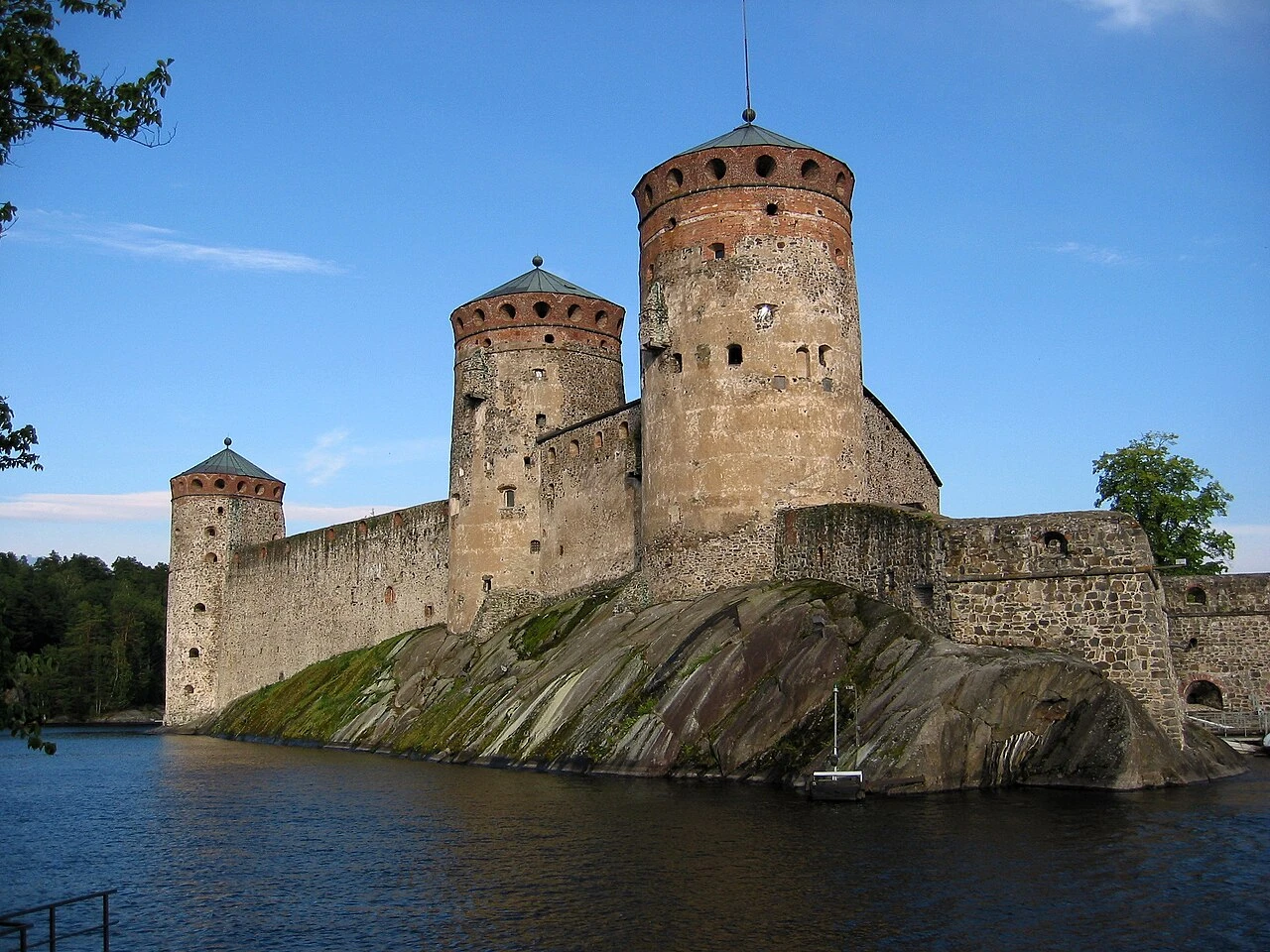
Olavinlinna Castle
Content & sources
User:Mikko Paananen · CC BY-SA 3.0