Languages
15Cité de Carcassonne Audio Guide
Cité de Carcassonne is a landmark in Carcassonne, France. Explore it with Stanza's GPS-triggered offline audio guide — available in 15 languages.
Quick Facts
17
Stops
15
Languages
100%
Offline
📍 Carcassonne, France · 43.2064°N, 2.3638°E
About Cité de Carcassonne
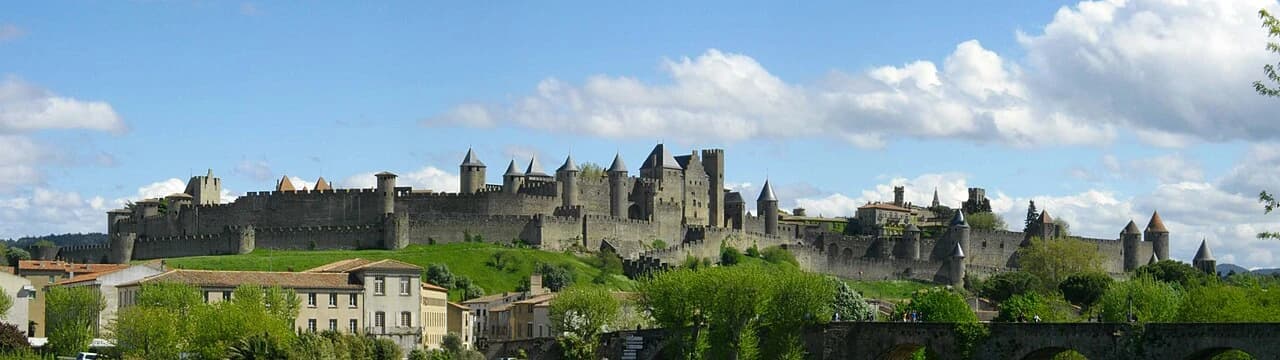
Cité de Carcassonne is a historic fortified town in France. It is renowned for its extensive medieval citadel, featuring double-walled fortifications and numerous towers.
Cité de Carcassonne is also known as Historic Fortified City of Carcassonne, Ville fortifiée historique de Carcassonne, cité de Carcassonne.
This self-guided audio tour features 17 narrated stops organized across 9 sections. As a citadel, Cité de Carcassonne offers a unique cultural experience in the heart of Carcassonne, France.
The Stanza audio guide is available in 15 languages and works entirely offline — download the complete tour including audio narration, maps, and images before your visit. As you walk through Cité de Carcassonne, GPS-triggered narration plays automatically at each point of interest.
Last updated:
What you will hear
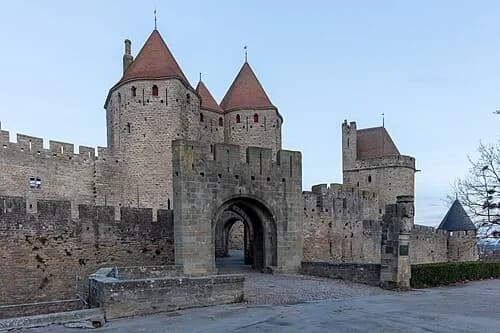
The Narbonne Gate
The primary arrival point. I used a clear dawn/dusk shot to show the massive 13th-century twin towers without crowds.
The Narbonne Gate
This entrance, reinforced with its distinctive twin towers, served as a primary defensive upgrade commissioned in the 13th century under the French kings. As you approach, the sheer scale of the masonry reveals the strategic importance of this site. The heavy stone blocks were laid to withstand prolonged sieges, while the reconstructed drawbridge offers a glimpse into the intricate security measures required to protect the thousands of inhabitants within. This entrance was designed to be imposing, intended to intimidate any approaching enemy army long before they reached the walls. Beyond these gates, the city is enveloped by two distinct lines of fortifications. These concentric walls created a layered defense system that made Carcassonne one of the most formidable strongholds in medieval Europe. From this vantage point, you can appreciate the architectural transition from local feudal power to the centralized control of the French crown. The gate stands as a physical boundary between the modern world and the medieval history preserved inside these walls.
The Legend of Dame Carcas
This stop introduces the city's most famous legend right at the entrance where her bust is located.
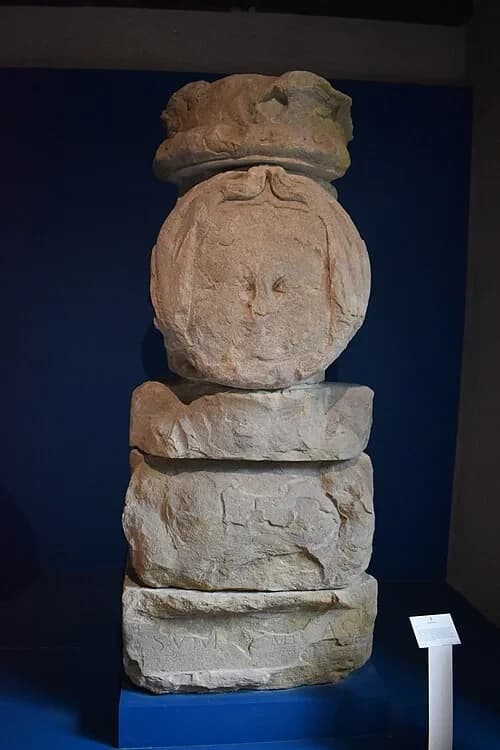
Statue of Dame Carcas
This stone bust represents Princess Carcas, the central figure in the city’s founding legend. Tradition holds that during a five-year siege by Charlemagne’s army, the city was near starvation. To fool the attackers, Carcas allegedly fed the last sack of grain to a pig and threw the well-fed animal over the walls. Charlemagne, convinced the city had endless supplies if they could afford to waste such a fattened pig, ordered his troops to retreat. As they left, Carcas rang the city bells in celebration. A scout reportedly remarked, 'Carcas sonne,' or 'Carcas rings,' giving the city its name. While this specific sculpture is a replica of a 16th-century original now housed in the museum, she remains a symbolic protector stationed at the main gate. Her presence commemorates a story of wit and resilience that has defined the identity of Carcassonne for centuries. The original stone carving shows the wear of centuries, but this replica ensures her likeness remains visible to every visitor entering the citadel.
The Count's Castle Entrance
The fortress-within-a-fortress. I selected a straight-on view of the bridge to show the secondary moat system.
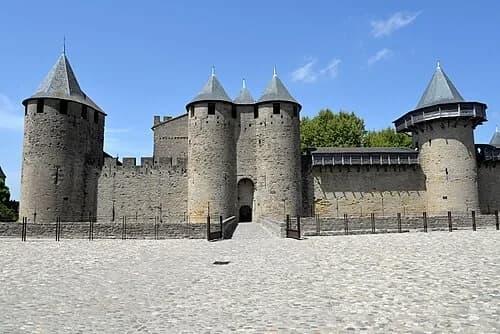
Count's Castle Entrance
The Count’s Castle represents the ultimate layer of protection for Carcassonne's nobility. Before the Albigensian Crusade of 1209, this was the primary residence of the powerful Trencavel family, the Viscounts of the city. Unlike the rest of the citadel, the castle is isolated by its own secondary moat and bridge system. This fortress-within-a-fortress design meant the castle could be held and defended independently even if the outer city walls were completely overrun by an invading force. The entrance you see is built to be a bottleneck, limiting how many soldiers could attack at once. Massive rounded towers flank the gate, providing multiple angles for archers to fire upon anyone attempting to cross the bridge. This site saw some of the most intense political transitions in the region's history as it shifted from the hands of the Occitan lords to the French royal administration following the northern conquests. The castle's interior remains a labyrinth of defensive courtyards and administrative halls that governed the surrounding territory.
The Painted History of the Citadel
Located inside the castle's museum, these 12th-century frescoes depict the battles between Franks and Saracens.
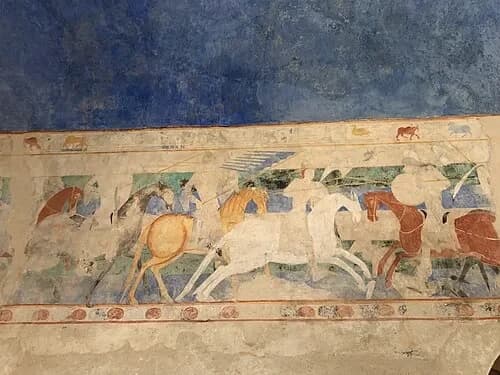
Battles Between the Franks and Saracens
12th century
These wall paintings inside the Count's Castle are among the few surviving examples of secular Romanesque art in the region. The scenes depict knights on horseback engaged in combat, specifically representing the historic and legendary clashes between Frankish and Saracen forces. In one section, you can see the rendering of horses and the long, pointed shields carried by the riders. These were more than just decorations; they functioned as political propaganda for the Trencavel lords. By showcasing scenes of Christian chivalry and victory, the nobility reinforced their status and their role as defenders of the land. The colors, though faded, still reveal a palette used to animate the walls of the castle's living quarters. These images provide a direct link to the martial culture of the 12th century, illustrating how the nobility viewed themselves through the lens of epic warfare. The upper border of the painting features smaller figures and motifs that frame the central combat scene, typical of the artistic style found in elite residences of the period.
The Lapidary Collection
Consolidating the museum's stone artifacts. I chose the Knight's Effigy as the representative piece for the city's chivalric history.
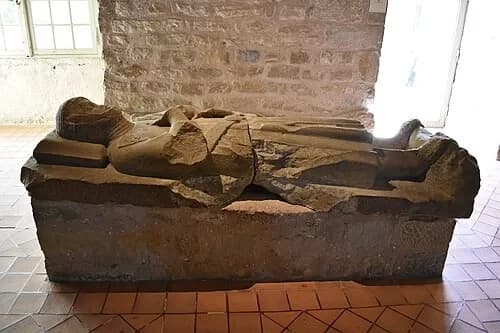
Tomb of the Unknown Knight
This gisant, or recumbent effigy, is a fine example of funerary sculpture from the castle’s lapidary collection. It depicts a knight in full battle regalia, resting with hands often joined in prayer. If you look closely at the stone carving, you can see the intricate texture of the chainmail and the shape of the shield resting alongside the figure. Such tombs were commissioned by high-ranking nobles to ensure their likeness and status were preserved for eternity. This specific figure represents the chivalric culture that thrived in the Occitan region before the Albigensian Crusade fundamentally changed the local social order. The knight's equipment—the long sword and the detailed surcoat—speaks to the wealth and military focus of the 13th-century aristocracy. These carvings are vital historical records, showing exactly how armor was worn and how noble identity was expressed through stone. The block of stone beneath the figure remains rough, highlighting the focused detail on the knight's armor and face. It provides a silent record of a warrior class that once governed these massive walls.
The Tour Pinte Watchtower
The highest point of the citadel, serving as the primary lookout during the royal period.
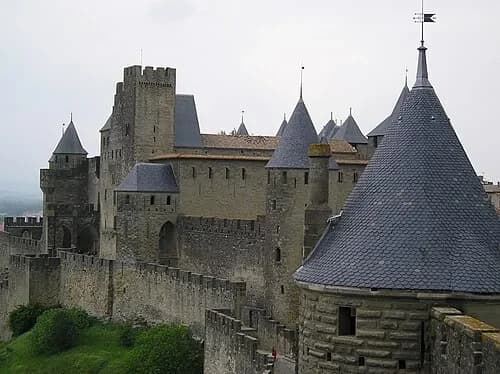
Pinte Tower Watchtower
The Tour Pinte is the tallest structure within the Cité, serving as the castle's primary lookout. Unlike the rounded towers found throughout the rest of the fortifications, this watchtower features a unique square shape, reflecting an older architectural style. Its height was essential for communication; from the top, guards could spot signal fires from distant mountaintop fortresses in the Pyrenees or identify approaching enemy cavalry long before they reached the gates. The tower's position at the highest elevation of the rocky spur provided an unobstructed 360-degree view of the Aude valley. This gave the defenders a significant tactical advantage, ensuring that no surprise attack could be successful. Because it stood inside the castle's own walls, it was the final observation post even if the outer rings of the city had been breached by invaders. The masonry of this tower is particularly dense, designed to withstand the high winds that frequently sweep across this elevated point. It remains a stark, vertical landmark visible from throughout the lower valley.
The Stained Glass Jewel Box
The interior of the basilica is famous for its light. I chose the nave view and the spectacular rose window.
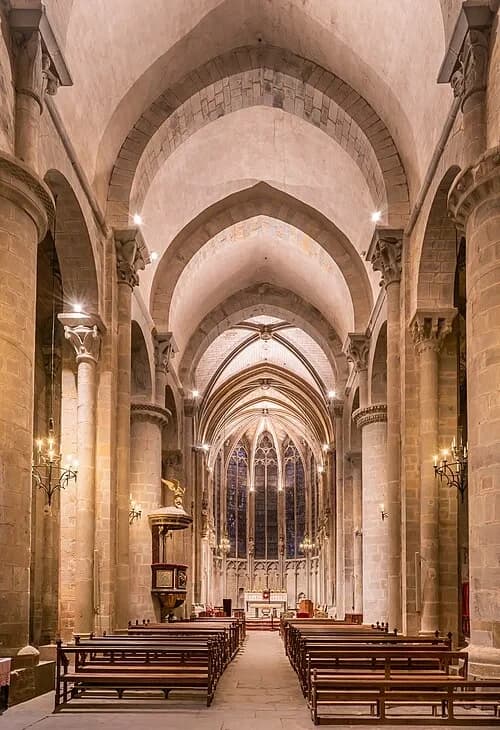
The Romanesque Nave
The nave of Saint-Nazaire is a prime example of 11th-century Romanesque architecture. Its design is characterized by thick, massive stone pillars and simple rounded arches that support the weight of the heavy barrel-vaulted ceiling. This style feels grounded and fortress-like, reflecting a time when churches often needed to provide physical as well as spiritual refuge. In contrast to the later Gothic additions, the nave has smaller windows and a more subdued lighting. This creates a sense of endurance and stability. The masonry here is remarkably well-preserved, showing the skill of the local artisans who worked on the cathedral centuries ago. As you move through this space, notice how the solid stone columns provide a rhythmic transition toward the brighter, more decorated altar area. This older section forms the backbone of the basilica, grounding the soaring glass and pointed arches of the later Gothic choir. The transition between these two styles is clearly visible where the rounded arches of the nave meet the sharp angles of the transept.
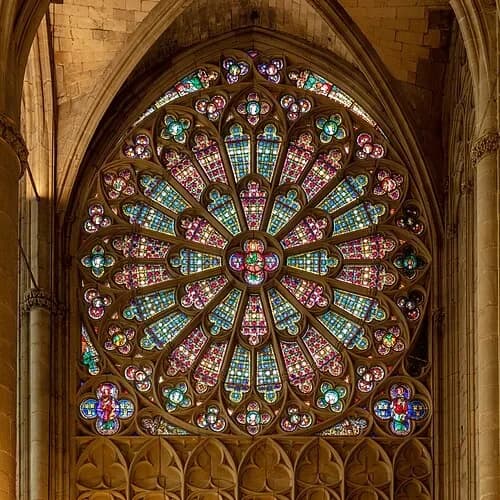
The North Rose Window
This spectacular circular window is one of the architectural highlights of the basilica. Dating back to the 14th century, the north rose window features an incredibly complex geometric pattern centered around a floral motif. The vibrant blues, deep reds, and rich purples are typical of the high Gothic period in southern France. These windows were designed to transform ordinary sunlight into a kaleidoscope of color, intended to represent divine light. Remarkably, much of the glass has survived through the centuries, despite periods when the city fell into neglect. The level of detail in the leadwork and the individual glass segments shows the pinnacle of medieval craftsmanship. It remains one of the finest examples of Gothic stained glass in the region, providing a brilliant contrast to the gray stone of the surrounding walls. The window serves as a focal point for the transept, drawing the eye upward into the vaulted ceiling. Each segment of glass contains unique patterns and figures that contribute to the window's overall symbolic geometry.
Porte d'Aude and the Roman Foundations
The western gate where the 3rd-century Roman masonry is most visible at the base of the towers.
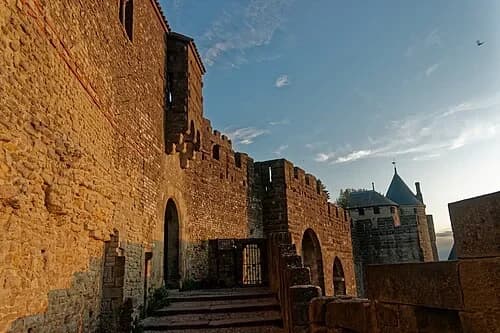
The Aude Gate
The Aude Gate offers a rare opportunity to see the different chronological layers of Carcassonne's defenses. If you look at the very base of the wall near this entrance, you will notice a distinct change in the stonework. The Roman foundation is characterized by small, regular square stones interspersed with horizontal layers of red brick. This 3rd-century masonry proves that this rocky spur has been a fortified site for nearly two thousand years. The gate itself was heavily modified during the medieval period to include a steep approach that made it nearly impossible for an enemy to use a battering ram effectively. Its position on the western side of the city overlooking the river Aude provided a critical escape route and supply point. This intersection of Roman engineering and medieval military strategy highlights the site's status as a vital stronghold. The small arched doorways and uneven stone steps near the gate show how the path was built to be easily defended by a small group of soldiers.
A City in Miniature
A reflective conclusion stop. The scale model helps visitors visualize the entire 11-hectare site they have just explored.
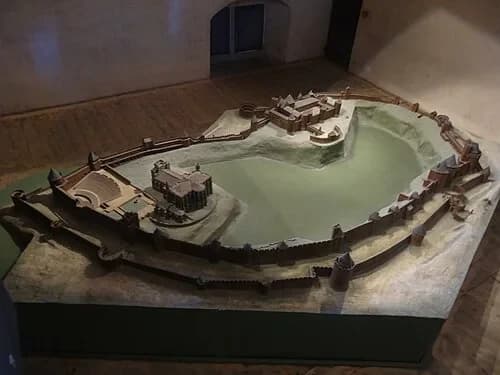
Models of the Historic Fortified City of Carcassonne
wood
This scale model provides a final overview of the 11-hectare layout of the citadel. From this bird's-eye perspective, the strategic design of the double-layered walls is fully visible, showing how the inner and outer circuits work together to create a formidable defense. During the Middle Ages, these streets were densely packed with houses and workshops serving thousands of residents. Today, the reality is quite different. The city has transitioned from a military stronghold into a global landmark that receives over four million visitors annually. Only about 50 permanent residents remain within the walls, mostly living in the quiet quarters away from the main gates. Looking at the miniature towers, you can see how the citadel’s role has shifted from survival to preservation. The model summarizes the three-kilometer perimeter you have just navigated, highlighting the contrast between the various phases of construction. It makes it easier to grasp the footprint of the Saint-Nazaire Basilica and the massive Count's Castle. The model clearly shows the narrow spacing of the 'Lices' path running between the two primary rings of stone.
Want to hear the rest?
Download the Stanza app to unlock all 17 stops and full GPS-guided navigation.
Frequently Asked Questions
How long does the Cité de Carcassonne audio tour take?
The Cité de Carcassonne audio guide includes 17 narrated stops. Most visitors spend 45 minutes to 1.5 hours exploring the complete tour, though you can listen at your own pace and skip or revisit any stop.
Is the Cité de Carcassonne audio guide available in my language?
Stanza supports 15 languages: English, Spanish, French, German, Italian, Portuguese, Russian, Japanese, Chinese, Korean, Arabic, Hindi, Polish, Dutch, Hebrew. Check the guide in the app to confirm the languages currently available for this tour.
Can I use the audio guide offline at Cité de Carcassonne?
Yes! Download the complete Cité de Carcassonne tour — including all audio, maps, and images — before your visit. The Stanza app works completely offline, so you don't need WiFi or mobile data at the venue.
How much does the Cité de Carcassonne audio guide cost?
The Stanza app is free to download. The current listed price for the Cité de Carcassonne audio guide is $2.99; app-store region and currency may affect the final price.
How do I use the Stanza audio guide at Cité de Carcassonne?
Download the free Stanza app, search for "Cité de Carcassonne", and download the tour. When you arrive at the venue, the app uses GPS to detect your location and automatically plays the relevant narration as you move between points of interest — completely hands-free.
What makes the Stanza audio guide different from other Cité de Carcassonne tours?
Stanza offers GPS-triggered narration that plays automatically as you walk through Cité de Carcassonne — no need to manually select stops. The tour is available in 15 languages, works fully offline, and includes 17 expertly narrated stops with images and historical context.
What other audio guides are available near Cité de Carcassonne?
Stanza offers multiple audio guides in Carcassonne, France and nearby areas. After downloading the app, browse the map to discover all available tours near Cité de Carcassonne. Each guide can be downloaded for offline use.