Stanza · Audio guide
Cathédrale Notre-Dame d'AmiensAudio guide
A place to remember. A story to take with you.
Amiens Cathedral is a masterpiece of High Gothic architecture known for its immense scale and intricate façade sculptures. It is a UNESCO World Heritage site and one of the largest cathedrals in France.
Download Stanza, then search for “Cathédrale Notre-Dame d'Amiens”.
About the tour
One guide. Your kind of visit.
Amiens Cathedral is a masterpiece of High Gothic architecture known for its immense scale and intricate façade sculptures. It is a UNESCO World Heritage site and one of the largest cathedrals in France.
Ready when you are.
- 01Get the free Stanza app.
iOS & Android
- 02Find your guide.
“Cathédrale Notre-Dame d'Amiens”
- 03Download before you go.
Works offline
Audio guide / 14 narrated stops
Inside the guide
Get to know a few of the stories before you go. Open a stop to read more.
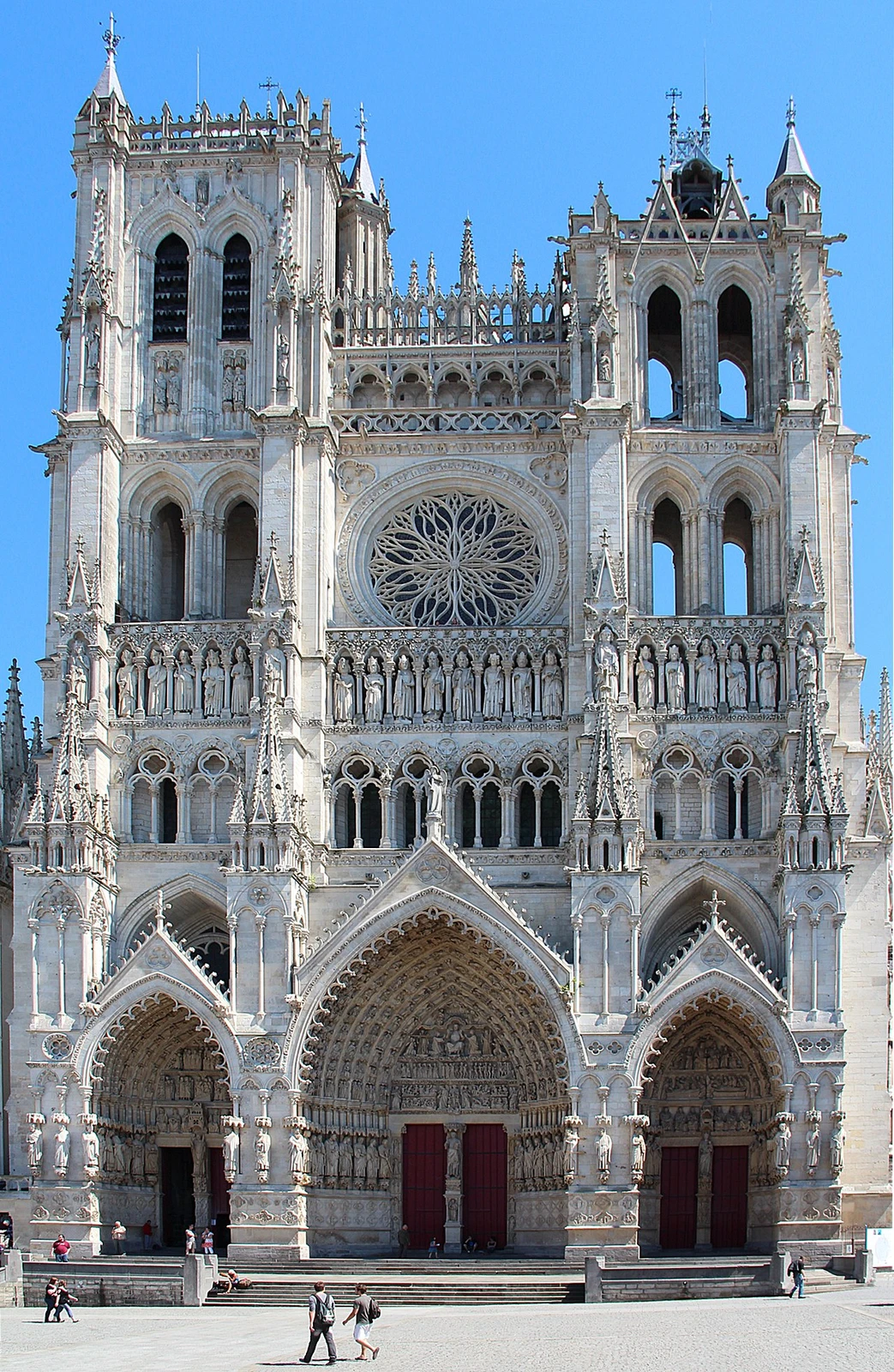
01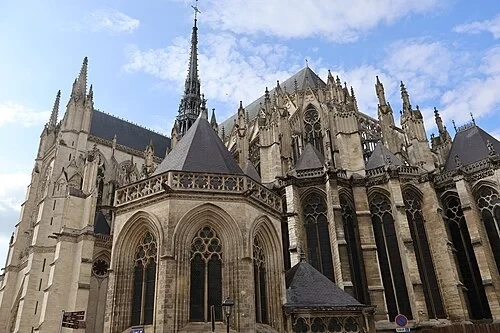 The Grand West Facade and PortalsThe Monumental Exterior
Welcome to Amiens Cathedral, an architectural achievement that encloses a staggering two hundred thousand cubic meters of space, making it the largest house of worship in France by volume. While many medieval cathedrals required centuries of intermittent labor, construction here began in 1220 under Bishop Évrard de Fouilloy and saw the main structure completed in a mere fifty years, by 1270. This remarkably rapid pace granted the building an unusual and striking architectural unity, representing the High Gothic style at its absolute peak. Looking at the exterior, the sheer scale becomes apparent, with a total length of one hundred forty-five meters and a transept spanning seventy meters across. Supporting these massive stone walls is a complex network of soaring flying buttresses, which redirect the immense weight of the vaulting outward and downward. Above it all, the towering central spire punctuates the skyline, a feature we will examine in more detail at the end of our journey. For now, the external facade prepares us for the scale of the wonders waiting inside, where light and structural innovation combine to create a weightless sanctuary.
Photo: Geugeor · CC BY-SA 4.0
02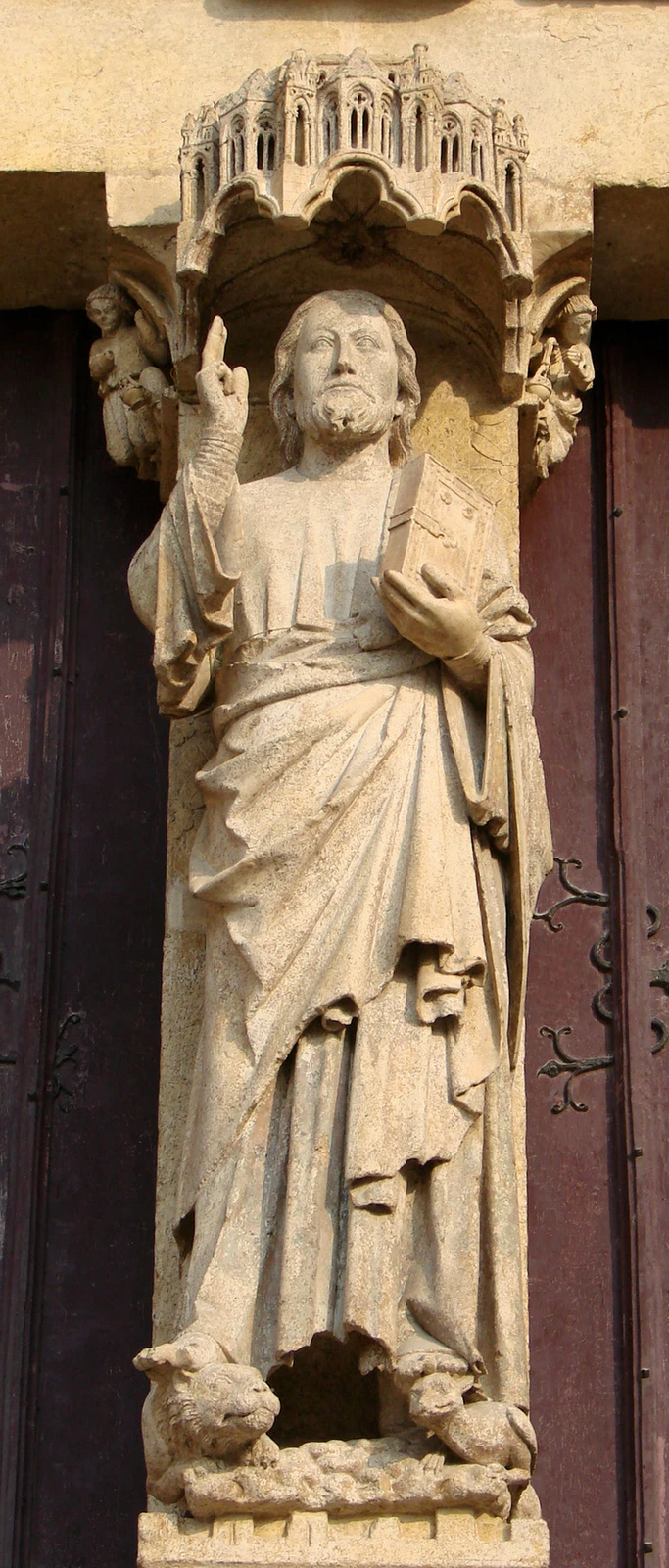 The Grand West Facade and PortalsThe Beautiful God
Positioned on the central trumeau pillar between the main double doors of the West Facade, the statue known as the 'Beau Dieu,' or Beautiful God, offers a comforting welcome to entering visitors. Local legend tells of a medieval sculptor who, paralyzed by a complete lack of creative inspiration, prayed intensely until he was granted a vivid vision of Christ's face, allowing him to carve this serene figure. The sculpture portrays Christ standing tall in simple, elegant robes, raising his right hand in a quiet gesture of blessing while holding a closed book in his left hand. Beneath his feet, a carved lion and a dragon lie defeated, representing the Christian triumph over evil, sin, and death. This particular depiction of Jesus marked a departure from the terrifying, apocalyptic imagery common on earlier Romanesque portals, presenting instead a merciful, approachable teacher. The drapery of the garments falls in heavy, natural folds, catching the shifting daylight and emphasizing the statue's lifelike quality. You can see how the sculpture is sheltered by an intricate Gothic canopy that mimics a heavenly city over Christ's head.
Photo: Vassil · Public domain
03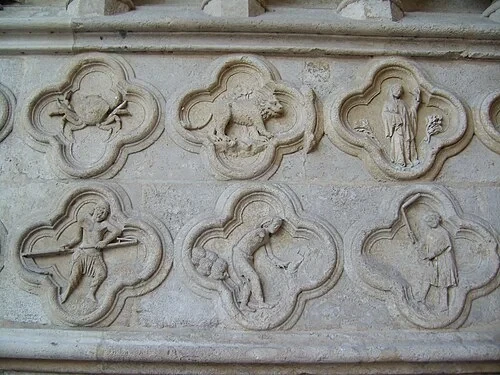 The Zodiac and Labors of the MonthsThe Zodiac of Amiens Cathedral
Carved along the lower base of the western portals, a series of low-relief stone medallions presents a fascinating window into the medieval worldview. These carvings are arranged in precise quatrefoil stone frames, a four-lobed decorative border typical of Gothic design. The upper row of medallions depicts astrological signs, including Cancer the crab and Leo the lion, while the lower row represents the corresponding 'labors of the months.' In these lower scenes, we see seasonal agricultural tasks, such as a peasant diligently clearing fields or harvesting crops with a hand-held scythe. This pairing of the zodiac with daily labor served a profound theological purpose, connecting the grand, cosmic order of the heavens to the humble, earthly realities of medieval life. For the illiterate peasants who visited the cathedral, these panels validated their daily struggles as part of a divine plan. The carvings also provide historians with a detailed visual record of thirteenth-century clothing, tools, and farming techniques. Look closely at the depth of the reliefs, which still retain their crisp outlines despite centuries of exposure to wind and rain near the ground.
Listen in the appPhoto: HaguardDuNord · CC BY 3.0
04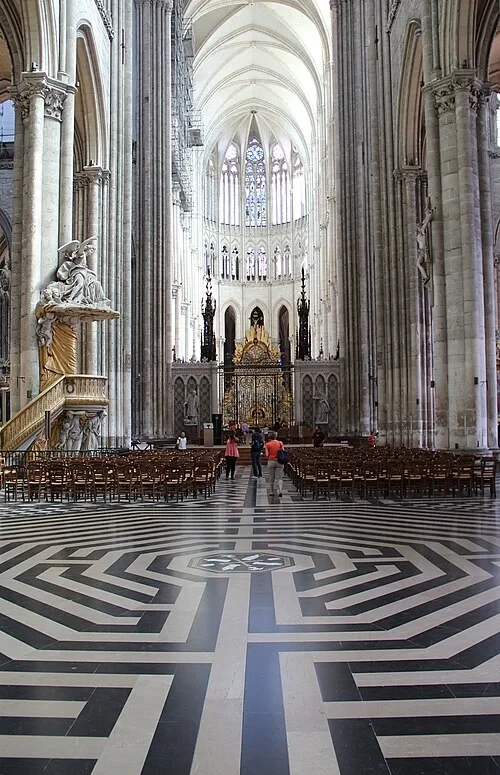 The Soaring Nave and LabyrinthThe Soaring Nave
Rising to an astonishing height of forty-two point three meters, the soaring vault of the central nave creates a sense of immense vertical space. Looking down at the stone floor reveals a striking contrast in the form of a black and white octagonal labyrinth inlaid directly into the paving. In the Middle Ages, pilgrims who lacked the means or safety to travel to the Holy Land would traverse this complex, winding path on their knees, using the physical journey as a symbolic pilgrimage to Jerusalem. At the very center of the labyrinth lies an octagonal metal and stone plaque. This central marker commemorates the three master masons responsible for designing and executing the cathedral's rapid construction: Robert de Luzarches, Thomas de Cormont, and his son, Renaud de Cormont. It also honors Bishop Évrard de Fouilloy, who laid the first stone. Though the current labyrinth is a nineteenth-century replication of the damaged thirteenth-century original, it precisely maintains the ancient dimensions and geometry. The pattern acts as a literal anchor for the eyes, drawing a line between the earthly path below and the heavenly heights of the vaults above.
Listen in the appPhoto: Jean-Pol GRANDMONT · CC BY-SA 3.0
05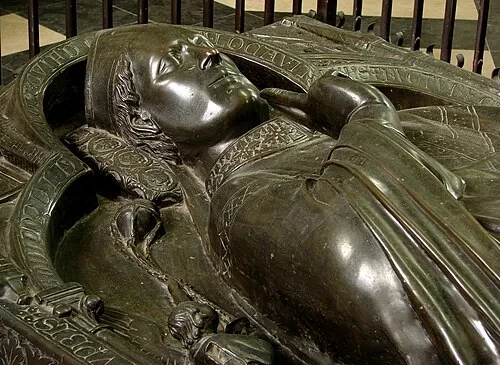 The Soaring Nave and LabyrinthEffigy of Evrard de Fouilloy
Resting in the nave is the bronze tomb effigy of Bishop Évrard de Fouilloy, the visionary leader who initiated the construction of the cathedral in 1220. Cast in the thirteenth century, this sculpture is incredibly significant as one of the very few original medieval bronze monuments in France to survive the widespread destruction and melting pots of the French Revolution. The bishop is depicted in solemn, eternal repose, his hands joined over his chest in prayer. At his feet, two small, cowering figures are carved, traditionally interpreted as representing the vices or demons conquered by the bishop's faith and leadership. A detailed Latin inscription borders the outer edge of the rectangular bronze frame, praising his work in founding this great structure. The dark patina of the metal preserves fine details, from the folds of his liturgical vestments to the stylized ring on his finger. Generations of visitors have rubbed the bronze, keeping certain raised edges polished to a golden sheen that contrasts with the deeper recesses of the casting.
Listen in the appPhoto: Vassil · Public domain
06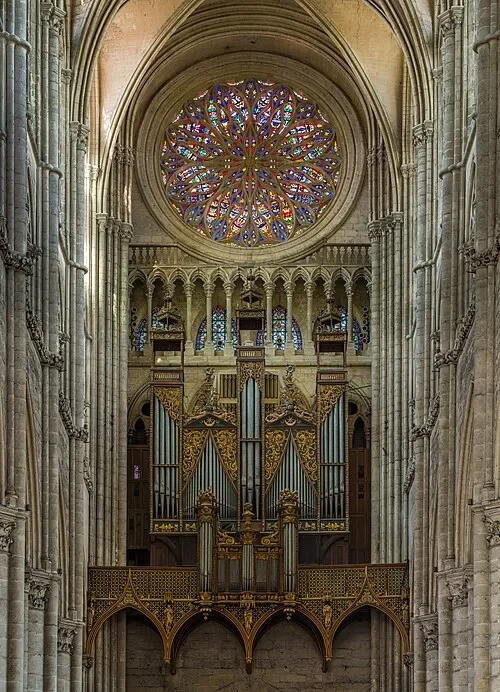 The Grand Organ and West Rose WindowThe Grand Organ and Rose Window
Dominating the west wall of the nave is the grand pipe organ, positioned directly beneath the monumental West Rose Window. A striking visual contrast exists between the dark, intricately carved wooden organ gallery and the kaleidoscope of colored light filtering through the stained glass above. The stone tracery of the rose window is executed in the Late Gothic Flamboyant style, characterized by curving, organic shapes designed to resemble flickering tongues of fire. This architectural style prized complex, flowing lines over the rigid geometry of earlier eras. The glass itself was carefully engineered to flood the interior stone surfaces with vibrant red, blue, and yellow hues, mimicking the dazzling, gem-like walls of the heavenly Jerusalem described in biblical texts. Below this display, the organ case features delicate wooden spires and carved figures that echo the cathedral's external stone buttresses. Originally constructed in the fifteenth century and expanded over the subsequent generations, the organ's wooden framework acts as a bridge between the physical structure of the cathedral and the musical liturgy that has filled the space for centuries. The stone gallery supporting the organ is supported by finely carved brackets.
Listen in the appPhoto: Diliff · CC BY-SA 3.0
07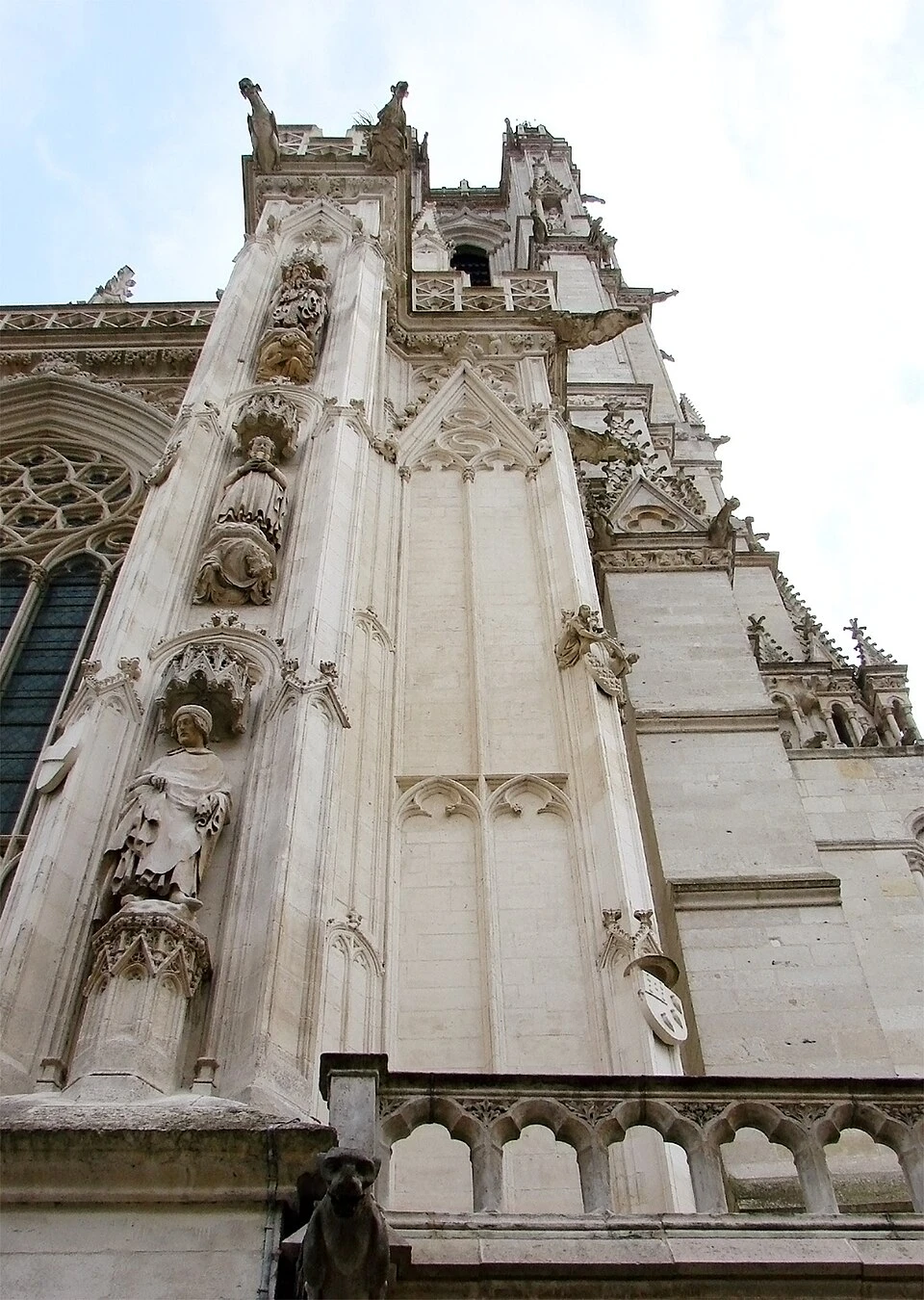 The North Transept and Beau PilierThe Beautiful Pillar
Constructed on the exterior corner near the north tower, the massive fourteenth-century architectural buttress known as the 'Beau Pilier,' or Beautiful Pillar, serves a vital structural role. It was built to reinforce the cathedral's corner against shifting pressures from the high vaults. Carved directly into this heavy stone pier is a vertical row of lifelike statues depicting King Charles V, his sons, and key political figures of the era. Integrating secular, contemporary portraits onto a sacred religious monument was a bold public statement, declaring royal patronage and cementing the political alliance between the French crown and the Church. Each figure is rendered with individualized features, wearing the elaborate draped clothing and headwear of the medieval court. The placement of these royal defenders on the exterior of the church physically and symbolically buttressed both the building and the ecclesiastical authority within. Looking closer at the architectural transitions of the pillar, small, expressive gargoyles can be seen jutting from the stone corners, designed to channel rainwater away from the delicate carvings of the royal court below.
Listen in the appPhoto: Vassil · Public domain
08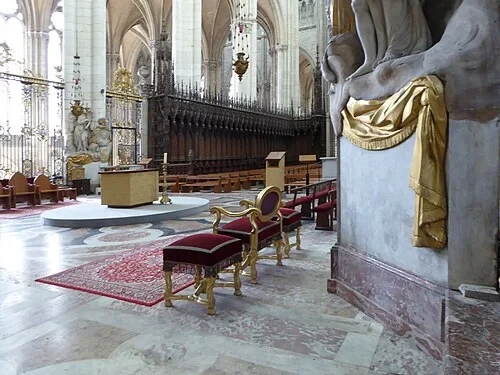 The Masterpiece Choir StallsThe Masterpiece Choir Stalls
Lining the central sanctuary are the magnificent oak choir stalls, representing a supreme peak of sixteenth-century French woodworking. Carved between 1508 and 1519 by local master carpenters, the choir contains one hundred ten original wooden seats, arranged in two facing rows. The towering backboards and armrests are decorated with approximately two thousand two hundred hand-carved fleurs-de-lys, a recurring motif that honors the cathedral's dedication to the Virgin Mary. Historically, these stalls served to separate the clergy and choristers from the general lay congregation during daily liturgies, creating a private, sacred enclosure for prayer and psalmody. The wood has aged to a deep, lustrous brown, worn smooth over five centuries of handling. Every surface is crammed with detail, from theological scenes to satirical depictions of daily life and folklore. The armrests, known as misericords, feature small ledges on their undersides, which provided a discreet seat for tired clergy who were required to stand for hours during long services. Looking at the sheer density of these carvings reveals the immense patience of the Renaissance craftsmen who labored here.
Listen in the appPIERRE ANDRE LECLERCQ · CC BY-SA 4.0
09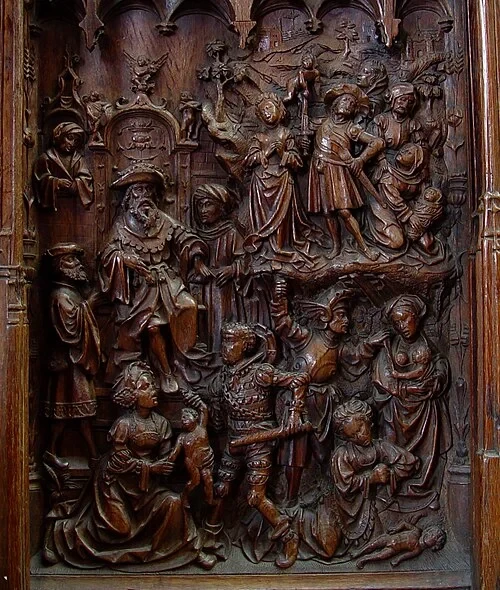 The Masterpiece Choir StallsMassacre of the Innocents
Examining the detailed panels of the choir stalls reveals a series of intricate micro-carvings that bring biblical stories to life. One particularly powerful relief depicts the tragic biblical narrative of the Massacre of the Innocents, ordered by King Herod. In the carving, Herod sits on an ornate, Gothic-style throne, gesturing coldly while soldiers execute his brutal command. The anonymous woodcarvers achieved an extraordinary depth of perspective within a single piece of oak, rendering the weeping faces of desperate mothers attempting to shield their children from the soldiers' weapons. Interestingly, the figures are dressed in contemporary sixteenth-century armor and garments rather than historical biblical attire. This deliberate choice allowed the medieval and Renaissance congregation to connect the ancient spiritual message directly to the political realities and conflicts of their own times. The high level of anatomical detail, from the tensed muscles of the guards to the flowing drapery of the clothing, highlights the exceptional skill of the Amiens workshop. You can see how the dark wood catches the light, casting deep shadows that emphasize the dramatic, emotional tension of the scene.
Listen in the appJames T. Womack and Anne Richardson · CC BY-SA 3.0
10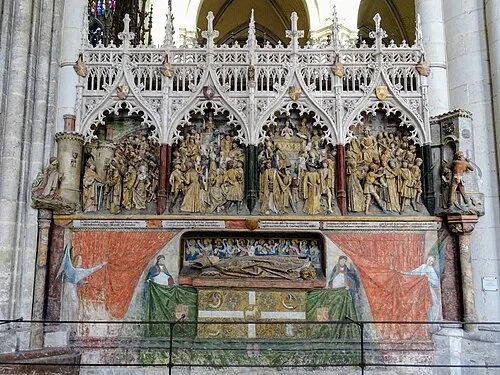 The Choir Screen and Tomb of Ferry de BeauvoirTomb of Bishop Ferry de Beauvoir
Set into the stone choir enclosure wall is the tomb of Bishop Ferry de Beauvoir, a remarkable monument that preserves its original medieval paint, or polychromy. During the Middle Ages, almost every statue and column in the cathedral was painted in vivid colors, a design choice that is largely lost today but remains brilliantly alive on this tomb. The painted surface displays deep reds, royal blues, and delicate gold leaf detailing. At the base of the monument, the carved stone effigy of the bishop lies in quiet repose. Above him, a series of relief panels tells stories from the life of Saint Firmin, the first bishop of Amiens who brought Christianity to the region. These brightly colored narrative panels functioned as a three-dimensional storybook for visitors, translating theology into understandable visual scenes. The gilded arches and painted draperies surrounding the tomb create an illusion of a small, private chapel within the larger cathedral structure. The persistence of these pigments over centuries provides a rare, authentic glimpse into the colorful splendor that once defined the entire Gothic interior.
Listen in the appIgnace-François Bonhommé · CC BY-SA 4.0
Cathédrale Notre-Dame d'Amiens
Frequently asked questions
How much does the guide cost?
Free app download. Listed guide price: $3.99. Guide price shown in the app. Audio guide only. Venue admission is separate.
Can I listen without internet?
Yes. Download the guide’s audio, images, and maps in the app before your visit. Your downloaded content is then available offline.
Can I listen in my language?
Stanza supports 15 languages. Check the app for the languages available for this guide.
Do I need to follow a schedule?
No. This is a self-guided experience. Choose your stops, pause whenever you like, and return to a story at your own pace.
At your own pace
Explore Cathédrale Notre-Dame d'Amiens.
Download Stanza, then search for “Cathédrale Notre-Dame d'Amiens”.
Free app download · Guide price shown in the app
Keep exploring
Nearby audio guides
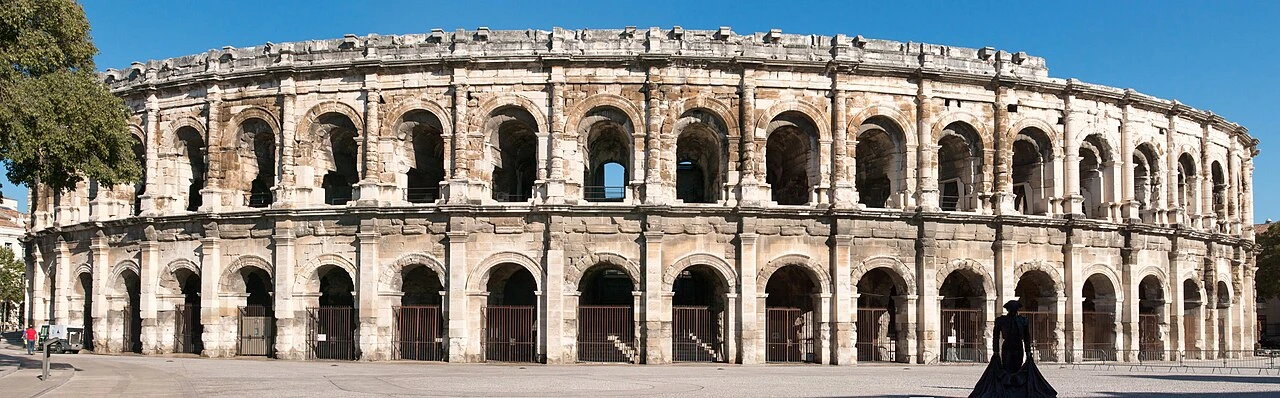
Nîmes
Amphitheater of Nîmes
Content & sources
Daniel VILLAFRUELA. · CC BY-SA 3.0
Paris
Arc de Triomphe de l'Étoile
Content & sources
Jiuguang Wang · CC BY-SA 2.0
Paris
Basilique du Sacré-Cœur de Montmartre
Content & sources
Tonchino · CC BY-SA 3.0
Saint-Denis
Basilique royale de Saint-Denis
Content & sources
Photo: Chabe01 · CC BY-SA 4.0