Languages
15Basilique royale de Saint-Denis Audio Guide
Basilique royale de Saint-Denis is a landmark in Saint-Denis, France. Explore it with Stanza's GPS-triggered offline audio guide — available in 15 languages.
Quick Facts
15
Stops
15
Languages
100%
Offline
📍 Saint-Denis, France · 48.9356°N, 2.3597°E
About Basilique royale de Saint-Denis
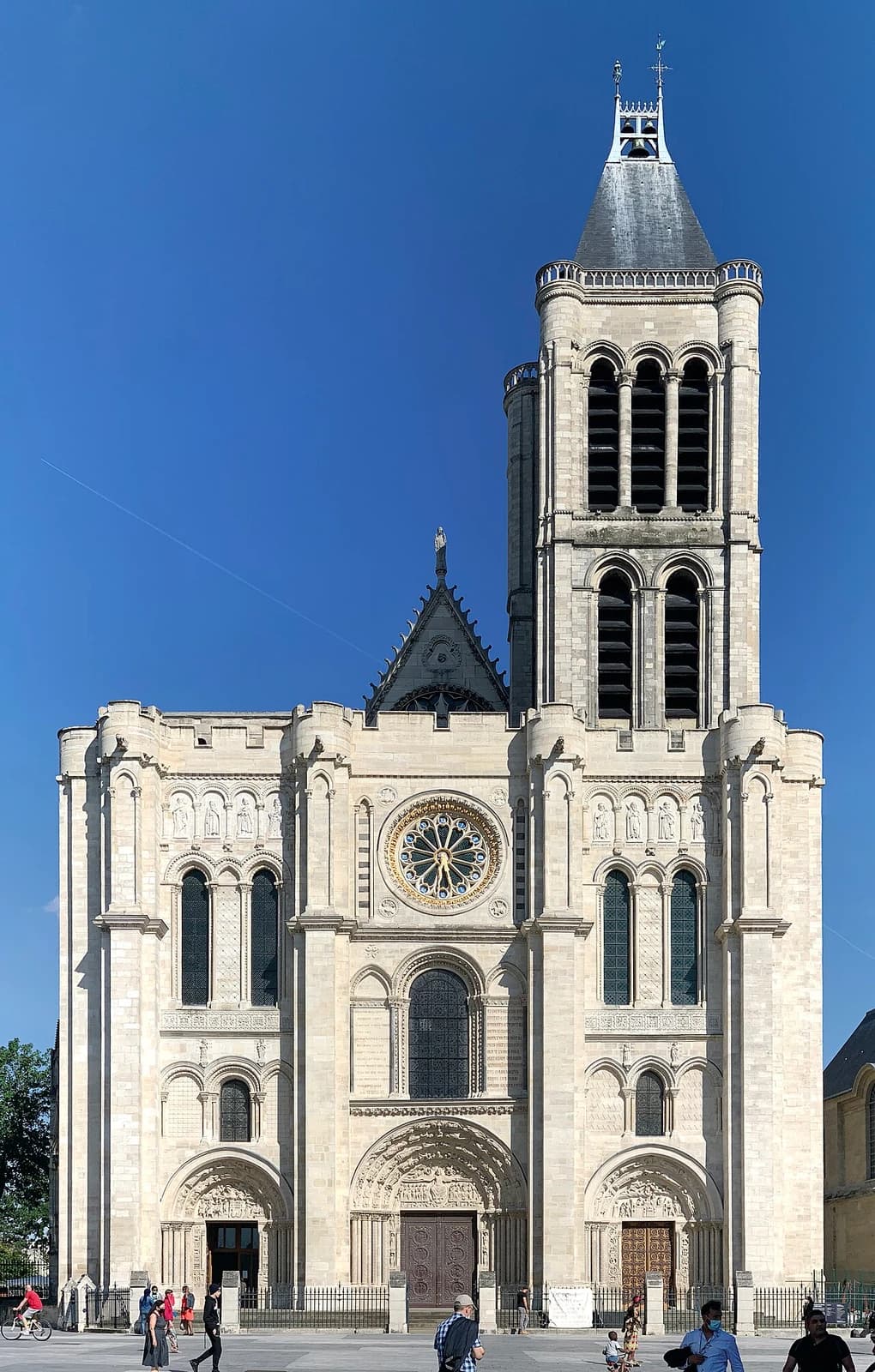
The Basilica of Saint-Denis is a large medieval church and the burial site of many French monarchs. It is considered the first masterpiece of Gothic architecture.
Basilique royale de Saint-Denis is also known as Basilica of St Denis, basilique Saint-Denis de Saint-Denis, basilique saint denis, basilique de Saint-Denis, and 10 other names in various languages.
This self-guided audio tour features 15 narrated stops organized across 6 sections, including The Nave and the Great Organ, The Transepts and Rose Windows, The Choir: Birthplace of Gothic Architecture, The Royal Necropolis: Renaissance Masterpieces, The Archaeological Crypt, The Profanation and the Royal Legacy. As a basilica, Basilique royale de Saint-Denis offers a unique cultural experience in the heart of Saint-Denis, France.
The Stanza audio guide is available in 15 languages and works entirely offline — download the complete tour including audio narration, maps, and images before your visit. As you walk through Basilique royale de Saint-Denis, GPS-triggered narration plays automatically at each point of interest.
Last updated:
What you will hear
The Nave and the Great Organ
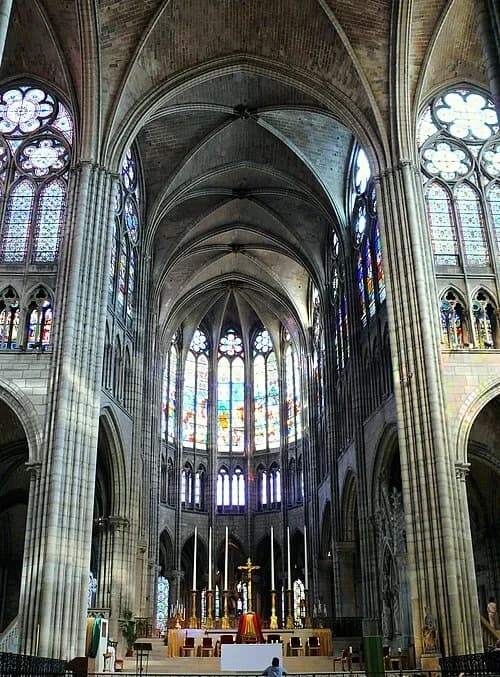
Transition inside to the 13th-century Rayonnant nave. Highlights the scale of the architecture and the monumental organ.
The Rayonnant Nave
Stepping into the nave, the verticality is immediate, with vaults soaring 29 meters above the floor. While the choir and facade represent the birth of Gothic, this central nave was rebuilt in the 13th century in the 'Rayonnant' style. This phase of architecture, overseen by master builder Pierre de Montreuil, focused on the 'dissolving' of the walls. By using an advanced system of slender internal columns and external flying buttresses, architects were able to remove the heavy load-bearing masonry that characterized earlier Romanesque buildings. This allowed for the installation of massive stained-glass windows, turning the church into a cage of light. The term Rayonnant refers to the radiating patterns of the rose windows and the sense of light beaming through the space. This design was intended to make the stone feel weightless, drawing the eye upward and creating a space that felt less like a building and more like a spiritual experience. The uniformity of the pillars and the rhythmic repetition of the arches emphasize the immense length of the basilica, leading the gaze toward the high altar.
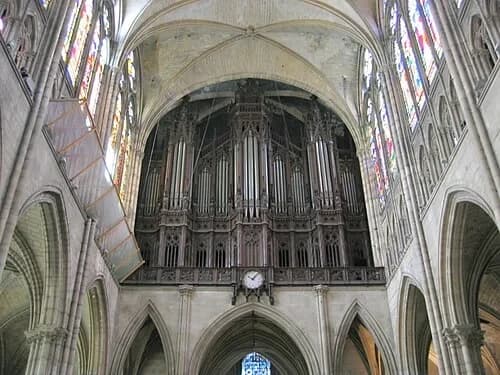
Saint-Denis Festival
1968
The monumental organ positioned at the back of the nave is a landmark in the history of music. Completed in 1841, it was the first major work by the legendary organ builder Aristide Cavaillé-Coll. At just 30 years old, Cavaillé-Coll introduced revolutionary mechanical systems that forever changed the capabilities of the instrument. He implemented the Barker lever, a pneumatic device that made the keys easier to play even when many pipes were engaged, and introduced a wind system that provided stable pressure for a variety of new stops. These innovations allowed the organ to mimic the nuances and power of a full symphony orchestra, leading to the development of the 'symphonic organ' style. This instrument became the prototype for many of the great organs found in European cathedrals today. It retains much of its original pipework and mechanical components, making it a rare survivor of 19th-century technology. For nearly two centuries, its complex internal lung and forest of pipes have provided the acoustic backdrop for royal ceremonies and the prestigious Saint-Denis music festival.
The Transepts and Rose Windows
Focus on the massive rose windows, explaining the theological importance of light in Gothic architecture.
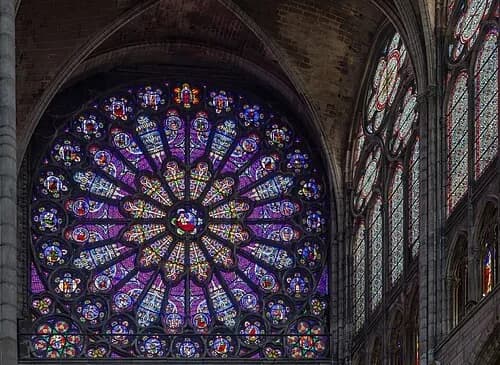
The North Rose Window
The massive rose window in the north transept is a primary example of 13th-century French glasswork. For Abbot Suger and the builders who followed him, light was not merely a functional necessity; it was a theological concept. They believed that light was a physical manifestation of the divine, and by filling the church with it, they were bringing the presence of God into the material world. This specific window is celebrated for its intricate geometric tracery, which supports segments of deep purple and brilliant blue glass. These specific hues are characteristic of the period, created using cobalt and manganese oxides that produced a saturated, jewel-like glow. The complex patterns were designed to be read like a celestial map, with every line and color contributing to a sense of cosmic order. During the middle of the day, when the sun is at its height, the window projects a kaleidoscopic pattern across the stone floor of the transept, momentarily transforming the gray masonry into a field of shifting colors.
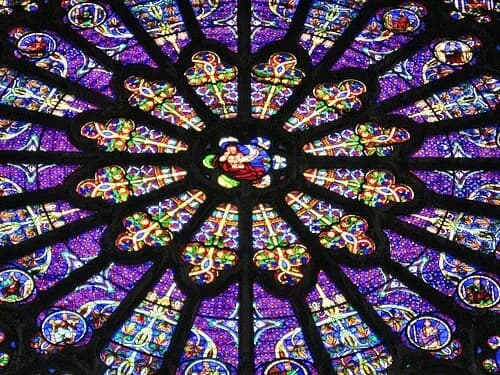
The Center of the Rose
Focusing on the very center of the rose window, you can identify the figure of Christ in the central medallion. From this point, all the architectural segments of the window radiate outward like the petals of a flower or the rays of the sun. This layout is deeply symbolic, representing Christ as the source of all light and the center of the Christian universe. The eye is naturally drawn through the outer layers of saints, prophets, and geometric patterns, always returning to this central anchor. Maintaining these delicate glass panels is a constant struggle against the passage of time. Over the centuries, the glass has been threatened by the accumulation of soot from candles and industrial pollution, as well as the corrosive effects of wind and rain. Meticulous restoration efforts involve carefully removing each lead-bound segment, cleaning the ancient glass with specialized techniques, and reinforcing the stone tracery. This ensures that the transparency intended by the medieval craftsmen remains intact, allowing the 13th-century vision of the cosmos to remain visible to modern visitors.
The Choir: Birthplace of Gothic Architecture
The heart of Abbot Suger's 1144 transformation. Explains the structural innovation of rib vaults and stained glass.
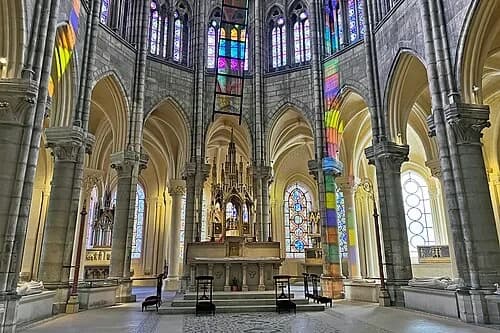
The Sanctuary of Light
This choir is the most historically significant area within the basilica. When it was consecrated in 1144 in the presence of the King of France and numerous prelates, it marked the formal introduction of the Gothic style to the world. The architecture here broke away from the thick, dark walls of the previous era, introducing a double ambulatory—two concentric aisles that allowed pilgrims to circulate smoothly around the high altar. Surrounding this ambulatory is a 'crown' of seven radiating chapels, each filled with large windows. Because the internal walls between these chapels were replaced with slim columns, the entire space feels open and unified. The design allows light to flood the sanctuary from multiple angles, illuminating the altar and the royal tomb effigies. This was exactly what Abbot Suger intended: a 'lucid' church where the brilliance of the architecture reflected the brilliance of the divine. Every detail, from the pointed arches to the ribbed vaults, was calculated to create an ethereal atmosphere that seemed to defy the heavy nature of stone.
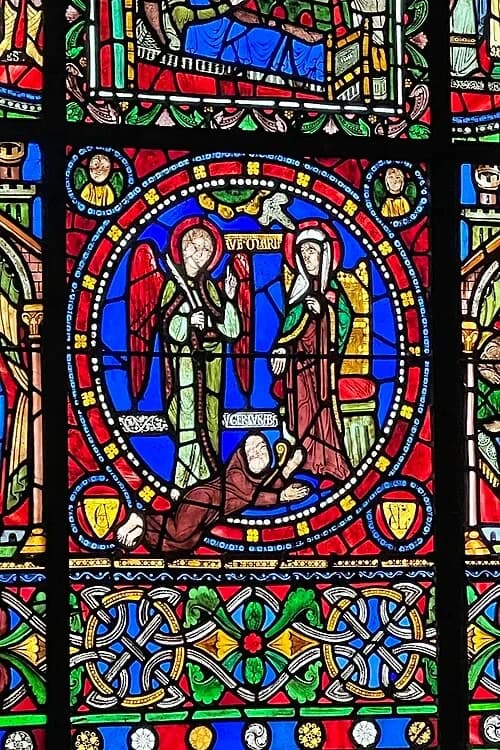
Abbot Suger's Signature
Among the towering figures of saints and kings in the stained glass, look for a small, humble figure kneeling at the feet of the Virgin Mary. This is Abbot Suger himself, placing his own likeness within the 'Celestial Jerusalem' he helped build. Suger was one of the most influential figures of his time, serving as the Abbot of Saint-Denis and as the regent of France while King Louis VII was away on Crusade. He was a rare combination of a powerful statesman and a visionary architect. By transforming this basilica into a masterpiece of light and height, Suger did more than build a church; he created a stage that reinforced the legitimacy of the French monarchy. Since Saint Denis was the patron saint of the kingdom and the protector of its kings, Suger’s architectural innovations served to glorify both the church and the state. His inclusion in the glass serves as a permanent signature, a reminder of the man whose intellectual and spiritual ambitions triggered an architectural revolution that would sweep across the continent for the next four centuries.
The Royal Necropolis: Renaissance Masterpieces
Showcases the shift from medieval gisants to elaborate Renaissance monuments. Includes the tombs of Louis XII and Francis I.
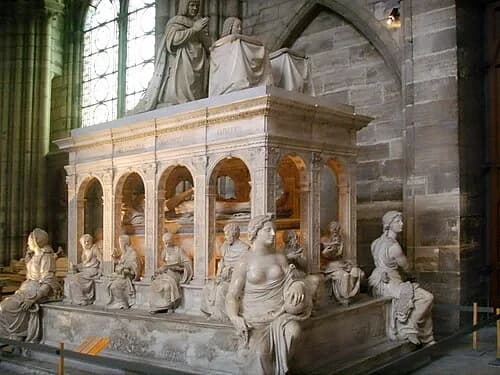
Tomb of Louis XII and Anne of Brittany
As you explore the royal tombs, this monument to Louis XII and Anne of Brittany marks a fascinating shift in artistic styles. It utilizes the Renaissance 'transi' or 'gisant' style, which presents a double view of the monarchs. Inside the lower arches, you see realistic, life-sized depictions of the king and queen as they would appear after death—naked, fragile, and showing the physical toll of mortality. This was a traditional medieval reminder of the leveling power of death. However, on the upper level, the monarchs are depicted as 'priants,' or praying figures. Here, they are shown in their full royal prime, idealized and dressed in fine robes, kneeling in eternal prayer. This upper section reflects the growing Renaissance emphasis on the individual and the enduring dignity of the crown. This two-story composition allows the viewer to contemplate both the earthly reality of death and the spiritual hope for the afterlife. The intricate marble carvings surrounding the base further illustrate the transition toward more ornate, classical decoration that would come to dominate royal burial practices in the following century.
The Archaeological Crypt
Explores the site's ancient origins as a Gallo-Roman cemetery and the location of Saint Denis's original tomb.
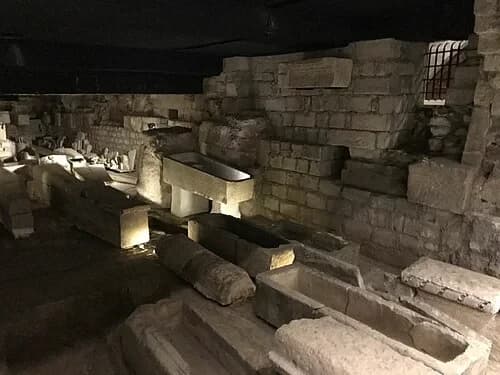
The Ancient Stone Sarcophagi
Descending into the archaeological crypt brings you to the oldest parts of the site. Here, you will see a collection of rough-hewn stone sarcophagi that date back to the Merovingian and Carolingian periods, some from as early as the 6th century. Long before the current Gothic basilica was even a concept, this area was a vast necropolis. The presence of the remains of Saint Denis made this the most prestigious burial ground in the region, attracting the first dynasties of what would eventually become the French nation. The simple, heavy stone lids and the weathered texture of the sarcophagi provide a stark contrast to the refined marble tombs in the church above. These are the burials of early Frankish nobles and the first kings, such as Clovis I, whose remains were moved here to be near the saint. Walking among these ancient stone containers, you are standing at the foundation of French history, in a space that has served as a sanctuary for the dead for over fifteen hundred years.
The Profanation and the Royal Legacy
Conclusion of the tour at the ossuary area, reflecting on the 1793 desecration and the basilica's role in French identity.
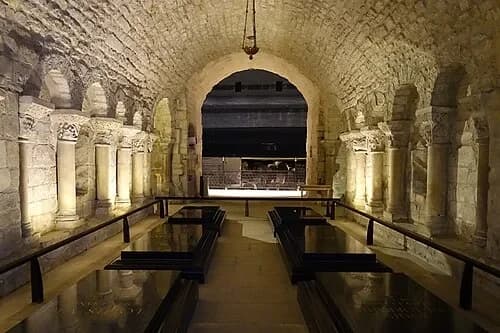
The Royal Ossuary
The black marble slabs on the floor mark a somber location known as the Royal Ossuary. Its existence is a direct result of the Profanation of 1793, one of the most chaotic episodes of the French Revolution. In October of that year, the revolutionary government ordered the destruction of royal monuments and the removal of all bodies to reclaim lead from the coffins for bullets. Over the course of several days, the tombs were broken open, and the remains of 42 kings, 32 queens, and numerous other royals were unceremoniously dumped into two large mass graves just outside the basilica walls. The bodies, some dating back nearly a thousand years, were covered in quicklime. Following the restoration of the monarchy in the 19th century, King Louis XVIII ordered the excavation of these pits. Because the remains had become mixed and decomposed, individual identification was impossible. The recovered bones were brought back into the basilica and placed behind these marble markers. Today, these slabs serve as a collective monument to the hundreds of royals whose individual resting places were lost to history during the revolution.
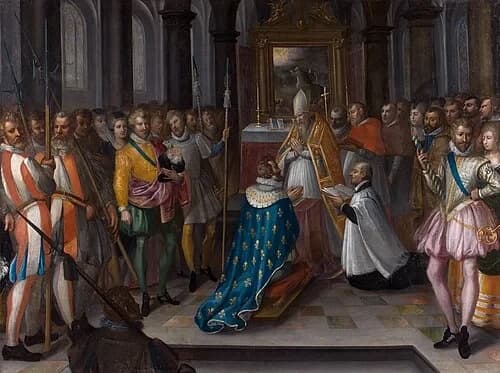
Abjuration of Henry IV
This painting commemorates a pivotal moment in French history that took place right here in the basilica: the conversion of Henry IV to Catholicism in 1593. At the time, France was torn apart by the Wars of Religion. Although Henry was the legal heir to the throne, as a Protestant, he was rejected by the Catholic majority and the city of Paris. Realizing that he could never truly rule a divided nation, he chose to abjure his faith. It was during this period that he is famously, though perhaps apocryphally, credited with saying, 'Paris is well worth a mass.' Choosing Saint-Denis for his conversion was a masterstroke of political symbolism. Since the basilica was the traditional burial place of French kings and the home of the kingdom's patron saint, converting here linked him directly to the long lineage of Catholic monarchs who came before him. This act of religious pragmatism was the key to ending the civil wars and allowed him to finally enter Paris and be crowned. His conversion reinforced the basilica's role as the essential center of French royal legitimacy.
Want to hear the rest?
Download the Stanza app to unlock all 15 stops and full GPS-guided navigation.
Frequently Asked Questions
How long does the Basilique royale de Saint-Denis audio tour take?
The Basilique royale de Saint-Denis audio guide includes 15 narrated stops. Most visitors spend 45 minutes to 1.5 hours exploring the complete tour, though you can listen at your own pace and skip or revisit any stop.
Is the Basilique royale de Saint-Denis audio guide available in my language?
Stanza supports 15 languages: English, Spanish, French, German, Italian, Portuguese, Russian, Japanese, Chinese, Korean, Arabic, Hindi, Polish, Dutch, Hebrew. Check the guide in the app to confirm the languages currently available for this tour.
Can I use the audio guide offline at Basilique royale de Saint-Denis?
Yes! Download the complete Basilique royale de Saint-Denis tour — including all audio, maps, and images — before your visit. The Stanza app works completely offline, so you don't need WiFi or mobile data at the venue.
How much does the Basilique royale de Saint-Denis audio guide cost?
The Stanza app is free to download. Free and paid audio guides are available; current prices are shown in the app.
How do I use the Stanza audio guide at Basilique royale de Saint-Denis?
Download the free Stanza app, search for "Basilique royale de Saint-Denis", and download the tour. When you arrive at the venue, the app uses GPS to detect your location and automatically plays the relevant narration as you move between points of interest — completely hands-free.
What makes the Stanza audio guide different from other Basilique royale de Saint-Denis tours?
Stanza offers GPS-triggered narration that plays automatically as you walk through Basilique royale de Saint-Denis — no need to manually select stops. The tour is available in 15 languages, works fully offline, and includes 15 expertly narrated stops with images and historical context.
What other audio guides are available near Basilique royale de Saint-Denis?
Stanza offers multiple audio guides in Saint-Denis, France and nearby areas. After downloading the app, browse the map to discover all available tours near Basilique royale de Saint-Denis. Each guide can be downloaded for offline use.