Stanza · Audio guide
Cathédrale Notre-Dame de RouenAudio guide
A place to remember. A story to take with you.
Rouen Cathedral is a Gothic cathedral famous for its dramatic architecture and being the subject of a series of paintings by Claude Monet. It is the seat of the Archbishop of Rouen.
Download Stanza, then search for “Cathédrale Notre-Dame de Rouen”.
About the tour
One guide. Your kind of visit.
Rouen Cathedral is a Gothic cathedral famous for its dramatic architecture and being the subject of a series of paintings by Claude Monet. It is the seat of the Archbishop of Rouen.
Ready when you are.
- 01Get the free Stanza app.
iOS & Android
- 02Find your guide.
“Cathédrale Notre-Dame de Rouen”
- 03Download before you go.
Works offline
Audio guide / 12 narrated stops
Inside the guide
Get to know a few of the stories before you go. Open a stop to read more.
01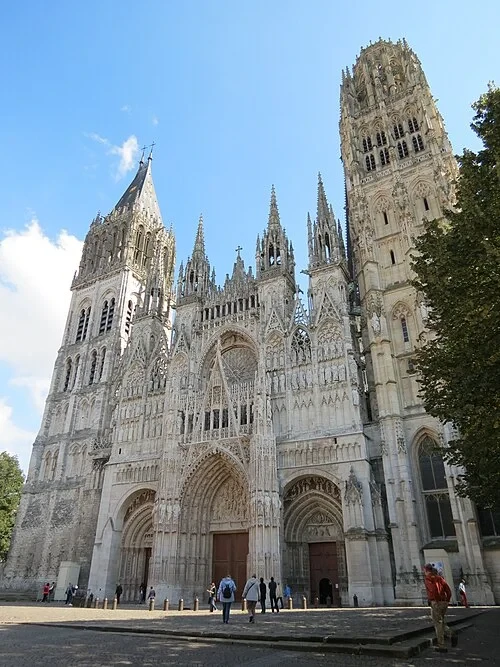 The West Facade and the Three TowersThe West Facade
Welcome to the west front of Rouen Cathedral. Looking at this monumental entrance, you can immediately see its grand scale, stretching exactly sixty-one point six meters across to claim the title of the widest facade in France. Construction here first began in the year 1145, starting with the Saint-Romain tower on the left. As you let your eyes trace the frontage, you will notice a striking visual asymmetry among the three towers. This uneven silhouette tells the story of centuries of evolving architectural tastes. The design transitions from the austere lines of the early Gothic period on the left to the highly decorated, elaborate details of the Flamboyant Gothic and Renaissance styles on the right. Generation after generation of builders left their unique mark on this facade, creating a complex stone structure. This exterior sets the stage for the spatial grandness and rich history waiting just inside the heavy wooden doors. Prepare to transition from this massive exterior public square into the quiet, soaring spaces of the interior.
Photo: Giogo · CC BY-SA 4.0
02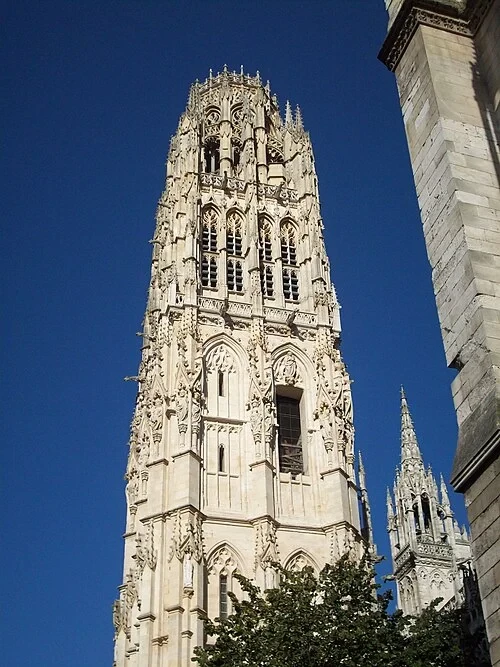 The West Facade and the Three TowersThe Butter Tower
Towering over the right side of the west facade is the striking structure known as the Butter Tower. Built in the late fifteenth and early sixteenth centuries, its peculiar name derives from a historical practice involving Lenten fasting. During Lent, religious rules strictly forbade the consumption of butter, milk, and other dairy products. However, wealthy parishioners could purchase special dispensations, or indulgences, from the church hierarchy. The diocesan authorities used the substantial funds raised from these butter permissions directly to finance the construction of this very tower. Beyond its unusual funding source, the tower is a textbook example of late Gothic architecture, specifically the Flamboyant style. The masonry appears almost fluid, covered in a dense web of delicate pointed arches, hollowed niches, and elaborate decorative pinnacles that catch the changing sunlight. It terminates in an octagonal crown, a departure from the spire design seen on the opposite side of the facade.
Photo: Giogo · CC BY-SA 3.0
03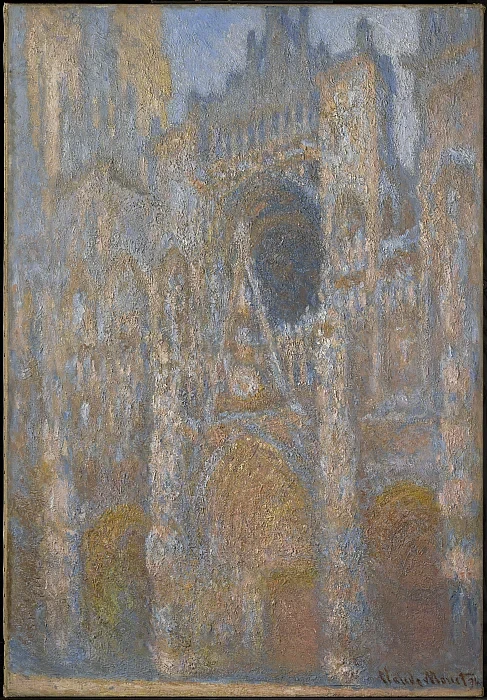 The West Facade and the Three TowersRouen Cathedral, Facade in Sunlight
In the early 1890s, French Impressionist painter Claude Monet became obsessed with the way light transformed the intricate carvings of Rouen Cathedral. To capture this phenomenon, he rented a room in a building directly across the square, setting up multiple canvases at once. Monet painted the facade thirty times, working rapidly to record the fleeting colors of dawn, midday glare, and the warm glow of sunset on the stone surface. Rather than focusing on the permanent architectural details, Monet wanted to document how atmosphere and light constantly redefined the solid structures. This series of paintings became a landmark achievement of Impressionism, proving that an object could have many different visual realities depending on the time of day and weather conditions. The thick, textured brushstrokes in his paintings mimic the rough, carved surfaces of the actual cathedral facade. Today, these works are scattered in museums worldwide, but they all originated from the very spot where you stand, looking at the same play of light and shadow across the stone portal.
Listen in the appClaude Monet · Public domain
04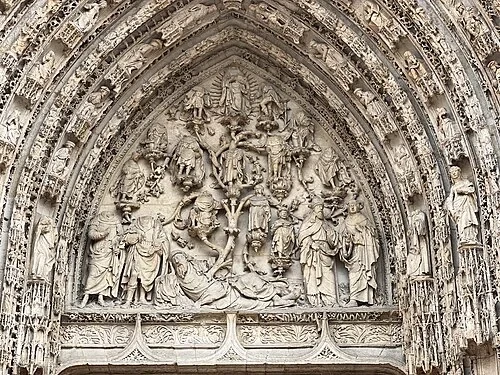 The West Front PortalsThe Jesse Tree Tympanum
Positioned directly above the central doorway is a masterpiece of medieval storytelling carved into the stone archway, known as a tympanum. This relief carving depicts the Tree of Jesse, a traditional Christian motif illustrating the genealogy of Christ. At the very bottom, you can identify the reclining, sleeping figure of Jesse. From his side, a symbolic family tree grows upward, its branching limbs cradling a succession of Judean kings, prophets, and ancestors, leading eventually to the Virgin Mary and Christ at the top. This visual display served as an illustrated Bible for the many medieval visitors who could not read. If you look closely at the figures, you will notice significant wear and missing elements, such as damaged heads and hands. Much of this destruction occurred during the religious conflicts of the sixteenth century, particularly when Huguenots attacked the cathedral's external imagery, and later during the French Revolution. Despite the scars of history, the complex composition remains an incredibly detailed example of Gothic narrative sculpture.
Listen in the appPhoto: Chabe01 · CC BY-SA 4.0
05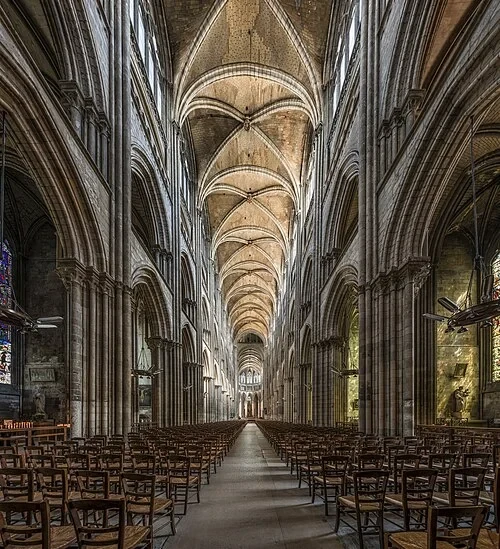 The Grand NaveThe Grand Nave
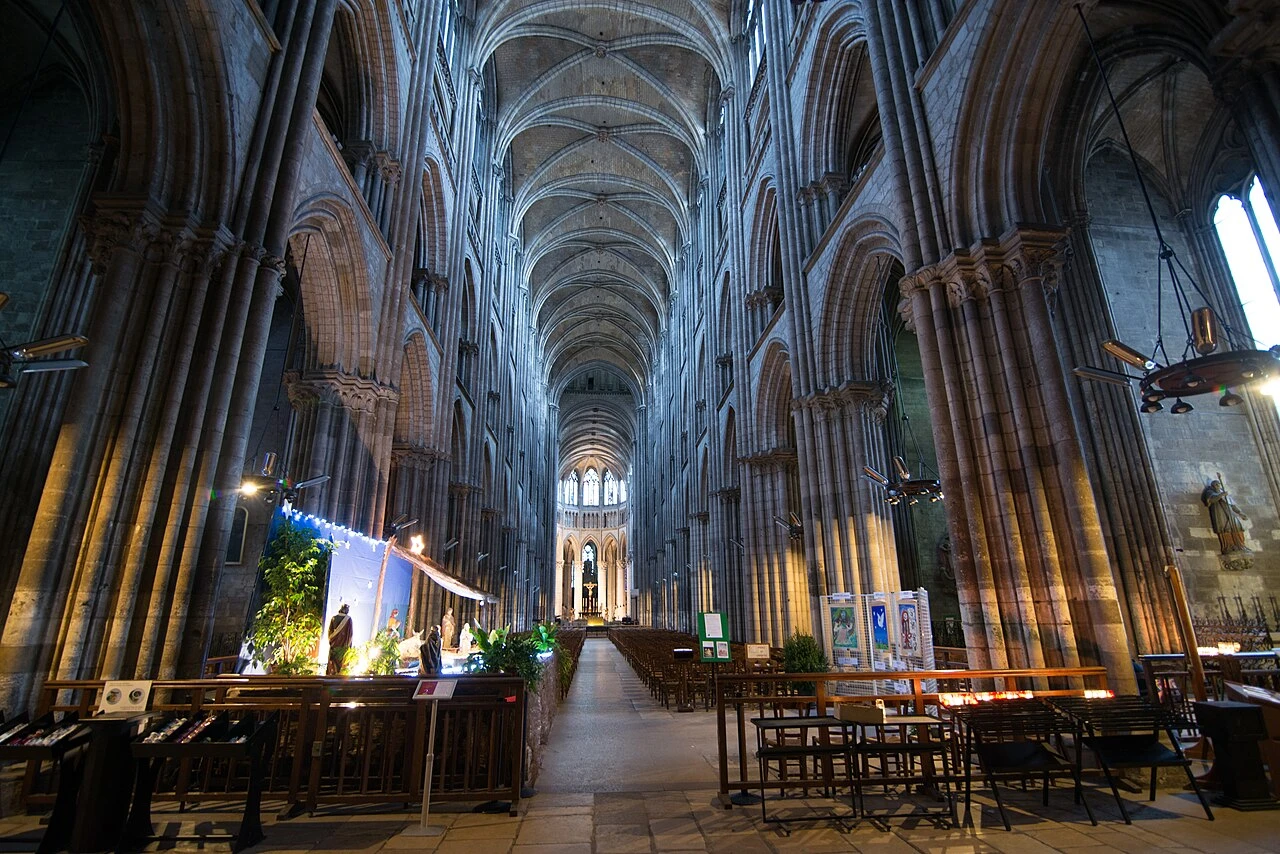
Stepping across the threshold brings you into the grand nave, where the dramatic vertical scale of early Gothic architecture is immediately apparent. The interior layout follows a classic medieval design featuring a four-level vertical elevation, a layout that became rare in later Gothic churches. At the ground level, massive compound piers form the main arcade, supporting heavy pointed arches. Above this runs the gallery level, followed by the narrow, decorative passageway known as the triforium. Finally, at the very top, the clerestory windows allow natural light to filter down into the expansive space. This sophisticated four-story arrangement serves a deliberate visual purpose, creating a sense of rhythm that draws the eye upward along the vertical stone shafts. The lines culminate in the elegant rib vaults that span the ceiling far overhead. By distributing the immense weight of the roof to the external buttresses, this architectural engineering allowed medieval builders to construct taller walls with larger window openings, filling the space with light and creating an atmosphere of weightlessness.
Listen in the appPhoto: DXR · CC BY-SA 3.0
06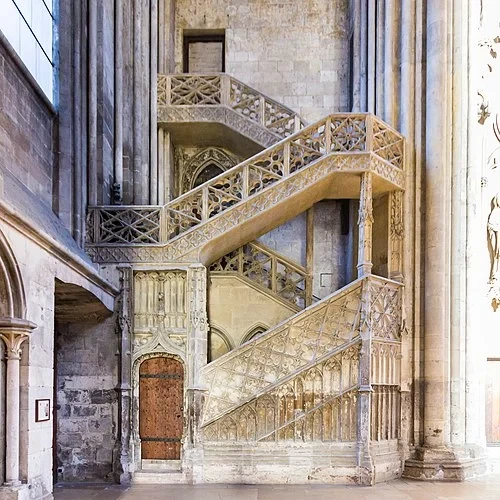 The Booksellers' StaircaseThe Booksellers' Staircase
Located within the north transept of the cathedral is the Booksellers' Staircase, a highly celebrated work of late fifteenth-century masonry. This ornamental staircase was constructed to provide the cathedral canons, or resident clergy, with direct and private access from the church interior to their scriptorium and library located above the cloister. What makes this structure particularly noteworthy is its exceptionally delicate stonework. The openwork balustrades and supporting arches are decorated with intricate Gothic tracery that looks almost like lace rather than carved stone. Tiny geometric shapes, pointed arches, and floral motifs cover every visible surface of the staircase. Despite the density of the decoration, the overall structure maintains a light, airy quality that harmonizes with the soaring proportions of the transept. The name of the staircase also reflects the historic activity that once took place just outside the adjacent portal, where manuscript sellers, binders, and book merchants set up their stalls to serve both the clergy and literate citizens of Rouen.
Listen in the appRaimond Spekking · CC BY-SA 4.0
07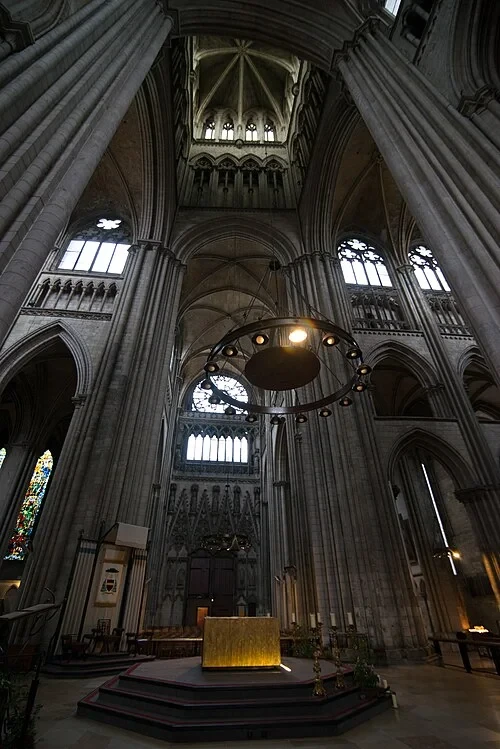 The Lantern Tower and Cast-Iron SpireThe Lantern Tower
Gazing directly upward at the central crossing where the nave intersects with the transepts reveals one of the most distinctive features of Norman Gothic architecture: the hollow lantern tower. Unlike many other French cathedrals that opted for solid stone vaults at this intersection, Norman builders preferred to construct open, tower-like spaces that rise high above the roofline. This architectural choice serves a vital practical function. By incorporating rows of windows high up on the tower's walls, the design allows a dramatic column of natural daylight to flood directly down into the altar area, which would otherwise remain in shadow. Looking up into this vertical void, you can appreciate the geometry of the supporting arches and the soaring stone columns that carry the massive weight of the tower above. The play of light shifting across the upper galleries throughout the day highlights the complexity of the masonry, providing a bright focal point that unites the main axes of the church interior.
Listen in the appJorge Láscar from Melbourne, Australia · CC BY 2.0
08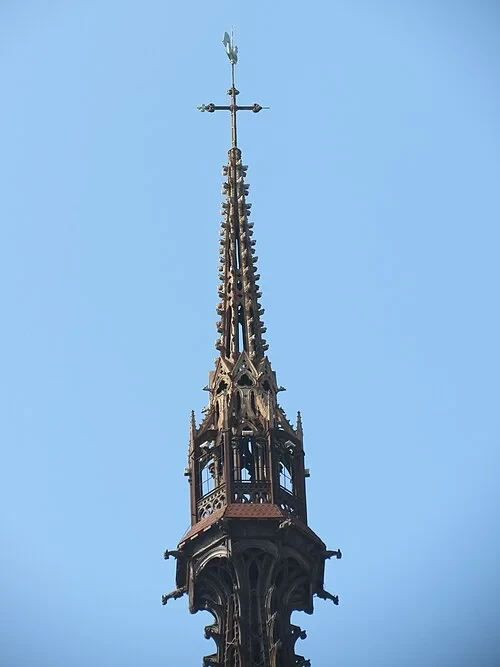 The Lantern Tower and Cast-Iron SpireThe Cast-Iron Spire
Dominating the skyline of Rouen is the soaring central spire, which reaches a verified height of one hundred and fifty-one meters. Completed in the late nineteenth century, this openwork spire briefly earned the cathedral the title of the tallest building in the world from 1876 until 1880, when it was surpassed by Cologne Cathedral. The spire is constructed entirely from cast iron, a choice that sparked intense debate and controversy during its planning and construction. Following a devastating fire in 1822 that destroyed the previous wooden and lead spire, local authorities decided to use iron to minimize future fire risks and to showcase modern industrial capabilities. Critics, however, argued that a heavy iron structure was out of character for a medieval Gothic building and feared it would compromise the structural integrity of the ancient stone lantern tower below. Despite the initial public skepticism, the spire stands today as a defining silhouette of the city, merging nineteenth-century engineering with medieval design.
Listen in the appPhoto: Giogo · CC BY-SA 4.0
09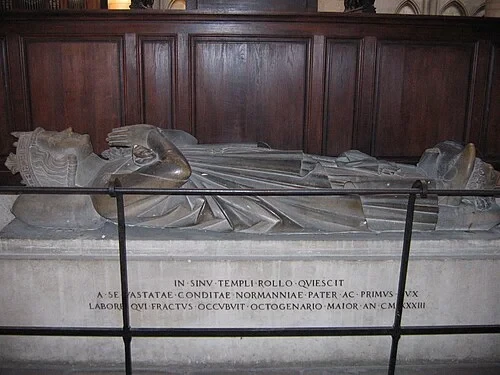 The Ambulatory and Royal TombsTomb of Rollo of Normandy
In one of the side chapels lies the tomb of Rollo, the legendary Viking chieftain who became the first Duke of Normandy. In the early tenth century, Rollo led devastating Norse raids along the Seine River, threatening the heart of the West Frankish kingdom. To secure peace, King Charles the Simple made a historic treaty with the Viking leader. As a condition of this agreement, Rollo agreed to defend the region from other raiders and convert to Christianity. His baptism took place on this very cathedral site in the year 915. This key event marked the formal birth of the Duchy of Normandy, transforming fierce Viking invaders into settled Norman rulers who would eventually conquer England and influence all of Europe. The tomb figure, or recumbent effigy, shows Rollo in peaceful repose, representing his dual identity as a Norse warrior and a Christian founder. Although the monument itself was restored in later centuries, it marks the final resting place of the patriarch whose descendants went on to shape medieval history.
Listen in the appUrban · CC BY-SA 3.0
10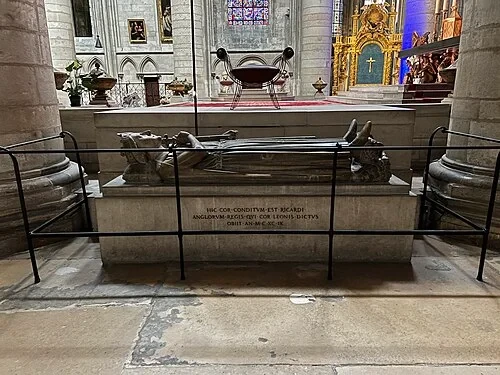 The Ambulatory and Royal TombsTomb of Richard the Lionheart
Within the choir area, visitors can view the tomb containing the heart of Richard the Lionheart, the famous King of England and Duke of Normandy. Following his death in 1199 from an infected crossbow wound sustained at a siege in central France, his body was divided for burial in accordance with a common medieval custom for high-ranking royalty. Different parts of his remains were sent to various locations that held political and personal significance for him. Richard specifically decreed that his heart should be preserved and buried here in Rouen. This gesture served as a powerful, permanent demonstration of his deep affection and loyalty to the people of Normandy, where he had spent much of his life and reign. The tomb is marked by a carved stone effigy depicting the king lying in state, wearing his royal crown and holding his scepter. This final resting place of his heart underscores the close political ties that once bound England and Normandy together under a single Anglo-Norman crown.
Listen in the appPhoto: Chabe01 · CC BY-SA 4.0
Cathédrale Notre-Dame de Rouen
Frequently asked questions
How much does the guide cost?
Free app download. Listed guide price: $3.99. Guide price shown in the app. Audio guide only. Venue admission is separate.
Can I listen without internet?
Yes. Download the guide’s audio, images, and maps in the app before your visit. Your downloaded content is then available offline.
Can I listen in my language?
Stanza supports 15 languages. Check the app for the languages available for this guide.
Do I need to follow a schedule?
No. This is a self-guided experience. Choose your stops, pause whenever you like, and return to a story at your own pace.
At your own pace
Explore Cathédrale Notre-Dame de Rouen.
Download Stanza, then search for “Cathédrale Notre-Dame de Rouen”.
Free app download · Guide price shown in the app
Keep exploring
Nearby audio guides
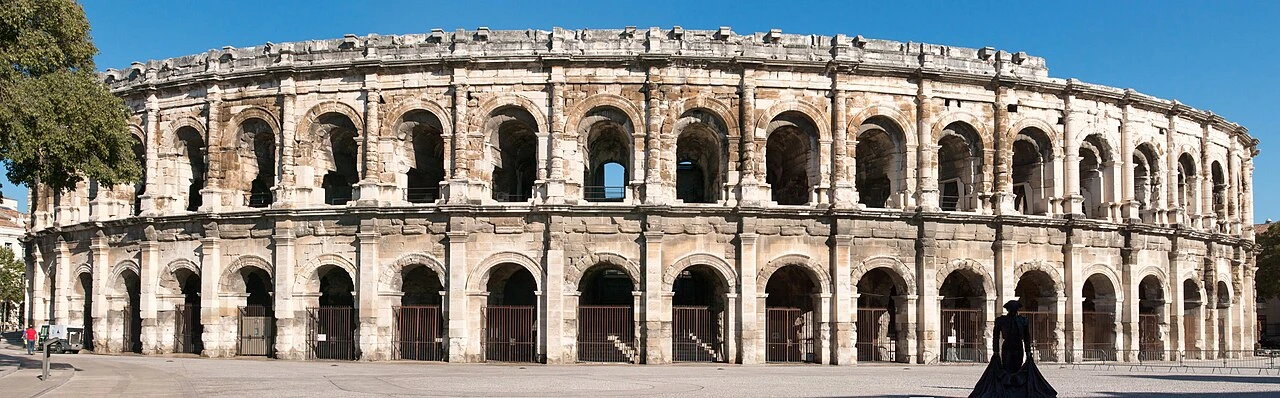
Nîmes
Amphitheater of Nîmes
Content & sources
Daniel VILLAFRUELA. · CC BY-SA 3.0
Paris
Arc de Triomphe de l'Étoile
Content & sources
Jiuguang Wang · CC BY-SA 2.0
Paris
Basilique du Sacré-Cœur de Montmartre
Content & sources
Tonchino · CC BY-SA 3.0
Saint-Denis
Basilique royale de Saint-Denis
Content & sources
Photo: Chabe01 · CC BY-SA 4.0