Stanza · Audio guide
Ulmer Münster Audio Guide
A place to remember. A story to take with you.
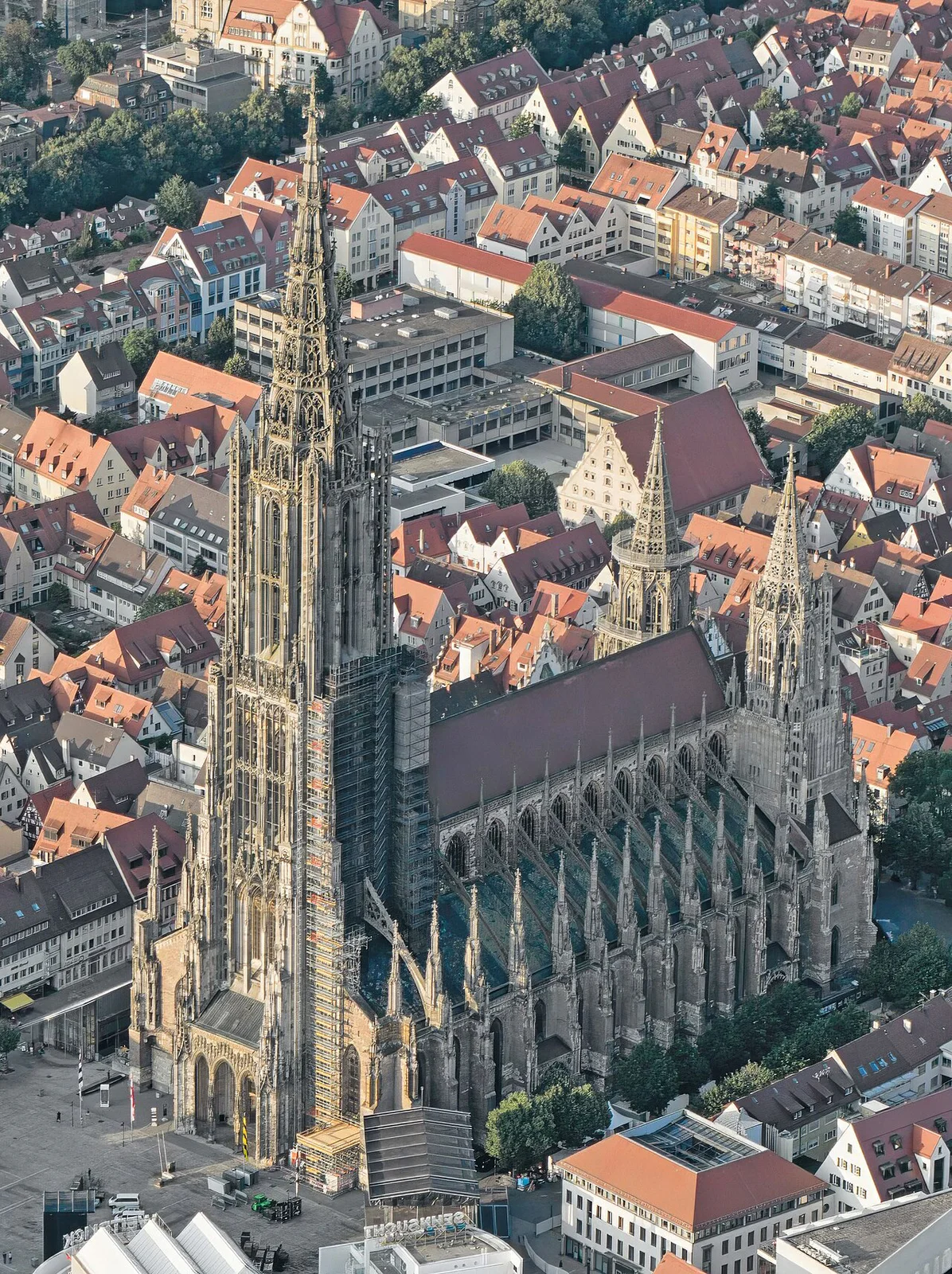
Ulm Minster is a Gothic church located in Ulm, Baden-Württemberg. It is the second-tallest church building in the world, with a steeple measuring 161.53 metres.
Download Stanza, then search for “Ulmer Münster”.
About the tour
One guide. Your kind of visit.
Ulm Minster is a Gothic church located in Ulm, Baden-Württemberg. It is the second-tallest church building in the world, with a steeple measuring 161.53 metres.
Ready when you are.
- 01Get the free Stanza app.
iOS & Android
- 02Find your guide.
“Ulmer Münster”
- 03Download before you go.
Works offline
Audio guide / 16 narrated stops
Inside the guide
Get to know a few of the stories before you go. Open a stop to read more.
01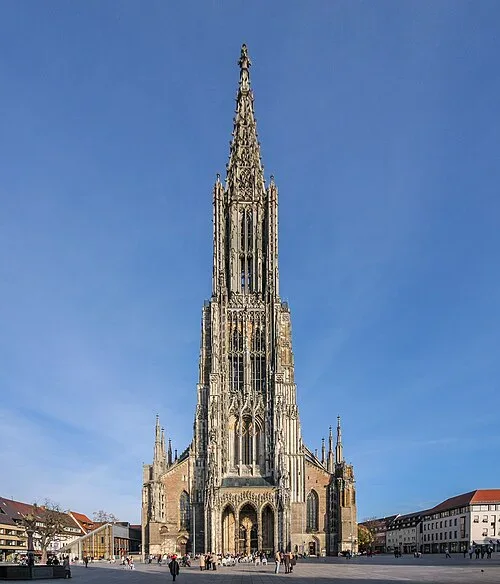 Münsterplatz and the Civic Miracle
Ulm Minster from the Münsterplatz
Welcome to Ulm Minster, a church with an unusual owner: nobody but the citizens of Ulm. The town's old parish church stood outside the city walls, and it answered to Reichenau Monastery, where Charlemagne had placed it back in 813. That arrangement turned dangerous in the fourteenth century, when conflicts like Emperor Charles IV's siege made the exposed church a liability. So the citizens chose something bold. Roughly ten thousand people lived in Ulm, and they resolved to build a new, independent church inside the walls, financed by themselves. The giant rising over this square is the result: a parish church, never a cathedral, never a bishop's seat. Its single great west spire, climbing alone above the façade, became the image of that civic decision. The stops ahead follow the story from foundation stone to spire top.
Photo: Martin Kraft · CC BY-SA 3.0
02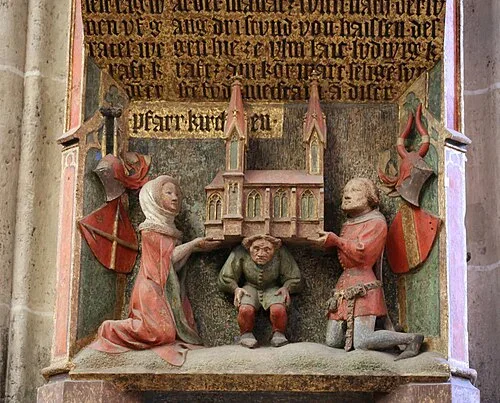 Münsterplatz and the Civic Miracle
The Foundation Stone Relief
A carved relief on the seventh pillar of the nave records the day this church began. On 30 June 1377, Mayor Ludwig Krafft, known as Lutz, laid the foundation stone. The carving tells it with a wink. The mayor and his wife lift a model of the church onto the bowed back of the master builder, Heinrich Parler. The inscription calls the gesture symbolic, though exactly what it was meant to say is left open. Parler knew his trade. He had gathered experience at Holy Cross Minster in Schwäbisch Gmünd, and had worked on Ulm's old parish church before that. His first plan was a hall church with three aisles of roughly equal height, a spire on the west and two steeples over the choir. He built the choir and the lower parts of its flanking towers before the work passed on.
Photo: Rufus46 · CC BY-SA 3.0
03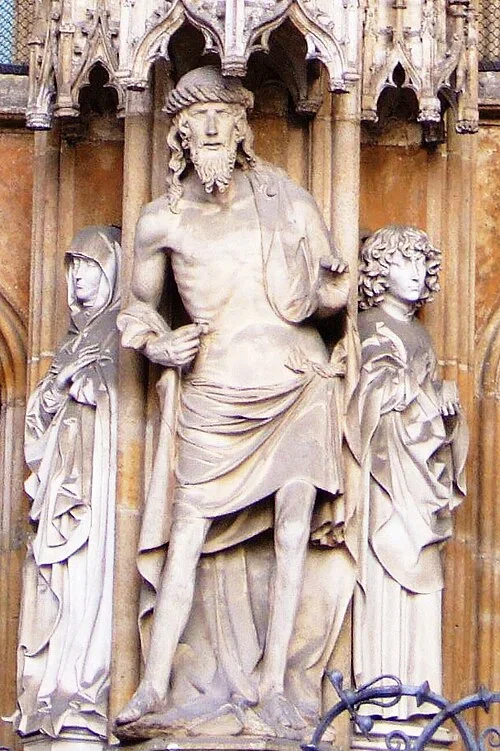 The West Porch and the Creation Tympanum
The Man of Sorrows at the Portal
On the central column of the main west portal stands the Man of Sorrows, carved in sandstone by Hans Multscher in 1429. Christ appears half-naked, crowned with thorns, his wounds on show, with mourning figures at his sides. Multscher was a local master, and this statue marks the threshold where Ulm's own late medieval school of sculpture announces itself. Inside the church, other names from that tradition are waiting, among them Jörg Syrlin and Michel Erhart, whose carved work fills the choir.
Listen in the appPhoto: Joachim Köhler · CC BY-SA 3.0
04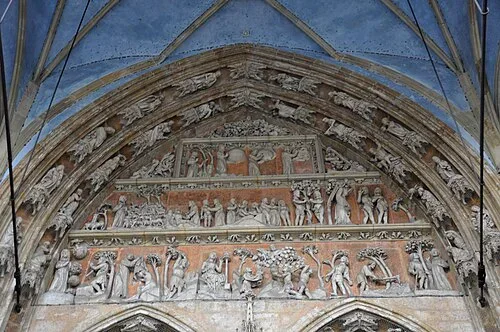 The West Porch and the Creation Tympanum
The Creation Tympanum
Above the main western doors, the tympanum unfolds the Book of Genesis in bands of carving. Most portals of this kind give their space to the Last Judgment. Here the Creation takes the main stage, with the Judgment pushed back into the corners. The work probably dates from the 1380s, made for a congregation of townsfolk rather than clergy. It reads like a theological picture book in stone: God making the world, then the early biblical history scene by scene, as people passed beneath on their way in. One panel shows God shaping the Earth as a rotating globe, ringed by the spheres of the planets. A reminder that learned medieval people already knew the world was round.
Listen in the appPhoto: Andreas Praefcke · CC BY 3.0
05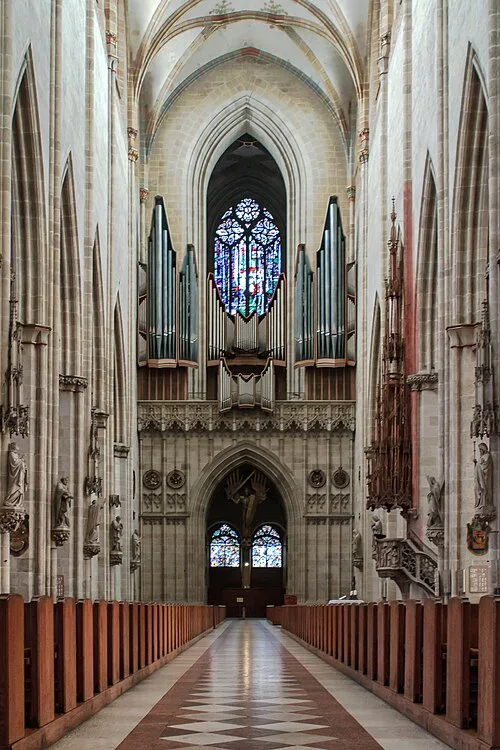 The Central Nave and the Structural Scare
The Nave and the Almost-Collapse
The church runs nearly 124 metres from end to end, and the walls around it are mostly brick. The towers and every carved detail are stone, which draws the eye, but the great surfaces of nave and choir show their brick plainly. In 1477 the master builder Matthäus Böblinger changed the plans, above all those of the main tower. His changes nearly undid the building. By 1492 the vaults, rising to different heights, were bending the piers, and the whole structure seemed headed for collapse. Burkhart Engelberg of Augsburg took charge and saved it. He reinforced the foundations of the west tower, tore out the heavy aisle vaults and rebuilt them at half the width, adding rows of slender columns to carry the load. Even so, the walls went without flying buttresses for three and a half centuries, and the north wall of the nave still leans out of true by twenty-seven centimetres. An organ here once had its own fame: Mozart played it in 1763.
Listen in the appPhoto: Avda · CC BY-SA 3.0
06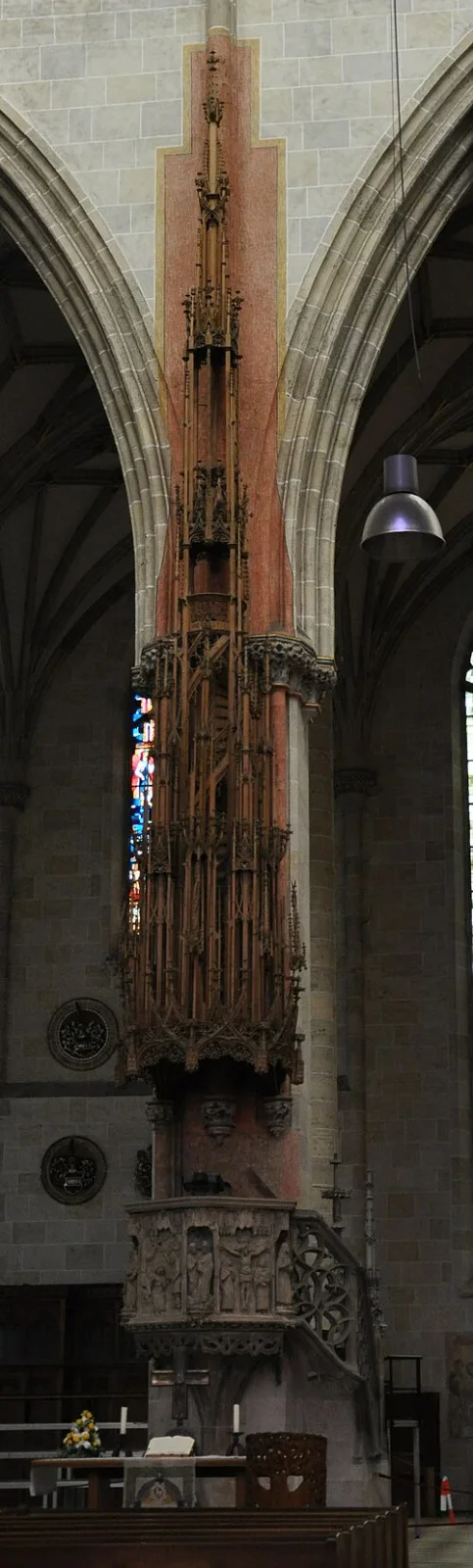 The Ornate Pulpit and the Einstein Connection
The Pulpit and the Reformation Storm
This pulpit carries the marks of Ulm's boldest vote. In 1530 and 1531 the full citizens of the city met and voted by name on leaving the old faith. Seven eighths of them chose the Protestant side, and Ulm Minster became a Lutheran church. What followed came quickly. On 19 June 1531, in the iconoclastic storm, more than sixty altars were removed, the high altar among them, and the reliefs on this pulpit's balustrade were smashed. The city council had warned the altar owners beforehand, so many families carried their altars to safety; some of the rescued pieces serve today in village churches around Ulm. The old great organ was pulled down as well, hauled out with teams of horses. The stone relief panels on the pulpit balustrade were carved anew in 1937 by Martin Scheible, replacing the ones destroyed in 1531. The soaring canopy above belongs to Jörg Syrlin the Younger.
Listen in the appUli E. · Public domain
07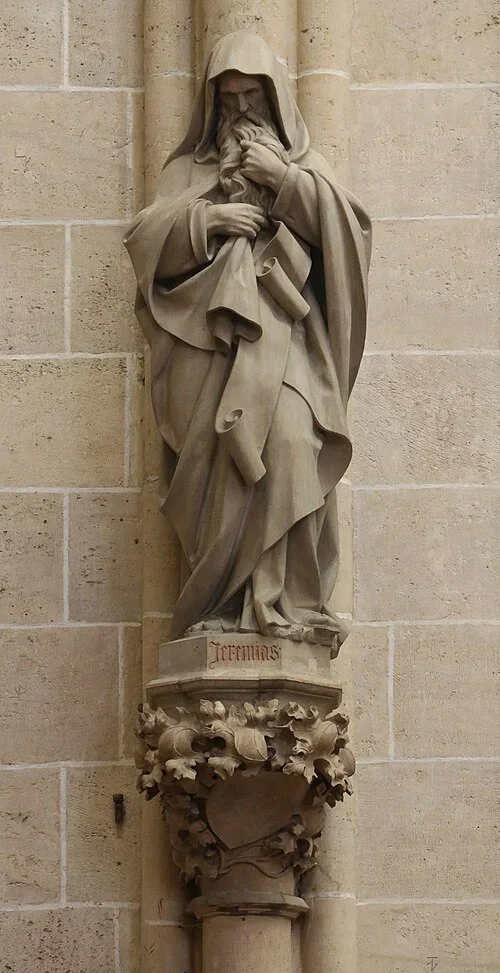 The Ornate Pulpit and the Einstein Connection
The Jeremiah Statue and the Einstein Gift
The prophet Jeremiah on this pillar has an unexpected story behind him. In 1877, marking half a millennium since the foundation stone, members of Ulm's Jewish synagogue congregation donated his statue. Among them was Hermann Einstein, the father of Albert Einstein. The court sculptor Karl Federlin carved the figure, which stands on the pulpit side of the nave below the great organ. Jeremiah is the only statue in the minster with a veiled head, drawing his hooded cloak around a scroll. A century later, the church added a stained glass window honouring Albert Einstein himself and his famous formula.
Listen in the appPhoto: Rufus46 · CC BY-SA 3.0
08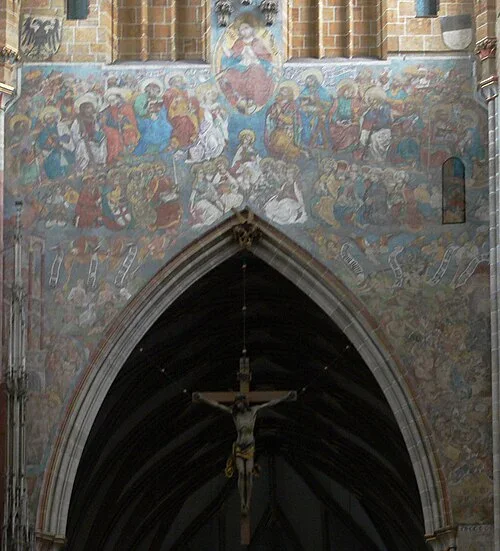 The Triumphal Arch and the Last Judgment Fresco
The Last Judgment Fresco
The Last Judgment spreads across the wall above the choir arch. Painted in 1471, the fresco covers about 145 square metres, which makes it one of the largest wall paintings north of the Alps. Christ presides at the top, with the saved and the damned streaming below, the image the medieval congregation carried with them at the threshold between nave and choir. The work is attributed, with some hesitation, to Hans Schüchlin. And it nearly vanished. In 1817 the interior frescoes were painted over in grey, the taste of that day. What survives above the arch outlasted that decision, a remnant of the colour the citizens' church once wore.
Listen in the appUli E. · Public domain
09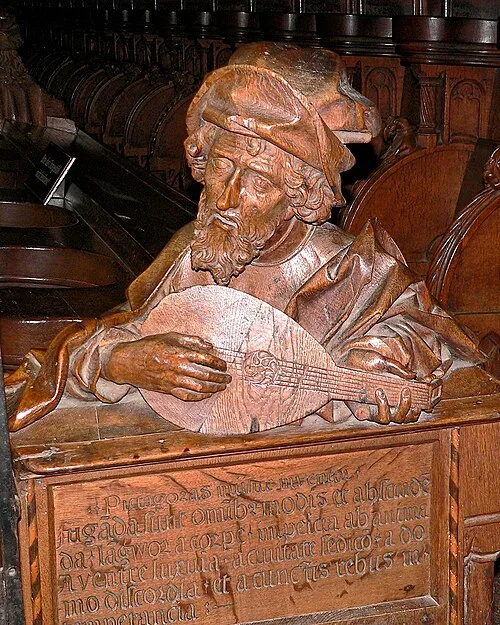 The Choir Stalls: Pagan Thinkers in a Christian Sanctuary
The Choir Stalls: Pythagoras in Church
Dark oak fills the choir, the stalls of Jörg Syrlin the Elder, counted among the most famous pews of the whole Gothic era. Hundreds of carved busts look down from its canopies and panels. What startles many visitors is who sits along the north side. The desk fronts carry the great minds of pagan antiquity — Pythagoras, Cicero, Terence, Ptolemy, Seneca, Quintilian, and Secundus the Silent. Pythagoras holds a lute in his carved hands. These were pre-Christian thinkers, given a place in the holiest part of a Christian church. The stalls stand at the meeting point of two eras, late Gothic craft opening onto the Renaissance love of antiquity. Even the lettering keeps that balance. The inscriptions use a rare script called Gotico-Antiqua, a hybrid of Gothic and humanist writing that echoes the printed books of the stalls' own day.
Listen in the appPhoto: Joachim Köhler · CC BY-SA 4.0
10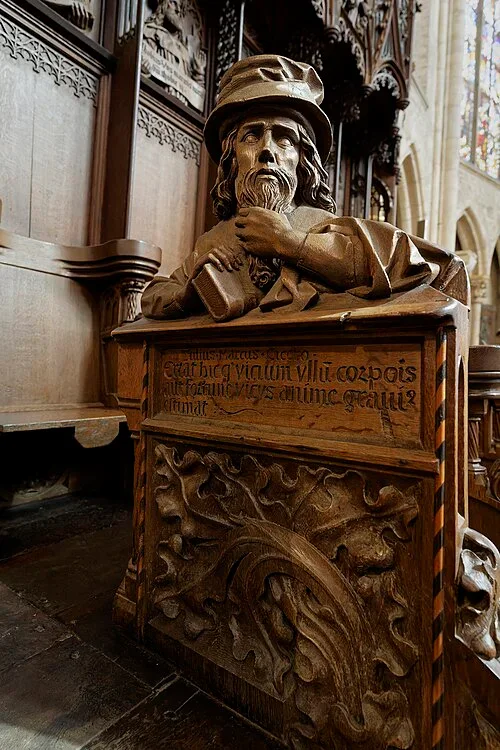 The Choir Stalls: Pagan Thinkers in a Christian Sanctuary
The Cicero Bust and the Carvers' Question
Cicero stares out from the oak, bearded and hooded, a book in his hands. He is one of hundreds of carved busts on the choir stalls, work of the years around 1470. Before the full commission, the city council tested the carver with a three-seat piece under the choir arch, made in 1468. Jörg Syrlin the Elder then led the work from 1469 to 1474, with the sculptor Michel Erhart collaborating above all on the busts. The side sections run eighteen metres, unusually low and long for Gothic taste. And the stalls keep a small mystery. Every bust on the men's side carries an inscription naming its subject, except the very first. That one figure stands silent. Art historians have read its face as the poet Virgil. Others suspected a self-portrait of Syrlin himself, sneaking the master into the row of ancients. Since newer scholarship gives the busts to Michel Erhart, that idea has lost much of its ground. The silent figure keeps its secret.
Listen in the appPhoto: Zinnmann · CC BY-SA 4.0
- 11
The High Altar Triptych
How a richly gilded altar from the very eve of the Reformation came to stand in a Lutheran choir.
- 12
The Choir and Its Windows
Medieval glass that outlived the raid which burned eighty percent of the city around it.
- 13
The Sacrament House
A needle-thin stone tower raised to guard the most precious thing in the late medieval church.
- 14
The Besserer Chapel Windows
The tiny private chapel where Ulm's merchant families prayed at the scale of a family.
- 15
Completing the Spire, 1890
How a building site paused for centuries finally reached the sky on 31 May 1890.
- 16
The View from the Top
Seven hundred sixty-eight steps to the panorama the medieval builders aimed at.
Ulmer Münster
Frequently asked questions
How much does the guide cost?
Free app download. Listed guide price: $0.99. Guide price shown in the app. Audio guide only. Venue admission is separate.
Can I listen without internet?
Yes. Download the guide’s audio, images, and maps in the app before your visit. Your downloaded content is then available offline.
Can I listen in my language?
This audio guide is available in 15 languages, including English.
Do I need to follow a schedule?
No. This is a self-guided experience. Choose your stops, pause whenever you like, and return to a story at your own pace.
At your own pace
Explore Ulmer Münster.
Download Stanza, then search for “Ulmer Münster”.
Free app download · Guide price shown in the app
Keep exploring
Nearby audio guides

Honau · 54 km
Lichtenstein Castle
Content & sources
Photo: -donald- · CC BY-SA 3.0
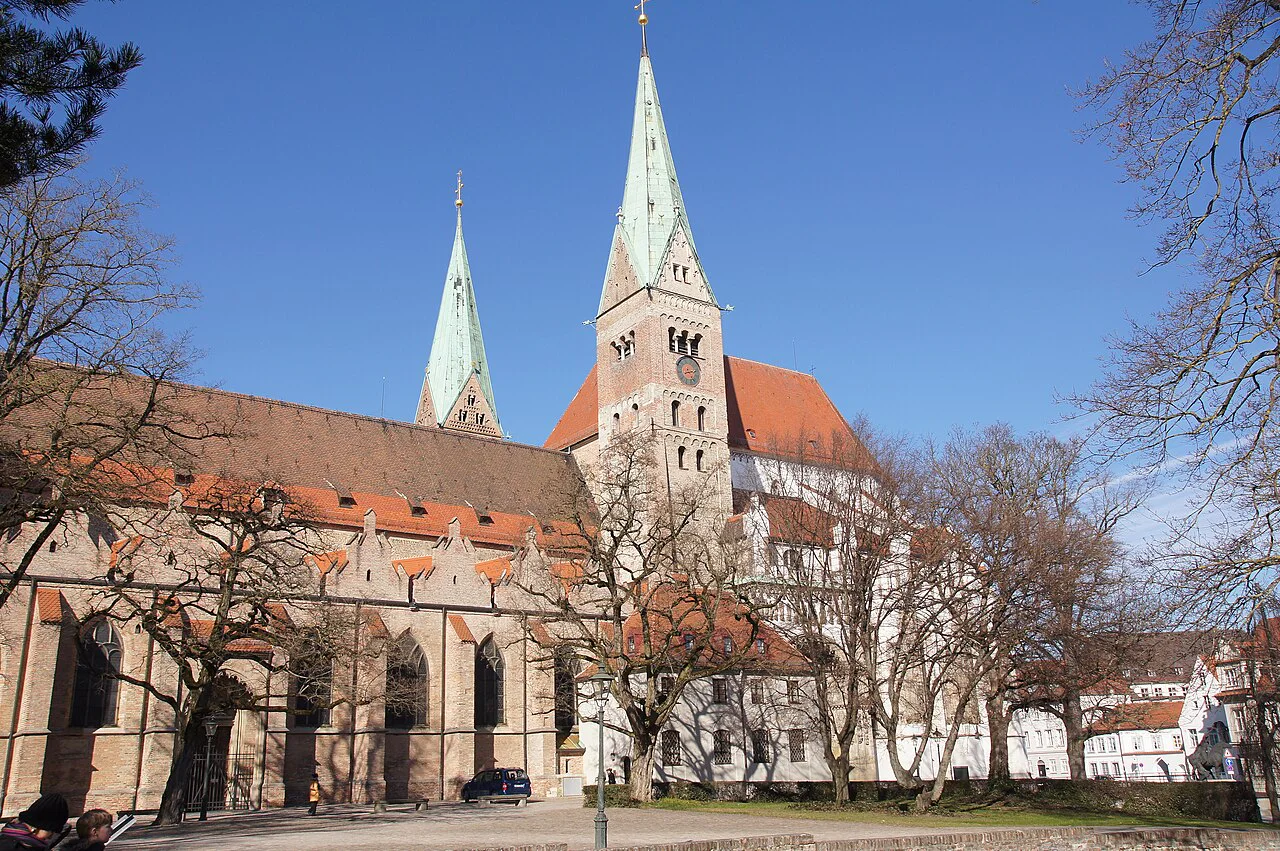
Augsburg · 67 km
Augsburger Dom
Content & sources
Allie_Caulfield from Germany · CC BY 2.0
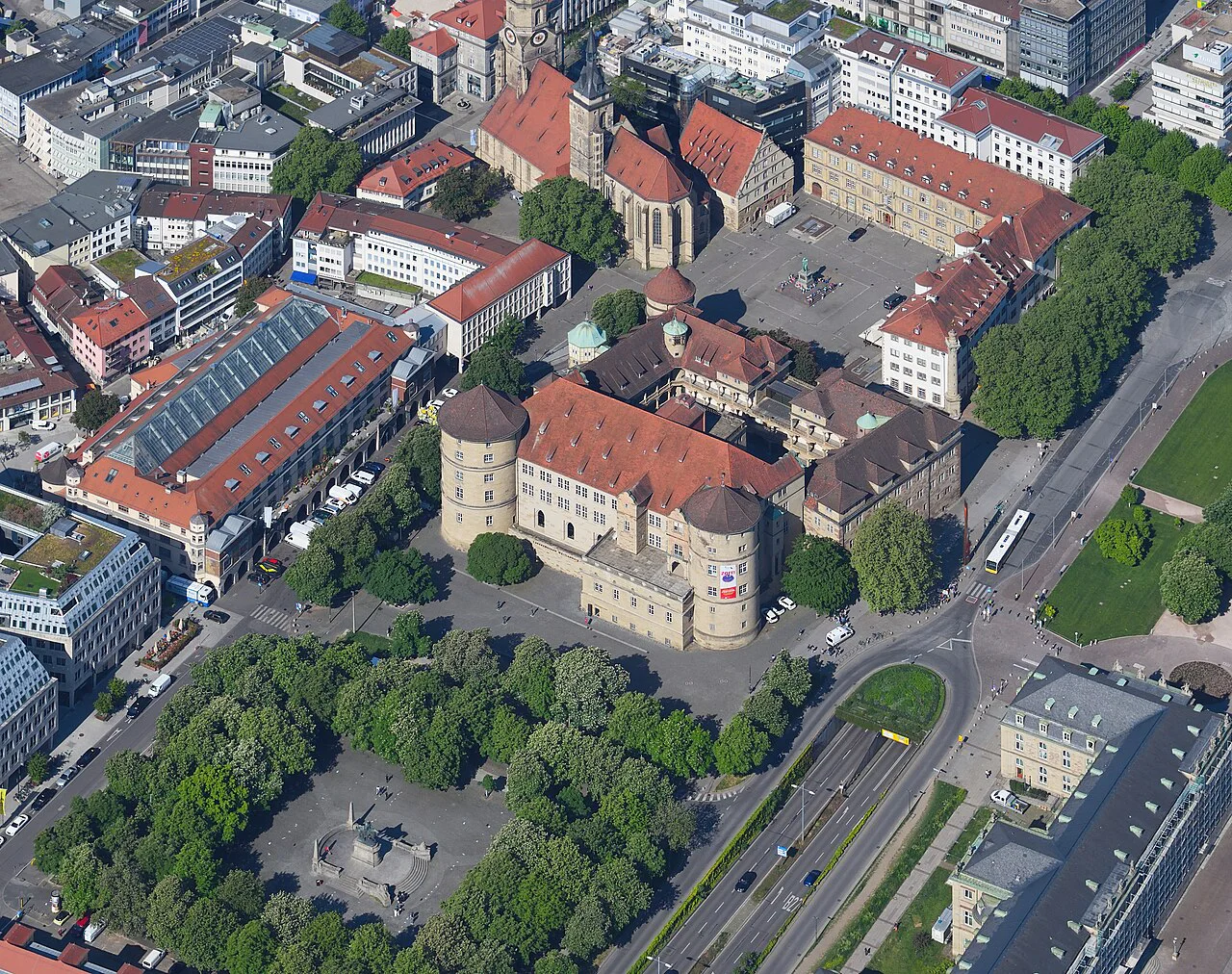
Stuttgart · 73 km
Altes Schloss Stuttgart
Content & sources
Photo: Carsten Steger · CC BY-SA 4.0

Bisingen · 76 km
Hohenzollern Castle
Content & sources
A. Kniesel (= User:-donald-), Lauffen · CC BY-SA 3.0