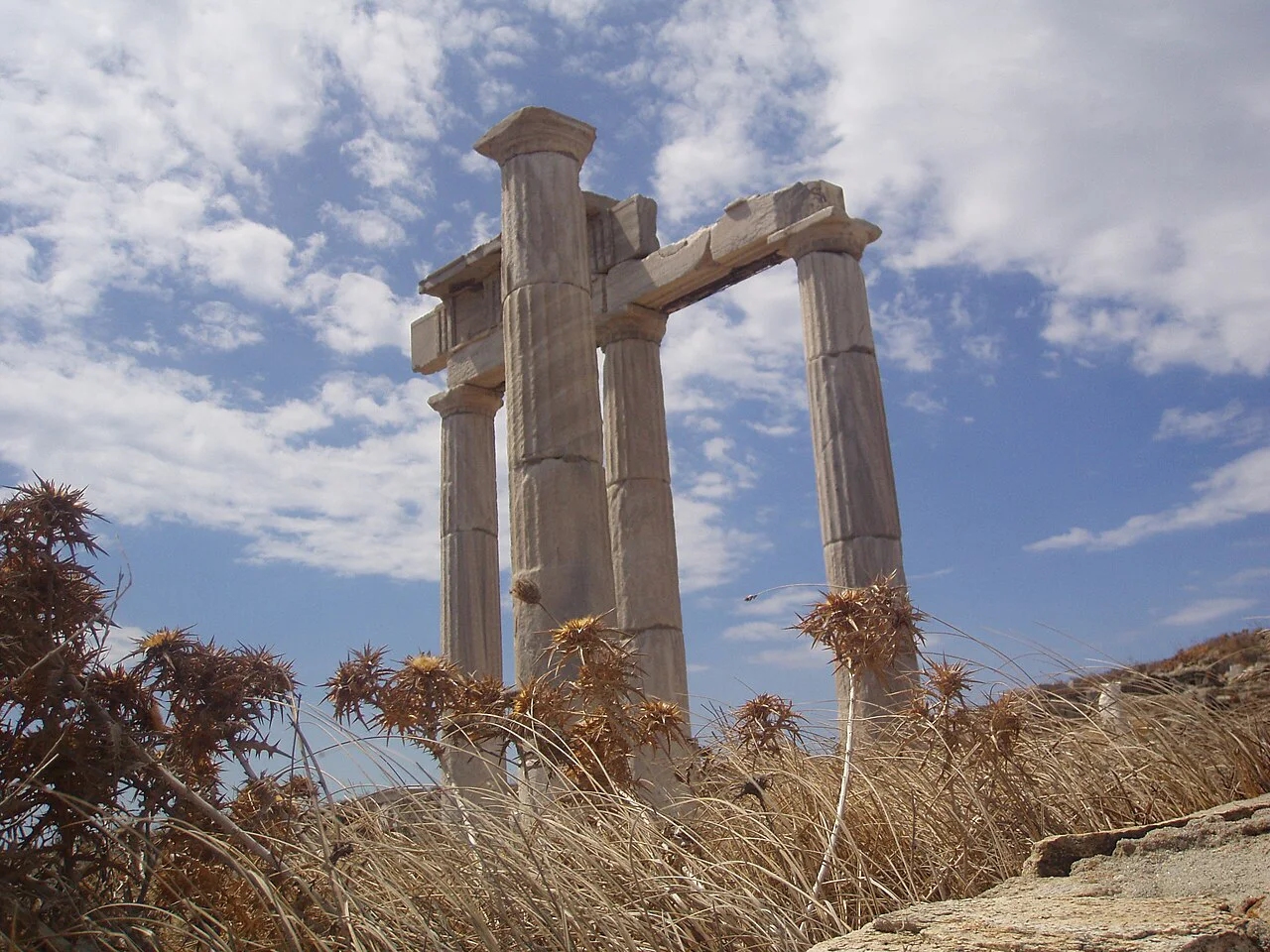
Stanza · Audio guide
Δήλος Audio Guide
A place to remember. A story to take with you.
Delos is a small Greek island located near Mykonos in the Cyclades archipelago. It is one of the most important mythological, historical, and archaeological sites in Greece.
Download Stanza, then search for “Δήλος”.
About the tour
One guide. Your kind of visit.
Delos is a small Greek island located near Mykonos in the Cyclades archipelago. It is one of the most important mythological, historical, and archaeological sites in Greece.
Ready when you are.
- 01Get the free Stanza app.
iOS & Android
- 02Find your guide.
“Δήλος”
- 03Download before you go.
Works offline
Audio guide / 51 narrated stops
Inside the guide
Get to know a few of the stories before you go. Open a stop to read more.
01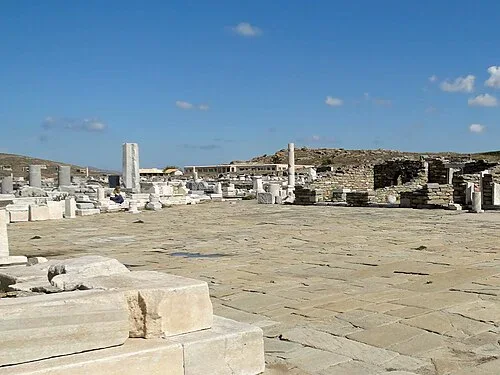 Agora of the Competaliasts
Delos is a speck of rock in the middle of the Cyclades, barely three and a half square kilometres, just off the coast of Mykonos. Few islands of that size carry more weight. It was held to be the birthplace of Apollo and Artemis, and Ionian pilgrims were treating it as a holy island by about 900 BC. This square, the Agora of the Competaliasts, was where arrivals from the sea met the island. It takes its name from an association honouring the Lares Compitales, guardian spirits of the crossroads, whom slaves and freedmen of the Italian community took as their own. The market took shape in the last quarter of the second century BC, opening straight onto the Sacred Harbour. Merchants, ship captains and bankers paid for monuments all around it, and shops lined its eastern and southern sides. Long before this market, Delos had guarded the treasury of the Delian League. Later it served Rome as a free port and a centre of the slave trade, before it was finally abandoned around the eighth century AD.
Bernard Gagnon · CC BY-SA 3.0
02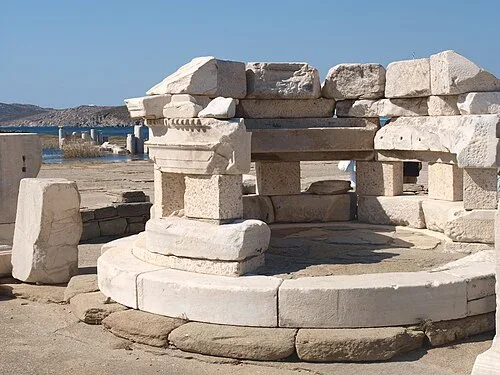 Agora of the Competaliasts
Circular monument in the Agora of the Competaliasts
Market days here were shaded affairs. The stone paving still holds the postholes that carried the poles of market awnings, stretched over the stalls. Monuments in the centre carried dedications, among them one to Hermes, the god of trade. The circular marble structure is the odd one out. Its original purpose is a puzzle: a carefully built ring of stone, close to the heart of the market.
Institute for the Study of the Ancient World from New York, United States of America · CC BY 2.0
03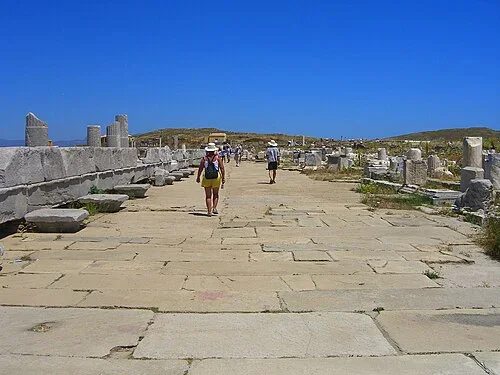 Sacred Way
 (Delos)
One road strings the island together, from the harbour market straight north into the precinct of Apollo. This is the Sacred Way, the route of solemn processions. Pilgrims and delegations came from every part of the Greek world, because Delos had grown into a shrine of Panhellenic standing, and they walked this road together toward the god. Porticoes flanked the procession, the South Stoa on one side and the stoa of the Macedonian king Philip on the other. The road was more than pavement. It ordered the whole island: harbour, market and temples strung along a single axis, so that the approach itself became the first act of the pilgrimage.
Listen in the appKevin Stroup · CC BY 3.0
04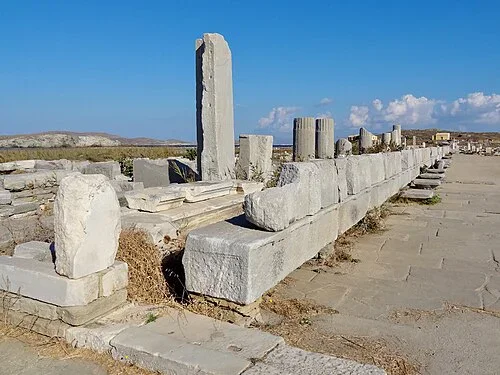 Stoa of Philip V
 in Delos
Kings competed for Apollo's favour, and they fought that contest in stone. In 354 BC the Delians themselves appealed to Philip the Second of Macedon, asking him to curb Athenian interference in the sanctuary, so Macedonian patronage answered a real local grievance. From 314 BC Delos broke away from Athens and its people ran the sanctuary on their own. The kings of Macedon marked the new order with monumental gifts, stoas built to be seen by every pilgrim in the Aegean. This Doric colonnade was raised by Philip the Fifth, who had the architrave inscribed: 'Offering of Philip, king of Macedonia, son of King Demetrios, to Apollo.' A royal signature, stretched above the columns for the whole harbour to read.
Listen in the appOlaf Tausch · CC BY 3.0
05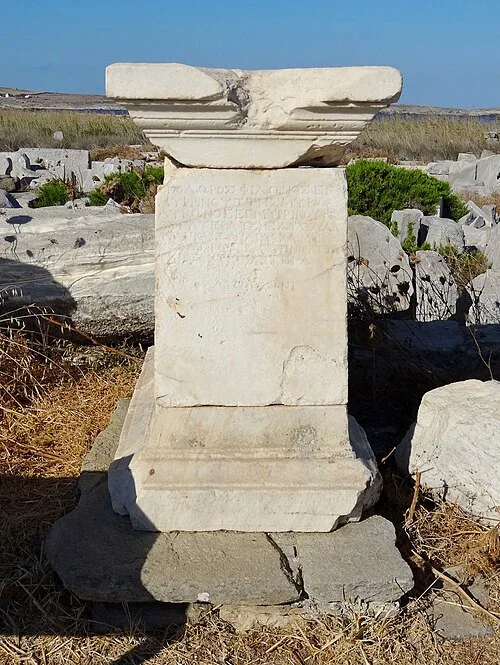 Stoa of Philip V
Inscribed statue base near the Stoa of Philip V
A stoa of a great power was never a bare wall. Between the columns stood statues of benefactors and worthies, each on a carved pedestal like this one, with an inscription telling passers-by what the honoured person had done. Honour worked as currency in the Hellenistic world. Cities and kings repaid service with marble, and they put it where the crowds would see it. The letters on this base are worn away now, and who it praised can no longer be said. Its place still tells the story: a portico displayed power as well as shelter from the sun.
Listen in the appOlaf Tausch · CC BY 3.0
06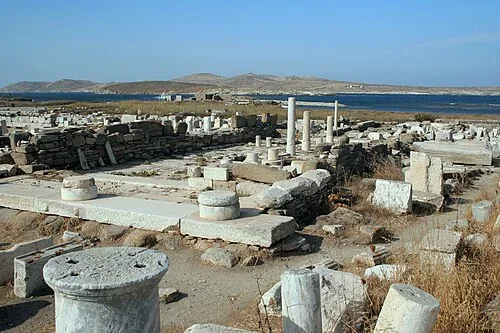 Oikos of the Naxians
 on Delos
Before Athens, before the kings of Macedon, another island set the tone on Delos: Naxos, then a leading power of the Cyclades. In the first quarter of the sixth century BC the Naxians built this grand hall, a long building with a colonnade running down its middle and a porch at the western end. In the middle of the century they added a marble façade on the east side, a costly finish for its day. One scholar argued the building was Delos's first temple of Apollo. Most now see it as an oikos, a communal hall, probably used for banquets. Either way it was Naxos's architectural statement at the shrine of the god, an island announcing in stone that it counted.
Listen in the appOlaf Tausch · CC BY 3.0
07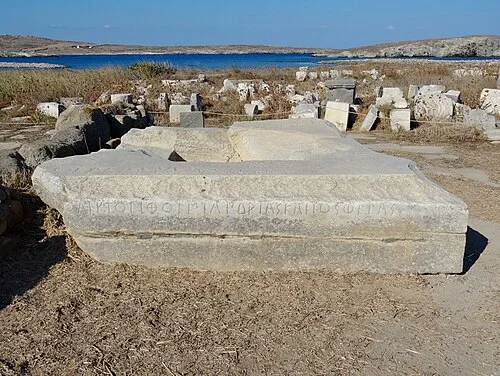 Oikos of the Naxians
Base of the Colossus of the Naxians
This great slab still lies where a giant once stood, close beside the sea. On it rose a colossal statue of Apollo, dedicated in Archaic times by the people of Naxos. Even the pedestal is the size of a small room, a single block hauled from the quarry and set down at the water's edge. The inscription on its face is worn nearly smooth. Of the god himself only fragments survive, some on the ground nearby and some in the island's museum.
Listen in the appOlaf Tausch · CC BY 3.0
08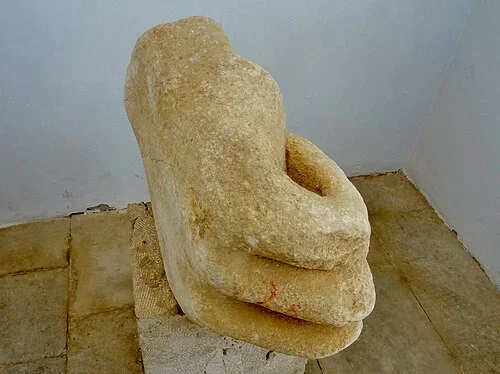 Colossus of the Naxians
A giant's hand, carved from marble. It belongs to the Colossus of the Naxians, a kouros of Apollo about nine metres tall. It dates to the end of the seventh century BC, and it is one of the largest kouroi ever known. The Naxians quarried the block near Melanes on their own island and hauled it ten kilometres to the harbour. The stone weighed about thirty tonnes, so it may have crossed to Delos on two ships lashed together. The inscription on the base, recorded in the fifteenth century by Cyriacus of Ancona, read simply: 'The Naxians, to Apollo.' The left hand was carved with a hole to grip a bow. Ropes and pulleys on a scaffold taller than the statue hauled it upright, and when it rose it stood higher than any building on the island. Time broke it apart. The head and upper legs are gone, a foot ended up in the British Museum, and the rest is scattered between the museum and the ground where it stood.
Listen in the appOlaf Tausch · CC BY 3.0
09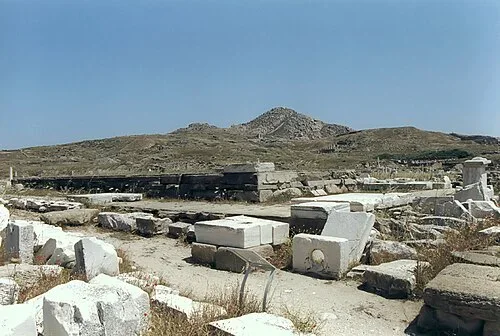 Temple of the Delians (Great Temple of Apollo)
After the Persian Wars the Greek cities banded together to guard the sea, and they chose Delos as their meeting ground. The Delian League was founded in 478 BC, and its congresses met here, in the temple of the god. The League's common treasury was kept on Delos as well, until Pericles had it moved to Athens in 454 BC. Building this great Doric temple began around the same time, paid for by the League itself. The work stopped when the money left for Athens, and was resumed and finished during Delos's independent years. It was the largest of the island's three temples of Apollo, ringed with columns, six across each end. War with Mithridates wrecked it in the end, and the lower foundations, the paving of the platform and a few broken columns are what remain.
Listen in the appPhoto: Zde · CC BY-SA 3.0
10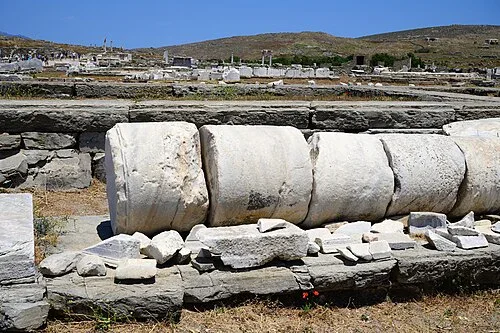 Temple of the Delians (Great Temple of Apollo)
Fallen column drums at the Temple of the Delians
The fallen drums give the measure of the temple, round stones stacked high to make each Doric column. Their surfaces are worth a close look, because they show a job left half done. Greek masons shaped drums like these only roughly on the ground, and carved the fluting for just a few inches at the top and bottom of the column, as a guide. Once the column stood, they climbed scaffolds and cut the rest of the grooves in place. On this temple that last stage never came. Its columns kept their plain, unfinished shafts, and so they show how a Greek column was made, stopped one step before the end.
Listen in the appPhoto: Zde · CC BY-SA 4.0
- 11
Temple of the Athenians in Delos
The plague year when Athens emptied Delos of its dead, and the marble temple it raised to mark the deed.
- 12
Temple of the Athenians — marble remains
Games on the freshly cleansed island, and the deportation that emptied Delos entirely.
- 13
Poros Temple of Apollo
Delos's first monumental temple of Apollo, and the tyrant who began the scrubbing of the sacred island.
- 14
Temple of Artemis in Delos
Apollo's twin sister had her own temple here, on cult ground far older than the marble shrines around it.
- 15
Stoa of Antigonos
A colossal Doric portico, raised by King Antigonus Gonatas to draw the sanctuary's northern boundary.
- 16
Temple of Leto (Letoon) in Delos
The sixth-century shrine of Leto, mother of the twins, and a genuine puzzle about the lions outside.
- 17
Agora of the Italians (Delos)
How a free port turned Delos into a commercial capital, and the grand merchants' complex it produced.
- 18
Merchant quarter toward the Sacred Lake
The two sacks of 88 and 69 BC, and how the trade routes left Delos behind.
- 19
Terrace of the Lions
The marble lionesses of Naxos, dedicated to Apollo shortly before 600 BC along the Sacred Way.
- 20
Snarling lioness of the Terrace of the Lions
A close look at the Archaic style: gaunt bodies, small heads, and a snarl frozen in marble.
- 21
Sacred Lake in Delos
The circular lake where legend placed the birth of the twins, and why it stands dry today.
- 22
Palm tree by Apollo's birthplace
A lone palm by the Sacred Lake, echoing the tree of the birth legend.
- 23
Establishment of the Poseidoniasts
The clubhouse of Beirut's merchants on Delos, where Levantine gods shared a hall with Roma.
- 24
House of the Lake (Delos)
A late Hellenistic mansion on ground that was gardens and shrines only a century before.
- 25
Mosaic floor of the House of the Lake
How Delian mosaic floors were made, from plain white-and-red geometry to cubes a millimetre wide.
- 26
Stoibadeion
Dionysus's festive terrace, with its colossal phallic pillars and a monument to a won theatrical contest.
- 27
Phallic pillar of the Stoibadeion
A colossal stone phallus on its stepped base, and the reliefs that turn a fertility emblem into a carved story.
- 28
Archaeological Museum of Delos
How a ghost island became one of the Mediterranean's great digs, and what this modest building holds.
- 29
Original lions of Naxos in the museum
The original lions, safe indoors at last, and the one that was stolen for Venice.
- 30
Figured mosaic with Athena and Hermes
A mythological mosaic lifted from a mansion floor, and why Delos's pottery ended up on Mykonos.
- 31
Wall painting of boxers, ca. 100 BC
Two boxers frozen mid-fight on a painted wall, with a name that may belong to a famous athlete.
- 32
Panther Mosaic Fragment (Delos Museum)
A snarling panther in mosaic, the beast that gave the House of Dionysus its name.
- 33
Neorion
A monumental stone foundation, and the hall built to house a ship offered to Apollo.
- 34
Monument with the Bulls
A carved bull's skull on a marble block, ornament in the oldest sacred tradition.
- 35
House of Hermes (Delos)
A house built as a stack of terraces, climbing the rocky slope toward the sea view.
- 36
Sanctuary of the Syrian Gods
The grandest sanctuary on Delos belonged to foreign gods: Atargatis and Hadad of Syria.
- 37
Temple of Isis (Delos)
A small complete temple front on a height, built for the Egyptian trinity of Isis, Serapis and Anubis.
- 38
Temple of Hera (Heraion)
Two columns by the sea mark a temple of Hera rebuilt around 500 BC, kept at a distance from Apollo.
- 39
Cave of Cynthus (Kynthos) on Delos
A cave of giant granite boulders on the mountain that was holy long before Apollo.
- 40
Cynthion (Mount Cynthus Summit)
The summit of Mount Cynthus, where a sanctuary of Zeus crowned the island and its pre-Greek name still clings to the rock.
- 41
House of the Masks: Column Walk
A surviving column and its fallen fellows at the House of the Masks, one of the best-known residences of the Theatre Quarter.
- 42
House of the Dolphins (Delos)
A Phoenician owner, a goddess from home, and the house he built on a Greek island.
- 43
House of the Dolphins: Atrium Mosaic
The circular mosaic at the heart of the House of the Dolphins, worn now but still the floor that named the house.
- 44
Greek Theatre of Delos
Seventy years of building, a round orchestra by the sea, and the Greek proverb that made Delos a byword for joy.
- 45
Theater Reservoir
A vaulted cistern with water still standing in it, and the puzzle of how Delos, an island with almost no water, stayed alive.
- 46
House of the Trident (Delos): Columned Court
Four fluted columns and a story of the sea god who raised Delos from the waves with one blow of his trident.
- 47
House of the Trident: Sea-Creature Mosaic and Block
A dark sea creature on the floor of the House of the Trident, beside a shape that may or may not be a trident.
- 48
House of Cleopatra and Dioscorides: Colonnade and Harbour View
Columns, a marble figure, and the open sea: the house of Cleopatra, wife of a rich Delos merchant.
- 49
House of Cleopatra and Dioscorides: Paired Statues
Two headless marble figures on a shared base, known by tradition as Cleopatra and her husband Dioscorides.
- 50
House of Dionysos (Delos): Peristyle Columns
Tall columns with scroll-shaped capitals still standing round the court of one of Delos's luxurious private houses.
- 51
House of Dionysos: Floor Mosaic and Spiral Border
A floor framed in running spirals, with one small worn scene at its edge and the famous panther elsewhere.
Δήλος
Frequently asked questions
How much does the guide cost?
Free app download. Listed guide price: $4.99. Guide price shown in the app. Audio guide only. Venue admission is separate.
Can I listen without internet?
Yes. Download the guide’s audio, images, and maps in the app before your visit. Your downloaded content is then available offline.
Can I listen in my language?
This audio guide is available in 15 languages, including English.
Do I need to follow a schedule?
No. This is a self-guided experience. Choose your stops, pause whenever you like, and return to a story at your own pace.
At your own pace
Explore Δήλος.
Download Stanza, then search for “Δήλος”.
Free app download · Guide price shown in the app
Keep exploring
Nearby audio guides
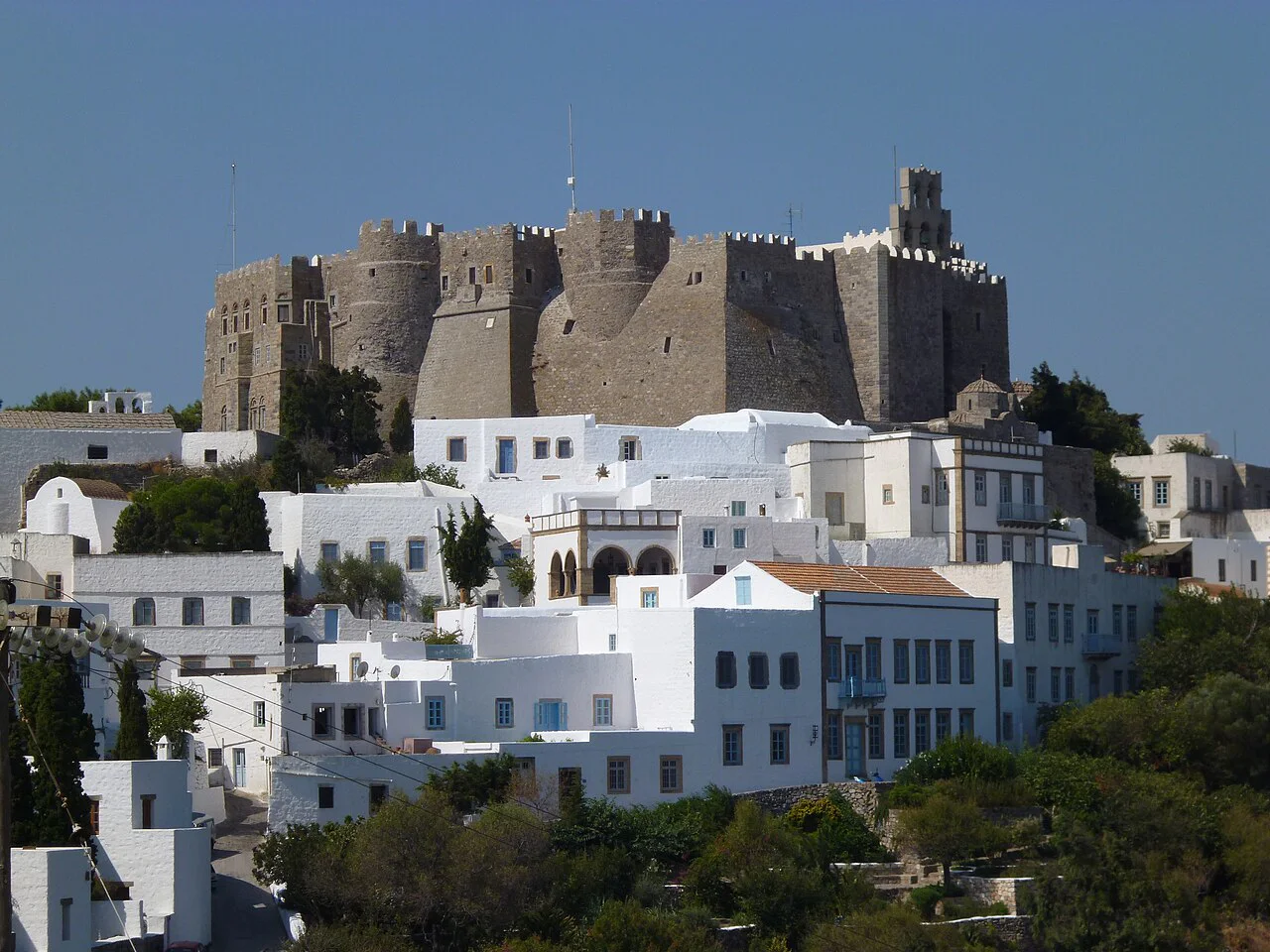
Patmos · 113 km
Μονή του Αγίου Ιωάννου του Θεολόγου
Content & sources
Valeria Casali · CC BY-SA 3.0
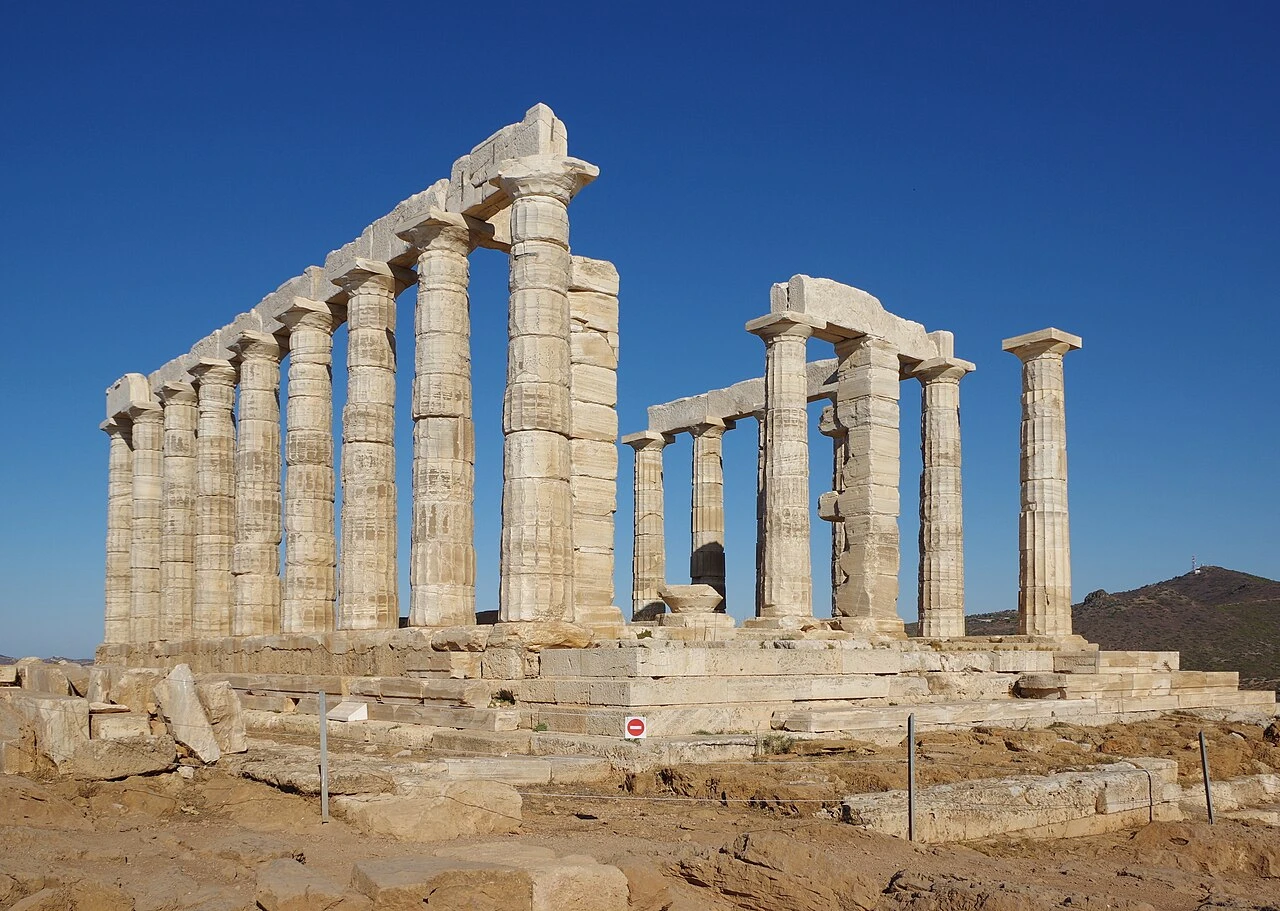
Sounion · 114 km
Temple of Poseidon at Sounion
Content & sources
Photo: Berthold Werner · CC BY-SA 3.0
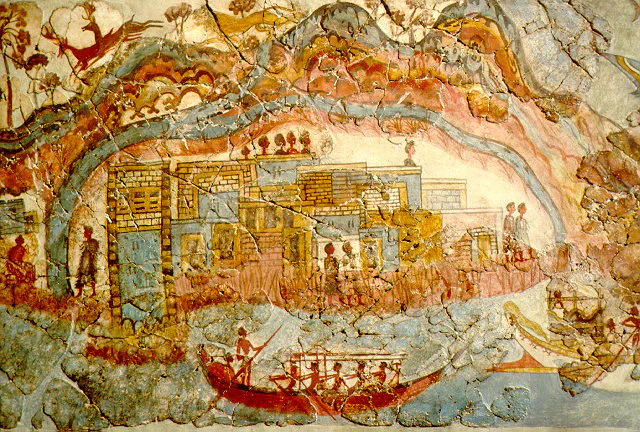
Thira Municipal Unit · 116 km
Ακρωτήρι Θήρας
Content & sources
unknown minoan artist · Public domain
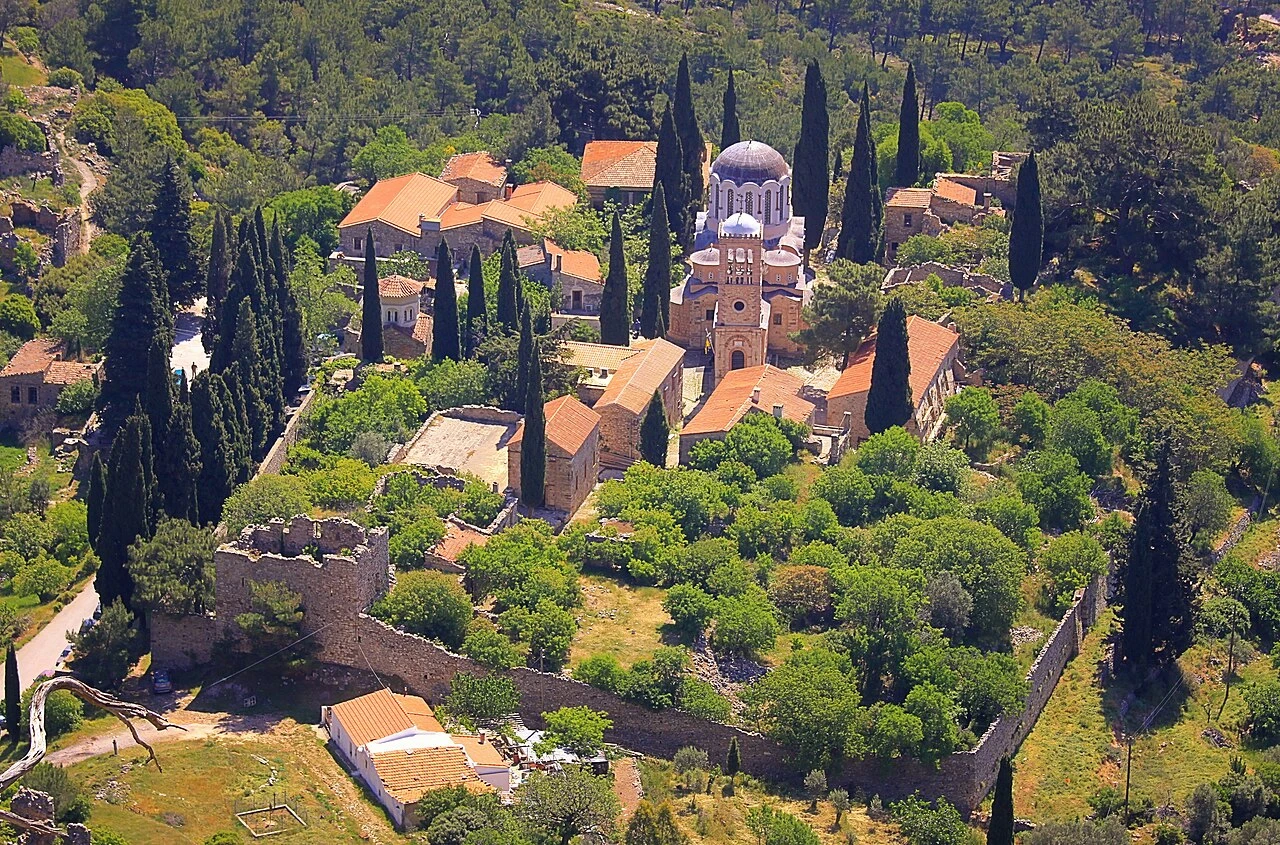
Chios · 129 km
Nea Moni of Chios
Content & sources
Photo: FLIOUKAS · CC BY-SA 4.0