Stanza · Audio guide
Ακρωτήρι Θήρας Audio Guide
A place to remember. A story to take with you.
Akrotiri is a Cycladic Bronze Age settlement site on the volcanic Greek island of Santorini. The name comes from the nearby village of Akrotiri, and the name of the site in antiquity is unknown.
Download Stanza, then search for “Ακρωτήρι Θήρας”.
About the tour
One guide. Your kind of visit.
Akrotiri is a Cycladic Bronze Age settlement site on the volcanic Greek island of Santorini. The name comes from the nearby village of Akrotiri, and the name of the site in antiquity is unknown.
Ready when you are.
- 01Get the free Stanza app.
iOS & Android
- 02Find your guide.
“Ακρωτήρι Θήρας”
- 03Download before you go.
Works offline
Audio guide / 15 narrated stops
Inside the guide
Get to know a few of the stories before you go. Open a stop to read more.
01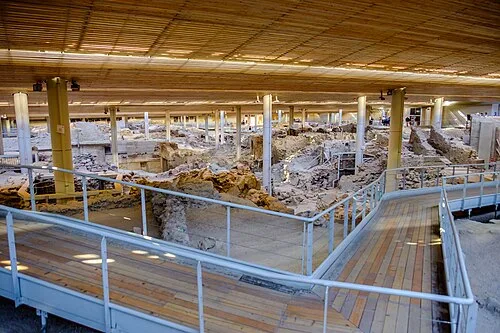 Shelter Entrance and Ancient City Panorama
Panoramic View from the Covered Walkway
Akrotiri is a Bronze Age town on the volcanic island of Santorini, in the Aegean Sea. Its ancient name is unknown, and the modern name comes from a nearby village. In the sixteenth century BC, the Theran eruption buried the town under ash and pumice. The burial preserved it so well that people often compare it with Pompeii, the Roman town preserved under volcanic debris. Some buildings rose to three storeys. Frescoes, pottery, furniture and advanced drainage systems have all been found here.
Photo: Hardscarf · CC BY-SA 4.0
02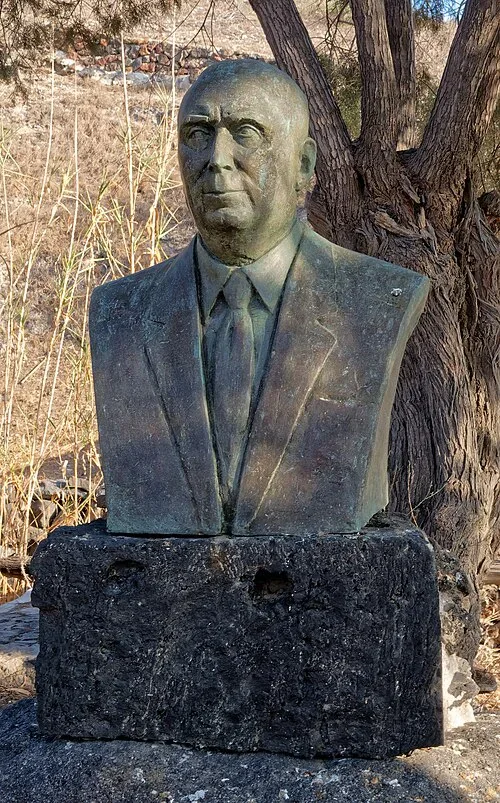 Shelter Entrance and Ancient City Panorama
Bronze Bust on Volcanic Stone Plinth
A bronze bust here commemorates Spyridon Marinatos, the archaeologist who began the excavation of Akrotiri and is buried at the site. In 1939, Marinatos studied rock layers from a villa excavated at Amnissos, near Knossos on Crete. He was the first to propose that the pumice found there might come from an eruption on Santorini. He thought the eruption had set off tsunamis when the volcano's caldera collapsed. Those waves, he believed, may have brought down Minoan civilization on Crete. He also suggested that a mythologized memory of this disaster might be one origin of the Atlantis legend. Other scholars first met his ideas with skepticism. Earlier, in 1899, Robert Zahn had dug at Potamos, near Akrotiri. Decades later, in 1967, Marinatos began the large-scale excavation here. A few hours into the digging, the remains of the buried town started to appear. Two seasons of work were needed to learn how big the town was. In 1975, after Marinatos's death, Christos Doumas took over as head of the excavations.
Photo: Holger Uwe Schmitt · CC BY-SA 4.0
03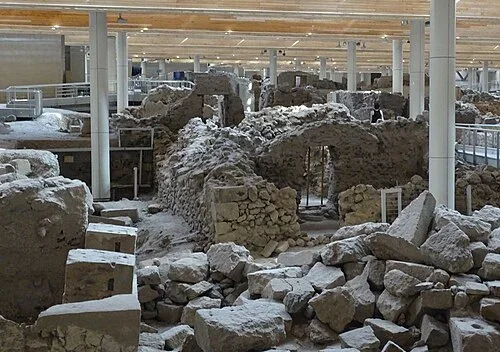 Xeste 3 and the Lustral Basin
Excavated Walls of Xeste 3
Xeste 3 stands southwest of the main excavations, and it is read as a place for rites of initiation and passage. It holds more frescoes than any other building found in the town so far. A suite of rooms links through polythyra. A polythyron is a series of double doors reaching the ceiling, set on wooden pillars. Open them all, and two rooms become one. Open just one, and it makes a passage. One room has a sunken depression. It was first read as a lustral basin, a basin for ritual washing. Scholars now read it as an adyton, an inner sanctuary. A niche in that room, read as a shrine, was decorated with ritual horns, stylized bull horns. Upstairs, more rooms served ritual purposes, and all of them were richly decorated.
Listen in the appAd Meskens You are free to use this picture for any purpose as long as you credit its author, Ad Meskens. Example: © Ad Meskens / Wikimedia Commons If you use this work outside of the Wikimedia projects, a message or a copy is very much appreciated. This image is not in the public domain. A statement such as "From Wikimedia Commons" or similar is not by itself sufficient. If you do not provide clear attribution to the author you do not comply with the terms of the file's license and you may not use this file. If you are unable or unwilling to provide attribution you should contact Ad Meskens to negotiate a different license. · CC BY-SA 4.0
04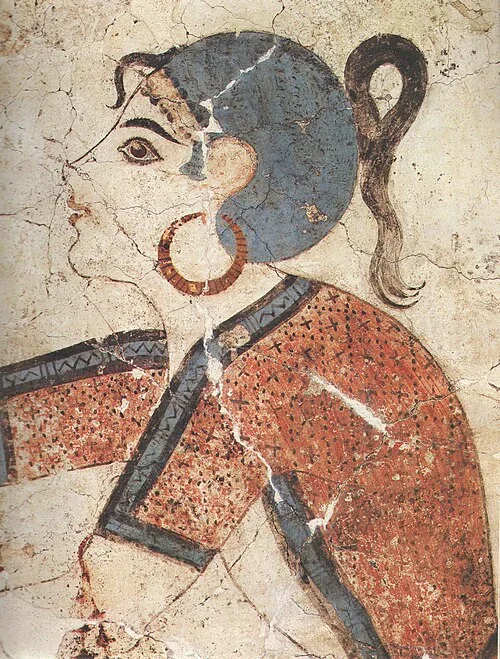 Xeste 3 and the Lustral Basin
Saffron Gatherers Fresco (Detail)
A painted woman in profile wears a blue headdress, a large hoop earring and a red dress flecked with dark dots. The paint appears to be mineral based, and that helped it survive. Its colors are white, yellow, red, brown, blue and black. The standard description calls the technique not true fresco, except in a few isolated cases. The paint went on when the plaster was wet, but the painter made no effort to keep it wet. As a result, the paint sinks into the plaster in some places and flakes off in others. Other accounts count it as true fresco. Akrotiri is a Cycladic site, but its inscriptions in Linear A and its painting styles tie it closely to Minoan Crete. On Crete, paintings from Knossos survive mostly as small fragments that fell to the ground. The Akrotiri paintings are far better preserved. The title speaks of saffron. Experts take the wider scene to show women gathering crocus. The painting is now shown in the Museum of Prehistoric Thera, in Fira.
Listen in the appanonymous · Public domain
05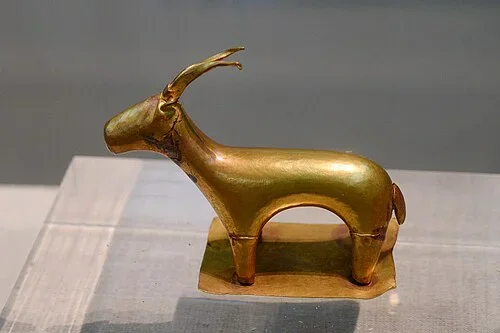 The House of the Benches and the Golden Ibex
Golden Ibex Figurine
A small gold figure of a standing animal shows curved horns, four legs and a flat base. It was found hidden beneath a floor. One account says it is the only gold object found in the town, though another reports a gold necklace from an early dig. Some accounts call the figure a golden goat. It lay near the House of the Benches, by the western end of Xeste 3. It is now shown in the Museum of Prehistoric Thera, in Fira. The House of the Benches also held a large deposit of horns. Between three and five hundred of them came from cattle, sheep and goats. Almost all had been altered by fire, their outer sheaths removed and their surfaces painted with ochre, a natural earth pigment. Their religious use is unknown.
Listen in the appPhoto: Zde · CC BY-SA 4.0
06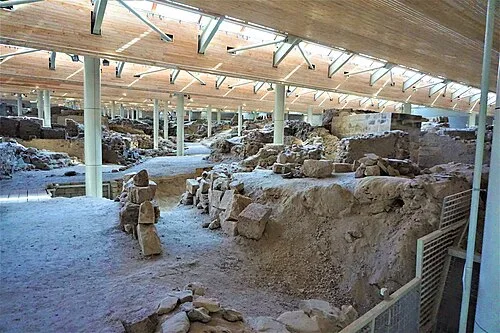 Telchines Road and Urban Infrastructure
Telchines Road
Only one street at Akrotiri has been cleared over any real length so far. It climbs the slope from south to north. Marinatos's team named it Telchines Road. The name comes from the Telchines of Greek myth, metalworkers, because a house on the street held a metal workshop. The street is at least two metres wide, and in places it opens into squares of varying size. These squares were the town's only open spaces. There were no private courtyards or gardens. The workshops around the squares suggest that craftsmen probably worked outdoors in fine weather. The streets were paved.
Listen in the appPhoto: Joyofmuseums · CC BY-SA 4.0
07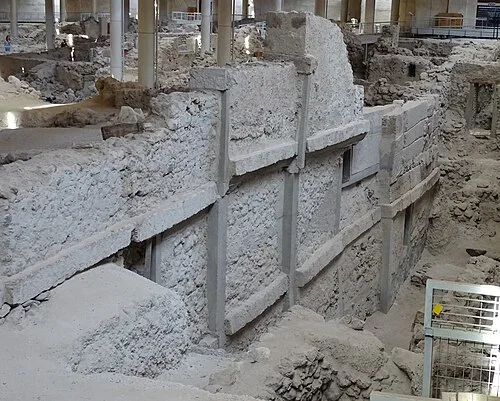 Telchines Road and Urban Infrastructure
Stone Walls Preserved to Upper Storeys
Many buildings at Akrotiri survived to more than one storey. The tall grey uprights standing against this wall look like modern supports. Marinatos noted that the standing walls made the digging unusually hard. He experimented with tunnelling into the pumice, and that technique was later abandoned.
Listen in the appAd Meskens You are free to use this picture for any purpose as long as you credit its author, Ad Meskens. Example: © Ad Meskens / Wikimedia Commons If you use this work outside of the Wikimedia projects, a message or a copy is very much appreciated. This image is not in the public domain. A statement such as "From Wikimedia Commons" or similar is not by itself sufficient. If you do not provide clear attribution to the author you do not comply with the terms of the file's license and you may not use this file. If you are unable or unwilling to provide attribution you should contact Ad Meskens to negotiate a different license. · CC BY-SA 4.0
08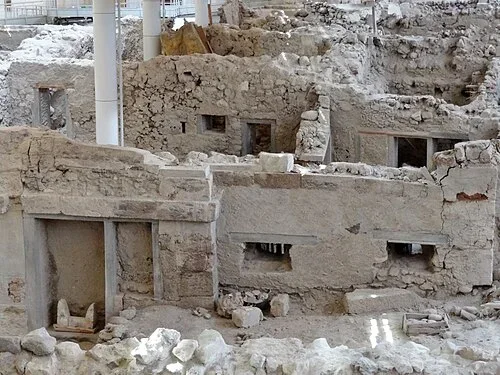 Complex Delta and the Spring Fresco Chamber
Excavated Rooms with Doorways and Windows
Sector Delta is a group of rooms, and the excavators gave each room a number. Room Delta 2 is where the Spring Fresco was found. Walls like these have stone doorways and rectangular window openings. A rhyton, a pouring vessel shaped like a boar's head, came from room Delta 17.
Listen in the appOlaf Tausch · CC BY 3.0
09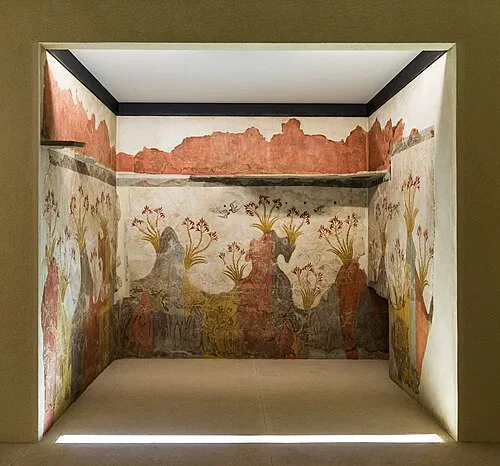 Complex Delta and the Spring Fresco Chamber
Spring Fresco (Museum Display)
The Spring Fresco was uncovered in 1970. It was the first fresco found perfectly preserved and still standing in its original position. Its wall was in poor condition, so the fresco had to be removed at once. The painted plants, with their red flowers, are now shown in the National Archaeological Museum in Athens. The rescue was a delicate job, and it gave the archaeologists and restorers invaluable experience.
Listen in the appPhoto: Jebulon · CC0
10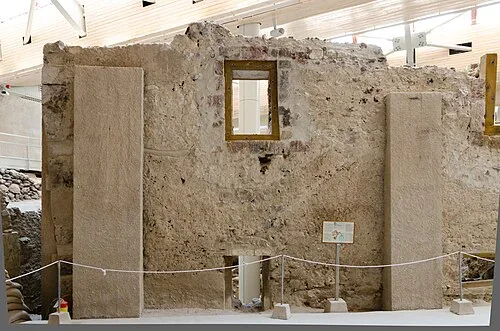 Triangle Square and the West House
House Wall with Window Opening and Standing Slabs
Some residents of Akrotiri arranged their windows so that painted walls inside could be seen from outside. This may have had a ritual purpose, and in some cases it may have been a rivalry for social standing. The opening here is a plain rectangle cut into a rough stone wall, with two tall stone slabs standing beside it. On the upper floors, walls were thinner. They were mostly wooden frames filled with clay, and some served only as rows of windows.
Listen in the appNorbert Nagel · CC BY-SA 3.0
- 11
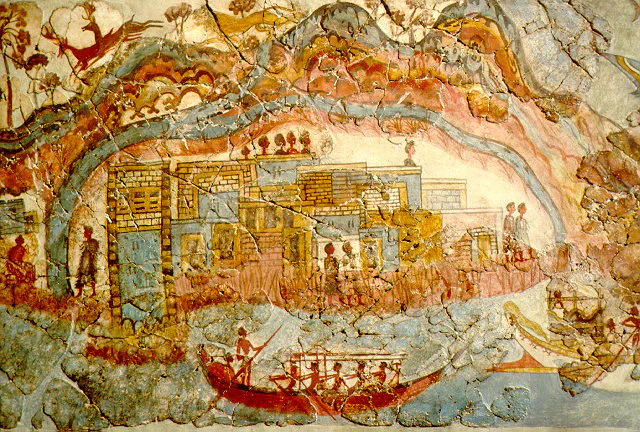
Ship Procession Frieze
A long painted line of boats, and what the maritime motifs of one house might say about its occupant.
- 12
The Fisherman Fresco
A young man with fish in both hands, from a painting found in the West House.
- 13
Pithoi Storeroom
Storage jars left in place, and the reason Akrotiri has so much surviving pottery.
- 14
Plaster Casts of Wooden Furniture
Ash-filled hollows that became plaster casts of wooden furniture, including the offering tables.
- 15
Squared Stone Wall and Doorway
A squared stone wall, and what the decorated houses suggest about the people who lived in them.
Ακρωτήρι Θήρας
Frequently asked questions
How much does the guide cost?
Free app download. Listed guide price: $1.99. Guide price shown in the app. Audio guide only. Venue admission is separate.
Can I listen without internet?
Yes. Download the guide’s audio, images, and maps in the app before your visit. Your downloaded content is then available offline.
Can I listen in my language?
This audio guide is available in 15 languages, including English.
Do I need to follow a schedule?
No. This is a self-guided experience. Choose your stops, pause whenever you like, and return to a story at your own pace.
At your own pace
Explore Ακρωτήρι Θήρας.
Download Stanza, then search for “Ακρωτήρι Θήρας”.
Free app download · Guide price shown in the app
Keep exploring
Nearby audio guides
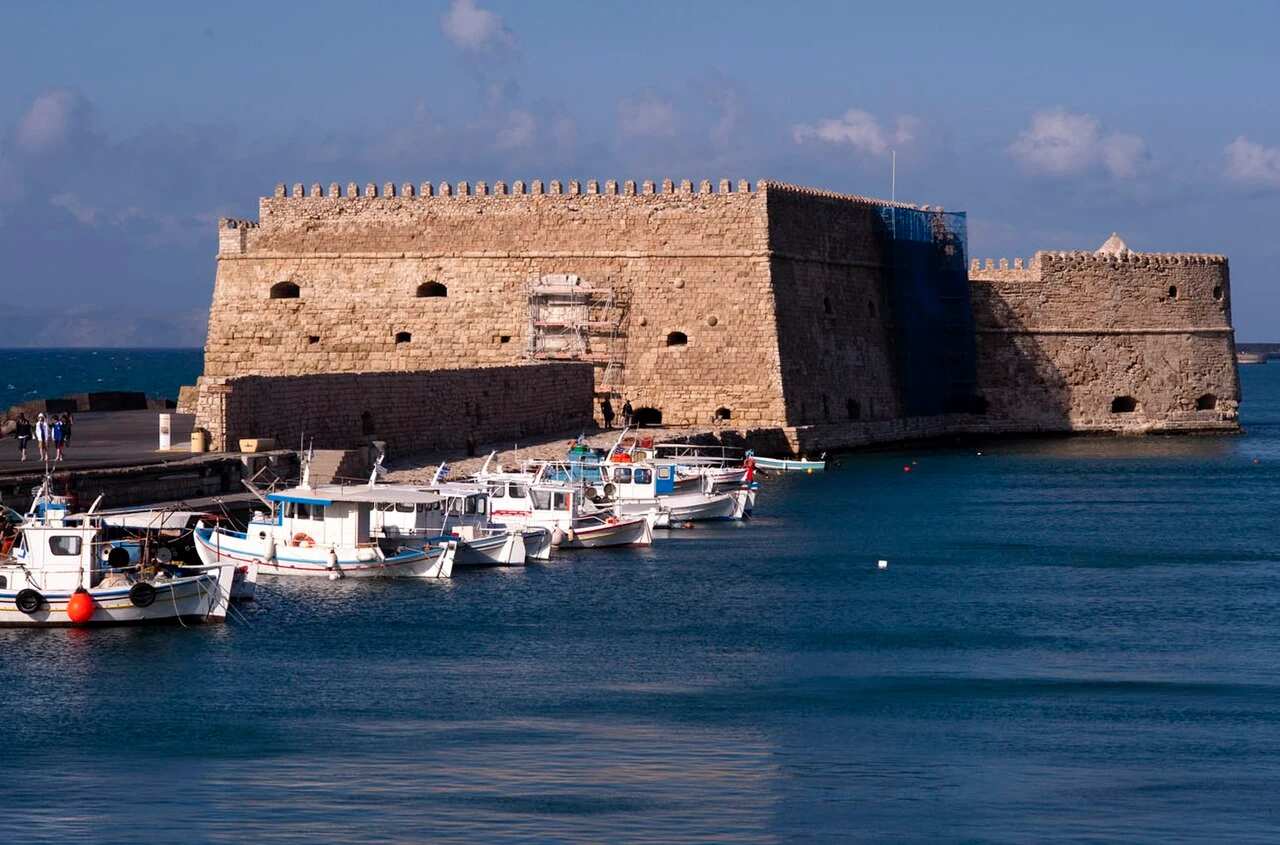
Heraklion · 115 km
Rocca a Mare
Content & sources
Γεώργιος Γιαννόπουλος · CC BY-SA 3.0
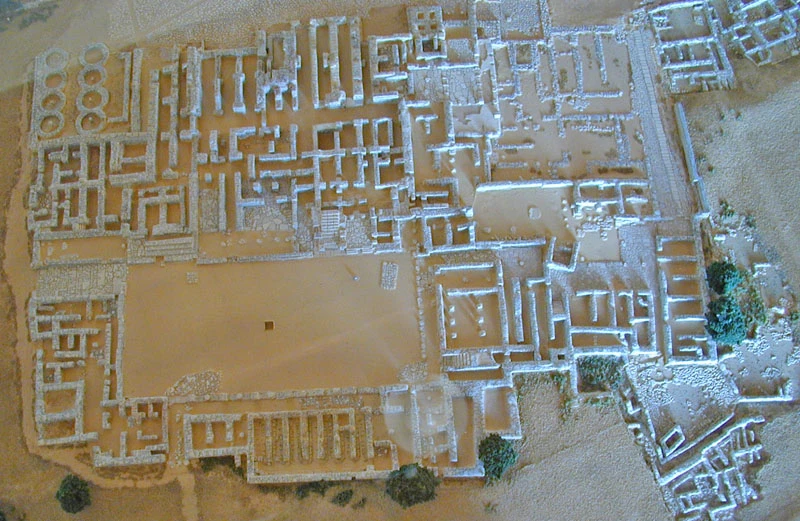
Malia · 118 km
Palace of Malia
Content & sources
No machine-readable author provided. Marsyas assumed (based on copyright claims). · CC BY 2.5
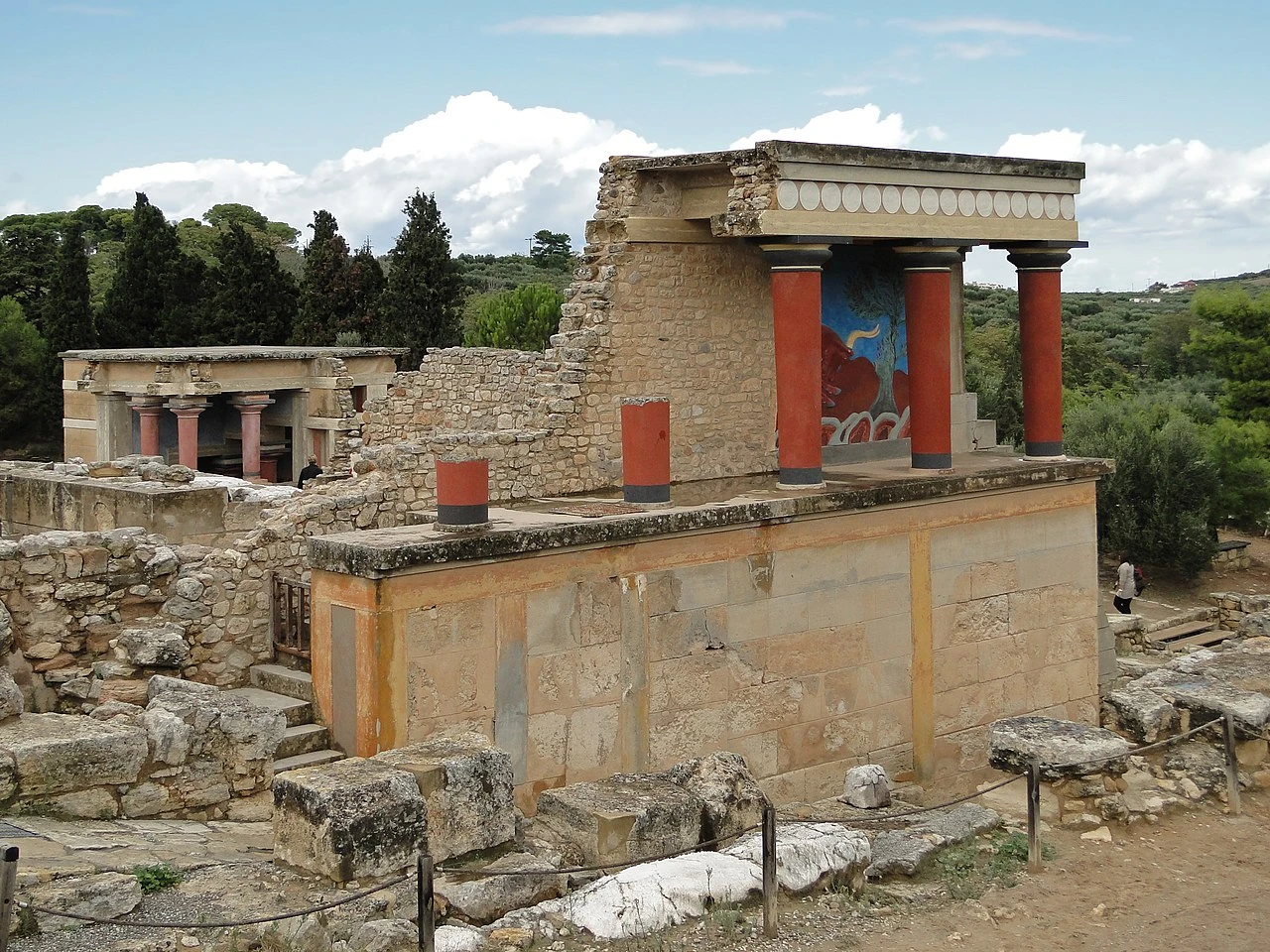
Heraklion · 119 km
Knossos
Content & sources
Bernard Gagnon · CC BY-SA 3.0
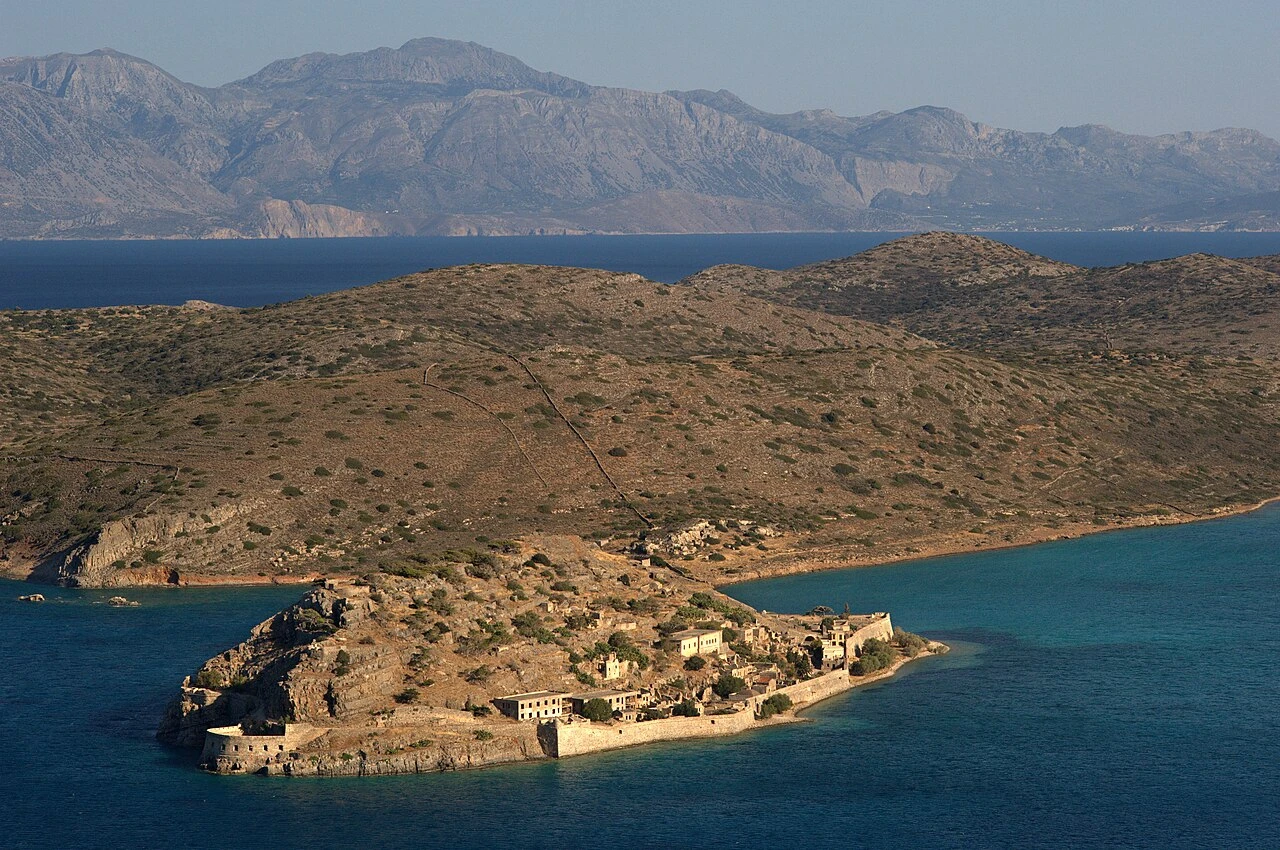
Agios Nikolaos Municipal Unit · 121 km
Spinalonga
Content & sources
Photo: Ggia · CC BY-SA 3.0