Stanza · Audio guide
Aquincum Audio Guide
A place to remember. A story to take with you.
Aquincum was an ancient city located on the northeastern borders of the Roman province of Pannonia. It is significant as the site where Marcus Aurelius is believed to have written part of his book Meditations.
Download Stanza, then search for “Aquincum”.
About the tour
One guide. Your kind of visit.
Aquincum was an ancient city located on the northeastern borders of the Roman province of Pannonia. It is significant as the site where Marcus Aurelius is believed to have written part of his book Meditations.
Ready when you are.
- 01Get the free Stanza app.
iOS & Android
- 02Find your guide.
“Aquincum”
- 03Download before you go.
Works offline
Audio guide / 39 narrated stops
Inside the guide
Get to know a few of the stories before you go. Open a stop to read more.
01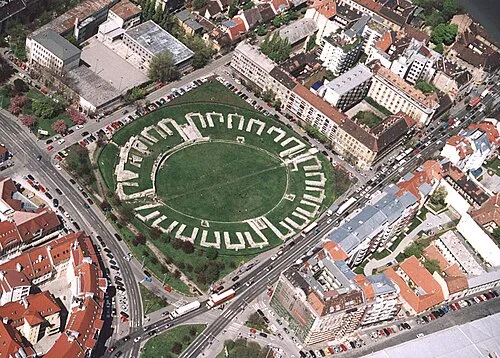 Military Amphitheatre of Aquincum
Aquincum Military Amphitheatre
The military amphitheatre of Aquincum began with a river crossing. The Danube here marked the edge of the Roman Empire, a frontier zone the Romans called the limes. Around the middle of the first century a cavalry unit of five hundred men built a fort on this spot. Then, in AD 89, a full legion arrived from Britain, the six-thousand-strong Legio II Adiutrix, welcomed by the emperor Domitian in person. That ceremony counts as the founding of Aquincum. Around the fortress grew a settlement of traders and veterans that Romans called the canabae, the military town. Its men were Roman citizens, and part of their task was spreading Roman habits like daily bathing and public games. The games needed a stage. This great oval beside the fortress, ringed by stone walls, was where the garrison and its town gathered.
Unknown author · CC BY-SA 2.5
02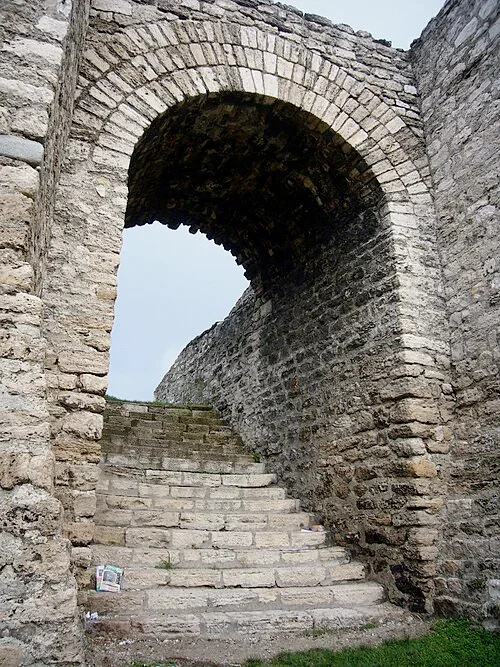 Military Amphitheatre of Aquincum
Amphitheatre Arch and Stairway
Gladiatorial combats and beast fights filled the two amphitheatres of Aquincum, both built in the first century. This vaulted passage and stairway are original masonry, the working fabric of a building that moved crowds up to their seats. Its proudest day came in 214. The emperor Caracalla reformed the province of Pannonia, dividing it into two parts of equal size, and chose Aquincum as the place to proclaim the new order. The fortress buildings were renovated for the occasion, and the governor's palace was expanded for the last time. The celebrations themselves were held in the amphitheatre, with the emperor's mother among the guests. Imperial visits always brought festivities to the frontier, but rarely one staged on this scale.
Chad K from Chicago · CC BY 2.0
03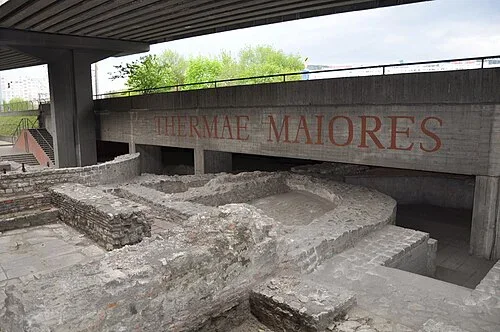 Thermae Maiores (Military Bath Museum)
Thermae Maiores - the Legionary Bath Museum
Under a modern bridge, with the words Thermae Maiores painted across the concrete, lies the great bath hall of the legionary fortress. Thermae Maiores means the Greater Baths, and the name fits the scale of the remains. Roman military builders worked in a strict order. Sewers and water channels went into the ground first, and only then did the walls rise above them. That discipline is why a fortress bath could run heated rooms and flowing water on this scale. The bath served the soldiers of the fortress, the same garrison whose arena and settlement stood nearby. The fortress's utility system has been reconstructed, so the plumbing of a legionary base can be traced here in one place.
Listen in the appPhoto: VinceB · CC BY-SA 3.0
04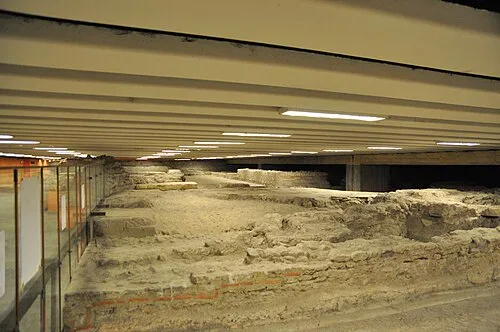 Thermae Maiores (Military Bath Museum)
Ruins Beneath the Modern City
Roman masonry survives inside the underpass at Flórián Square, framed by traffic and fluorescent light. It makes a single point better than any museum hall could. The two-thousand-year-old city did not stay inside today's fenced ruin gardens. Its remains extend across the whole Buda side and into central Pest, and the medieval streets of Óbuda and Pest alike followed the lines of the Roman walls. Post-war rebuilding and modern construction earthworks keep turning up ancient remains, so new finds surface regularly.
Listen in the appChristo · CC BY-SA 4.0
05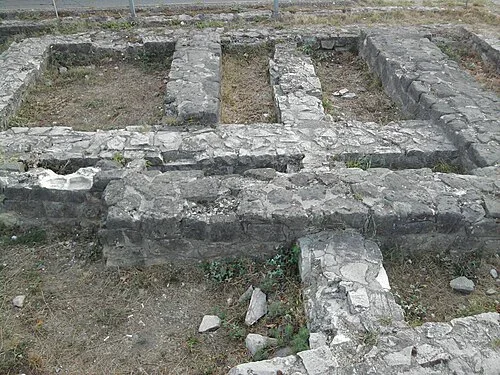 Cella Trichora (Early Christian Chapel)
Cella Trichora - Early Christian Burial Chapel
Christianity took root in Aquincum early, spreading through the city from the beginning of the third century. This burial chapel, the Cella Trichora, belongs to that community in the town's last generations; its name means a room with three lobes, and its low stone walls still trace that trefoil shape. By the mid-fourth century constant Sarmatian attacks were wearing the frontier down. The population gradually withdrew toward the safer interior of the province, and by the early fifth century the civil town stood abandoned. Some Germanic settlers moved into the empty forts and villas. Under a treaty of 433 Pannonia was handed over to the Huns. By then Aquincum could no longer be called a town at all: habitable buildings were crudely divided with clay walls, given packed-earth floors, and hearths were built into their corners.
Listen in the appB. S. O'Fren · CC BY-SA 2.5 hu
06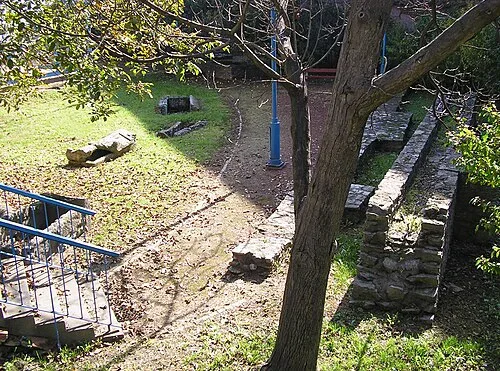 Hercules Villa
On the outskirts of the military town, close to the Danube, stood a suburban villa of unusual comfort. It takes its name from its floor mosaics, high-quality work depicting the myths of Hercules and Dionysus. The low stone walls in the park trace the ground plan of its rooms, with garden greenery where the household once walked. Villas like this show how far Mediterranean taste travelled. A provincial elite, living at the very edge of the Empire on the Danube, decorated their floors with the same mythological scenes fashionable in the heartland. Comfort and display were not reserved for the capital.
Listen in the appPhoto: Vadaro · Public domain
07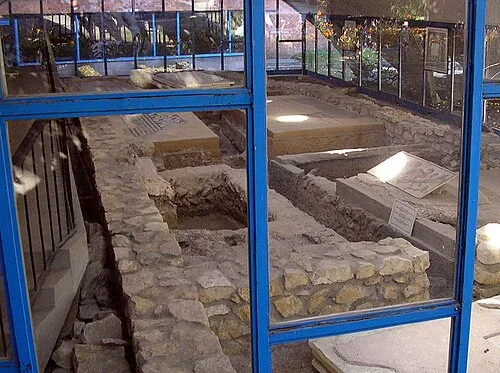 Hercules Villa
 - Mosaics Under Cover
The fragile floors and wall bases of the Hercules Villa are preserved where they were found, inside a shelter of blue-framed glass and metal. Conservators call this keeping remains in situ, in their original place, and it is the gentlest treatment an exposed urban ruin can get. Through the glazing, the excavated rooms lie open to view, with the mosaic floors and low wall bases marked out and labelled. Weather, frost and footsteps destroy bare ruins quickly, so protective covers like this one are what allow delicate plaster and pavement to last in the open air. The famous mythological floors that gave the villa its name lie within these protected rooms.
Listen in the appPhoto: Vadaro · Public domain
08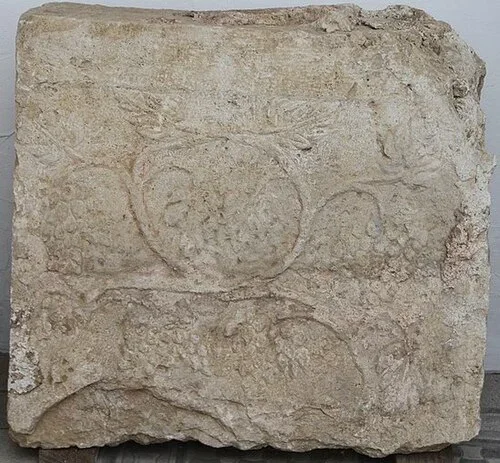 Aquincum Archaeological Park (Civil Town)
Tombstone with Grape Harvest Relief
A vine harvest is carved into this tombstone: heavy grape clusters, leaves, a basket held up for the picking. It is a fitting emblem for this spot, because the slopes above the Danube were vineyard country both in Roman times and in the centuries after. For a long while, the grand stone ruins here fed a legend. Medieval chroniclers took them for Sicambria, a mythical city of the Huns. The chronicler Anonymus wrote that the conquering Hungarians entered the city of King Attila and marvelled beyond measure at all the stone buildings, some ruined to the foundations, some not. The truth came to light in 1778, when a Swabian vine-grower of Óbuda, digging in his vineyard, struck the remains of Roman underfloor heating. The scholar István Schönvisner identified the find as the ancient Aquincum, and with that identification the written history of Roman Budapest begins.
Listen in the appPhoto: Mutialulu · CC0
09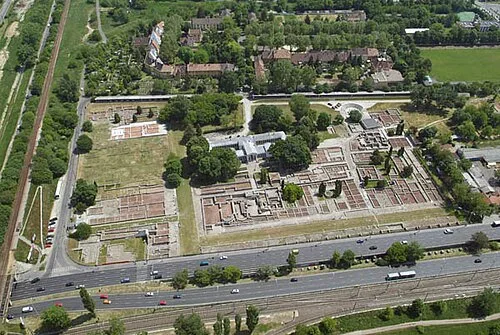 Aquincum Archaeological Park (Civil Town)
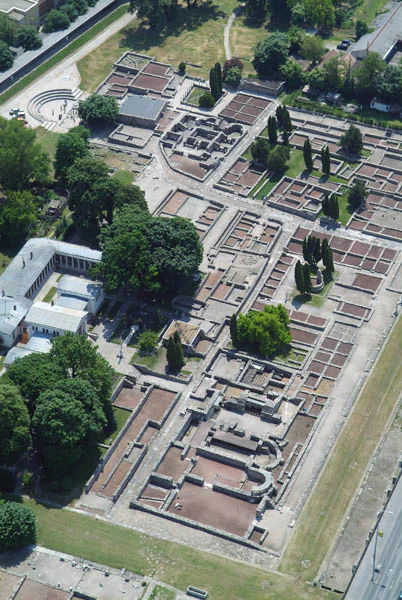
The Civil Town from the Air
The Eravisci, a Celtic tribe, lived here first. Rome turned the site into a frontier base, and after the province of Pannonia was reorganised in AD 103, Aquincum became the capital of the province of Pannonia Inferior. Under Hadrian the city gained municipal status, and under Septimius Severus it rose further, to colonia, the highest rank a provincial city could hold. By the end of the second century some thirty thousand people lived here, and the city was the heart of commercial life in Pannonia. The aerial view shows the self-governing civil town, its streets laid out in a tidy grid around the forum, the baths and the market. To the south, a second settlement, the canabae, grew up around the legionary fortress. Two cities in one, each with its own amphitheatre and its own baths, side by side on the frontier.
Listen in the appPhoto: Civertan · CC BY 3.0
10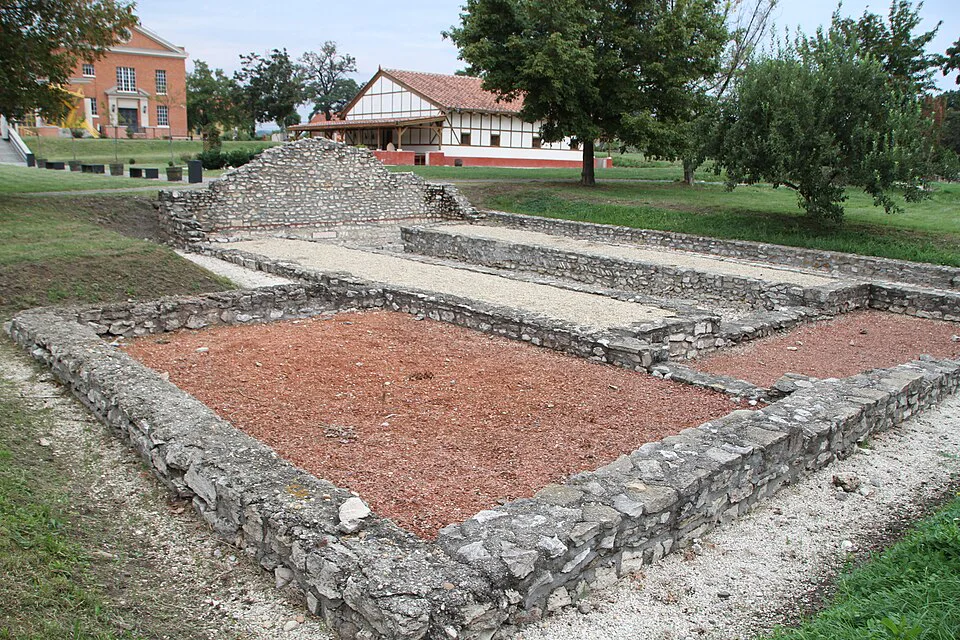 Mithraeum of Symphorus and Marcus
Aquincum had more than one sanctuary of Mithras, and this small one in the civil town is linked to two dedicatees, Symphorus and Marcus. Its low walls and gravelled rooms sit quietly among the trees, a modest building for a modest congregation. Small private sanctuaries like this suited the way the town grew. Merchants and craftsmen often moved to Aquincum from other provinces, set up branch businesses there, and banded together in associations, like the Collegium Agrippinensium, a club of Rhine-based traders. A group of colleagues could fund a sanctuary of their own, meet behind closed doors, and worship apart from the official temples of the forum. Several such congregations evidently coexisted in the same town.
Listen in the appPhoto: Bjoertvedt · CC BY-SA 4.0
- 11
Aquincum Aqueduct
The stone arcade that carried spring water downhill to the baths and fountains of the civil town.
- 12
The Reconstructed Painter's House
A full Roman town house rebuilt on its original plot, timber and plaster, from the ground up.
- 13
Painted Room of the Painter's House
Red panels and painted candelabra: how polished a modest provincial house could look inside.
- 14
Dining Room (Triclinium)
How Romans actually ate: reclining on couches around low tables, in a room rebuilt to show it.
- 15
Bedroom (Cubiculum)
A small sleeping room, a wooden bed, and a fire you could carry.
- 16
Kitchen of the Painter's House
Where the household's food was cooked: a live hearth, stacked pots and hanging herbs.
- 17
House Shrine (Lararium)
A little temple in the house, where the family honoured its protecting gods.
- 18
Mosaic Floor of the Private Bath
The mosaic floor of a private bath suite, proof that a rich family could bathe at home in style.
- 19
Hypocaust - Underfloor Heating
Rows of small brick pillars that once carried a warm floor above a hidden furnace.
- 20
Door Frame from the Fourth Civilian Bath
A carved doorway from yet another bathhouse, counted as the fourth in the civil town.
- 21
Aquincum Museum
How scattered finds became Hungary's largest excavation, and the museum raised among the ruins.
- 22
Museum Entrance Hall
The hall where the ancient city's sculpture and carved stones are gathered under one roof.
- 23
The Aquincum Water Organ
The famous water organ of 228, rebuilt and still able to sound.
- 24
Hall of the Governor's Palace
Emperors at the frontier capital, and Marcus Aurelius writing his Meditations here.
- 25
Roman Jewellery from Aquincum
Gold, glass and beads from a display case, and the trade routes that filled it.
- 26
Tombstone of Centurion Titus Flavius Magnus
A cracked limestone tombstone that gives one soldier of the garrison his name back.
- 27
Mithraeum of Victorinus
A small, intimate sanctuary of the mystery god Mithras, with altars set up by a man named Victorinus.
- 28
Birth of Mithras Relief
A carved youth pushing himself out of solid rock: the image that defines the god Mithras.
- 29
Millstone from the Craftsmen's Quarter
A heavy rotary millstone from the yards where Aquincum's artisans lived and worked.
- 30
Row of Shops (Tabernae)
Small shop units opening straight onto the main street, where commerce met the pavement.
- 31
Macellum - the Market Hall
The macellum, the civil town's formal market building, arranged around a round central pavilion.
- 32
Meat Market Pavilion
The curved wall of the market pavilion, traditionally identified as the meat market.
- 33
Statue of Fortuna Nemesis
A draped statue of the goddess of fortune, with her rudder and wheel, from the world of official civic religion.
- 34
Great Public Baths of the Civil Town
The Great Public Baths, where the citizens of the civil town shared hot, warm and cold rooms as a daily routine.
- 35
Civil Basilica (Law Court)
The basilica, the public hall where trials were held and deals were struck, on a corner of the Forum.
- 36
The Forum and Large Sanctuary
The Forum and its monumental sanctuary, the political and religious heart of the civil town on the Danube.
- 37
Stone Sewer Cover
A stone drain cover set in the ancient paving, the visible end of the sewers beneath the streets.
- 38
Aquincum Civil Amphitheatre
The civil town's own amphitheatre, built of earth and stone just outside its northern wall.
- 39
Inside the Civil Amphitheatre
From ground level, the quiet grassy bowl of the citizens' arena, its shape preserved in the earthworks.
Aquincum
Frequently asked questions
How much does the guide cost?
Free app download. Listed guide price: $3.99. Guide price shown in the app. Audio guide only. Venue admission is separate.
Can I listen without internet?
Yes. Download the guide’s audio, images, and maps in the app before your visit. Your downloaded content is then available offline.
Can I listen in my language?
This audio guide is available in 15 languages, including English.
Do I need to follow a schedule?
No. This is a self-guided experience. Choose your stops, pause whenever you like, and return to a story at your own pace.
At your own pace
Explore Aquincum.
Download Stanza, then search for “Aquincum”.
Free app download · Guide price shown in the app
Keep exploring
Nearby audio guides
Budapest · 6 km
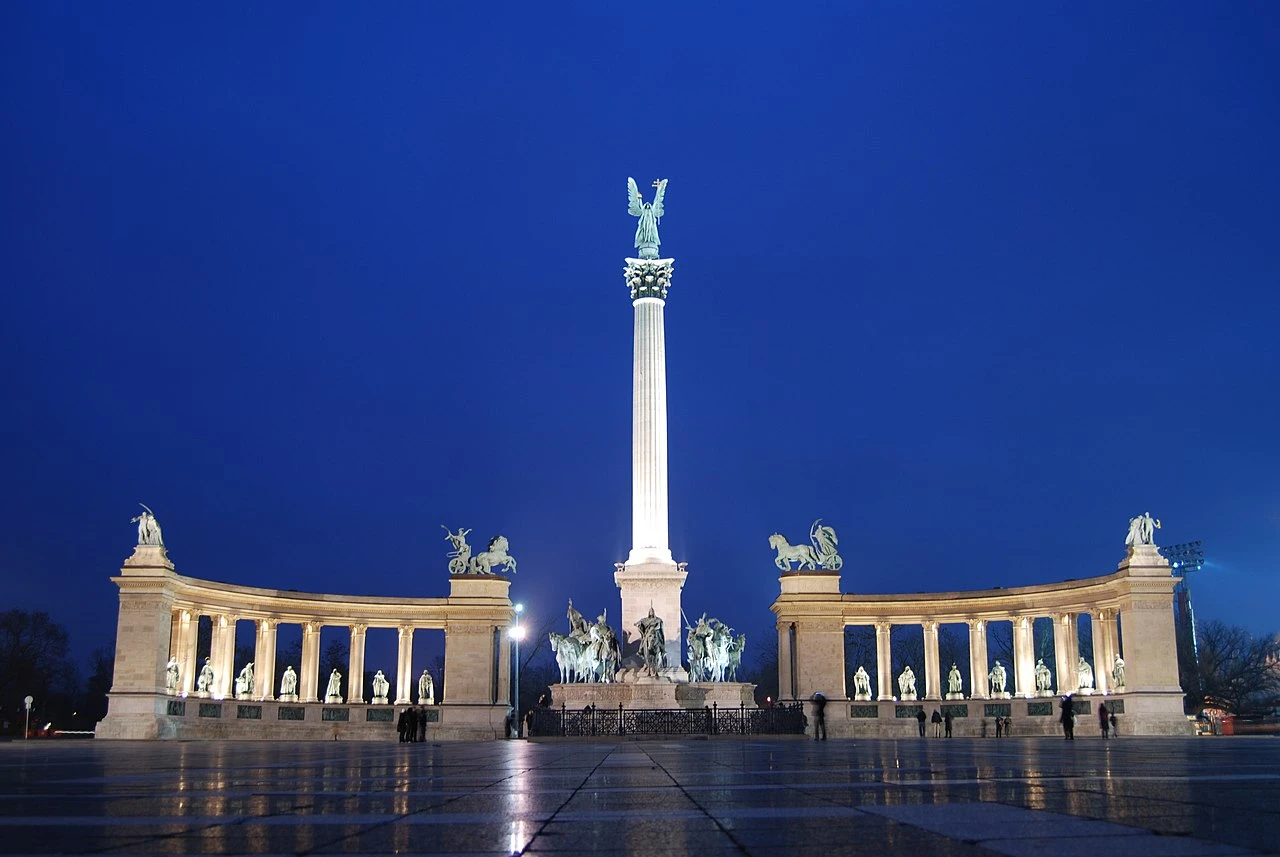
Millennium Monument
Content & sources
Paul Mannix · CC BY 2.0
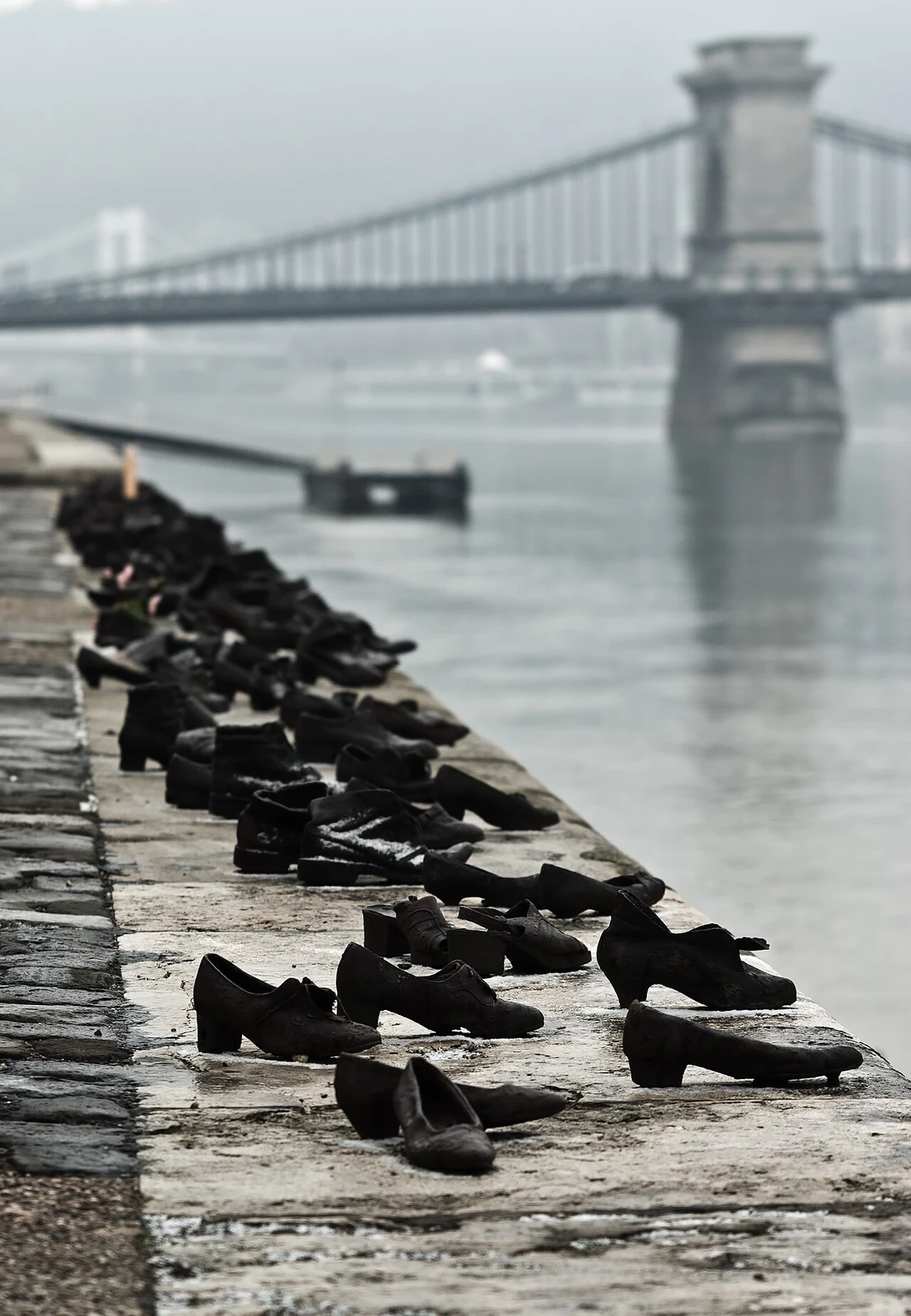
Budapest · 7 km
Shoes on the Danube Bank
Content & sources
Photo: Nikodem Nijaki · CC BY-SA 3.0
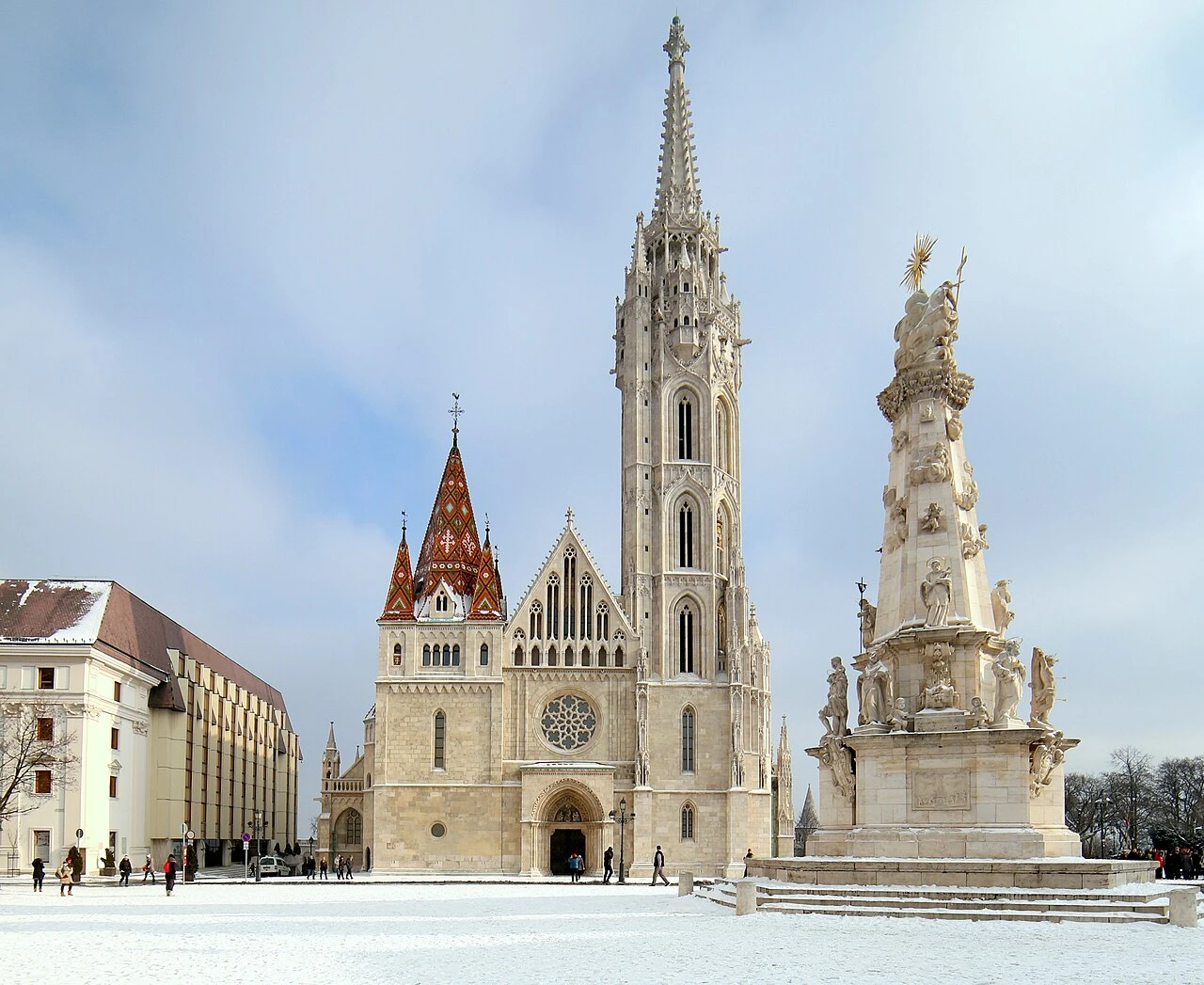
Budapest · 7 km
Matthias Church
Content & sources
Photo: Thaler Tamas · CC BY-SA 4.0
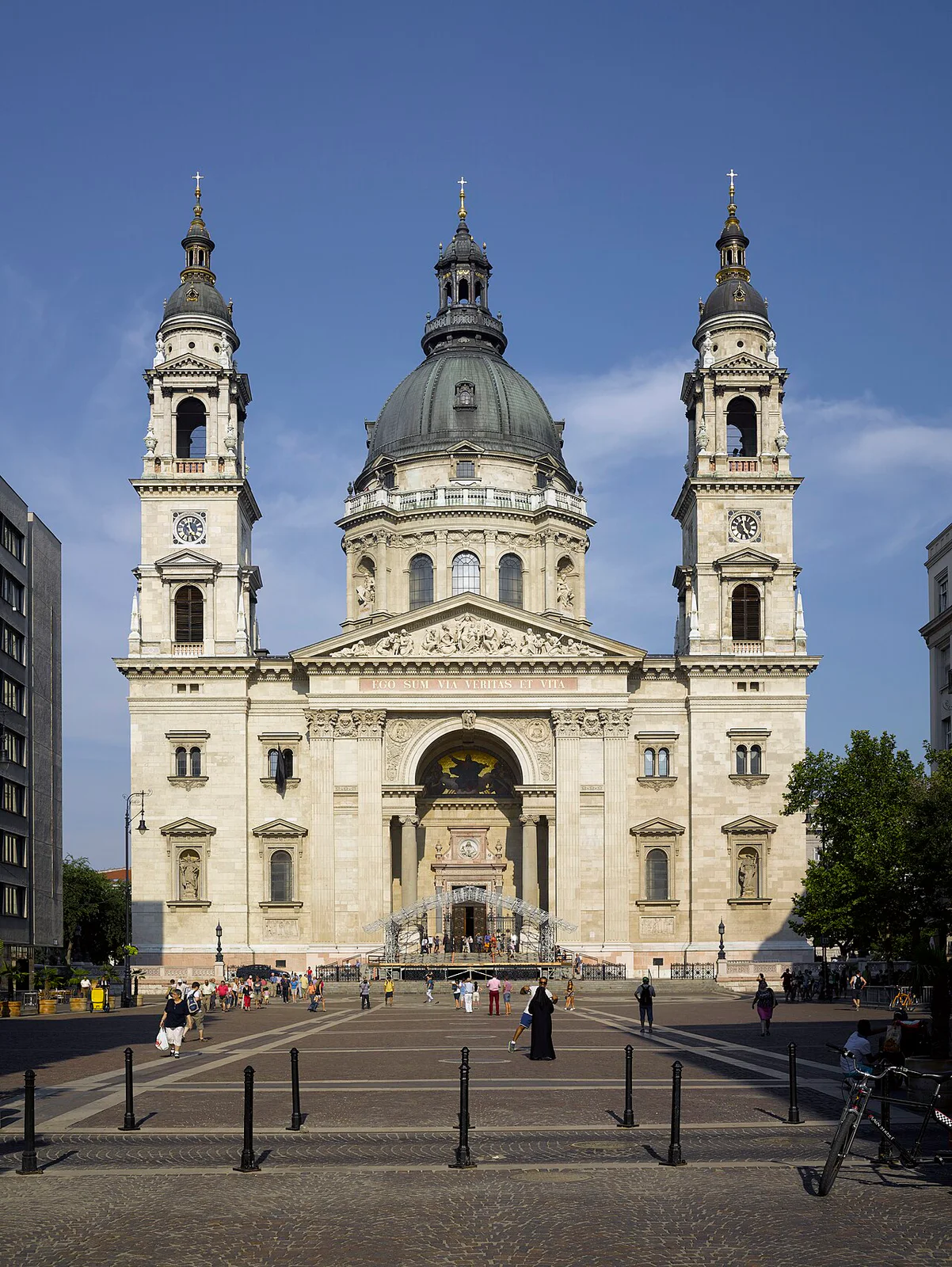
Budapest · 7 km
St. Stephen's Basilica
Content & sources
Photo: Godot13 · Attribution