Stanza · Audio guide
Kapaleeshwarar Temple Audio Guide
A place to remember. A story to take with you.
The Kapaleeshwarar Temple is a Hindu temple dedicated to the god Shiva. Built around the 17th century A.D., it is an example of South Indian architecture.
Download Stanza, then search for “Kapaleeshwarar Temple”.
About the tour
One guide. Your kind of visit.
The Kapaleeshwarar Temple is a Hindu temple dedicated to the god Shiva. Built around the 17th century A.D., it is an example of South Indian architecture.
Ready when you are.
- 01Get the free Stanza app.
iOS & Android
- 02Find your guide.
“Kapaleeshwarar Temple”
- 03Download before you go.
Works offline
Audio guide / 11 narrated stops
Inside the guide
Get to know a few of the stories before you go. Open a stop to read more.
01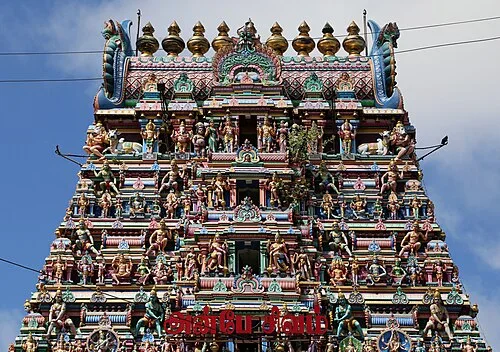 Eastern Gopuram Gateway
The Eastern Gopuram
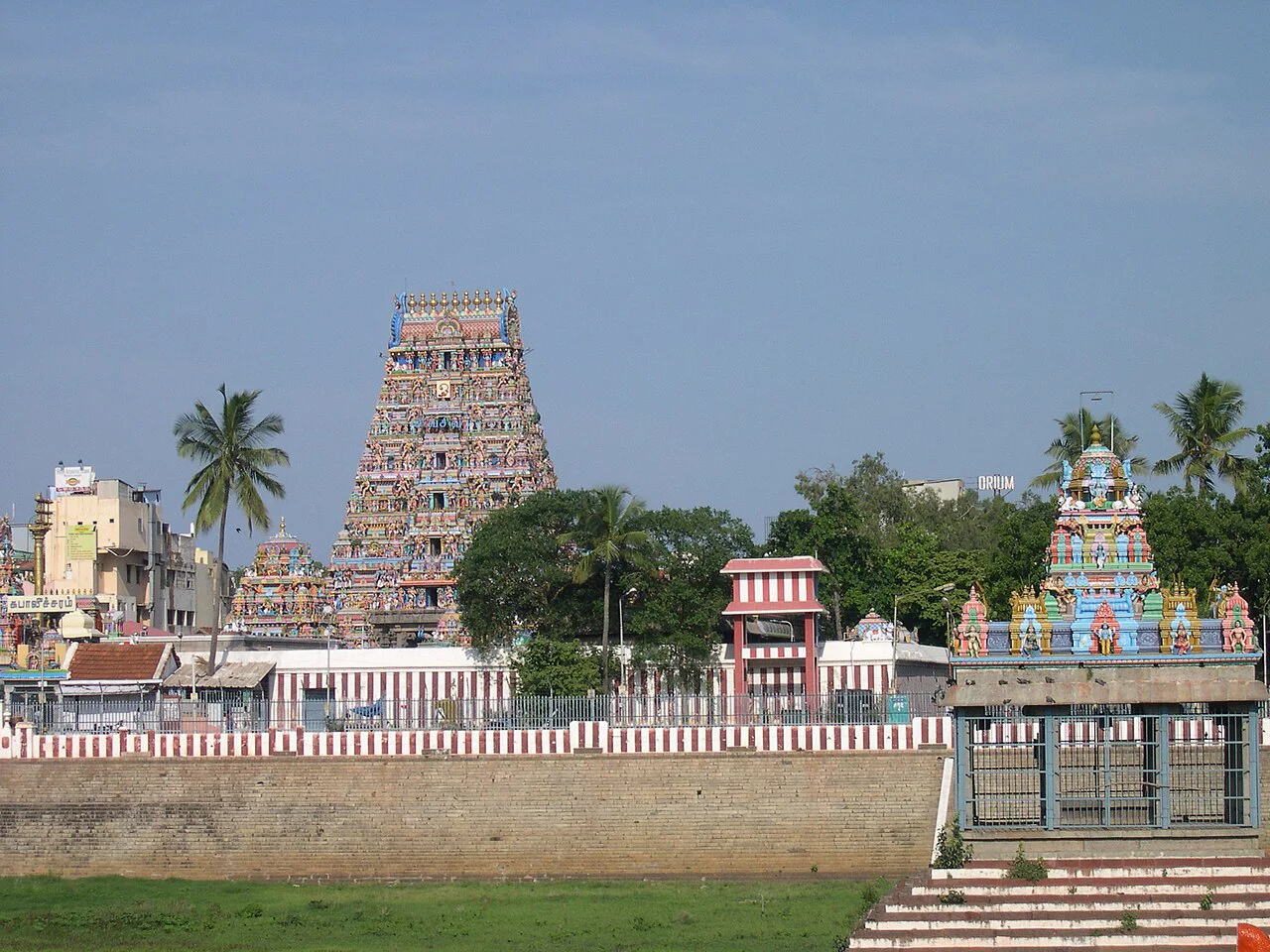
Welcome to the Kapaleeshwarar Temple, a temple of Shiva in Mylapore, Chennai, praised by Tamil poets since the seventh century. Over the next stops we'll move from this gateway through the courtyard shrines, out to the festival chariot and the temple tank. The eastern gopuram is the temple's signature. It is a Dravidian gateway tower, built to overpower the street it stands on. It rises about forty metres. That is roughly a hundred and thirty feet of tiers crowded with figures modelled in painted stucco, gods and guardians stacked one above the other. Shiva is worshipped here as Kapaleeshwarar. His sanctum comes a few stops later.
Photo: Sailko · CC BY 3.0
02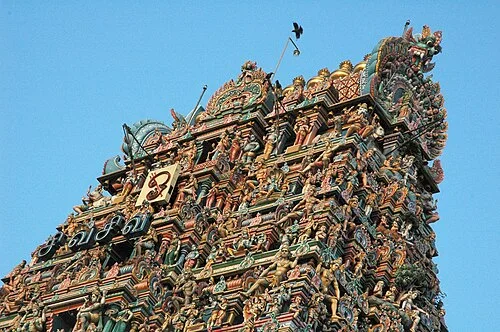 Eastern Gopuram Gateway
Gopuram Detail: Stucco Figures and a Temple That Moved
The figures crowding the tower's upper tiers are stucco, sculpted plaster shaped and painted by hand. The temple is a showcase for the sthapathis, the hereditary craftsman families of the Viswakarma tradition who build the temples of Tamil Nadu. The tower itself is younger than it looks. The original Kapaleeshwarar temple is thought to have stood by the seashore in the seventh century, under the Pallava kings. That view rests on the hymns of the Nayanar saints. Sambandar describes the temple by the sea, and so does Arunagirinathar, a poet of a much later age. Inside the present temple, inscriptions reach back to the twelfth century. Then, in the seventeenth century, the temple was relocated inland and rebuilt. The gopuram, raised in 1906, belongs to that later chapter.
Jpatokal · CC BY-SA 4.0
03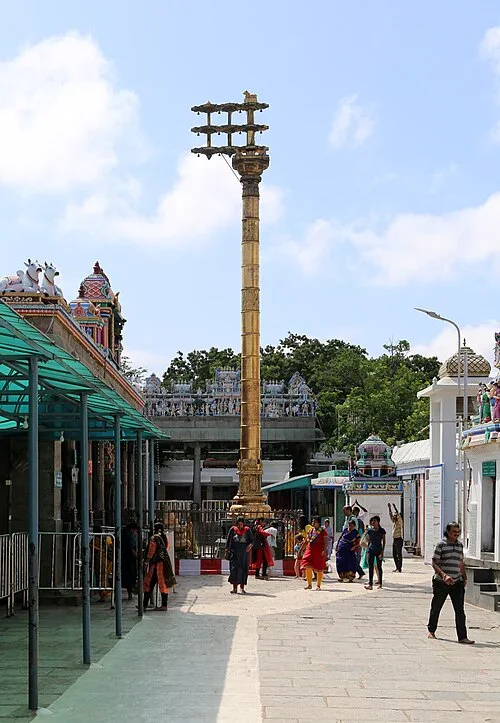 Main Courtyard & Dwajasthambam
The Courtyard and Dwajasthambam: A Temple of Daily Worship
Inside the courtyard rises a tall brass-plated pole, the dwajasthambam, the temple's flagpole. It marks a temple that lives by a fixed rhythm of worship. Priests perform the puja six times a day, from early morning until late at night. Each service follows four steps: a sacred bath for the deity, decoration with clothes and jewels, a food offering, and the waving of lamps. Every ritual is performed for both Kapaleeshwarar and his consort Karpagambal. The worship is set to music, the long nadasvaram pipe and the tavil drum, while priests read from the Vedas and worshippers prostrate before the temple mast. The flagpole has a festival role too. The annual celebration opens here with dhvajarohanam, the hoisting of the flag, and the festival itself gets its own stop later.
Listen in the appPhoto: Sailko · CC BY 3.0
04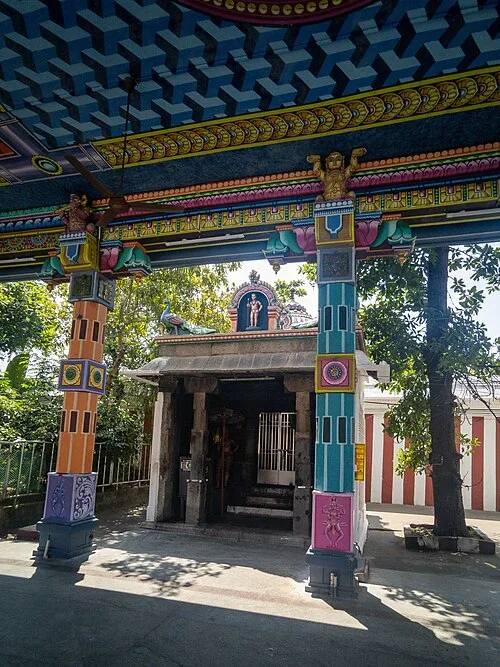 Kapaleeshwarar Main Sanctum
Kapaleeshwarar Sanctum: Lord of the Skull
The name Kapaleeshwarar is built from two words: kapala, a head, and Ishvara, a name of Shiva. It makes him the Lord of the Skull, and the story behind it is one of the temple's founding legends. According to the Puranas, the god Brahma and Shiva met on top of Mount Kailash. Brahma failed to show Shiva the respect due to him. So Shiva plucked off one of Brahma's five heads. In penance, Brahma came down to the site of Mylapore and installed a lingam to please Shiva. That lingam is how Shiva is represented in the sanctum here, the stone form at the heart of the temple's worship.
Listen in the appPhoto: Rainer Halama · CC BY-SA 4.0
05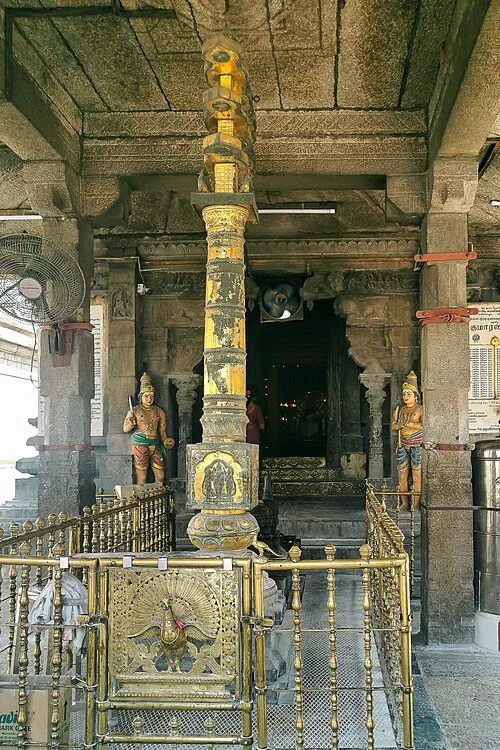 Karpagambal Shrine & Sacred Punnai Tree
Karpagambal Shrine: The Goddess and the Peahen
Parvati, Shiva's consort, is worshipped here as Karpagambal, the goddess of the wish-yielding tree. Her legend is the one that names the whole neighbourhood. According to the Puranas, a curse turned Parvati into a peahen. She did penance at this spot, worshipping Shiva until she regained her own form. A peahen is mayil in Tamil, and the area around the temple took its name from her: Mylai, Mylapore. The tradition is kept visibly alive, with a peacock and a peahen kept caged inside the temple. On Fridays the goddess is honoured in a special way, dressed in a kasu mala, a garland strung not with flowers but with gold coins.
Listen in the appPhoto: Rainer Halama · CC BY-SA 4.0
06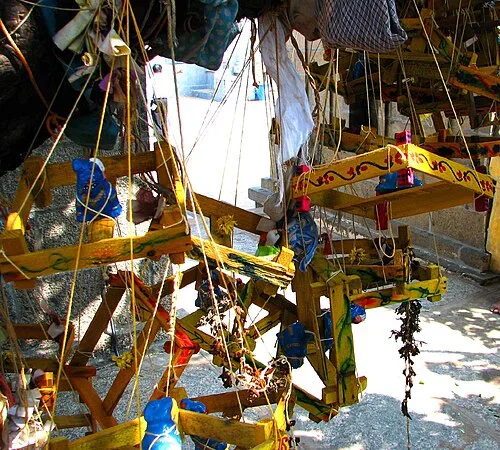 Karpagambal Shrine & Sacred Punnai Tree
Cradle Offerings Under the Tree
Hung from the temple's trees are small wooden cradles, painted blue and yellow and strung up on cords. They are votive offerings, left by families as personal prayers. At shrines of the goddess, such cradles are traditionally offered in hope of children, a plea for a family of one's own. Each one stays hanging among the others, a small crowd of wishes in painted wood.
Listen in the appmichael clarke stuff · CC BY-SA 2.0
07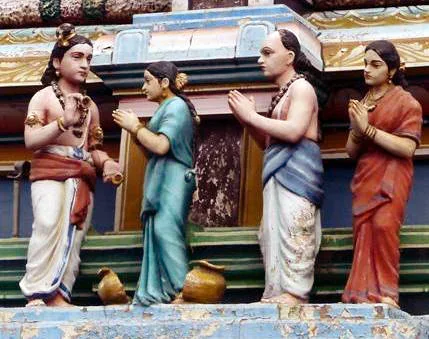 Shrine of Saint Sambanthar & Poompavai Miracle
Sambanthar and Poompavai
This stucco group shows a young woman standing before a revered figure: the saint Thirugnana Sambanthar and Poompavai. The story goes that Poompavai was the daughter of Sivanesa Chettiar, a merchant of Mylapore. She died of a snake bite, and her father kept her ashes. Sambanthar, a seventh-century Nayanar saint, sang the Poompavai Pathigam, his set of hymns for this shrine, and Poompavai was restored to life. The temple keeps a shrine for Sambanthar alongside Poompavai to this day. His hymns in praise of this temple belong to the Tevaram, the seventh-century Tamil Shaiva canon. That is what makes Kapaleeshwarar a Paadal Petra Sthalam, one of the sacred shrines the Nayanar poets sang.
Listen in the appPhoto: Jagadeeswarann99 · CC BY-SA 4.0
08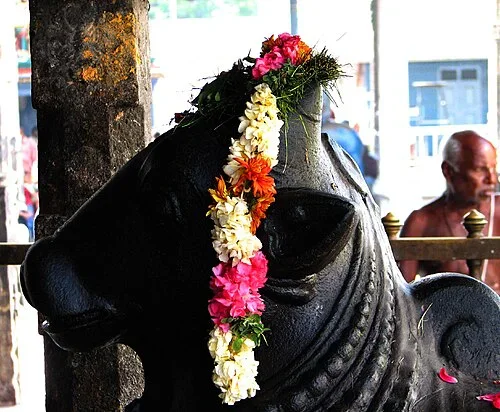 Nayanar Saints Gallery
The Garlanded Nandi
The black stone bull wears garlands of fresh flowers laid by worshippers. He is Nandi, the mount of Shiva, a fixture at Shiva temples everywhere. Here he introduces a wider tradition: the vahanas, the vehicles on which the divine couple ride in procession. The temple's list runs from the bull and the elephant to a bandicoot, a goat and a parrot. Statues of Kapaleeshwarar and Karpagambal are seated on a vahana and carried around the temple while the band plays. Devotees gather around and count it a privilege to pull or lift the deities themselves. A golden chariot is a recent addition to the fleet. The grandest vehicle of all waits at the next stop.
Listen in the appmichael clarke stuff · CC BY-SA 2.0
09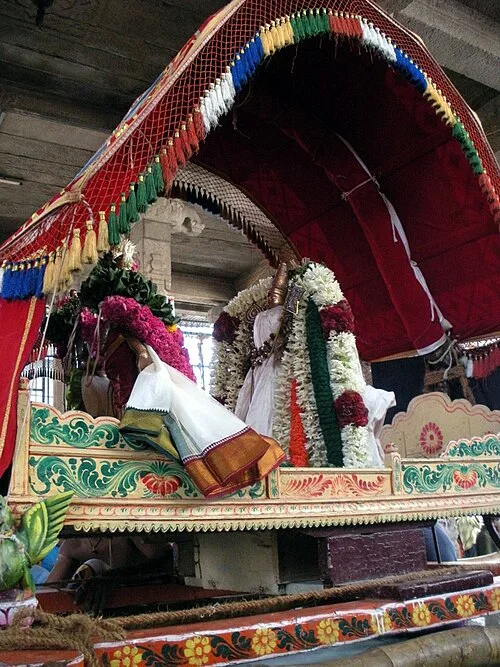 Temple Chariot Pavilion
The Temple Chariot (Ther)
The great carved structure in its pavilion is the ther, the temple's festival chariot, about thirteen metres tall. It crowns the Panguni Peruvila, the nine-day spring festival held in the Tamil month of Panguni, between mid-March and mid-April. The festival opens with the flag hoisting at the pole heard about earlier, and it builds day by day with different vahanas carrying the divine couple. On the seventh morning comes the ther. Crowds of devotees pull the chariot, decorated with flowers and statues, through the streets. On board, Kapaleeshwarar is depicted holding a bow, seated on a throne beside Karpagambal, while Brahma is depicted driving. The eighth day belongs to the Arupathimoovar festival, named for the sixty-three Nayanar saints, whose idols all follow Kapaleeshwarar's idol in procession. The nine days end with Tirukkalyanam, the marriage of Kapaleeshwarar and Karpagambal.
Listen in the appMohan Krishnan (talk) · CC BY-SA 3.0
10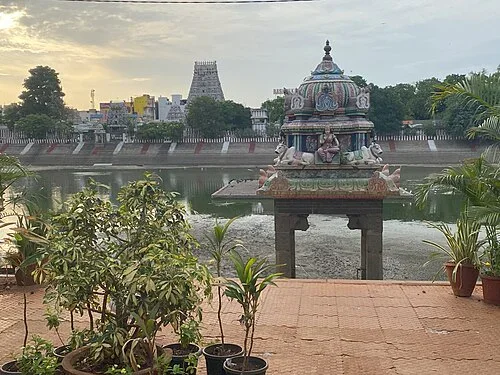 Theppakulam Temple Tank
The Theppakulam: Temple Tank and Float Festival
The broad sheet of water next to the temple is the theppakulam, the temple tank, known as the Mylapore Tank. It lies to the west, and the temple's smaller western gopuram faces straight onto it. It is counted among the oldest and best-kept temple tanks in the city, about a hundred and ninety metres long. It runs a hundred and forty-three metres across, and it holds water all through the year. At its centre stands a mandapam of sixteen pillars roofed in granite. Once a year, during a three-day float festival, idols of Kapaleeshwarar and other deities are taken around the tank on the water, to the chanting of Vedic hymns.
Listen in the appPhoto: KurinchiRays · CC BY 4.0
- 11
One of Seven: Mylapore's Sacred Circuit
Seven Shiva shrines, an indispensable eighth, and the old saying that Mylapore is Kailash.
Kapaleeshwarar Temple
Frequently asked questions
How much does the guide cost?
Free app download. Listed guide price: $0.99. Guide price shown in the app. Audio guide only. Venue admission is separate.
Can I listen without internet?
Yes. Download the guide’s audio, images, and maps in the app before your visit. Your downloaded content is then available offline.
Can I listen in my language?
This audio guide is available in 15 languages, including English.
Do I need to follow a schedule?
No. This is a self-guided experience. Choose your stops, pause whenever you like, and return to a story at your own pace.
At your own pace
Explore Kapaleeshwarar Temple.
Download Stanza, then search for “Kapaleeshwarar Temple”.
Free app download · Guide price shown in the app
Keep exploring
Audio guides — India
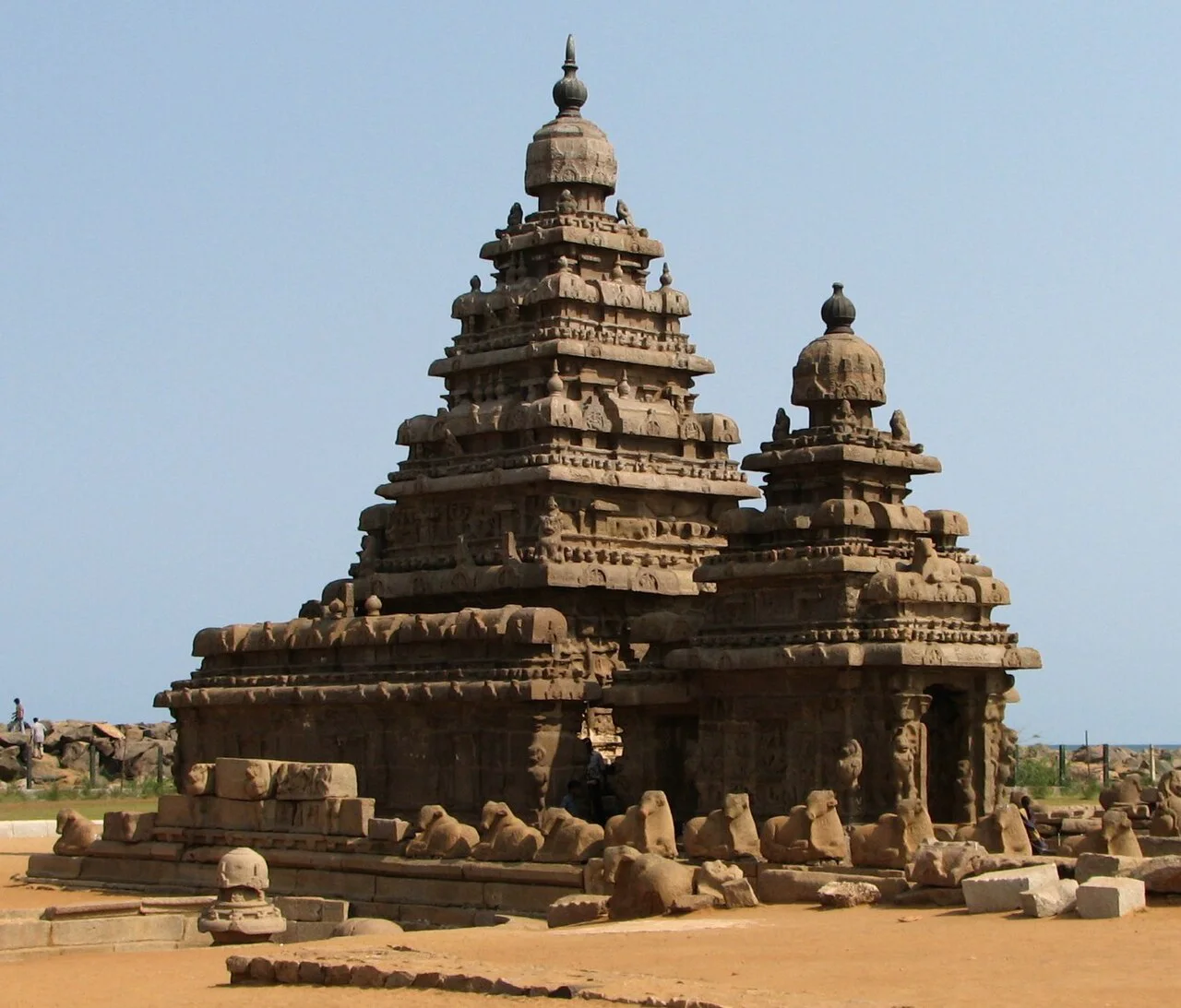
Mahabalipuram · 47 km
Shore Temple
Content & sources
mckaysavage · CC BY 2.0
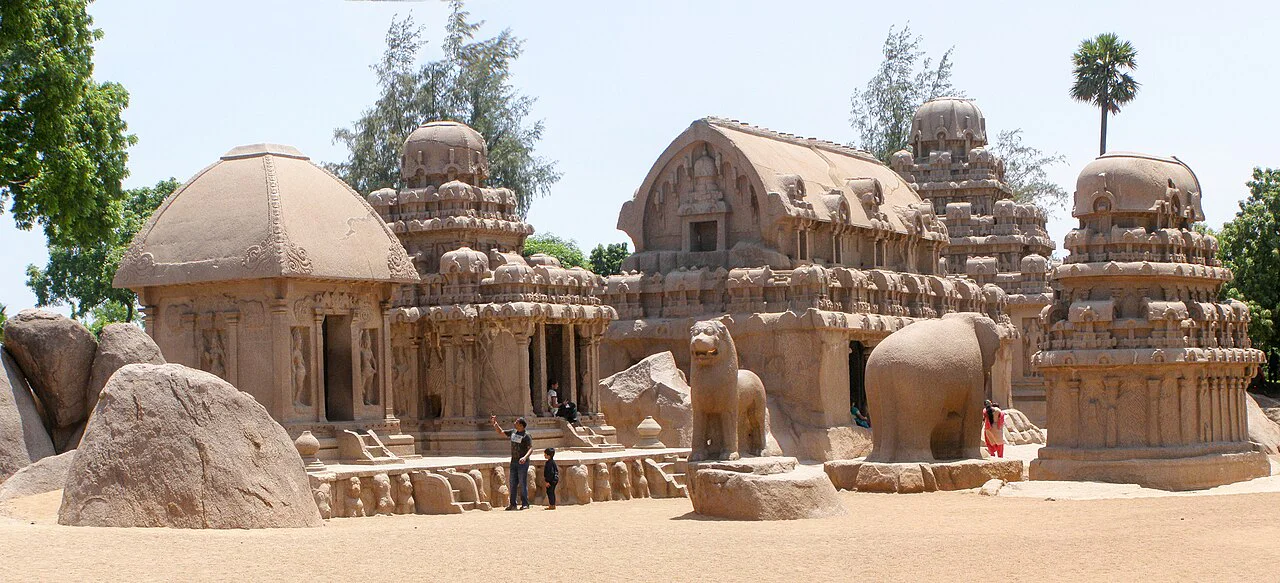
Mahabalipuram · 48 km
Pancha Rathas
Content & sources
Photo: BluesyPete · CC BY-SA 3.0
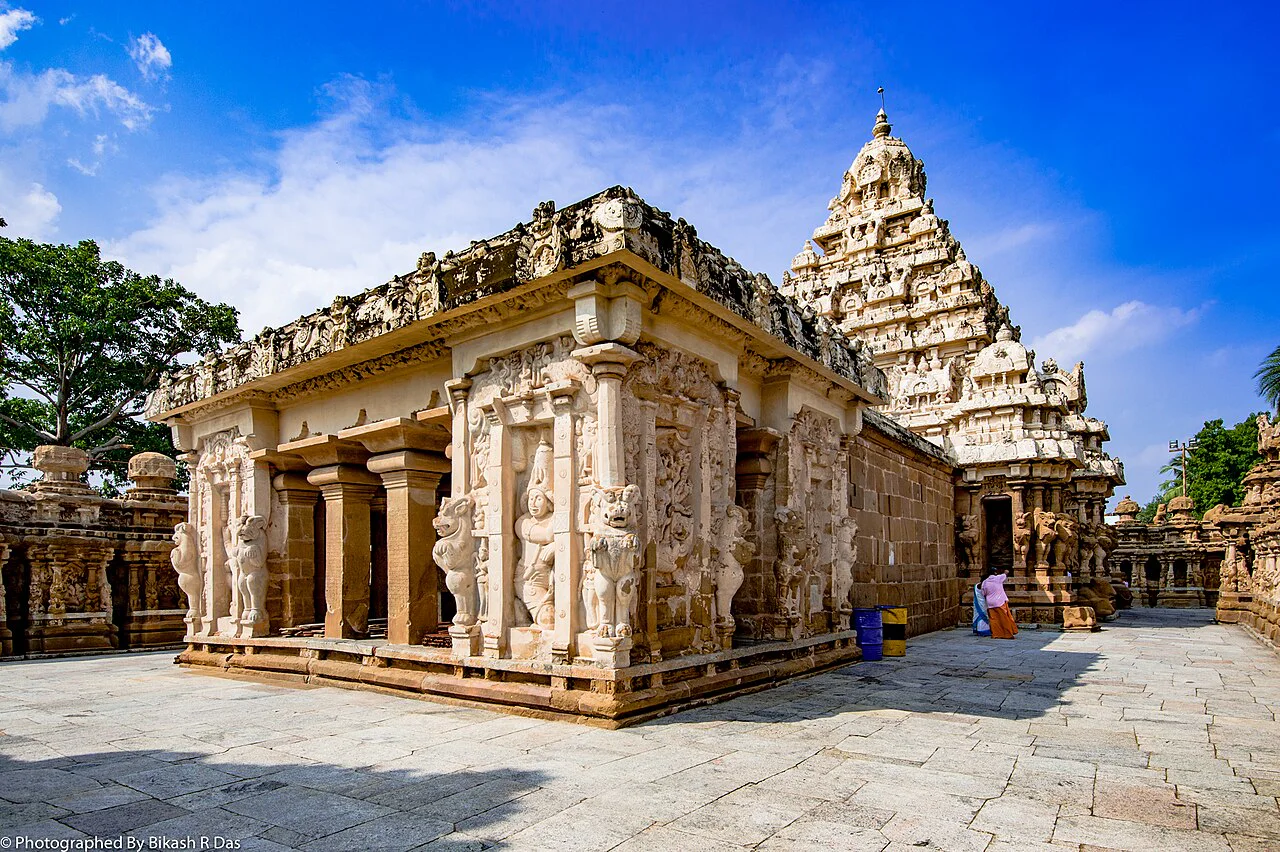
Kanchipuram · 66 km
Kailasanathar Temple, Kanchipuram
Content & sources
Bikash Das from bangalore, india · CC BY 2.0
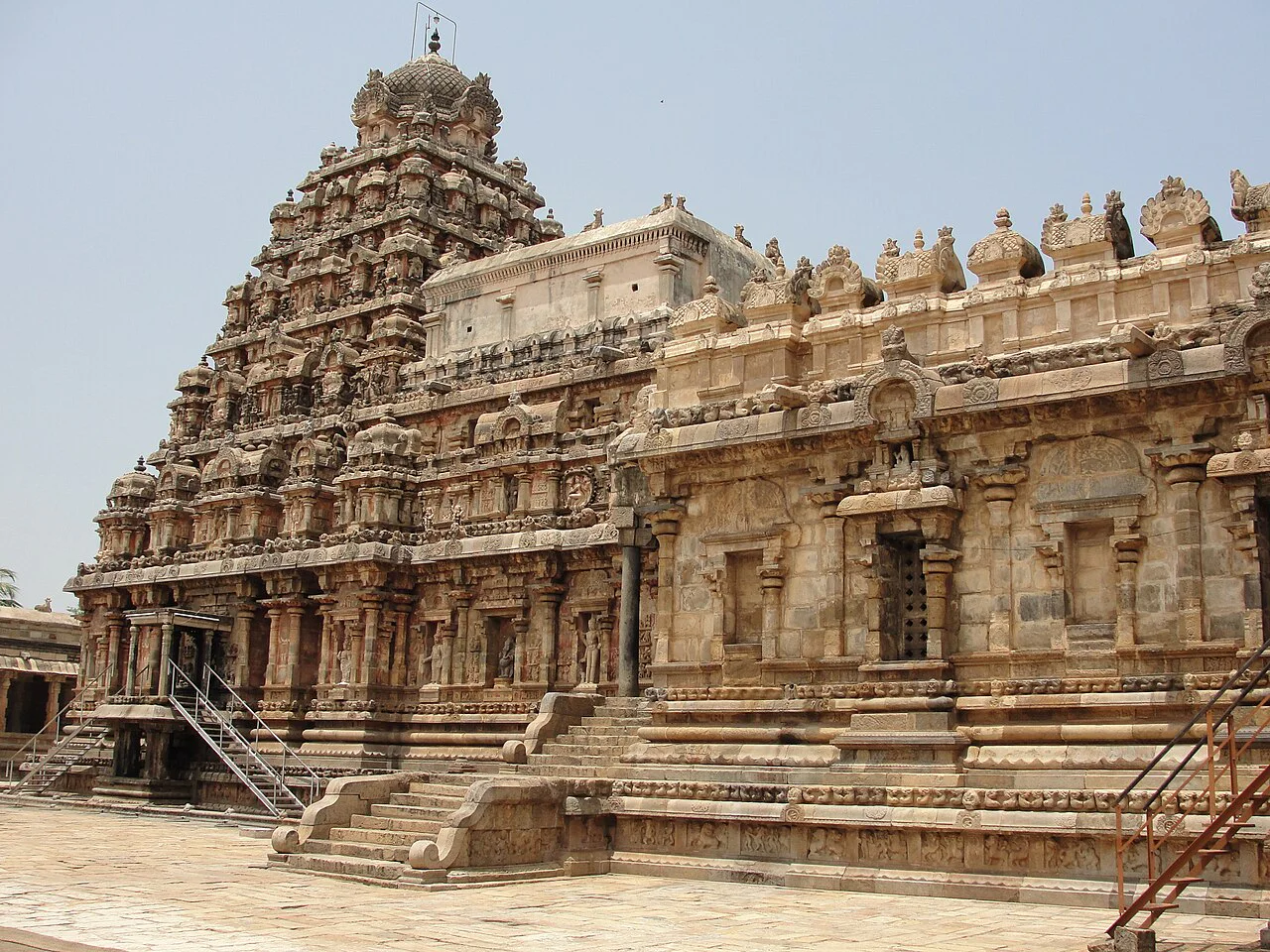
Dharasuram
Airavatesvara Temple
Content & sources
Photo: Thamizhpparithi Maari · CC BY-SA 3.0