Stanza · Audio guide
Kailasanathar Temple, Kanchipuram Audio Guide
A place to remember. A story to take with you.
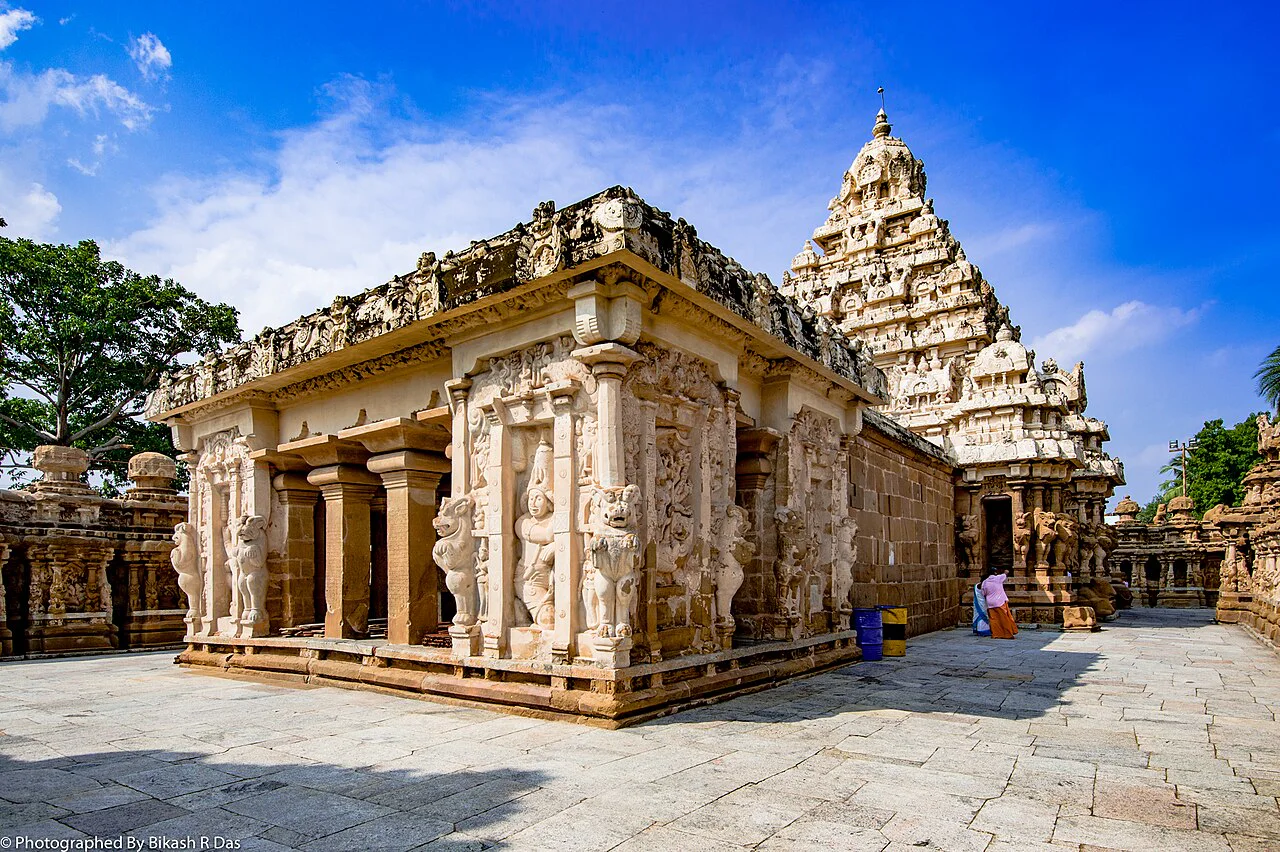
The Kailasanathar Temple is a historic Hindu temple in Kanchipuram built around 700 CE by Narasimhavarman II. It is one of the oldest surviving monuments in the city and reflects Dravidian architecture.
Download Stanza, then search for “Kailasanathar Temple, Kanchipuram”.
About the tour
One guide. Your kind of visit.
The Kailasanathar Temple is a historic Hindu temple in Kanchipuram built around 700 CE by Narasimhavarman II. It is one of the oldest surviving monuments in the city and reflects Dravidian architecture.
Ready when you are.
- 01Get the free Stanza app.
iOS & Android
- 02Find your guide.
“Kailasanathar Temple, Kanchipuram”
- 03Download before you go.
Works offline
Audio guide / 11 narrated stops
Inside the guide
Get to know a few of the stories before you go. Open a stop to read more.
01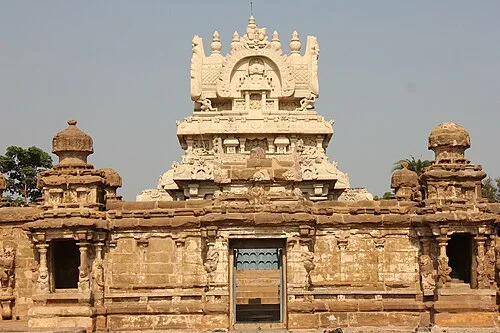 Front Gopuram and Precursor Shrines
The Gopuram and Entrance Wall
Welcome to the Kailasanathar temple, the Lord of Kailasa, in Kanchipuram. Around the year 700, a Pallava king named Narasimhavarman the Second began something new here. Temples before his time were built of wood, or carved straight into cave walls and boulders, the way you see at Mahabalipuram. This one was raised as freestanding masonry, stone upon stone, the first of its kind in South India. Its builders knew the weight problem: granite foundations carry the load, while the walls and carvings above are all sandstone. The king's son, Mahendravarman the Third, finished the front facade and the entrance tower. Eight small shrines sit built into that entrance wall, a foretaste of the many more within. Locals also tell that the temple served the royal family as a refuge in wartime. A secret escape tunnel, they say, was dug by the kings, and part of it can still be seen. Where exactly it runs, the stories do not quite agree.
Photo: Satz007 · CC BY-SA 3.0
02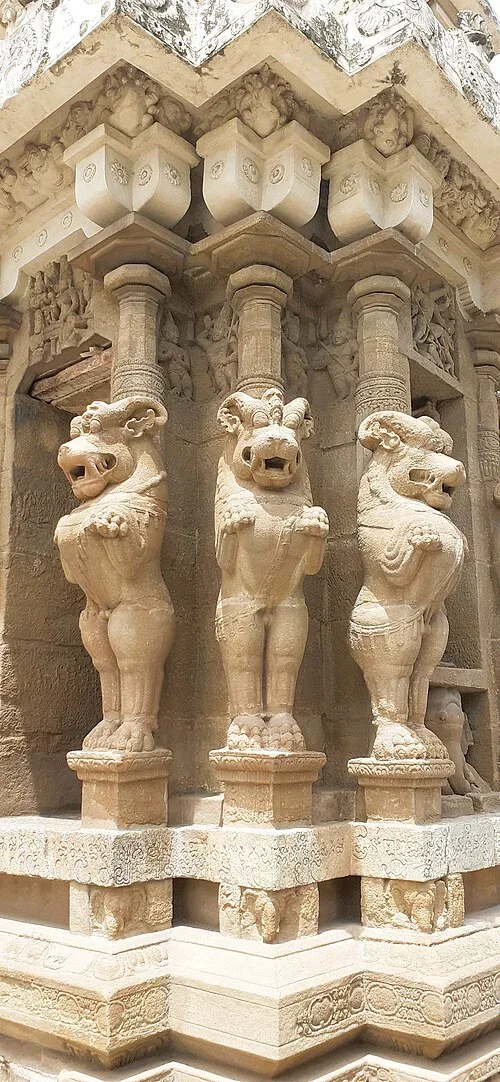 Maha-Mandapa and Pallava Lion Pillars
Lion Pillars of the Mandapa
Rearing lions hold up this hall. They are the signature of late Pallava carving, and the temple's most striking sculptural feature. Each pillar grows from a mythical lion that springs out in several directions at once, mane and jaws carved in sandstone. The builders did not plan it quite this way, though. The mandapa, the gathering hall, began life standing apart from the sanctuary behind it. Only later was a smaller hall, the ardhamantapa, slipped in between the two to join them. Some have felt that this connecting piece spoiled the composition a little. The lions, at least, were there from the start, and they repeat across the whole complex, pillar after pillar.
Photo: Ssriram mt · CC BY-SA 4.0
03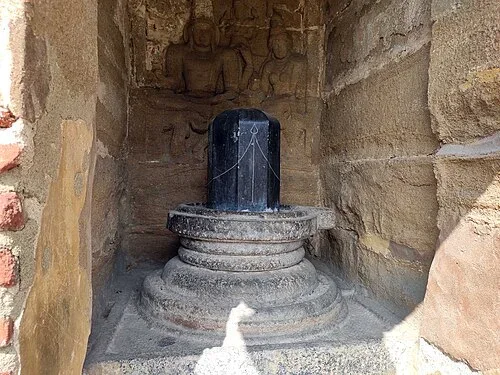 Central Sanctum and the 16-Sided Shivalinga
The Sanctum and the Sixteen-Sided Linga
At the heart of the temple sits a Shivalinga with sixteen sides, cut from smooth black granite. Over it rises the vimana, a tower of four storeys climbing in a pyramidal shape, with a small domed roof at the very top. The sanctum below has its own carved pedestal, guarded by Nandi, the bull who watches over Shiva in temples across this region. Around the sanctum stand nine shrines, seven of them outside and two flanking its entrance, each holding a form of Shiva. This is no abandoned monument. Worship here has never stopped, and on the night of Maha Shivaratri thousands of devotees fill the temple in the evening to pray before the main deity.
Listen in the appLodo from Moscow, Russia · CC BY-SA 2.0
04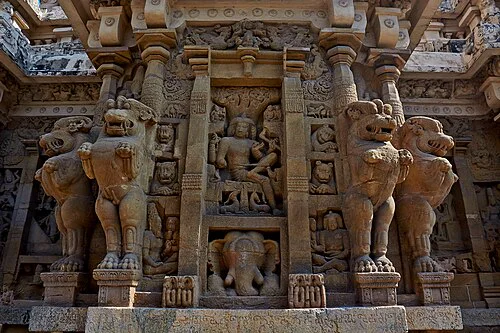 Outer Sanctum Wall Sculptures
Dakshinamurthy and the Vimana Walls
The outer walls of the sanctum read like a book of theology, chapter by chapter in stone. On the south wall, Shiva appears as Dakshinamurthy, the silent teacher, seated in a posture of peace and quietude. On the west wall, the story turns cosmic: Lingodbhava, Shiva emerging as a blazing pillar of fire. In the legend, Brahma and Vishnu set out to find the ends of that pillar, one flying upward, one digging down, and neither succeeds. The carving shows them beside the flame, with flying spirits on the level below. Lions frame the niche, the same guardian beasts that hold up the pillars of the hall. Every panel has its place, so a walker around the sanctum passes through the whole story of the god.
Listen in the appPhoto: R.K.Lakshmi · CC BY-SA 4.0
05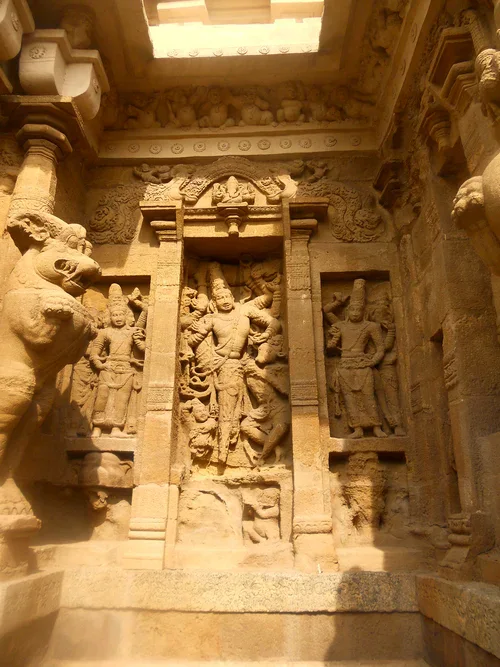 Outer Sanctum Wall Sculptures
Shiva as Lord of the Dance
Here Shiva dances. The west-facing hall carries him in two forms, Sandhya Tandavamurti and Urdhava Tandavamurti, one the evening dance, the other with a leg flung high above his head. Around him the ganas, his impish attendants, dance in their own poses, and Brahma, Vishnu, Nandi and Parvati complete the ensemble. Local tradition tells why the raised leg matters. The story goes that Shiva and Parvati held a dance contest, and Shiva won it with this Urdhava move, lifting his foot where his consort would not. Whether that contest is told by this exact niche or across the temple's sculptures generally, the carving keeps the debate alive in stone.
Listen in the appKesavan Muthuvel · CC BY-SA 3.0
06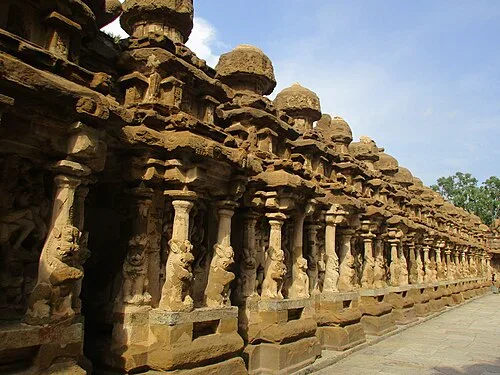 The 58 Courtyard Subshrines
The Fifty-Eight Subshrines
The high wall around the courtyard holds a ring of fifty-eight small shrines, each one set into a niche of the compound wall. Together they form a continuous gallery, chapel after chapel, enclosing the main shrine. They are dedicated to the many forms of Shiva, and many carry Somaskanada reliefs, showing Shiva and his consort Parvati in one dance pose after another. To walk the circuit once was to pass an entire world of the god's aspects, each shrine a small sanctuary of its own. The row runs on and on, lion pillar after lion pillar, all of it conceived as a single design.
Listen in the appPhoto: Charlottetreesa · CC BY-SA 4.0
07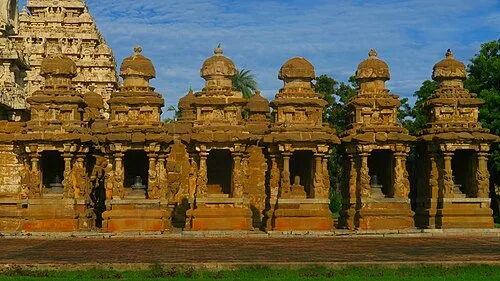 The 58 Courtyard Subshrines
Inside a Subshrine Chamber
Inside one of these chambers, the walls open onto a wider faith. The inner faces of the circuit carry a whole galaxy of images: Durga, Kartikeya, Tripurantaka, Gangadhara holding back the Ganges in a strand of his hair, and Vishnu in his avatars Narasimha and Trivikrama. This breadth reflects the Smartha tradition, which honours Shiva, Vishnu, Devi, the Sun, Ganesha and Kartikeya side by side, even within a temple named for Shiva. Among all these figures, one image is judged the most noteworthy of all: Ardhanariswara, the god who is half Shiva and half Parvati in one body, seated on a bull.
Listen in the appShrini from Chennai, India · CC BY 2.0
08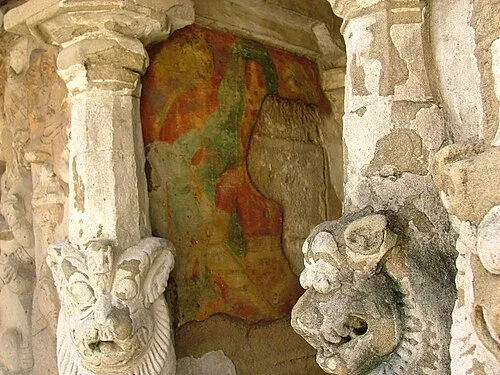 Inner Wall Murals and Early Tamil Epigraphy
Fragments of Early Pallava Murals
Patches of red and green still cling to the walls of these cells, and they are rarer than any carving here. They are the last traces of murals counted among the earliest and finest Hindu paintings in Tamil Nadu. Their style is compared with the famous caves at Ajanta, and with the eighth-century Vaikunthaperumal temple in this same city of Kanchipuram. Once, far more of this interior was painted; what survives is weathered pigment on carved sandstone, framed by a lion capital standing guard. The colour has lasted some thirteen hundred years, and it is still fading.
Listen in the appVenkatarangan Thirumalai · CC BY-SA 4.0
09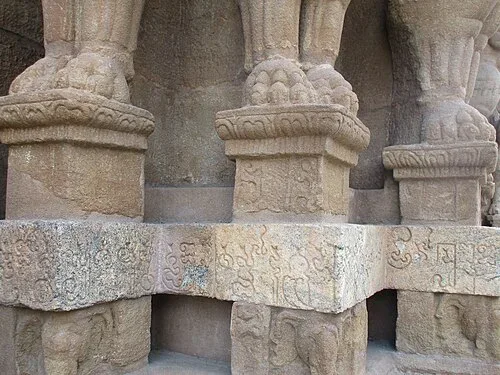 Inner Wall Murals and Early Tamil Epigraphy
Inscriptions of Rajasimha
Bands of script run along the base blocks here, the temple speaking in its own voice. Among the many inscriptions on these walls is the earliest stone record of the twenty-eight Saivagamas, the texts at the root of Shaiva worship. In it, King Rajasimhavarman, the very builder of this temple, declares his personal faith in Shaivism. It is a rare thing to hear a patron's own conviction, cut into the monument while he still walked these courts. The walls carry many more inscriptions in early scripts, and scholars of regional history and Tamil temple tradition return to them again and again.
Listen in the appPhoto: Charlottetreesa · CC BY-SA 4.0
10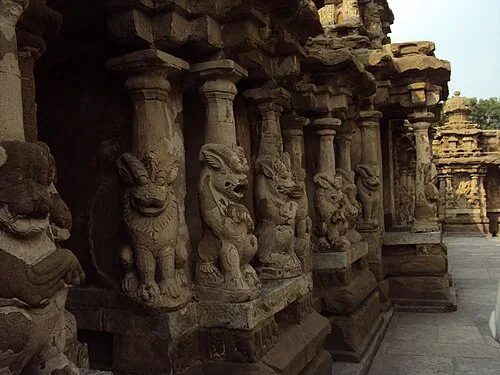 The Symbolic Rebirth Passage
The Rebirth Passage
Along the compound wall runs a passage with a strange purpose. To enter it, a devotee climbs seven steps and squeezes through a narrow opening called the Gate of Death. The corridor is so tight that it must be crawled, and the crawl itself stands for the passage through life. Coming out of the far end, through the Gate of Birth, is likened to emerging from the mother's womb, the Hindu belief in rebirth made physical. Those who complete the circuit are told the blessings equal a visit to paradise, and that the cycle of rebirth itself is broken, a liberation called Moksha. The passage is genuinely tight, and some visitors find the crawl difficult. For many, this dark little tunnel is the most personal moment the temple offers.
Listen in the appPhoto: Tshrinivasan · CC BY-SA 3.0
- 11
Sunset over the Kailasanathar Temple
The temple at sunset, and the Chola emperor it is said to have inspired.
Kailasanathar Temple, Kanchipuram
Frequently asked questions
How much does the guide cost?
Free app download. Listed guide price: $0.99. Guide price shown in the app. Audio guide only. Venue admission is separate.
Can I listen without internet?
Yes. Download the guide’s audio, images, and maps in the app before your visit. Your downloaded content is then available offline.
Can I listen in my language?
This audio guide is available in 15 languages, including English.
Do I need to follow a schedule?
No. This is a self-guided experience. Choose your stops, pause whenever you like, and return to a story at your own pace.
At your own pace
Explore Kailasanathar Temple, Kanchipuram.
Download Stanza, then search for “Kailasanathar Temple, Kanchipuram”.
Free app download · Guide price shown in the app
Keep exploring
Audio guides — India
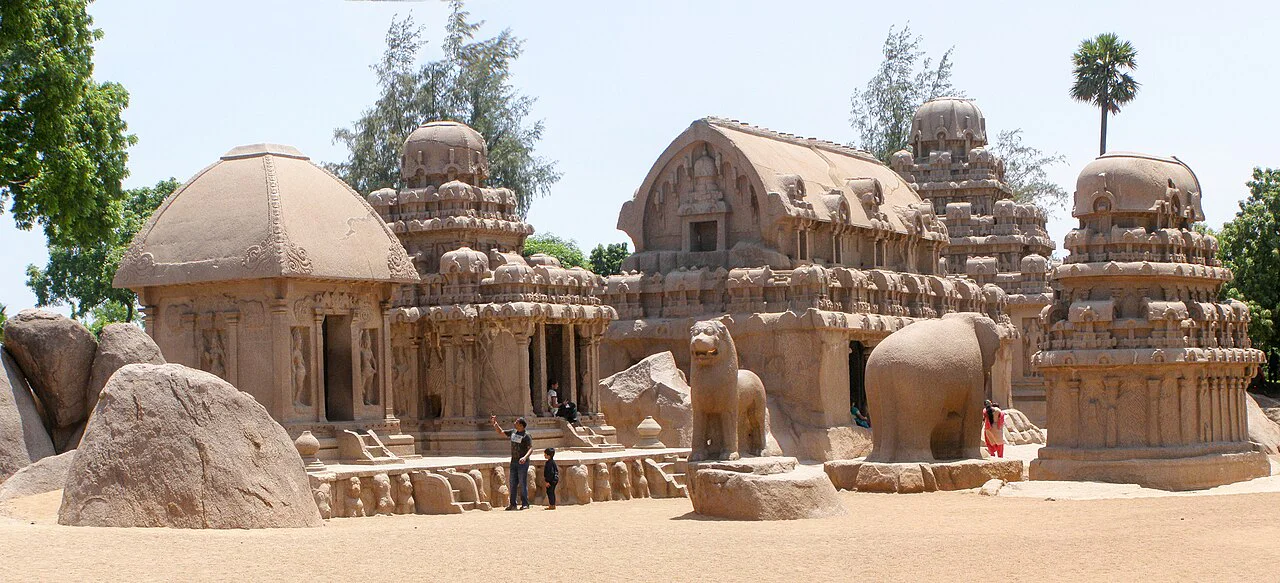
Mahabalipuram · 60 km
Pancha Rathas
Content & sources
Photo: BluesyPete · CC BY-SA 3.0
Mahabalipuram · 61 km
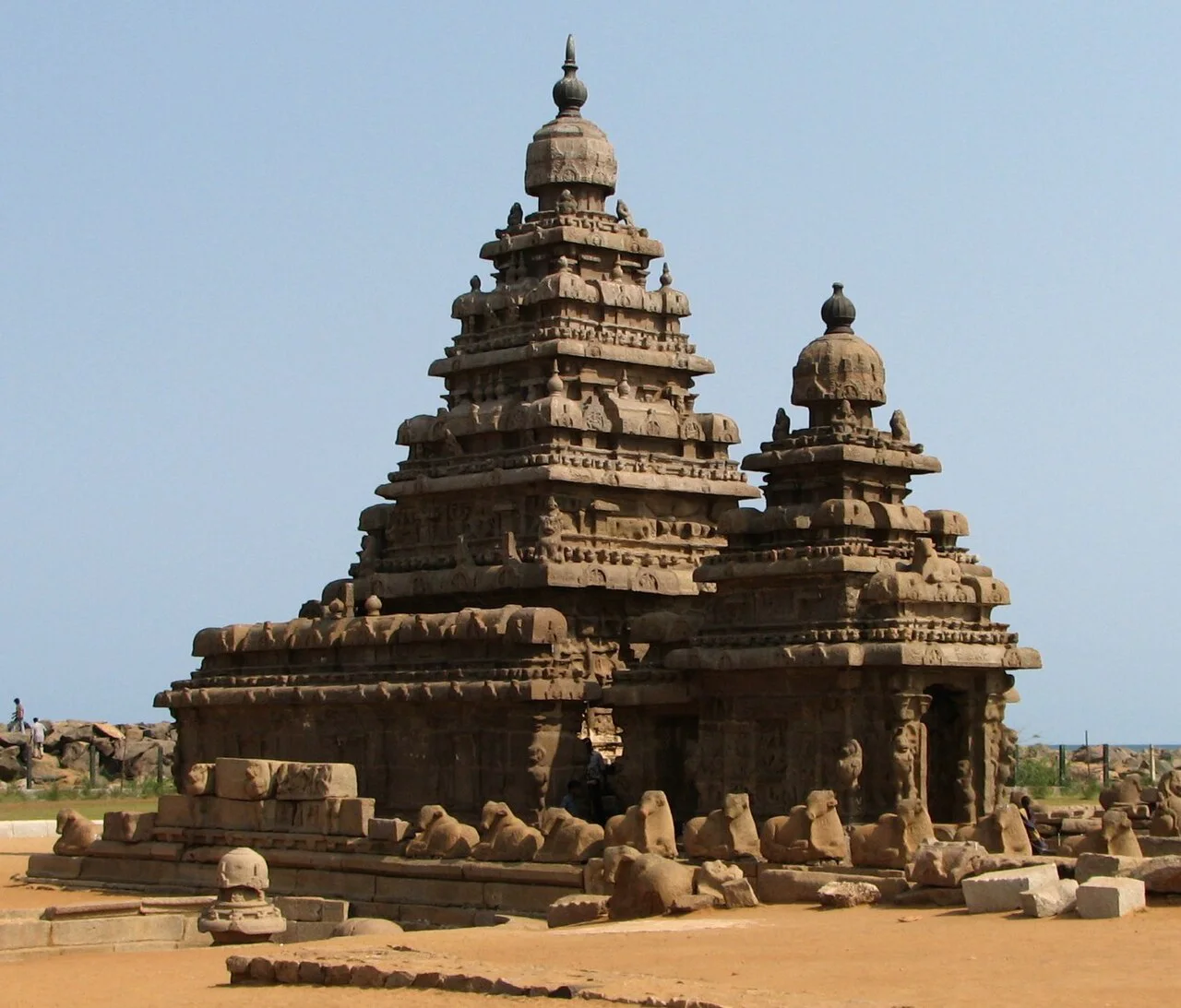
Shore Temple
Content & sources
mckaysavage · CC BY 2.0
Chennai · 66 km
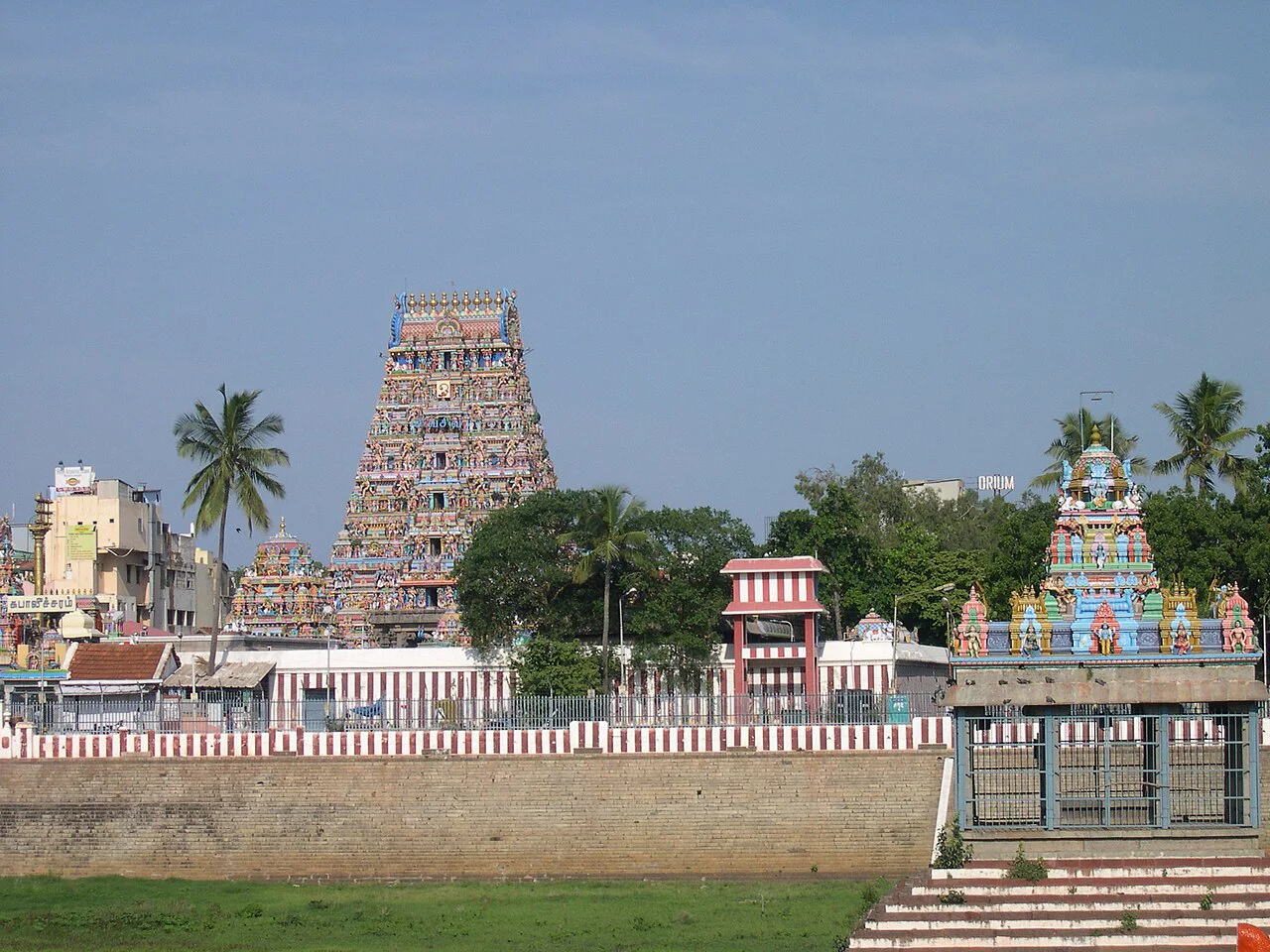
Kapaleeshwarar Temple
Content & sources
G V Balasubramanian · CC BY-SA 2.0
Dharasuram
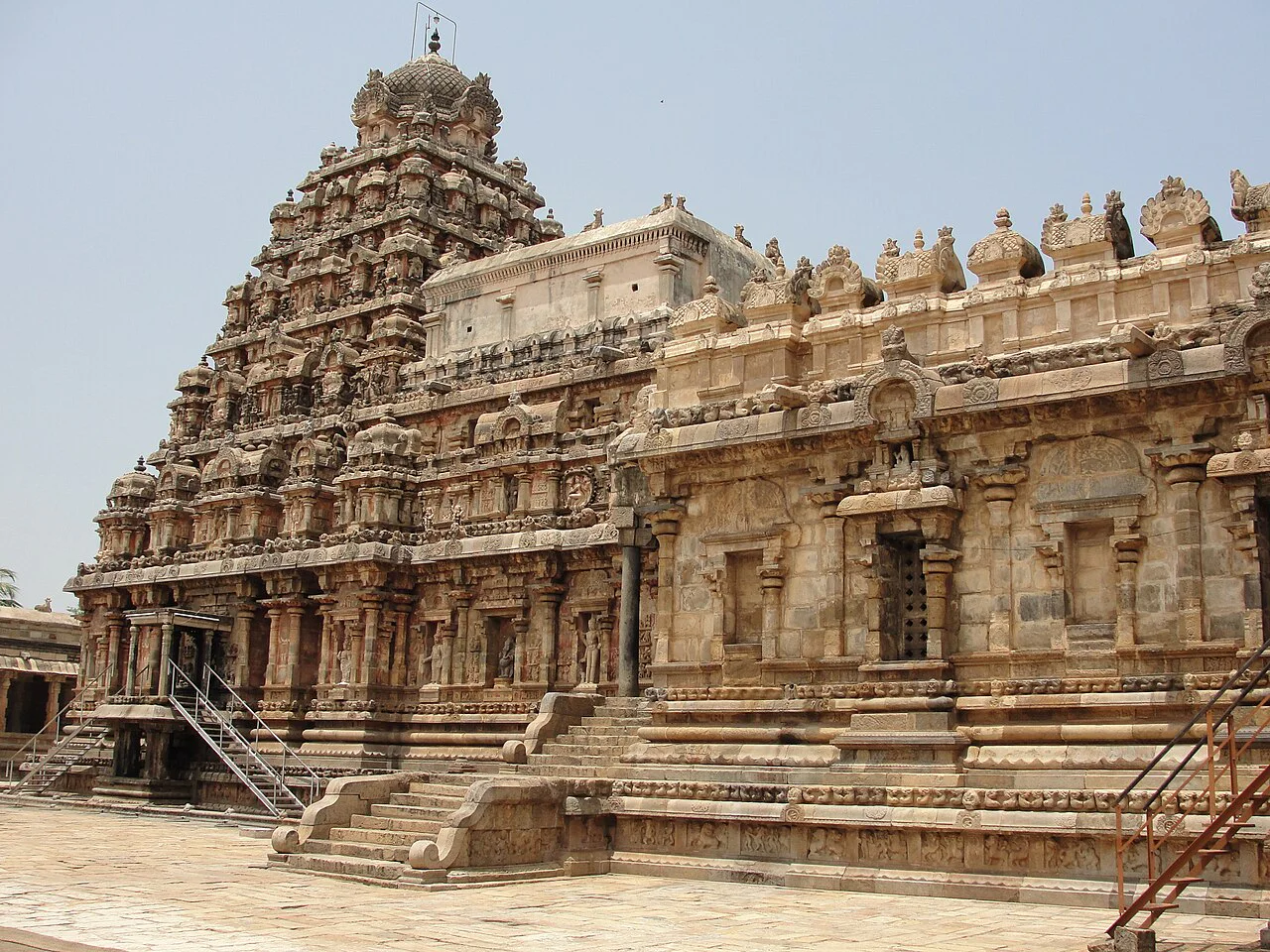
Airavatesvara Temple
Content & sources
Photo: Thamizhpparithi Maari · CC BY-SA 3.0