Stanza · Audio guide
Pancha Rathas Audio Guide
A place to remember. A story to take with you.
Pancha Rathas is a monument complex at Mahabalipuram that serves as an example of monolithic Indian rock-cut architecture. It is part of the UNESCO World Heritage Site inscribed as the Group of Monuments at…
Download Stanza, then search for “Pancha Rathas”.
About the tour
One guide. Your kind of visit.
Pancha Rathas is a monument complex at Mahabalipuram that serves as an example of monolithic Indian rock-cut architecture. It is part of the UNESCO World Heritage Site inscribed as the Group of Monuments at Mahabalipuram.
Ready when you are.
- 01Get the free Stanza app.
iOS & Android
- 02Find your guide.
“Pancha Rathas”
- 03Download before you go.
Works offline
Audio guide / 9 narrated stops
Inside the guide
Get to know a few of the stories before you go. Open a stop to read more.
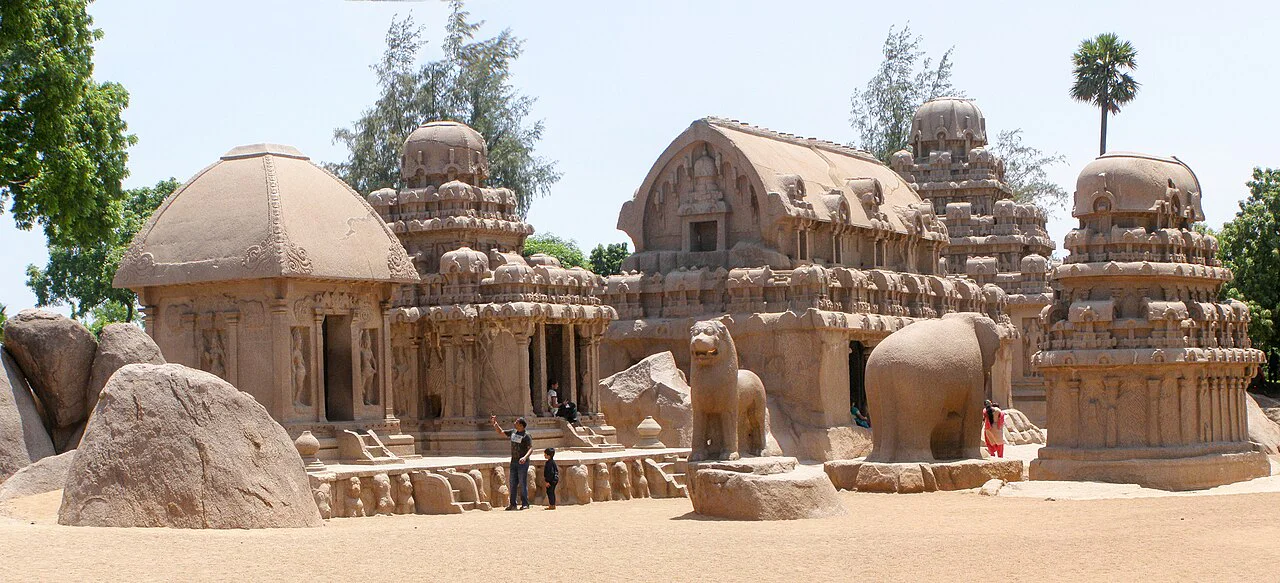
01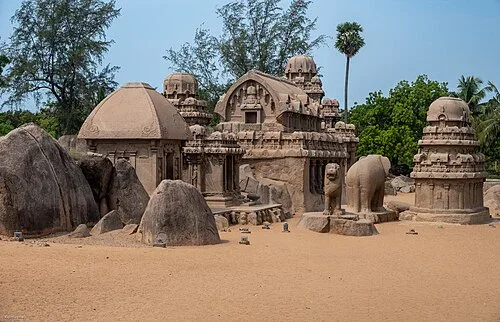 Site Entrance and Complex Overview
Pancha Rathas: The Granite Chariots of Mamallapuram
Welcome to the Pancha Rathas, five small shrines and a family of stone animals on India's Coromandel Coast. They stand at Mamallapuram, a town on the Bay of Bengal about thirty-five miles south of Chennai. In the seventh century this was a port town of the Pallava dynasty, and their sculptors did something remarkable here. Each shrine was carved whole from a single outcropping of pink granite. Nothing was stacked up from blocks; everything was cut down out of the rock. All five sit together on one common plinth, which slopes gently from north to south. And each shrine follows its own layout, so the row reads like a workshop trying out ideas side by side. UNESCO inscribed the monuments of Mamallapuram as a World Heritage Site in 1984.
xiquinhosilva · CC BY 4.0
02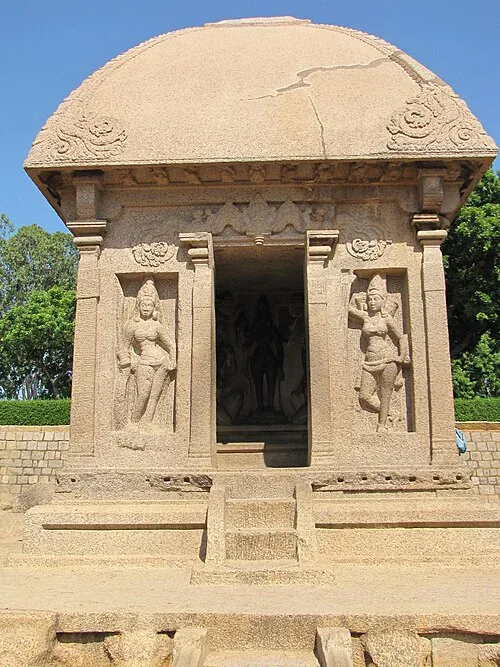 Draupadi Ratha
: A Temple Shaped Like a Village Hut
The smallest shrine in the row stands at its northern end, and it imitates the humblest building its makers knew. The Draupadi Ratha is a square little structure whose roof curves like thatch, with the rounded ridges of a village hut rendered in solid granite. The Pallava builders took a form meant to last a season and translated it into stone meant to last forever. Two carved figures stand in niches flanking the doorway, keeping watch at the entrance. Inside, the little chamber holds the mother goddess Durga, carved in relief and standing on a lotus.
Parijat Dasgupta · CC BY-SA 4.0
03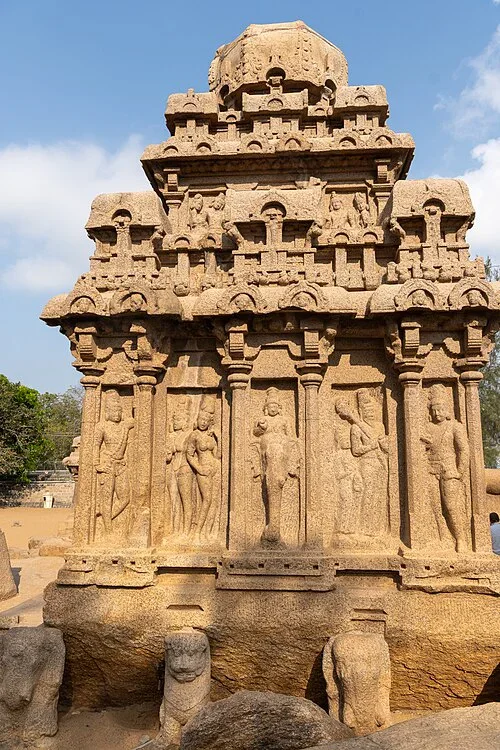 Arjuna Ratha
: The Square Template and the Pandava Names
Beside the hut shrine, sharing the same raised platform, stands the Arjuna Ratha, a compact square tower of two tiers. Its facade shows the early Dravidian template in miniature: niches holding carved figures, slender pilasters, and rows of miniature roof forms running around the top. The names of all five shrines come from the Mahabharata, the great Indian epic, after the Pandava brothers and their shared queen Draupadi. Historians treat these labels as later misnomers, since the monuments have no real link to the epic's characters. The Archaeological Survey of India has even suggested a neutral term instead, vimanas, the word for temple towers. The Pandava names stuck anyway, and they are the ones everyone still uses.
Listen in the appPhoto: Rainer Halama · CC BY-SA 4.0
04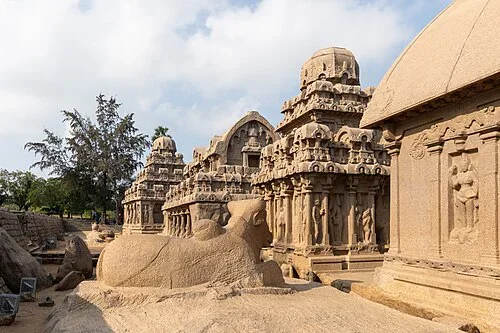 Monolithic Nandi and Lion Sculptures
The Stone Menagerie: Nandi and the Guardian Animals
Not every monolith here is a shrine. In the open ground around the chariots stand life-sized sacred animals, each one carved from its own separate neighbouring boulder. There is an elephant, a lion, and a recumbent bull, Nandi, the mount of the god Shiva. The court sculptors treated these animals as monuments in their own right, companions to the shrines rather than decoration on them. The Nandi bull rests just behind the Arjuna Ratha.
Listen in the appPhoto: Rainer Halama · CC BY-SA 4.0
05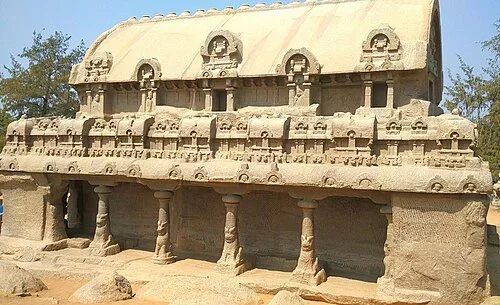 Bhima Ratha
: The Barrel Vault and the Wooden Original
The Bhima Ratha has the largest footprint of the five, stretching roughly thirteen metres from end to end. Its long rectangular hall is covered by a barrel vault, a roof that curves like an upturned boat. A plaque at the site explains the idea: the Pallavas planned these structures as models of chariots in rock, based on ancient rathas built in wood. Scholars trace the designs back to timber construction, and some see echoes of the vaulted Buddhist chaitya halls in this roof. Pillared galleries run along both long sides, and their columns are mounted with seated lions. The vault overhead is the clearest place to see a wooden building preserved in granite.
Listen in the appPhoto: Zuhebkhan94 · CC BY-SA 4.0
06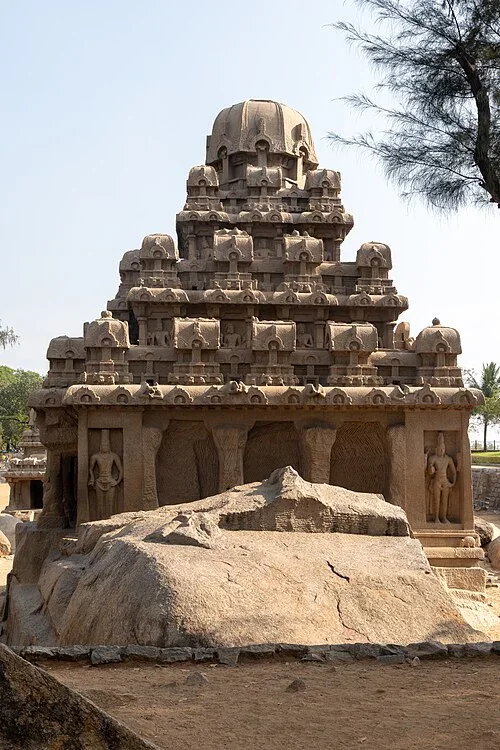 Dharmaraja Ratha
: The Crowning Experiment
The tallest of the five rises about forty feet, a square tower stepping upward in three tiers. Its walls are crowded with carved panels of the gods, among them Brahma and Ardhanarishvara. One panel holds a portrait rather than a deity: King Narasimhavarman the First, carved in the company of the gods. On the eastern face, Indra sits on his mount Airavata, a white elephant. The work was done by master craftsmen of the Pallava court, under Mahendravarman the First and his son Narasimhavarman. Most accounts place the carving in the mid-seventh century, though some historians, pointing to later inscriptions, argue the monuments belong to the reign of Narasimhavarman the Second instead.
Listen in the appPhoto: Rainer Halama · CC BY-SA 4.0
07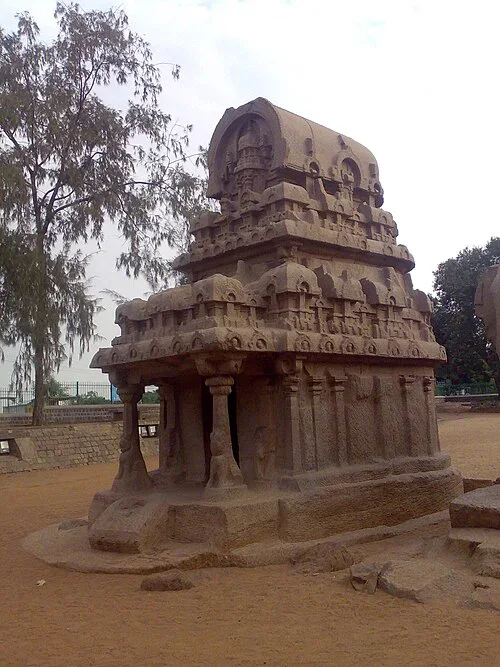 Nakula Sahadeva Ratha and Monolithic Elephant
Nakula Sahadeva Ratha: The Shrine Shaped Like an Elephant's Back
Set slightly apart from the others, the Nakula Sahadeva Ratha breaks the pattern of straight walls. Its rear curves in a smooth half-moon, an apsidal plan shaped like the back of an elephant. The design is simple, with little embellishment in its curved apses. With this one, the survey of shapes is complete: square plans at three of the shrines, a rectangle at Bhima, and a curve here. No other ratha in the row has this rounded rear wall.
Listen in the appTfi2010 · CC BY-SA 3.0
08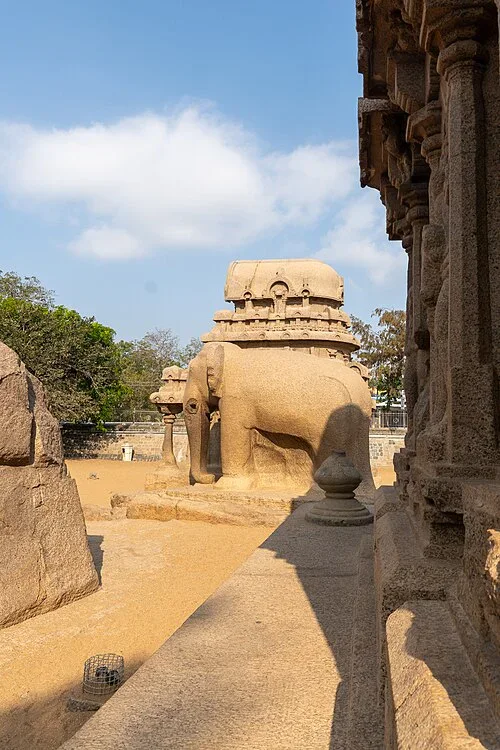 Nakula Sahadeva Ratha and Monolithic Elephant
The Monolithic Elephant
Beside the curved shrine stands the elephant you heard of among the guardian animals. Tradition pairs the elephant-backed shrine with its elephant companion. The rounded back of the ratha and the rounded bulk of the elephant make a deliberate-looking pair.
Listen in the appPhoto: Rainer Halama · CC BY-SA 4.0
09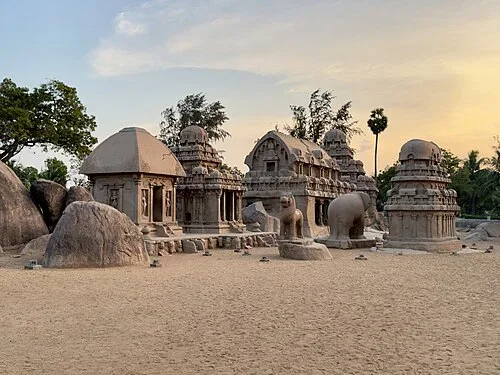 Complex Perimeter Walk and Exit
The Frozen Worksite: Why the Chariots Were Never Consecrated
Here is the twist the whole row keeps quiet: none of these ornate shrines was ever finished. When King Narasimhavarman the First died in 668, the carving stopped. The shrines were never completed, never consecrated, and never used for worship. Uncut rock still shows at the bases and tops of the rathas, where the sculptors never reached. Yet the experiment was not wasted, because these shapes became templates for the much larger temples that later rose across Tamil Nadu. The granite has looked after them ever since, shrugging off salty sea winds and even tsunamis, one as recent as 2004.
Listen in the appPhoto: Oleg Yunakov · CC BY-SA 4.0
Pancha Rathas
Frequently asked questions
How much does the guide cost?
Free app download. Listed guide price: $0.99. Guide price shown in the app. Audio guide only. Venue admission is separate.
Can I listen without internet?
Yes. Download the guide’s audio, images, and maps in the app before your visit. Your downloaded content is then available offline.
Can I listen in my language?
This audio guide is available in 15 languages, including English.
Do I need to follow a schedule?
No. This is a self-guided experience. Choose your stops, pause whenever you like, and return to a story at your own pace.
At your own pace
Explore Pancha Rathas.
Download Stanza, then search for “Pancha Rathas”.
Free app download · Guide price shown in the app
Keep exploring
Audio guides — India
Mahabalipuram · 1 km
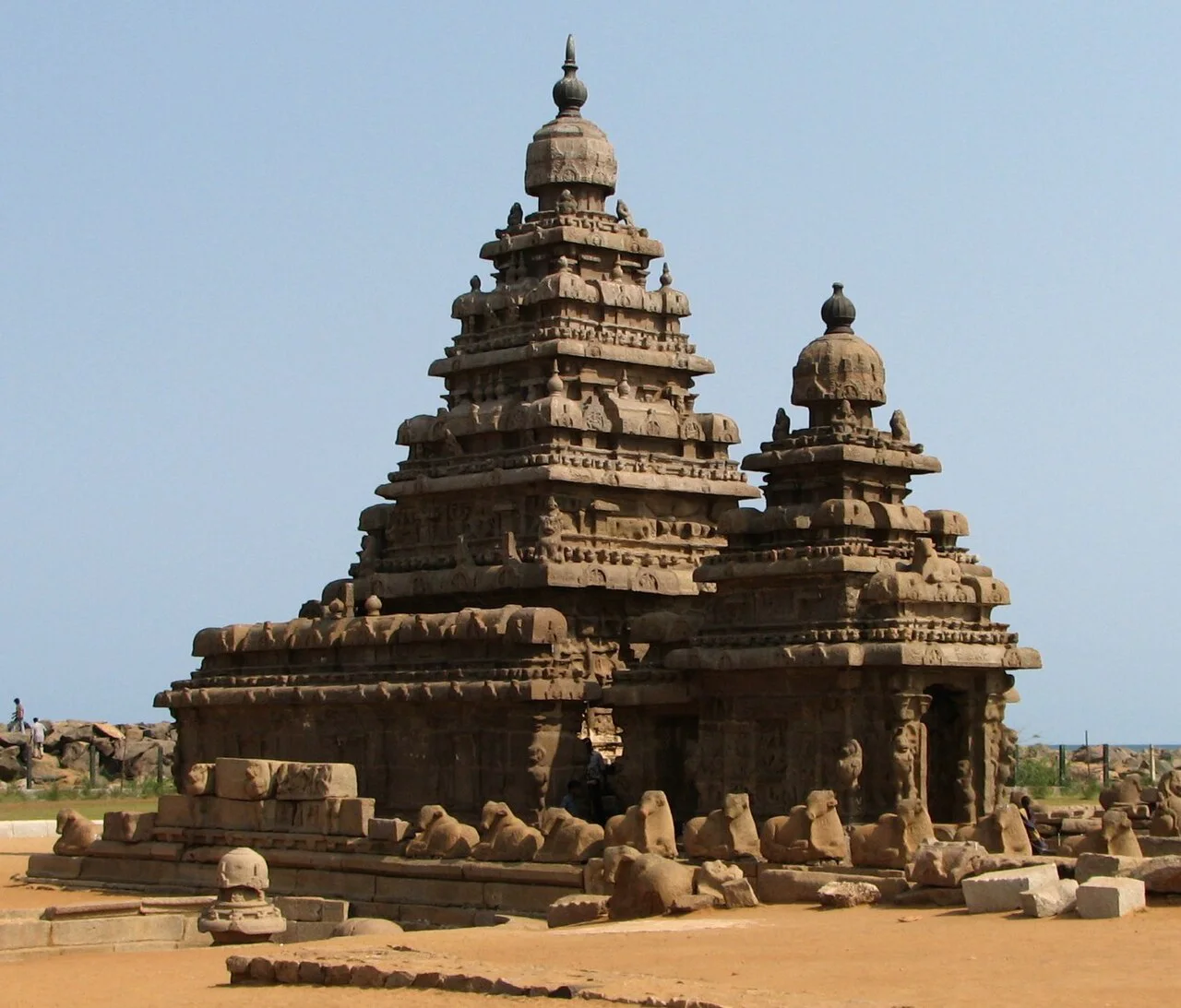
Shore Temple
Content & sources
mckaysavage · CC BY 2.0
Chennai · 48 km
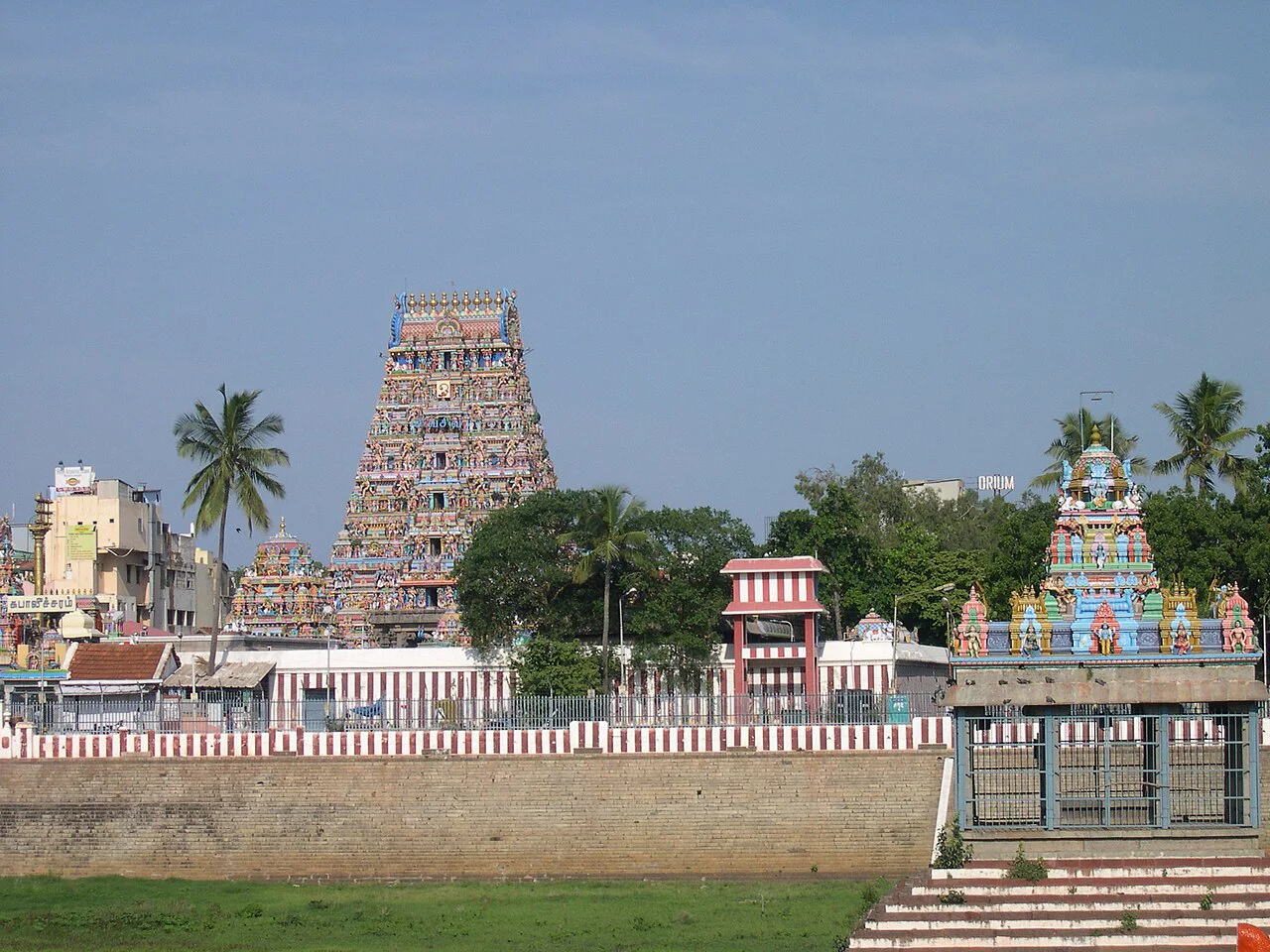
Kapaleeshwarar Temple
Content & sources
G V Balasubramanian · CC BY-SA 2.0
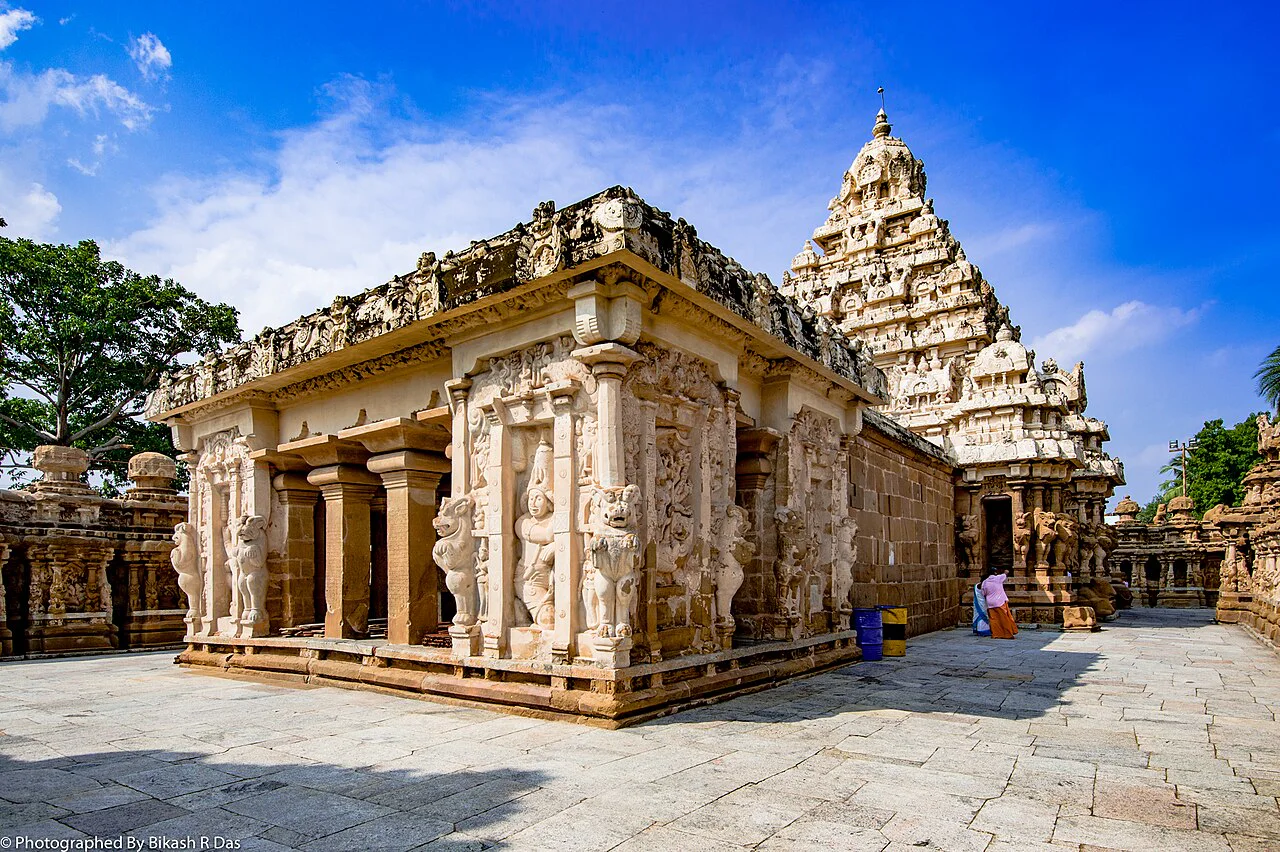
Kanchipuram · 60 km
Kailasanathar Temple, Kanchipuram
Content & sources
Bikash Das from bangalore, india · CC BY 2.0
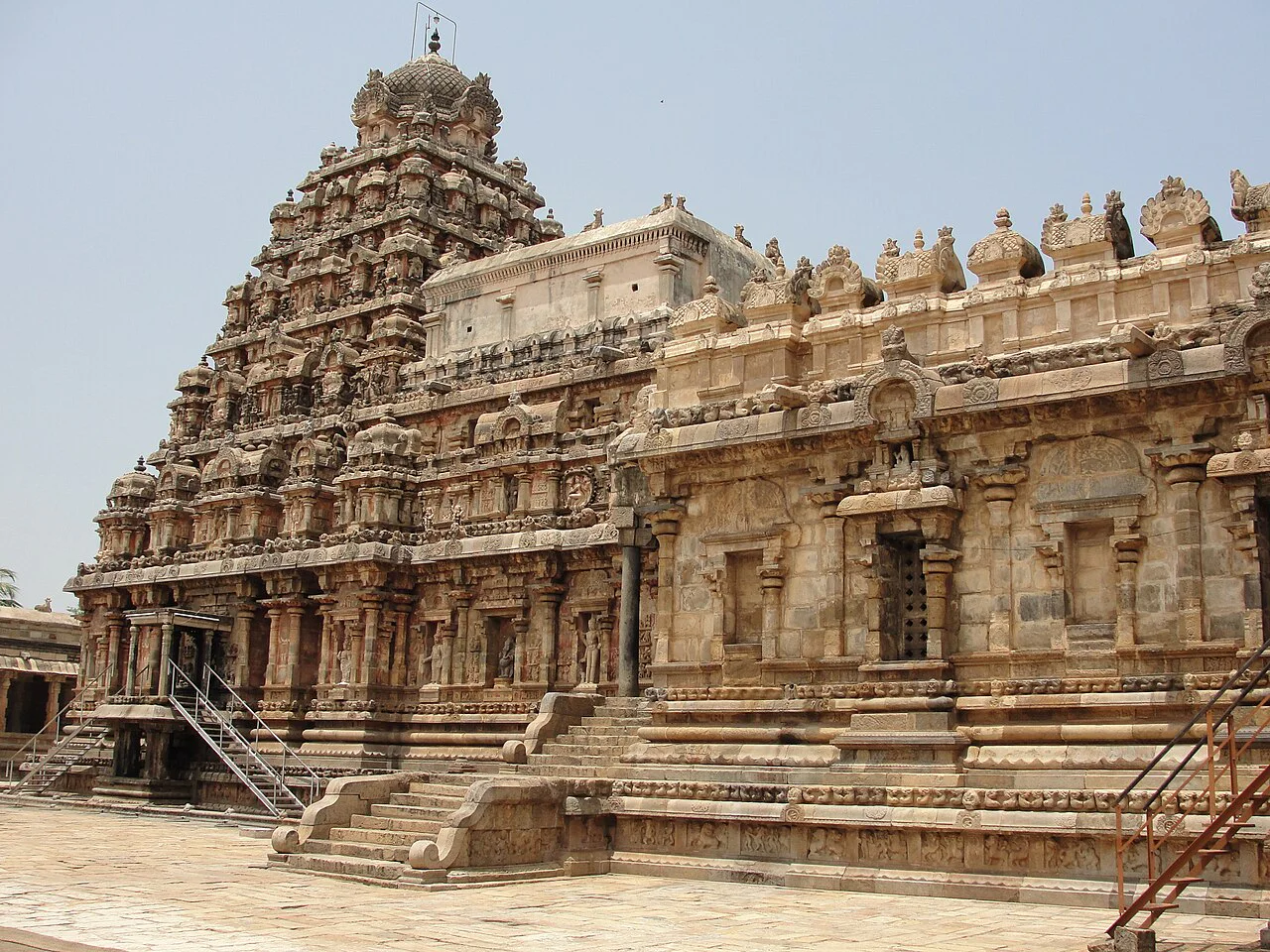
Dharasuram
Airavatesvara Temple
Content & sources
Photo: Thamizhpparithi Maari · CC BY-SA 3.0