Stanza · Audio guide
Jama MasjidAudio guide
A place to remember. A story to take with you.
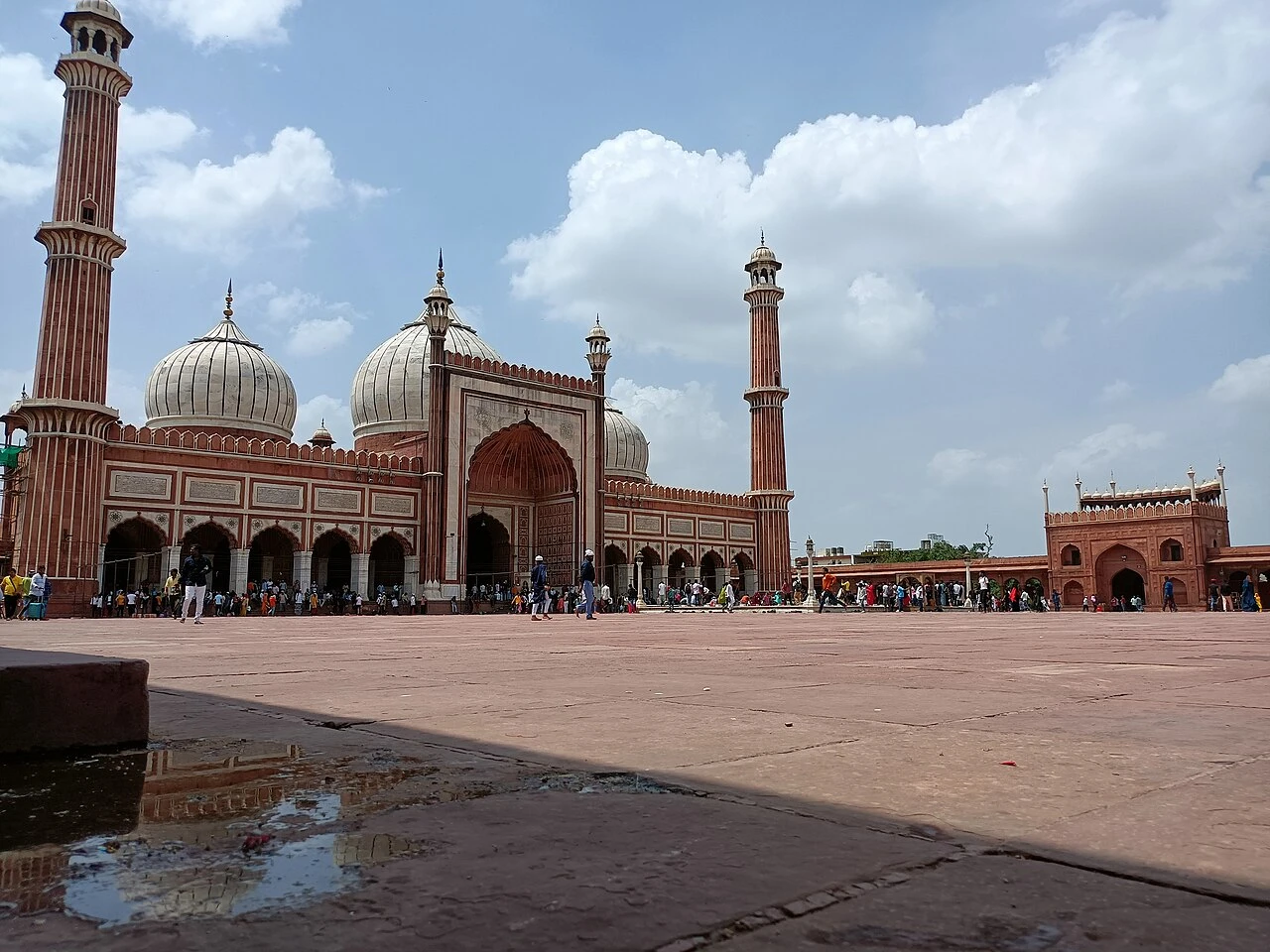
Jama Masjid is one of the largest mosques in India, built by Mughal Emperor Shah Jahan. Located in Old Delhi, it serves as a major place of worship and a significant architectural landmark.
Download Stanza, then search for “Jama Masjid”.
About the tour
One guide. Your kind of visit.
Jama Masjid is one of the largest mosques in India, built by Mughal Emperor Shah Jahan. Located in Old Delhi, it serves as a major place of worship and a significant architectural landmark.
Ready when you are.
- 01Get the free Stanza app.
iOS & Android
- 02Find your guide.
“Jama Masjid”
- 03Download before you go.
Works offline
Audio guide / 18 narrated stops
Inside the guide
Get to know a few of the stories before you go. Open a stop to read more.
01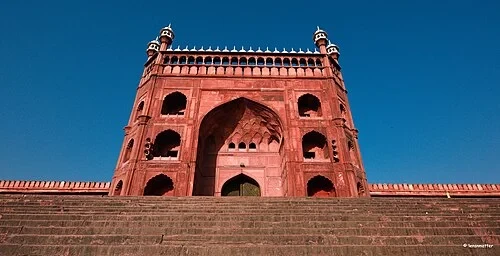 The Imperial Ascent: Eastern GateThe Emperor's Staircase
Welcome to the Jama Masjid, one of the largest and most significant mosques in the world. As you begin your visit, take a moment to appreciate the sheer scale of the structure rising before you. Construction of this massive complex began in 1644 under the orders of Emperor Shah Jahan, the same visionary who commissioned the Taj Mahal and the nearby Red Fort. It was an immense undertaking that took 12 years to complete, requiring the labor of over 5,000 dedicated workers and artisans. The entire mosque is built upon a massive, 10-meter-high plinth, which creates a dramatic, elevated platform for the sacred space. This architectural choice was both practical and symbolic; by raising the mosque above the surrounding landscape, the designers physically separated the sanctuary from the bustling, noisy streets of the city below. As you stand here, notice how the elevation creates a sense of detachment from the urban chaos, preparing your mind for the tranquility found within the walls. The broad staircase leading up to the main gates serves as a grand introduction to a site that was intended to represent the peak of imperial piety and power in the Mughal Empire.
Lensnmatter · CC BY 3.0
02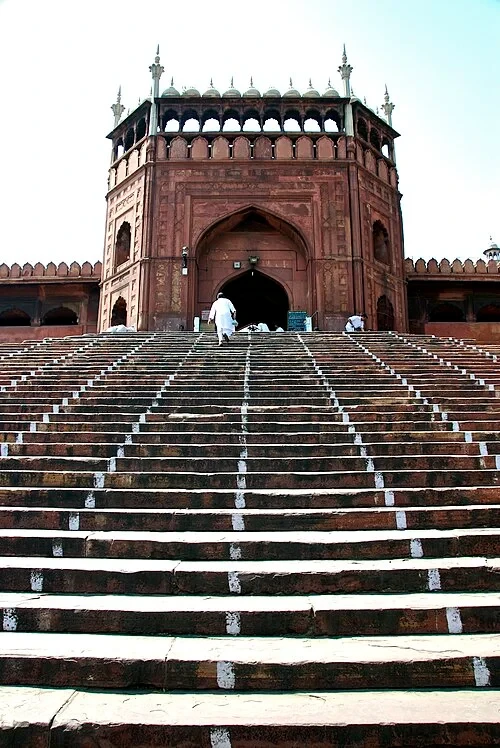 The Imperial Ascent: Eastern GateThe Ascent to the Eastern Gate
Notice the wide, shallow steps beneath you as you make your way toward the entrance. There are more than thirty of these broad steps, carved primarily from red sandstone. In the centuries following the mosque's completion in 1656, this particular gate�the Eastern Gate�held a very special status. It was traditionally reserved for the Emperor himself, who would arrive on horseback or in a palatial procession from the nearby Red Fort. As you climb, consider the physical and symbolic weight of this ascent. The act of moving upward reinforces the transition from the secular, everyday world of the marketplace into the sacred, spiritual realm of the mosque. The width of the stairs was designed to accommodate the grand scale of royal processions, ensuring that the Emperor's entrance was as majestic as the building itself. Today, while the gate is open to all visitors, the rhythmic climb still serves as a moment of preparation. The gradual rise allows the surrounding city skyline to slowly fall away, focusing your attention on the towering gateway that marks the threshold of this historic sanctuary.
Peter Rivera from Stamford, CT, USA · CC BY 2.0
03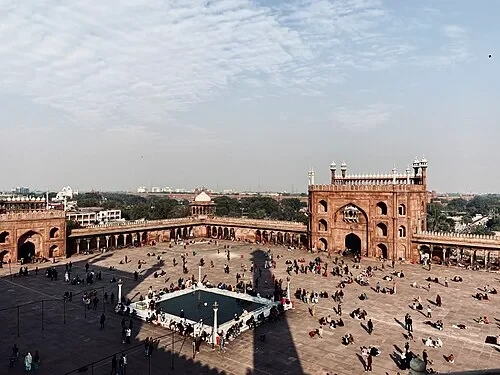 The Sea of Sandstone: The Great CourtyardThe Great Courtyard
As you pass through the gateway and step into the main courtyard, or 'Sahn,' the true magnitude of the Jama Masjid reveals itself. This immense square is approximately 99 meters on each side, creating one of the largest congregational spaces in the Islamic world. It was engineered to accommodate up to 25,000 worshippers at a single time, a necessity for the massive crowds that gather for Friday prayers and major festivals like Eid. Observe the visual transition in the materials surrounding you. The floor of the courtyard is primarily composed of red sandstone, mirroring the defensive walls of the city. However, as your eyes move toward the main prayer hall and the central structures, you will see a deliberate shift to white marble. This contrast is a hallmark of Mughal design, where the rugged sandstone provides a sturdy foundation, while the polished white marble highlights the most sacred and architecturally significant features. Surrounded on three sides by arched galleries, or dalans, the courtyard acts as a massive outdoor sanctuary. Even when empty, the sheer openness of the space is intended to evoke a sense of humility and awe, placing the individual worshipper within a vast, communal context under the open sky.
Listen in the appPhoto: Paulrichardhealy1 · CC BY-SA 4.0
04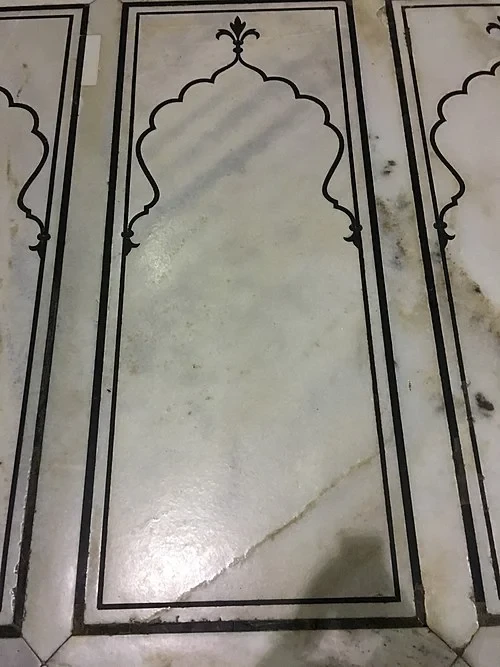 The Sea of Sandstone: The Great CourtyardThe Marble Prayer Mats
Look closely at the floor of the courtyard and the prayer hall. You will notice thousands of rectangular outlines inlaid into the white marble. These represent 'Janamaz,' or individual prayer rugs. By permanently etching these markings into the stone using black marble inlays, the architects ensured that every individual in a crowd of thousands would have a designated spot. This isn't just about personal space; it is about perfect communal alignment. In Islamic prayer, it is essential for the congregation to stand in straight, parallel rows facing the 'Qibla,' or the direction of Mecca. These markings act as a grid, guiding the massive influx of people during congregational prayers so that the entire assembly moves as one synchronized unit. The contrast of the dark lines against the pale marble creates a rhythmic pattern across the vast floor, turning the ground itself into a functional piece of art. It is a subtle but powerful reminder of the discipline and unity inherent in the rituals performed here, where the individual becomes part of a perfectly ordered whole.
Listen in the appPhoto: Rashid Jorvee · CC BY-SA 4.0
05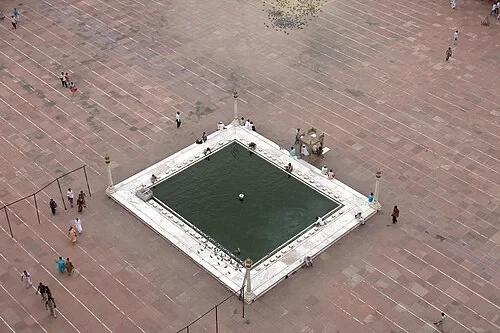 The Mirror of Piety: Central Ablution TankThe Central Ablution Tank
At the heart of the great courtyard sits the 'Hauz,' a large square pool used for 'Wudu,' the ritual ablution required before prayer. Before entering the prayer hall to communicate with the divine, worshippers perform a specific series of washings, cleansing their hands, face, and feet. This ritual serves as a symbolic purification, helping the faithful transition into a state of spiritual readiness. Beyond its religious function, the pool serves a vital practical purpose in the local climate. In the intense, dry heat of Delhi, the presence of such a large body of water acts as a natural cooling element. The evaporation from the pool helps lower the temperature in the immediate vicinity, providing a refreshing microclimate for those resting or preparing for prayer. The architecture surrounding the tank is simple and elegant, featuring small fountains and marble borders where worshippers sit. This area is often a focal point of quiet activity, as the sound of trickling water provides a soothing soundtrack that cuts through the distant noise of the city, reinforcing the courtyard's role as a place of both physical and spiritual restoration.
Listen in the appVyacheslav Argenberg · CC BY 4.0
06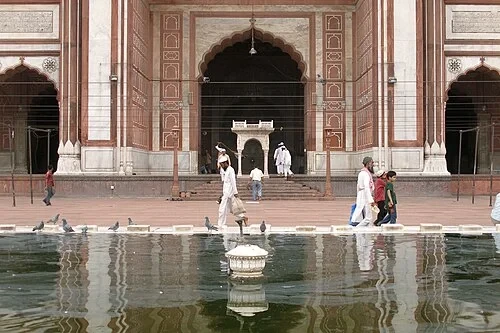 The Mirror of Piety: Central Ablution TankReflections of Piety
Take a moment to stand near the edge of the central pool and look down at the water�s surface. When the air is still, the pool transforms into a perfect mirror, capturing the reflection of the three great domes and the towering minarets of the main prayer hall. This visual effect was a common feature in Mughal garden and mosque design, intended to create a sense of symmetry and infinite beauty. The reflection doubles the architectural impact of the building, making the heavy stone structures appear to float weightlessly on the water. This play between the solid architecture and its fluid reflection often inspires a sense of deep tranquility. Even though the bustling markets of Old Delhi are just outside the mosque's walls, the atmosphere inside the courtyard remains remarkably serene. The mirroring effect helps to draw the eye inward, away from the outside world and toward the harmony of the design. It is a place where the grandeur of imperial architecture meets the quietude of nature, inviting visitors to pause and reflect, much like the water itself reflects the sky and the sanctuary.
Listen in the appVyacheslav Argenberg · CC BY 4.0
07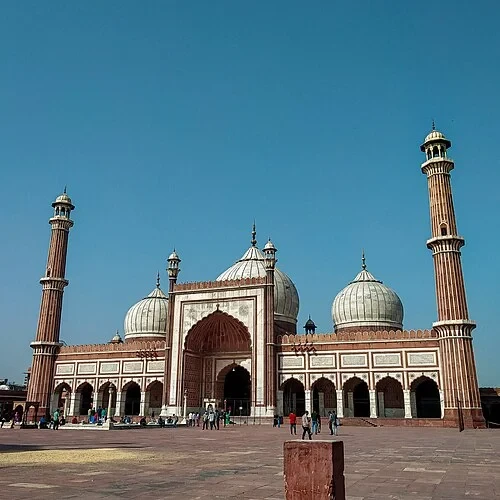 The Pinnacle of Mughal Style: Main Prayer Hall FacadeThe Main Prayer Hall Facade
The main prayer hall stands as the architectural climax of the entire complex. Its facade is a brilliant example of the Mughal style, which seamlessly blended Persian, Islamic, and indigenous Indian elements. The primary material is red sandstone, but it is heavily ornamented with white marble, creating the bold, striped appearance that is so characteristic of Shah Jahan�s era. Above the roofline, you will see three massive, bulbous domes. These domes are a classic Mughal signature, known for their slightly constricted necks and elegant, swelling shapes. They are covered in vertical stripes of black and white marble, which draws the eye upward and adds a sense of dynamic movement to the static stone. The facade features a large central archway, known as a 'pishtaq,' which is flanked by smaller arched openings. This rhythmic arrangement of arches creates a sense of depth and invitation. The combination of the warm, earthy red stone and the cool, bright white marble ensures that the building remains visually striking even from a great distance, standing as a proud testament to the sophisticated aesthetics of the 17th-century Mughal court.
Listen in the appPhoto: Oye yogesh · CC BY-SA 4.0
08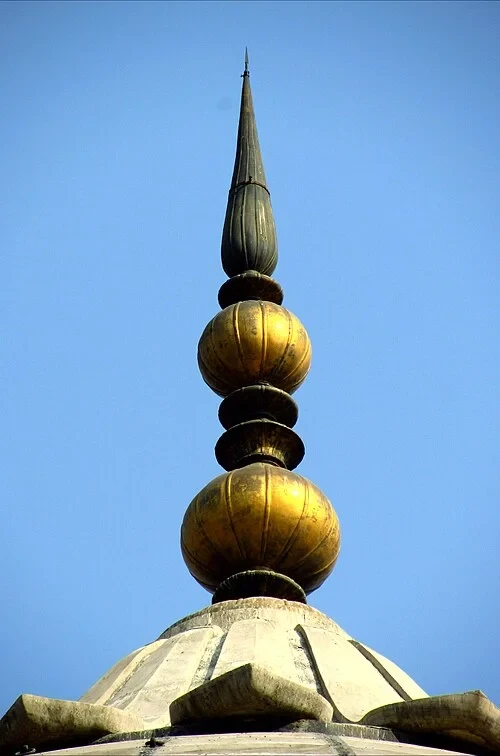 The Pinnacle of Mughal Style: Main Prayer Hall FacadeThe Gilded Finials
If you look to the very top of the three bulbous domes, you will see shining, golden finials. While they may appear small from the ground, these ornaments are quite large and represent the final flourish of the mosque�s vertical design. Finials like these were often crafted from copper or brass and then gilded to catch the sunlight, serving as brilliant beacons visible from across the city. Beyond their decorative appeal, these finials have a deeper significance. In sacred architecture, the finial serves as a symbolic point of contact between the earthly structure and the heavens above. Reaching toward the sky, they represent the spiritual aspirations of the congregation. The engineering required to place such heavy marble domes and their crowning finials was remarkable for the time. Each dome is a double-layered structure, which allows for the massive exterior scale you see here while maintaining more intimate proportions for the ceiling inside. The finials provide a delicate, tapering conclusion to the solid mass of the domes, adding an element of grace to the mosque's monumental skyline and reflecting the light of the sun throughout the day.
Listen in the appAamir7890 · CC BY-SA 3.0
09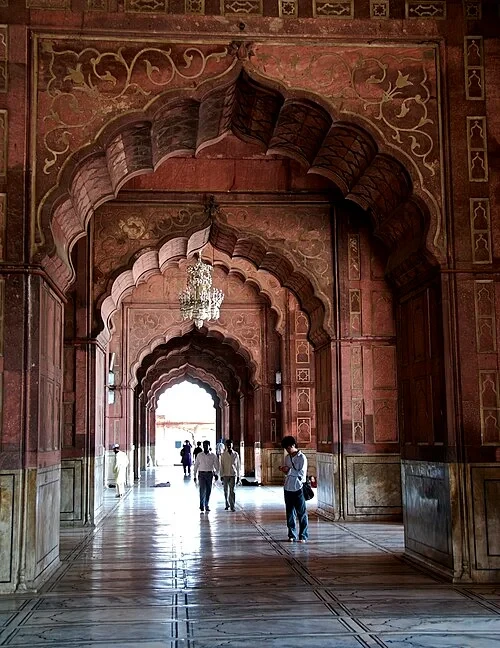 The Sanctuary of Arches: Interior Prayer HallThe Hall of Arches
Stepping into the main prayer hall, you immediately feel a change in atmosphere. The interior is a long, rectangular space measuring roughly 61 meters in length and 27 meters in width. The hall is defined by a series of high, rhythmic arches that support the roof and domes above. These are scalloped or 'cusped' arches, a favorite decorative motif in Shah Jahan�s architecture that adds a sense of delicate elegance to the heavy stone supports. The hall is designed to be a sanctuary in every sense of the word. The thick walls and elevated position keep the interior significantly cooler than the outside air, even during the peak of summer. The space is largely open, allowing for the free flow of air and the unhindered movement of the congregation. There is no furniture; instead, the cool marble floor provides a place for thousands to sit or prostrate in prayer. The repetition of the arches creates long, deep perspectives that draw the eye toward the western wall. In this quiet, shaded environment, the frantic pace of life in the surrounding city feels worlds away, replaced by a profound sense of space and stillness intended for spiritual focus.
Listen in the apphttps://www.flickr.com/photos/riverap1/ · CC BY 2.0
10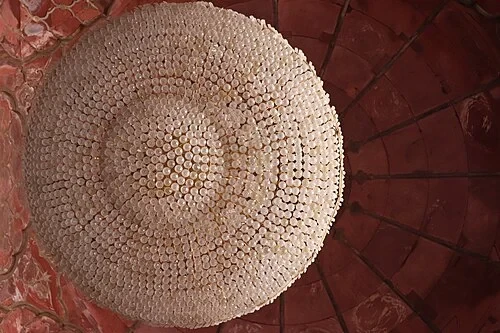 The Sanctuary of Arches: Interior Prayer HallLight of the Sanctuary
As you explore the interior of the prayer hall, look upward at the high ceilings to see the ornate chandeliers suspended from the arches. These fixtures are more than just practical light sources; they are essential to the spiritual ambiance of the sanctuary, particularly during the evening prayers. When lit, they cast a warm, soft glow that plays across the white marble surfaces and creates a dance of light and shadow within the deep alcoves of the hall. The interaction of light with the architecture is a key element of the experience here. During the day, natural light filters in through the large arched openings, illuminating the prayer mats on the floor. In the evening, the chandeliers take over, emphasizing the height of the scalloped arches and the vastness of the space. The coolness of the marble beneath your feet combined with the soft illumination from above creates a multisensory experience of peace. These lighting fixtures have been updated over the centuries, but they continue to fulfill the same role they did in the time of the emperors: highlighting the beauty of the sacred space and providing a sense of comfort and guidance to the faithful who gather here under the cover of night.
Listen in the appVIKASH KUMAR · CC BY-SA 4.0
Jama Masjid
Frequently asked questions
How much does the guide cost?
Free app download. Listed guide price: $1.99. Guide price shown in the app. Audio guide only. Venue admission is separate.
Can I listen without internet?
Yes. Download the guide’s audio, images, and maps in the app before your visit. Your downloaded content is then available offline.
Can I listen in my language?
Stanza supports 15 languages. Check the app for the languages available for this guide.
Do I need to follow a schedule?
No. This is a self-guided experience. Choose your stops, pause whenever you like, and return to a story at your own pace.
At your own pace
Explore Jama Masjid.
Download Stanza, then search for “Jama Masjid”.
Free app download · Guide price shown in the app
Keep exploring
Nearby audio guides
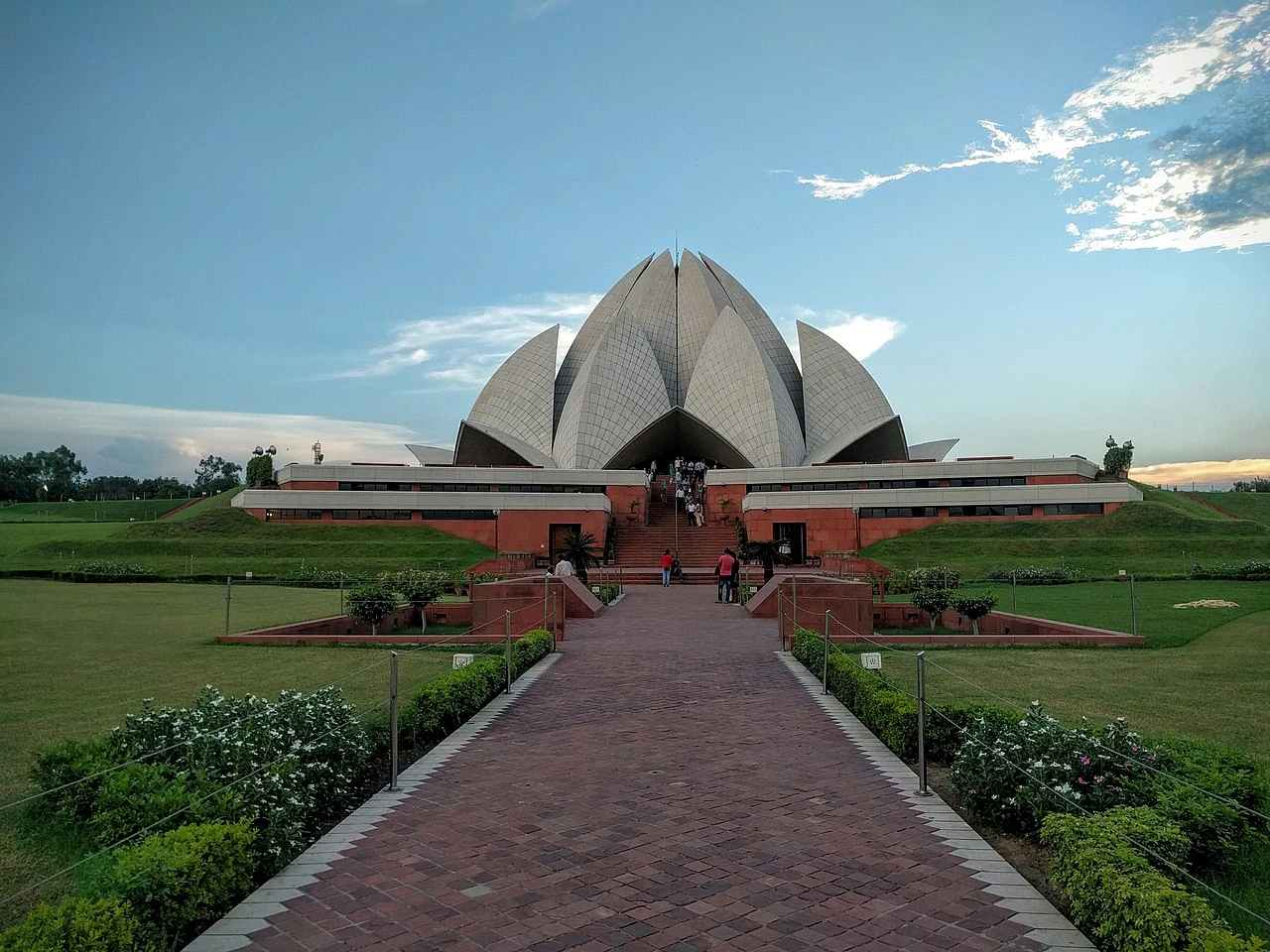
Delhi
Lotus Temple
Content & sources
C Jaideep · CC BY-SA 4.0
Delhi
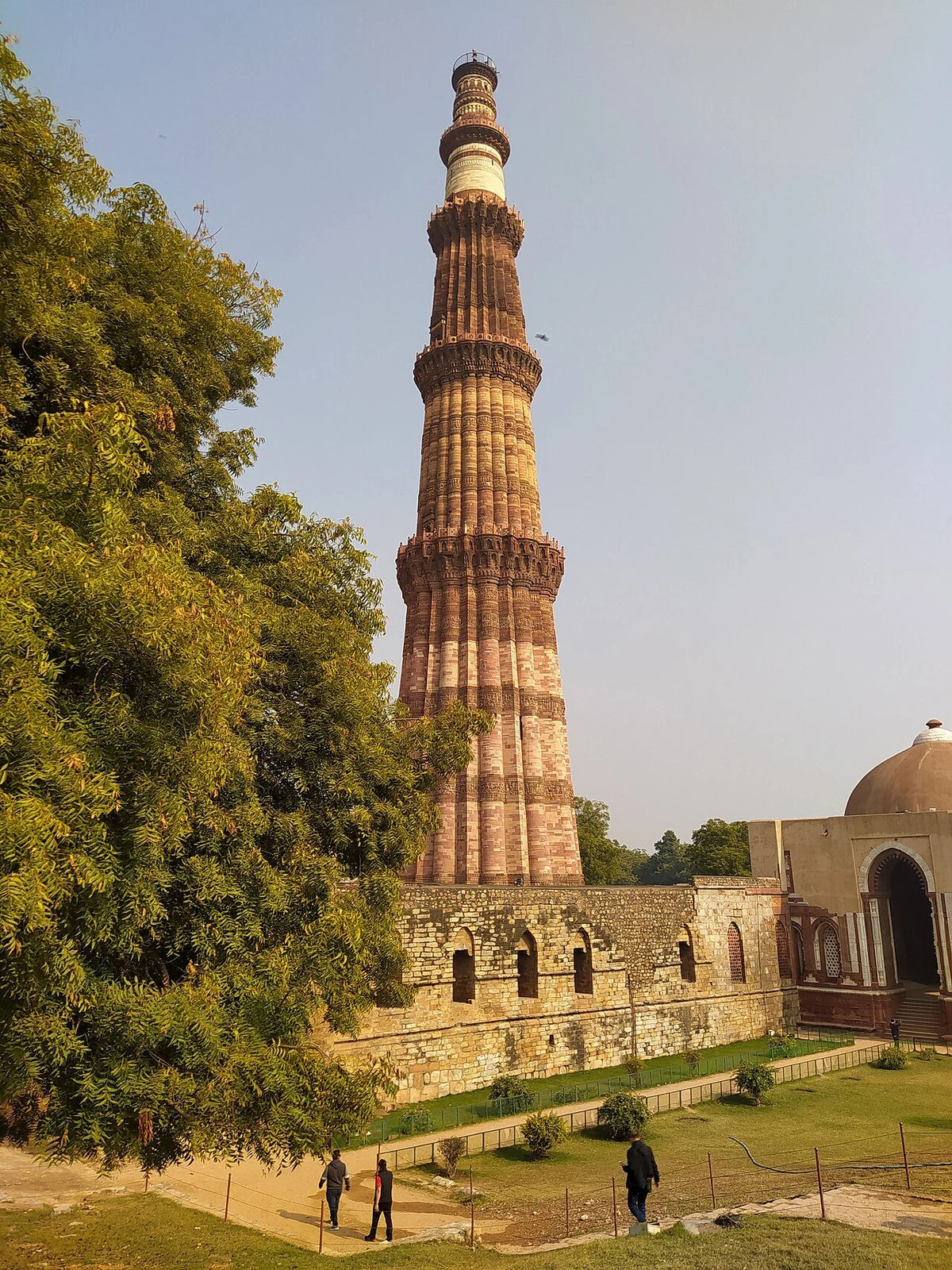
Qutb Minar
Content & sources
Photo: Akbarzoda · CC BY-SA 4.0
Delhi
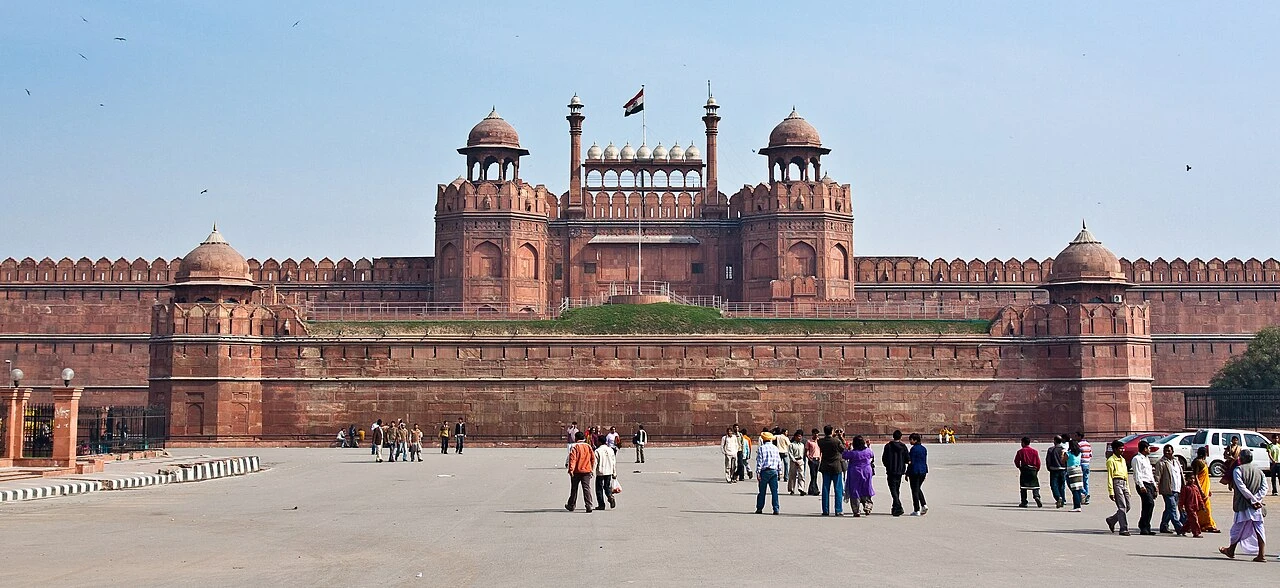
Red Fort
Content & sources
Photo: PerSona77 · CC BY-SA 3.0
Agra
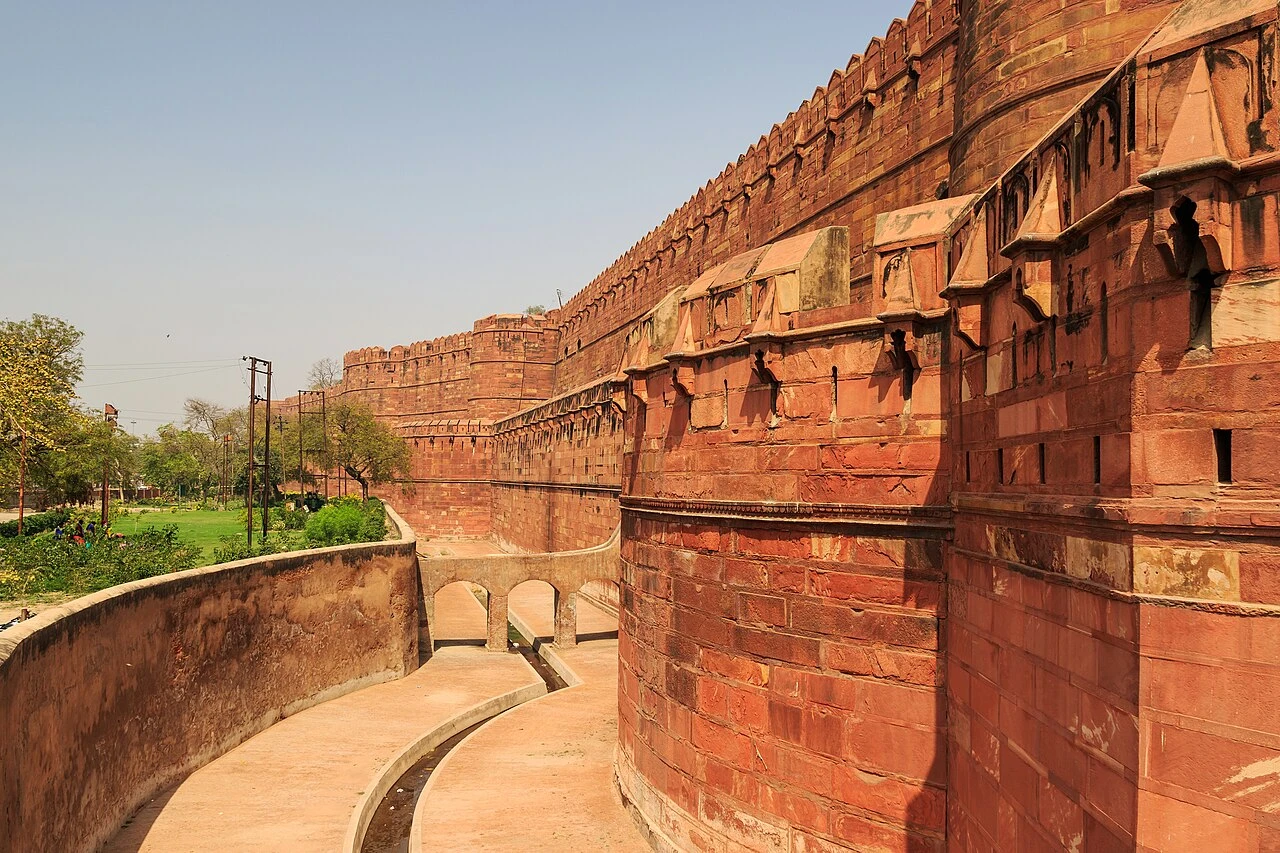
Agra Fort
Content & sources
Photo: A.Savin · FAL