Stanza · Audio guide
Bhimbetka rock shelters Audio Guide
A place to remember. A story to take with you.
The Bhimbetka rock shelters are an archaeological site in central India that exhibit the earliest traces of human life in the region. This UNESCO World Heritage Site spans the Paleolithic and Mesolithic…
Download Stanza, then search for “Bhimbetka rock shelters”.
About the tour
One guide. Your kind of visit.
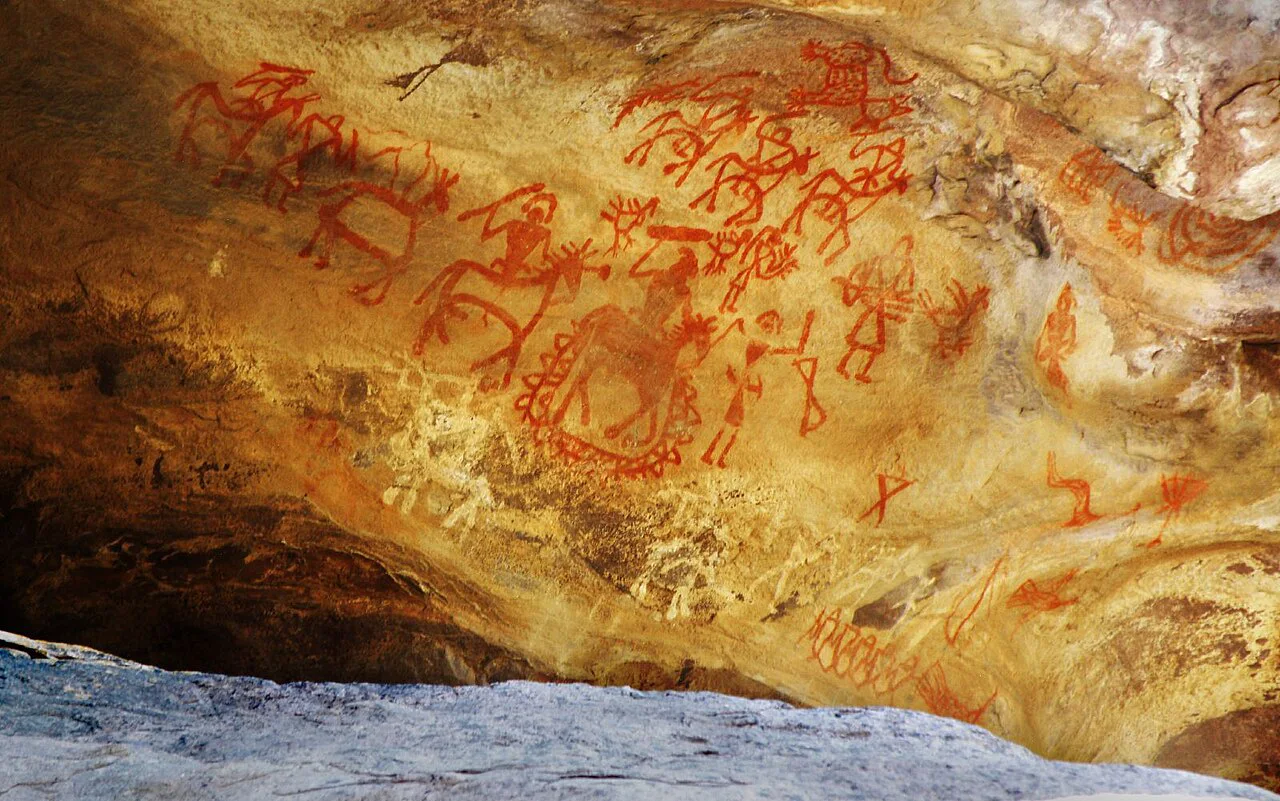
The Bhimbetka rock shelters are an archaeological site in central India that exhibit the earliest traces of human life in the region. This UNESCO World Heritage Site spans the Paleolithic and Mesolithic periods and contains over 750 rock shelters.
Ready when you are.
- 01Get the free Stanza app.
iOS & Android
- 02Find your guide.
“Bhimbetka rock shelters”
- 03Download before you go.
Works offline
Audio guide / 14 narrated stops
Inside the guide
Get to know a few of the stories before you go. Open a stop to read more.
01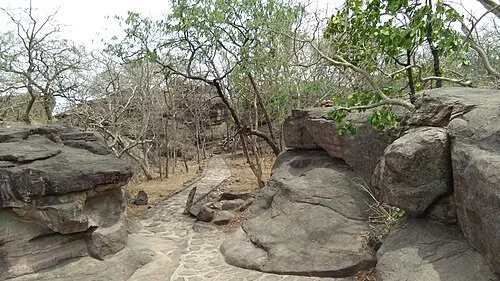 Entrance Pathway and Forest Approach
Path to the Shelters
Welcome to Bhimbetka, a forest of sandstone outcrops about forty-five kilometres south-east of Bhopal, in the Vindhya Range. The name comes from an old local legend. Bhimbetka means Bhima's resting place, after the mighty Pandava brother of the Mahabharata. The story goes that Bhima sat here during his exile and talked with the people of the forest. That legend is belief, not history, but the stones themselves hold a far older story. People sheltered here for tens of thousands of years, and they painted on the walls. A British official, W. Kincaid, first mentioned the place in a scholarly paper in 1888, working from accounts he gathered from local adivasi communities. The real discovery came later. In 1957 the archaeologist V. S. Wakankar saw these rock formations and was struck by how much they resembled ones he had studied in Spain and France. He returned with a team of archaeologists and reported prehistoric rock shelters here.
Photo: Umang21079 · CC BY-SA 4.0
02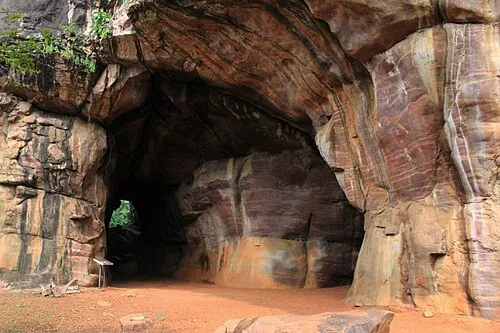 The Auditorium Cave (Cave 3)
Auditorium Cave - The Gathering Place
Seven hills carry the rock shelters of Bhimbetka: Vinayaka, Bhonrawali, Bhimbetka, Lakha Juar on its east and west sides, Jhondra and Muni Babaki Pahari. Across them lie more than seven hundred numbered shelters. They spread over roughly ten kilometres. The archaeological literature puts the exact count at seven hundred and fifty-four. Nearly five hundred of those places carry paintings. None of this was built. Wind and water wore the sandstone into overhangs and chambers, and people simply moved in, generation after generation. The largest shelter of them all is the Auditorium rock, and its quartzite towers rise high enough to be seen from several kilometres away. Robert Bednarik, an archaeologist who studied the site, described its atmosphere as cathedral-like, with Gothic arches and soaring spaces. It forms the central feature of the whole complex, with the painted shelters fanning out on either side. Some of these caves were inhabited more than a hundred thousand years ago.
Vijay Tiwari · CC BY-SA 4.0
03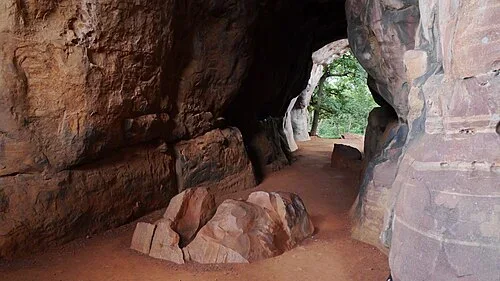 The Auditorium Cave (Cave 3)
Auditorium Cave No. 3 and the Chief's Rock
The Auditorium cave earned its name from its shape. Its plan resembles a right-angled cross, with four branches aligned to the four directions of the compass. The main entrance faces east. At the end of the eastern passage stands a boulder with a near-vertical face, distinctive enough to be picked out from a distance and from every direction. Archaeologists have dubbed it Chief's Rock, or King's Rock. The grand title can mislead. There is no evidence that the boulder ever played a part in any ceremony, or that it held any official role. The name is a modern label for a striking landmark, not a memory of a prehistoric chief.
Listen in the appDinesh Valke from Thane, India · CC BY-SA 2.0
04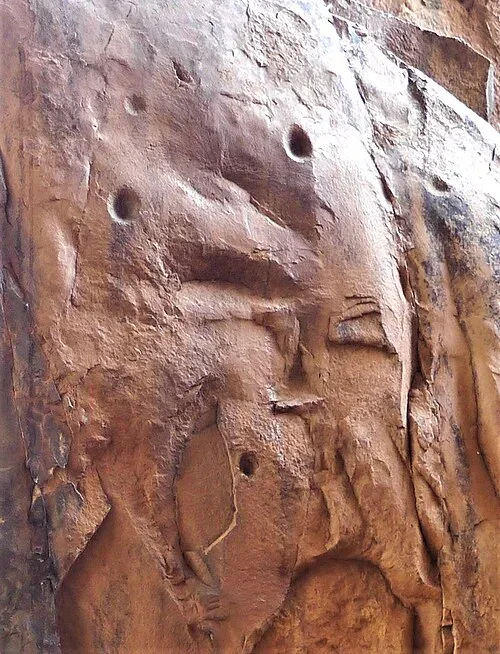 The Ancient Cupules of Auditorium Cave
The Ancient Cupules
Pecked into the hard quartzite of this cave are small round hollows, known as cupules. Each one was made by deliberate pounding, blow after blow, in stone that does not give way easily. Markings like these are counted among the oldest human-made rock features known anywhere, made long before anyone here painted an animal. The same cave carries a modern cautionary tale. In 2020, researchers reported a remarkable find on the roof of the Auditorium cave. It was the fossil of Dickinsonia, an early animal from some five hundred and fifty million years ago. The report fed grand conclusions about how the ancient continents formed. Then came a closer look. The supposed fossil turned out to be the decayed remains of a giant honeybee hive. Even experienced eyes can misread these stones, worth remembering before every other painting on this trail.
Listen in the appDinesh Valke from Thane, India · CC BY-SA 4.0
05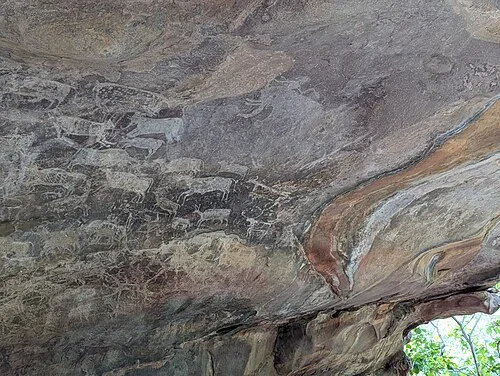 The Zoo Rock (Cave 4)
The Zoo Rock Herd
White figures crowd the ceiling of this shelter: elephants, bison, deer and the barasingha, the swamp deer. This packed shelter is popularly called Zoo Rock, a single canvas holding the creature-world of the painters. A careful study by Yashodhar Mathpal identified the species across the site. Deer and antelope turn up more often than anything else. Alongside them he found sloth bear, wolf, rhinoceros, wild cattle, monkeys and peafowl, and one domesticated dog. Whoever painted these animals knew them at close quarters, in motion and at rest. The herd on this ceiling is characteristic of that crowded Zoo Rock style, where the creatures nearly overlap.
Listen in the appPhoto: AuraLabHatUrn · CC BY-SA 4.0
06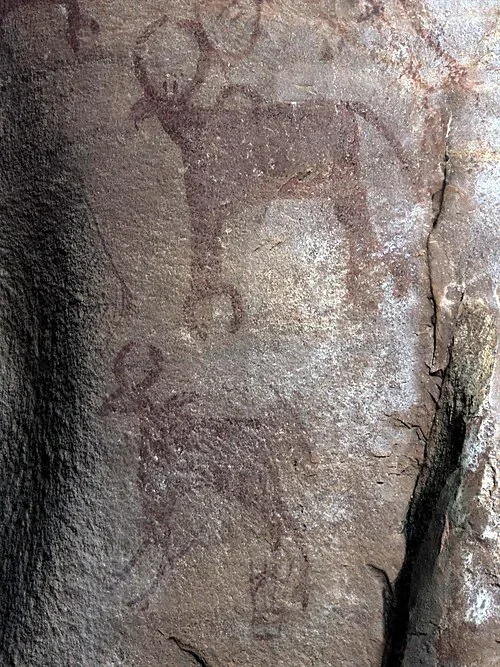 The Zoo Rock (Cave 4)
Deer in Hematite Red
The red deer here were painted with ground hematite, an iron ore that gives a deep, lasting red. Black came from manganese oxides and from charcoal, and other colours from plants. These are vegetable and mineral colours, ground and painted straight onto the stone, yet they have endured for millennia. The reason is where they were placed. The painters generally worked deep inside a niche or on an inner wall, out of the rain and the direct sun. V. S. Wakankar sorted the whole collection into seven periods. The earliest he dated to the Upper Palaeolithic, linear figures in green, dancing and hunting, as long ago as forty thousand years. Other estimates put the oldest paintings far later, around ten thousand BCE, and the latest geometric figures run into the medieval age. That long sequence is the thread this trail follows, from the first hunters to the last painters.
Listen in the appPhoto: Vu2sga · CC BY-SA 4.0
07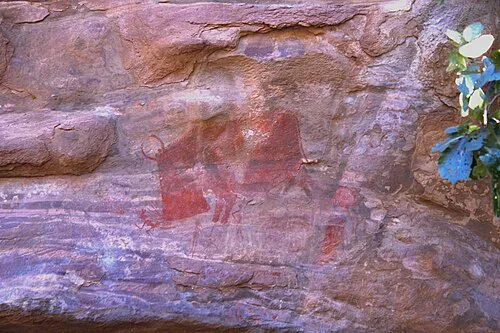 The Boar Rock
One animal dominates this shelter, painted large in red, and the place is known by it as the Boar Rock. The figure reads as a boar to some eyes, a horned wild bovine to others, and the identification is genuinely open. What is not in doubt is the scale. In these Mesolithic paintings the animals often dwarf the humans beside them, and the contrast appears deliberate. People are drawn small and stylised, with linear decoration running across their bodies. The beasts get the monumentality. A single creature, charged with size and presence, could name a whole shelter and hold the name for thousands of years.
Listen in the appKuldeepsingh Mahawar · Public domain
08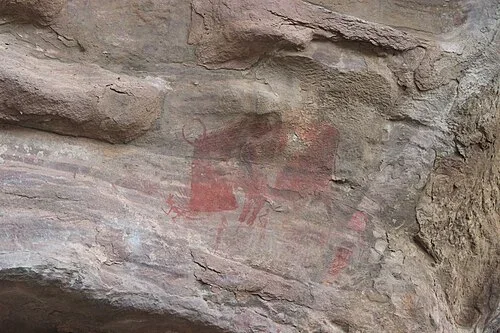 The Boar Rock
The Hunter and the Beast
Hunting at Bhimbetka is told as story, not as list. In one famous panel a bison turns on the hunter who has faced it, while two companions stand helplessly nearby. Yashodhar Mathpal noticed another group running flat out from a rhinoceros, and others stalking deer and antelope. The painters record the tools as clearly as the drama: bows and arrows, barbed spears, pointed sticks, shields. Not every scene is a chase. Fish and turtle are shown caught in nets, and rats are driven from their burrows to be seized. Read together, the panels are composed narratives, with danger, teamwork, failure and success. The hunters sometimes lose, and the painters did not hide it.
Listen in the appSanmarga Mitra · CC BY-SA 4.0
09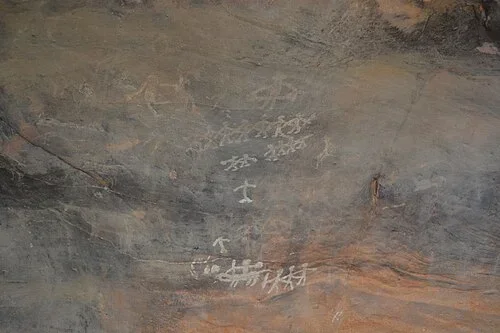 The Dancing Figure Cave
Dancers in White
White stick figures dance across this ceiling, arms linked, bodies leaning into the movement. The Mesolithic paintings here record far more than food and danger. They show communal dances, birds, musical instruments, mothers and children, pregnant women, men carrying dead animals back to camp, drinking scenes and burials. All of it is rendered in rhythmic movement, figures arranged as if caught mid-step. These panels give early evidence of dance in Indian art. Which figures mark a burial or a specific ritual is a matter of scholarly reading rather than proof. What is certain is that the people who painted them were recording themselves, together.
Listen in the appPhoto: Nandanupadhyay · CC BY-SA 3.0
10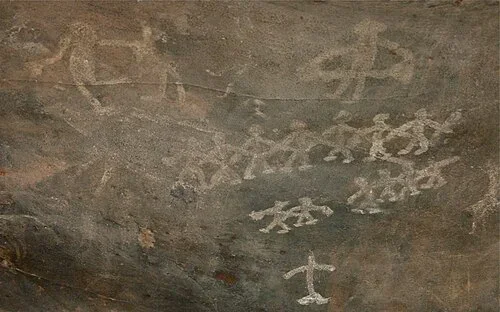 The Dancing Figure Cave
The Musician and the Dancers
Roughly twenty dancers fill this panel, some in lines, some apart, and one figure stands out as a musician. Musical instruments appear in these Mesolithic scenes, so the dancing had sound. V. S. Wakankar, the archaeologist who first reported these shelters, left his own affectionate mark on the site. In one of the desolate shelters he found a painting of a man dancing while holding a trident-like staff. He nicknamed the figure Nataraja, after Shiva, the cosmic dancer of Hindu tradition. The name is the archaeologist's, not the painter's, made thousands of years apart. Still, it draws a line from these prehistoric dancers to the sacred imagination that later settled over this landscape.
Listen in the appNagarjun Kandukuru · CC BY 2.0
- 11
The War Scene
Riders, swords and sky chariots, when the walls turned from hunting stories to battles between rulers.
- 12
From Hunters to Horsemen
The whole arc of Bhimbetka in one panel: from stick-figure hunters to armed horsemen, backed by the dig in the dirt.
- 13
The Tortoise in Stone
A rock shaped like a tortoise by wind and water alone, and the dates that put Bhimbetka on the world list.
- 14
View from the Shelters
The wide view over forest and plain, where more than a hundred thousand years of human presence comes into focus.
Bhimbetka rock shelters
Frequently asked questions
How much does the guide cost?
Free app download. Listed guide price: $1.99. Guide price shown in the app. Audio guide only. Venue admission is separate.
Can I listen without internet?
Yes. Download the guide’s audio, images, and maps in the app before your visit. Your downloaded content is then available offline.
Can I listen in my language?
This audio guide is available in 15 languages, including English.
Do I need to follow a schedule?
No. This is a self-guided experience. Choose your stops, pause whenever you like, and return to a story at your own pace.
At your own pace
Explore Bhimbetka rock shelters.
Download Stanza, then search for “Bhimbetka rock shelters”.
Free app download · Guide price shown in the app
Keep exploring
Audio guides — India
Pithampur Tahsil
Mandu, Madhya Pradesh
Content & sources
Bernard Gagnon · CC BY-SA 3.0
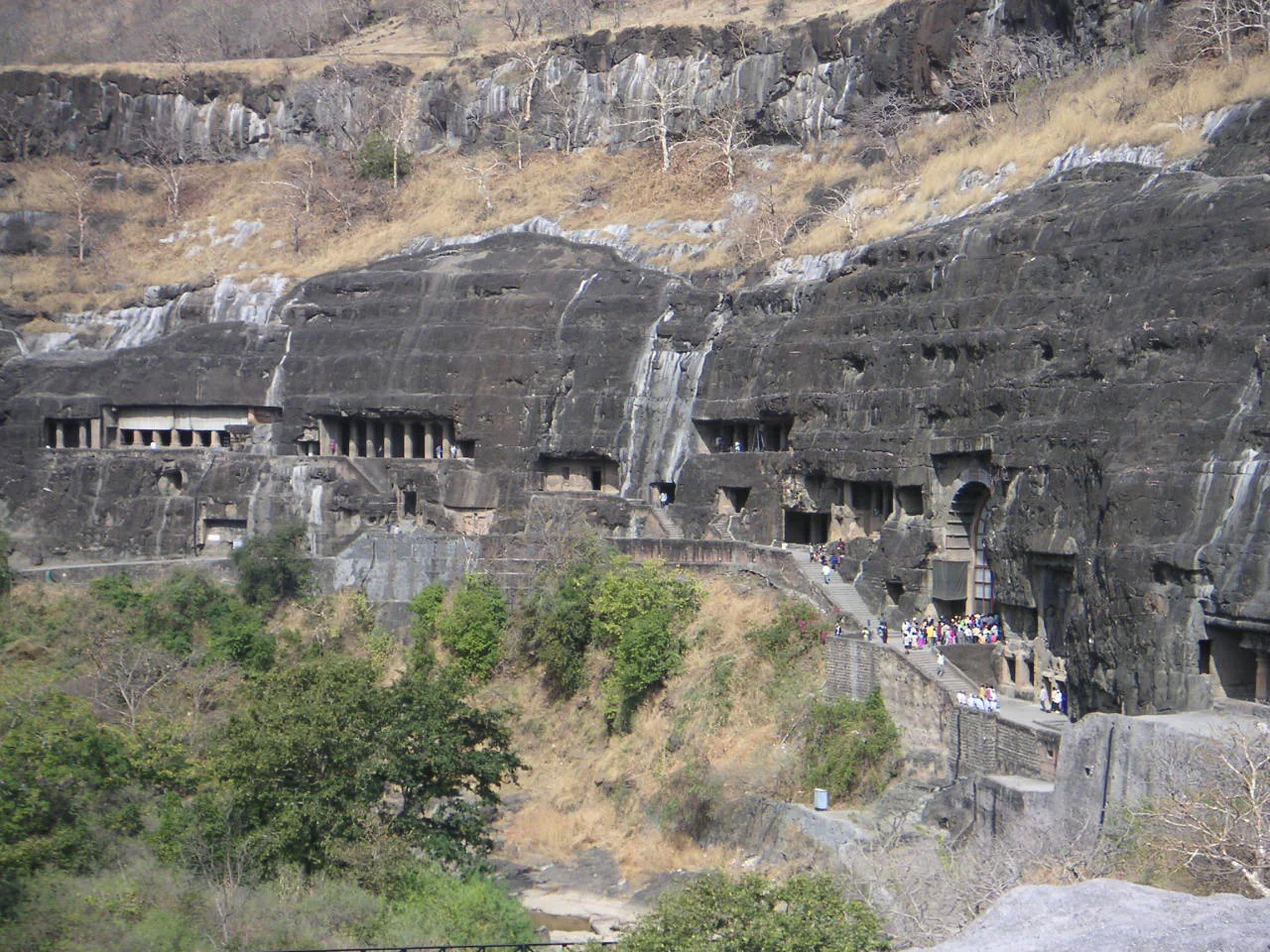
Aurangabad district
Ajanta Caves
Content & sources
No machine-readable author provided. Soman assumed (based on copyright claims). · CC BY 2.5
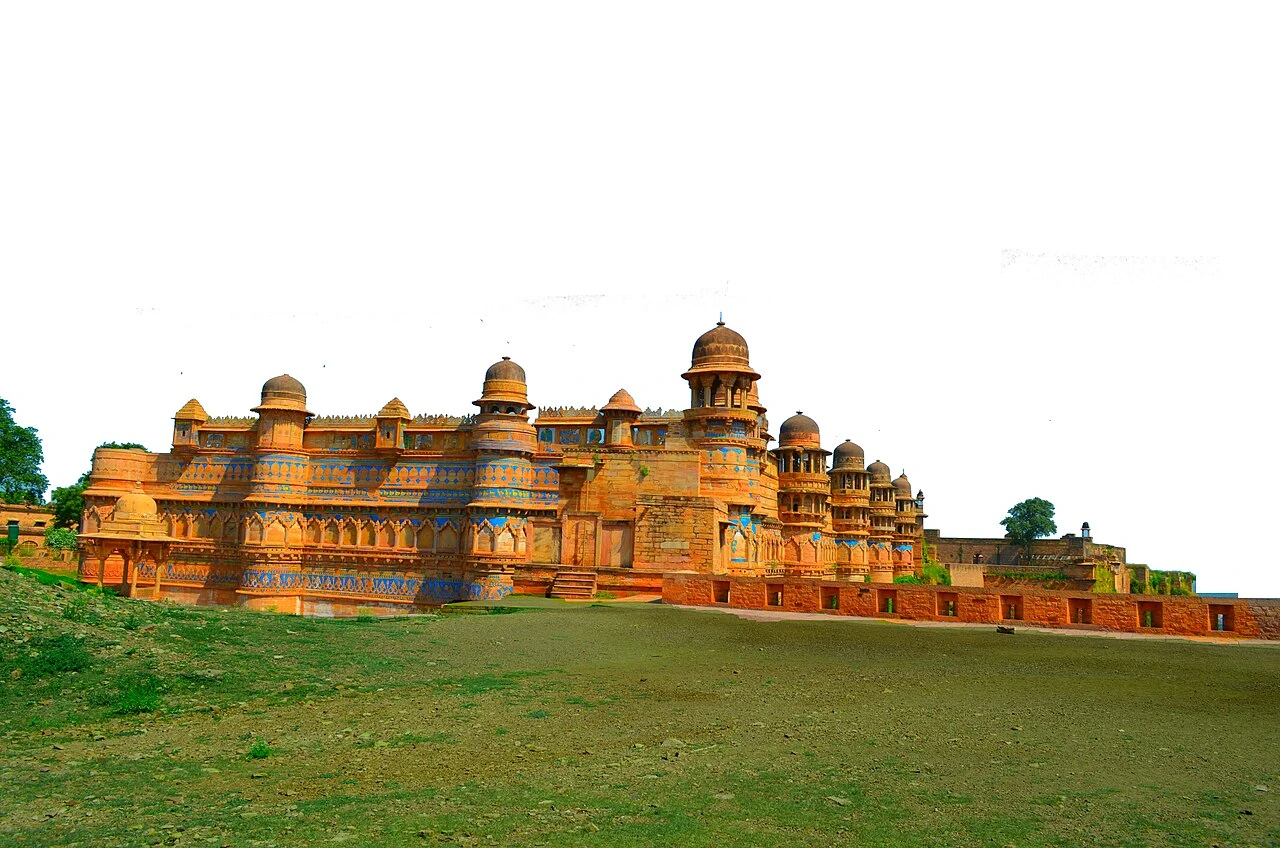
Gwalior
Gwalior Fort
Content & sources
Abhishek Dwivedi · CC BY-SA 4.0
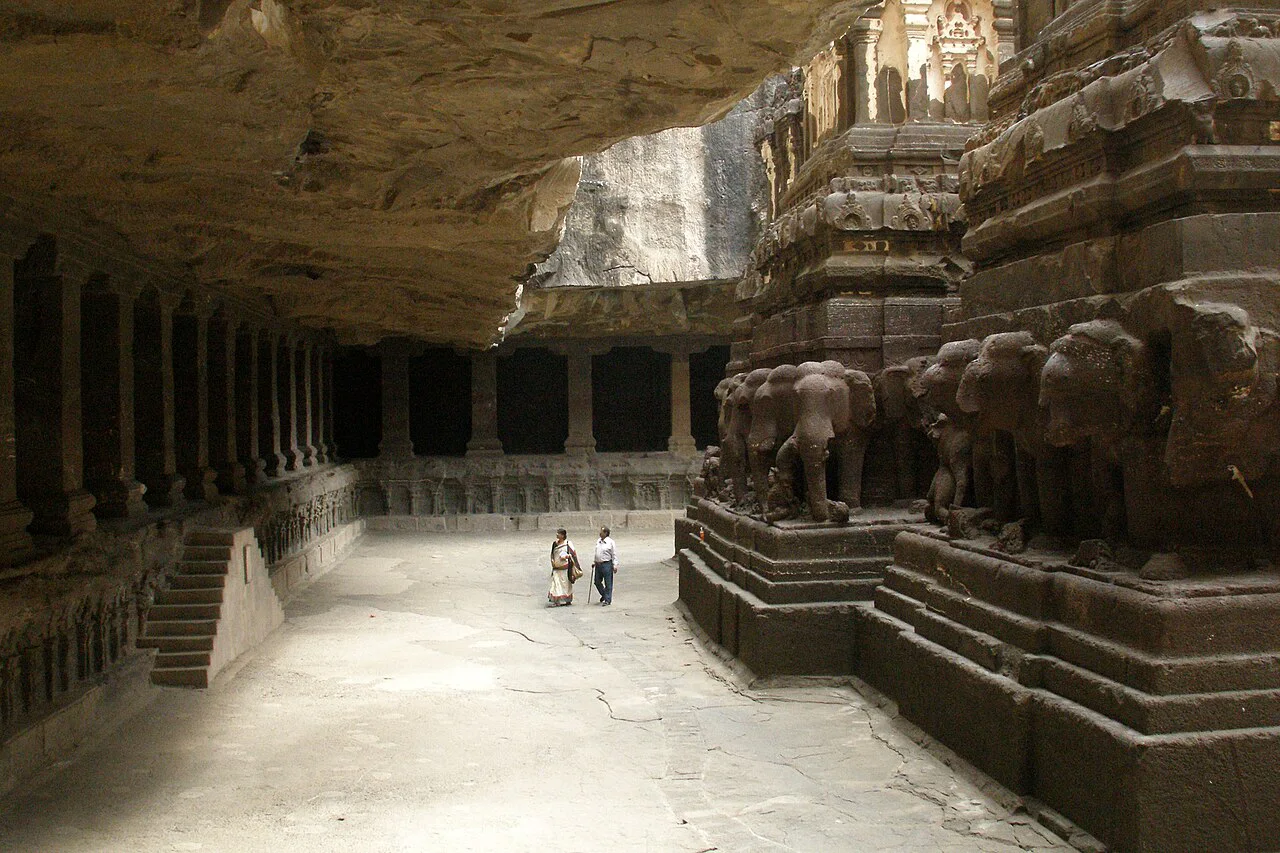
Aurangabad district
Ellora Caves
Content & sources
Vyacheslav Argenberg · CC BY 4.0