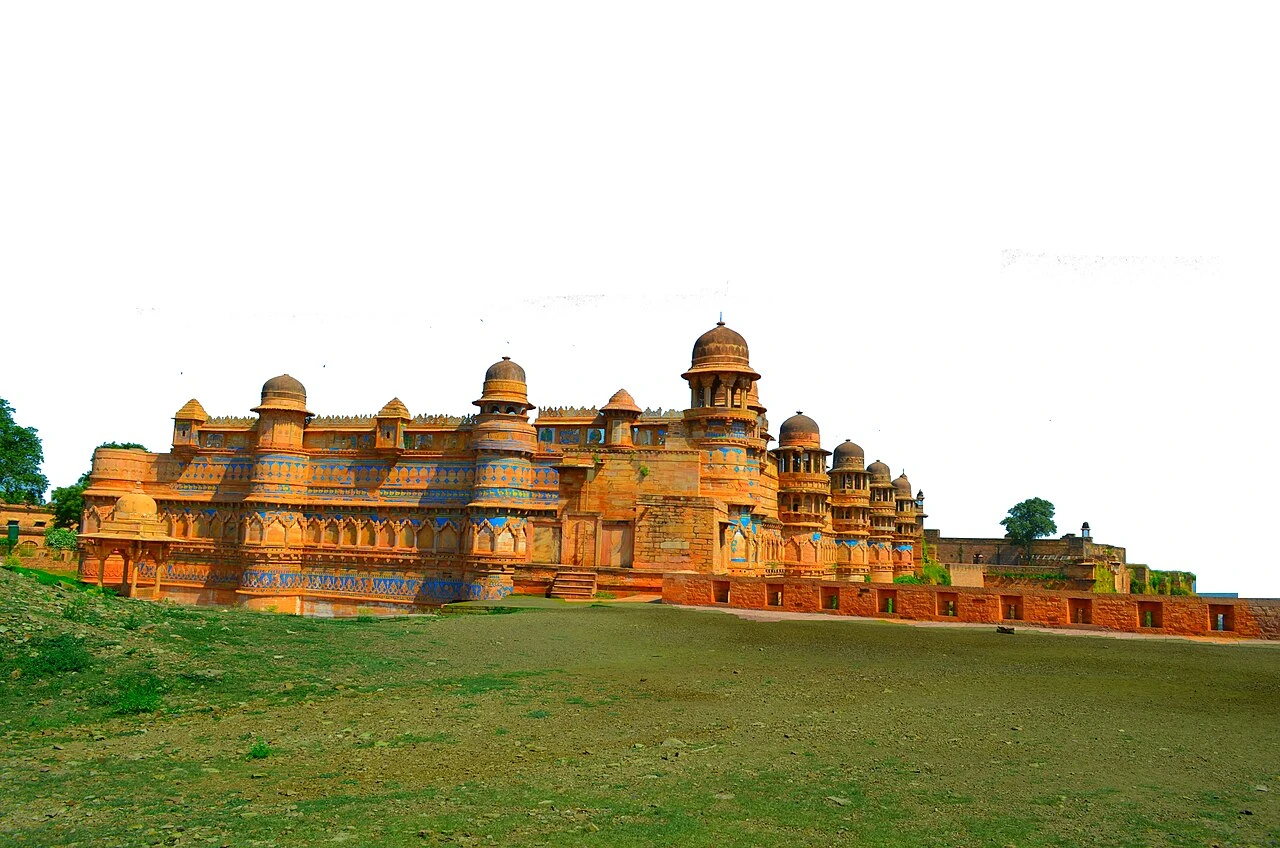
Stanza · Audio guide
Gwalior FortAudio guide
A place to remember. A story to take with you.
Gwalior Fort is a historic hill fortress located in Gwalior, Madhya Pradesh, India. This large defensive structure has witnessed numerous battles and served as a strategic point for various empires.
Download Stanza, then search for “Gwalior Fort”.
About the tour
One guide. Your kind of visit.
Gwalior Fort is a historic hill fortress located in Gwalior, Madhya Pradesh, India. This large defensive structure has witnessed numerous battles and served as a strategic point for various empires.
Ready when you are.
- 01Get the free Stanza app.
iOS & Android
- 02Find your guide.
“Gwalior Fort”
- 03Download before you go.
Works offline
Audio guide / 32 narrated stops
Inside the guide
Get to know a few of the stories before you go. Open a stop to read more.
01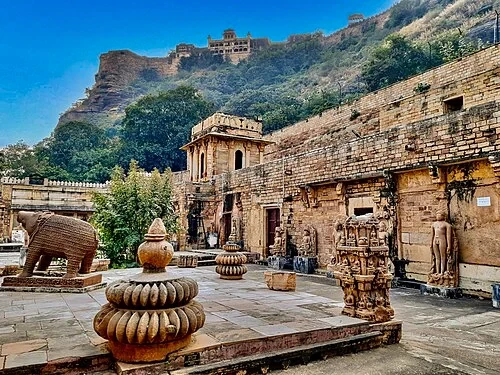 Gujari Mahal Archaeological MuseumGujari Mahal Archaeological Museum
Welcome to the Gujari Mahal, a grand palace built in the 15th century by Raja Man Singh Tomar for his favorite queen, Mrignayani. She was a peasant woman from the Gujar clan who captivated the king with her courage and beauty. However, she only agreed to marry him on three firm conditions: she would never live in seclusion behind a veil, she would always have access to fresh water from her home village, and she would always accompany him into battle. To respect her first rule, the king built this separate palace for her outside the main fort walls. Today, the structure houses a renowned archaeological museum, but its layout still reflects its royal beginnings. Notice the central courtyard, a hallmark of traditional palace design, which now provides a spacious setting for ancient stone carvings. This space was once a private sanctuary for the queen, designed to offer comfort and independence away from the formal restrictions of the main court. The palace remains a significant example of Tomar architecture, combining defensive strength with the elegance required for a royal residence.
Photo: Ms Sarah Welch · CC0
02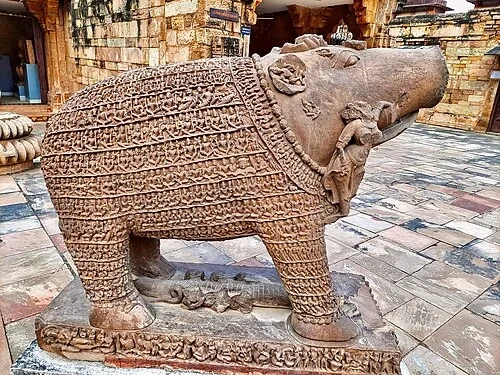 Gujari Mahal Archaeological MuseumThe Great Monolithic Boar
This massive 9th-century sculpture depicts Varaha, the boar incarnation of the god Vishnu. Carved from a single block of sandstone, it was brought here from an ancient temple site in Badoh-Pathari. Take a moment to examine the boar's body in detail. You will find it is covered in over 1,000 tiny, perfectly rendered figures. These carvings represent the sages, gods, and constellations that make up the universe, symbolizing how the divine supports all existence. In Hindu mythology, Varaha is the savior of the Earth. According to the legend, a demon had dragged the Earth to the bottom of the cosmic ocean. Vishnu took the form of this powerful boar to dive deep and rescue the world. If you look near the snout, you can see the Earth goddess, Bhudevi, clinging safely to one of his tusks. The sheer scale and density of the carvings demonstrate the incredible skill of medieval Indian sculptors, who transformed a solid block of stone into a crowded, symbolic narrative. The heavy legs and powerful stance of the animal convey the strength required for his mythological feat.
Photo: Ms Sarah Welch · CC0
03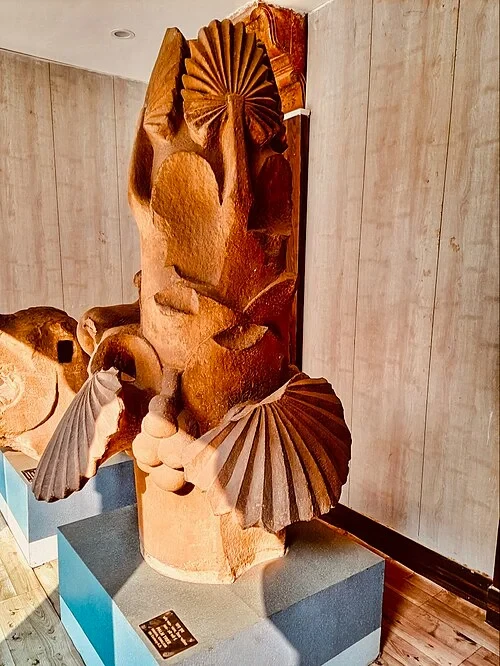 Gujari Mahal Archaeological MuseumAncient Fan Palm Pillar
Among the many religious artifacts here, this stone fragment stands out for its unique, nature-inspired design. Dating back to the 1st or 2nd century, this piece is a 'capital,' which served as the decorative top of a large pillar. It is expertly carved to resemble a fan palm tree, an unusual choice for architectural elements of that era. You can clearly see the detailed, radiating fronds and the heavy, realistic clusters of fruit hanging from the center. In ancient India, the palm tree was a symbol of physical strength and was closely associated with Balarama, the brother of Krishna. Balarama is often depicted with a palm tree on his banner. This artifact is particularly significant because it represents a rare survival of non-religious or secular motifs from the early historical period. While most surviving stone works from this time depict gods or devotees, this pillar capital focuses on the local flora. The craftsmanship reveals how early builders drew direct inspiration from the natural world to create monumental structures that were both symbolic and visually grounded in their environment.
Listen in the appPhoto: Ms Sarah Welch · CC0
04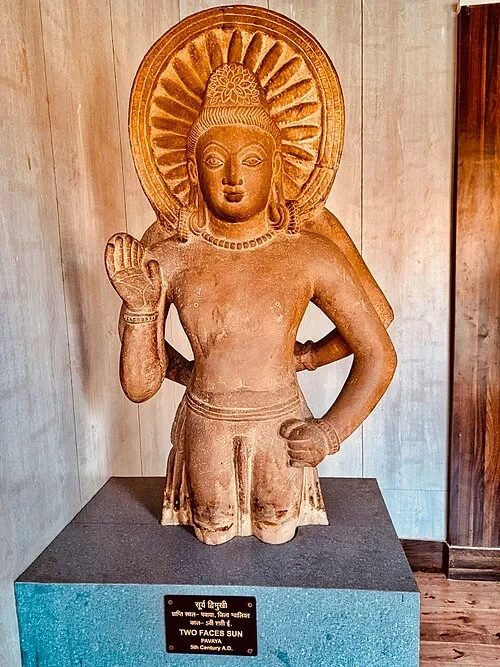 Gujari Mahal Archaeological MuseumThe Sun God in Boots
This 5th-century statue depicts Surya, the Hindu Sun God, and it holds two very surprising details that set it apart from typical Indian iconography. First, notice that Surya is represented with 'two faces' carved back-to-back. Second, look down at his feet. Unlike most Indian deities who are almost always shown barefoot, Surya is clearly wearing knee-high boots. This unusual footwear is a fascinating stylistic marker of the time. It reflects the influence of Central Asian and Scythian cultures that traveled along the Silk Road and left an imprint on Indian art during the Gupta period. The boots were traditionally associated with the attire of Northern peoples, which the sculptors incorporated into Surya’s divine image to emphasize his solar, far-reaching nature. Behind the god’s head, you can see a large circular halo, which represents the radiating disk of the sun itself. The figure is carved with a sense of calm and stability, typical of the 5th-century style. This object serves as a stone record of how trade and cultural exchange influenced the way people visualized their gods over fifteen hundred years ago.
Listen in the appPhoto: Ms Sarah Welch · CC0
05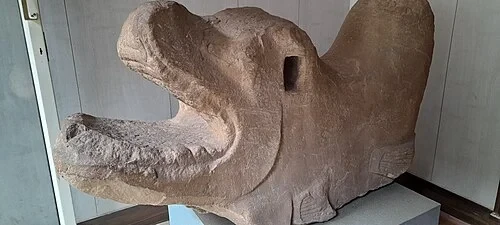 Gujari Mahal Archaeological MuseumThe Ancient Stone Crocodile
This heavy stone sculpture represents a 'Makara,' a mythical sea creature from Indian tradition that bears a strong resemblance to a crocodile. Carved around 200 BC, it is among the oldest and most significant objects in the museum's collection. In Hindu and Buddhist iconography, the Makara is the 'vahana,' or sacred vehicle, of the river goddess Ganga. Notice the creature's wide-open, toothy jaws and the heavy, blocky carving style. These features are characteristic of the Mauryan or Shunga periods, an era when stone sculpture was beginning to evolve into the grand styles seen in later centuries. This specific Makara originally stood as a decorative and symbolic element on a gateway in the ancient city of Besnagar. Its presence at a gateway was meant to invoke the purifying power of the river. The textured skin and the curled tail, though worn by time, still convey a sense of primal energy. Objects like this provide a direct link to the earliest days of permanent stone architecture in India, showing how mythical animals were integrated into the very fabric of urban and religious life.
Listen in the appPhoto: Sakshi batham · CC BY 3.0
06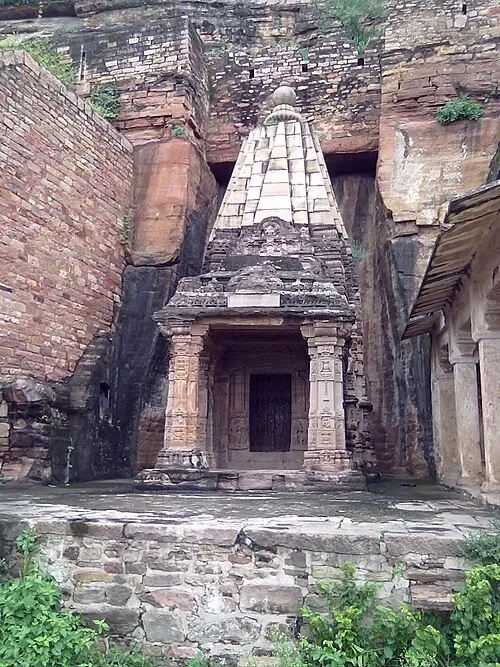 Chaturbhuj TempleChaturbhuj Temple
The Chaturbhuj Temple is a remarkable feat of engineering and artistry from the year 875. Unlike most buildings that are constructed by stacking stone blocks, this entire structure was created through a process of subtraction. Sculptors started with the solid cliff face and chipped away the excess rock to reveal the temple inside. This makes the building essentially a massive, hollowed-out sculpture that you can actually walk into. The temple is dedicated to Vishnu, often referred to here as 'Chaturbhuj,' a Sanskrit name meaning 'Four-Armed.' As you approach, notice how the temple emerges directly from the living rock of the hillside. The exterior is decorated with intricate carvings, including figures of deities and celestial beings, all of which are part of the same original stone mass. This method of rock-cut architecture required immense planning, as a single mistake in carving could not be easily corrected. It stands as a profound example of the dedication and skill of the Gurjara-Pratihara artisans who transformed the rugged landscape into a site of spiritual significance. The temple serves as a permanent, immovable fixture of the Gwalior plateau.
Listen in the appPhoto: Geek 007 · CC BY-SA 3.0
07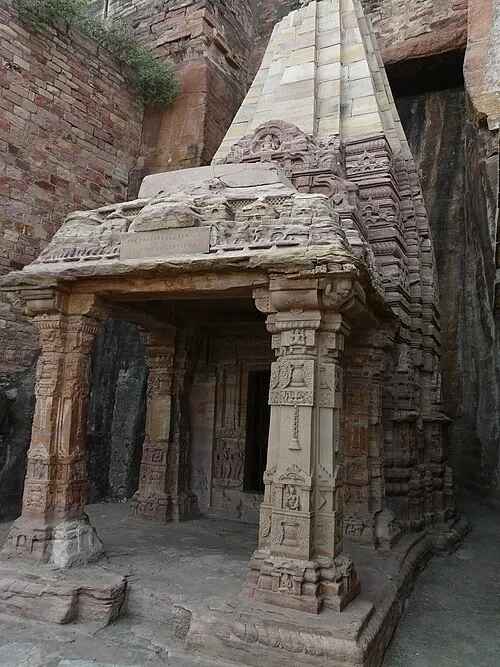 Chaturbhuj TempleThe Birthplace of Zero
Inside the Chaturbhuj Temple, look for a small stone tablet set into the wall. This unassuming inscription from the 9th century is a major landmark in the global history of mathematics. The text records a donation of land and flowers to the temple, specifying measurements and quantities. If you look closely at the numbers carved into the stone, you will see a small, clear circle. This is the second-oldest known written example of the digit '0' in the world. Before the concept of zero was formalized as a digit, it was often represented by a gap or a placeholder, rather than a specific symbol with its own numerical value. The development of zero as a number changed the way humanity understood math, science, and trade, making complex calculations possible. This specific carving provides physical evidence of India’s central role in developing the decimal system we use today. It is a quiet but powerful reminder of how a simple geometric shape on a temple wall in Gwalior became one of the most foundational tools of modern civilization.
Listen in the appVarun Shiv Kapur from New Delhi, India · CC BY 2.0
08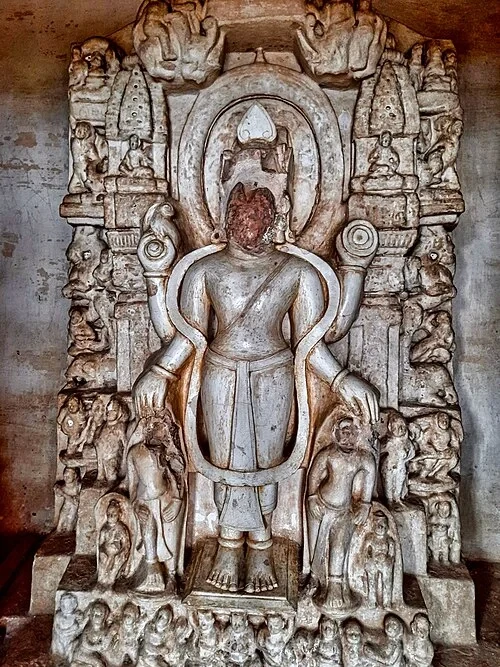 Chaturbhuj TempleThe Inner Idol of Vishnu
Located in the innermost sanctuary of the temple is the main deity, carved directly into the back wall of the rock. This figure represents the four-armed Vishnu, the namesake of the temple. Over the course of twelve hundred years, the statue has been heavily eroded by the elements and partially damaged, but the four arms are still clearly visible. Notice the bright red marks on the face and body. This is 'sindoor,' or vermilion, applied by modern worshippers who visit the site today. This reminds us that the Chaturbhuj Temple is not merely an archaeological relic but a living shrine that continues to be part of the community's spiritual life. The presence of these modern offerings creates a stark contrast against the ancient, weathered sandstone. Despite the loss of fine detail on the face and torso, the figure maintains a sense of quiet authority within the small, dark chamber. The deep shadows of the sanctuary emphasize the form of the deity, which was once sharply defined by the hands of 9th-century craftsmen. It remains a powerful symbol of endurance, surviving centuries of transition on the Gwalior plateau.
Listen in the appPhoto: Ms Sarah Welch · CC0
09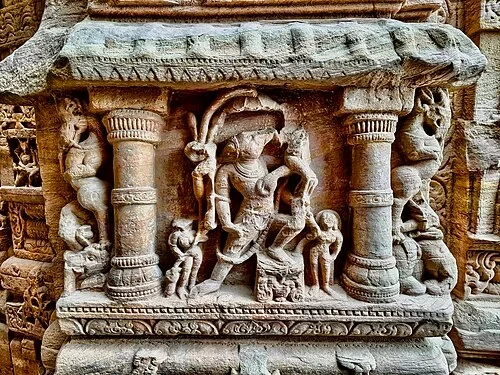 Chaturbhuj TempleVaraha Relief Carving
On the exterior of the temple, you can find this detailed relief carving of Varaha, the boar-headed incarnation of Vishnu. The scene depicts the moment Varaha rescues the earth goddess from the depths of the ocean. Notice how the sculptor utilized the depth of the rock face to create a dynamic sense of movement, with the powerful figure of the god stepping forward. Surrounding the central figure are smaller carvings of heavenly attendants and deities who are depicted as witnessing this miraculous event. The texture of the sandstone here is particularly interesting; it shows the visible effects of over a millennium of exposure to harsh mountain winds and monsoon rains. This weathering has softened the edges of the figures, giving them a timeless, organic appearance that blends into the cliffside. The play of light and shadow across the relief changes throughout the day, bringing different details of the divine rescue mission into focus. This carving serves as a monumental illustration of a core Hindu myth, literally etched into the foundation of the fort itself, ensuring the story remains visible to all who pass by.
Listen in the appPhoto: Ms Sarah Welch · CC0
10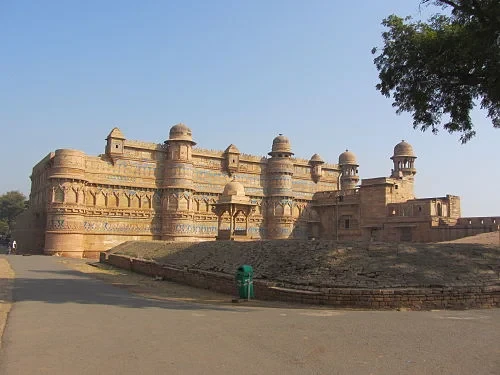 Man Singh PalaceMan Singh Palace
Built around 1500, the Man Mandir Palace is one of the most striking sights within Gwalior Fort. It is famous for the vibrant turquoise, yellow, and green tiles that decorate its exterior walls, giving the fort a unique and colorful appearance. Unlike the monochromatic stone used in most Indian fortresses of the period, this palace was designed to be a riot of color and light. Its beauty was so widely recognized that when the first Mughal Emperor, Babur, visited the site, he famously described it as the 'pearl among the fortresses of India.' Look up at the architecture of the facade; you will see massive circular towers topped with elegant domed cupolas, or 'chhatris.' The palace served as both a residence and a symbolic statement of Raja Man Singh Tomar’s power and taste. The blend of Hindu and early Islamic architectural elements seen here proved to be highly influential, setting a standard for royal residences across northern India. Even today, the brilliant blue tiles catch the sunlight, providing a glimpse of the splendor that once characterized the height of the Tomar dynasty's reign.
Listen in the appPhoto: Sanchari5491 · CC BY-SA 3.0
Gwalior Fort
Frequently asked questions
How much does the guide cost?
Free app download. Listed guide price: $2.99. Guide price shown in the app. Audio guide only. Venue admission is separate.
Can I listen without internet?
Yes. Download the guide’s audio, images, and maps in the app before your visit. Your downloaded content is then available offline.
Can I listen in my language?
Stanza supports 15 languages. Check the app for the languages available for this guide.
Do I need to follow a schedule?
No. This is a self-guided experience. Choose your stops, pause whenever you like, and return to a story at your own pace.
At your own pace
Explore Gwalior Fort.
Download Stanza, then search for “Gwalior Fort”.
Free app download · Guide price shown in the app
Keep exploring
Nearby audio guides
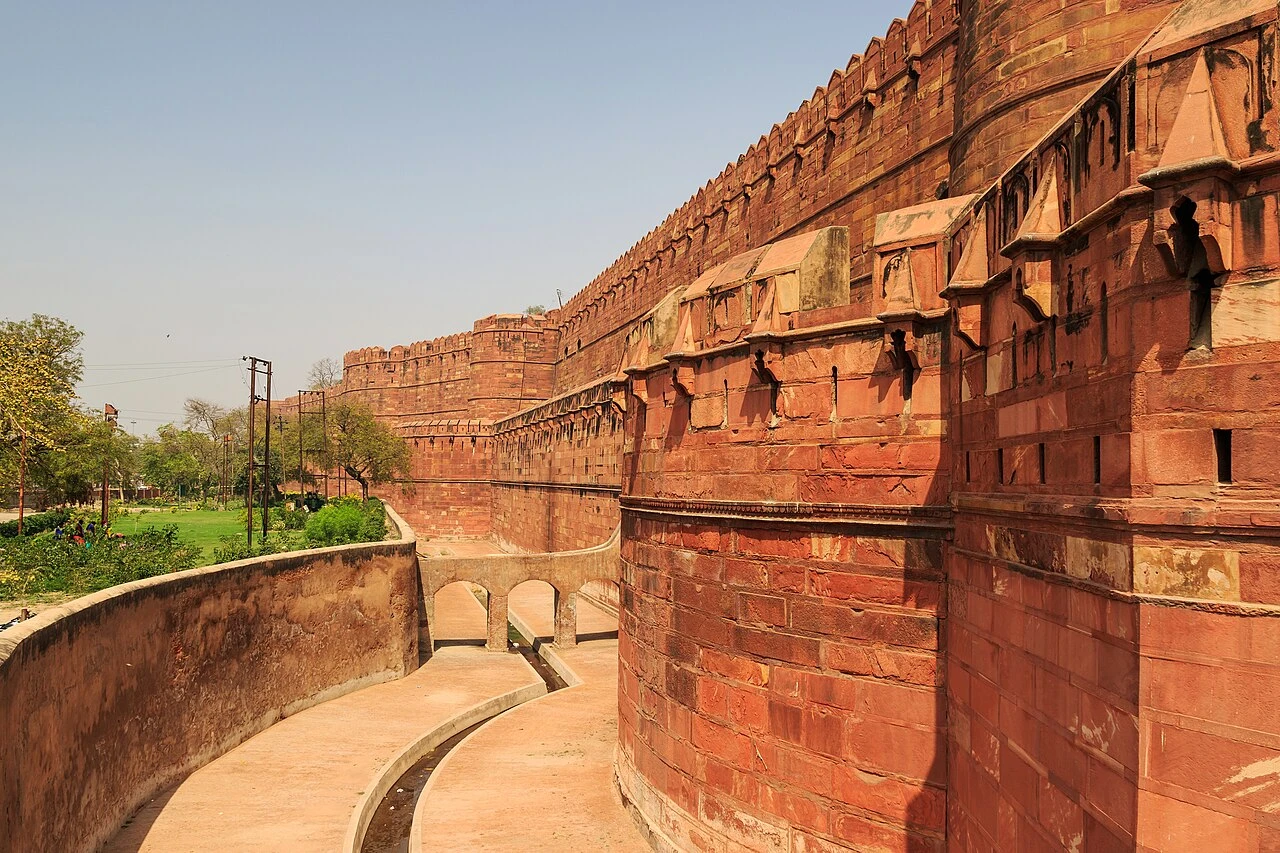
Agra
Agra Fort
Content & sources
Photo: A.Savin · FAL
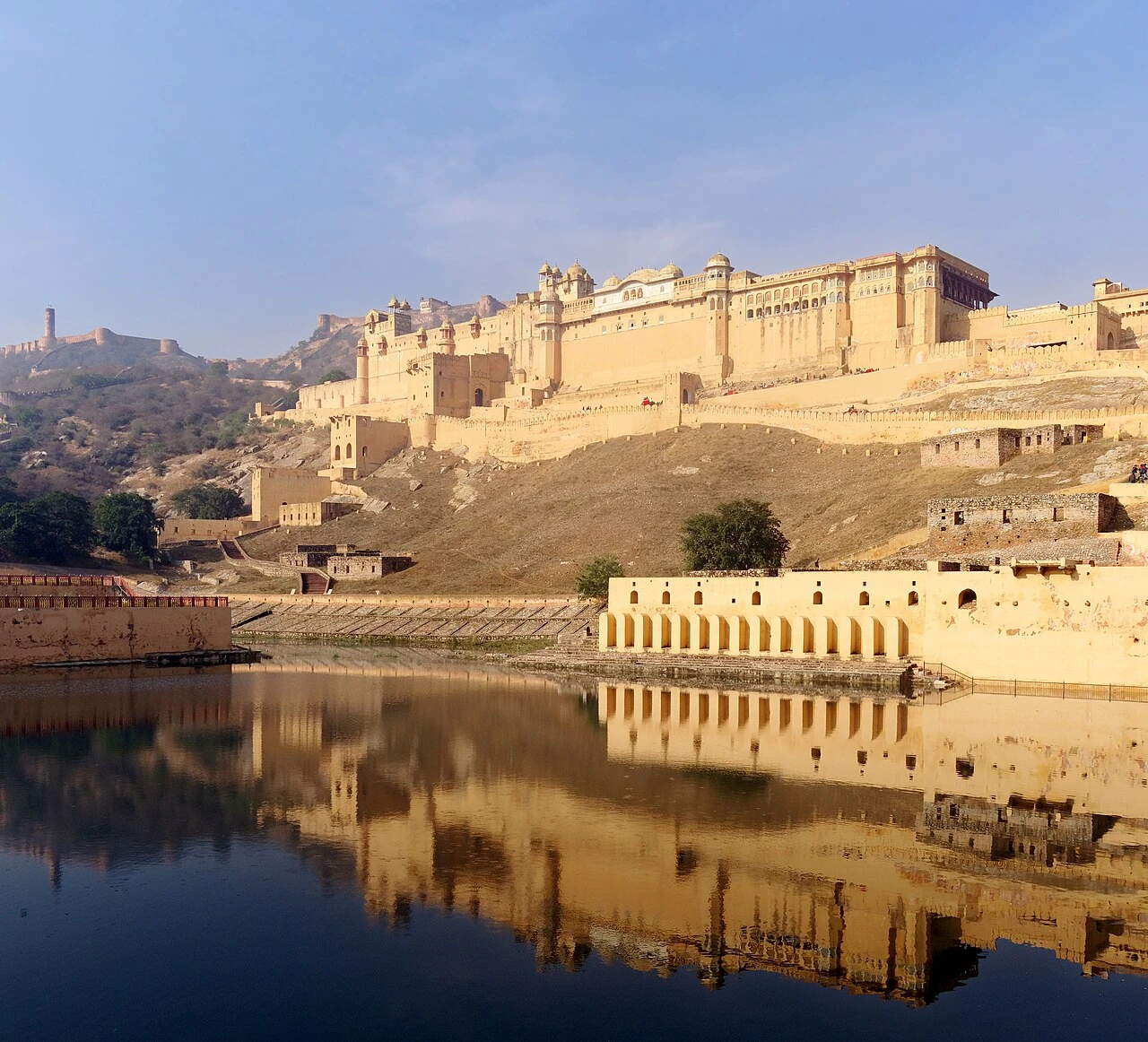
Jaipur Municipal Corporation
Amber Fort
Content & sources
Jakub Hałun · CC BY-SA 4.0
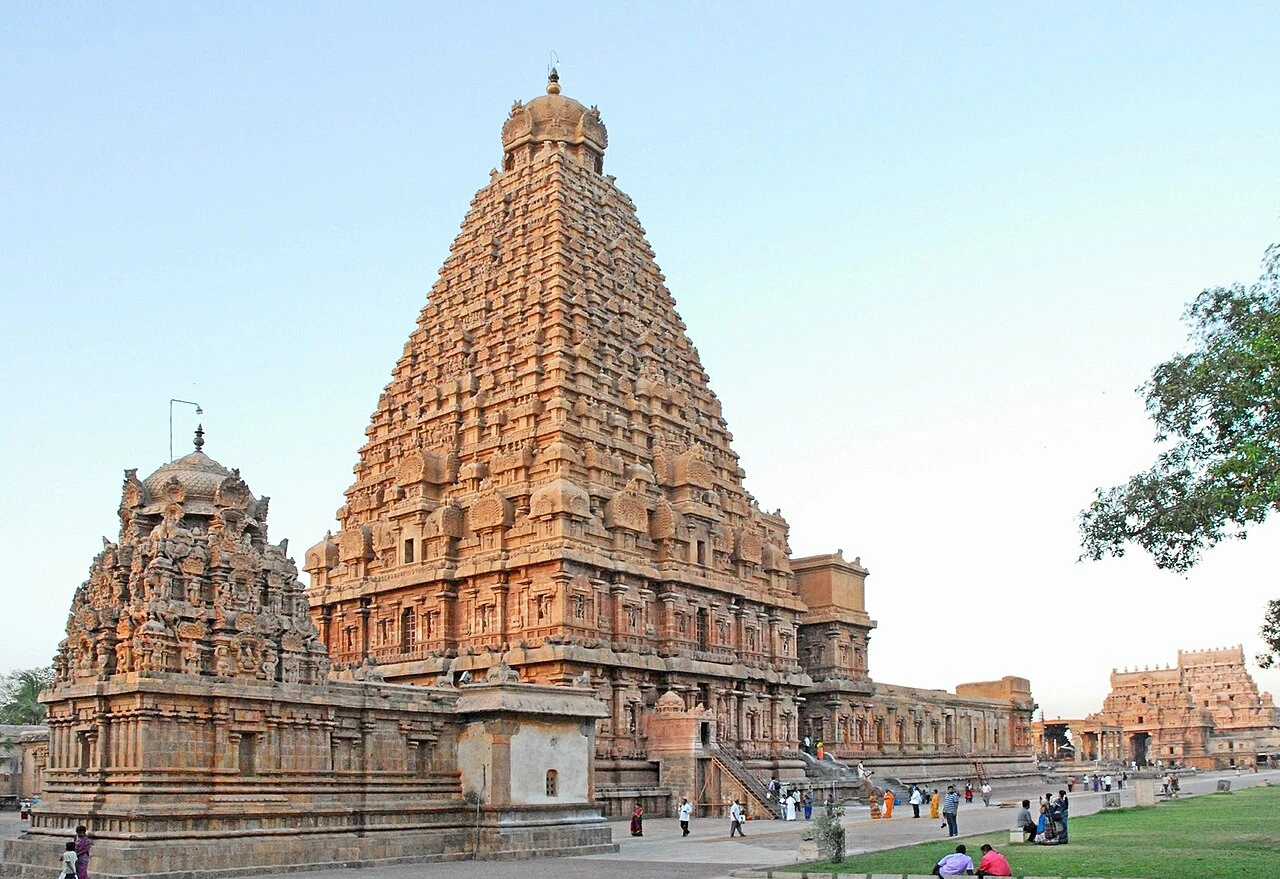
Thanjavur
Brihadisvara Temple
Content & sources
Jean-Pierre Dalbéra from Paris, France · CC BY 2.0
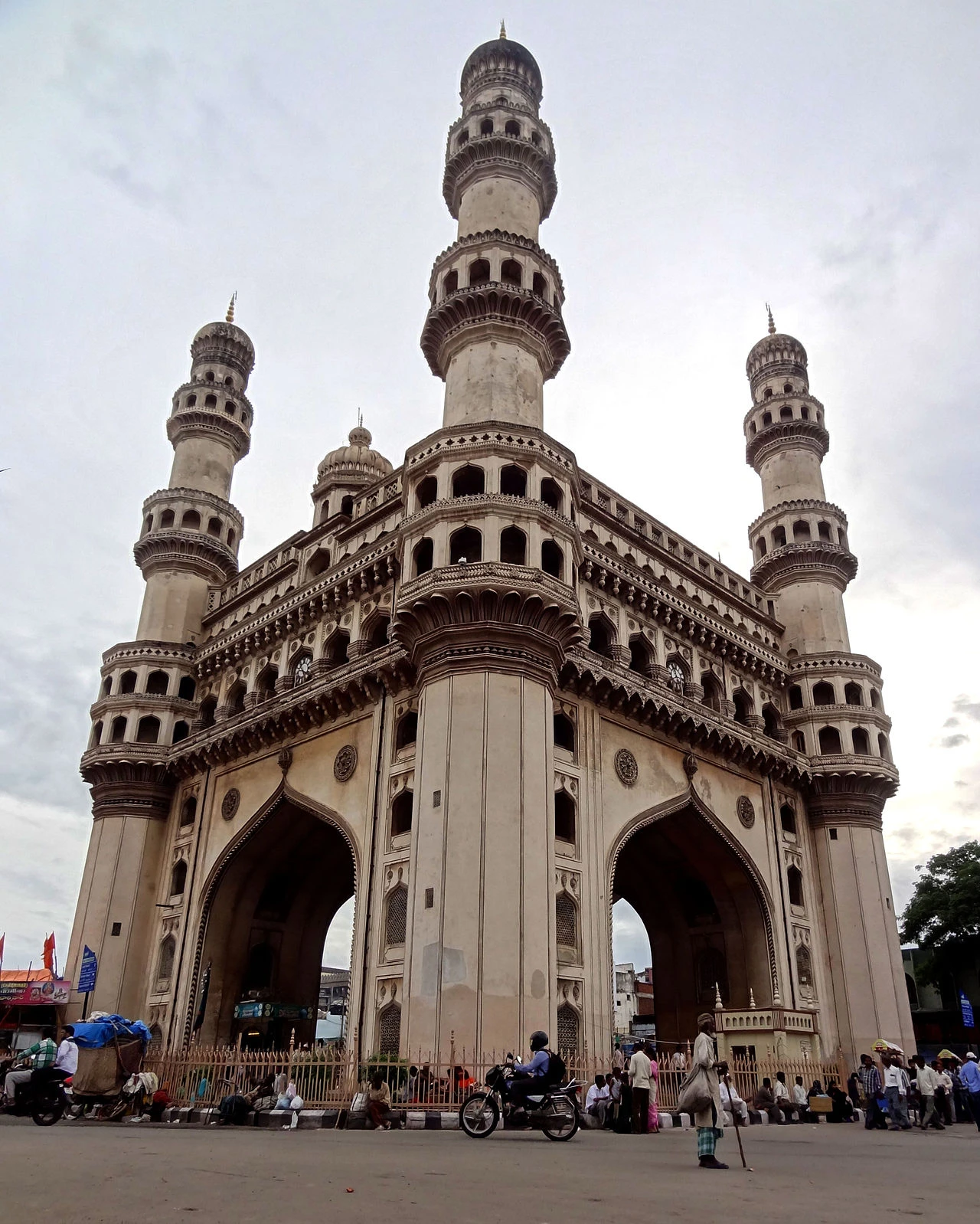
Hyderabad
Charminar
Content & sources
Gopikrishna Narla · CC BY-SA 3.0