Stanza · Audio guide
Nahargarh Fort Audio Guide
A place to remember. A story to take with you.
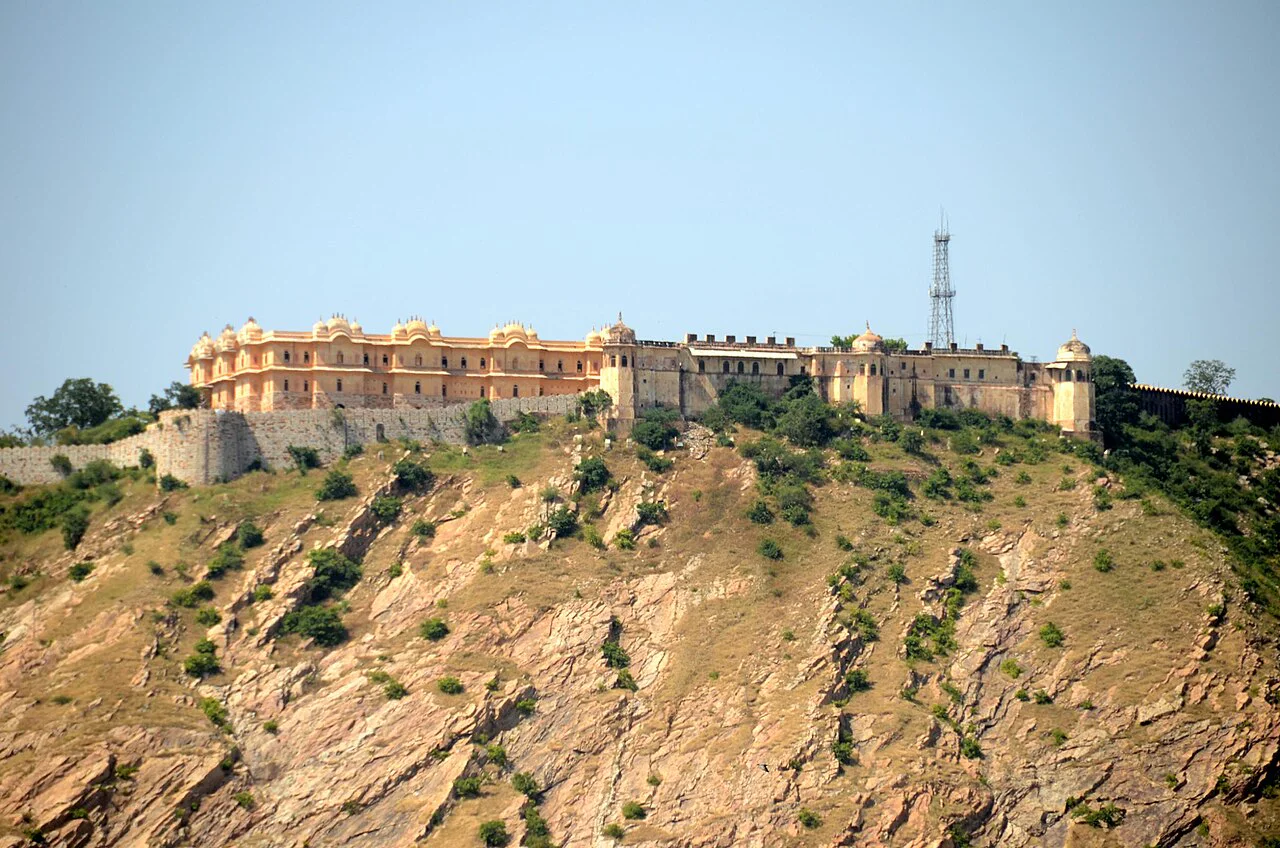
Nahargarh Fort is a hill fort located on the edge of the Aravalli Hills overlooking Jaipur. It once formed a strong defence ring for the city along with Amber Fort and Jaigarh Fort.
Download Stanza, then search for “Nahargarh Fort”.
About the tour
One guide. Your kind of visit.
Nahargarh Fort is a hill fort located on the edge of the Aravalli Hills overlooking Jaipur. It once formed a strong defence ring for the city along with Amber Fort and Jaigarh Fort.
Ready when you are.
- 01Get the free Stanza app.
iOS & Android
- 02Find your guide.
“Nahargarh Fort”
- 03Download before you go.
Works offline
Audio guide / 11 narrated stops
Inside the guide
Get to know a few of the stories before you go. Open a stop to read more.
01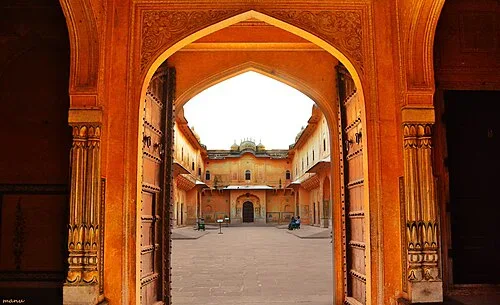 Main Fortress Gateway and Outer Courtyard
Gateway into the Ridge Fort
Welcome to Nahargarh Fort, on the edge of the Aravalli Hills above Jaipur. Maharaja Sawai Jai Singh II began this stronghold in 1734, as a place of retreat on the ridge over his new capital. The summit rises some two hundred metres above the streets. Through the great arched gateway, a tall opening framed in carved stone, the way leads on into a sunlit courtyard. Nahargarh never stood alone. With Amber Fort below and Jaigarh Fort beyond, it formed a defence ring around the city. This tour follows the fort from its gateway to its palace suites, and out at last to the ramparts above Jaipur.
lensnmatter · CC BY 2.0
02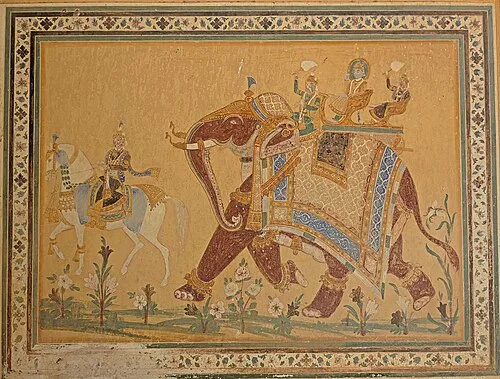 Nahar Singh Bhomia Temple Shrine
The Name and the Restless Spirit
Nahargarh was not the fort's first name. It began as Sudershangarh, and the story goes that the building work would not stay done. A spirit walked the ridge and obstructed the construction, again and again. He was Nahar Singh Bhomia, and the disturbance was taken seriously enough that the builders sought counsel from tantriks. The remedy was a temple, raised within the fort in his memory. With the spirit pacified, the fort became known by his name. Nahargarh means the abode of tigers, though the name honours a man rather than the animals. The old paintings here, of princes on caparisoned elephants with their retinues, belong to that same courtly world of the maharajas.
Photo: Barkhaharlalka · CC BY-SA 4.0
03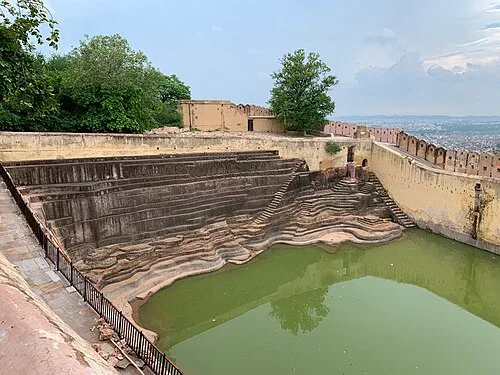 Nahargarh ki Bawari (Historic Stepwell)
Nahargarh ki Bawari
A fortress on a bare hilltop needs water it can trust. Rajasthan's hill forts answered with stepwells, deep reservoirs reached by long flights of steps, built to catch and hold the monsoon rain. Nahargarh ki Bawari is this fort's own answer. Its stone tiers descend in wide curves to green water, with the old fort wall standing above and the city of Jaipur visible in the distance. The steps let people and vessels reach the water, whatever level it stood at. The fort has since found a second life on screen; some scenes of the film Rang De Basanti were shot here.
Listen in the appPhoto: Chainwit. · CC BY-SA 4.0
04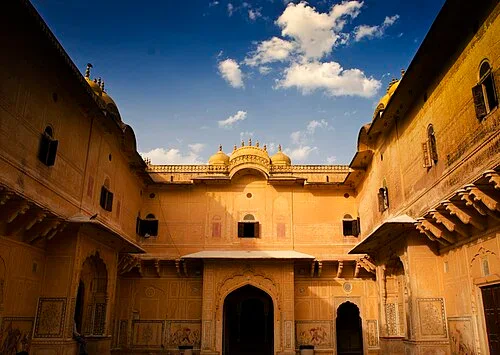 Madhavendra Bhawan Entrance Courtyard
Madhavendra Bhawan: The Palace Within the Fort
For its first hundred and thirty-four years Nahargarh was a military post. Then it learned a softer trade. The fort was extended in 1868, in the reign of Sawai Ram Singh, and between 1883 and 1892 a range of palaces rose inside its walls. The design is credited to an architect named Dirgh Patel, and the building account came to nearly three and a half lakh rupees. The new complex took the name Madhavendra Bhawan, after Sawai Madho Singh, the maharaja who built it. Its honey-coloured walls, small domes and symmetrical arcades gather around quiet courtyards. The fort also served the maharajas as a hunting residence.
Listen in the appNayan Jyoti Nath · CC BY-SA 4.0
05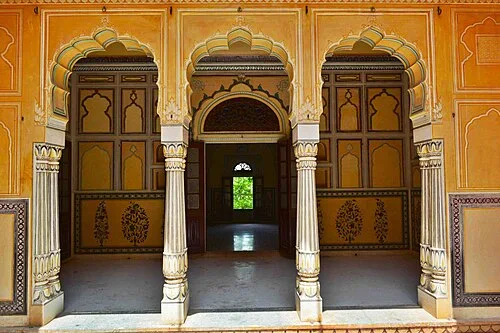 Queens' Frescoed Suites
Suites for Nine Queens
Inside Madhavendra Bhawan, the plan reads like a family drawn in stone. Nine separate apartments were built for the maharaja's queens. Each one rises two storeys high, around a courtyard of its own. The queens' blocks were even fitted with the modern sanitation of their day, a comfort not to be taken for granted on a hilltop. Delicate frescoes survive on the walls, floral panels and painted figures in soft colours. The triple-arched pavilion here shows the style at its best, its columns and painted panels framing the rooms beyond. Identical suites, side by side, kept nine households equal under one roof.
Listen in the appPhoto: Anupamg · CC BY-SA 4.0
06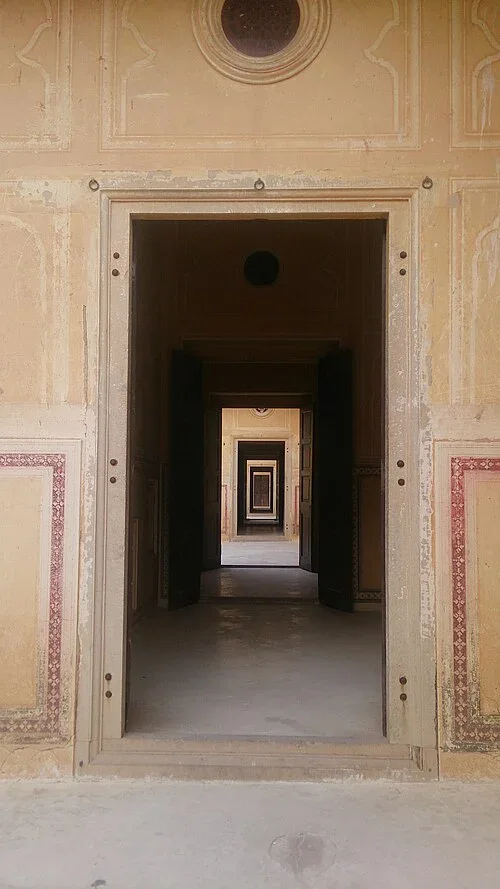 Queens' Frescoed Suites
Doors within Doors
The suites are strung together by corridors, and the doorways open into one another. From one end of the range, the view runs through door after door until the passages blur into a single tunnel of frames. Every queen's apartment connected to the others, and all of them led toward the king's suite at the head of the range. A private world, joined hall to hall.
Listen in the appVijay Singh · CC BY-SA 4.0
07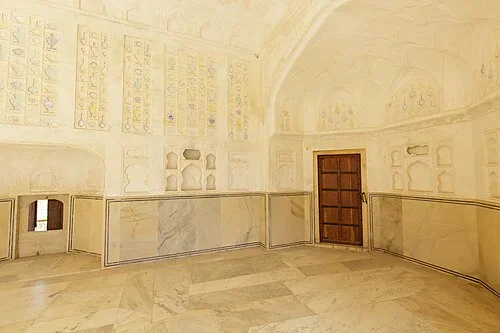 King's Suite Chambers
The King's Suite and a Place of Refuge
At the head of the residential range sat the king's own suite, the master apartment that every corridor served. Its white chambers carry recessed niches and a marble wainscot, refinement far removed from a soldier's post. The fort had one recorded hour as a refuge. In 1857, during the Indian Mutiny, rebellion swept across northern India. Sawai Ram Singh, the king of Jaipur, moved the Europeans of the region inside Nahargarh's walls for their protection. Among them was the wife of the British Resident. A stronghold built for retreat gave shelter when it was asked for.
Listen in the appThomas Fuhrmann · CC BY-SA 4.0
08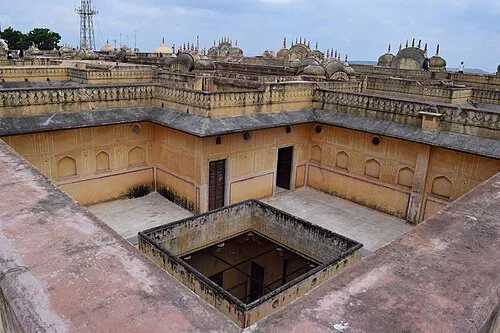 Rooftop Terraces and Maze of Domes
Roof Terraces and a Skyline of Domes
From the roof, the palace explains itself. The apartment blocks repeat in matching units, each one crowned with small domed pavilions known as chhatris. Terraces step between them, edged with stone railing, so the whole roofline reads as a skyline of small domes and level walks. The same forms return again and again, mirrored across the courtyards below. Moving upward through the building, the rooms give way to open air and the breeze off the ridge.
Listen in the appPhoto: Chicklu · CC BY-SA 4.0
09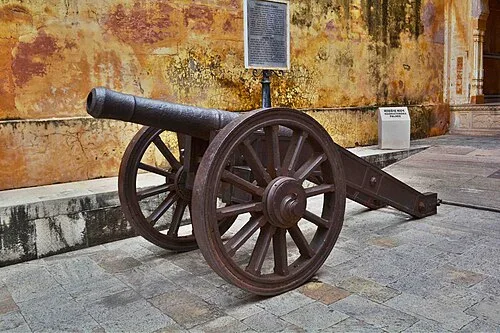 Rampart Cannons and Time Gun Bastion
The Gun that Told the Time
A cannon rests here on its carriage, a long barrel over great spoked wheels, the face of the fort's artillery. Yet Nahargarh's most surprising daily duty was telling the time. Until April 1944, the Jaipur State government kept its official clock by the sun, read from the Samrat Yantra, the giant sundial at the Jantar Mantar observatory. The signal that carried that time across the city was a gun, fired from this fort. When the cannon sounded, Jaipur set its watches by a shadow on a sundial miles away.
Listen in the appPhoto: Anupamg · CC BY-SA 4.0
10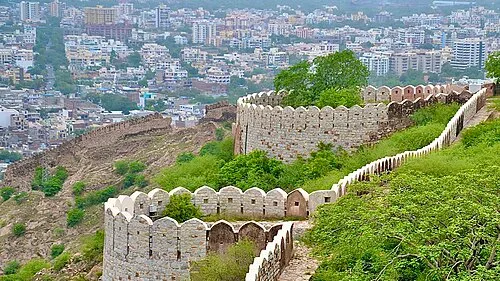 Western Ramparts and Jaipur City Overlook
Walls across the Hills, City Below
The walls are the fort's boldest stroke. From the ramparts they run out over the hills, crenellated lines of stone snaking along the green ridge. They connect Nahargarh directly with Jaigarh, the fort above the old capital of Amber. The whole city spreads out below, rooftops and avenues reaching to the horizon. For all that stone, the fort never came under attack in its history. Its gates saw diplomacy instead of battle, including treaties with the Maratha forces who warred with Jaipur in the eighteenth century.
Listen in the appPhoto: Harshil s mehta · CC BY 4.0
- 11
Sunset from the Western Ramparts
Padao, the sunset side of the fort, and the quiet the ridge keeps after dark.
Nahargarh Fort
Frequently asked questions
How much does the guide cost?
Free app download. Listed guide price: $0.99. Guide price shown in the app. Audio guide only. Venue admission is separate.
Can I listen without internet?
Yes. Download the guide’s audio, images, and maps in the app before your visit. Your downloaded content is then available offline.
Can I listen in my language?
This audio guide is available in 15 languages, including English.
Do I need to follow a schedule?
No. This is a self-guided experience. Choose your stops, pause whenever you like, and return to a story at your own pace.
At your own pace
Explore Nahargarh Fort.
Download Stanza, then search for “Nahargarh Fort”.
Free app download · Guide price shown in the app
Keep exploring
Nearby audio guides
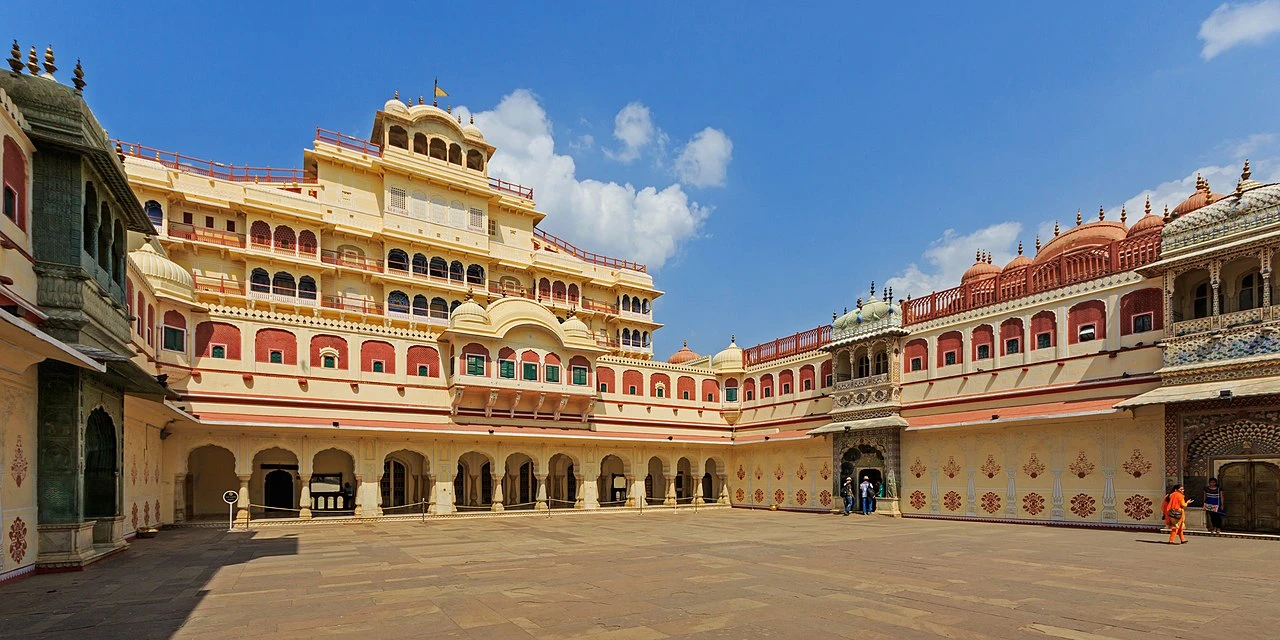
Jaipur · 2 km
City Palace
Content & sources
Photo: A.Savin · FAL
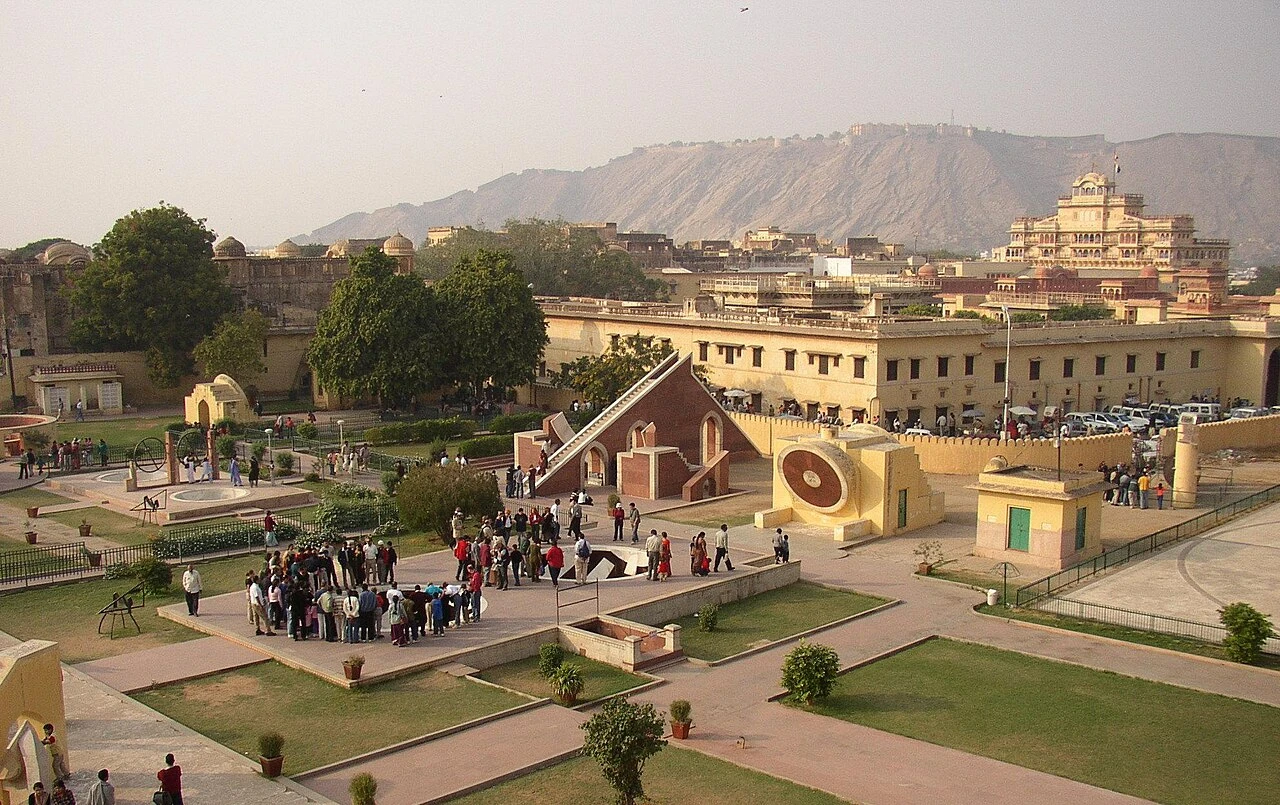
Jaipur · 2 km
Jantar Mantar, Jaipur
Content & sources
Photo: Knowledge Seeker · Public domain
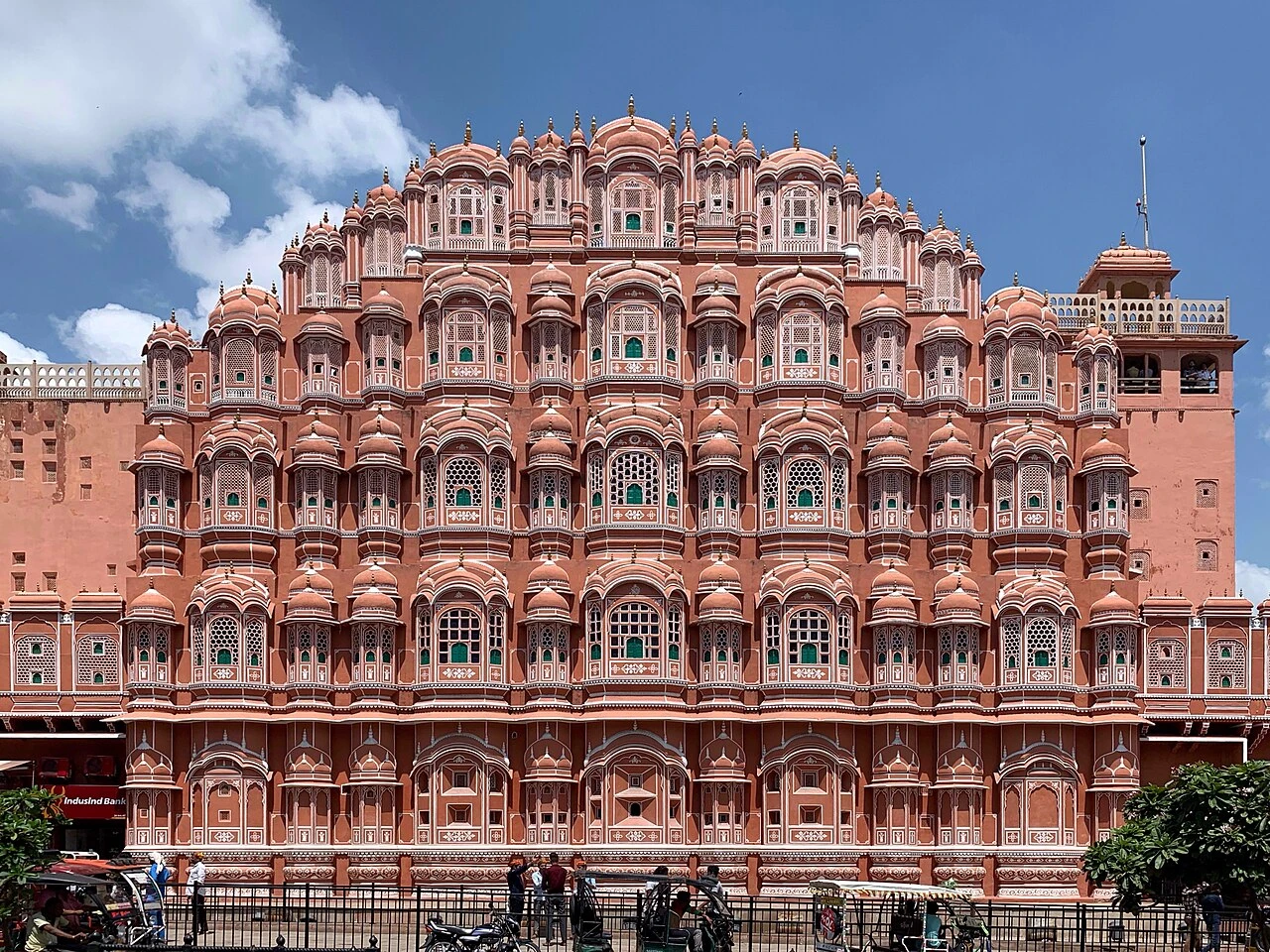
Jaipur · 2 km
Hawa Mahal
Content & sources
Photo: Chainwit. · CC BY-SA 4.0
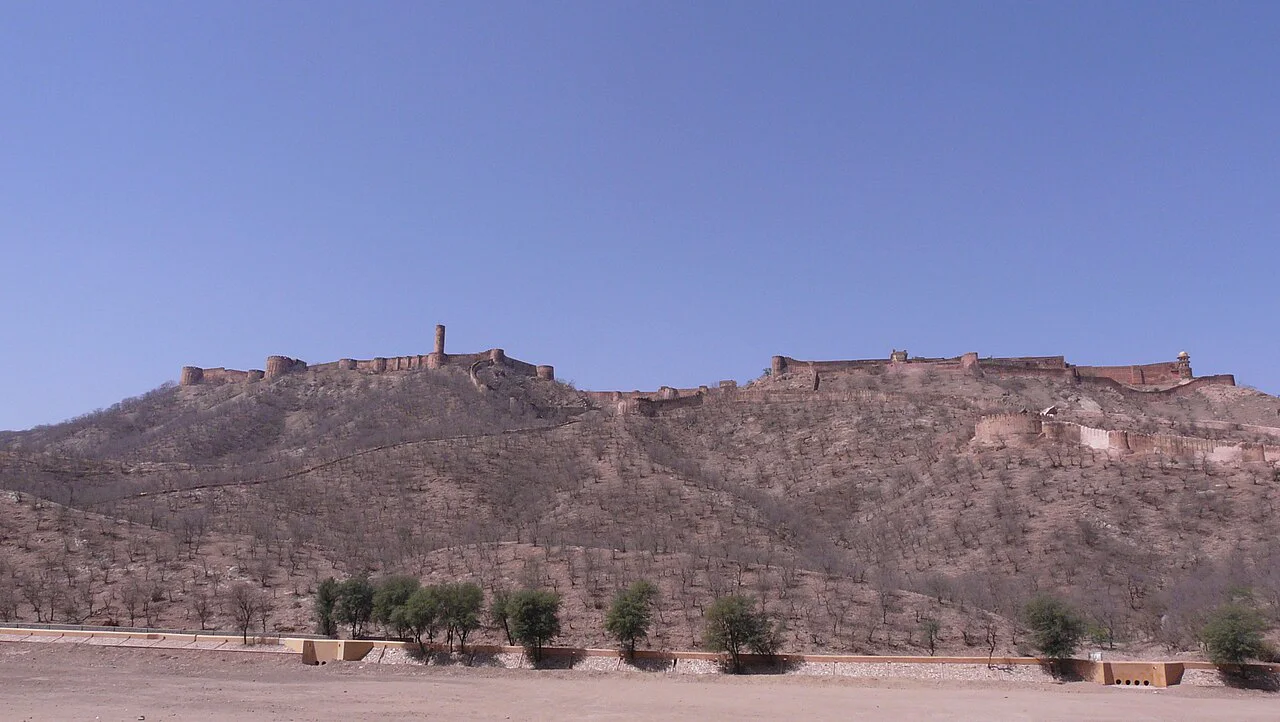
Jaipur · 6 km
Jaigarh Fort
Content & sources
Ashwin Kumar from Bangalore, India · CC BY-SA 2.0