Stanza · Audio guide
St. Paul's Cathedral, Kolkata Audio Guide
A place to remember. A story to take with you.
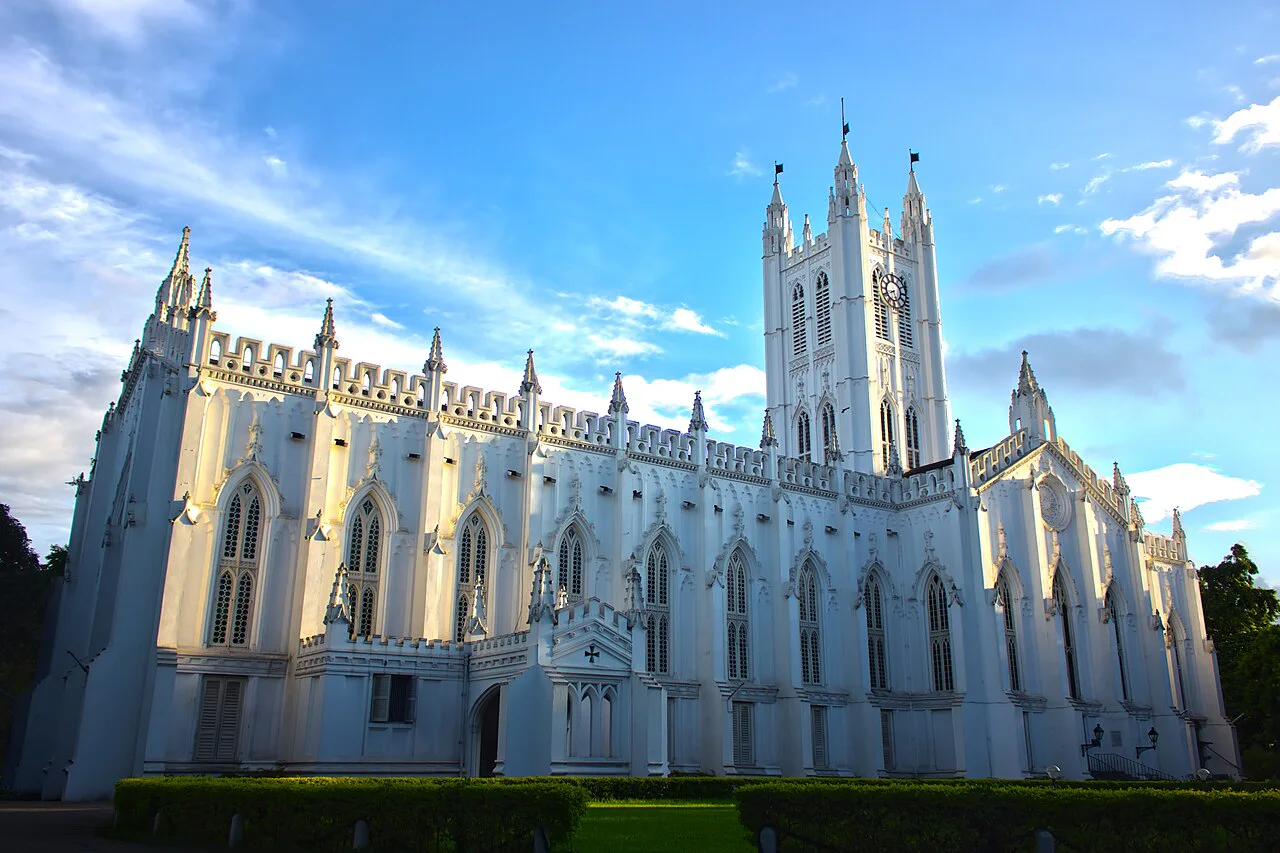
St. Paul's Cathedral is an Anglican cathedral located in Kolkata, India, noted for its Gothic architecture. It is the largest church in the city and was the first new-built cathedral in the overseas territory…
Download Stanza, then search for “St. Paul's Cathedral, Kolkata”.
About the tour
One guide. Your kind of visit.
St. Paul's Cathedral is an Anglican cathedral located in Kolkata, India, noted for its Gothic architecture. It is the largest church in the city and was the first new-built cathedral in the overseas territory of the British Empire.
Ready when you are.
- 01Get the free Stanza app.
iOS & Android
- 02Find your guide.
“St. Paul's Cathedral, Kolkata”
- 03Download before you go.
Works offline
Audio guide / 10 narrated stops
Inside the guide
Get to know a few of the stories before you go. Open a stop to read more.
01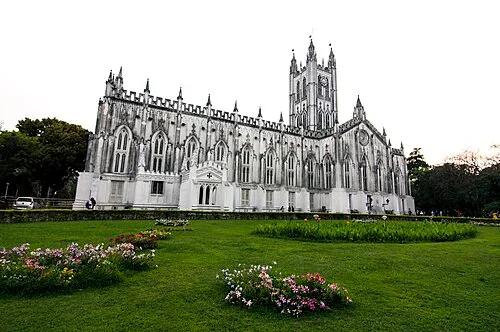 Sir William Prentice Memorial Gate and Cathedral Gardens
Cathedral Gardens and the View from the Lawn
A white Gothic cathedral rises from quiet lawns and flowerbeds in central Kolkata, and this tour follows it from those lawns to the candles of the high altar. Welcome to St. Paul's. The ground beneath the gardens has a story of its own. It was once known as Fives Court. In 1762 the spot was described as forest so wild that it harboured tigers. When the site was first proposed for a cathedral, people dismissed it as too far south. In the end, seven acres were set aside here. The gardens were laid out in 1847. Sixty-three species of trees went into the ground that year. Out of that improbable wilderness grew what is said to be the first Anglican cathedral in Asia.
Photo: Thakurdalan-M.. · CC BY-SA 4.0
02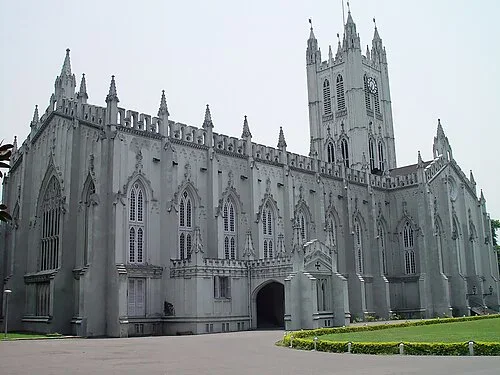 North Façade and the Canterbury Bell Harry Tower
The North Façade in Indo-Gothic White
Pinnacles, pointed arches and a long white wall: the north façade announces a style with a name of its own. The Imperial Gazetteer called the design Indo-Gothic, meaning Gothic architecture shaped to meet the climate of India. Not everyone was flattered. One contemporary jab called it spurious gothic, adapted to the exigencies of the Indian climate. The reason for building was simple crowding. St. John's Church had become too small for Calcutta's growing European community. By 1810 Bengal held four thousand British men. British women numbered only about three hundred. St. Paul's was raised to give the community room, and when it was finished it took over from St. John's as the cathedral of the Diocese of Calcutta.
Photo: Jafro · CC BY-SA 3.0
03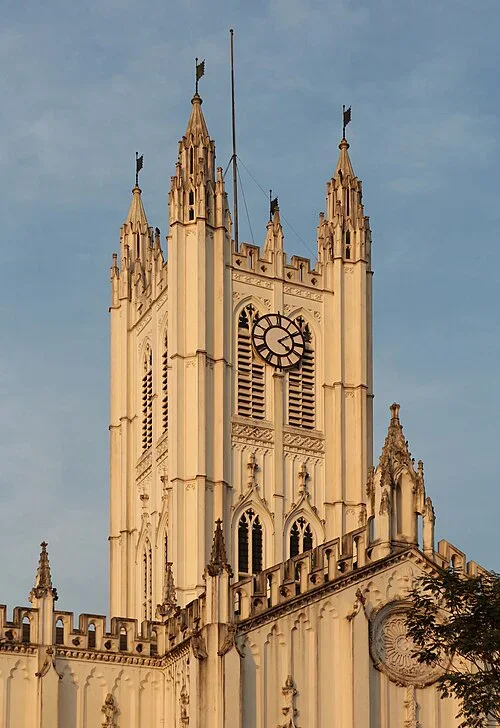 North Façade and the Canterbury Bell Harry Tower
The Tower of Canterbury in Calcutta
Against the sky, the square tower rises in pale stone, a clock face set high, small flagpoles on its pinnacles. Earthquakes are the story here. In 1897 a quake damaged the cathedral, and it was refurbished. Then came the massive earthquake of 1934, when Calcutta was devastated and the steeple tower collapsed. What stands now is a rebuilt tower, raised to a revised design. It follows the central Bell Harry tower of Canterbury Cathedral in England. From roof to spire it climbs about sixty-one metres. The tower that greets the sky today is a survivor, rebuilt in the image of an English original.
Listen in the appBernard Gagnon · CC BY-SA 3.0
04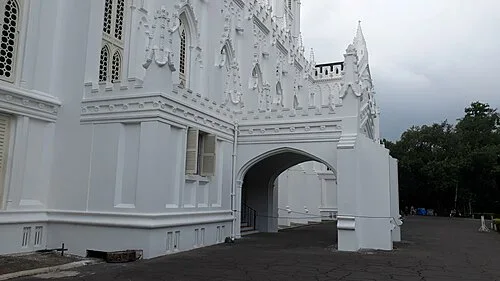 Main Entrance Portal and Architect's Memorial
Entering the Cathedral
A broad white archway, carved and pinnacled, leads in from the garden, and the threshold holds the cathedral's founding dates. The project had stalled for years before Bishop Daniel Wilson brought it back to life. He laid the cornerstone on the eighth of October, 1839. Construction took eight years in all. On the eighth of October, 1847, the cathedral was consecrated. Queen Victoria marked the occasion from afar, sending ten pieces of silver-gilt plate for the new building. The ceremony drew a large gathering of Europeans and local people alike. Eight years of work ended in a single morning of blessing.
Listen in the appPhoto: Pinakpani · CC BY-SA 4.0
05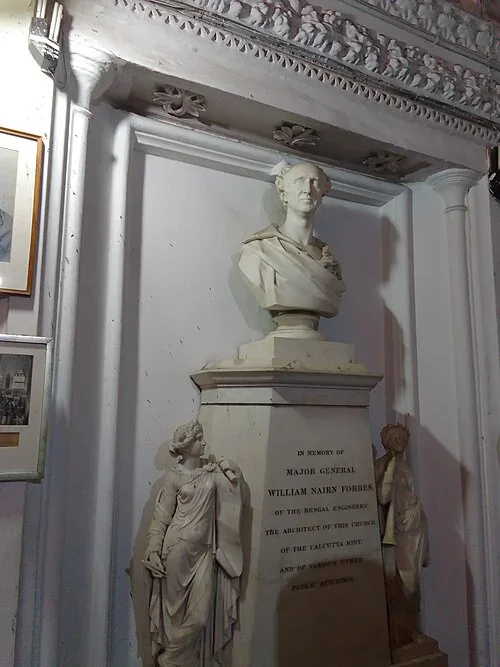 Main Entrance Portal and Architect's Memorial
Memorial to Major General William Nairn Forbes
A marble bust gazes out from its pedestal, above an inscription to Major General William Nairn Forbes of the Bengal Engineers. The words call him the architect of this church. He nearly missed the chance. In 1819, at the request of the Marquess of Hastings, then Governor-General of Bengal, Forbes drew up a design for the proposed cathedral. It was turned down as too expensive. The bishop who had chosen the site died before any plans took shape, and three successors lasted only brief tenures. Not until 1832 did Bishop Daniel Wilson revive the project. At his request, Forbes designed the cathedral with the architect C. K. Robinson, modelling the tower and spire on Norwich Cathedral in England.
Listen in the appPhoto: Sumasa · CC BY-SA 4.0
06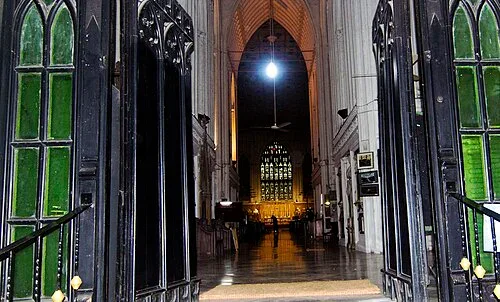 The Pillarless Indo-Gothic Nave
The Pillarless Nave
Down the middle of the cathedral runs one unbroken sweep of space, with not a pillar to block it. The nave stretches about seventy-five metres. It is some twenty-five metres across, and it has no aisles along its flanks. When the cathedral was completed, that roof span was the largest of its kind. The roof is a shallow curve, arching over iron trusses dressed with Gothic tracery. The open design lets air move and keeps every sightline clear, a practical answer to Bengal's heat. The builders used special bricks, light in weight but strong under compression, with ashlars of Chunar stone. Inside and out, the surfaces were plastered with fine chunam, a lime plaster worked as stucco. Eight hundred to a thousand worshippers can fill the wooden pews.
Listen in the appPhoto: Amit Sen · CC BY-SA 4.0
07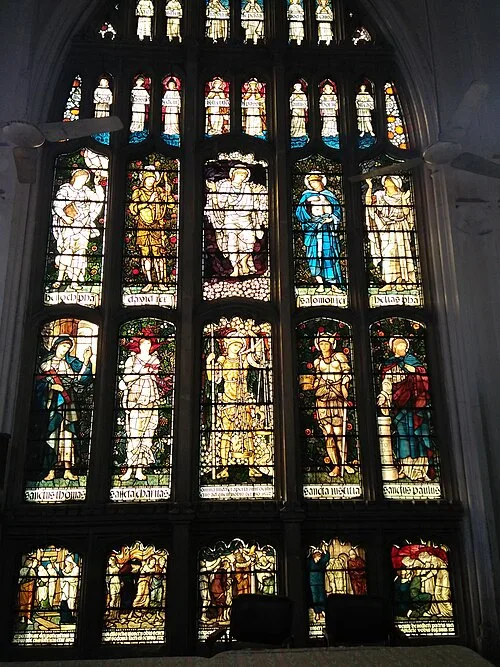 The Pre-Raphaelite West Window
The Burne-Jones West Window
The west wall glows with stained glass, panel after panel of robed figures in deep reds, blues and gold. The designer was Sir Edward Burne-Jones, a master of the pre-Raphaelite painters. The glass itself came from Morris and Company, William Morris's celebrated workshop. It was designed in 1880 as a memorial to Lord Mayo, the Viceroy who was assassinated in the Andaman Islands. The windows sit in half-sunk arches along the western side. Each panel sets a saint in strong colour, the name painted low across the glass. It is a memorial in light rather than in stone.
Listen in the appPhoto: Halder97Sudipto · CC BY-SA 3.0
08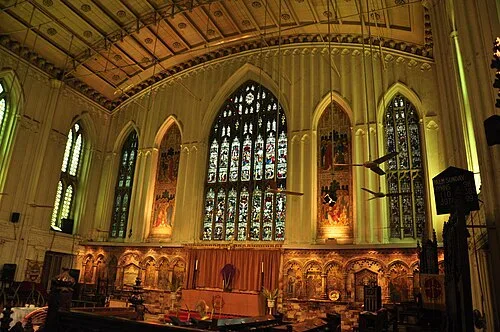 Sanctuary, High Altar, and Blomfield Reredos
Sanctuary and the Blomfield Reredos
At the east end, behind the altar, the wall turns into carved stone storytelling. This decorated screen, the reredos, dates to 1879 and is the work of Sir Arthur Blomfield. Its carvings show episodes from the life of St. Paul, the Annunciation, the Adoration of the Magi, and the Flight into Egypt. Blomfield came back in 1886 to paint the eastern wall with further scenes of the apostle's life. On the southern flank of the altar stands the episcopal throne. It is no museum piece. The Bishop of Calcutta still takes his seat there, as the sanctuary remains the working heart of the diocese.
Listen in the appPhoto: Amitabha Gupta · CC BY-SA 4.0
09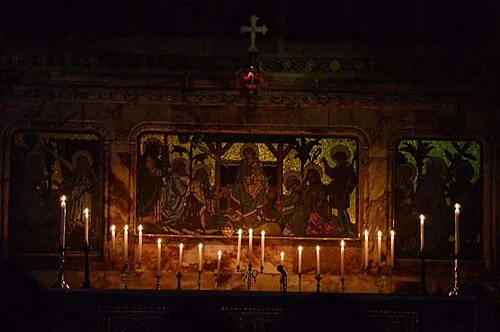 Sanctuary, High Altar, and Blomfield Reredos
The High Altar by Candlelight
Candle flames flicker against a mosaic of the birth of Christ above the high altar. The cathedral around it is no relic behind a rope. St. Paul's is the working cathedral of the Diocese of Calcutta, part of the Church of North India. Services are held regularly, and people of every denomination are welcome to visit. At Christmas the church fills with a large congregation, as people gather from near and far for the festivities. The same altar has carried the city's worship from the consecration of 1847 to tonight's candles.
Listen in the appPhoto: Halder97Sudipto · CC BY-SA 3.0
10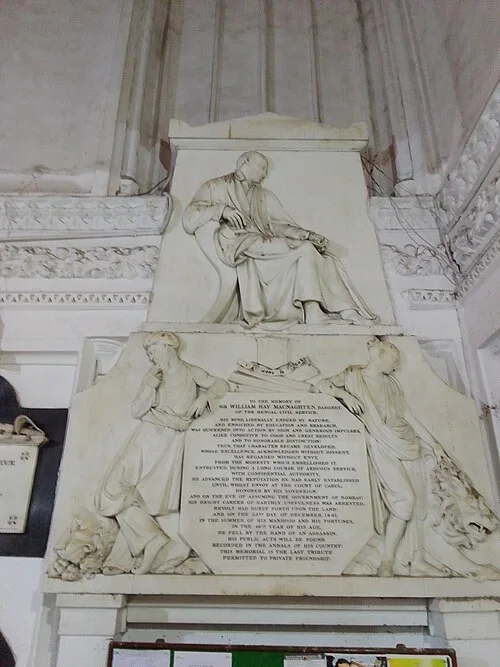 Sanctuary Vaults and Colonial Memorials
Walls of Memory: Sir William Hay Macnaghten
White marble covers a wall of the cathedral in memory of Sir William Hay Macnaghten, a Baronet and member of the Supreme Council of Bengal. A robed figure sits above the long inscription, with mourning figures carved on either side below. Monuments like this give the cathedral a second life, as a wall of the imperial city's memory. Its most enduring resident lies out of sight. Bishop Daniel Wilson, who revived and built this cathedral, asked to be buried here, and he rests in an underground chamber. A plaque conferred on him by Queen Victoria is displayed nearby. A building raised to ease a crowded congregation now holds nearly two centuries of the city's memory.
Listen in the appPhoto: Sumasa · CC BY-SA 4.0
St. Paul's Cathedral, Kolkata
Frequently asked questions
How much does the guide cost?
Free app download. Listed guide price: $0.99. Guide price shown in the app. Audio guide only. Venue admission is separate.
Can I listen without internet?
Yes. Download the guide’s audio, images, and maps in the app before your visit. Your downloaded content is then available offline.
Can I listen in my language?
This audio guide is available in 15 languages, including English.
Do I need to follow a schedule?
No. This is a self-guided experience. Choose your stops, pause whenever you like, and return to a story at your own pace.
At your own pace
Explore St. Paul's Cathedral, Kolkata.
Download Stanza, then search for “St. Paul's Cathedral, Kolkata”.
Free app download · Guide price shown in the app
Keep exploring
Audio guides — India
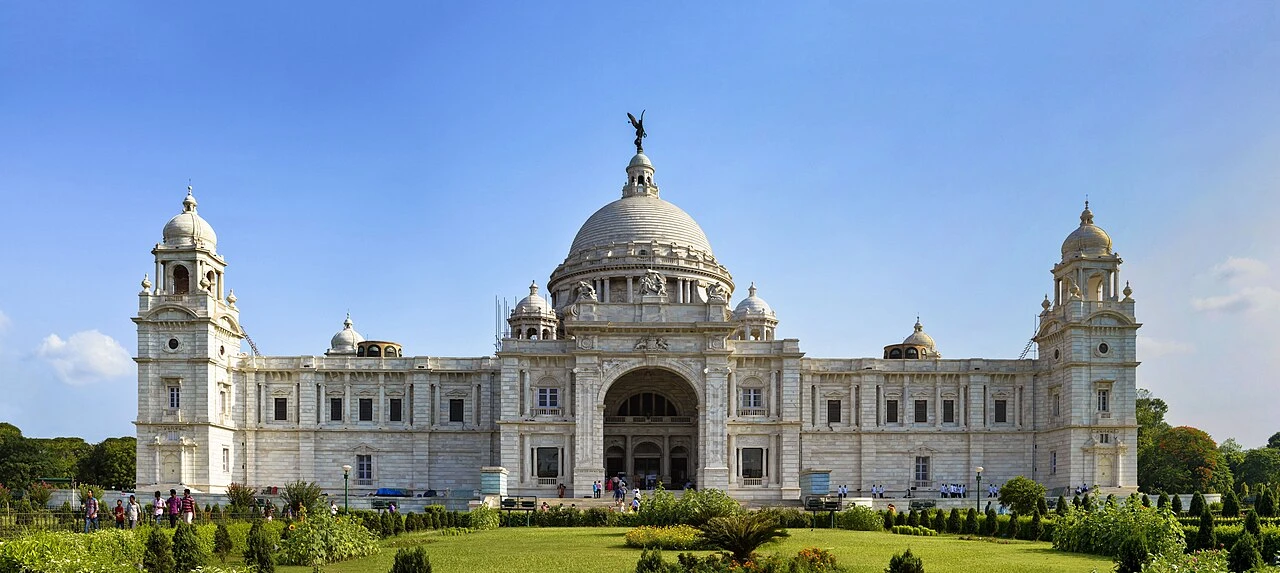
Kolkata · 1 km
Victoria Memorial
Content & sources
Photo: Subhrajyoti07 · CC BY-SA 4.0
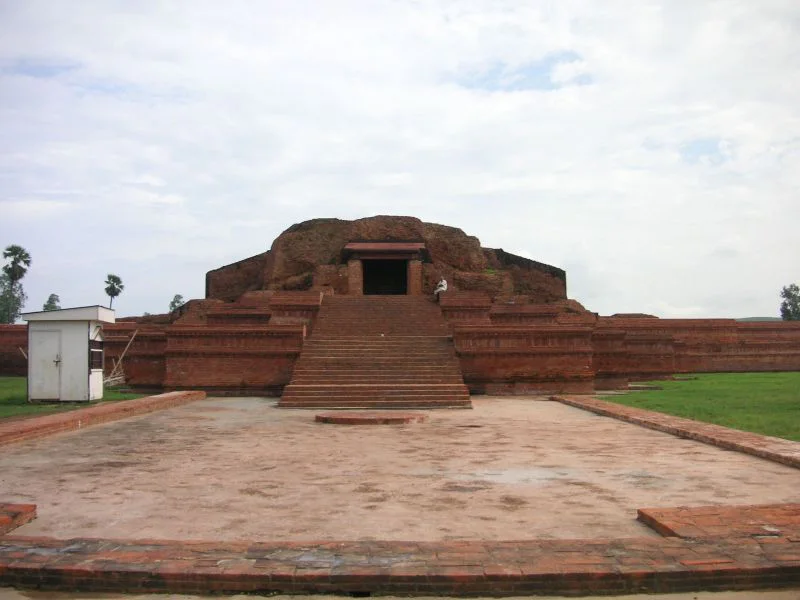
Mathurapur
Vikramashila
Content & sources
Photo: Alokprasad · CC BY 2.0
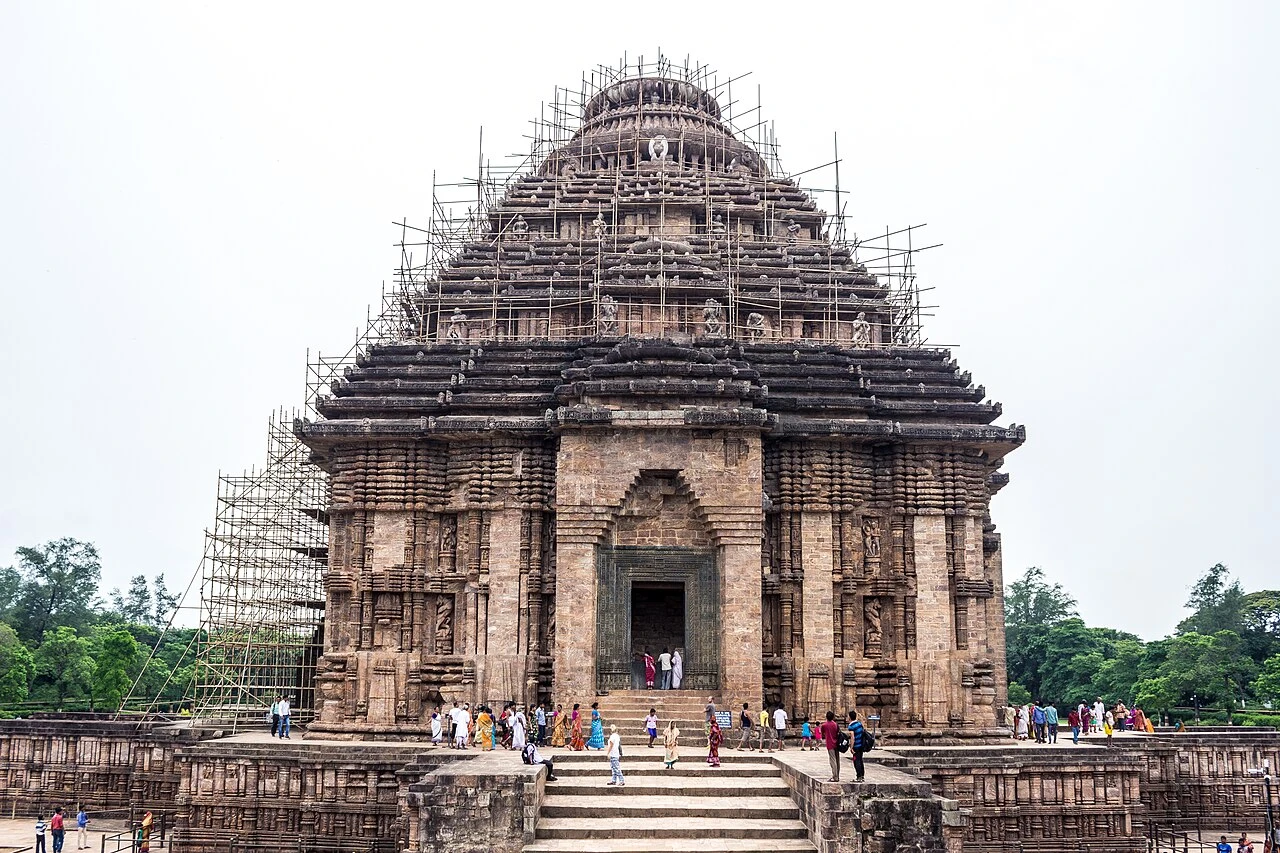
Konark
Konark Sun Temple
Content & sources
Dhruv Raj Kashyap · CC BY-SA 4.0
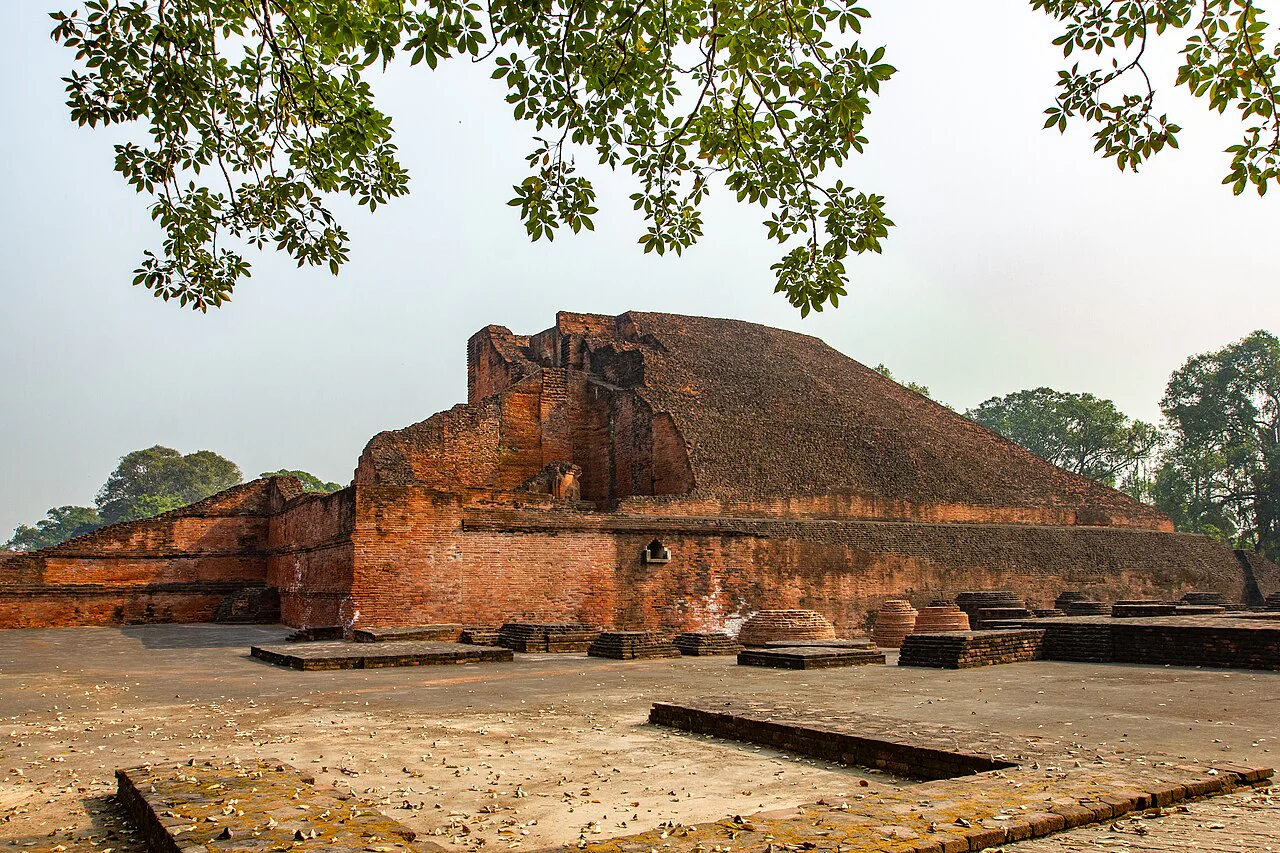
Nalanda
Nalanda mahavihara
Content & sources
Photo: Uphogaphy · CC BY-SA 4.0