Languages
15Konark Sun Temple Audio Guide
Konark Sun Temple is a landmark in Konark, India. Explore it with Stanza's GPS-triggered offline audio guide — available in 15 languages.
Quick Facts
16
Stops
15
Languages
100%
Offline
📍 Konark, India · 19.8874°N, 86.0946°E
About Konark Sun Temple
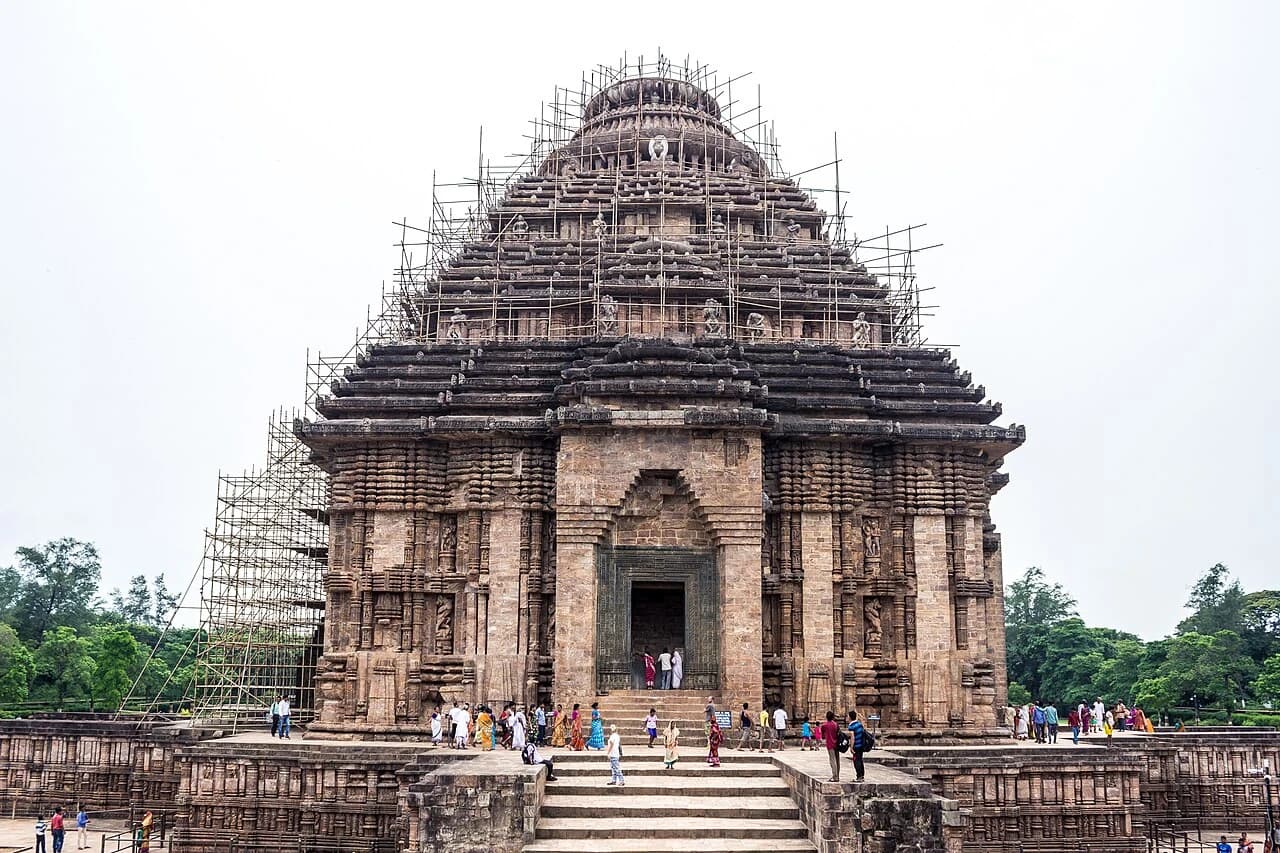
The Konark Sun Temple is a 13th-century Surya temple located in Odisha, India. It is a UNESCO World Heritage site renowned for its intricate stone carvings and unique chariot-like architecture.
Konark Sun Temple is also known as Good Black Pagoda, Surya Deula, Sun Temple, Konarak Temple, and 4 other names in various languages.
This self-guided audio tour features 16 narrated stops organized across 6 sections, including The Eastern Entrance and Guardian Lions, Nata Mandira: The Hall of Dance, The Celestial Chariot and Seven Horses, The Iconic Wheels and Sundials, Surya: The Three Aspects of the Sun, Mayadevi Temple and Engineering Legacy. As a temple, Konark Sun Temple offers a unique cultural experience in the heart of Konark, India.
The Stanza audio guide is available in 15 languages and works entirely offline — download the complete tour including audio narration, maps, and images before your visit. As you walk through Konark Sun Temple, GPS-triggered narration plays automatically at each point of interest.
Last updated:
What you will hear
The Eastern Entrance and Guardian Lions
Establishes the 'Black Pagoda' identity and the symbolic entrance. Includes the wide panorama of the site and the famous Gaja-Simha statues.
The Sun Temple Complex
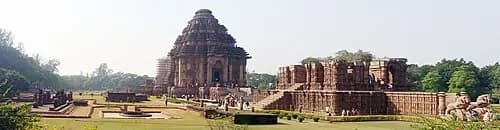
Welcome to the Konark Sun Temple, a marvel of 13th-century design that transforms heavy stone into a celestial chariot for the Sun God, Surya. This entire complex was built to resemble a massive vehicle with twenty-four giant wheels, led by seven horses. European sailors navigating the coast once called this site the 'Black Pagoda' because of its dark silhouette against the sky, which served as a vital landmark for their voyages. While the temple remains impressive today, much of its original scale has been lost to time. The building you see directly in front of you is the Jagamohana hall, which stands about thirty-nine meters high. However, this was originally just the entrance hall. Behind it once rose a main sanctum tower that reached a staggering seventy meters into the air before it collapsed centuries ago. Even in its current state, the site reflects the grand ambition of its creators, who sought to capture the movement of the sun in permanent masonry.
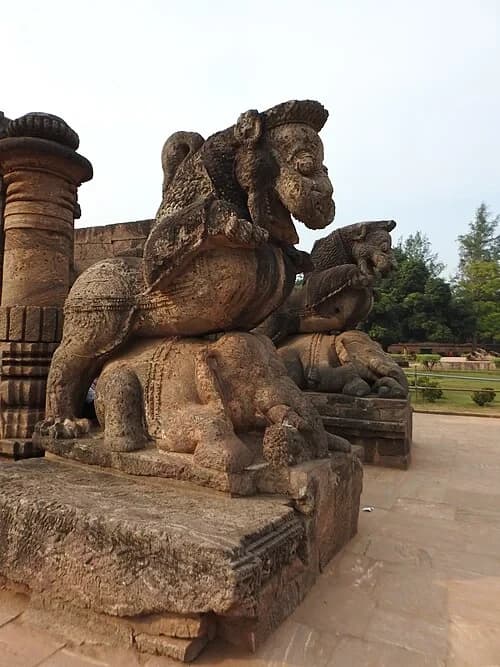
The Guardian Lions
A pair of imposing Gaja-Simha statues guards the entrance to the temple, presenting a complex visual message to every pilgrim who arrived. In these sculptures, a powerful lion is shown rearing up and crushing a massive elephant. Underneath the elephant, a smaller human figure lies pinned to the ground. This specific arrangement contains layers of Hindu symbolism intended to prepare visitors for their entry into the sacred space. The lion represents pride and power, while the elephant symbolizes material wealth and worldly abundance. The human figure at the bottom represents the ego. By showing the lion overcoming the elephant and the elephant overcoming the man, the sculpture warns that human pride and the pursuit of riches can easily crush the spirit. Entering the temple required leaving behind these earthly distractions to achieve a state of humility and spiritual focus. These guardians were the first thing a visitor would encounter, serving as a reminder that the path toward the divine begins with the surrendering of the self.
Nata Mandira: The Hall of Dance
Focuses on the intricately carved pillars and the temple's role in the performing arts. Highlights the famous musicians and dancers.
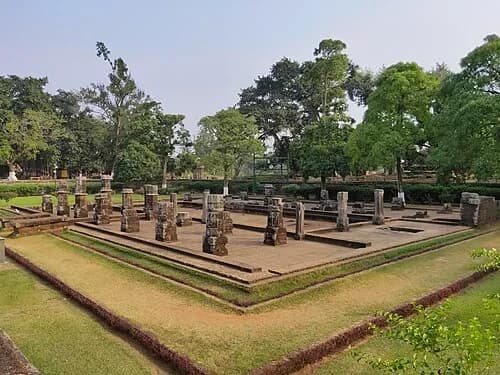
The Hall of Dance
The Nata Mandira, or Hall of Dance, stands as a separate structure from the main temple, elevated on a high platform to distinguish it as a stage for performance. This was the vibrant cultural heart of the complex, where Devadasis, or temple dancers, performed the intricate movements of Odissi dance to honor the Sun God. While the hall is open to the sky today, it originally featured a heavy stone roof that would have acted as a massive acoustic chamber. The music of drums, cymbals, and bells would have resonated within the space, carrying the rhythm across the entire temple complex. Even without its roof, the architecture remains striking. The platform is accessible via broad stairways, and every inch of the remaining structure is covered in carvings. Performers would have been surrounded by images of musicians and celestial beings, making their movements part of a larger, eternal celebration of light and life. This structure highlights how religious worship in 13th-century Odisha was inextricably linked to the performing arts.
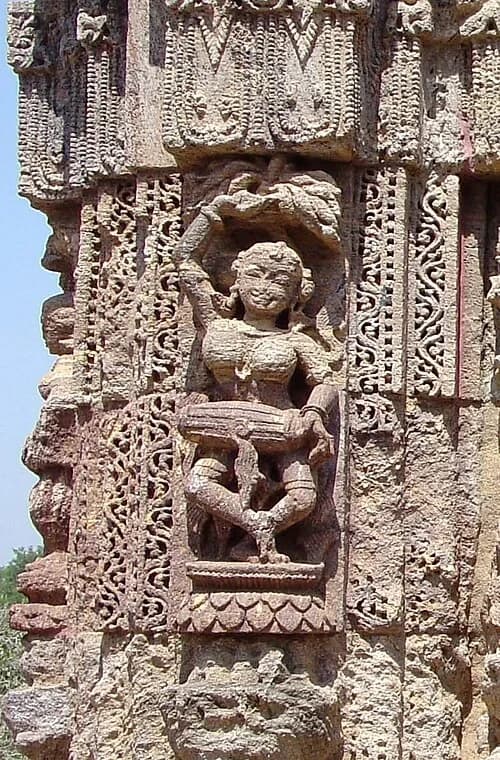
The Drummer Relief
The pillars and walls of the Dance Hall are densely packed with musicians, showcasing the rich musical tradition of the Eastern Ganga era. This specific carving features a female musician playing the 'Mardal,' a traditional double-sided drum that remains central to Odissi dance and music today. Notice the posture of the figure, with her body subtly bent and her hands positioned as if mid-beat. The sculptor has captured the tension in her fingers and the decorative ornaments on her arms and legs, suggesting the vibrancy of the performances that once occurred here. In the 13th century, music and dance were not merely entertainment; they were considered forms of yoga and paths to spiritual enlightenment. Figures like this one provide a permanent record of the instruments and costumes used during the temple's golden age. String instruments, flutes, and various types of drums are all represented across the pillars, creating a visual symphony that complements the architectural grandeur of the site. These reliefs demonstrate that every surface of the temple was intended to participate in the collective worship of Surya.
The Celestial Chariot and Seven Horses
Explains the unique architectural design of the temple as a chariot for Surya. Highlights the symbolism of the seven horses.
Seven Celestial Horses
Leading the temple chariot are seven celestial horses, carved in high relief as if they are galloping across the sky. While time and erosion have softened their details, their dynamic, forward-leaning postures still suggest a great deal of speed and energy. These horses are deeply symbolic, representing the seven days of the week and the seven colors that make up a ray of light—the colors of the rainbow. In Hindu mythology, the Sun God Surya travels through the heavens in a chariot pulled by these stallions, ensuring the continuity of time and the cycles of nature. The placement of the horses at the front of the complex gives the impression that the entire stone structure is being pulled toward the east, toward the rising sun. Their powerful legs are depicted in mid-stride, and their heads are turned as if straining against their harnesses. This design successfully turned a static building into a narrative scene, helping visitors visualize the daily journey of the deity they came to worship. These stallions are the engine of the Sun Temple, personifying the relentless movement of time itself.
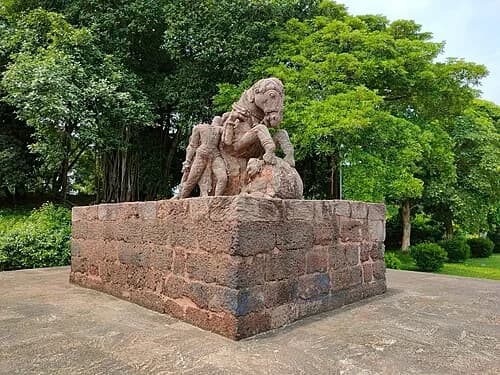
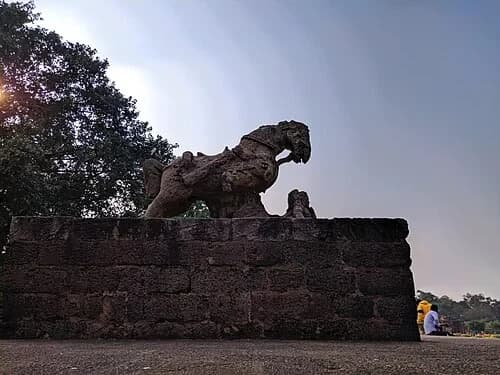
The War Horse
Two massive, free-standing sculptures of war horses guard the southern entrance to the temple complex, though only one is clearly visible here. These figures are celebrated for their raw power and dynamic energy, standing in stark contrast to the more delicate carvings found on the temple walls. The horse is depicted in a triumphant stance, trampling a figure beneath its hooves, which represents an enemy in battle. This imagery was a direct tribute to the military might of King Narasingha Deva I, whose kingdom was known for its formidable cavalry and success in defending its borders. Unlike the symbolic animals meant for religious reflection, these horses served a political purpose, reminding all who visited of the king’s secular authority and strength. The proportions are slightly exaggerated to emphasize the horse's muscular form and decorated harness. Despite centuries of weathering from the salty sea air, the sense of motion remains intact. These sculptures are often cited as masterpieces of medieval Indian military art, capturing the spirit of an empire that saw its king as both a devout servant of the sun and a warrior.
The Iconic Wheels and Sundials
Covers the 24 massive wheels that function as precision sundials. Explains the scientific mastery of the 13th-century architects.
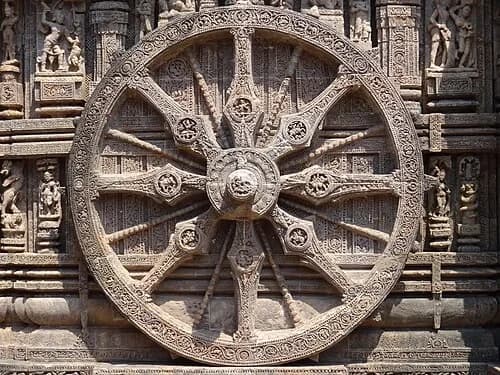
The Great Sundial
The twenty-four massive stone wheels of the Sun Temple are its most iconic feature, and they represent far more than just decoration. Arranged in pairs along the base of the structure, these wheels represent the twenty-four fortnights of the Hindu lunar year. However, they were also designed as high-precision scientific instruments. Each wheel functions as a giant sundial. The central hub and the eight major spokes allow for the calculation of time based on the shadow cast by the sun. By observing where the shadow falls on the intricate carvings of the wheel's rim, ancient visitors could determine the time of day with surprising accuracy, down to the minute. Each spoke is decorated with scenes from daily life, ranging from hunting trips to religious rituals, making every wheel a miniature encyclopedia of 13th-century culture. The level of detail is extraordinary, with thin, bead-like patterns and floral motifs covering almost every square inch of the stone. These wheels stand as a testament to the advanced mathematical and astronomical knowledge of the era, where science and art were blended into a single, functional masterpiece.
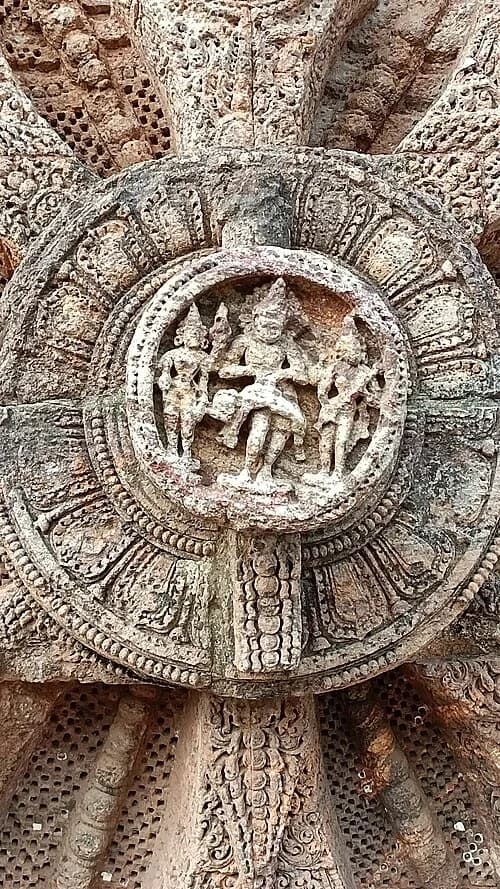
Avatar in the Hub
If you look closely at the central hub of the great wheels, you will find intricate carvings of various deities, including this one depicting the Narasimha avatar of Vishnu. Narasimha is the half-lion, half-man incarnation who arrived to defeat a demon king, and he is a popular figure in the religious traditions of the region. Seeing a Vaishnavite figure like Narasimha in a temple dedicated to the Sun God might seem surprising, but it reflects the broad and inclusive religious landscape of the Eastern Ganga Dynasty. While Surya was the primary focus of this site, the kings of that era often patronized multiple traditions, and many viewed different gods as manifestations of the same divine power. The carving itself is remarkably detailed given its small scale, showing the lion-headed figure in a classic seated posture. Surrounding the hub are concentric circles of floral and geometric patterns, drawing the eye toward this central spiritual image. These small details in the hubs ensure that even the functional parts of the temple, like the sundials, were infused with religious meaning, offering pilgrims various points of devotion as they moved around the chariot's exterior.
Surya: The Three Aspects of the Sun
Explores the standing chlorite statues of Surya positioned to catch the sun's rays at different times of the day.
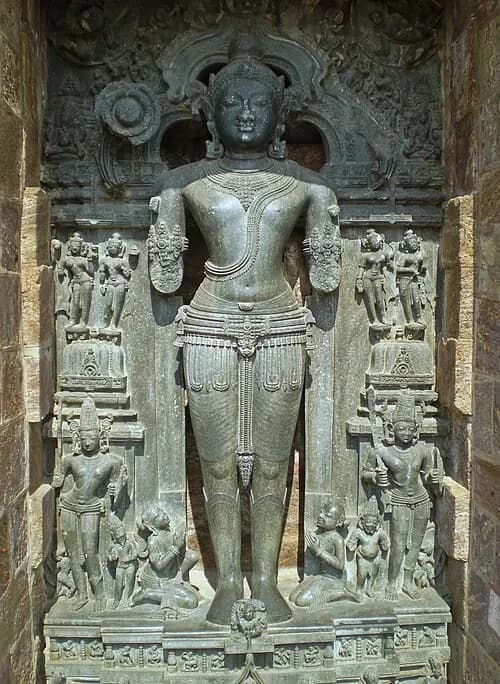
Surya of the South
Three large statues of Surya are placed in deep niches on the exterior of the temple, each representing the sun at a different time of day. This southern statue represents the sun in its full mid-day glory. Unlike the warm red stone of the main temple structure, these statues were carved from green chlorite, a much harder and finer-grained stone that allows for incredibly sharp detail. The contrast between the dark green figure and the red background makes the god stand out prominently. Take a look at Surya’s feet—he is wearing knee-high boots. This is a very unusual feature in Indian iconography, as most deities are depicted barefoot. This stylistic choice is believed to be an influence from Central Asian traditions, where Surya was often shown as a horseback-riding warrior from the north. The statue is surrounded by smaller figures, including his charioteer, Aruna, and celestial attendants. Surya’s expression is calm and stoic, reflecting the steady and unchanging nature of the sun as it reaches its highest point in the sky. The preservation of this chlorite carving is remarkable, retaining much of the polish it had eight centuries ago.
Mayadevi Temple and Engineering Legacy
Concludes the tour at the secondary shrines and discusses the engineering efforts to preserve the main hall.
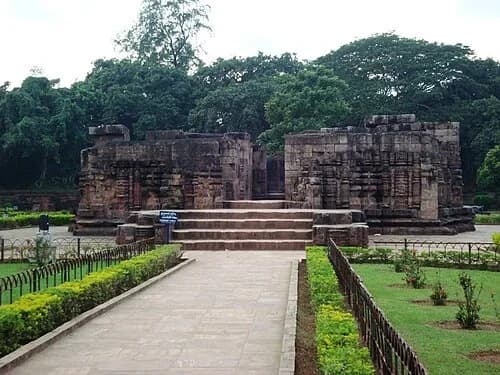
Temple of Mayadevi
To the west of the main temple, you can see the ruins of a smaller structure known as the Temple of Mayadevi. For a long time, this building was completely buried under mounds of sand and debris. It was only during 20th-century excavations that the full extent of this secondary temple was revealed. Mayadevi is considered to be one of the wives of the Sun God, Surya, and this temple was dedicated to her. Its discovery was significant because it proved that the Konark complex was much larger and more complex than scholars originally realized. It wasn't just a single chariot; it was a layered sacred landscape with multiple shrines and halls. The Temple of Mayadevi is actually older than the main Sun Temple, likely dating back to the late 11th or early 12th century. This suggests that the site was already a prominent center of sun worship long before King Narasingha Deva I began his massive project. The carvings here are similar in style to the main temple but on a smaller scale, featuring various deities and decorative motifs that reinforce the solar theme of the entire site.
Want to hear the rest?
Download the Stanza app to unlock all 16 stops and full GPS-guided navigation.
Frequently Asked Questions
How long does the Konark Sun Temple audio tour take?
The Konark Sun Temple audio guide includes 16 narrated stops. Most visitors spend 45 minutes to 1.5 hours exploring the complete tour, though you can listen at your own pace and skip or revisit any stop.
Is the Konark Sun Temple audio guide available in my language?
Stanza supports 15 languages: English, Spanish, French, German, Italian, Portuguese, Russian, Japanese, Chinese, Korean, Arabic, Hindi, Polish, Dutch, Hebrew. Check the guide in the app to confirm the languages currently available for this tour.
Can I use the audio guide offline at Konark Sun Temple?
Yes! Download the complete Konark Sun Temple tour — including all audio, maps, and images — before your visit. The Stanza app works completely offline, so you don't need WiFi or mobile data at the venue.
How much does the Konark Sun Temple audio guide cost?
The Stanza app is free to download. The current listed price for the Konark Sun Temple audio guide is $2.99; app-store region and currency may affect the final price.
How do I use the Stanza audio guide at Konark Sun Temple?
Download the free Stanza app, search for "Konark Sun Temple", and download the tour. When you arrive at the venue, the app uses GPS to detect your location and automatically plays the relevant narration as you move between points of interest — completely hands-free.
What makes the Stanza audio guide different from other Konark Sun Temple tours?
Stanza offers GPS-triggered narration that plays automatically as you walk through Konark Sun Temple — no need to manually select stops. The tour is available in 15 languages, works fully offline, and includes 16 expertly narrated stops with images and historical context.
What other audio guides are available near Konark Sun Temple?
Stanza offers multiple audio guides in Konark, India and nearby areas. After downloading the app, browse the map to discover all available tours near Konark Sun Temple. Each guide can be downloaded for offline use.