Stanza · Audio guide
Thikse Monastery Audio Guide
A place to remember. A story to take with you.
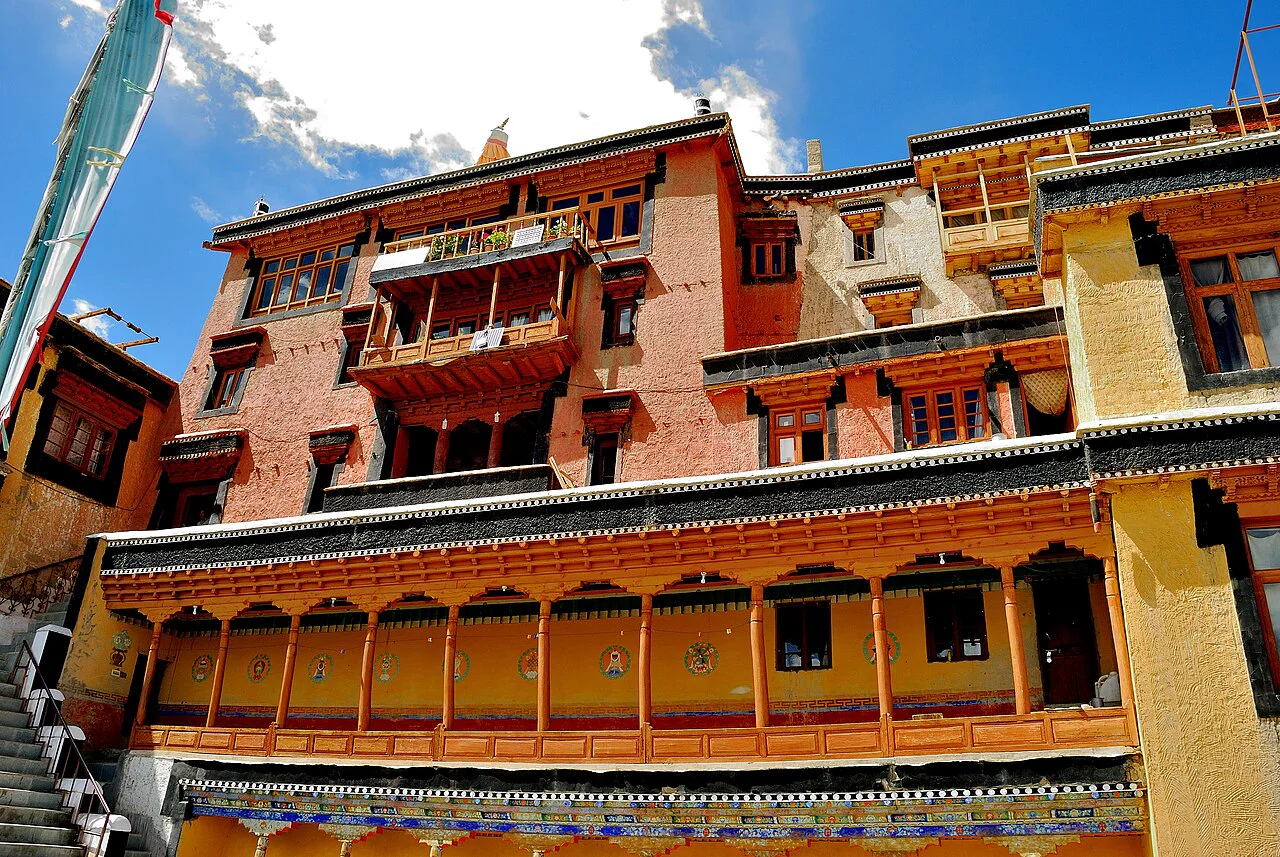
Thiksey Monastery is a Buddhist monastery affiliated with the Gelug school of Tibetan Buddhism. It is the largest monastery in central Ladakh and is noted for its resemblance to the Potala Palace in Lhasa.
Download Stanza, then search for “Thikse Monastery”.
About the tour
One guide. Your kind of visit.
Thiksey Monastery is a Buddhist monastery affiliated with the Gelug school of Tibetan Buddhism. It is the largest monastery in central Ladakh and is noted for its resemblance to the Potala Palace in Lhasa.
Ready when you are.
- 01Get the free Stanza app.
iOS & Android
- 02Find your guide.
“Thikse Monastery”
- 03Download before you go.
Works offline
Audio guide / 11 narrated stops
Inside the guide
Get to know a few of the stories before you go. Open a stop to read more.
01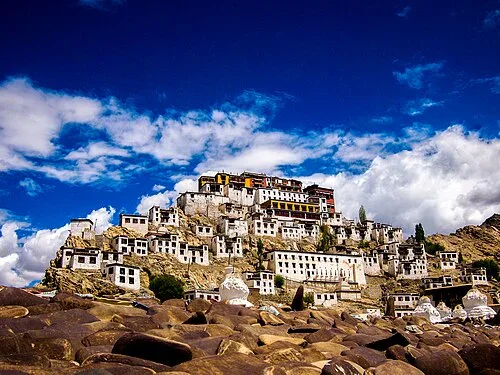 Hillside Approach and Dzong Architecture
Thiksey Monastery: The Mini Potala
Welcome to Thiksey, the largest monastery in central Ladakh, high in the Indus Valley at about three thousand six hundred metres. From a distance it reads as one building, but it is really a whole hillside of structures, twelve levels tall. The whitewashed and red-painted buildings rise in ascending order of importance. Ordinary dwelling units sit at the foot of the slope, temples and the chief lama's residence claim the top. Tibetan fort-monasteries were built in this stacked dzong pattern, and Thiksey follows it so closely that people call it the Mini Potala, after the great palace of the Dalai Lamas in Lhasa. A visit here means open-air stone staircases all the way up, and a stupa waits at the highest point. How the monastery came to this hill is a story of a sacred gift and two crows, waiting at the gate below.
Photo: Caesardeka · CC BY-SA 3.0
02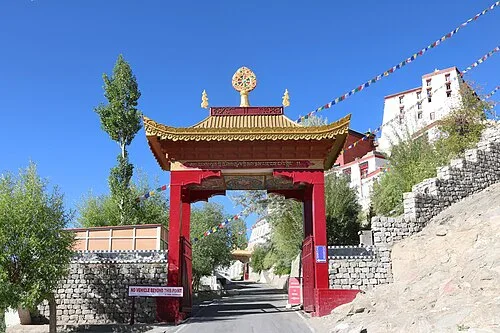 Hillside Approach and Dzong Architecture
The Entrance Gate
Here at the entrance gate, the founding story of Thiksey begins with a gift. In the early fifteenth century, Je Tsongkhapa, founder of the Gelug school of Tibetan Buddhism, sent disciples to distant lands to spread his teachings. To one of them, Jangsem Sherap Zangpo, he gave a small statue of Amitayus, the Buddha of long life. Inside it were bone powder and a drop of Tsongkhapa's own blood. Sherap Zangpo carried it to the King of Ladakh. The king loved the gift and ordered his minister to help establish the Gelug order in Ladakh. So in 1433 Sherap Zangpo founded a small village monastery called Lhakhang Serpo, the Yellow Temple, at Stagmo north of the Indus. The order grew slowly at first. His pupil Palden Zangpo carried the work on, and the story goes that during a ritual near the Yellow Temple, two crows snatched the ceremonial torma offering and flew off with it. When Palden and his disciples searched for it, they found it on this hill, set down on a stone, perfectly ordered and undisturbed. Palden took it as a divine directive, and built the great monastery here.
Ingo Mehling · CC BY-SA 3.0
03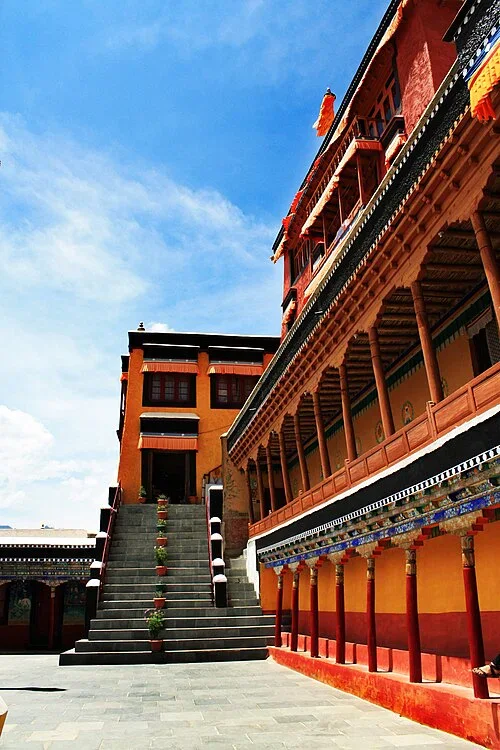 Main Courtyard and Prayer Stairway
Courtyard and the Assembly Hall Building
Thiksey is not a monument but a working monastery, home today to around sixty lamas. The colour code tells you what each building does. The yellow building holds the assembly hall, the dukhang, while the red buildings house the guardian deity shrines. Every morning around seven, synchronized chanting of sutras rises from the prayer hall, and worshippers still come for it. The monastery's influence reaches beyond its own walls. In Ladakh, nunneries long held a lowly status, and nuns lived in harsh conditions. In the 1990s that began to change, helped by a conference of Buddhist women in Leh and the founding of the Ladakh Nuns Association. Thiksey's own chief lama backed these efforts, and the monastery donated land at Nyerma, nearby, for a new nunnery. The nuns themselves set aside their old title, ani, which literally means aunt and carried the sense of a servant, and took the name cho-mos, female religious practitioners.
Listen in the appAshwin Kumar from Bangalore, India · CC BY-SA 2.0
04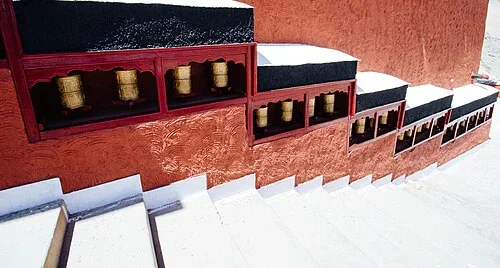 Main Courtyard and Prayer Stairway
The Prayer Wheel Stairway
In monasteries of the Tibetan tradition, the climb to the temples is itself an act of devotion. Along routes like this one, worshippers pass rows of prayer wheels, cylinders set into the wall beside the steps. Each one holds written prayers inside, and setting the cylinder spinning is believed to set those prayers in motion. One turn, one recitation, without a word spoken. The wheels here line a deep red wall above whitewashed steps, gold against crimson. Mani walls and stupas mark the approaches to the monastery complex, so the whole ascent moves through sacred ground.
Listen in the appAshwin Kumar from Bangalore, India · CC BY-SA 2.0
05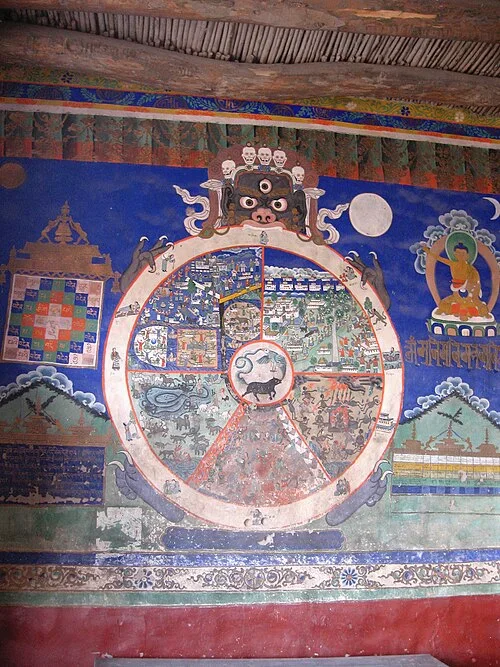 Assembly Hall (Dukhang) and Sacred Murals
The Wheel of Life Mural
At the entrance to the assembly hall, a wall painting shows the Bhavacakra, the Wheel of Life. It is one of the most demanding images in Buddhist art, placed deliberately where everyone entering must pass it. A fearsome figure grips the great wheel in its hold, and within its ring lie the segments of existence, realm after realm. Three small creatures carry the painting's warning: a snake, a bird and a pig, standing for ignorance, attachment and aversion. These are the earthly ties a being must overcome to reach enlightenment, and to escape the cycle of death and rebirth. That is why the wheel hangs at a threshold. Everyone who walks in to pray walks past the lesson first.
Listen in the appPhoto: Redtigerxyz · CC BY-SA 3.0
06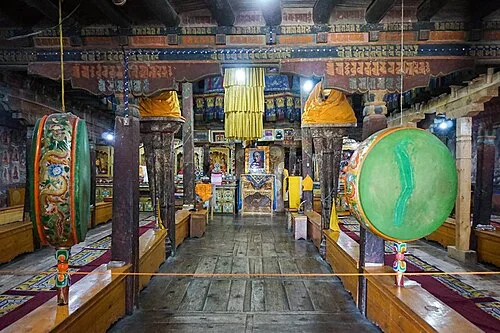 Assembly Hall (Dukhang) and Sacred Murals
Inside the Assembly Hall
Beyond the mural lies the assembly hall, the spiritual heart of Thiksey, a room of chant and gathering. At its far end, behind the main prayer room with its handwritten and painted books, sits a small inner sanctum of Gautama Buddha. He is flanked by two bodhisattvas, Manjushri on the right and Maitreya on the left. The hall also holds an image of the Thousand-armed Avalokiteshvara with Padmasambhava, and murals of the deities Mahakala and Sitatapatra. The seating spells out the monastery's place in the world. The seat at the centre is for the Dalai Lama himself, and to its right stands the seat of the head lama. Around them run the low benches where the community sits, with great drums hanging ready for the prayers.
Listen in the appBernard Gagnon SONY ILCE-5000 · CC BY-SA 4.0
07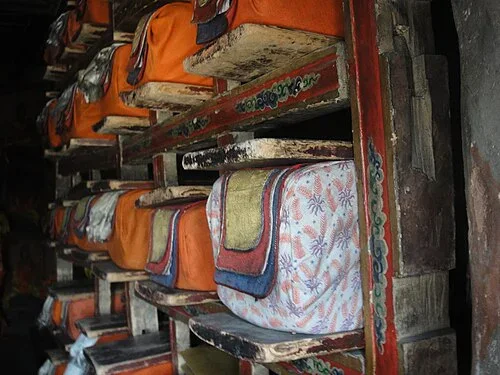 Assembly Hall (Dukhang) and Sacred Murals
Sacred Scriptures of the Assembly Hall
Along the hall's wooden shelves rest the monastery's scriptures, and they are treated as sacred objects rather than ordinary books. Here lie the volumes of the Tengyur, the collected commentaries of the Tibetan Buddhist canon, the great body of writing that explains the Buddha's teaching. There are two hundred and twenty-five of them, and each volume is wrapped in silk against dust and damage. They sit stacked in cloth bundles on shelves whose painted wood has darkened with age. Higher up the monastery, the Lamokhang temple keeps further scriptures including the Kangyur, the canon's other great half, waiting later in the climb.
Listen in the appJessie Hey · CC BY 2.0
08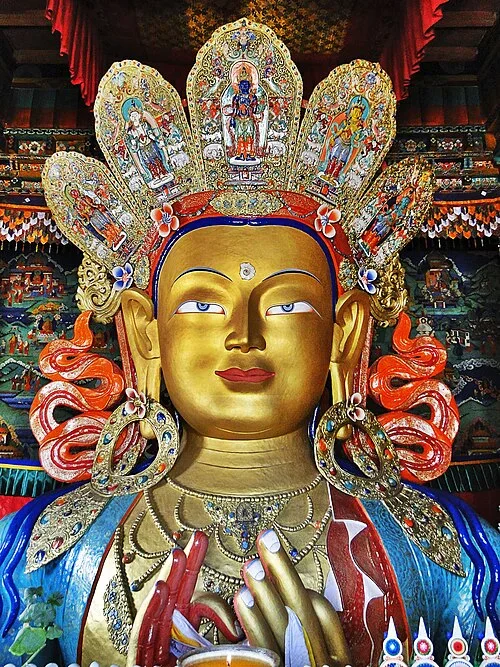 Maitreya Buddha Temple
The Maitreya Buddha
The most famous image inside Thiksey is the Maitreya, the future Buddha, and he fills his temple from floor to roof. The statue rises fifteen metres, the largest of its kind in Ladakh, and covers two full storeys of the building. The temple was erected to commemorate a visit by the fourteenth Dalai Lama to this monastery in 1970. The golden face looks down with half-closed eyes beneath a great fluted crown, the hands raised in the gesture of teaching. What surprises most visitors is the pose. Maitreya is usually shown standing or seated on a high throne, but here he sits in the lotus position, calm and cross-legged. How a figure this size was made, and by whom, is its own story.
Listen in the appPhoto: Ronakshah1990 · CC BY-SA 4.0
09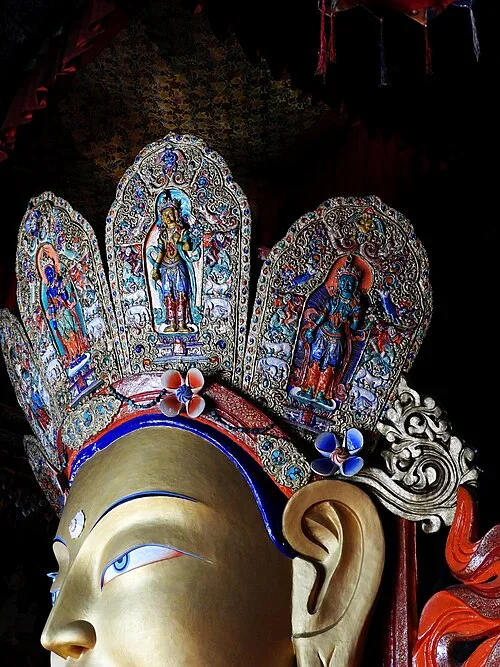 Maitreya Buddha Temple
The Crown of the Maitreya
The Maitreya's crown rewards a slow look. Five tall lobes rise above the golden face, each one worked with inlaid figures of buddhas and bodhisattvas in blues, greens and reds, with metal flourishes spilling out beside the ears. The statue took four years to build, made by local artists working under the master Shilp Guru Nawang Tsering of the Central Institute of Buddhist Studies in Leh. They built it in clay and copper, finished with gold paint, and the painted blues of the eyes and the fine linework of the crown show what that patience produced. Every lobe, every flower at the hairline, was shaped by hand.
Listen in the appPhoto: Sumita Roy Dutta · CC BY-SA 4.0
10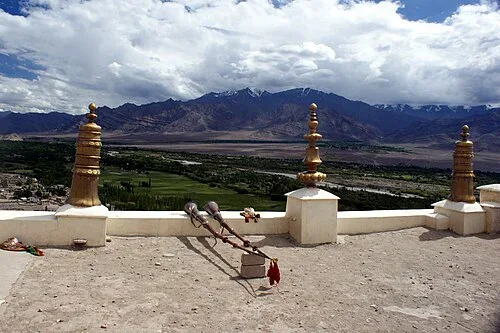 Rooftop Terrace and Valley Viewpoint
Rooftop Ritual Terrace
On the summit terrace, long horns and ritual instruments rest against the white parapet wall, waiting for the days they are needed. Those days come each year with the Gustor ritual, held from the seventeenth to the nineteenth day of the ninth month of the Tibetan calendar, falling in October or November. Sacred mask dances, the Cham, are performed in the monastery precincts, dancers in masked costume moving to the sound of these instruments. At the base of the hill a trade fair gathers at the same time, with villagers from all over Ladakh coming to barter, trade and socialize. For smaller festivals through the year, the monks make sand mandalas, intricate designs poured grain by grain in coloured sand.
Listen in the appPhoto: Kondephy · CC BY-SA 3.0
- 11
The Indus Valley View
What the valley view explains: a fortress of faith that once directed ten monasteries and dozens of villages.
Thikse Monastery
Frequently asked questions
How much does the guide cost?
Free app download. Listed guide price: $0.99. Guide price shown in the app. Audio guide only. Venue admission is separate.
Can I listen without internet?
Yes. Download the guide’s audio, images, and maps in the app before your visit. Your downloaded content is then available offline.
Can I listen in my language?
This audio guide is available in 15 languages, including English.
Do I need to follow a schedule?
No. This is a self-guided experience. Choose your stops, pause whenever you like, and return to a story at your own pace.
At your own pace
Explore Thikse Monastery.
Download Stanza, then search for “Thikse Monastery”.
Free app download · Guide price shown in the app
Keep exploring
Audio guides — India
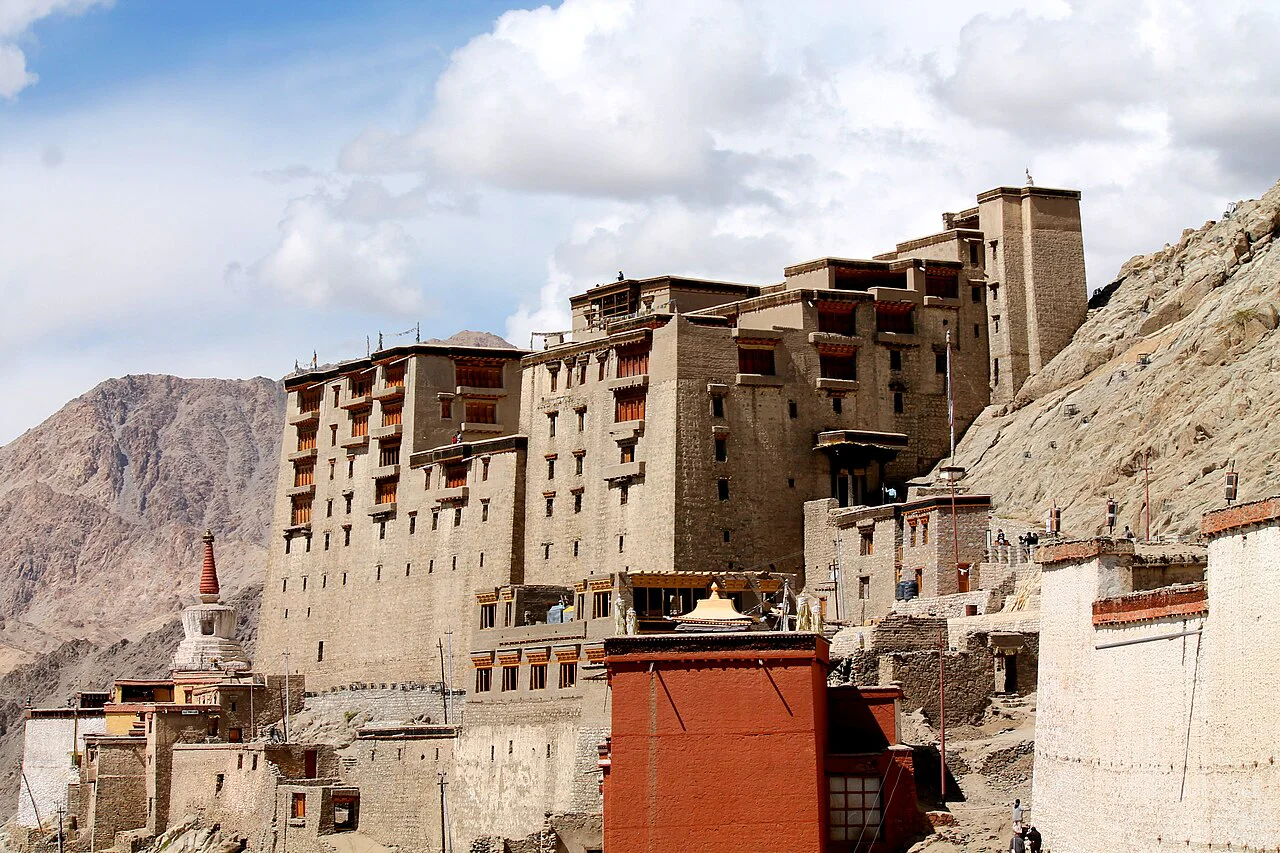
Leh · 14 km
Leh Palace
Content & sources
Photo: RPSkokie · CC BY-SA 4.0
Katra
Vaishno Devi Temple
Content & sources
Abhishek Chandra · Public domain
Amritsar
Harmandir Sahib
Badrinath
Badrinath Temple
Content & sources
Photo: रामेश्वर गौड़ · CC BY-SA 4.0