Languages
15India Gate Audio Guide
India Gate is a landmark in New Delhi, India. Explore it with Stanza's GPS-triggered offline audio guide — available in 15 languages.
Quick Facts
10
Stops
15
Languages
100%
Offline
📍 New Delhi, India · 28.6129°N, 77.2293°E
About India Gate
India Gate is a prominent triumphal arch located in New Delhi, India. It serves as a war memorial dedicated to Indian soldiers who died in World War I and other conflicts.
India Gate is also known as इंडिया गेट, ईन्डिया गेट, इन्डिया गेट, इण्डिया- गेट, and 1 other names in various languages.
This self-guided audio tour features 10 narrated stops organized across 5 sections, including The Ceremonial Axis: Kartavya Path, Lutyens' Triumphal Arch, Amar Jawan Jyoti: The Eternal Flame, The Canopy: From Empire to Independence, The National War Memorial. As a triumphal arch, India Gate offers a unique cultural experience in the heart of New Delhi, India.
The Stanza audio guide is available in 15 languages and works entirely offline — download the complete tour including audio narration, maps, and images before your visit. As you walk through India Gate, GPS-triggered narration plays automatically at each point of interest.
Last updated:
What you will hear
The Ceremonial Axis: Kartavya Path
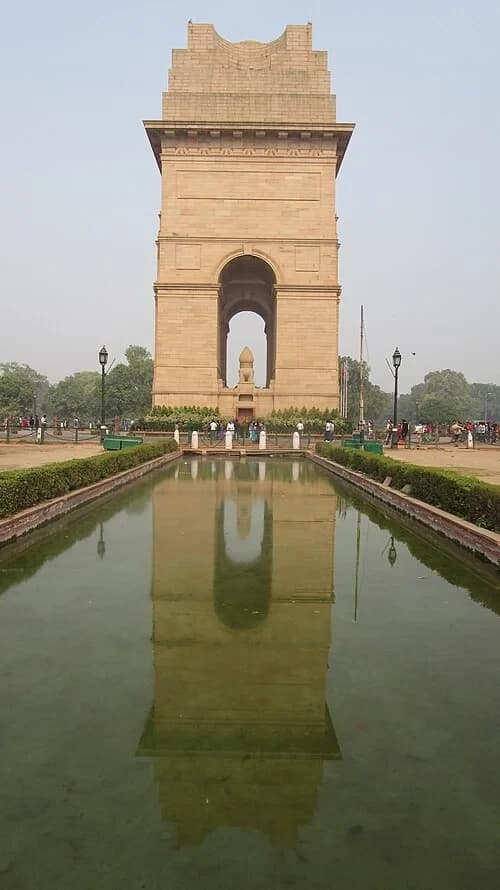
This area establishes the monument's setting at the eastern end of India's most significant ceremonial road. The image captures the symmetry and grand scale of the approach.
The Monumental Approach
Standing at the head of the ceremonial Rajpath, this 42-meter-tall arch dominates the landscape. Designed by British architect Sir Edwin Lutyens, the structure is a masterwork of what he called the 'elemental mode.' Unlike many traditional memorials, Lutyens deliberately avoided specific religious symbols, choosing instead a universal architectural language to commemorate individual sacrifice. While the form draws inspiration from the Arc de Triomphe in Paris, its proportions and purpose are uniquely Indian. Look at the reflection in the surrounding pools to appreciate the building's perfect vertical and horizontal symmetry. This site was conceived as the All India War Memorial to record the service of soldiers from across the subcontinent. The archway acts as a monumental frame for the horizon, inviting you to consider the vast scale of the grounds. The surrounding green spaces and water features were integrated to provide a place of public gathering while maintaining a dignified atmosphere. Notice how the structure appears to change color depending on the time of day and the quality of the light.
Lutyens' Triumphal Arch
Focuses on the architectural design by Sir Edwin Lutyens and the human connection through the thousands of names inscribed on the walls. It covers the 'elemental mode' of the arch and its secular purpose.
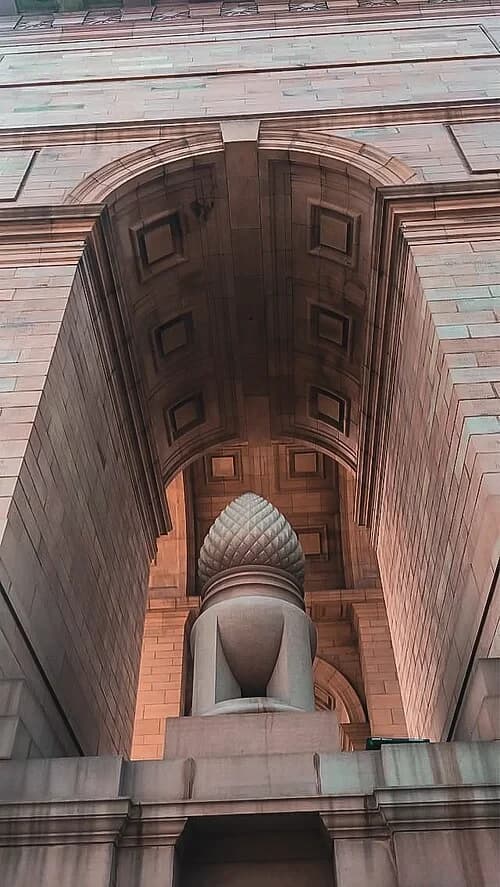
The Stone Urn
Entering the interior of the arch reveals the impressive 30-foot span of the walkway. Looking up, you can see a series of deeply recessed geometric patterns carved into the ceiling, which add a sense of depth and complexity to the otherwise massive stone blocks. Positioned high above the archway is a large stone urn. Sir Edwin Lutyens designed a shallow, domed bowl at the very peak of the gate, intended to hold burning oil during significant anniversaries and commemorations. Although this practice is rarely seen today, the presence of the urn remains a key part of the memorial’s original functional design. The masonry inside also highlights a deliberate material transition. Near the ground, the red stone has a rougher, more tactile finish. As your eyes move upward, the stone transitions into smoother, more refined textures. This graduation in the stonework was intended to draw the viewer's gaze toward the sky. The play of light and shadow within these recessed ceiling panels changes throughout the day, highlighting different facets of the intricate carvings. A distinct line separates the different phases of masonry work.
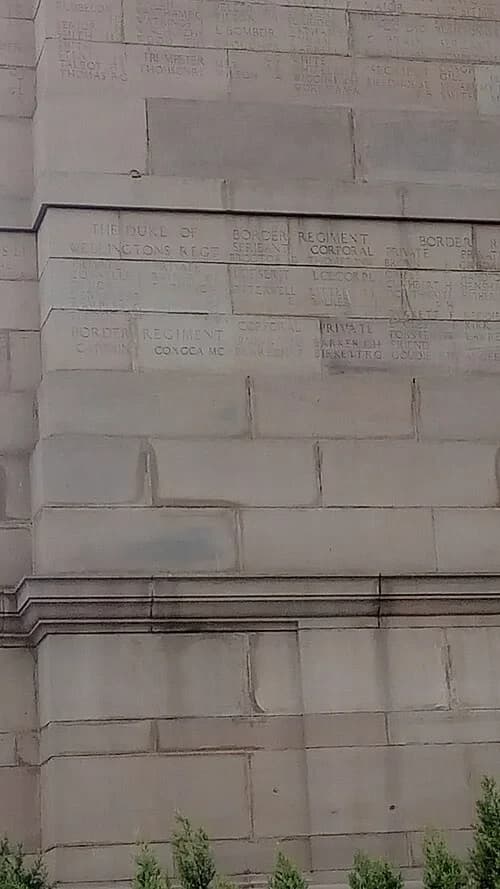
Names of the Fallen
Beyond the grand scale of the architecture lies the human heart of the monument: thousands of names carved directly into the stone surfaces. In total, 13,313 individual names are inscribed here, representing a portion of the 74,187 Indian Army soldiers who lost their lives during World War I and the Third Anglo-Afghan War. These inscriptions serve as the only headstones for many who died far from home. If you look closely at the inscriptions, you can distinguish various units and ranks. You might spot references to the 'Duke of Wellington's Regiment' alongside the ranks of 'Serjeant,' 'Corporal,' and 'Private.' This listing of names reflects the vast diversity of the men who served, coming from different regions and backgrounds to form a single fighting force. The letters are deeply cut into the sandstone to resist the weathering effects of the Delhi climate. The names are organized by regiment and then by rank, following the military traditions of the time. This massive catalog of individuals transforms the monumental arch into a personal space of remembrance for families and visitors alike. Small variations in the stone's color occasionally run through the lines of text.
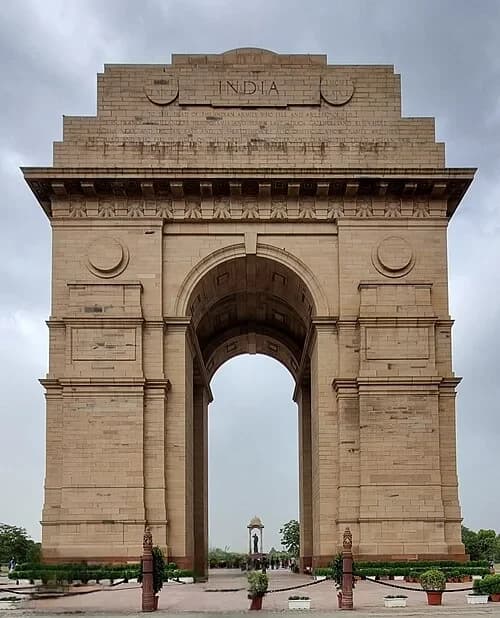
The Triumphal Arch
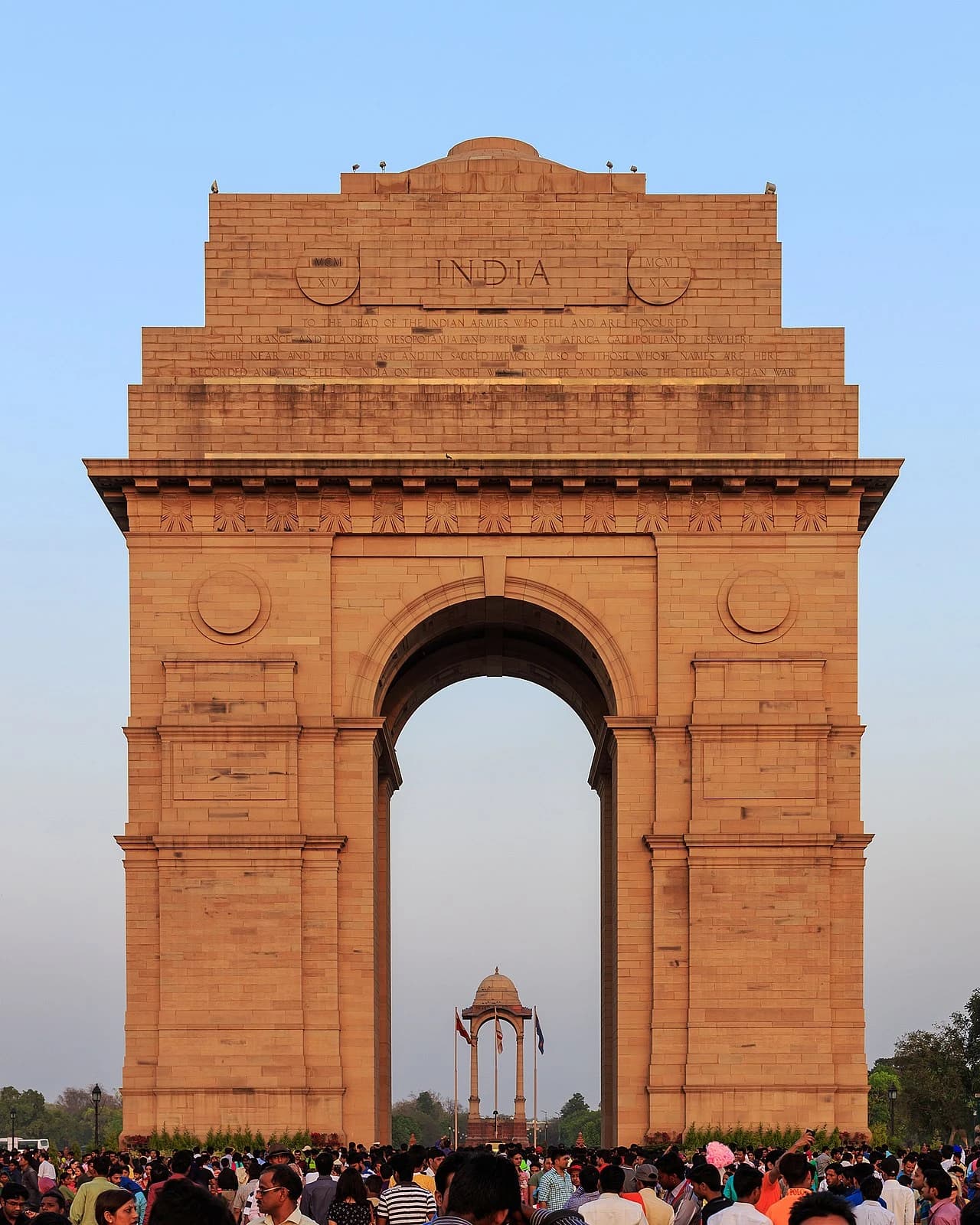
The construction of this memorial was a massive undertaking that spanned exactly ten years. The Duke of Connaught laid the foundation stone on February 10, 1921, but it was not until February 12, 1931, that the structure was finally inaugurated. The exterior features a distinct contrast of textures and colors, achieved by using a combination of red and pale sandstone sourced from Bharatpur. If you look toward the very top, just below the crowning dome, you will see a prominent cornice. This area is decorated with Imperial sunburst motifs, which were symbols of the era's authority. Carved boldly across the center is the word 'INDIA.' To the left and right of the name are Roman numerals: MCMXIV for 1914 and MCMXIX for 1919. These dates mark the beginning and end of the First World War, the primary conflict this monument commemorates. The stonework is meticulously joined, showing the precision of the masonry involved in such a large-scale project. The lower portions of the pillars use the darker red stone, providing a visual anchor for the lighter-colored sections that rise toward the sky.
Amar Jawan Jyoti: The Eternal Flame
Located directly beneath the main arch, this memorial honors the unknown soldier. Although the flame was merged with the National War Memorial in 2022, the site remains a critical stop for understanding modern Indian military history.
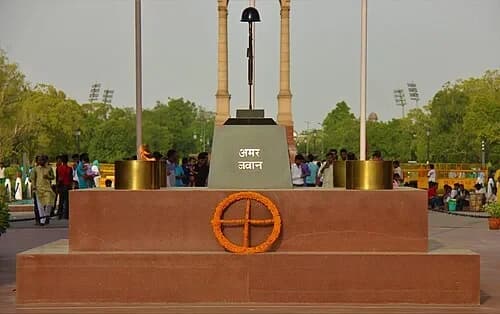
The Flame of the Immortal Soldier
Beneath the soaring arch sits a black marble plinth known as the Amar Jawan Jyoti, or the Flame of the Immortal Soldier. This feature was not part of Lutyens' original 1931 design; it was added in the early 1970s following the Indo-Pakistani War of 1971. Its purpose was to provide a dedicated space to honor the unknown soldiers who died in service of independent India. Traditionally, four eternal flames burned here, one on each side of the cenotaph, kept lit around the clock. However, a significant historical shift occurred in January 2022. The eternal flame that had burned here for fifty years was ceremonially merged with the flame at the nearby National War Memorial. While the physical fire has been moved, the marble structure remains a site of deep reverence. It is often the focal point for official wreath-laying ceremonies by visiting dignitaries and military leaders. The polished surface of the marble reflects the interior of the archway above, creating a somber visual connection between the different eras of Indian military history. The plinth stands on a raised platform, keeping it slightly elevated from the main pedestrian walkway.
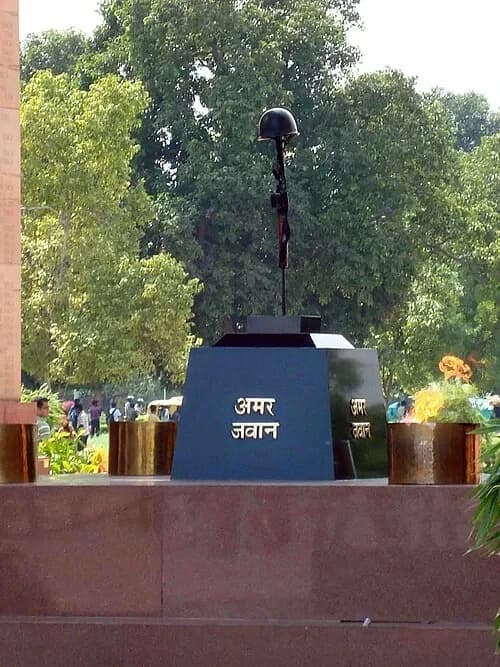
The Soldier's Pedestal
Sitting prominently on the marble cenotaph is a stark, symbolic arrangement: an inverted L1A1 self-loading rifle, its bayonet fixed into the ground, topped by a soldier’s helmet. This imagery is the universal symbol for the fallen soldier across India, representing a life cut short in the line of duty. On all four sides of the pedestal, you can see the words 'Amar Jawan'—meaning 'Immortal Soldier'—inscribed in elegant gold lettering using the Hindi script. This specific memorial represents a pivotal shift in the site's narrative. While the India Gate itself was built to honor those who fought in the World Wars under the British Raj, this pedestal refocuses the site on the soldiers who have served India since its independence in 1947. The materials used here, primarily dark stone and gold, contrast sharply with the surrounding tan sandstone of the arch. This visual distinction marks the layers of history that have been added to the site over time. The helmet's rounded form rests securely on the butt of the rifle, creating a silhouette that is instantly recognizable to millions of citizens. It serves as a quiet counterpoint to the busy city life that flows around the memorial park.
The Canopy: From Empire to Independence
This stop highlights the transition of national identity. The stone canopy that once housed King George V now hosts a statue of Subhas Chandra Bose, symbolizing India's freedom from colonial rule.
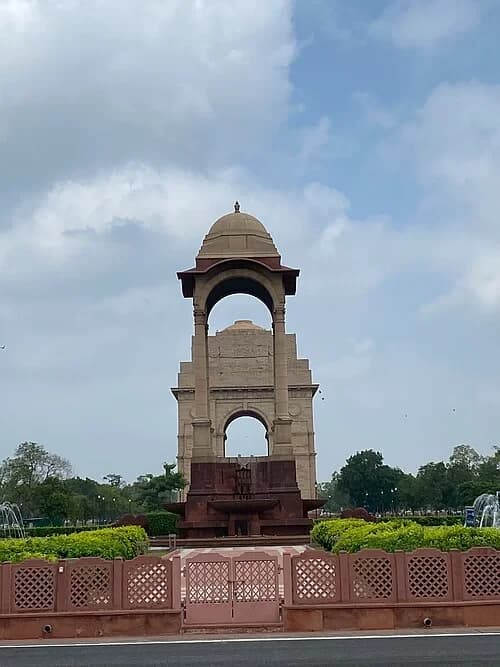
The Empty Canopy View
A short distance from the main arch stands a domed sandstone canopy, an architectural feature that Lutyens modeled after the 6th-century pavilions of Mahabalipuram. Its intricate carvings and slender pillars were designed to harmonize with the neighboring India Gate. For decades, this canopy housed a massive marble statue of King George V, which was a central symbol of British rule in India. However, following independence, the presence of the monarch's statue became a point of contention. In 1968, after a series of public protests, the statue was removed and relocated to Coronation Park. Today, the canopy remains empty, serving as a framed window through which you can view the India Gate along the ceremonial axis. This deliberate void creates an architectural dialogue between the two structures, highlighting the transition from a colonial past to an independent present. The view from this vantage point allows you to appreciate how Lutyens used classical Indian forms to create a monument that felt both grand and locally grounded. The surrounding pavement and garden beds are arranged to guide visitors toward this central viewing point. Notice how the light filters through the open arches of the canopy, casting long shadows across the stone floor.
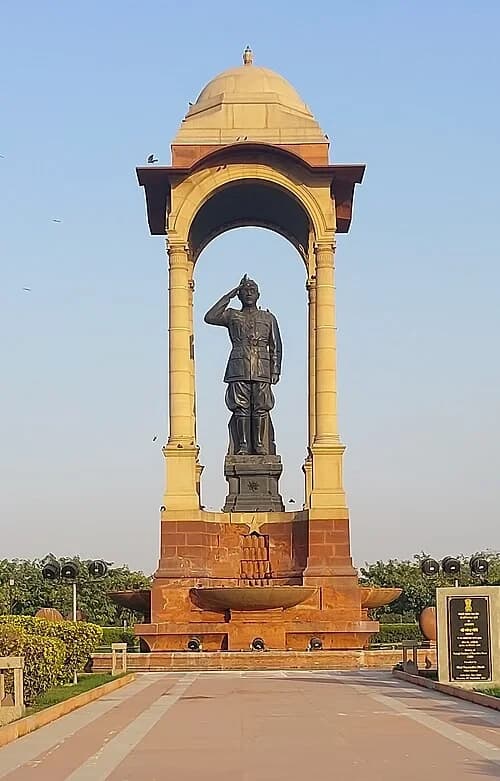
Statue of Subhas Chandra Bose
Arun Yogiraj · granite
Standing tall near the India Gate is a 28-foot-tall statue carved from a single block of granite. It depicts Subhas Chandra Bose, the prominent nationalist leader known affectionately as 'Netaji.' Installed in 2022, the statue replaced a temporary holographic projection that had occupied the space earlier that year. Bose is shown in a characteristic and powerful posture, standing straight in his military uniform and offering a formal salute. This installation is part of a broader effort to transform the area into a site that honors the leaders of the Indian independence struggle. By placing this figure here, the site reclaims a space that was once defined by symbols of colonial authority. The dark, polished granite of the statue offers a strong visual contrast to the surrounding light-colored sandstone structures. It was crafted by a team of sculptors to ensure that every detail, from the folds in the uniform to the expression on the face, was accurately represented. The statue stands on a tiered pedestal, elevating it so it can be seen from across the ceremonial axis of the Rajpath. Small details, like the buttons on the tunic and the cap, are rendered with sharp precision.
The National War Memorial
The final stop on the tour is the modern memorial complex. It serves as the primary site for military remembrance in India today, featuring concentric rings that represent different aspects of military life and sacrifice.
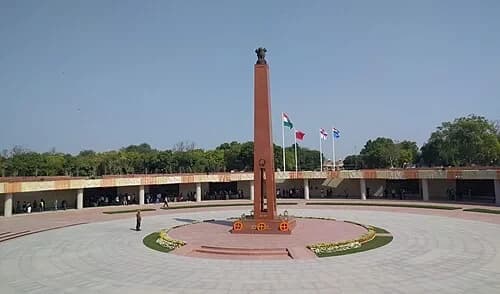
The Circle of Sacrifice Obelisk
Just to the east of the India Gate lies the National War Memorial, a modern 40-acre complex inaugurated in 2019. This site was established to serve as the primary location for military remembrance in contemporary India, complementing the older First World War memorial. At the very center of the complex stands a 15-meter tall obelisk, which is the heart of the 'Tyag Chakra,' or the Circle of Sacrifice. Unlike the India Gate, which honors those who died under the British Raj, this memorial is dedicated to the more than 26,000 soldiers who have lost their lives in various conflicts and peacekeeping missions since India became independent in 1947. The obelisk is topped by a symbol representing the state and is surrounded by a series of concentric circles, each with its own symbolic meaning. The design of the park is intended to be immersive, with walkways that lead visitors through the different layers of the nation's military story. The central pillar acts as a vertical anchor for the entire landscape, visible from several points across the memorial grounds. Lush greenery and paved plazas provide a quiet environment for reflection away from the city's traffic.
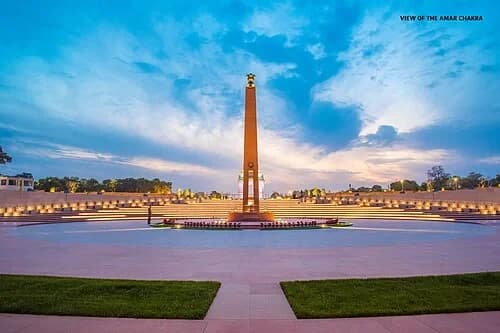
The Circle of Immortality
The layout of the National War Memorial consists of four concentric circles: the Circle of Immortality, the Circle of Sacrifice, the Circle of Bravery, and the Circle of Protection. Each of these rings serves a specific symbolic purpose in honoring the armed forces. The names of over 26,000 fallen soldiers are inscribed individually on the circular walls of these rings, ensuring that each person's service is permanently recorded. The lighting design is a crucial feature here; as the sun sets, the rings are illuminated, creating a glowing path that leads toward the central obelisk. A key moment in the site's recent history occurred in 2022, when the eternal flame from under the India Gate was united with the flame at the base of this obelisk. This ceremonial move was intended to symbolize a continuous line of national service and memory, linking the soldiers of the past with those of the present. As you walk through the different circles, you can see how the architecture uses repetition and symmetry to create a sense of order and dignity. The circular walls are built to a height that feels protective rather than imposing, allowing visitors to view the names up close. Small bronze plaques are set into the stone to mark specific battles and units.
Frequently Asked Questions
How long does the India Gate audio tour take?
The India Gate audio guide includes 10 narrated stops. Most visitors spend 45 minutes to 1.5 hours exploring the complete tour, though you can listen at your own pace and skip or revisit any stop.
Is the India Gate audio guide available in my language?
Stanza supports 15 languages: English, Spanish, French, German, Italian, Portuguese, Russian, Japanese, Chinese, Korean, Arabic, Hindi, Polish, Dutch, Hebrew. Check the guide in the app to confirm the languages currently available for this tour.
Can I use the audio guide offline at India Gate?
Yes! Download the complete India Gate tour — including all audio, maps, and images — before your visit. The Stanza app works completely offline, so you don't need WiFi or mobile data at the venue.
How much does the India Gate audio guide cost?
The Stanza app is free to download. The current listed price for the India Gate audio guide is $1.99; app-store region and currency may affect the final price.
How do I use the Stanza audio guide at India Gate?
Download the free Stanza app, search for "India Gate", and download the tour. When you arrive at the venue, the app uses GPS to detect your location and automatically plays the relevant narration as you move between points of interest — completely hands-free.
What makes the Stanza audio guide different from other India Gate tours?
Stanza offers GPS-triggered narration that plays automatically as you walk through India Gate — no need to manually select stops. The tour is available in 15 languages, works fully offline, and includes 10 expertly narrated stops with images and historical context.
What other audio guides are available near India Gate?
Stanza offers multiple audio guides in New Delhi, India and nearby areas. After downloading the app, browse the map to discover all available tours near India Gate. Each guide can be downloaded for offline use.