Stanza · Audio guide
Dhamek Stupa Audio Guide
A place to remember. A story to take with you.
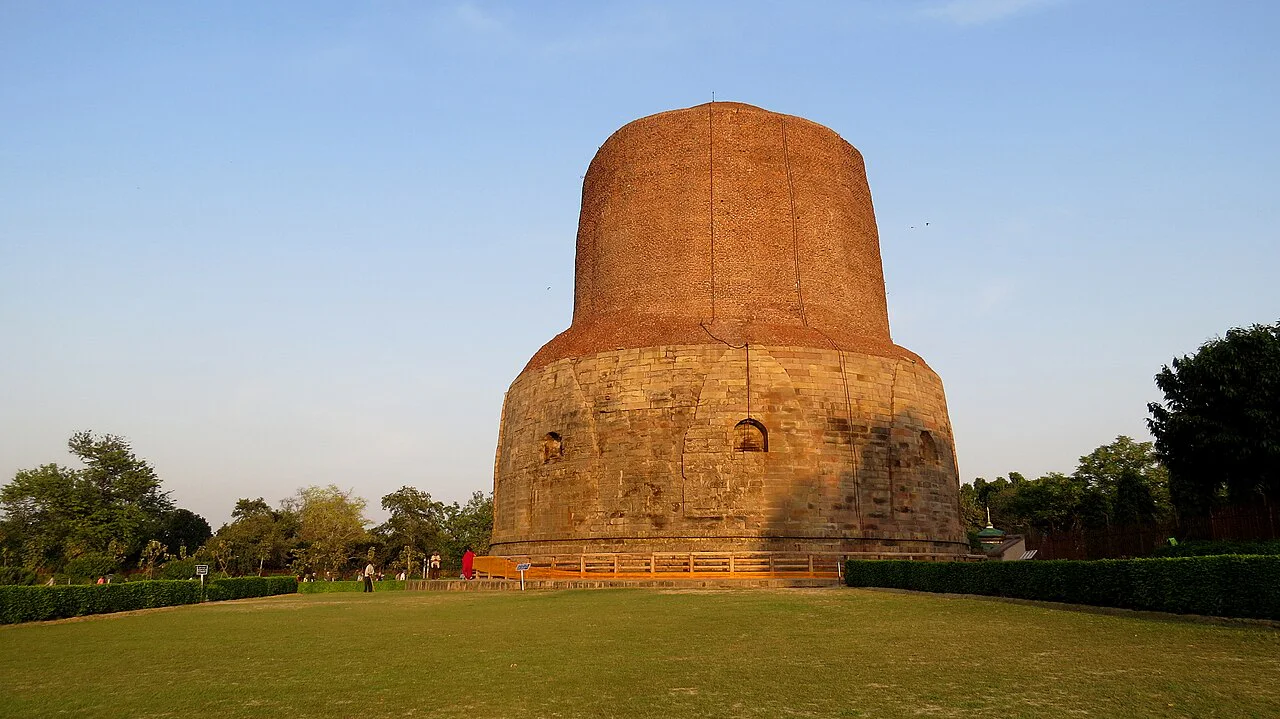
Dhamek Stupa is a massive stupa located in Deer Park at Sarnath in Uttar Pradesh, India. It marks the location where the Buddha gave his first teaching to his first five disciples.
Download Stanza, then search for “Dhamek Stupa”.
About the tour
One guide. Your kind of visit.
Dhamek Stupa is a massive stupa located in Deer Park at Sarnath in Uttar Pradesh, India. It marks the location where the Buddha gave his first teaching to his first five disciples.
Ready when you are.
- 01Get the free Stanza app.
iOS & Android
- 02Find your guide.
“Dhamek Stupa”
- 03Download before you go.
Works offline
Audio guide / 10 narrated stops
Inside the guide
Get to know a few of the stories before you go. Open a stop to read more.
01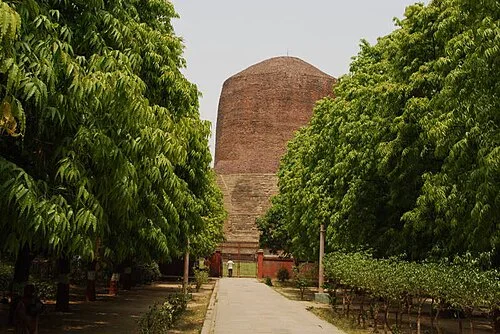 Approach Path and the Sacred Deer Park
Approach into the Sacred Deer Park
Welcome to Sarnath, where a long walkway lined with trees runs towards a huge mound of brick rising at its end. That mound is the Dhamek Stupa, and Sarnath lies about eight kilometres northeast of Varanasi. In the Buddha's time this was Deer Park, a green sanctuary set aside by a local king so that the animals could live here unharmed. Ancient sources call it Mriga-dayaa-vanam, a sanctuary for animals. The Lalitavistara sutra preserves the choice the Buddha made when he decided to teach: Deer Park by the Hill of the Fallen Sages, outside of Varanasi. For Buddhists, Sarnath counts among the eight most important pilgrimage places in their tradition. A stupa, in its simplest sense, is a solid commemorative monument, a mass of brick and stone raised to hold a memory. The lawns and trees around it today keep something of that old park-like character. Even the name carries meaning: Dhamek comes from the Sanskrit dharmeksā, pondering of the law.
Diego Tirira from Quito, Ecuador · CC BY-SA 2.0
02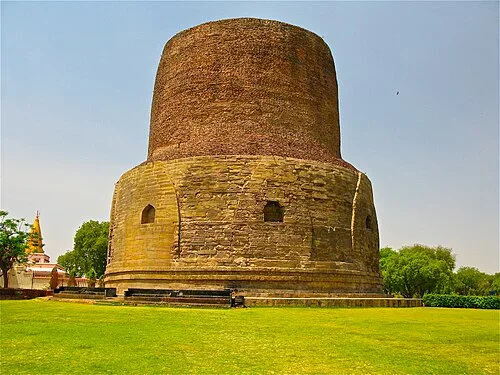 Approach Path and the Sacred Deer Park
Dhamek Stupa: Marking the First Sermon
Here is the reason this ground became sacred. The Dhamek Stupa marks the spot where the Buddha gave his first teaching. After attaining enlightenment, he came to this park and taught his first five disciples. He set out the Four Noble Truths and the Noble Eightfold Path, the foundations of Buddhist practice. The moment mattered for more than its words. It marked the formation of the sangha, the Buddhist monastic community that grew from this first preaching. The stupa was raised to hold the memory of it, so that generations of pilgrims would have a place to come to. Tradition holds that all five of those first disciples eventually became fully liberated.
Ken Wieland · CC BY-SA 2.0
03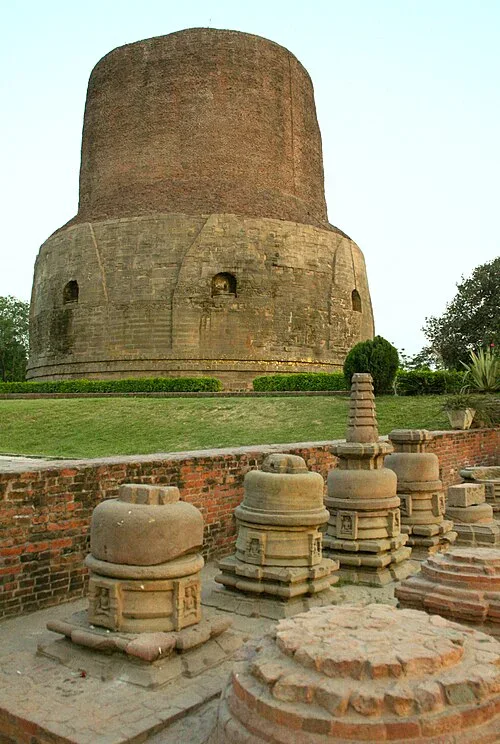 The Solid Cylinder Stupa Core
A Solid Cylinder of Brick and Stone
The Dhamek is the most massive structure in Sarnath. In its present shape it is a solid cylinder of bricks and stone, about forty-four metres high and twenty-eight metres across. There are no inner chambers, no hidden rooms, no staircase. Nothing about it is hollow. It is simply a mass of masonry, built to be walked around rather than entered. That is what pilgrims do at stupas of this kind, circling the solid body as an act of devotion. The little stupas standing before the great one are votive stupas, raised by pilgrims, and a later stop tells their story. From here the shape reads clearly: a broad stone-skirted base carrying a tall brick drum above it.
Listen in the appJon Gudorf Photography · CC BY-SA 2.0
04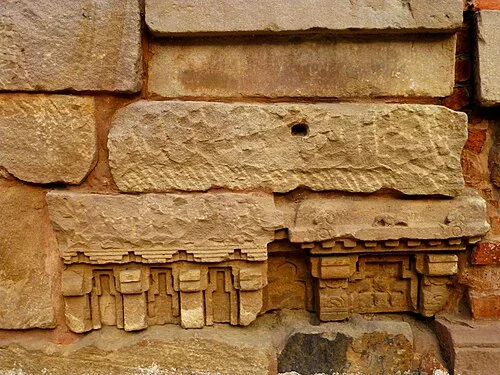 The Solid Cylinder Stupa Core
Layered Masonry: Ashokan Base, Gupta Completion
The wall of the stupa is a record of building across centuries. A first stupa stood on this spot in the time of the Mauryan emperor Ashoka, traditionally dated to 249 BCE. The lower courses of masonry seem to have survived from that early structure. Over the centuries the stupa was enlarged on six separate occasions. The form it keeps today was completed during the Gupta era, around 500 CE, when the stone facing was added. The upper drum never received that dressing. It remains bare brick, which is why the top looks so different from the base. One monument, two great ages of Indian building: an Ashokan foundation beneath a Gupta completion.
Listen in the appPhoto Dharma from Penang, Malaysia · CC BY 2.0
05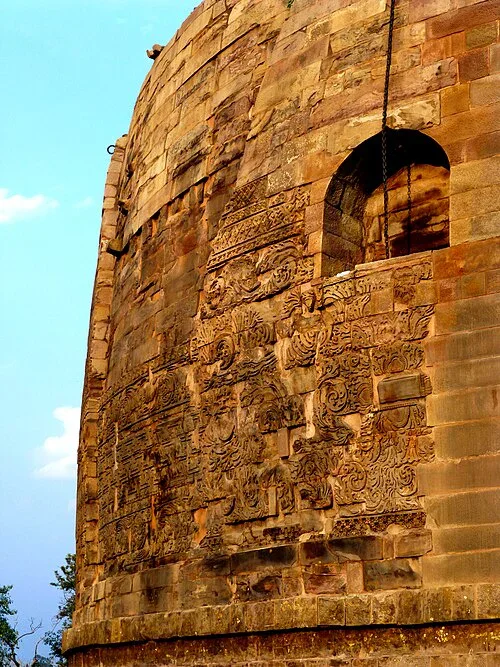 Gupta-Era Stone Carvings
Gupta-Era Floral Carvings on the Lower Drum
The carved band around the lower drum is some of the finest Gupta decorative work to survive at Sarnath. Deep floral scrolls wind across the stone, delicately cut, in a style characteristic of the Gupta era and firmly dated to the fifth and sixth centuries CE. Among the scrollwork appear carved figures of humans and birds. There are inscriptions as well, written in Brahmi, the ancient script of early India. What those inscriptions say is a question the stone has not yet answered. The birds and figures peering out of the vines belong to the same Gupta campaign that gave the stupa its finished stone face.
Listen in the appPhoto Dharma from Penang, Malaysia · CC BY 2.0
06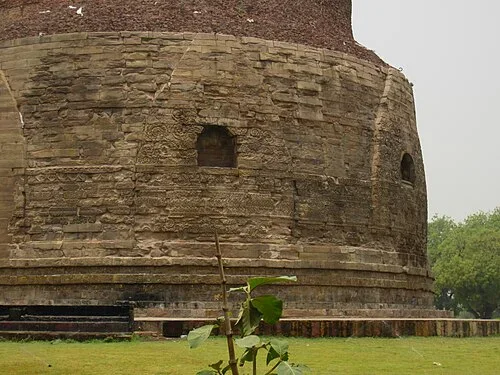 Gupta-Era Stone Carvings
Niches in the Lower Drum and the Relic Tradition
Stupas were built, first of all, to house relics. After the Buddha's parinirvana, his passing, his remains were cremated and the ashes divided and buried under eight stupas, with two further stupas encasing the urn and the embers. The Dhamek Stupa was not one of those eight, but it was raised in the same tradition. The dark, sealed niches in the lower drum may once have held sacred images. Whether relics were ever set into these particular openings, though, no one can say. Nor has anyone confirmed what lies inside the solid mass today. The tradition is the reason monuments like this were raised at all: a marker of the Buddha's presence that might also hold something of him.
Listen in the appL Ram Vidhya Sagar · CC BY-SA 3.0
07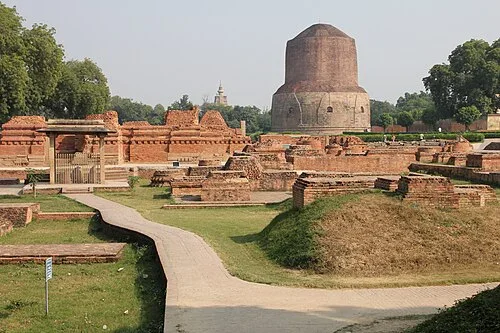 Monastery Ruins and Votive Stupas
Monastery Ruins and Xuanzang's Account
The brick plinths spread across this ground are the floors and foundations of monastic buildings. In 640 CE the Chinese pilgrim Xuanzang visited Sarnath and recorded what he saw. There were more than 1,500 priests here, in a flourishing monastic colony. He described the main stupa as nearly 300 feet high, far taller than the monument stands today. Either he was measuring something that has since been lost, or the figure was generous. The gap has never been fully explained. What his account makes clear is that Sarnath was then a living monastic centre, where monks studied, taught and kept the memory of the first sermon. These brick plinths are what remains of the buildings that held such a community.
Listen in the appR. M. Calamar from Brooklyn, New York, USA · CC BY 2.0
08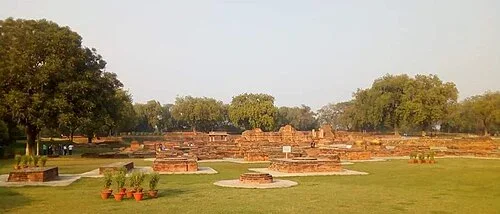 Monastery Ruins and Votive Stupas
The Group of Votive Stupas
Scattered across the lawn are small brick stupas, each one a miniature of the great monument nearby. These are votive stupas, modest offerings raised by pilgrims at a sacred site, a practice known at Buddhist places generally. A pilgrim with modest means could still leave a mark here by raising one. Their form repeats, in little, the dome and base of the Dhamek. Devotion at Sarnath belonged to ordinary pilgrims as much as to emperors.
Listen in the appPhoto: SpeakingArch · CC BY-SA 4.0
09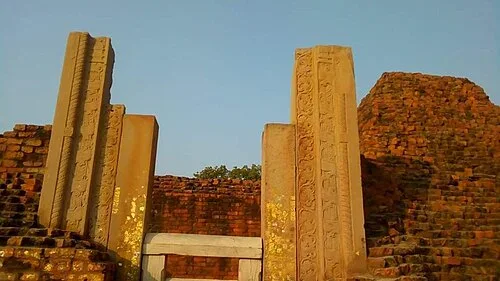 Sandstone Railings and Neighboring Sacred Shrines
The Chunar Sandstone Railing and the 1794 Dispersal
These heavy posts are cut from Chunar sandstone, each carved from a single block, with figures and ornament running down the shaft. They speak for the skill of the ancient masons. The ruinous story beside them belongs to a much later date. In January 1794, workers in the service of Babu Jagat Singh dismantled the nearby Dharmarajika Stupa and hauled its bricks away to build a market in Jagatganj, Varanasi. His crew also stripped a large part of the Dhamek's stone facing and carried off several Buddha statues, which Jagat Singh kept at his house in Jagatganj. The digging, though, produced a discovery. Jonathan Duncan, a charter member of the Asiatic Society, described in 1799 how a green marble reliquary, encased in a sandstone box, had been found in the relic chamber of the Dharmarajika Stupa. It held a few bones and some pearls, which were immersed in the Ganges. His account was the first firm written reference to the ruins at Sarnath. The reliquary itself was sent to the Asiatic Society, and then disappeared. The outer sandstone box came to light again in 1835, found by Alexander Cunningham.
Listen in the appPhoto: SpeakingArch · CC BY-SA 4.0
10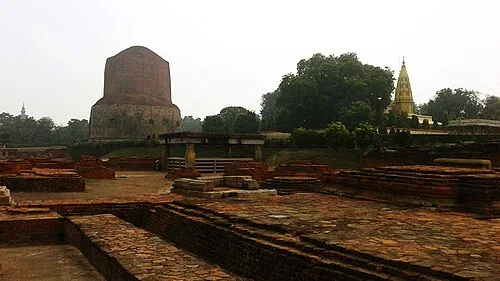 Sandstone Railings and Neighboring Sacred Shrines
Dhamek Stupa and the Jain Temple: A Shared Sacred Landscape
The stupa and the spire of a Jain temple rise together in this view. That shared skyline reaches further back than it looks. A 17th-century Jain manuscript describes a temple in Varanasi as a pilgrimage site, close to a famous Bodhisattva sanctuary at a place called dharmeksā. That is the very word the stupa's name comes from. Whether dharmeksā points to this exact spot is not settled. But the text shows that Sarnath's sacredness drew more than one faith. Over some 2,300 years this ground has drawn emperors and monks, pilgrims and scholars. Through all of it the great stupa has kept its place, marking the moment when the teaching that became Buddhism was first spoken here.
Listen in the appPhoto: Deepak Purti · CC BY-SA 4.0
Dhamek Stupa
Frequently asked questions
How much does the guide cost?
Free app download. Listed guide price: $0.99. Guide price shown in the app. Audio guide only. Venue admission is separate.
Can I listen without internet?
Yes. Download the guide’s audio, images, and maps in the app before your visit. Your downloaded content is then available offline.
Can I listen in my language?
This audio guide is available in 15 languages, including English.
Do I need to follow a schedule?
No. This is a self-guided experience. Choose your stops, pause whenever you like, and return to a story at your own pace.
At your own pace
Explore Dhamek Stupa.
Download Stanza, then search for “Dhamek Stupa”.
Free app download · Guide price shown in the app
Keep exploring
Audio guides — India
Varanasi · 8 km
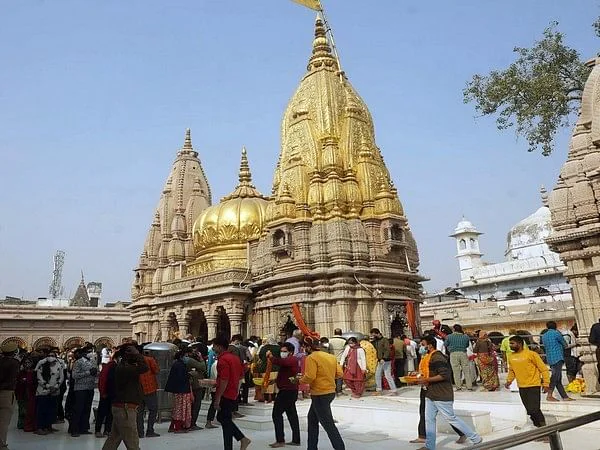
Kashi Vishwanath Temple
Content & sources
Photo: Das740724 · CC BY-SA 4.0
Makhdumpur
Barabar Caves
Content & sources
Thomas Fraser Peppé · Public domain
Bodh Gaya
Mahabodhi Temple
Content & sources
Photo: Bpilgrim · CC BY-SA 2.5
Vaishali
Vaishali
Content & sources
mself · CC BY-SA 2.5