Stanza · Audio guide
Kashi Vishwanath Temple Audio Guide
A place to remember. A story to take with you.
Kashi Vishwanath Temple is a Hindu temple dedicated to Shiva located in Varanasi. It is a Hindu pilgrimage site and one of the twelve Jyotirlinga shrines.
Download Stanza, then search for “Kashi Vishwanath Temple”.
About the tour
One guide. Your kind of visit.
Kashi Vishwanath Temple is a Hindu temple dedicated to Shiva located in Varanasi. It is a Hindu pilgrimage site and one of the twelve Jyotirlinga shrines.
Ready when you are.
- 01Get the free Stanza app.
iOS & Android
- 02Find your guide.
“Kashi Vishwanath Temple”
- 03Download before you go.
Works offline
Audio guide / 8 narrated stops
Inside the guide
Get to know a few of the stories before you go. Open a stop to read more.
01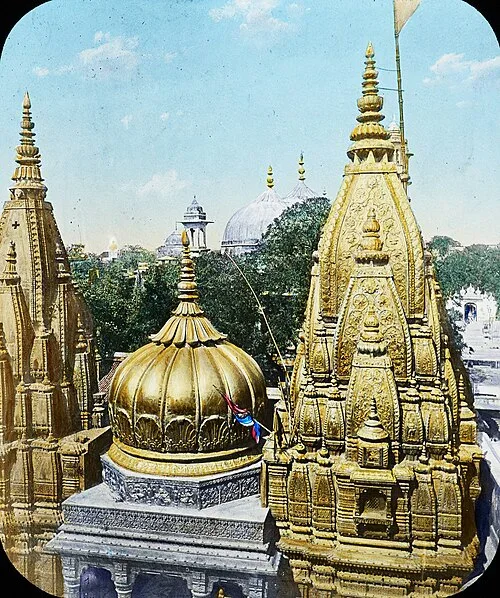 Temple Precinct and Ahilyabai's Revival
The Sikh Monarch's Golden Tribute
Welcome to Kashi Vishwanath, Shiva's shrine in Varanasi, among the holiest cities of Hinduism. Over the next few stops, this tour follows its gold, its legends and its long, interrupted story. People call it the Golden Temple, and the nickname comes from a royal gift. In 1835 Maharaja Ranjit Singh, the Sikh ruler of the Punjab, donated a tonne of gold for the temple. His wife, Maharani Datar Kaur, had urged him to make the offering. The gold was used to plate the dome and the spires, and three domes were covered in pure gold. By the early twentieth century the gilding was already old news, gleaming over the city rooftops. The gift fixed a name onto a shrine that was already centuries old when the shine arrived.
Unknown author · Public domain
02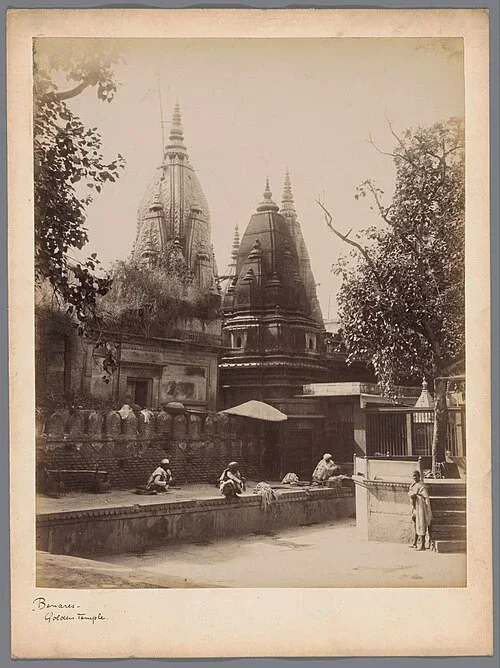 Temple Precinct and Ahilyabai's Revival
The Golden Temple of Benares: Ahilyabai's Sanctuary
The temple sits in a narrow lane called Vishwanath Gali, not far from the Ganges. The deity worshipped here is Vishwanath, Lord of the Universe. The sanctuary with the tall carved spire is not the first temple on this ground, but it is the one that still stands. For more than a century before it, no formal temple had housed the sacred shrine here. In 1780 the Maratha queen Ahilyabai Holkar of Indore built the present temple on a site beside the old one. Her finished work rises above its walled courtyard, with people resting on the stone steps below. She is remembered as one of the great builders of her age, and this is her best-known work. Pilgrims have been coming to her temple ever since.
Rijksmuseum · CC0
03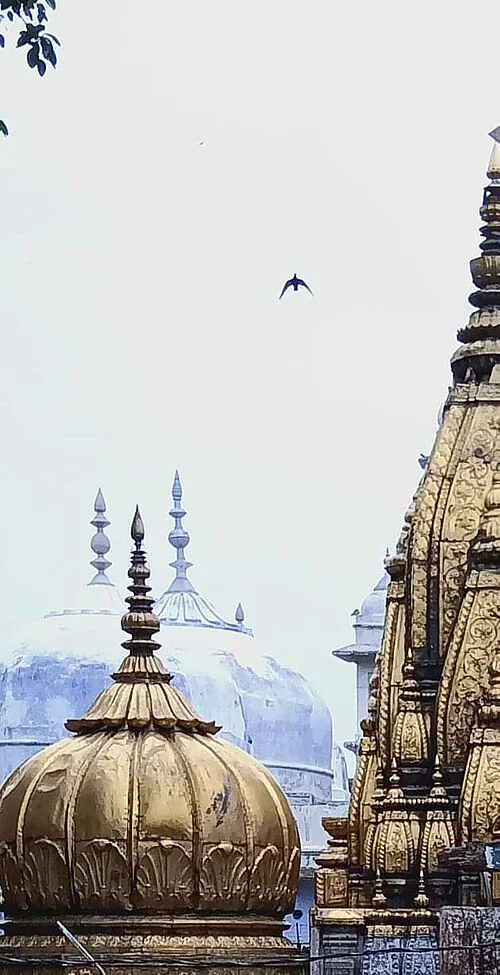 The Golden Spires of Ranjit Singh
The Temple Today: Corridor and Crowds
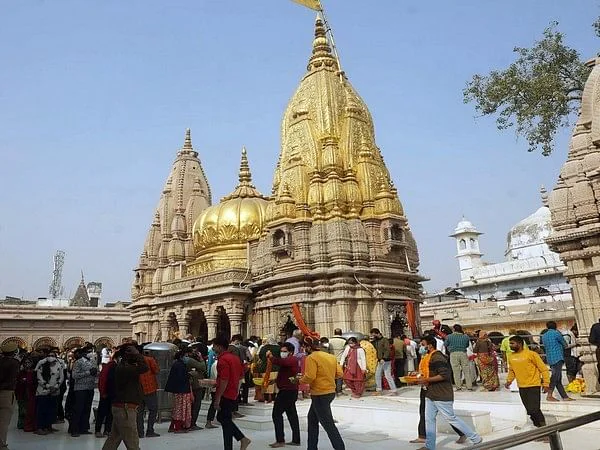
The golden dome against the pale sky belongs to a temple that is still changing. In 2019 Prime Minister Narendra Modi launched the Kashi Vishwanath Dham Corridor, to link the temple directly with the ghats of the Ganges and ease the crowds. It was opened on the thirteenth of December 2021 with a sacred ceremony. About 1,400 residents and businesses inside the corridor's area were moved elsewhere and compensated. During the work, labourers uncovered more than 40 ruined temples that had been buried under later buildings. Among them were the Gangeshwar Mahadev and Manokameshwar Mahadev shrines, which have since been rebuilt. The temple now draws an average of about 45,000 pilgrims a day, which makes it one of the most visited Hindu temples in India.
Listen in the appPhoto: Sharmashiva76 · CC BY-SA 4.0
04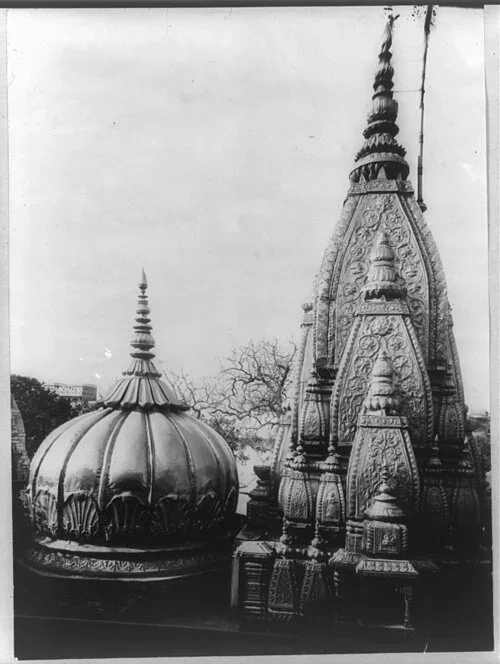 The Golden Spires of Ranjit Singh
Anatomy of the Golden Shikhara
The temple is laid out as a quadrangle, with smaller shrines to other deities set around it. There are shrines here to Vishnu, Ganesha, Kartikeya, Shani and Parvati, among others. The structure itself is made of three parts. The first is the main spire, which rises fifteen and a half metres, roughly fifty feet. The second is the gold dome beside it. The third is a smaller gold spire within the sanctuary, which carries a flag and a trident. The ribbed dome and the carved spire stand clear against the sky. Much of the gilding among them traces back to the Sikh king's tonne of gold. Inside, a congregation hall leads the way to the innermost sanctum.
Listen in the appFrank and Frances Carpenter Collection · Public domain
05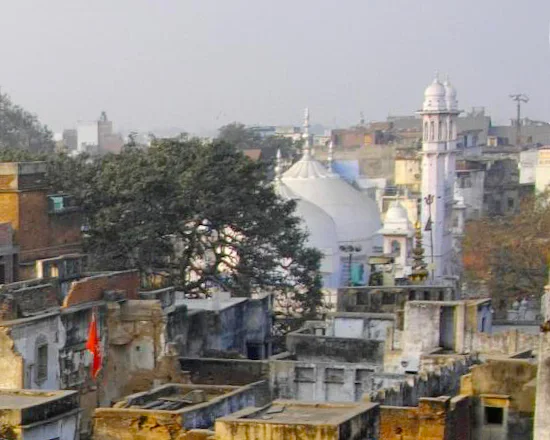 Architectural Memory and the Gyanvapi Boundary
The Gyanvapi Boundary: Destruction and Memory
The white dome and minaret beside the temple belong to the Gyanvapi Mosque, and the boundary between the two carries a hard history. The oldest shrine here, the Adi Vishveshwar, was razed in 1194, when the Ghurid armies defeated Jayachandra of Kannauj and destroyed the city of Kashi. A mosque went up on its site soon afterwards. The temple was rebuilt nearby, damaged again under the Sharqi rulers, and demolished once more under Sikandar Lodi. Under the emperor Akbar, Raja Man Singh began rebuilding, and Raja Todar Mal carried the work forward in 1585. Then in 1669 the Mughal emperor Aurangzeb ordered the temple destroyed, and a mosque was built on its site afterwards. The remains of the older temple can still be seen in the mosque's foundation, its columns and its rear wall. Historians still debate why Aurangzeb acted. Some point to a battle in 1664, in which the Mahanirvani Akhara claimed victory over his forces, a claim drawn from the order's own manuscripts. Others link the demolition to rebellious local landowners. It is said to have been meant as a warning to the anti-Mughal factions and Hindu religious leaders of the city.
Listen in the appPhoto: MPF · CC BY 2.0
06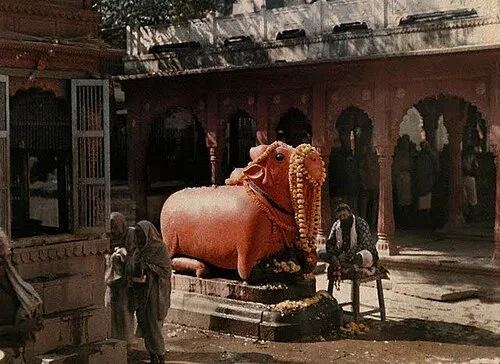 Courtyard of the Sacred Nandi Bull
Nandi and the Well of Wisdom
In the temple court sits Nandi, the bull that carries Shiva, garlanded with flowers and facing his lord. A Nandi faces the sanctum in every Shiva temple, watching over his master. To the north of the main temple lies a small well called Gyan Vapi, the well of wisdom. Tradition tells that when Aurangzeb's forces came in 1669, the chief priest leapt into the well with the Jyotirlinga in his arms. The story says he hid the sacred image there to keep it from the invaders, until it could be enshrined again. Whether the leap happened exactly so cannot now be proven; it is a story devotees have kept alive for generations. The old well still lies in the narrow ground between the temple and the mosque.
Listen in the appFranklin Price Knott · Public domain
07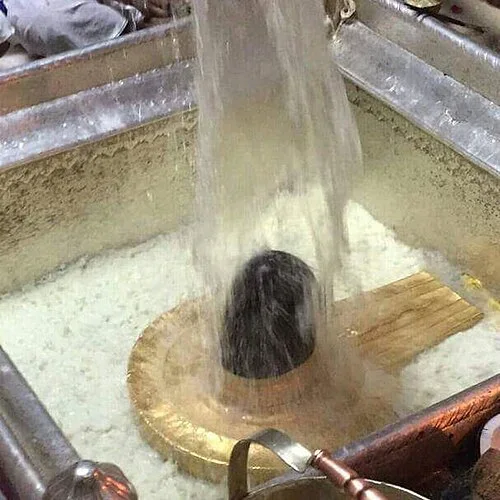 Garbha Griha and the Sacred Jyotirlinga
The Jyotirlinga of Liberation
The lingam in the sanctum is carved of black stone. It stands sixty centimetres tall, and measures ninety centimetres around. It rests in a silver altar, and it is one of the twelve Jyotirlingas, the shrines where Shiva is worshipped as a pillar of light. The founding legend explains why. Brahma and Vishnu once argued over which of them was supreme. A boundless column of light appeared between them, and each set out to find its end. Vishnu took the form of a boar and dug down into the earth. Brahma became a swan and scoured the heavens. Neither found it. Vishnu admitted honestly that he could not. Brahma claimed falsely that he had reached the summit. For the lie, Shiva cut off Brahma's fifth head and cursed him to receive little reverence, while truthful Vishnu would be honoured for eternity. And Shiva anchored his light at Varanasi, the first Jyotirlinga to manifest.
Listen in the appPhoto: Ashuvns99 · CC BY-SA 4.0
08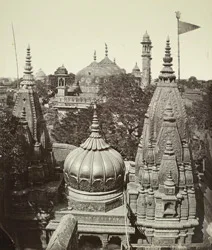 Vishwanath Gali and Kashi's Eternal Legacy
Kashi the Unabandoned: Liberation and Legacy
Scripture gives Vishweshwara a rank above every other deity, and above every inhabitant of Kashi's sacred circuit, a holy boundary running some fifty miles around the city. A visit to this temple, together with a bath in the Ganges, is held to set a pilgrim on the path to moksha, liberation from the cycle of rebirth. Hindus from all over the world try to make the journey at least once in a lifetime. Tradition adds a gentle condition: a pilgrim should give up at least one desire here. The full pilgrimage also reaches Rameswaram in the far south, where travellers carry Ganges water for prayer and bring back sand from that temple's shore. The Puranas devote whole sections to this city, and the Skanda Purana counts more than a thousand temples within it. Devotees also call this ground Avimukta, the never-forsaken, because they believe Shiva never abandons it. Temple and mosque share one skyline here, and the golden spires above the alley have carried pilgrims' vows for centuries.
Listen in the appPrasad, Madho · Public domain
Kashi Vishwanath Temple
Frequently asked questions
How much does the guide cost?
Free app download. Listed guide price: $0.99. Guide price shown in the app. Audio guide only. Venue admission is separate.
Can I listen without internet?
Yes. Download the guide’s audio, images, and maps in the app before your visit. Your downloaded content is then available offline.
Can I listen in my language?
This audio guide is available in 15 languages, including English.
Do I need to follow a schedule?
No. This is a self-guided experience. Choose your stops, pause whenever you like, and return to a story at your own pace.
At your own pace
Explore Kashi Vishwanath Temple.
Download Stanza, then search for “Kashi Vishwanath Temple”.
Free app download · Guide price shown in the app
Keep exploring
Audio guides — India
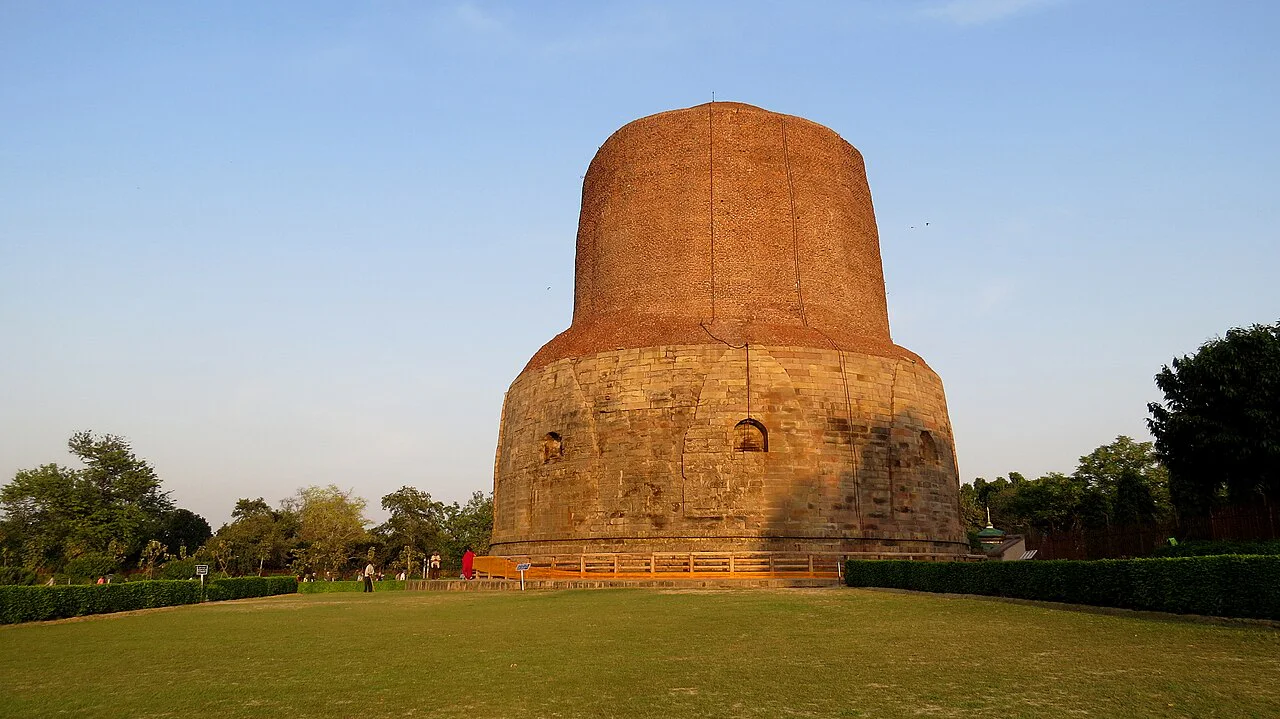
Sarnath · 8 km
Dhamek Stupa
Content & sources
Photo: Preeti Prajapati · CC BY-SA 4.0
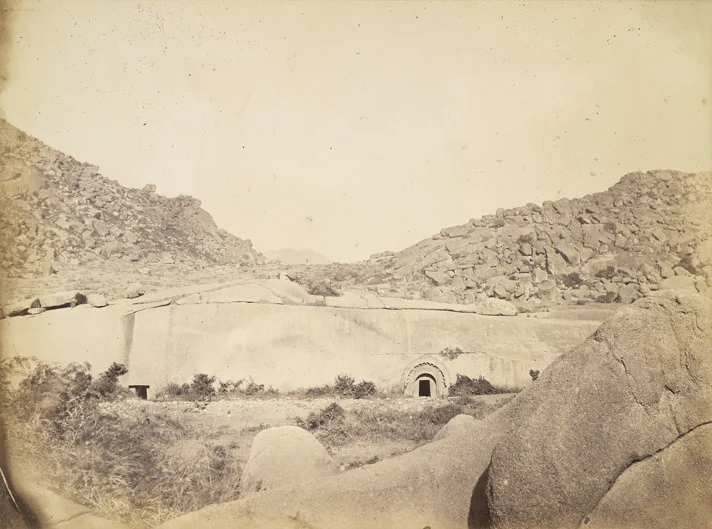
Makhdumpur
Barabar Caves
Content & sources
Thomas Fraser Peppé · Public domain
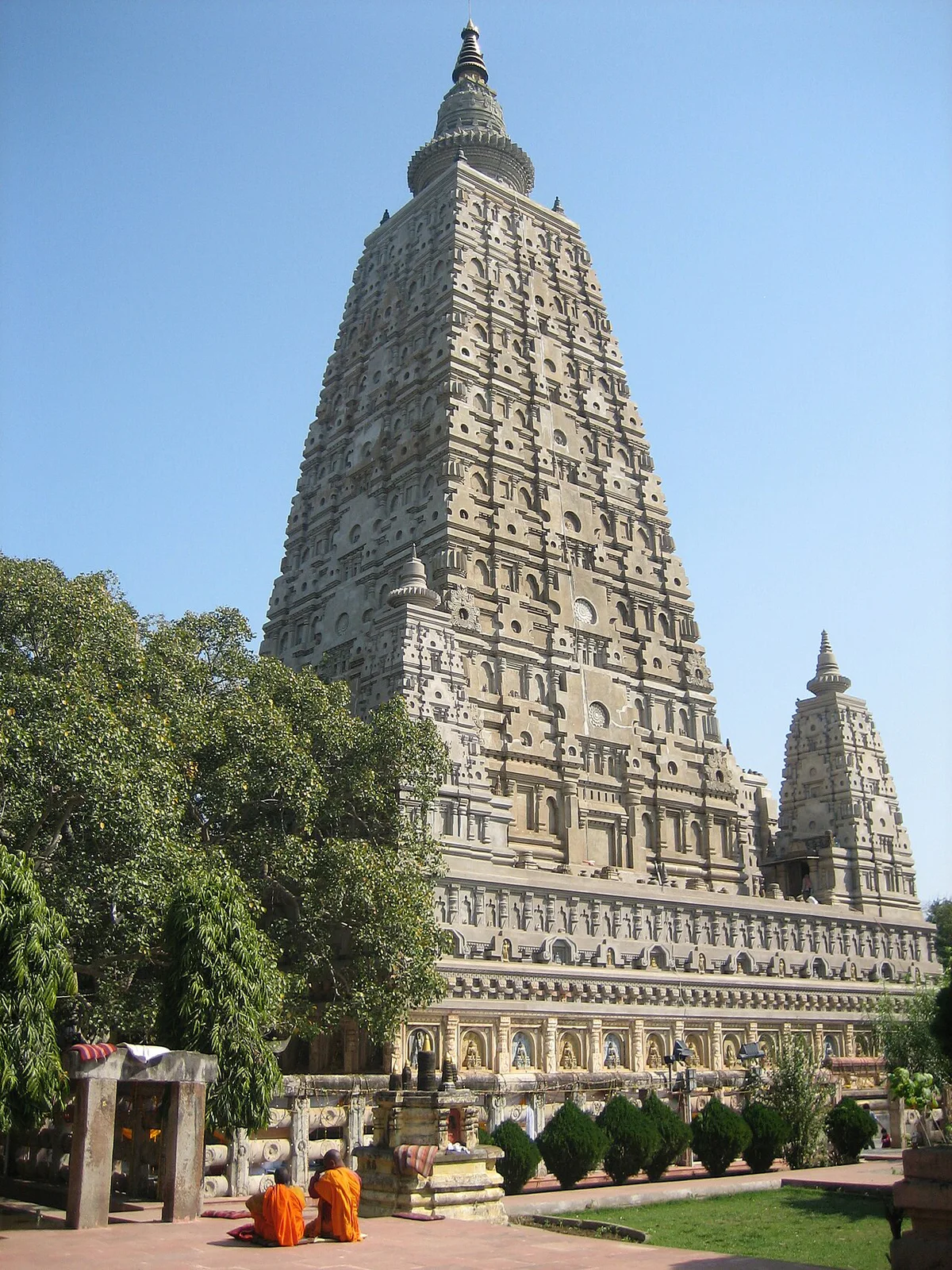
Bodh Gaya
Mahabodhi Temple
Content & sources
Photo: Bpilgrim · CC BY-SA 2.5
Vaishali
Vaishali
Content & sources
mself · CC BY-SA 2.5