Stanza · Audio guide
Chennakeshava Temple, Somanathapura Audio Guide
A place to remember. A story to take with you.
The Chennakesava Temple is a 13th-century Vaishnava Hindu temple located on the banks of the River Kaveri in Somanathapura. It was consecrated in 1258 CE by Somanatha Dandanayaka, a general of the Hoysala…
Download Stanza, then search for “Chennakeshava Temple, Somanathapura”.
About the tour
One guide. Your kind of visit.
The Chennakesava Temple is a 13th-century Vaishnava Hindu temple located on the banks of the River Kaveri in Somanathapura. It was consecrated in 1258 CE by Somanatha Dandanayaka, a general of the Hoysala King Narasimha III.
Ready when you are.
- 01Get the free Stanza app.
iOS & Android
- 02Find your guide.
“Chennakeshava Temple, Somanathapura”
- 03Download before you go.
Works offline
Audio guide / 12 narrated stops
Inside the guide
Get to know a few of the stories before you go. Open a stop to read more.
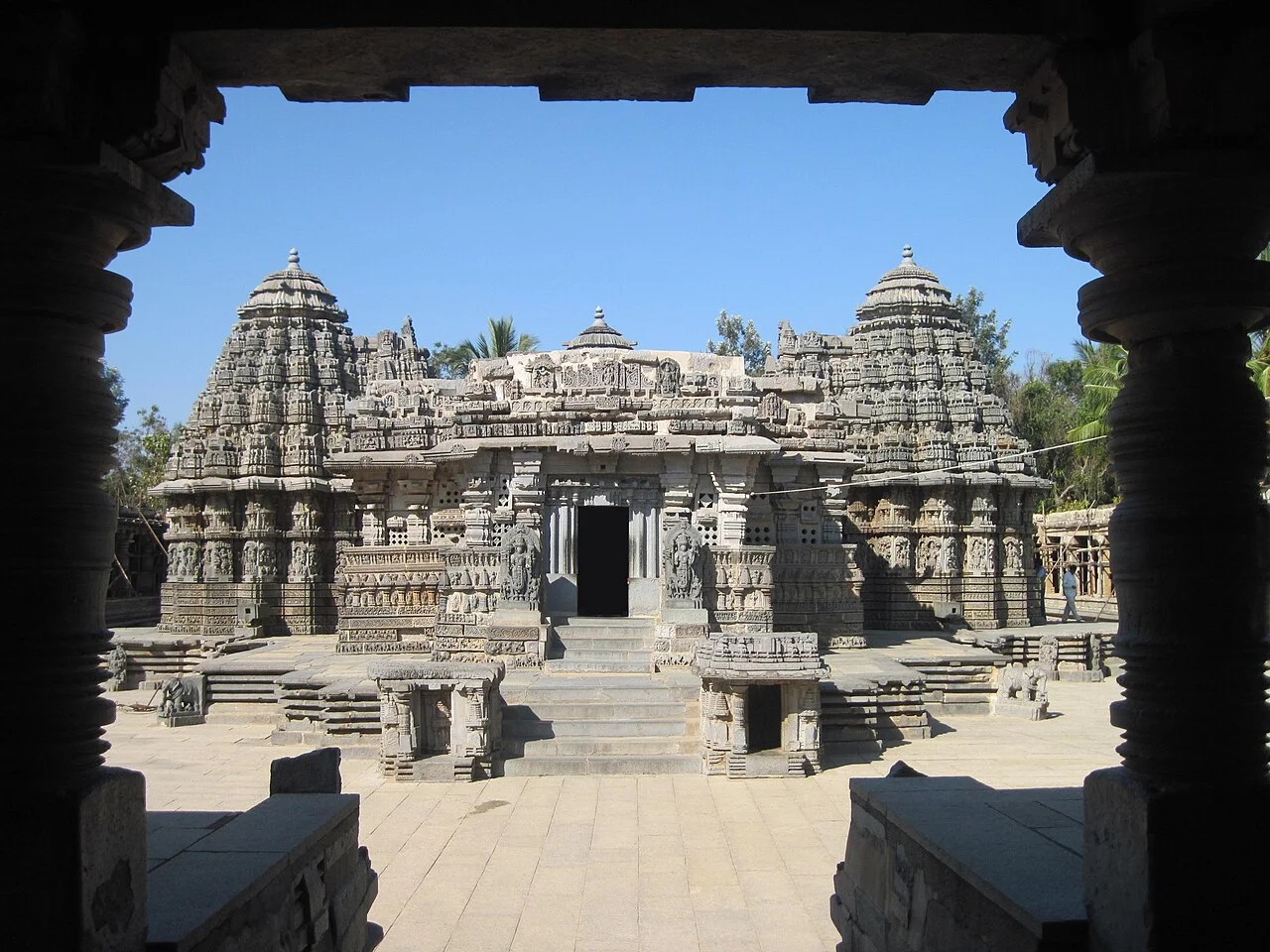
01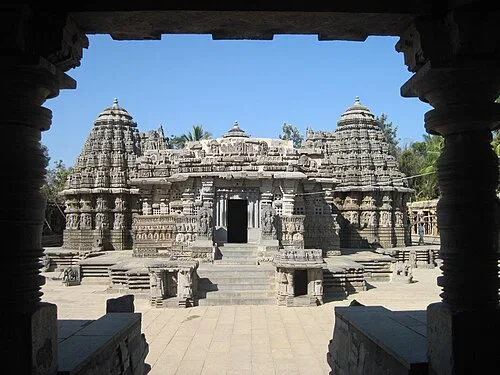 Entrance Porch and Enclosing Cloister
The Temple from the Entrance Porch
Welcome to Somanathapura, on the banks of the river Kaveri. Through this porch frame, the whole temple presents itself at once: three towers rising from one shared hall, inside a walled courtyard. That triple-shrine design is called a trikuta, and it is the signature of this place. The story begins with a general. His name was Somanatha Dandanayaka, and he served the Hoysala king Narasimha the Third. Here he founded an agrahara, a grant town where Brahmin scholars received land and the means to maintain their temples. He built this Vaishnava temple at its center and consecrated it in 1258. The town took his name: Somanatha-pura, the town of Somanatha. Just inside the gate stand tall inscription stones, cut in old Kannada, that record the temple's history. The route ahead runs along the cloister of small shrines, then up onto the platform, around the carved walls, and finally into the three sanctums at the heart of it all.
Vedamurthy J · CC BY-SA 3.0
02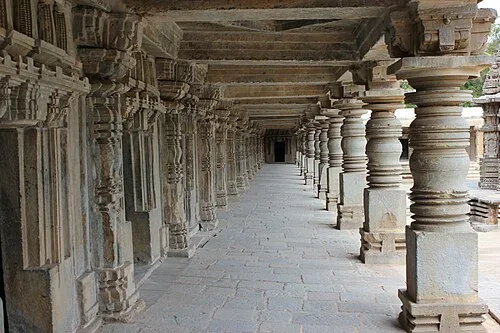 Entrance Porch and Enclosing Cloister
Cloister Corridor of Miniature Shrines
A pillared corridor runs around the courtyard, and it once held sixty-four small shrines. Fifty-eight of them were single cells. Four more were linked doubles, set at the corners, and two stood near the entrance. Each housed a Vedic or Puranic deity, and there were rooms nearby for visiting pilgrims. Today many of the shrine images are defaced, their limbs broken or destroyed. Recovered fragments lie in a heap inside the temple, among them Jaina statues seated in the Kayotsarga meditation posture. The ceilings of the western row carry no carving at all. Instead they hold a repair inscription from the Vijayanagara era. Two dated records describe the damage this temple suffered. One is from 1497, the other from 1550, and they describe the damage and the repairs. The repairs were paid for by the Vijayanagara emperors in the sixteenth century. Eight major stone inscriptions in all preserve this temple's past, scattered from the entrance slabs to a Shiva temple at the edge of the original land grant. Some of the restored stonework can still be picked out by its lighter color and plainer finish.
Photo: Dineshkannambadi · CC BY-SA 3.0
03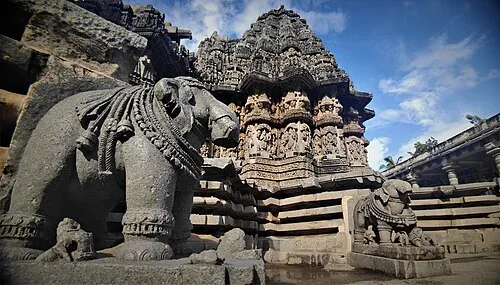 The Elevated Star-Shaped Platform and Triple Towers
Tower and Stone Elephant
Two signature elements meet in this view. The tower above, the shikhara, is built on a plan that alternates rotating squares with star-shaped lotuses of sixteen petals. As it rises, the interim shikaras are capped with kalashas, the pots used in Hindu ceremonies. Around each large wall image on the tower hangs a torana arch. On the western side these arches are simple and geometric. On the north and south they bloom into hanging fruits, flowers and creeping vines, some carved with buds at different stages of opening, one with a lion at its center. At the base sits the carved stone elephant, a survivor of an original scheme. Fifteen elephants once stood at the star points of the platform. Eleven survive, every one of them damaged.
Listen in the appPhoto: Sanandana C M · CC BY-SA 4.0
04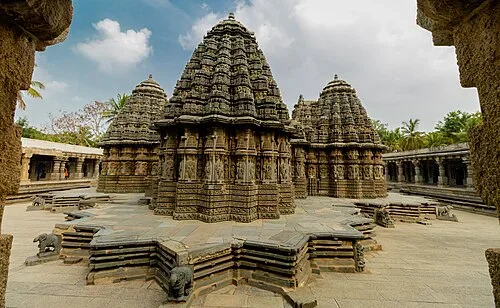 The Elevated Star-Shaped Platform and Triple Towers
The Star-Shaped Jagati Platform
The entire temple stands on a raised plinth about three feet high, star-shaped, with steps at its east end. In temple symbolism this jagati represents the worldly platform, the level of ordinary life from which the worshipper climbs toward the divine. It doubles as the pradakshina patha, the circumambulation path. Devotees walk it clockwise, and the walk has a purpose: the wall carvings are arranged so the great epics can be read in their correct narrative sequence. The star shape is not decoration alone. Each point adds an extra facet of wall, giving the sculptors more surface to carve. The whole temple fits a symmetrical square of eighty-nine feet on each side, aligned to the east-west and north-south axes. Within it, three sanctums share one common hall, the sabha-mandapa, each sanctum opening through its own small puja mandapa.
Listen in the appPhoto: Jmadhu · CC BY-SA 4.0
05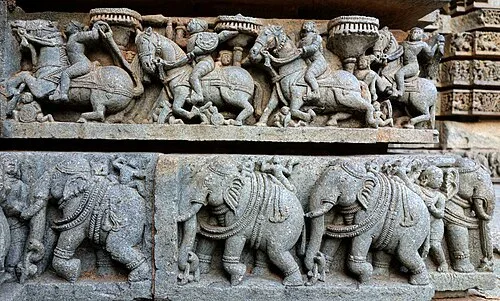 The Epic Narrative Friezes
Elephant and Horseman Friezes
The lowest band of the outer wall is about six inches tall, and it marches with elephants. They move to the left, in the clockwise direction a devotee walks. None is a copy of another. Some charge in war, throwing enemies. Others tease the riders in front of them. Above the elephants comes the band of horsemen, armed riders on a military march. In places a camel replaces the horse, a hint that the Hoysala army had adopted camels into its ranks. The sculptors allowed themselves jokes. Dwarfs and monkeys appear propping up the raised foreleg of a horse. Above the horsemen runs a scroll of flowers, fruits and peacocks, and above that, the epic friezes.
Listen in the appPhoto: Schoschi · CC BY-SA 4.0
06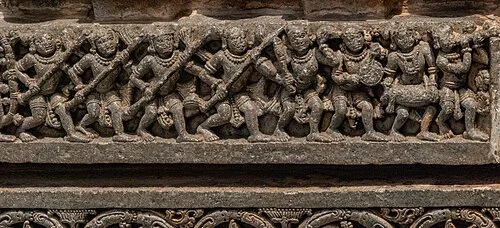 The Epic Narrative Friezes
Epic Story Frieze
Above the nature scroll runs the mythology band. It is about seven inches tall, some two and a half feet above the platform. Its hundreds of small panels tell three great texts in sequence. The Ramayana comes first, though only its early books are depicted. From there the band turns to the Bhagavata Purana, the legends of Krishna, and finishes with the Mahabharata. This is the scripture the clockwise walk was designed to read. The craft itself left a record. Among the large relief panels on the walls, the first sixty and the last sixty show the finest detail, while the middle sixty-five are plainer. And some panels carry the carved signature of the artist who made them.
Listen in the appPhoto: Bikashrd · CC BY-SA 4.0
07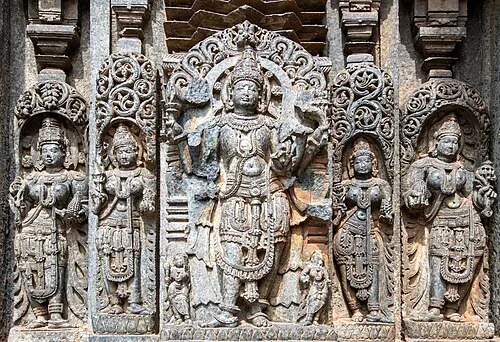 The Upper Wall Deity Gallery
Upper Wall Deity Reliefs
Above the frieze bands, on all three towers, a gallery of large deity reliefs wraps around the temple. There are about ninety of them, each framed by its own torana arch. Most show Vishnu, often with Lakshmi. Others depict Shakti, Shiva, Brahma, Saraswati, Indra, the love god Kama and his wife Rati. Many of these figures carry visible damage. Noses are broken, limbs chopped away, stone jewelry cut out of the surface. Some reliefs are damaged so heavily that identifying the deity is no longer possible, which is why several figures in this gallery cannot be named with certainty.
Listen in the appRohit Sharma · CC BY-SA 4.0
08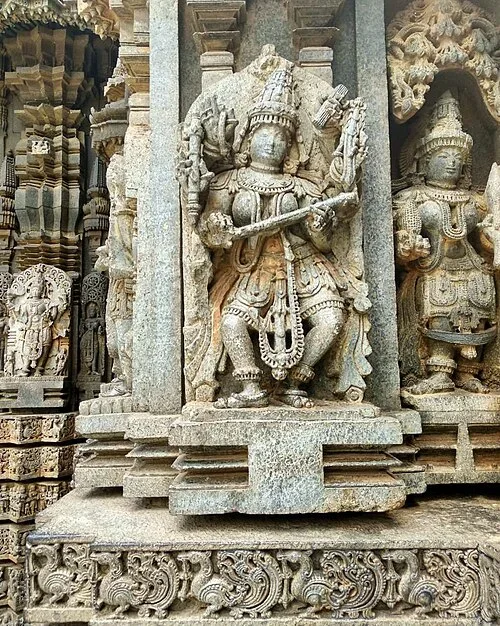 The Upper Wall Deity Gallery
Saraswati Relief
One panel on this upper wall can be named with confidence: Saraswati, goddess of learning. She holds her veena, the long-necked lute, and stands with the Vedas, the oldest scriptures of Hinduism. Beneath the great reliefs runs a carved peacock band, part of the layered decoration of the wall. Her presence makes a wider point about this temple. Though it was built for Vishnu worship, its sculptors did not keep to one tradition. Panels of Shiva, of the Goddess in her Shakti forms, and of Surya the sun god share the same wall. Numbered clockwise from the entrance, a relief of Surya comes twelfth, and a run of Shaiva panels follows soon after. The gallery gathers the whole Hindu cosmos onto a single wall.
Listen in the appPhoto: SpeakingArch · CC BY-SA 4.0
09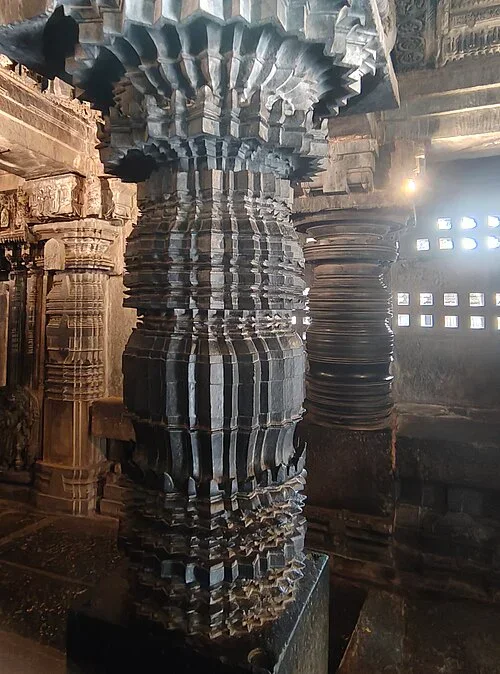 Navaranga Hall: Lathe-Turned Pillars and Ceilings
Lathe-Turned Pillar
Inside the hall, the roof rests on lathe-turned pillars. Soapstone made this possible: a green-grey chloritic schist, soft when it leaves the quarry and hardening as it meets the air. The stone does not occur locally, so it was imported from elsewhere in South India. Its softness let the artists carve the intricate detail seen across the whole temple. The pillars themselves were shaped on a lathe, like wood. All but two are the same size. Most carry five stacked mouldings drawn from common life: a disc, a bell, a pot, a wheel and an umbrella. The four central pillars of the Navaranga are square, with yaksha spirit-figures on their brackets, now damaged or gone. The two pillars east of the center break the pattern. They are cut as thirty-two-pointed stars.
Listen in the appPhoto: SweetuTeNonu · CC BY-SA 4.0
10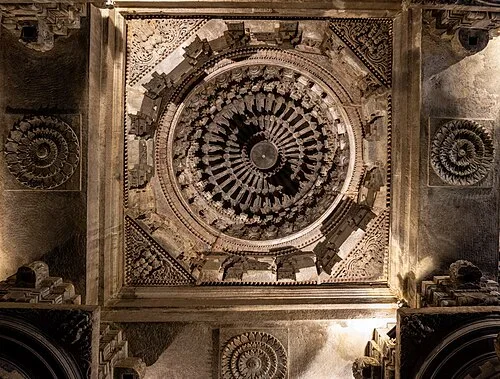 Navaranga Hall: Lathe-Turned Pillars and Ceilings
Carved Ceiling
Overhead, the hall's roof is divided into sixteen carved square bays. Nine of them lie in the sabha mandapa. The remaining seven sit near the eastern entrance. No two are alike. Each carries nature motifs woven with Hindu symbolism. Among the designs are lotuses shown at successive stages of opening, a palm-leaves theme, and an endless knot standing for karma and the cycle of rebirth. One bay shows dancers, musicians and soldiers around standing figures of Vishnu and Shiva. In another, the rafters are laid out in the pattern of the Sri Chakra, a tantric diagram. The architects lit this dim hall with perforated stone screens set into the walls, which sift the daylight as it enters.
Listen in the appRohit Sharma · CC BY-SA 4.0
- 11
Venugopala, Krishna with the Flute
Krishna caught mid-melody, with cows, gopis and running sages all lost in his music.
- 12
Janardhana Idol
The preserved Janardhana, the empty shrine of Keshava, and the temple that outlasted its wars.
Chennakeshava Temple, Somanathapura
Frequently asked questions
How much does the guide cost?
Free app download. Listed guide price: $0.99. Guide price shown in the app. Audio guide only. Venue admission is separate.
Can I listen without internet?
Yes. Download the guide’s audio, images, and maps in the app before your visit. Your downloaded content is then available offline.
Can I listen in my language?
This audio guide is available in 15 languages, including English.
Do I need to follow a schedule?
No. This is a self-guided experience. Choose your stops, pause whenever you like, and return to a story at your own pace.
At your own pace
Explore Chennakeshava Temple, Somanathapura.
Download Stanza, then search for “Chennakeshava Temple, Somanathapura”.
Free app download · Guide price shown in the app
Keep exploring
Audio guides — India
Mysore · 25 km
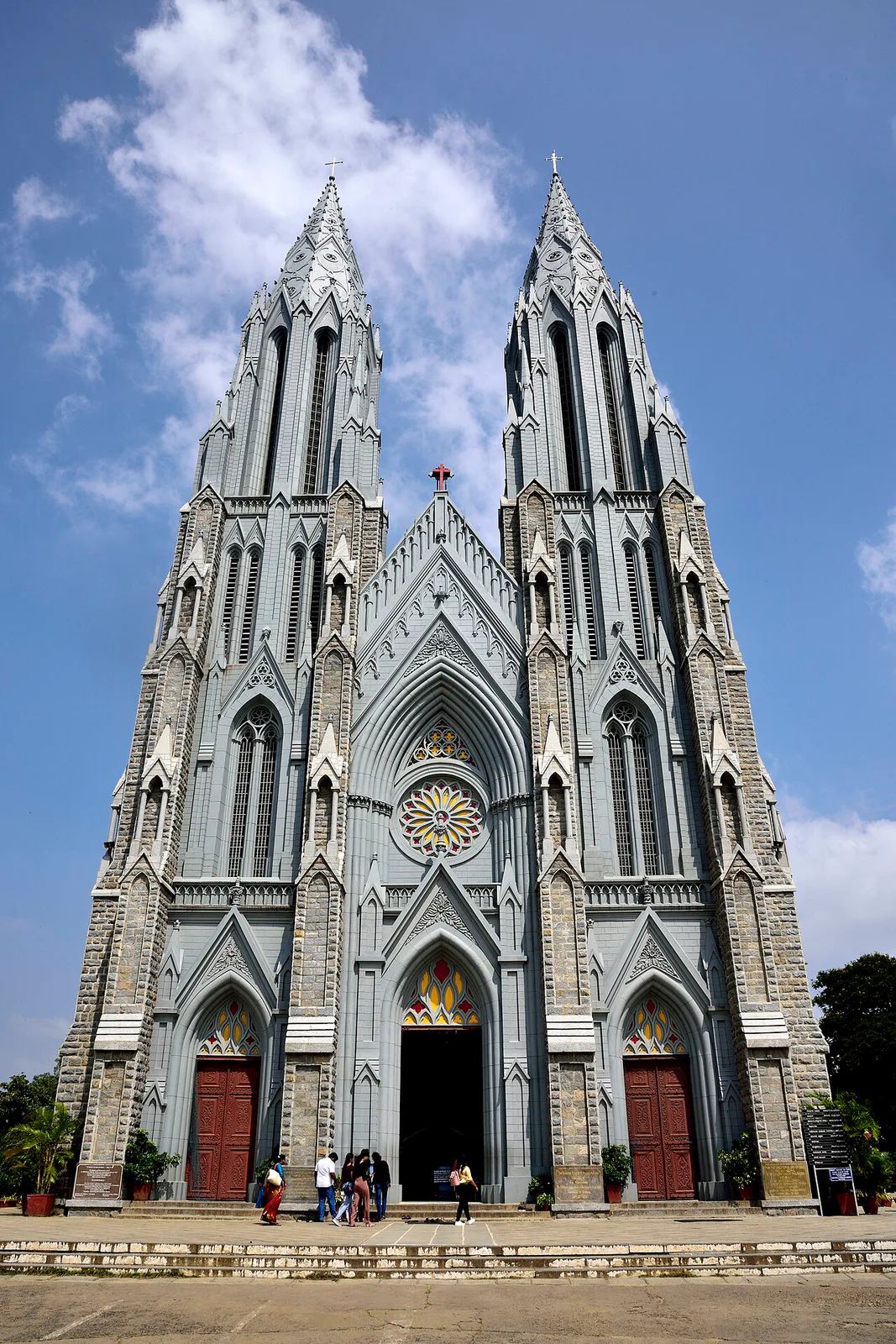
St. Philomena's Cathedral, Mysore
Content & sources
Photo: Shashank Mehendale · CC BY-SA 4.0
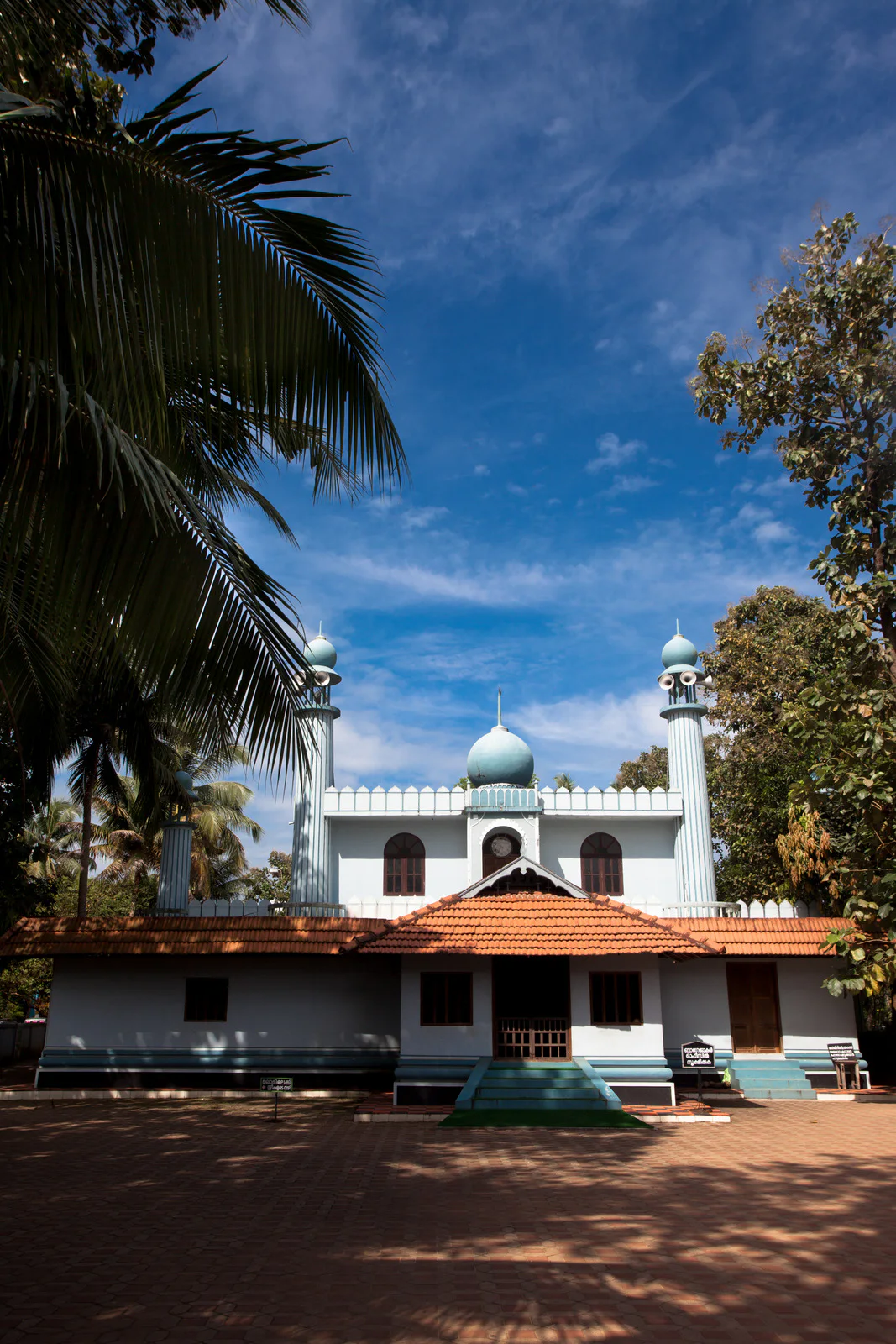
Lokamaleswaram
Cheraman Juma Mosque
Content & sources
Shahinmusthafa · CC BY-SA 3.0
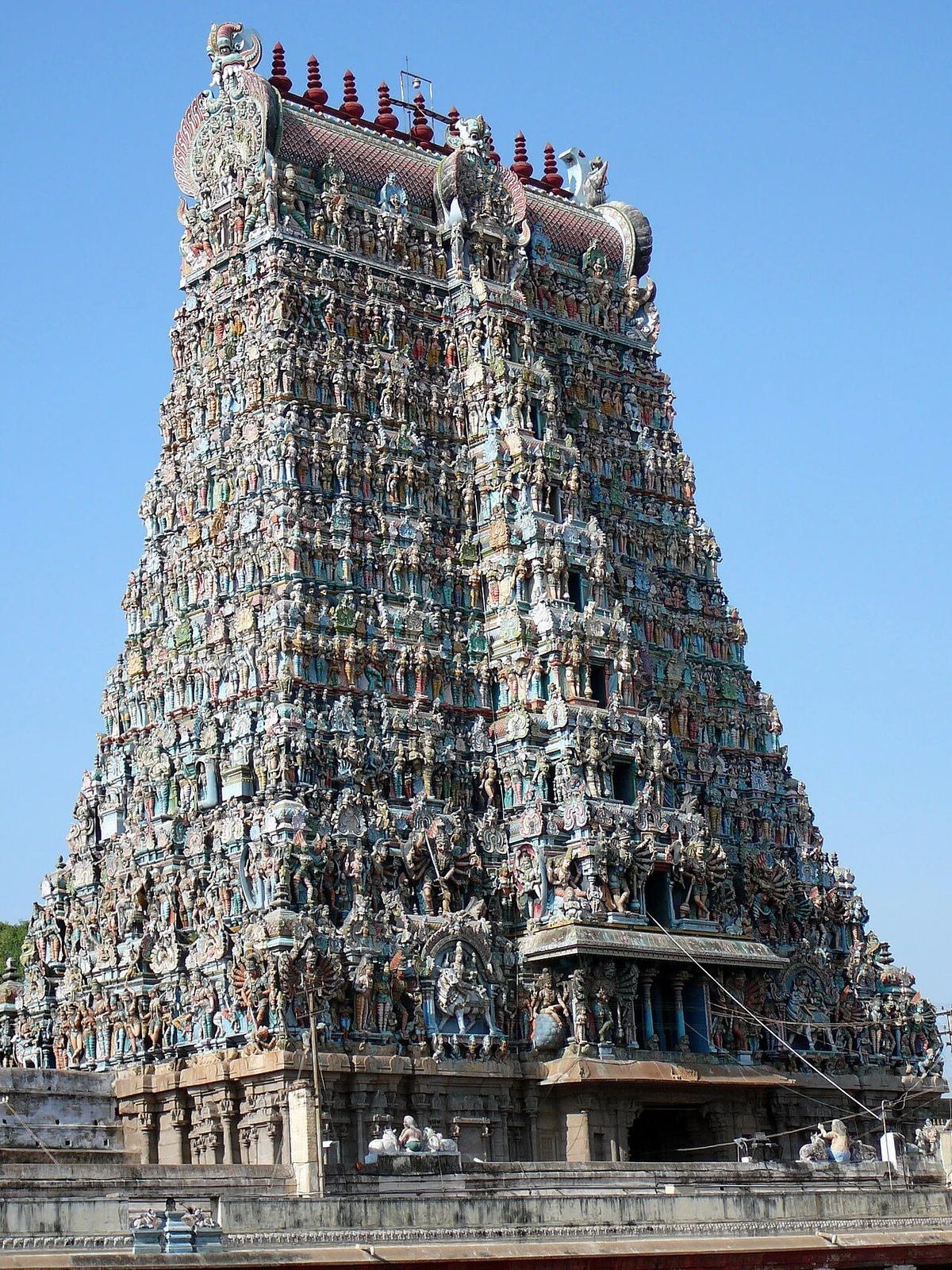
Madurai
Meenakshi Temple
Content & sources
Photo: Kumar Appaiah · CC BY-SA 2.5
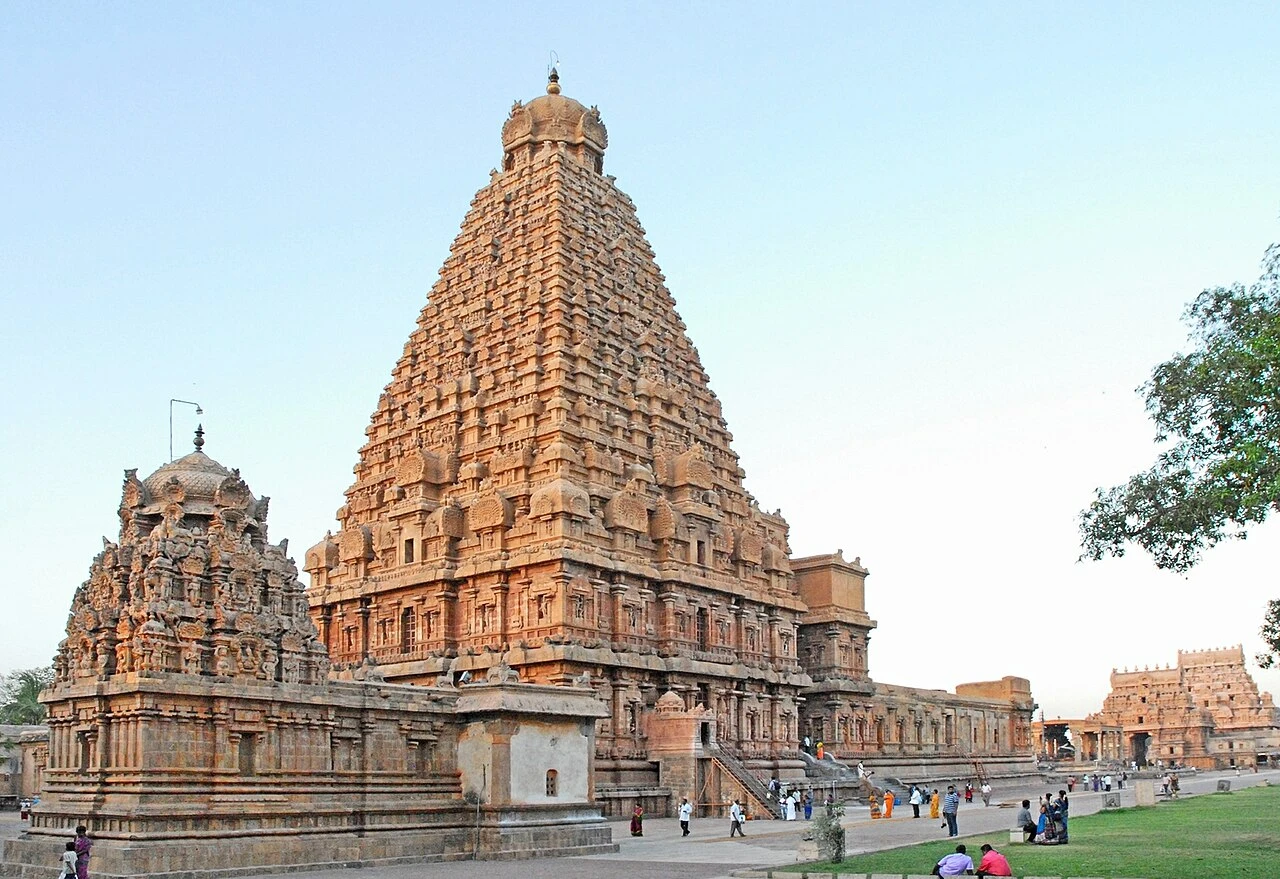
Thanjavur
Brihadisvara Temple
Content & sources
Jean-Pierre Dalbéra from Paris, France · CC BY 2.0