Stanza · Audio guide
Tanah Lot Audio Guide
A place to remember. A story to take with you.
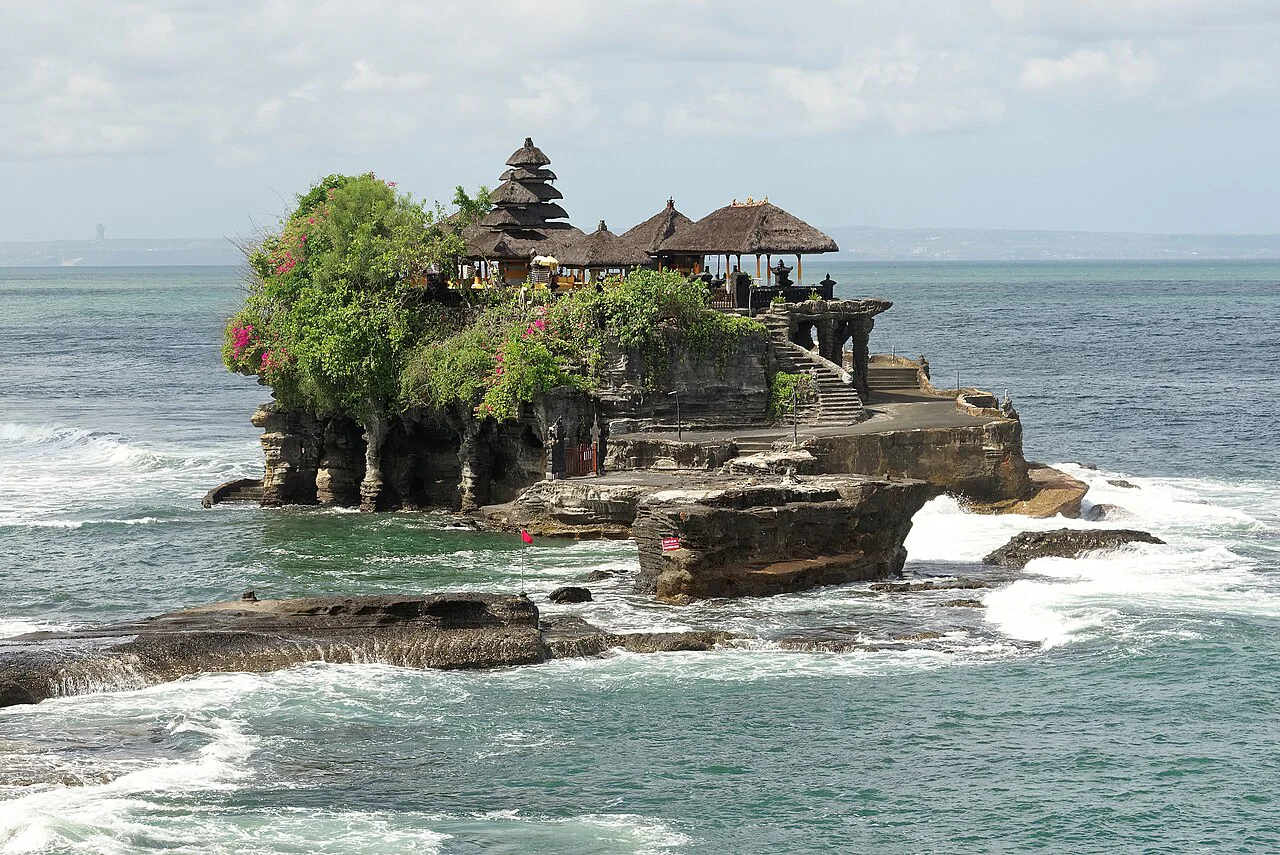
Tanah Lot is a rock formation off the Indonesian island of Bali. It is home to the ancient Hindu pilgrimage temple Pura Tanah Lot.
Download Stanza, then search for “Tanah Lot”.
About the tour
One guide. Your kind of visit.
Tanah Lot is a rock formation off the Indonesian island of Bali. It is home to the ancient Hindu pilgrimage temple Pura Tanah Lot.
Ready when you are.
- 01Get the free Stanza app.
iOS & Android
- 02Find your guide.
“Tanah Lot”
- 03Download before you go.
Works offline
Audio guide / 9 narrated stops
Inside the guide
Get to know a few of the stories before you go. Open a stop to read more.
01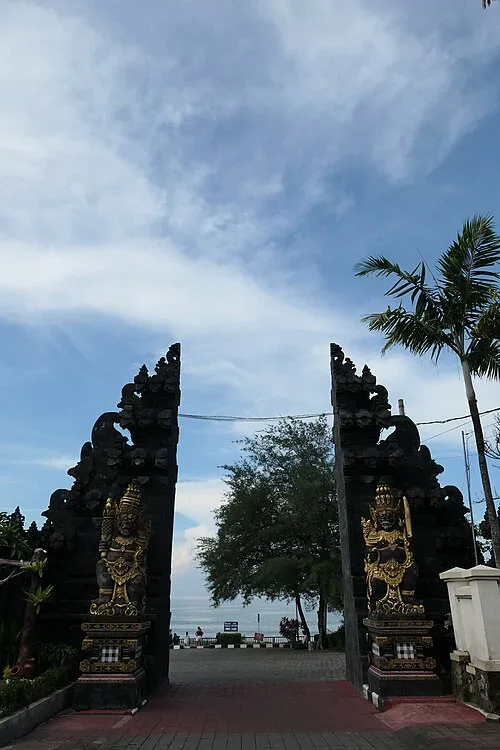 The Grand Split Gate (Candi Bentar)
The Split Gateway (Candi Bentar) to Pura Tanah Lot
Welcome to Tanah Lot, a temple whose name means land in the sea. This great gate, split down the middle, is the doorway between two worlds. On one side lies the market path, lined with souvenir shops on both sides of the way down to the water. Through the gap, the ground becomes temple ground, sacred to the Balinese Hindus. Pura Tanah Lot is one of the seven main sea temples strung along Bali's southwestern coast. Its deity is Dewa Baruna, the god of the sea and of the sea's power. The gate you see here is not ancient fabric. It was rebuilt during the modern restoration campaign that also saved the temple rock itself, a story still to come. For now, pass through the split gateway and into the temple's domain.
Photo: Anandajoti · CC BY-SA 4.0
02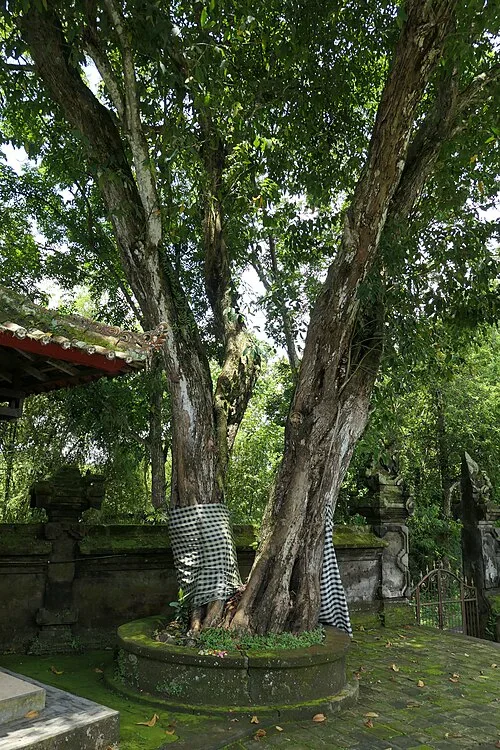 The Sacred Trees and Clifftop Gardens
Sacred Trees of the Temple Precinct
These old trees with their trunks wrapped in black and white checkered cloth are more than scenery. The cloth marks them as consecrated, part of a temple landscape where the trees themselves share in the holiness of the place. Tanah Lot is not a monument preserved from a distance. It is a living temple, and its calendar still turns. Every 210 days, on the Balinese Pawukon calendar, the temple celebrates its Odalan festival, its anniversary of consecration. The same cycle governs temple celebrations across Bali, and at Tanah Lot it often falls near the great island-wide days of Galungan and Kuningan. And the temple honours more than the sea. Dang Hyang Nirartha, the wandering priest remembered as its founder, is himself worshipped here. Five centuries on, people still pray to the man whose story you will hear shortly.
Photo: Anandajoti · CC BY-SA 4.0
03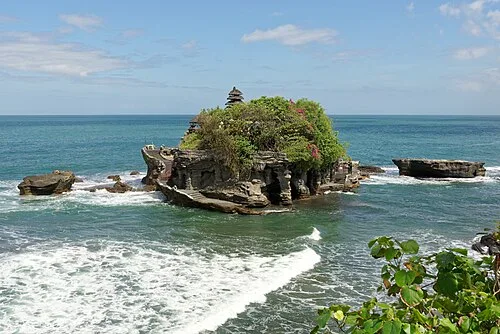 The Sea Temple and Engineered Cliffs
The Sea Rock and Its Tides
This is the signature view of Tanah Lot: a temple rock standing offshore, ringed by the sea. At high tide the water closes around it completely, and the rock becomes an island. Only when the tide falls can anyone reach it on foot, walking across the exposed seabed. That daily drama nearly destroyed the temple. From the 1980s the rock face began to crumble, and the area around and inside the temple grew dangerous. The Balinese government began protecting the shore, laying heavy wave-breaker blocks in front of the rock from 1987. Later came a full stabilization project, running from June 2000 to February 2003, paid for with a loan from the Japan Bank for International Cooperation. Underwater breakers and artificial reef were built beneath the surface, out of sight. The result is startling: over one-third of what reads as natural rock here is actually artificial, sculpted and disguised to keep the temple looking untouched.
Listen in the appJakub Hałun · CC BY-SA 4.0
04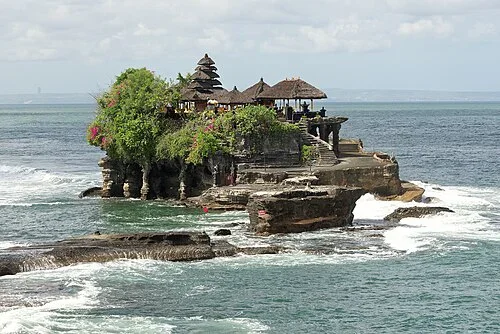 The Sea Temple and Engineered Cliffs
The Temple on the Rock: Dang Hyang Nirartha and the Founding
The story the Balinese tell of this rock begins in the sixteenth century, under King Dalem Waturenggong. A brahmana priest named Dang Hyang Nirartha travelled from Java, spreading the Hindu faith across Bali, Lombok and Sumbawa. Following a holy light he saw shining from the southern sea, he came to the coast at the village of Beraban. The village chief, Bendesa Beraban, resisted his teaching, and as Nirartha's followers grew, the chief ordered him to leave Tanah Lot. Nirartha agreed to go. But first, the legend says, he used his spiritual power to move the very rock he had meditated on, out from the shore and into the sea, though not far from the beach. On that rock he built the temple. Then he transformed his sash into sea snakes, black banded with yellow and venomous, to guard the rock forever. Seeing all this, the story goes, Bendesa Beraban finally came to believe, and his people with him.
Listen in the appJakub Hałun · CC BY-SA 4.0
05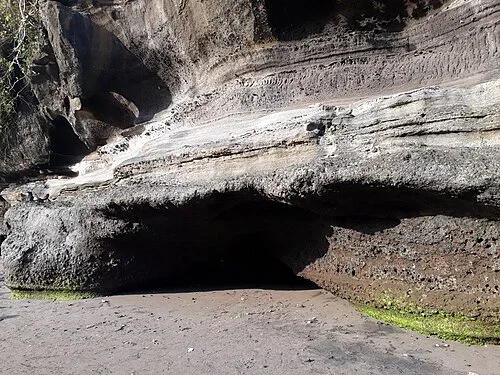 The Holy Caves of the Temple Base
The Cave of the Holy Spring
At the foot of the temple rock there are caves, reachable only when the tide has drawn back. In one of them, the water that seeps from the ground is fresh, not salt. The legend traces it to Nirartha himself. As told at the temple rock, the priest worked his wonders on this shore before departing, and one of them was to strike his wooden staff into the earth beneath the great boulder. Fresh water sprang forth at once, though the rock stood in the middle of the sea. Balinese Hindus regard that water as holy water, a gift from God to the people of Beraban through the priest. Pilgrims who come down to the base of the rock at low tide can receive a traditional blessing with it. Fresh water, welling up under the ocean, is hard to explain and easy to hold sacred.
Listen in the appPhoto: Shafamarisan · CC BY-SA 4.0
06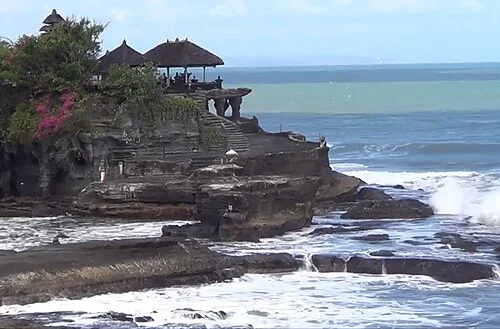 The Sacred Sea Stairs and Makara Guardians
The Rock Base and the Sea Stairs
From the base of the rock, stone stairs climb toward the temple above. They lead to the sacred inner courtyards on the summit, where the shrines stand. Those courts are reserved for Balinese Hindu worshippers; pilgrims ascend to pray, while other visitors remain below. The stairs are the boundary between the public shore and the temple's holiest ground. And the rock holds one more relic of the founding story. Before leaving the village of Beraban for good, Nirartha gave the converted chief, Bendesa Beraban, a keris, a sacred dagger. Its power, the tradition says, was to drive away every disease that attacked the crops, so the village would always harvest. The chief who had once driven the priest away received from his hand the charm that kept his fields alive.
Listen in the appAntaraTV · CC BY 3.0
07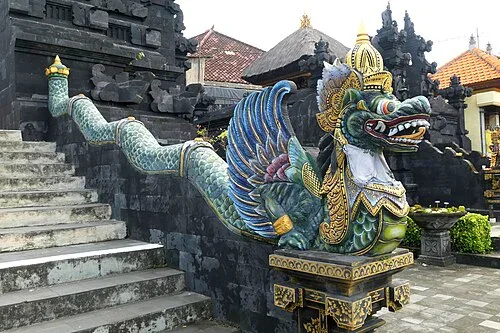 The Sacred Sea Stairs and Makara Guardians
The Makara Guardian on the Stairway
Here on the stairway, a carved creature coils along the balustrade, its scaled body spouting up the rail to a fierce crowned head. This is a makara, a protective being of Hindu temple art, set where it belongs: at a threshold. Balinese architecture places guardians at every passage between the ordinary world and the sacred one, exactly as the split gateway does on a larger scale. The same instinct stands behind the founding legend, where Nirartha set his sea snakes to watch the rock. Stone or story, the idea is the same. Nothing unwelcome crosses into the temple unchallenged.
Listen in the appPhoto: Anandajoti · CC BY-SA 4.0
08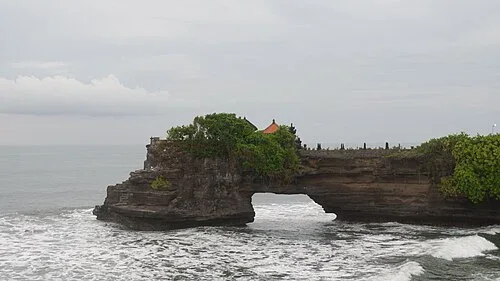 Pura Batu Bolong and the Natural Arch
Tanah Lot does not stand alone on this coast. A short way north, about three hundred meters along the shore, rises its companion, Pura Batu Bolong. The name tells what you see: bolong means hole, and the cliff here is pierced by a natural arch, hollowed through by the sea. The rock juts toward the water like a bridge, arched and connected to the land at its root, and the temple stands at its seaward end. Waves crash through the opening beneath it. The Indonesian account describes two temples on the rocks of this shore, one on the great boulder and one on the jutting cliff, a pair of sea sanctuaries guarding the same stretch of coast at Beraban.
Listen in the appPhoto: Alharomain354 · CC BY-SA 4.0
09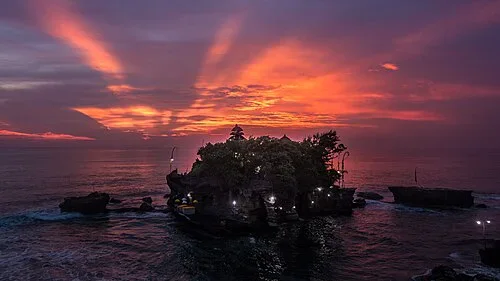 The Sunset Viewpoint
Sunset over the Sea Temple
At day's end, Tanah Lot becomes the image the world knows. The sun drops toward the Indian Ocean behind the rock, and the temple turns to a black silhouette against a sky of burning red and violet. The shrine roofs and the guardian snakes and the sea all darken together, while the temple lights begin to glow along the shore. The Indonesian sources have long praised this shore as a beautiful place to watch the sun go down, and the crowds agree. A 2019 study counted Tanah Lot among the most visited places in Indonesia, drawing about half a million tourists a year. A rock the sea claimed, a priest's legend, a spring of fresh water, and a sky on fire: that is what people come half a million times a year to see.
Listen in the appJean-Marc Astesana from Voisins le Bretonneux, France · CC BY-SA 2.0
Tanah Lot
Frequently asked questions
How much does the guide cost?
Free app download. Listed guide price: $0.99. Guide price shown in the app. Audio guide only. Venue admission is separate.
Can I listen without internet?
Yes. Download the guide’s audio, images, and maps in the app before your visit. Your downloaded content is then available offline.
Can I listen in my language?
This audio guide is available in 15 languages, including English.
Do I need to follow a schedule?
No. This is a self-guided experience. Choose your stops, pause whenever you like, and return to a story at your own pace.
At your own pace
Explore Tanah Lot.
Download Stanza, then search for “Tanah Lot”.
Free app download · Guide price shown in the app
Keep exploring
Nearby audio guides
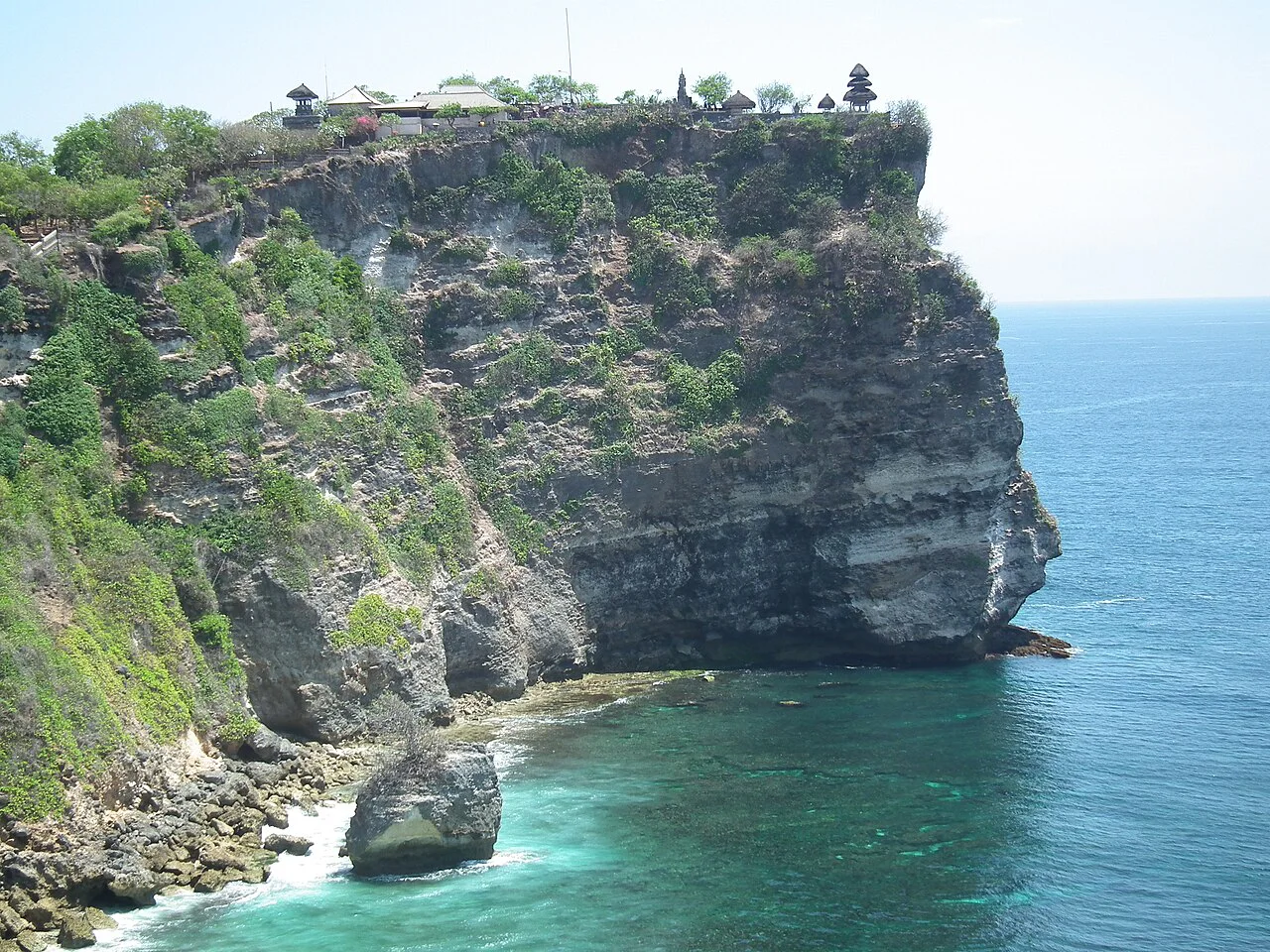
Kuta Selatan · 23 km
Uluwatu Temple
Content & sources
Photo: GeoffClarke · CC BY-SA 3.0
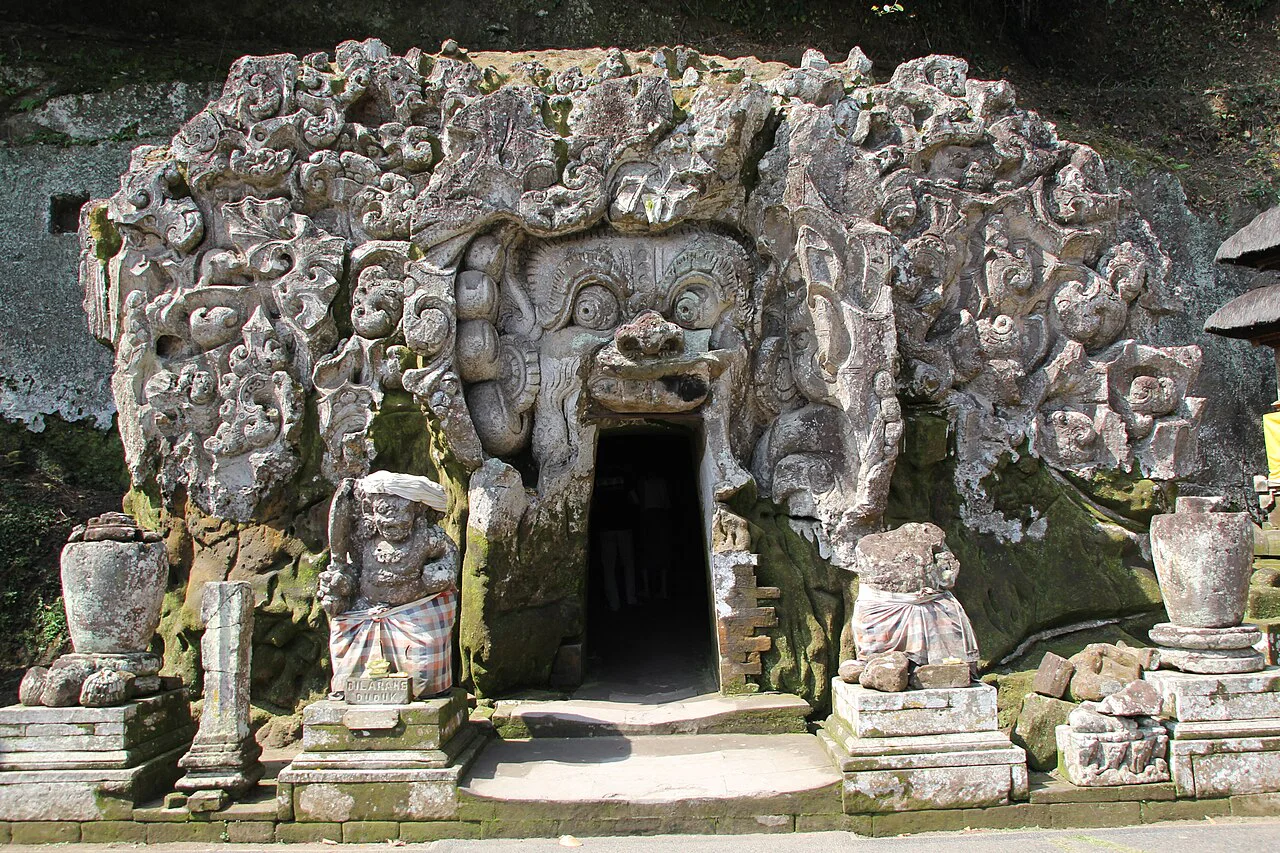
Gianyar · 24 km
Goa Gajah
Content & sources
Photo: DerGenaue Allrounder · CC BY-SA 3.0
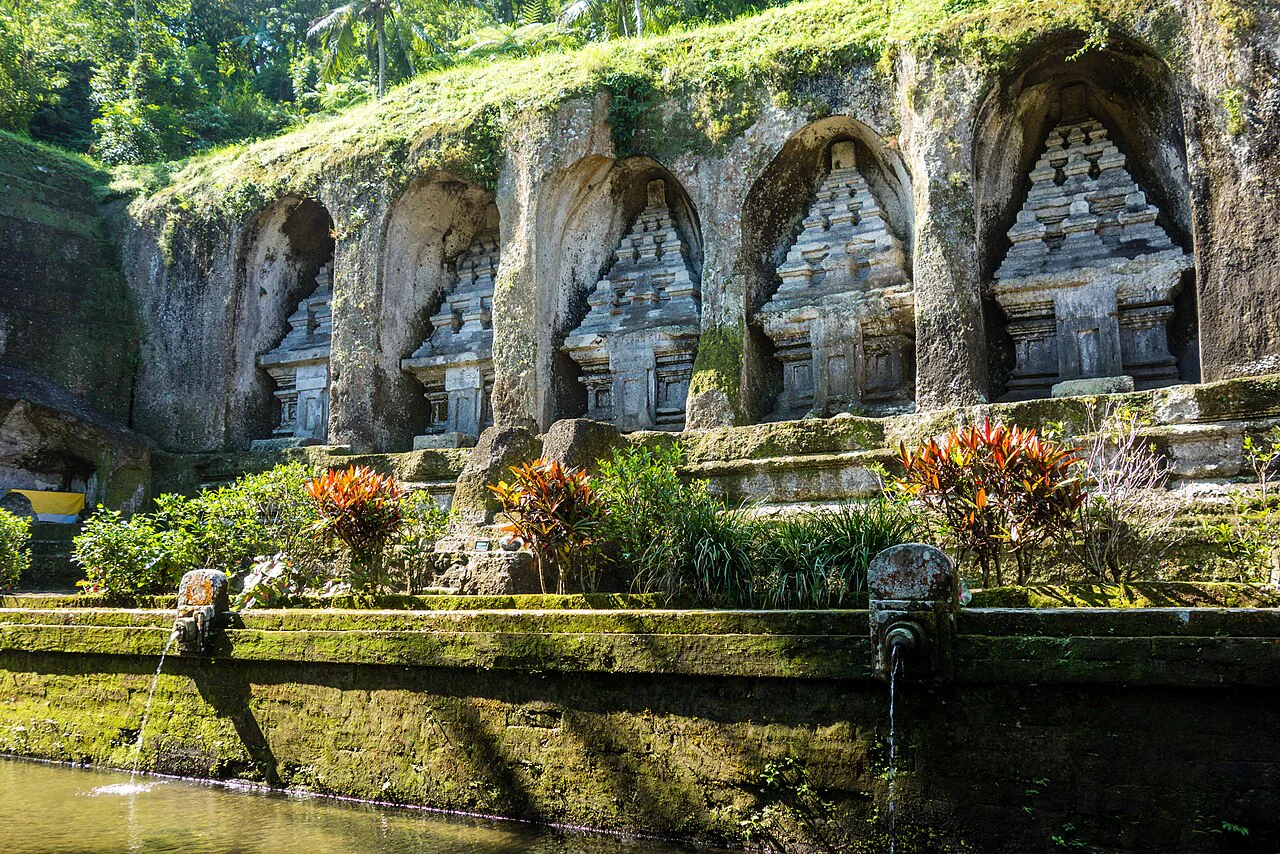
Tampaksiring · 33 km
Gunung Kawi
Content & sources
Visions of Domino · CC BY 2.0
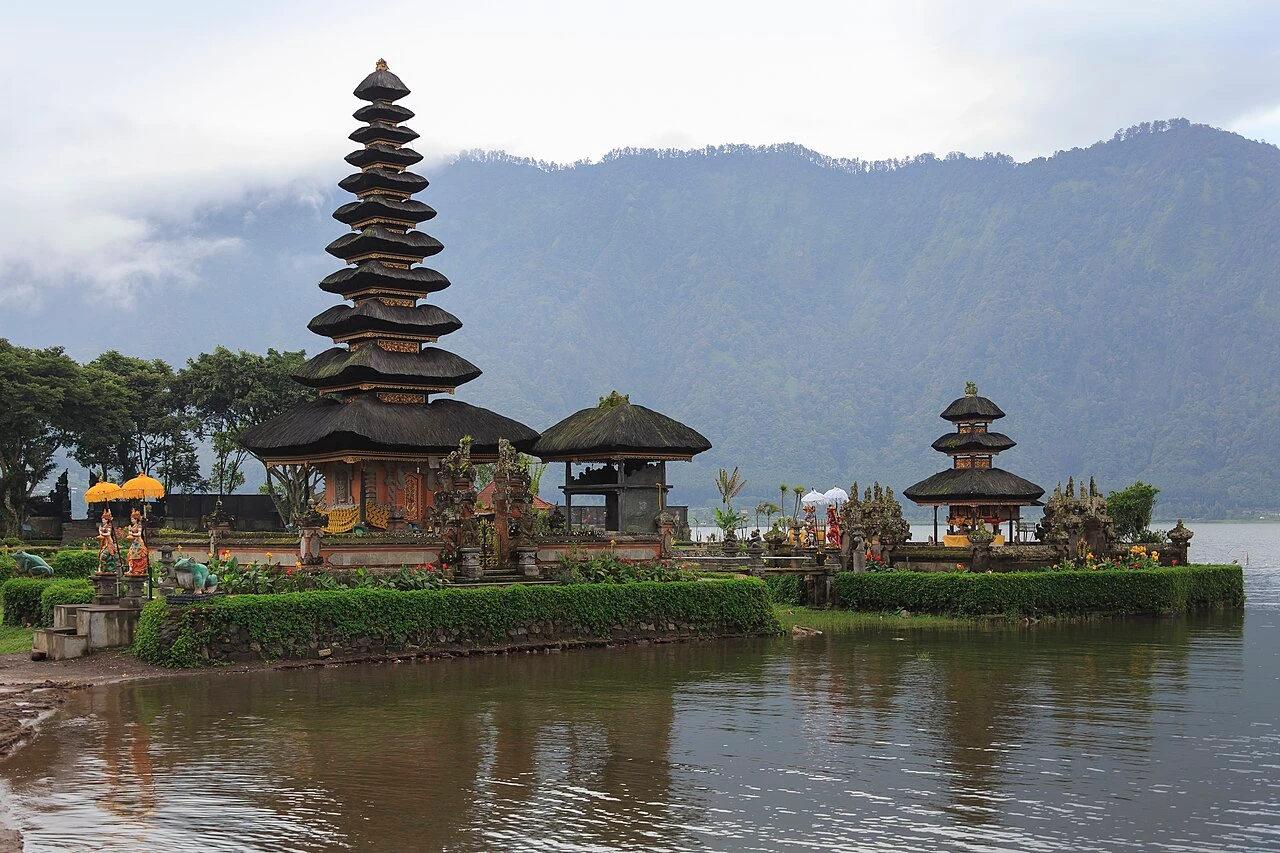
Baturiti · 40 km
Pura Ulun Danu Bratan
Content & sources
CEphoto, Uwe Aranas · CC BY-SA 3.0