Languages
15Candi Borobudur Audio Guide
Candi Borobudur is a landmark in Desa Borobudur, Indonesia. Explore it with Stanza's GPS-triggered offline audio guide — available in 15 languages.
Quick Facts
20
Stops
15
Languages
100%
Offline
📍 Desa Borobudur, Indonesia · -7.6079°N, 110.2038°E
About Candi Borobudur
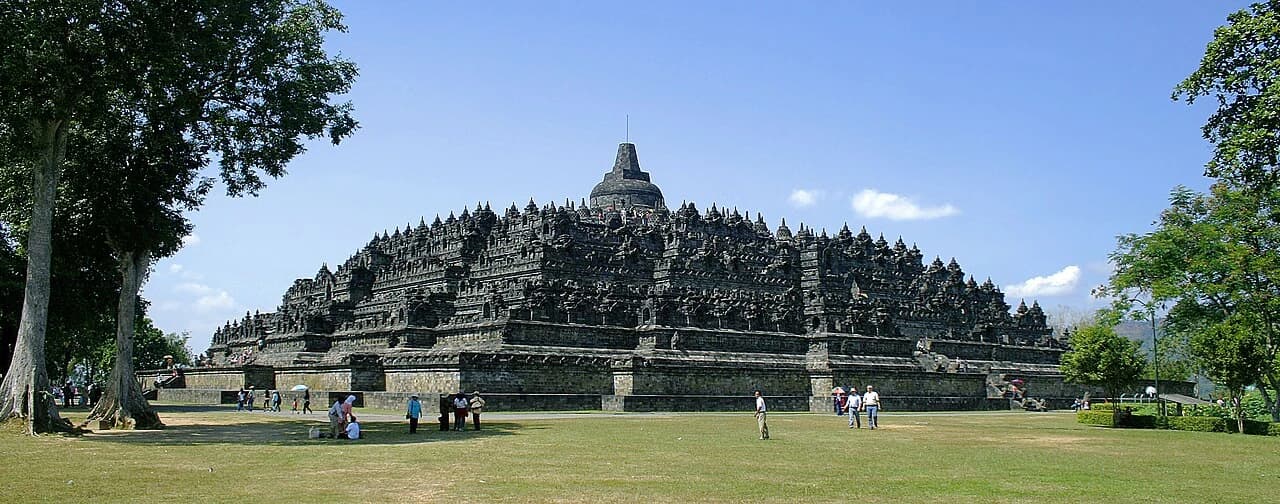
Borobudur is a 9th-century Mahayana Buddhist temple in Central Java, Indonesia. It is also a prominent archaeological site and a major tourist attraction.
Candi Borobudur is also known as Boro Budor, Candi Borobudur.
This self-guided audio tour features 20 narrated stops organized across 7 sections. As a temple, Candi Borobudur offers a unique cultural experience in the heart of Desa Borobudur, Indonesia.
The Stanza audio guide is available in 15 languages and works entirely offline — download the complete tour including audio narration, maps, and images before your visit. As you walk through Candi Borobudur, GPS-triggered narration plays automatically at each point of interest.
Last updated:
What you will hear
Arrival at the Three-Dimensional Mandala
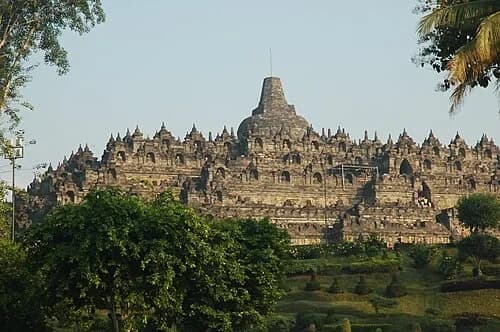
Start with a grand overview of the temple complex to explain the mandala structure and the architectural ensemble. Use the northwest view to frame the site before entering.
Scale of the Mandala
The architectural footprint of Borobudur is truly immense, featuring a square base that measures 123 meters on each side. Rising 35 meters into the sky, the structure is composed of approximately 55,000 cubic meters of andesite stone, a type of volcanic rock found locally. Interestingly, the temple is not a solid block of masonry; it was built atop a natural hill, which serves as its core. The design consists of nine stacked platforms. The bottom six levels are square, while the top three are circular. From this distance, you can see how the sharp corners and enclosed galleries of the lower platforms eventually give way to the smooth, curved terraces above. This transition represents the spiritual progression from the complex, rigid world of earthly desires to the simple, boundless state of enlightenment. Every block was meticulously carved and fitted together to withstand the tropical environment and the passage of centuries. The andesite stone used throughout has a dark, porous texture, which has weathered to a deep gray color over the last millennium. This volcanic material was carved with incredible precision to create the thousands of relief panels and statues that cover the temple’s exterior.
The East Gate and Guardian Lions
Enter through the traditional main entrance. Introduce the architectural style and the protective lion sculptures that flank the stairs.
The Main East Gate
In Buddhist tradition, the ritual of Pradaksina is essential for a sacred visit. This involves walking around the monument in a clockwise direction, always keeping the sacred structure to your right-hand side. The East Gate is specifically aligned to capture the rising sun, symbolizing the start of the path toward wisdom. As you follow this circular route, you will encounter thousands of narrative relief panels. These carvings were designed to be read in sequence, starting right here at the eastern entrance. By following the clockwise path, the stories unfold in their intended order, guiding you through various moral lessons and life stories of the Buddha. This practice transforms the act of walking into a moving meditation, allowing visitors to absorb the teachings depicted in the stone while physically ascending the temple. Each level offers a new layer of narrative, ensuring that the pilgrim's progress is both physical and spiritual. Historically, this entrance was the grandest of the four gates, once featuring more elaborate ornamentation and guarded by stone figures. The tradition of beginning here has been maintained for over twelve hundred years, connecting modern visitors with the millions of pilgrims who have walked these galleries since the ninth century.
The Stone Guardian
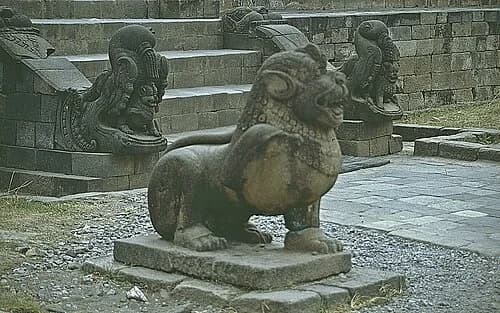
These figures are classic examples of eighth-century Javanese stone carving. Notice the distinct style: the lions have a powerful, squat posture with thick limbs and highly stylized manes that look like decorative curls. While lions are not native to the island of Java, they were frequently used in ancient Hindu-Buddhist architecture across the region as symbols of royalty and spiritual strength. Their presence at the foot of the stairs signals to visitors that they are entering a sacred space that demands respect and focus. Each entrance was once flanked by a pair of these stone sentinels, though many have been worn down by time or damaged over the centuries. The craftsmanship seen in the facial features and the muscular tension in their bodies reflects the high level of skill possessed by the Sailendra-era artisans. They were carved from the same local andesite stone as the rest of the temple, designed to appear both ferocious and protective. As you pass by them, you are moving from the outer grounds into the narrative galleries. These lions remain some of the most iconic sculptural elements of the temple, welcoming those who seek to climb toward the higher realms of the monument.
The Hidden Foot: Karmawibhangga
Explore the base level, which was covered for structural reasons. Use the archival photography of Kassian Céphas to show the hidden reliefs depicting the law of cause and effect.
The Law of Karma
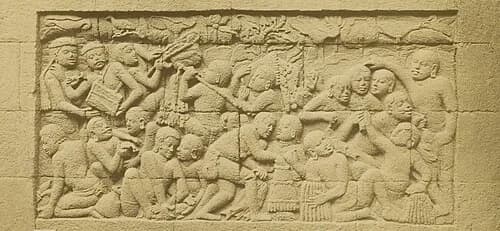
During the temple's construction, engineers realized the massive weight of the upper levels might cause the structure to slide or collapse. To provide extra stability, they built a wide encasement wall around the base, which unfortunately covered up 160 intricate relief panels. This series, known as the Karmawibhangga, illustrates the consequences of human actions. Because they are now mostly concealed, we rely on historical records, like the 1890 photographs taken by Kassian Céphas, to see what they look like. The scenes are vivid and often blunt, showing the rewards for virtuous behavior and the grim punishments for greed, violence, and other vices. They capture a broad spectrum of ninth-century life, from bustling markets and family scenes to depictions of hellish suffering. The figures are carved with a lively realism, showing people in various states of joy, anger, and pain. Only a small section at the southeast corner remains visible today, offering a glimpse into this lower world of earthly attachment that the temple’s architecture encourages us to leave behind. This 'hidden foot' reminds us that even the parts of the temple we cannot see were designed with a specific pedagogical and spiritual purpose.
First Gallery: The Life of Prince Siddhartha
Walk through the first gallery to see the Lalitavistara series, following the Buddha's journey from birth to enlightenment.
Birth of a Prince
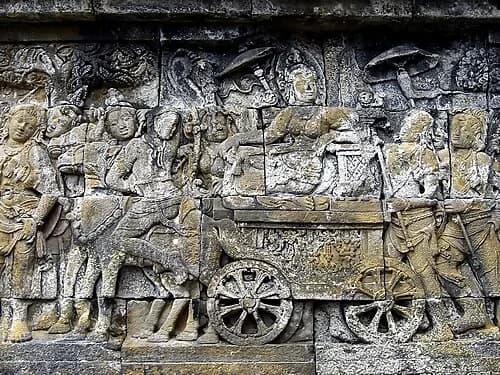
Located in the first gallery, this panel is part of the Lalitavistara series, which chronicles the life of the Buddha from his descent from heaven until his first sermon. The scene shown here is rich with historical detail. You can see the Queen seated in an elaborate horse-drawn carriage, surrounded by a retinue of attendants. Pay close attention to the smaller elements: the decorative umbrellas held by the guards and the specific patterns in the clothing worn by the court officials. Although the story is set in ancient India, the carvers at Borobudur depicted the scenes using the fashion, architecture, and customs of eighth-century Java. This makes the reliefs an invaluable record of what royal life looked like during the Sailendra Dynasty. The carriage itself is a marvel of stone carving, showing the intricate wheels and harness. This level of detail was intended to ground the spiritual narrative in a reality that would have been recognizable to the people of the time. As you walk past, notice the deep relief carving, which creates strong shadows and gives the scene a sense of three-dimensional depth. This is one of the many panels that guide you through the transition from prince to enlightened being.
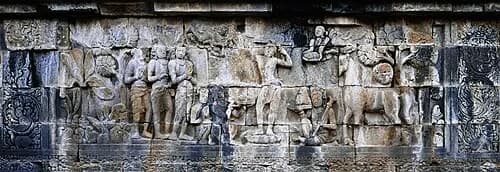
The Great Renunciation
After witnessing the suffering of the world outside his palace walls, Prince Siddhartha decided to leave his life of luxury to seek a solution to human pain. In this pivotal relief, he is shown using his sword to cut off his hair, which in ancient times was a clear sign of his noble status. By removing his jewelry and fine clothes, he transformed from a wealthy prince into a wandering ascetic. This specific panel is one of 120 in this gallery that meticulously detail the Buddha's life. The composition is dynamic, focusing on the prince’s resolve and the transition he is undergoing. Notice how the figures around him react to this startling change. For the pilgrim walking these corridors, this scene serves as a powerful reminder of the sacrifices required on the path to enlightenment. The carving style here is particularly fluid, capturing the movement of the sword and the drapery of the prince's simple new garments. The weathered stone still preserves the determined expression on the prince’s face. This level of the temple is designed to engage the visitor with the human aspects of the Buddha’s story, making his eventual enlightenment feel both earned and profound.
Lower Balustrades: Tales of Virtue
Observe the Jataka and Avadana tales on the lower balustrades, which use animal fables and legends to teach Buddhist morality.
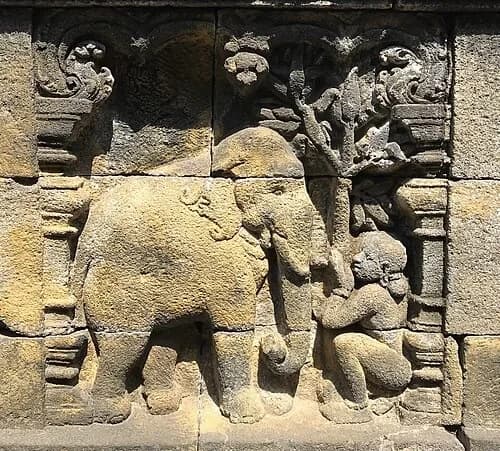
Tales of Morality
In this relief, you can see a large, detailed elephant interacting with human figures. This is a scene from the Jataka, which are stories of the Buddha’s many incarnations before he achieved enlightenment. In these tales, the Buddha might appear as a monkey, a deer, or, as seen here, a noble elephant. These narratives were specifically placed on the lower balustrades where they would be easily accessible to everyone, including common people who might not have been deeply schooled in complex theology. Each story illustrates a specific virtue, such as selfless compassion, deep wisdom, or the willingness to sacrifice for the good of others. The carvings are expressive and lively, making the moral points easy to understand through visual storytelling. By observing how the 'Future Buddha' behaved in these animal forms, visitors were encouraged to cultivate similar virtues in their own lives, preparing their minds for the more abstract spiritual concepts found on the higher levels of the monument. The andesite stone blocks show the wear of time, but the interaction between the large animal and the smaller human figures remains clear. These fables provided a foundation of moral conduct for every pilgrim who climbed the stairs of Borobudur.
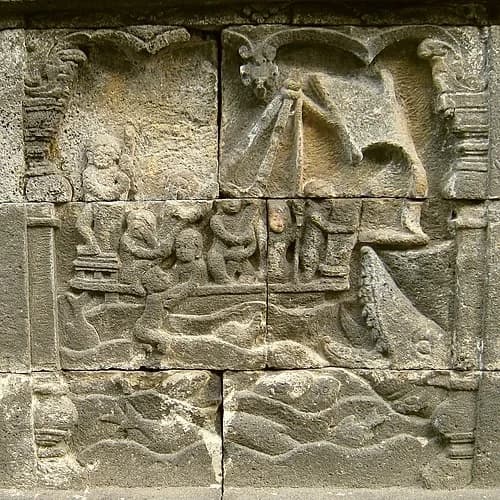
Harvest from the Sea
Beyond their spiritual meaning, the carvings at Borobudur are incredible historical documents. This particular panel shows a sea voyage in great detail. Notice the construction of the vessel, including the masts and the rigging. Scholars consider these reliefs to be some of the most important records of ancient maritime technology in Southeast Asia. They reveal that ninth-century Javanese mariners possessed advanced knowledge of shipbuilding, allowing them to navigate far across the oceans. Below the ship, the artist has carved the churning water and a large, toothy creature, which could be a literal sea monster or a symbolic representation of the dangers inherent in sea travel. This blend of real-world technology and mythological elements is typical of the temple's narrative style. It reminds us that for the people who built Borobudur, the spiritual journey was often compared to a perilous voyage across a vast sea, with enlightenment as the final, safe harbor. The detail in the ship's double-outrigger system is so accurate that modern researchers have used it as a blueprint for reconstruction. These panels bridge the gap between the divine stories of the temple and the everyday lives of the sailors and traders who lived in the region.
Architecture and the UNESCO Restoration
A close look at the masonry. Discuss how 55,000 cubic meters of stone were laid without mortar and the massive dismantling project of the 1970s.
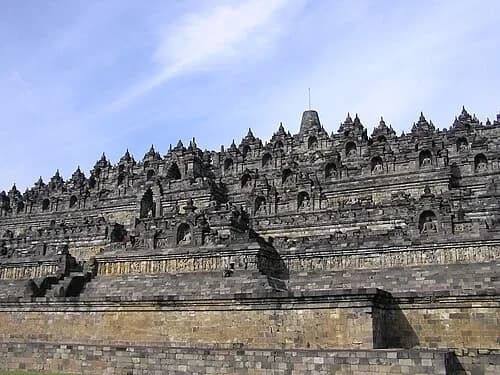
Engineering Without Mortar
Artisans used an ingenious system of interlocking joints—similar to modern building blocks—to connect the thousands of volcanic stones. This allowed the structure to remain flexible during earthquakes while maintaining its overall shape. Between 1975 and 1982, the monument underwent a massive restoration project led by UNESCO and the Indonesian government. During this time, over one million individual stones were carefully dismantled, numbered, and cleaned. The primary goal was to install a modern hidden drainage system to prevent rainwater from eroding the structure from the inside out. As you look at the walls now, you are seeing the result of this Herculean effort to stabilize the temple for future generations. The precision of the original ninth-century masonry was so high that many of the stones could be put back into their exact original positions. This project remains one of the largest and most complex architectural conservation efforts ever undertaken. By exploring the galleries, you can still see the subtle dovetail and notch joints where the andesite blocks meet. This engineering ensures that the temple can withstand the heavy tropical rains and the seismic activity frequent on the island of Java, standing firm after more than twelve centuries.
Samudra Raksa Museum: The Cinched Ship
Conclude with the maritime history of ancient Java. Connect the ship reliefs on the temple walls to the full-scale reconstruction housed here.

Voyage of the Replica
In 2003, the stone images of Borobudur took on a physical form in the shape of a seaworthy replica. Based entirely on the technical blueprints found in the temple's reliefs, this vessel, named the Samudra Raksa, was constructed using traditional methods. To test the seaworthiness of this ancient design, a crew embarked on a journey from Indonesia across the Indian Ocean, eventually reaching Ghana in West Africa. This successful voyage covered thousands of miles and proved that Javanese mariners of the eighth and ninth centuries possessed the technology and navigational skills required for long-distance maritime travel. It turned the stone carvings of Borobudur into more than just religious or historical art; it established them as evidence of a highly advanced seafaring civilization. By successfully retracing a potential ancient trade route, the expedition validated the maritime prowess of the Sailendra era. The replica now stands as a physical manifestation of the knowledge preserved in the temple’s stone galleries. It serves as a reminder that the stories carved into this monument are deeply rooted in the lived experiences and remarkable achievements of the people who built it. The model shows the complex rigging and traditional sails used during the crossing.
Want to hear the rest?
Download the Stanza app to unlock all 20 stops and full GPS-guided navigation.
Frequently Asked Questions
How long does the Candi Borobudur audio tour take?
The Candi Borobudur audio guide includes 20 narrated stops. Most visitors spend 45 minutes to 1.5 hours exploring the complete tour, though you can listen at your own pace and skip or revisit any stop.
Is the Candi Borobudur audio guide available in my language?
Stanza supports 15 languages: English, Spanish, French, German, Italian, Portuguese, Russian, Japanese, Chinese, Korean, Arabic, Hindi, Polish, Dutch, Hebrew. Check the guide in the app to confirm the languages currently available for this tour.
Can I use the audio guide offline at Candi Borobudur?
Yes! Download the complete Candi Borobudur tour — including all audio, maps, and images — before your visit. The Stanza app works completely offline, so you don't need WiFi or mobile data at the venue.
How much does the Candi Borobudur audio guide cost?
The Stanza app is free to download. The current listed price for the Candi Borobudur audio guide is $2.99; app-store region and currency may affect the final price.
How do I use the Stanza audio guide at Candi Borobudur?
Download the free Stanza app, search for "Candi Borobudur", and download the tour. When you arrive at the venue, the app uses GPS to detect your location and automatically plays the relevant narration as you move between points of interest — completely hands-free.
What makes the Stanza audio guide different from other Candi Borobudur tours?
Stanza offers GPS-triggered narration that plays automatically as you walk through Candi Borobudur — no need to manually select stops. The tour is available in 15 languages, works fully offline, and includes 20 expertly narrated stops with images and historical context.
What other audio guides are available near Candi Borobudur?
Stanza offers multiple audio guides in Desa Borobudur, Indonesia and nearby areas. After downloading the app, browse the map to discover all available tours near Candi Borobudur. Each guide can be downloaded for offline use.