Stanza · Audio guide
Istiqlal Mosque, Jakarta Audio Guide
A place to remember. A story to take with you.
Istiqlal Mosque is the largest mosque in Southeast Asia and the national mosque of Indonesia. It was built to commemorate Indonesian independence and opened to the public in 1978.
Download Stanza, then search for “Istiqlal Mosque, Jakarta”.
About the tour
One guide. Your kind of visit.
Istiqlal Mosque is the largest mosque in Southeast Asia and the national mosque of Indonesia. It was built to commemorate Indonesian independence and opened to the public in 1978.
Ready when you are.
- 01Get the free Stanza app.
iOS & Android
- 02Find your guide.
“Istiqlal Mosque, Jakarta”
- 03Download before you go.
Works offline
Audio guide / 10 narrated stops
Inside the guide
Get to know a few of the stories before you go. Open a stop to read more.
01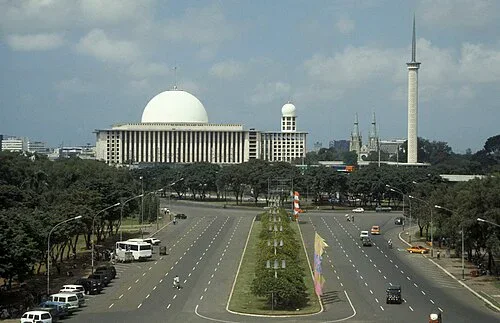 Arrival & Colonial Citadel Site
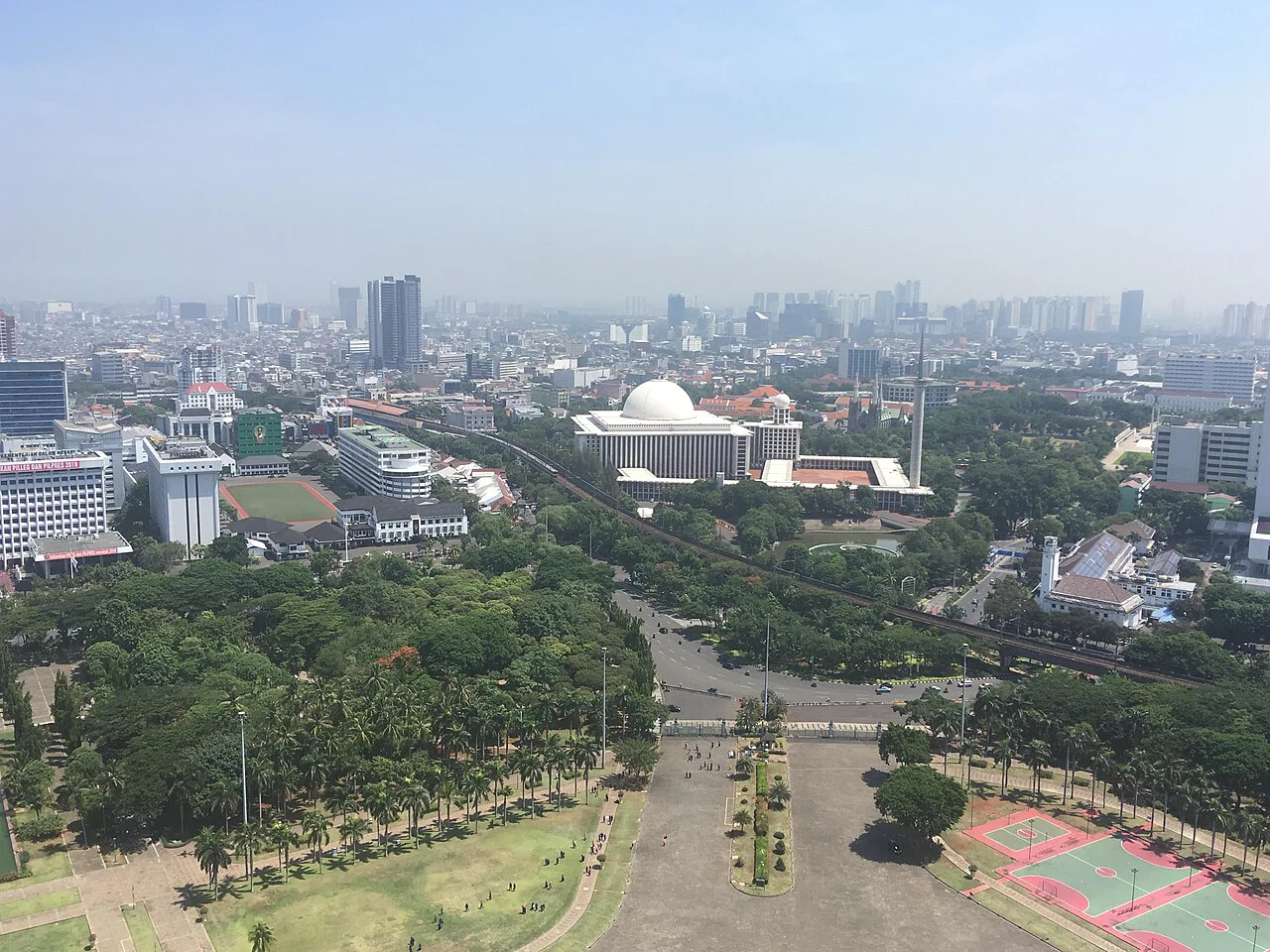
Istiqlal Mosque and Jakarta Cathedral
Welcome to the Istiqlal Mosque in Jakarta, the national mosque of Indonesia. Istiqlal is an Arabic word meaning independence, and independence is the whole reason this building exists. It is the largest mosque in Southeast Asia and the ninth largest in the world. Across the complex there is room for some two hundred thousand worshippers. The whole ensemble sits in one sweep: the great white dome, the slender minaret, the broad square in front, and the twin spires of Jakarta Cathedral close beside it. Beyond them lies Merdeka Square with the National Monument, and the Immanuel Church is near as well. The mosque stands on ground that was once Wilhelmina Park, a colonial garden where some of the old trees may be a hundred years old, with a branch of the Ciliwung river running through. Over the next stops, the story of why this spot was chosen, how the building works, and what it means that a mosque and a cathedral share the same ground.
Jacob Derk de Jonge · CC BY 4.0
02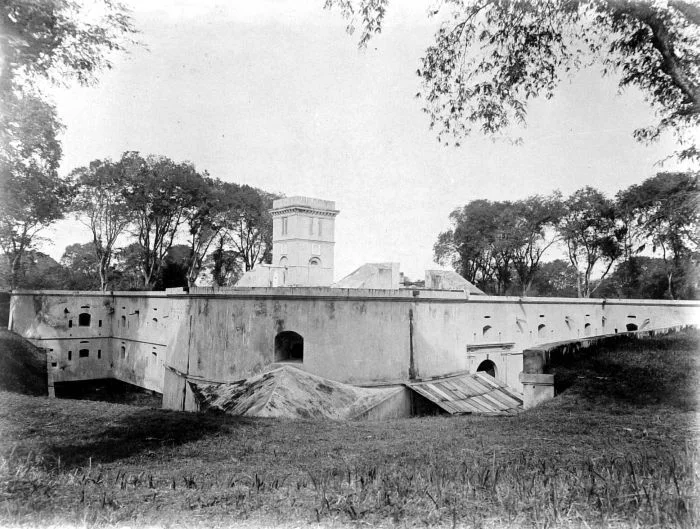 Arrival & Colonial Citadel Site
The Colonial Citadel
A Dutch fort once stood on this ground. The Citadel Prins Frederick, built in 1837, was part of the colonial fortification of Jakarta until the land was needed for something else entirely. When the new nation planned its national mosque, two locations competed. Vice President Mohammad Hatta suggested a plot near residential areas on Thamrin Avenue, where the Hotel Indonesia stands today. President Sukarno wanted something grander. A national mosque, he insisted, belonged near the most important square of the nation, close to the Merdeka Palace. That followed an old Javanese tradition: the kraton, the ruler's palace, and the masjid agung, the grand mosque, should both stand around the city square. So the site was set in Taman Widjaja Kusuma, the former Wilhelmina Park, facing Jakarta Cathedral. The old citadel came down to clear the way. Sukarno also wanted the mosque beside the cathedral and the Immanuel Church, as a statement of religious harmony under Pancasila — a statement this tour returns to at its final stop.
Unknown author · CC BY-SA 3.0
03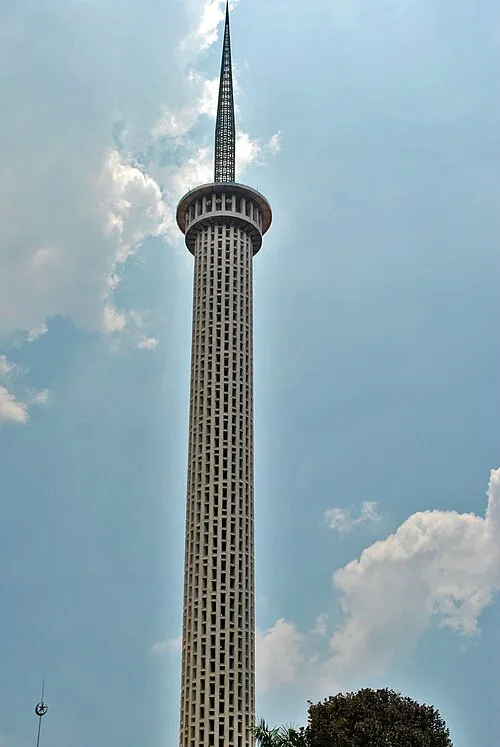 Grand Courtyard & Single Minaret
The Single Minaret
Most of the world's great mosques raise their minarets in pairs or clusters, in the Arabic, Persian, Turkish and Indian manner. Istiqlal has exactly one. The single minaret stands for the oneness of God, the first principle of Islam. The marble-clad shaft rises about sixty-seven metres. On top of it sits a thirty-metre stainless steel pinnacle, bringing the whole tower to nearly ninety-seven metres. Thirty is no accident: the pinnacle represents the thirty juz', the thirty parts into which the Quran is divided. A popular explanation attaches to the shaft's height as well, saying that sixty-six point six six metres honours a claimed six thousand six hundred and sixty-six verses of the Quran. The verse count does not hold up as fact, but the number was clearly chosen to carry that meaning. Either way, every figure in the tower points the same direction: upward, and toward one God.
Listen in the appBxHxTxCx (using album) · CC BY-SA 2.0
04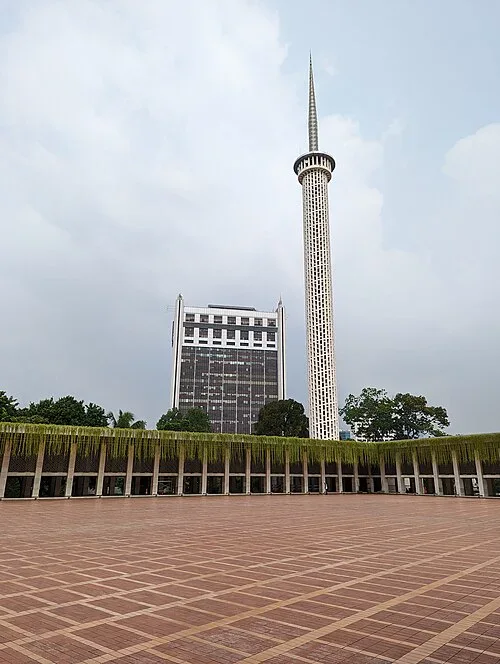 Grand Courtyard & Single Minaret
The Inner Courtyard and Seven Gates
The courtyard is the mosque's open-air room, ringed by arcades that tie the grounds to the main building and run out to the minaret in the southern corner. Seven entrance gates lead into the complex. Each is named after one of the Asmaul Husna, the Names of God in Islam — Al Malik the King, Al Ghaffar the Forgiving, and their companions. Seven gates for the Seven Heavens of Islamic cosmology. The layout works in levels: ablution fountains stand on the ground floor, where worshippers wash before prayer, while the main prayer hall and the courtyard sit a floor above. Between 2019 and 2020 the whole complex underwent a major renovation, with thirty-five million dollars spent on polished marble, new gates, LED lighting, renewed gardens and a two-storey basement car park. Under Grand Imam Nasaruddin Umar the mosque added solar panels, water recycling and slow-flow faucets. In 2022 it received EDGE certification from the International Finance Corporation, part of the World Bank — the first green-certified place of worship in the world.
Listen in the appAisha Tanduk · CC BY-SA 4.0
05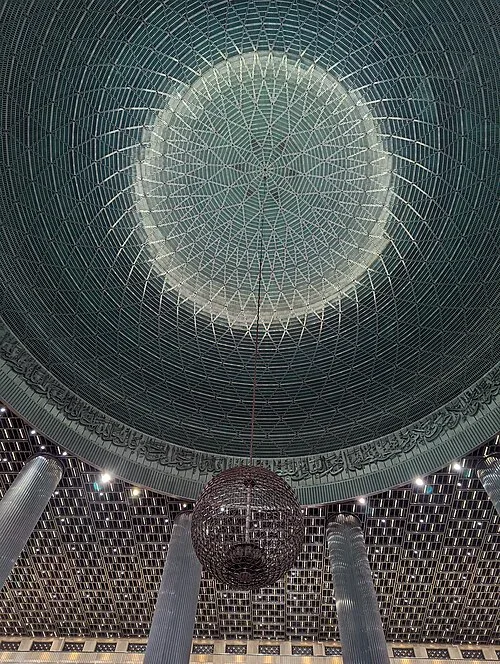 Main Prayer Hall & The 45-Meter Dome
The 45-Metre Dome
The dome overhead holds the mosque's founding idea. It measures forty-five metres across on the outside, and forty-five stands for the year of the Proclamation of Indonesian Independence, 1945. The underside spreads out in a fine geometric lattice, ringed at the rim by a band of Arabic calligraphy. Crowning the dome is a stainless steel pinnacle in the shape of a crescent and star, the symbol of Islam. The smaller secondary dome carries a pinnacle of its own, said to bear the name of Allah in calligraphy. Ornament stays restrained throughout: this is a deliberately minimalist interior, its decoration geometric rather than ornate, with the great chandelier hanging alone at the centre of it all.
Listen in the appAisha Tanduk · CC BY-SA 4.0
06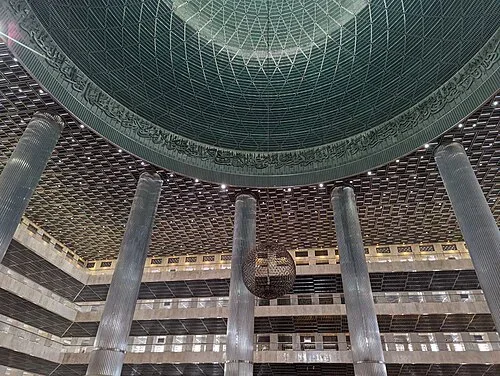 Main Prayer Hall & The 45-Meter Dome
The Main Prayer Hall
The story of this hall begins before there was a hall. After the proclamation of independence in 1945, the idea of a grand national mosque was raised by Wahid Hasyim, Indonesia's first minister for religious affairs, and Anwar Cokroaminoto, who later chaired the Masjid Istiqlal Foundation. Their committee formed in 1953 and brought the proposal to President Sukarno, who welcomed it. In 1954 he was appointed technical chief supervisor of the project himself. Sukarno laid the foundation stone on 24 August 1961. Construction then took seventeen years. It fell to President Suharto to inaugurate the building as the national mosque on 22 February 1978. Overhead, twelve round columns carry the dome, each one clad in stainless steel. Twelve for the twelfth of Rabi' al-awwal, the date honoured as the birthday of the Prophet Muhammad.
Listen in the appAisha Tanduk · CC BY-SA 4.0
07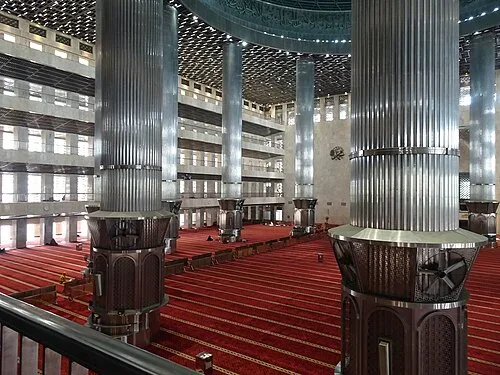 Five Levels & Visitor Balcony Arcades
The Five-Level Prayer Hall
Above the main floor of the hall rise four levels of balconies. Five floors in all — a number this building repeats on purpose. It stands for the Five Pillars of Islam, for the five daily prayers, and for Pancasila, the five principles of the Indonesian state. Staircases at the corners of the building give access to every level. The balcony tiers also serve visitors, opening a view across the whole hall: column after column, and the red-carpeted floor stretching out below. Even the way in carries a number. The main hall is reached through an entrance covered by a dome eight metres across, and eight stands for August, the month of Indonesian independence.
Listen in the appMichael Coghlan · CC BY-SA 4.0
08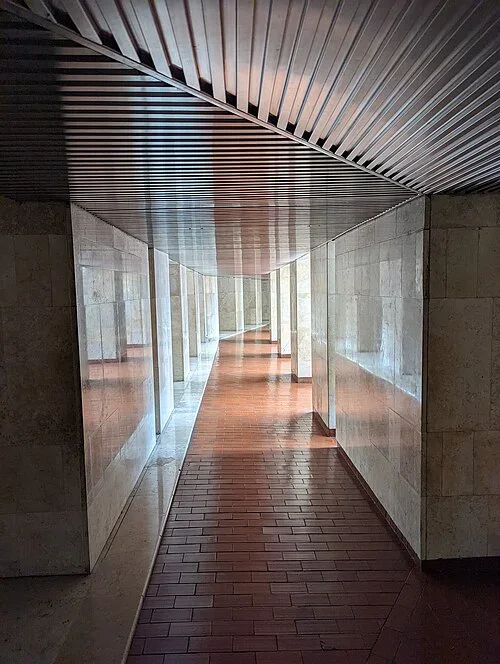 Five Levels & Visitor Balcony Arcades
The Marble Corridor: Silaban's Design
Polished marble walls, a ribbed metal ceiling, clean lines running toward the light: this corridor shows the hand of the architect. His name was Friedrich Silaban, and he won the commission in a national design competition held in 1955, judged with the entries anonymous. His winning theme was a single word, Ketuhanan — Divinity. Silaban was a Protestant Christian, the son of a Lutheran pastor, from the Batak Protestant Christian Church. The national mosque of the country with the world's largest Muslim population, drawn by a Christian — a choice embraced as a statement of unity in diversity. The style is modernist, in the New Formalist and International Style: steel and concrete structure, marble on floors and walls, geometric stainless steel ornament in place of traditional carving. Not everyone was persuaded. Some Muslims in Indonesia found the dome and minaret too modern, too Arabic, out of harmony with Islamic architecture in Indonesia. In response, President Suharto began an initiative to build more mosques in the Javanese triple-roofed style. Istiqlal itself kept Silaban's modernist design.
Listen in the appAisha Tanduk · CC BY-SA 4.0
09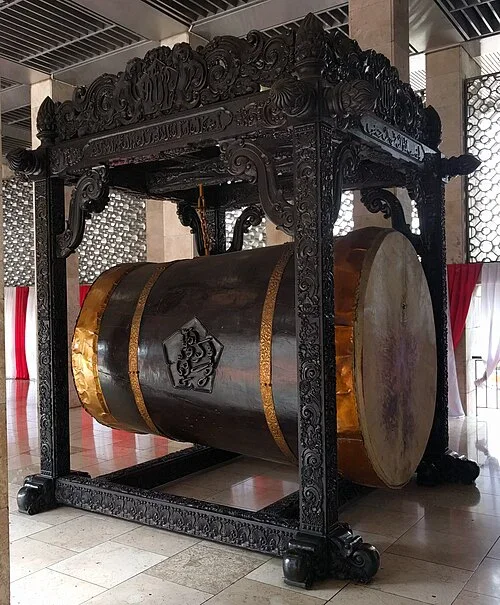 Traditional Javanese Bedug Drum
The Bedug Drum
On the southern side of the mosque, near the minaret, stands this great drum on its richly carved frame. It is a bedug, a large drum made of wood and stretched cow skin. Across Indonesia, the bedug sounds alongside the adhan, the call to prayer — a practice Muslims here share with the wider Islamic world. The ornately carved frame around it is Javanese craft, working inside a building of steel, concrete and marble. When prayer time comes, the old instrument has its place in the most modern mosque in the country.
Listen in the appPhoto: Baldersdod · CC BY-SA 4.0
10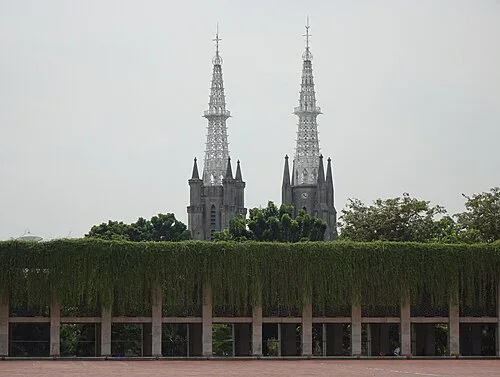 Interfaith Harmony Promenade
The Mosque Wall and the Cathedral Spires
The twin spires of Jakarta Cathedral rise just beyond the mosque wall, close enough to share a frame with the minaret. Sukarno chose this placement deliberately, as the citadel story told; what followed from it is the point here. The two communities built a physical link: the Terowongan Silaturahmi, the Tunnel of Friendship, connecting Istiqlal Mosque with the Cathedral of St. Mary of the Assumption. Work began with hopes of finishing before Ramadan in 2020, and the tunnel was finally inaugurated in December 2024 by President Prabowo Subianto. Small gestures happen above ground as well. At Christmas, when cathedral crowds overflow, the mosque lends its parking space to Christian worshippers. In September 2024 Pope Francis visited, and together with Grand Imam Nasaruddin Umar he signed the Istiqlal Declaration on interfaith harmony and care for the environment. The Pope called this mosque concrete proof of religious moderation in Indonesia. A mosque and a cathedral face each other across one square, joined underneath by a tunnel called Friendship.
Listen in the appMichael Coghlan · CC BY-SA 4.0
Istiqlal Mosque, Jakarta
Frequently asked questions
How much does the guide cost?
Free app download. Listed guide price: $0.99. Guide price shown in the app. Audio guide only. Venue admission is separate.
Can I listen without internet?
Yes. Download the guide’s audio, images, and maps in the app before your visit. Your downloaded content is then available offline.
Can I listen in my language?
This audio guide is available in 15 languages, including English.
Do I need to follow a schedule?
No. This is a self-guided experience. Choose your stops, pause whenever you like, and return to a story at your own pace.
At your own pace
Explore Istiqlal Mosque, Jakarta.
Download Stanza, then search for “Istiqlal Mosque, Jakarta”.
Free app download · Guide price shown in the app
Keep exploring
Audio guides — Indonesia
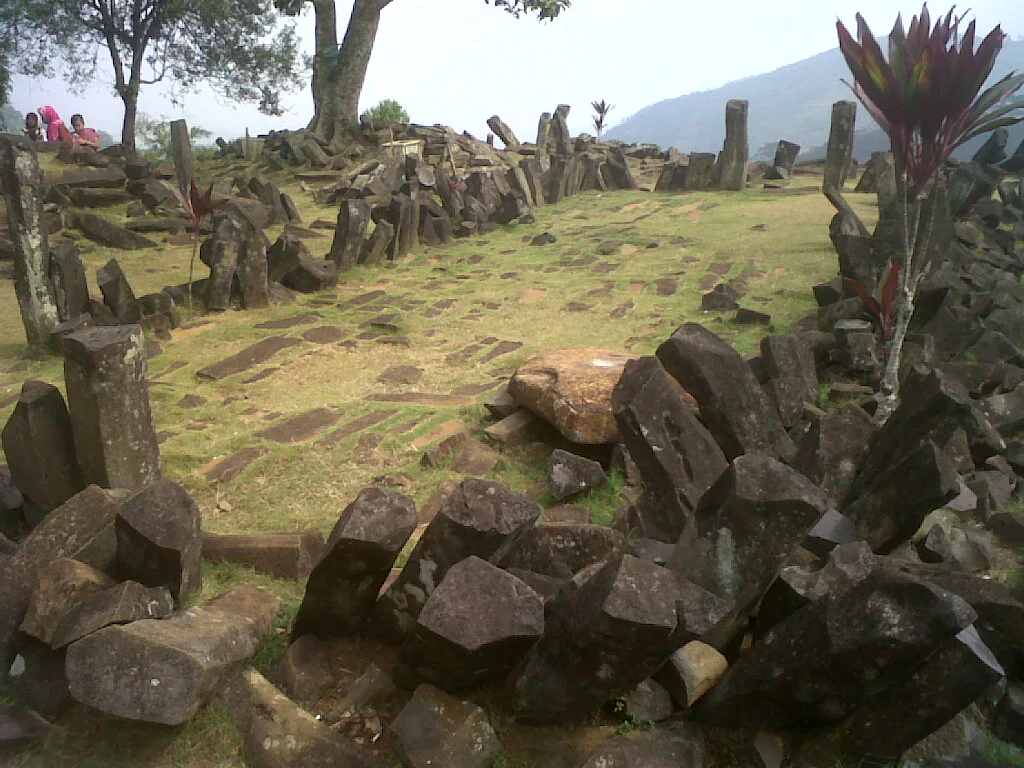
Cianjur · 95 km
Gunung Padang
Content & sources
Mohammad Fadli · CC BY-SA 3.0
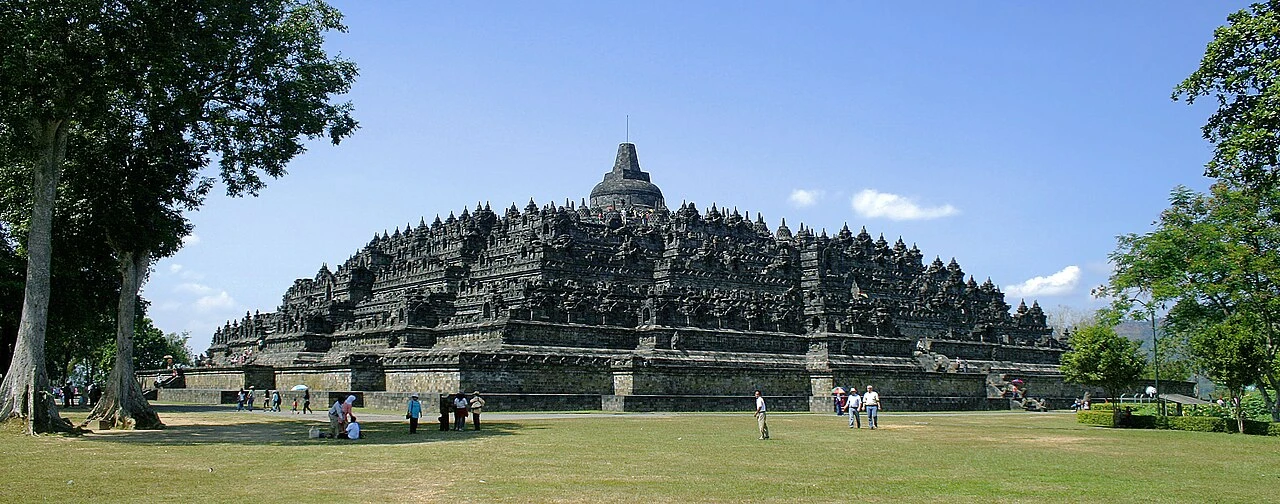
Desa Borobudur
Borobudur
Content & sources
Gunawan Kartapranata · CC BY-SA 3.0
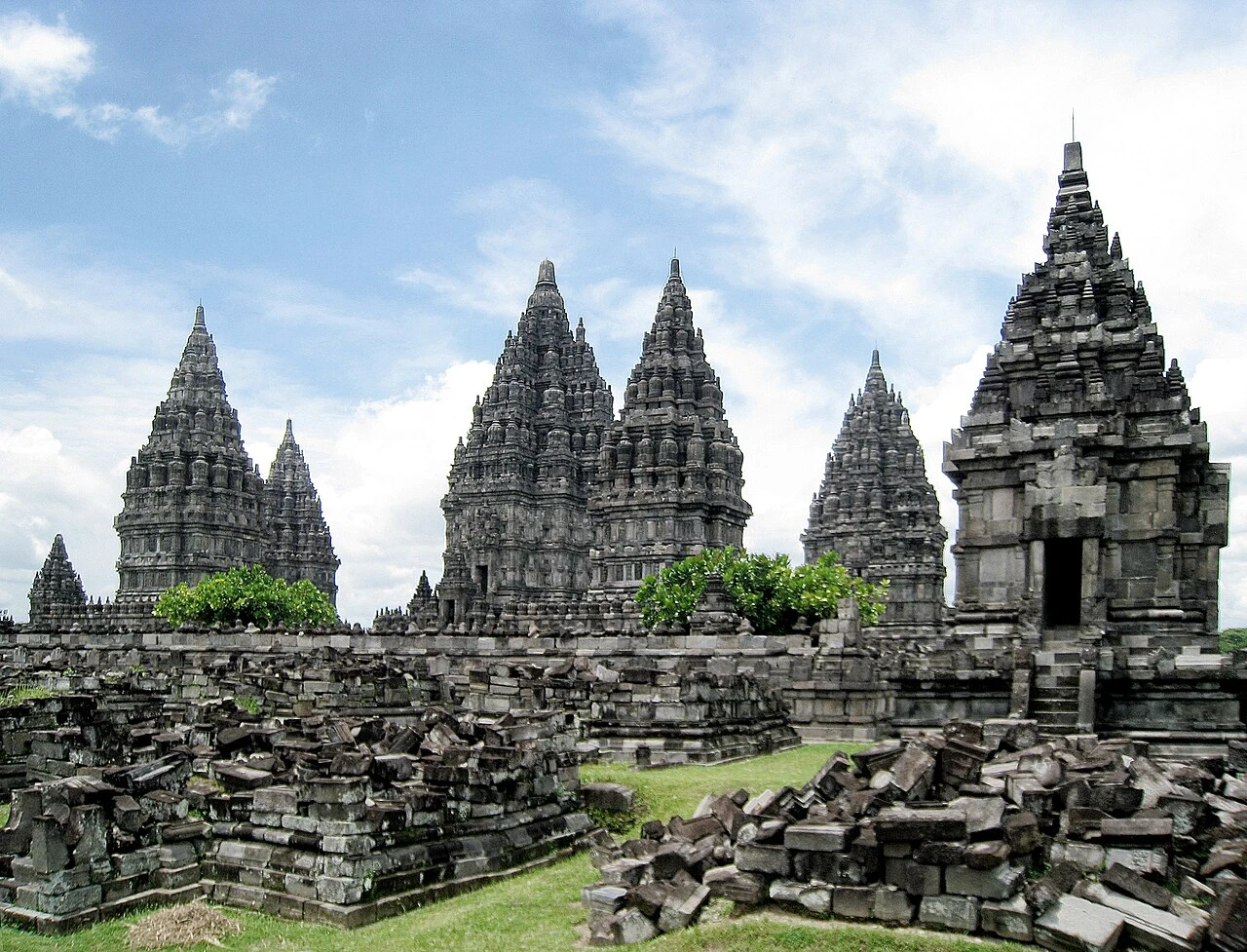
Bokoharjo
Prambanan Temple
Content & sources
Gunawan Kartapranata · CC BY-SA 3.0
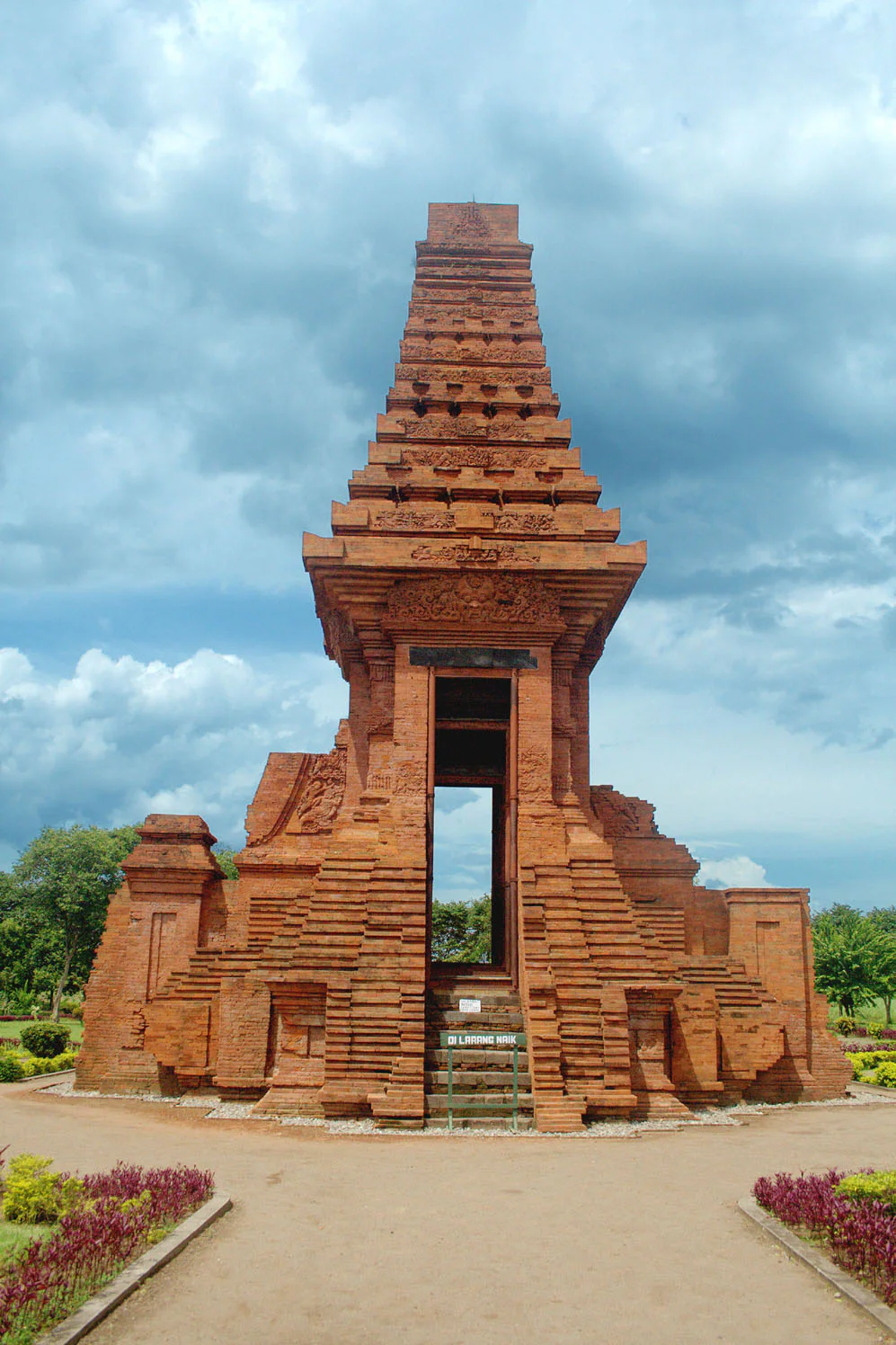
Bejijong
Trowulan
Content & sources
Gunawan Kartapranata · CC BY-SA 3.0