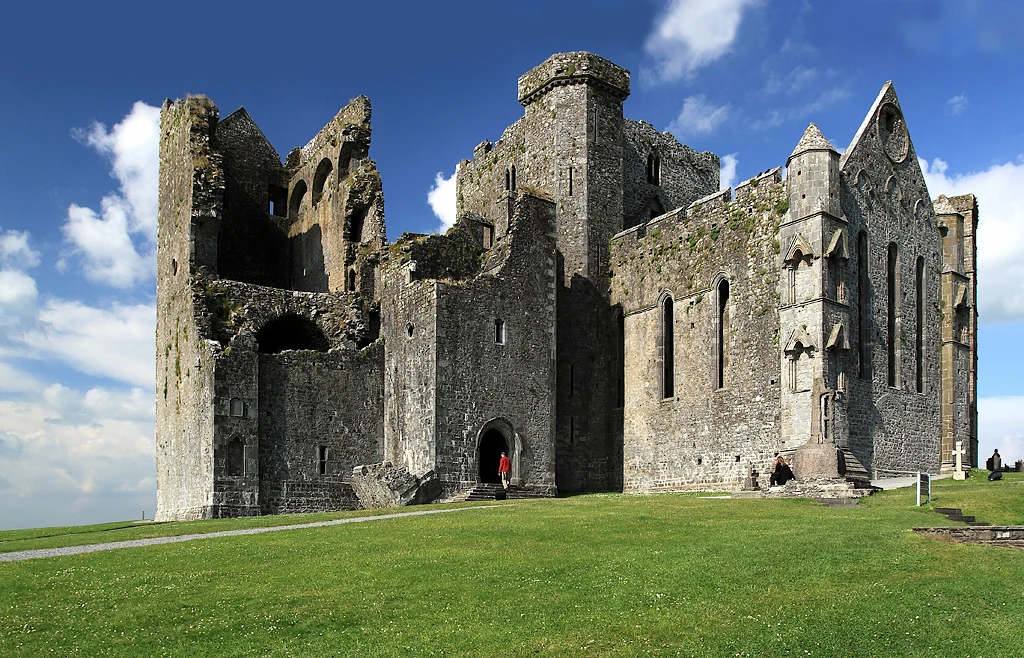
Stanza · Audio guide
Rock of Cashel Audio Guide
A place to remember. A story to take with you.
The Rock of Cashel is a historic site featuring a collection of medieval ecclesiastical buildings, including a 12th-century round tower, a high cross, and a Romanesque chapel. It served as the traditional…
Download Stanza, then search for “Rock of Cashel”.
About the tour
One guide. Your kind of visit.
The Rock of Cashel is a historic site featuring a collection of medieval ecclesiastical buildings, including a 12th-century round tower, a high cross, and a Romanesque chapel. It served as the traditional seat of the Kings of Munster for several centuries.
Ready when you are.
- 01Get the free Stanza app.
iOS & Android
- 02Find your guide.
“Rock of Cashel”
- 03Download before you go.
Works offline
Audio guide / 14 narrated stops
Inside the guide
Get to know a few of the stories before you go. Open a stop to read more.
01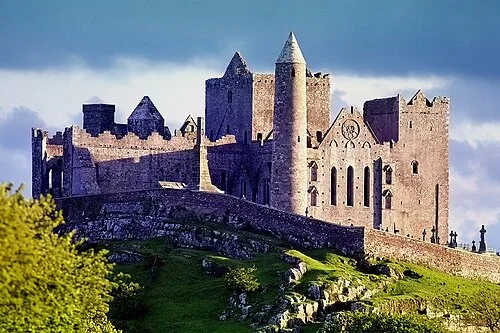 The Citadel of Munster Kings & Hall of the Vicars Choral
The Rock of Cashel: Citadel of the Kings of Munster
Welcome to the Rock of Cashel, a limestone outcrop rising sheer from the Tipperary plain. For centuries this was the seat of the kings of Munster. In the fifth century the Eóganachta clan built their fortress here and held supremacy over the region for hundreds of years. In 977 a man named Brian Boru was crowned king on this rock, and he made Cashel his capital. He would go on to become the most famous high king in Irish history. The decisive change came in 1101. King Muirchertach Ua Briain gave his fortress on the Rock to the Church, and a royal capital became an ecclesiastical citadel. Local legend ties the place to Saint Patrick himself. The story goes that Patrick banished the Devil from a cave in a mountain thirty kilometres north, and the Rock landed here where it stands. The same mountain is called the Devil's Bit, bitten out of its summit. An old life of Patrick also makes Cashel the place where he converted the King of Munster. What you see today is mostly the twelfth and thirteenth centuries: a chapel, a great cathedral, a round tower and a hall. Each one has its own story ahead.
Eddi Laumanns aka RX-Guru · CC BY-SA 3.0
02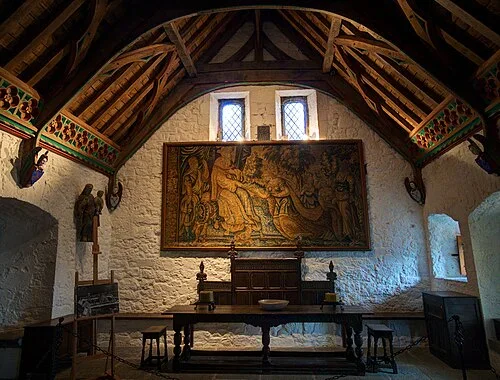 The Citadel of Munster Kings & Hall of the Vicars Choral
The Hall of the Vicars Choral
This hall, built in the fifteenth century, was the last major building added to the Rock. It belonged to the vicars choral, the men whose job was to sing the cathedral services. They were laymen, appointed to carry the chanting so the clergy could officiate. At Cashel there were originally eight of them, and they had their own corporate seal, a sign of real standing. Later the group shrank to five honorary vicars. They hired singing-men to do the actual work in their place, and that arrangement carried on until 1836. The hall was restored by the Office of Public Works for European Architectural Heritage Year in 1975. Today visitors enter the whole site through this building. The high timber roof gives a sense of how the singing men's quarters once felt.
Photo: Rob Hurson · CC BY-SA 4.0
03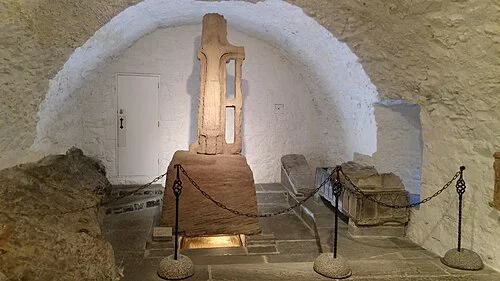 Saint Patrick's Cross & Inauguration Site
Saint Patrick's Cross: The Original
Saint Patrick's Cross is one of the oldest treasures on the Rock, carved in the twelfth century. It stands more than two metres tall, cut from sandstone. Nine centuries of Irish weather have worn the carving soft, blurring the figure and the detail. That slow erosion is why the original now lives indoors. This whitewashed vaulted undercroft shelters it, along with stone coffins set out nearby. The cross you may have seen standing outside, in front of the cathedral, is a replica. The original was moved in to save what carving remains. Even weathered, its unusual outline still reads clearly against the pale walls: no ring around the head, as most Irish high crosses have, and a stone upright bracing one arm.
Listen in the appPhil Champion · CC BY-SA 2.0
04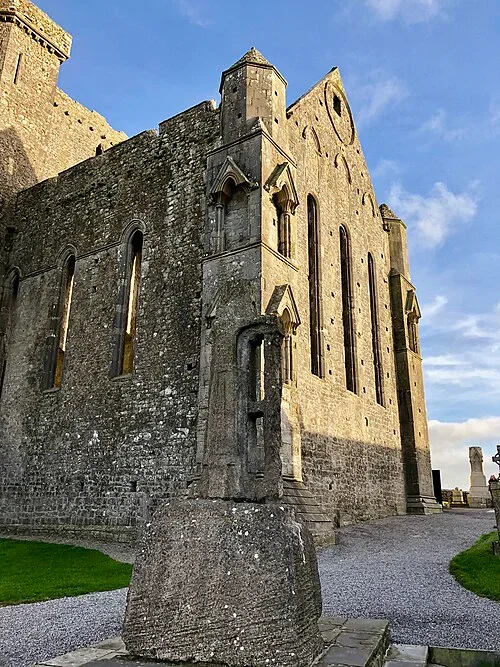 Saint Patrick's Cross & Inauguration Site
The Cross Base Beneath the Cathedral Walls
Outside, a replica of Saint Patrick's Cross stands on a massive stone base in front of the cathedral's south side. This is where the original once stood. The base is a great tapering block, far broader than the slender cross it carries. From here the cathedral's south wall rises straight up, and the corner turret climbs above it. The scale is worth noting. A tall cross barely reaches the first window sills of the Gothic masonry behind it. This spot sits at the edge of the cathedral's ground, and Cormac's Chapel is the next part of the story.
Listen in the appWarren LeMay from Covington, KY, United States · CC0
05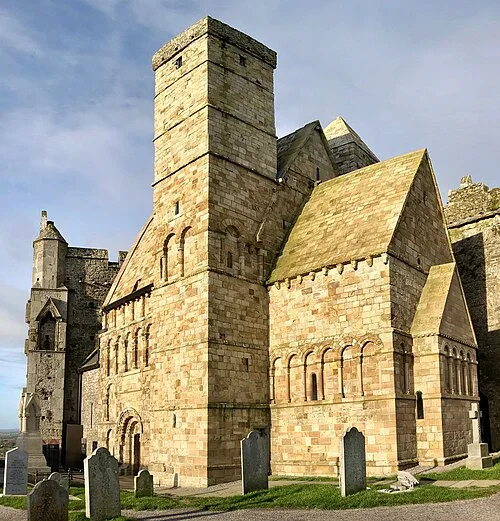 Cormac's Chapel: Hiberno-Romanesque Architecture
Cormac's Chapel: Hiberno-Romanesque Masterpiece
Cormac's Chapel is the architectural jewel of the Rock. King Cormac Mac Carthaigh commissioned it, and the work began in 1127. It was consecrated seven years later, in 1134. The building blends European Romanesque architecture with distinctively Irish elements, so completely that scholars give the style its own name: Hiberno-Romanesque. The twin towers flanking the junction of nave and chancel tell the continental part of the story. An Irish abbot named Dirmicius, living in the German city of Regensburg, sent two of his carpenters to help with the work. Towers like these are otherwise unknown in Ireland, and their Germanic character is hard to miss. The steep stone roof, the barrel-vaulted ceilings and the arcading running along the outside walls all belong to the same sophisticated design. Gravestones lean in the grass at its base, as they have for a long time.
Listen in the appWarren LeMay from Covington, KY, United States, stitched by Borvan53 · CC0
06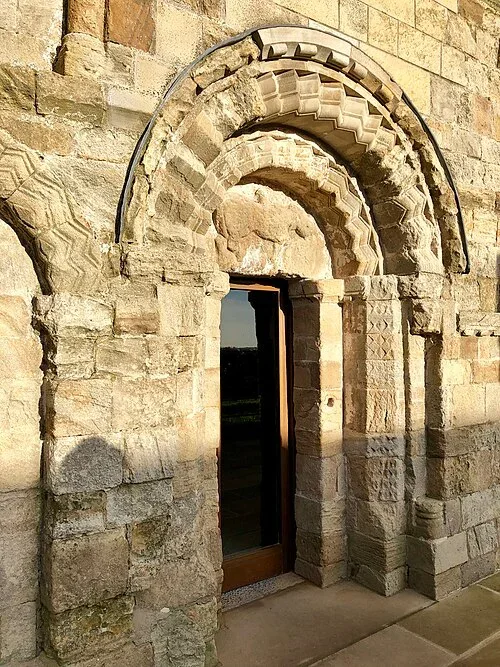 Cormac's Chapel: Hiberno-Romanesque Architecture
The Carved North Portal
The north doorway of Cormac's Chapel is a magnificent carved portal. Its power comes from layering. Order after order of chevron moulding, the sharp Romanesque zigzag, rings the arch in deep concentric bands. Each layer steps back from the last, pulling the eye inward toward the door itself. Above the opening sits a carved tympanum, the semicircular stone that fills the arch. The capitals and the jambs down the sides carry their own patterns, worked into the golden sandstone. Carved tympana like this one were placed over both of the chapel's doorways, and arcading decorates the building inside and out. This doorway shows how much skill the chapel's twelfth-century masons commanded.
Listen in the appWarren LeMay from Covington, KY, United States · CC0
07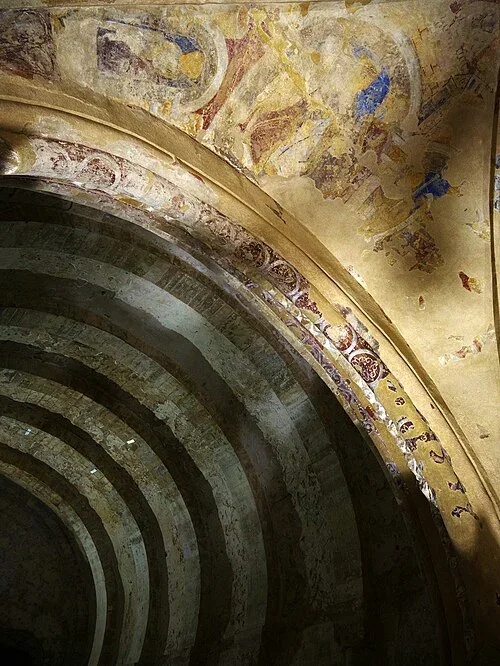 Cormac's Chapel: Frescoes & Viking Sarcophagus
Ireland's Only Romanesque Frescoes
Inside Cormac's Chapel survive the only Romanesque frescoes in Ireland. Over the arch, faint reds and blues and ochres still glow where paint has clung to the stone. Whole areas have flaked away, which makes what remains all the more precious. The paint's enemy was water. The chapel was built mainly of sandstone, and over the centuries that stone soaked up moisture like a sponge. The damp worked through the walls and badly damaged the frescoes. Saving them called for drastic measures. Conservators enclosed the entire chapel in a rain-proof shell and ran dehumidifiers inside to draw the water out of the stone, slowly and safely. That treatment is why access to the chapel today is limited, with tours kept small and controlled. What survives of the paint is still fragile.
Listen in the appPhoto: Rob Hurson · CC BY-SA 4.0
08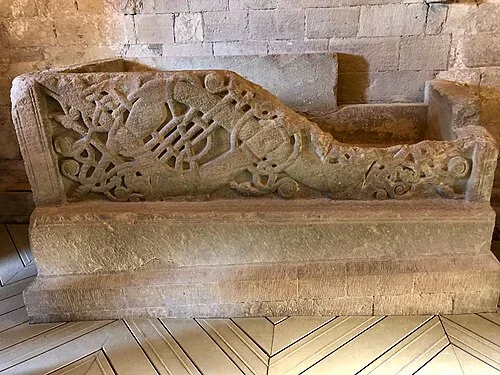 Cormac's Chapel: Frescoes & Viking Sarcophagus
The Carved Sarcophagus of Cormac's Chapel
Inside the chapel sits a stone sarcophagus, its front covered in deep carving. Animals and knots of interlace wind across the slab, each line woven through the next in the manner of early medieval Irish stonework. Art historians compare this style of interlaced animal carving to Scandinavian work of the same period, though the tomb's exact date and its occupant remain open questions. What is certain is how rare such carving is. Most early medieval stone sculpture in Ireland has been lost or worn away. Here, sheltered within the chapel walls, an entire sculptural programme has survived: the tomb, the doorway and the painted walls all in one building.
Listen in the appWarren LeMay from Covington, KY, United States · CC0
09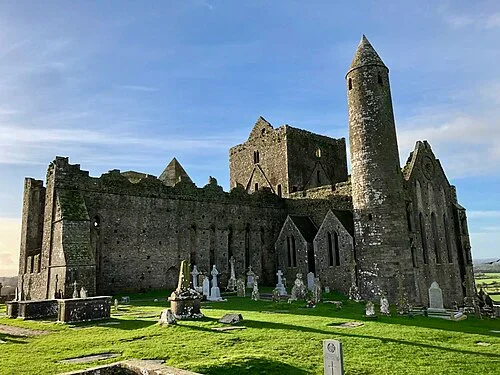 The Gothic Cathedral & Archbishop's Castle
The Gothic Cathedral of 1235-1270
The great cathedral took thirty-five years to build, from 1235 to 1270. Its plan tells you what it had to be. It is a cruciform church with a central tower, and at its west end a massive residential tower house. Church and fortress in one building, exactly what an archbishop's citadel required. Its darkest day came in 1647, during the Irish Confederate Wars. English Parliamentarian troops under Murrough O'Brien, Earl of Inchiquin, stormed the Rock. The Confederate soldiers defending it were killed, as were the Catholic clergy who had taken refuge in the cathedral. Among the dead was Theobald Stapleton, a Catholic priest. The troops looted or destroyed many important religious artefacts. It remains one of the most notorious events in the site's history.
Listen in the appWarren LeMay from Covington, KY, United States · CC0
10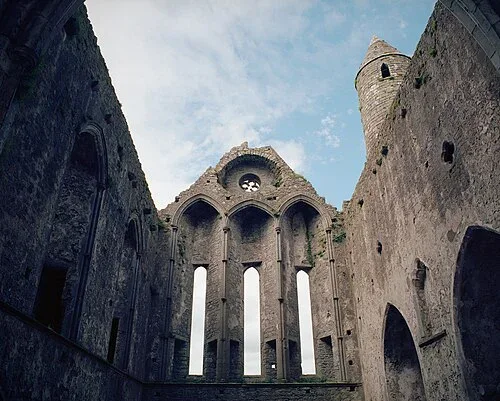 The Gothic Cathedral & Archbishop's Castle
The Roofless Nave: Open to the Sky
The cathedral's tall Gothic windows now frame nothing but sky. The building was not ruined by war or by age. It was ruined by a decision. Around 1749 Arthur Price, the Anglican Archbishop of Cashel, had the roof removed. What had been called the jewel among Irish church buildings was left open to the weather, and decay followed. Price's decision was criticised at the time, and it has been criticised ever since. Once the roof was gone, the weather did the rest, and the interior emptied out. What remains is a shell of magnificent thirteenth-century masonry, the arches and windows still standing in their full shape.
Listen in the appPhoto: Rob Hurson · CC BY-SA 4.0
- 11
The Round Tower: Oldest on the Rock
The Rock's oldest and tallest building, a dry-stone round tower from about 1100.
- 12
The Tower Doorway Above the Ground
Why the tower's doorway hangs nearly four metres above the ground.
- 13
Scully's Cross, Felled by Lightning
Scully's Cross, raised in 1860 and brought down by a single lightning strike in 1976.
- 14
The Walled Plateau and the Golden Vale
The walled plateau, its crowded graveyard, and the view over the Golden Vale that explains everything.
Rock of Cashel
Frequently asked questions
How much does the guide cost?
Free app download. Listed guide price: $1.99. Guide price shown in the app. Audio guide only. Venue admission is separate.
Can I listen without internet?
Yes. Download the guide’s audio, images, and maps in the app before your visit. Your downloaded content is then available offline.
Can I listen in my language?
This audio guide is available in 15 languages, including English.
Do I need to follow a schedule?
No. This is a self-guided experience. Choose your stops, pause whenever you like, and return to a story at your own pace.
At your own pace
Explore Rock of Cashel.
Download Stanza, then search for “Rock of Cashel”.
Free app download · Guide price shown in the app
Keep exploring
Nearby audio guides
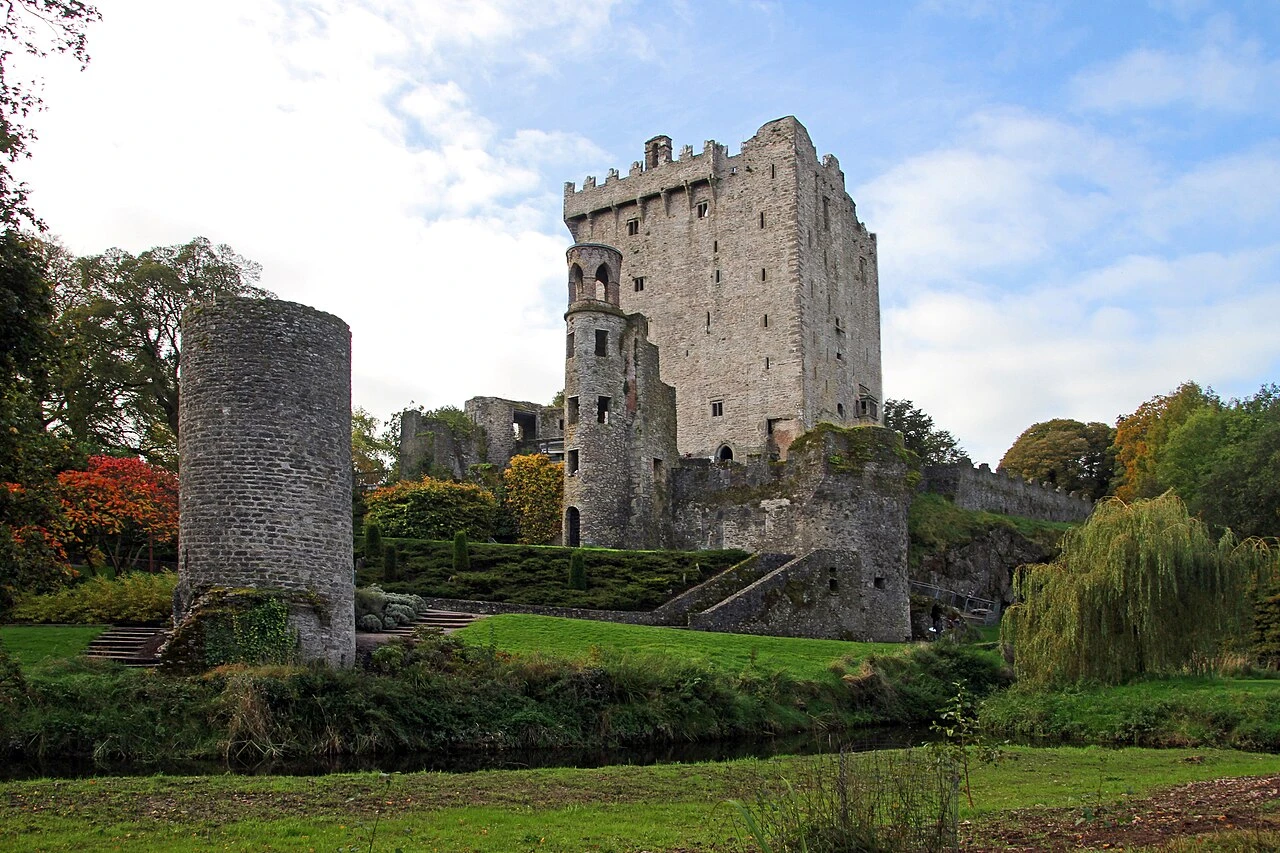
Cork · 80 km
Blarney Castle
Content & sources
Photo: Gerd Eichmann · CC BY-SA 4.0
County Wicklow · 118 km
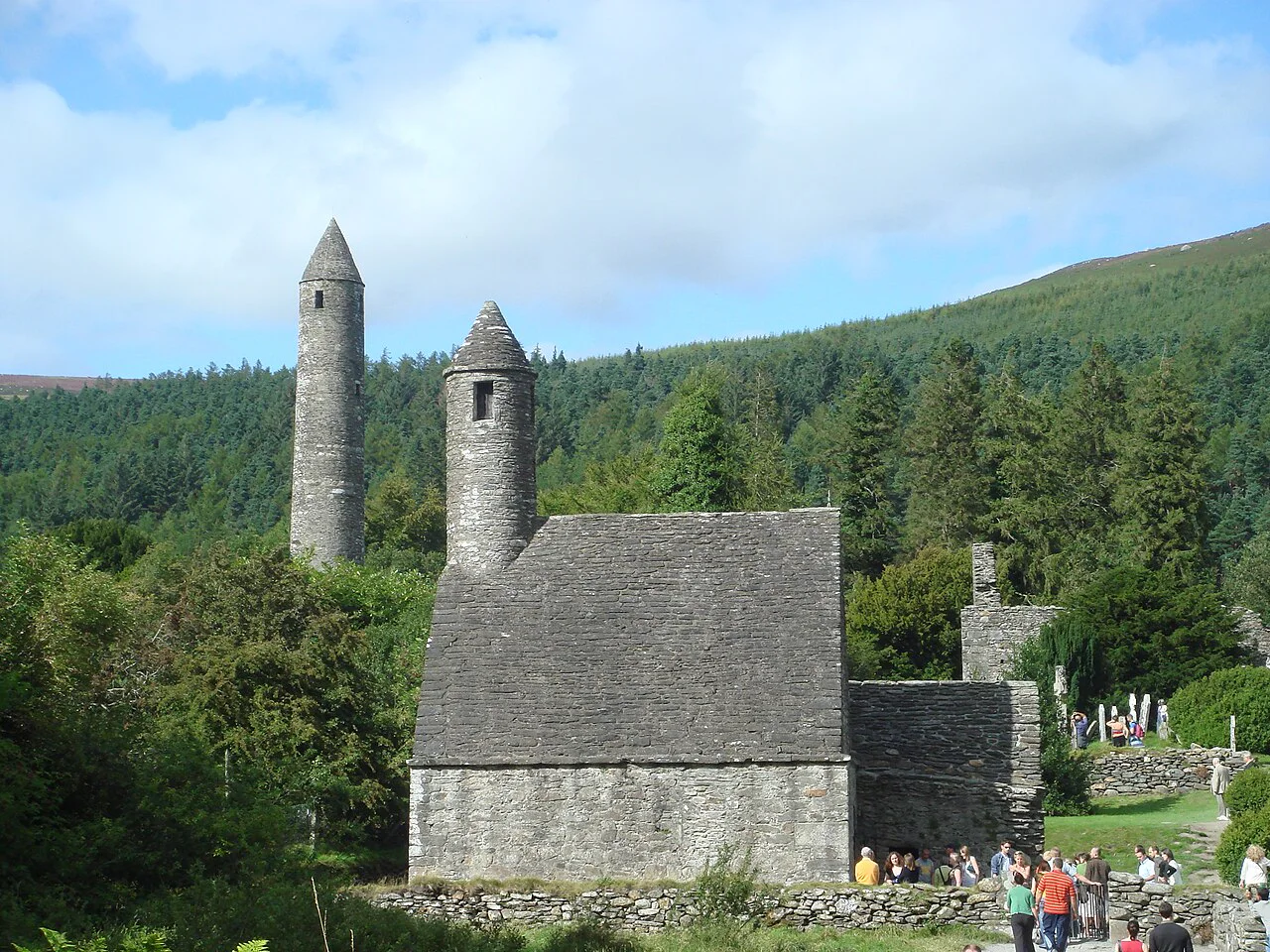
Glendalough
Content & sources
Schcambo at English Wikipedia · CC BY 3.0
Dublin · 142 km
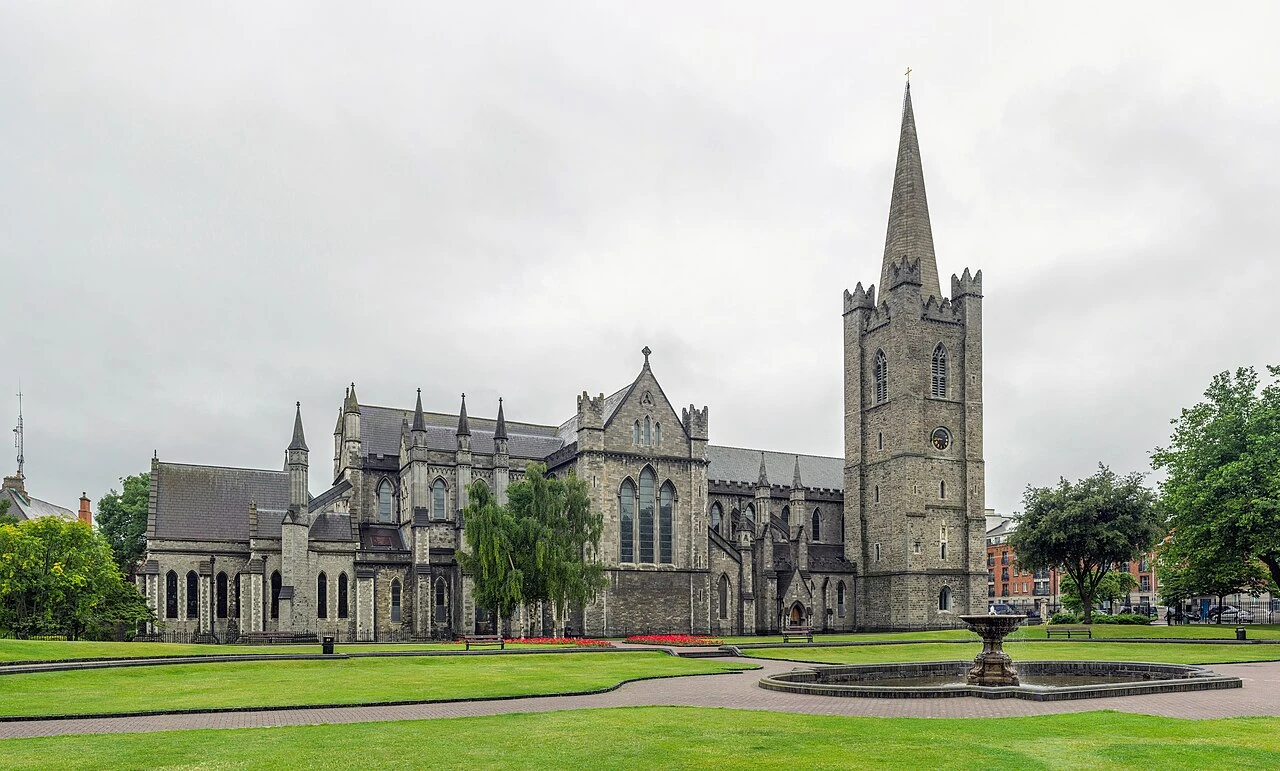
St. Patrick's Cathedral
Content & sources
Photo: Diliff · CC BY-SA 3.0
Dublin · 142 km
Dublin Castle
Content & sources
Photo: FoekeNoppert · Public domain