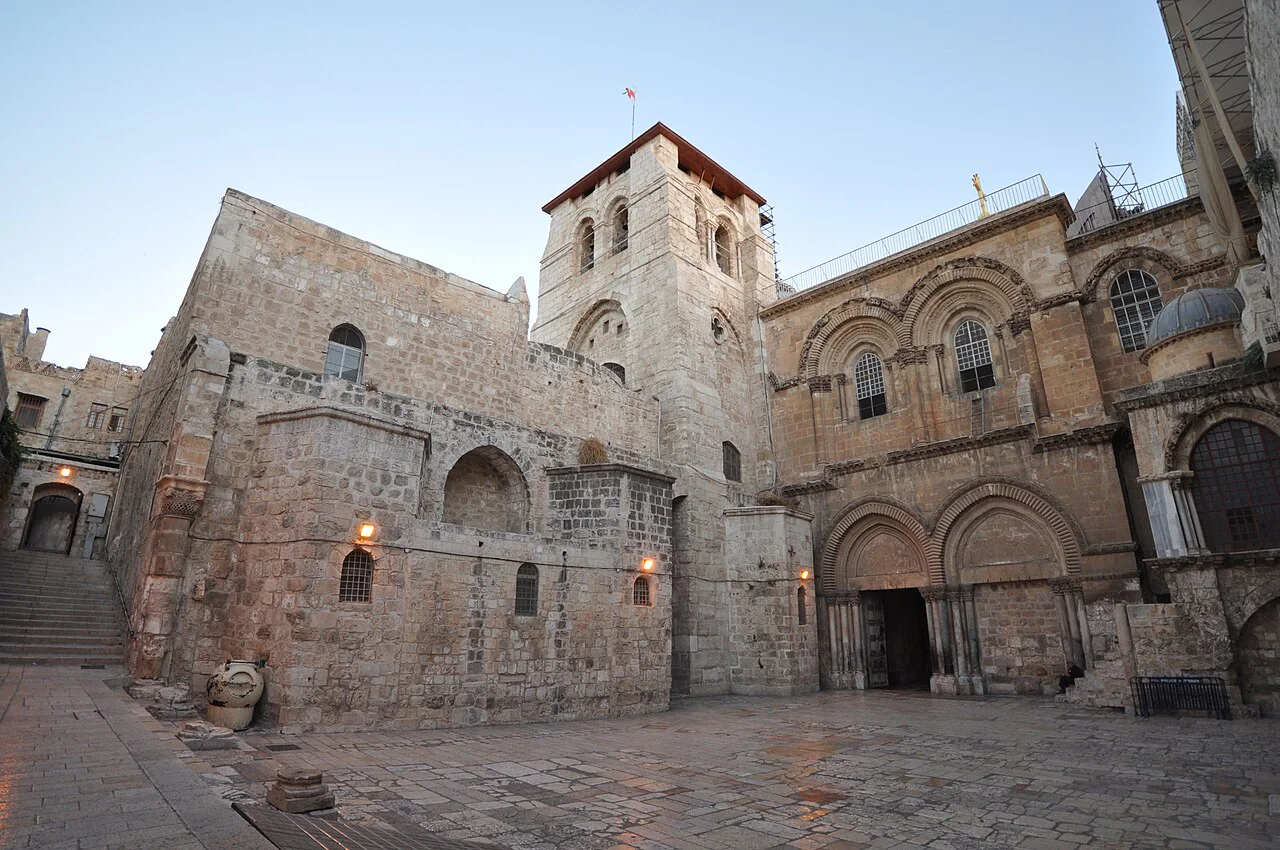
 Stanza / Audio guide
Content & sources
Stanza · Audio guide
Church of the Holy Sepulchre Audio Guide
A place to remember. A story to take with you.
The Church of the Holy Sepulchre is a fourth-century church located in the Christian Quarter of the Old City of Jerusalem. It is considered the holiest site in Christianity and has served as an important…
Download Stanza, then search for “Church of the Holy Sepulchre”.
About the tour
One guide. Your kind of visit.
The Church of the Holy Sepulchre is a fourth-century church located in the Christian Quarter of the Old City of Jerusalem. It is considered the holiest site in Christianity and has served as an important pilgrimage destination since the fourth century.
Ready when you are.
- 01Get the free Stanza app.
iOS & Android
- 02Find your guide.
“Church of the Holy Sepulchre”
- 03Download before you go.
Works offline
Audio guide / 14 narrated stops
Inside the guide
Get to know a few of the stories before you go. Open a stop to read more.
01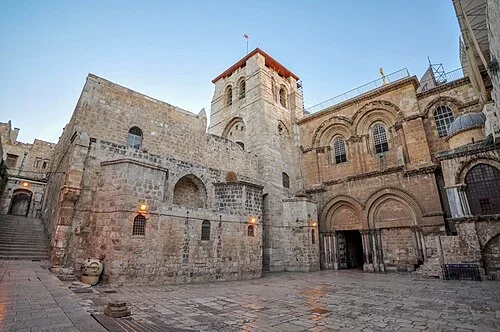 The Parvis Courtyard and Crusader Facade
The Parvis and the Crusader Facade
Welcome to the Church of the Holy Sepulchre, where most Christians locate both the crucifixion of Jesus and his empty tomb. The building's story begins with the emperor Hadrian, who around the year 135 covered the spot with a temple to Aphrodite. About 326, Constantine ordered the temple torn down and a church raised instead. As the old soil was cleared away, a rock-cut tomb came to light, and the bishop Macarius identified it as the burial place of Jesus. The great portal of the church is Crusader work from the twelfth century, one late chapter of that much longer story. Its original carved lintels now sit in the Rockefeller Museum, the mosaics that once filled its tympanums are gone, and nothing survives of the first doors. Reaching the church means threading a narrow, winding route through the streets of the Muristan, and that squeeze has turned dangerous before. When fire broke out in 1840, dozens of pilgrims were trampled to death in the crush. Only the left-hand doorway is open today; the right has long been bricked up.
Jorge Láscar from Australia · CC BY 2.0
02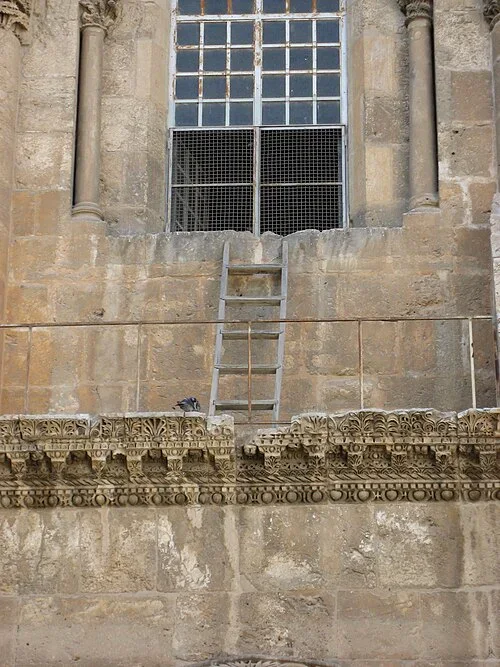 The Parvis Courtyard and Crusader Facade
The Immovable Ladder
A short wooden ladder leans against the upper window of the facade, and it has stood there since before 1728. Nobody knows who first placed it or why. It survives because of an arrangement called the Status Quo, which governs this whole church. An Ottoman decree of 1757 froze the rights of the communities here, and a firman of Sultan Abdülmecid the First in the early 1850s pinned the rules down for good. Everything was to remain in its present state, and even the smallest change now needs the consent of all sides. Six communities share the building: the Roman Catholics, Greek Orthodox, Armenian Apostolics, Copts, Syriacs and Ethiopian Orthodox. The rules are taken seriously. In 2002 a Coptic monk shifted his chair a short way into the shade, and the dispute that followed sent eleven people to hospital. The ladder itself belongs to no one that all the rest will agree on, so there it stays.
Photo: Meron Shaban · CC BY-SA 3.0
03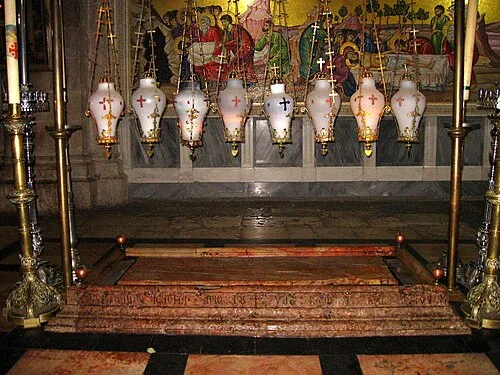 The Stone of Anointing
Just inside the entrance lies a long slab of reddish stone, one of the first things pilgrims meet. Tradition holds that here Joseph of Arimathea prepared the body of Jesus for burial. That identification, though, is an old one rather than an ancient one. It is first attested in the Crusader era, notably by the Italian Dominican pilgrim Riccoldo da Monte di Croce, who described it in 1288. The stone itself is younger still. The slab now in place was laid during the reconstruction of 1810. Pilgrims lean low over it to touch the surface, and the stone is polished smooth by all those hands. Behind it the wall carries the blue balconies and red banners of the Brotherhood of the Holy Sepulchre, hung with lamps.
Listen in the appPhoto: Adriatikus · CC BY-SA 3.0
04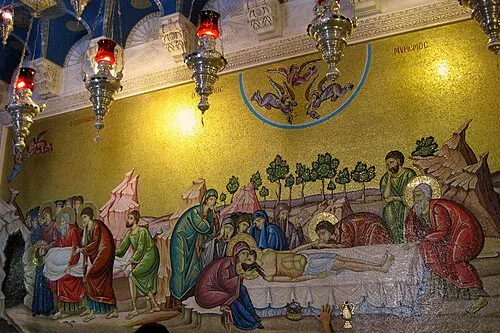 The Stone of Anointing
The Anointing Mosaic
The wall behind the anointing stone carries a modern mosaic that tells the story in three scenes. On the right, the Descent from the Cross, as the body is taken down. At the centre, the anointing of the body, the very act the slab below represents. On the left, the Burial. Read in order, the picture walks a pilgrim from the cross to the grave, the same journey the church itself makes from entrance to tomb. It is a lesson set in glass tesserae, preparing the visitor for the small shrine that waits deeper inside the building.
Listen in the appPhoto: Oleg Moro · CC BY-SA 3.0
05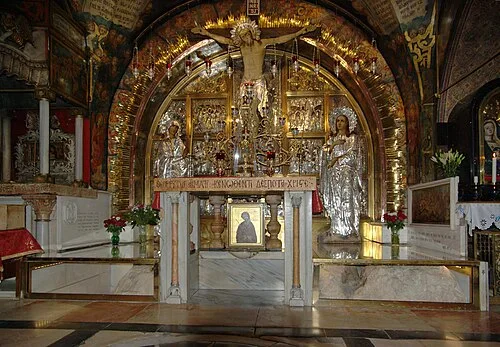 The Chapels of Golgotha
The Altar of the Crucifixion
A stairway just inside the entrance climbs to Calvary, the most lavishly decorated part of the whole church. Golgotha is divided here between two chapels, each with its own altar. The Greek Orthodox Altar of the Crucifixion stands directly over the rock, and through a hole in the floor beneath it pilgrims reach down to touch the bedrock itself. To the south stretches the Catholic Chapel of the Nailing to the Cross, the eleventh station of the Cross. Between the two sits the Catholic Altar of the Stabat Mater, with an eighteenth-century bust of the Virgin and a crowd of ex-votos, the small offerings left by the faithful. This church holds the final stations of the Via Dolorosa, and pilgrims still follow them up these stairs.
Listen in the appPhoto: Berthold Werner · CC BY-SA 3.0
06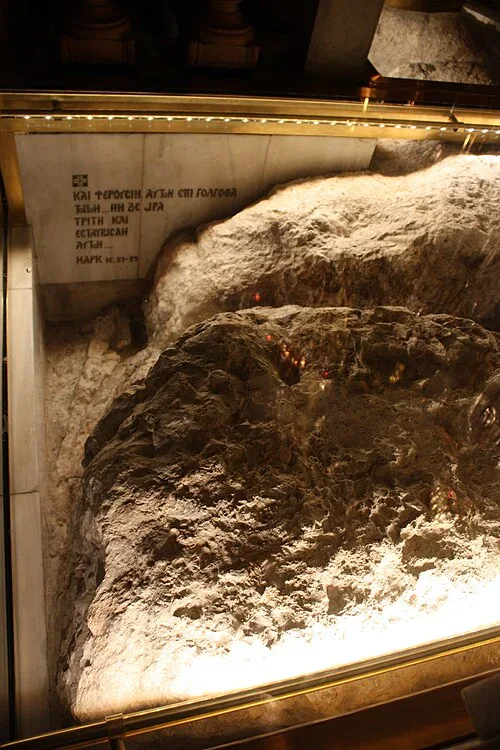 The Chapels of Golgotha
The Rock of Calvary
On both sides of the Orthodox altar, the rock of Calvary sits encased behind protective glass. What makes the outcrop remarkable is a decision made when the first church was built. The builders quarrying the site in Constantine's day cut away the softer stone all around it. They left this harder bedrock standing, so that the rock of the Crucifixion would be preserved inside the church rather than levelled with the rest. The building was raised around the rock, not over its ruins.
Listen in the appWknight94 talk · CC BY-SA 3.0
07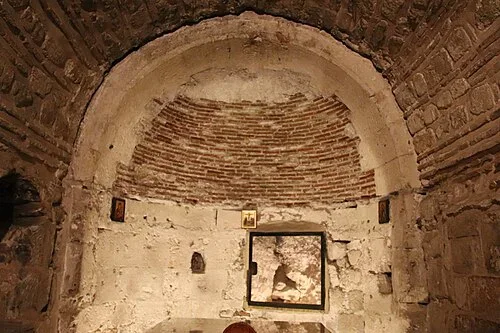 The Chapel of Adam
Directly beneath the Calvary chapel lies a low stone chapel named for Adam. Tradition says Jesus was crucified over the very place where Adam's skull was buried. Some tell it further: the blood of Christ ran down the cross and through the rocks to fill that skull. At the back of the eleventh-century apse, a window looks onto the rock of Calvary, and the rock carries a visible crack. Tradition holds the fissure was caused by the earthquake that followed Jesus's death. Some scholars read it differently, as the work of quarrymen cutting along a natural flaw in the stone. Both explanations are still offered at the same window.
Listen in the appGary Todd from Xinzheng, China · CC0
08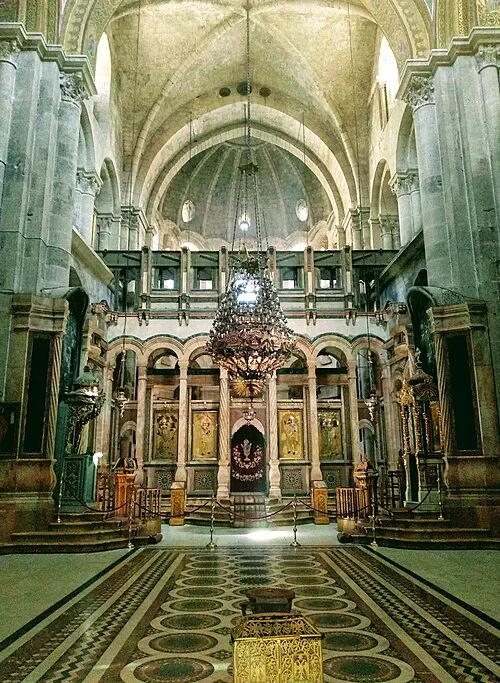 The Catholicon and Omphalos
The Catholicon
East of the rotunda opens the great Crusader nave, the catholicon, which houses the main altar of the church in Greek Orthodox hands today. An iconostasis screens the sanctuary behind it. Two episcopal thrones stand at its front, and the southern seat is the patriarchal throne of the Greek Orthodox Patriarch of Jerusalem. The northern seat is for an archbishop or bishop, though a popular claim that it belongs to the Patriarch of Antioch has since been dispelled. In the mid-seventeenth century the church received an unusual visitor. Evliya Çelebi, the renowned Ottoman traveller and a devout Muslim, admired its beautiful adornment yet found it lacking in spirituality, comparing it to something like a tourist attraction. After touring the building, he wrote that he performed two prostrations in a corner, and voiced the hope that it might one day become a Muslim place of worship.
Listen in the appPhoto: Fjmustak · CC BY-SA 4.0
09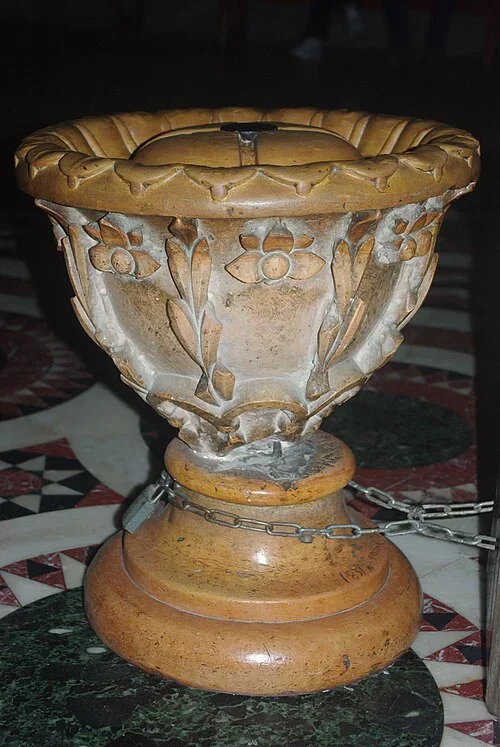 The Catholicon and Omphalos
The Omphalos Stone
Set into the floor of the transept crossing, beneath the catholicon's dome, is a carved stone vessel with a sculpted bowl. It is the omphalos, Greek for navel. The stone was once thought to mark the very centre of the world, the middle point of creation. Orthodox Christians still venerate it as such, bound up with the site of the Crucifixion and the Resurrection. The whole dome of the catholicon is set directly over this one spot.
Listen in the appSergey Serous · CC BY 3.0
10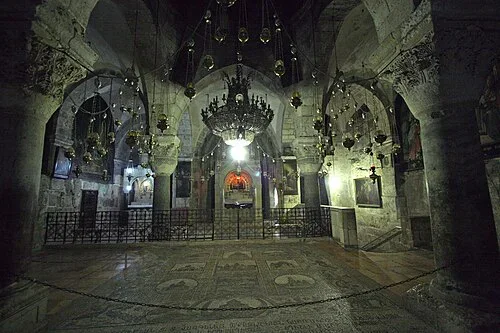 The Subterranean Chapel of Saint Helena
The Chapel of Saint Helena
Stairs descend between two small chapels, the Armenian Chapel of the Division of Robes and the Greek Chapel of the Derision, into an underground church. The Armenians own it and call it the Chapel of Saint Gregory the Illuminator, after the saint who brought Christianity to Armenia. Others name it for Helena, the mother of Constantine, and the legends that gathered here are strong ones. By the Crusader period, a cistern below was rumoured to be where Helena found the True Cross, and it began to be venerated as such. There is no evidence of that identification before the eleventh century, and investigation has dated the cistern itself to the repairs of Constantine the Ninth Monomachos. East of the chapel, excavators made a quieter discovery: a fourth-century drawing of a Roman pilgrim ship, low walls that once carried the platform of Hadrian's temple, and a higher fourth-century wall built for Constantine's basilica. The Armenians turned that space into the Chapel of Saint Vartan, reachable by permission.
Listen in the appzvonimir atletic · CC BY 2.0
- 11
The Pilgrims' Carved Crosses
A stone wall covered in small hand-carved crosses, each one left by a pilgrim who made the journey.
- 12
The Aedicule
The small shrine at the heart of the rotunda, its two rooms, and the reasons it looks as it does today.
- 13
The Dome of the Anastasis
The great dome of the Anastasis, the church's destruction in 1009, its rebuilding in 1048, and the fire ceremony that still fills the rotunda.
- 14
Inside the Tomb Chamber
Inside the tomb chamber itself: the marble-covered burial bed, what the 2016 investigation found beneath it, and the worship that continues there daily.
Church of the Holy Sepulchre
Frequently asked questions
How much does the guide cost?
Free app download. Listed guide price: $0.99. Guide price shown in the app. Audio guide only. Venue admission is separate.
Can I listen without internet?
Yes. Download the guide’s audio, images, and maps in the app before your visit. Your downloaded content is then available offline.
Can I listen in my language?
This audio guide is available in 15 languages, including English.
Do I need to follow a schedule?
No. This is a self-guided experience. Choose your stops, pause whenever you like, and return to a story at your own pace.
At your own pace
Explore Church of the Holy Sepulchre.
Download Stanza, then search for “Church of the Holy Sepulchre”.
Free app download · Guide price shown in the app
Keep exploring
Nearby audio guides
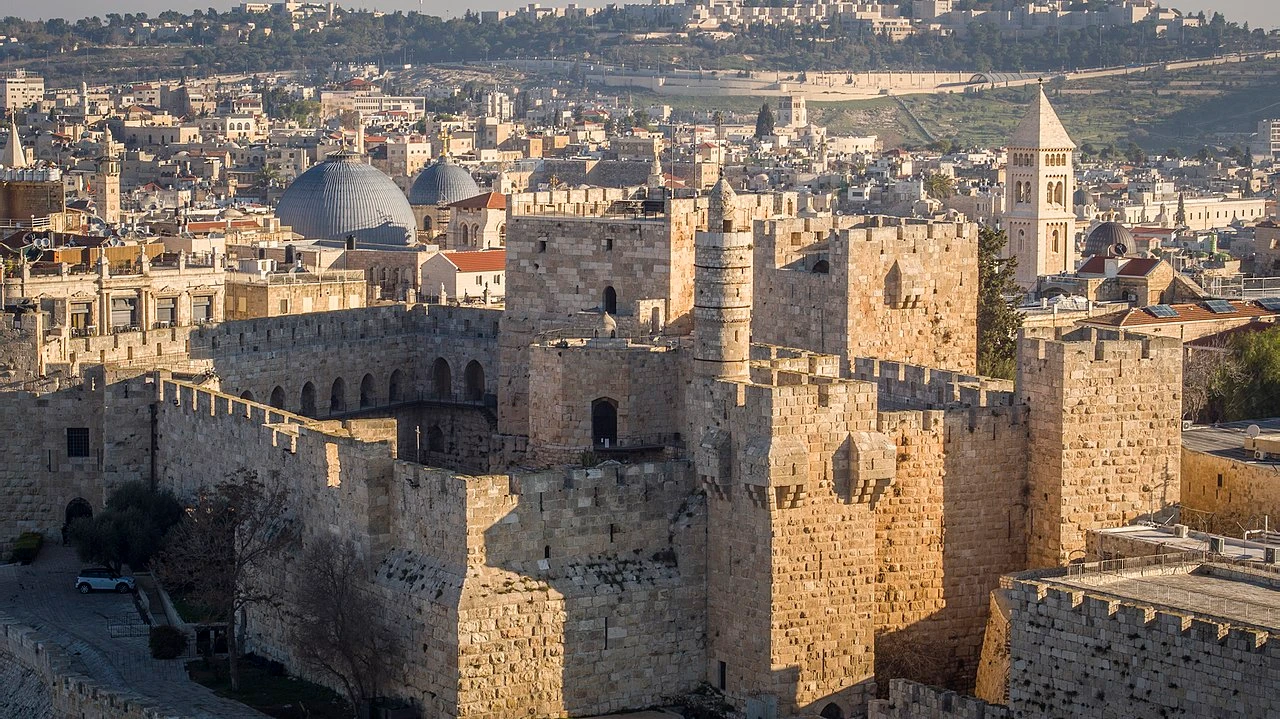
Jerusalem · 1 km
Tower of David
Content & sources
Photo: אורי אלוני · CC BY-SA 4.0
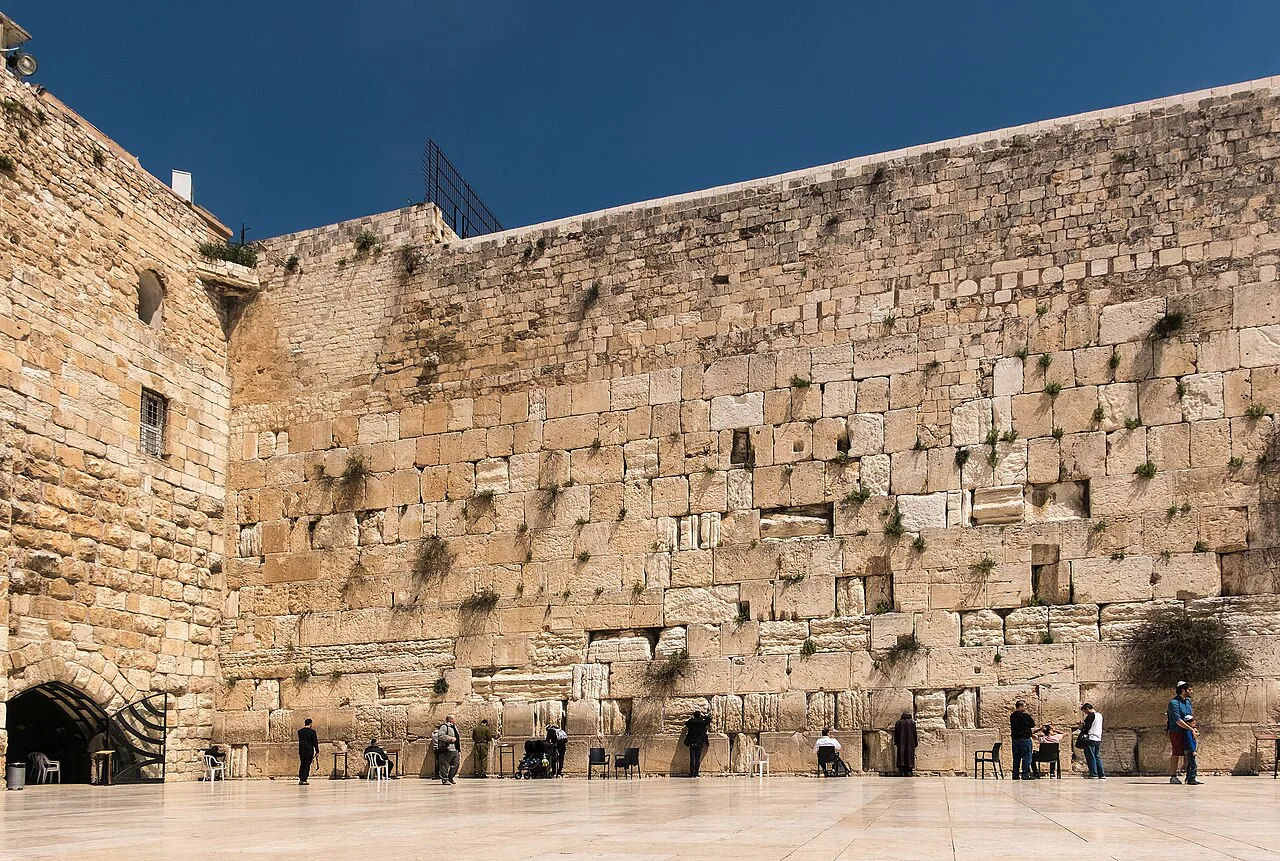
Jerusalem · 1 km
Western Wall
Content & sources
Photo: Ralf Roletschek · GFDL 1.2
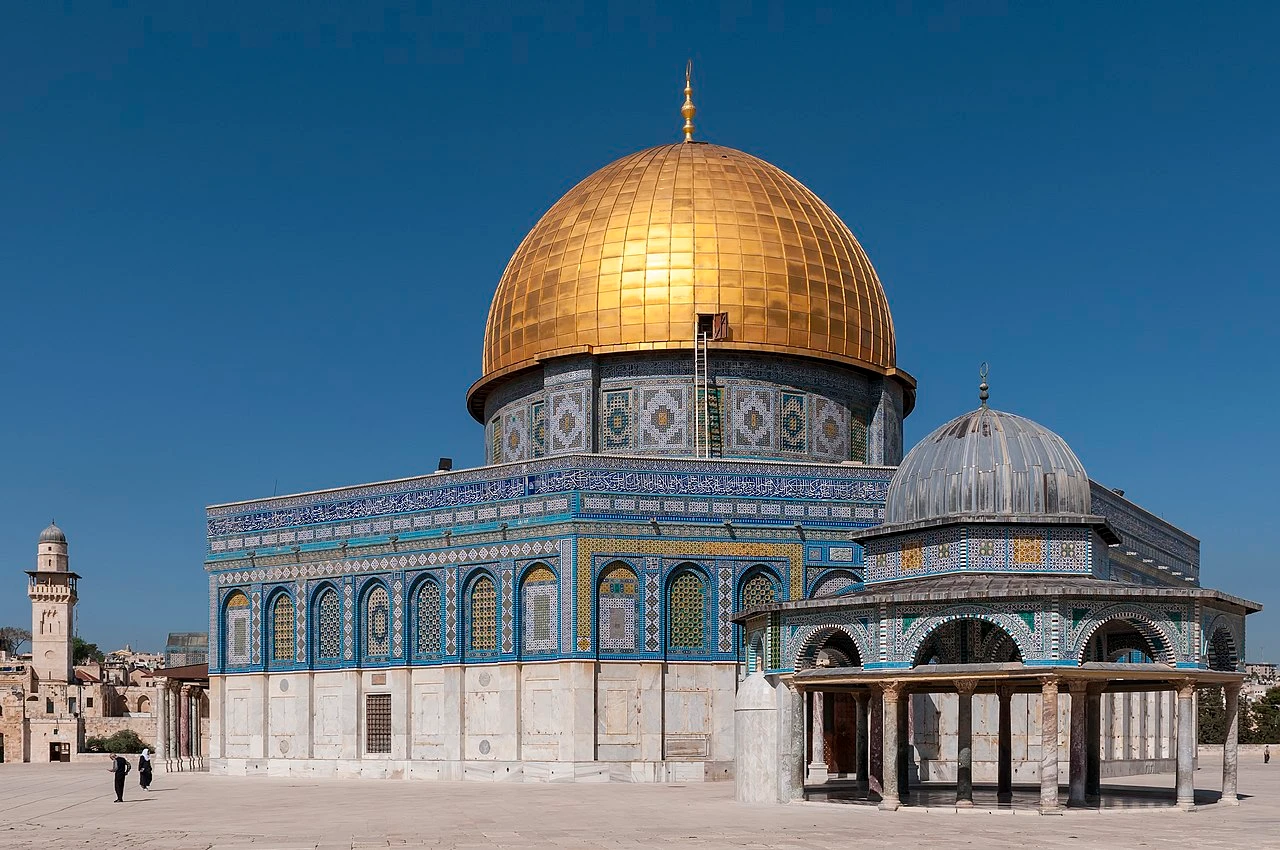
Jerusalem · 1 km
Dome of the Rock
Content & sources
Photo: Ralf Roletschek · GFDL 1.2
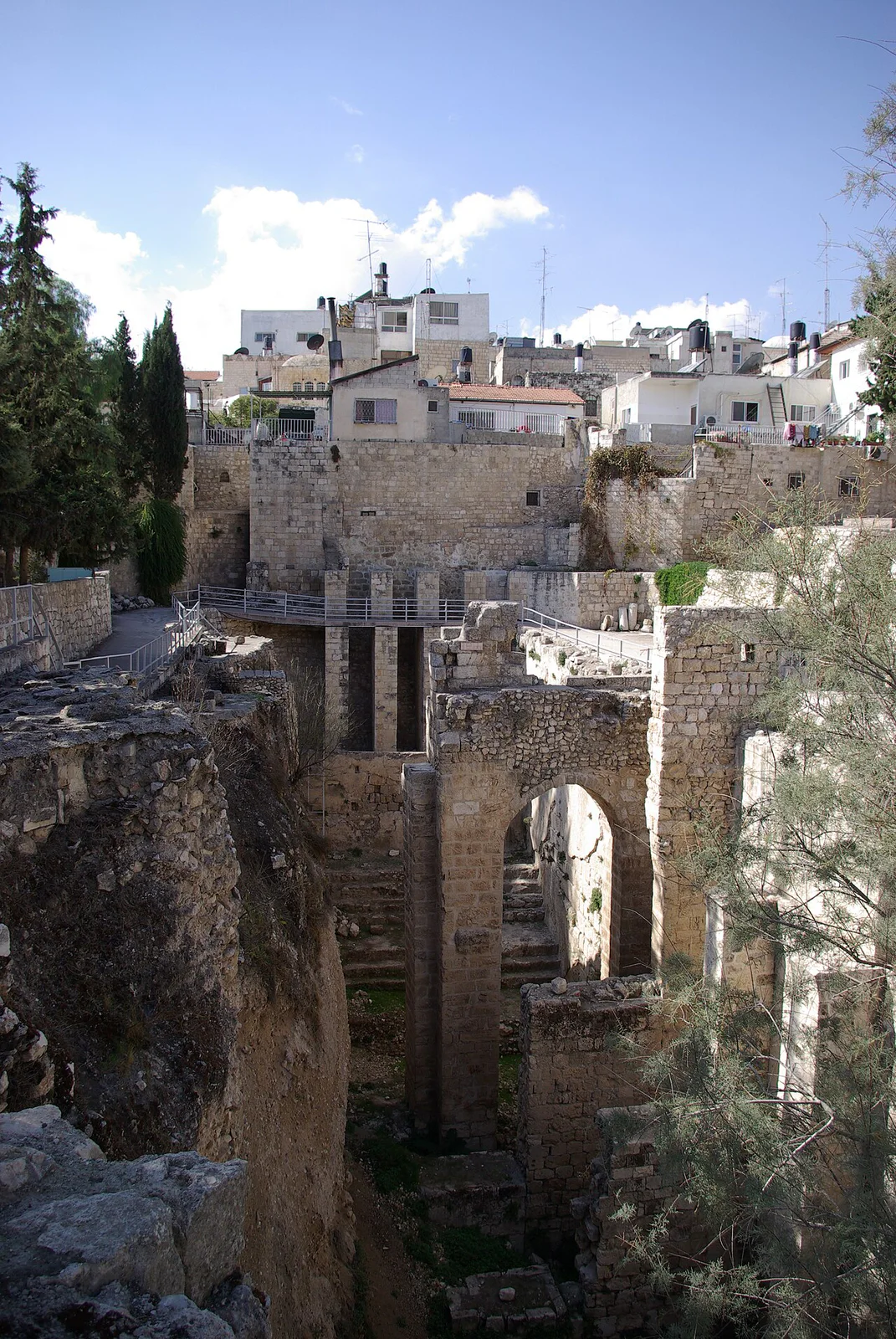
Jerusalem · 1 km
Pool of Bethesda
Content & sources
Photo: Berthold Werner · Public domain
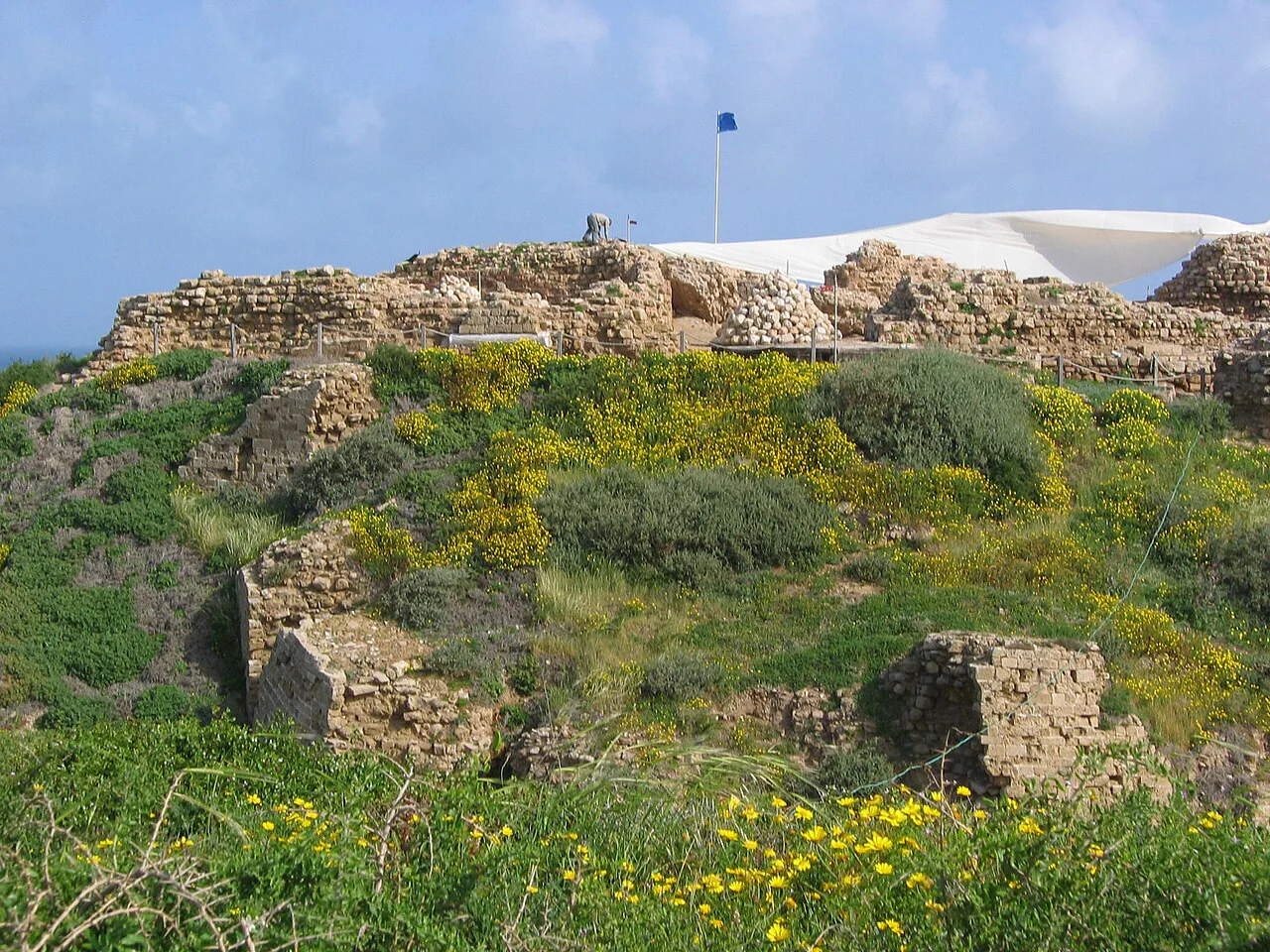
Herzliya · 61 km
Apollonia–Arsuf
Content & sources
Gilgamesh · CC BY-SA 3.0