Stanza · Audio guide
Duomo di Amalfi Audio Guide
A place to remember. A story to take with you.
Amalfi Cathedral is a medieval Roman Catholic cathedral located in the Piazza del Duomo in Amalfi, Italy. It is dedicated to the Apostle Saint Andrew, whose relics are kept within the building.
Download Stanza, then search for “Duomo di Amalfi”.
About the tour
One guide. Your kind of visit.
Amalfi Cathedral is a medieval Roman Catholic cathedral located in the Piazza del Duomo in Amalfi, Italy. It is dedicated to the Apostle Saint Andrew, whose relics are kept within the building.
Ready when you are.
- 01Get the free Stanza app.
iOS & Android
- 02Find your guide.
“Duomo di Amalfi”
- 03Download before you go.
Works offline
Audio guide / 13 narrated stops
Inside the guide
Get to know a few of the stories before you go. Open a stop to read more.
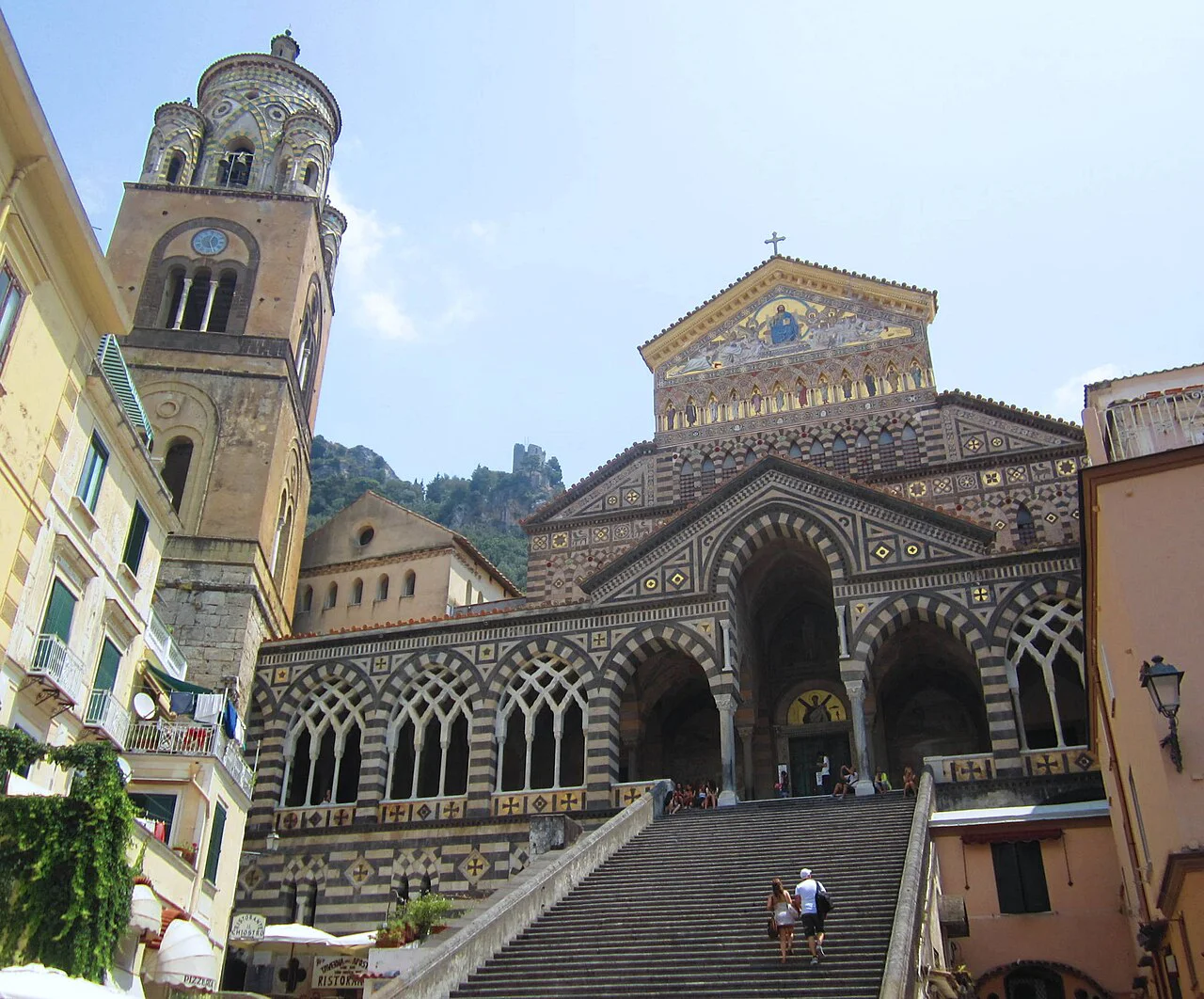
01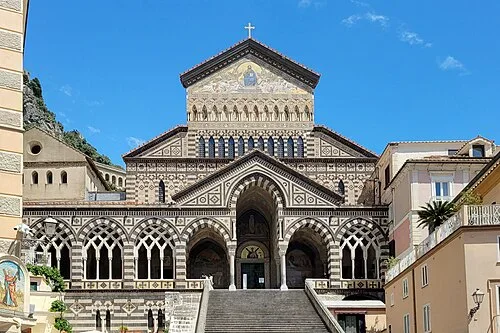 Piazza del Duomo and the Monumental Facade
The Cathedral of Sant'Andrea from Piazza del Duomo
Welcome to the Duomo di Amalfi, the cathedral of Saint Andrew. This was the seat of Amalfi's archbishops when the town was a bold maritime republic, and it remains the shrine of the Apostle Andrew himself. The first thing anyone notices is the climb. Sixty-two steps, wide and steep, rise from the square to the doors, so the approach to the church is a small pilgrimage in itself. The front is striped marble and stone, with a tall pediment covered in mosaic and a deep porch with delicate Arab-Moorish tracery in its windows. That mixture of styles is no accident. Amalfi traded across the whole Mediterranean, and the building wears the influences of East and West side by side. Over the next stops, the tour moves from the square to the doors, the cloister, the older church beside this one, and finally down to the tomb of the Apostle himself.
Bernard Gagnon · CC BY 4.0
02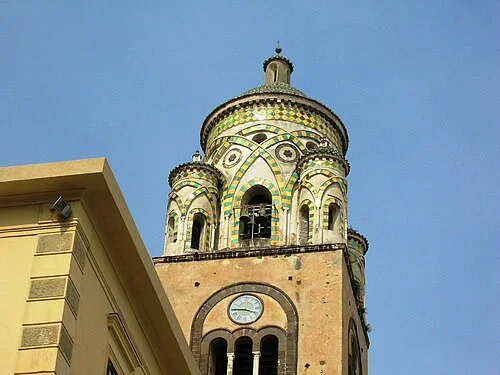 Piazza del Duomo and the Monumental Facade
The Majolica Bell Tower
Beside the cathedral rises one of the strangest bell towers in Italy. It began in the Romanesque style around 1180, but the work stretched on for well over a hundred years. At the top sits a larger central turret, ringed by four small ones, and every surface glitters with brightly coloured majolica tiles. The glazed tiles form interlaced Gothic arches, an Arab-Norman style found only in southern Italy. This is the most ornate example of that type of medieval bell tower anywhere. The tower served more than bells. In times of war it was used for defense, watching over the town and its coast.
Listen in the appMentnafunangann · CC BY-SA 3.0
03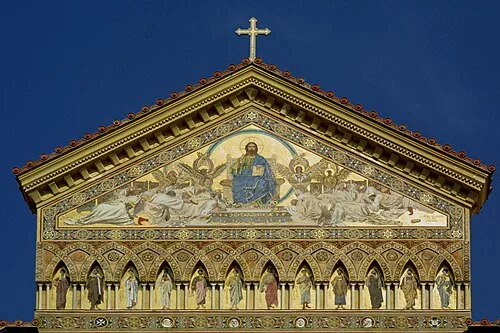 Piazza del Duomo and the Monumental Facade
Domenico Morelli's Mosaic of the Triumph of Christ
The mosaic at the top of the facade shows Christ in glory, attended by crowds of figures in gold. It is called the Triumph of Christ, and it comes from designs by the Neapolitan painter Domenico Morelli. The story behind it begins on the twenty-fourth of December, 1861, when a strong wind tore a section from the deteriorating top of the facade, which crashed through the vaults of the atrium below. How bad the damage really was is disputed. Some say the harm was light, and that the mayor of the time talked up an almost total collapse to justify a grand renewal. Either way, the decision was made to strip away the Renaissance and Baroque layers from the front of the church entirely. The architect Errico Alvino then rebuilt the whole facade in a rich Arab-Norman and Gothic style, more ornate than what stood before. The work was finished in 1891, thirty years after the wind did its work.
Listen in the appJ.T. 羅德生 · CC BY-SA 2.0
04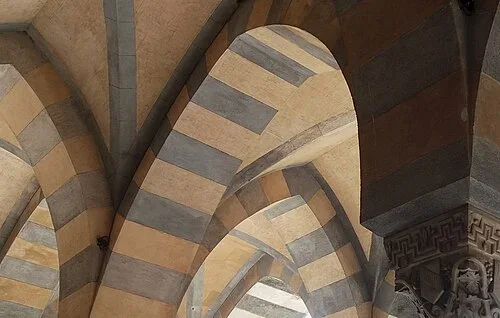 The Portico and Byzantine Bronze Doors
The Covered Atrium
The arches of the entrance hall are banded in alternating stone and brick, pale and dark stripes climbing into the vaults. This covered atrium is the hinge of the whole complex. It links the bell tower, the Paradise Cloister and the old Basilica of the Crucifix to the doors of the cathedral, joining buildings that once stood apart into a single entrance sequence. The striped masonry gives the space a quiet, cool rhythm before the cathedral's great bronze doors.
Listen in the appPhoto: Rudolfo Kithera · CC0
05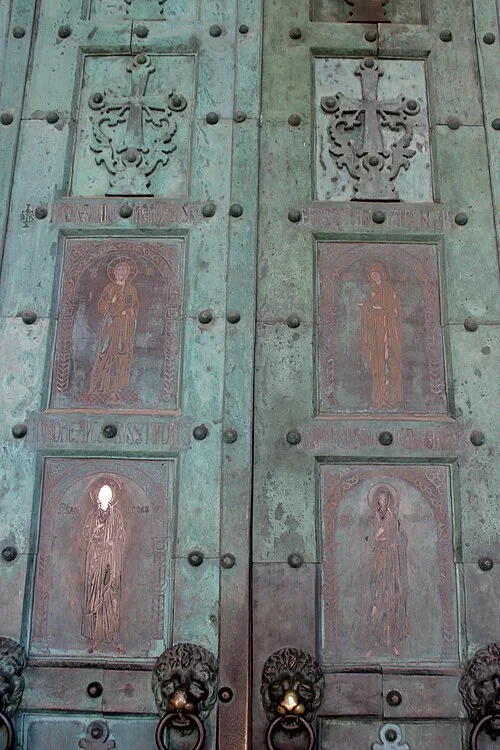 The Portico and Byzantine Bronze Doors
The Bronze Doors of Constantinople
The panels of these doors carry cast crosses and standing saints in rows, green with age, with lion-head ring pulls at the bottom. They were cast in Constantinople before 1066, and they are signed by their maker, Simeon of Syria. That makes them the earliest bronze doors of post-Roman manufacture anywhere in Italy. They are also proof of what Amalfi was. This small coastal republic sent its merchants directly into the Byzantine capital, and ordered a cathedral door from its workshops the way a rich city might order cloth or spices. A door is an ordinary thing to spend money on, and an extraordinary thing to survive. Every visitor since the eleventh century has passed through these same panels.
Listen in the appMiguel Hermoso Cuesta · CC BY-SA 4.0
06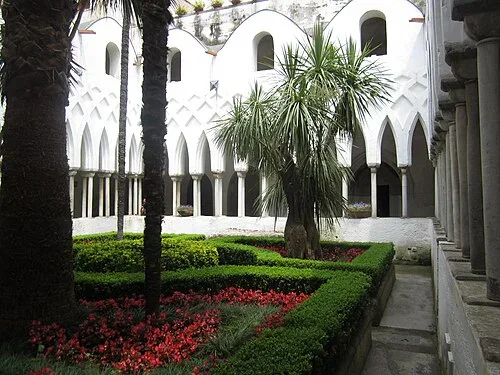 Paradise Cloister (Chiostro del Paradiso)
Paradise Cloister
Slender white columns hold up interlaced arches around a garden of hedges and flowers. This is the Paradise Cloister, built in the thirteenth century in the Arab-Norman style. It was made as a burial ground for Amalfi's noble families, who wanted to be laid to rest beside the cathedral. Building it cost the church something. By the twelfth century the two original churches here had been joined into one great Romanesque church with six aisles. From 1266 the aisles were reduced to five, because the left aisle of the older church had to be demolished to make room for this cloister. So the noble families' cemetery stands where a whole aisle of the medieval cathedral once ran.
Listen in the appPhoto: Luca Aless · CC BY-SA 3.0
07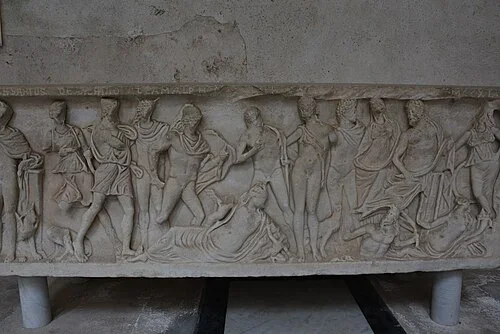 Paradise Cloister (Chiostro del Paradiso)
A Roman Sarcophagus Reused
Among the cloister arcades sits an ancient Roman sarcophagus, its side carved with a frieze of classical figures in flowing drapery. The carving is ancient Roman work, made for a pagan burial centuries before this cemetery existed. Medieval Amalfitans did not see it that way. They took carved Roman sarcophagi like this one and reused them as tombs for their own dead, a practice called spolia. The old stone was handsome, ready-made, and free for the taking. So Amalfi's nobility were buried under pagan carving, the city's ancient past lying directly beneath its medieval one.
Listen in the appMentnafunangann · CC BY-SA 4.0
08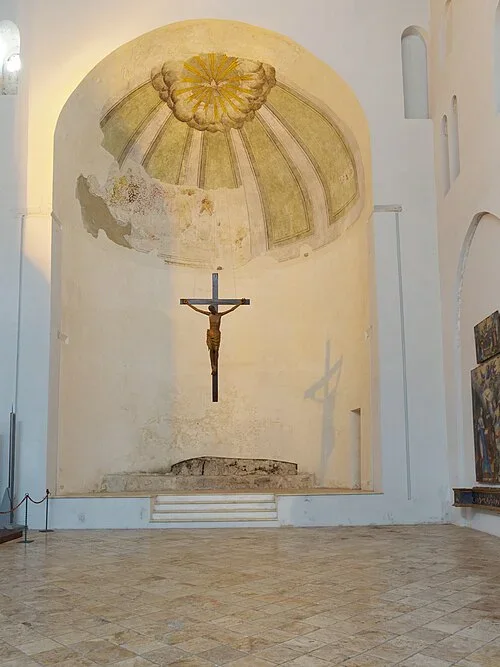 Basilica of the Crucifix and Diocesan Museum
Basilica of the Crucifix: The First Church
The whitewashed walls of this hall are plain, with a painted apse dome and a wooden crucifix hanging in the curve of the arch. This is the oldest building in the complex, a church first raised in the ninth century on the ruins of an earlier temple. In 987 the Duke Mansone the First had a second church built alongside it, the one that became today's cathedral. For centuries the two were used at the same time, as was the custom in the early churches of Campania. After the Counter-Reformation they were separated again, the older one becoming the Basilica of the Crucifix. Today it houses the Diocesan Museum, its stripped stonework showing what the complex looked like before the Baroque dressing.
Listen in the appPhoto: Arnoldius · CC BY-SA 3.0
09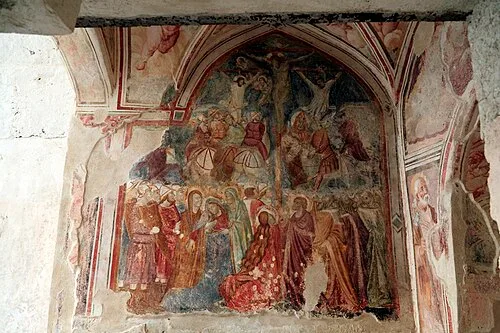 Basilica of the Crucifix and Diocesan Museum
Medieval Fresco in the Basilica of the Crucifix
On the wall of the basilica a medieval fresco shows the Crucifixion. Its colours have faded and the plaster is worn, but the scene is still legible: Christ at the centre, and dense crowds of figures gathered on either side, soldiers and mourners in red and blue robes. Paintings like this once covered the walls of the old church, before later work covered or stripped them away. What survives here is a trace of how the earliest part of the complex was decorated, inside a building whose bare stone now does most of the talking.
Listen in the appFalk2 · CC BY-SA 4.0
10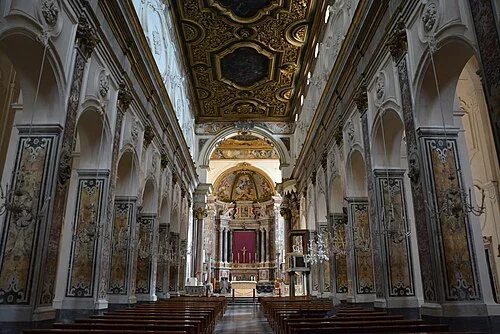 Cathedral Central Nave and High Altar
The Baroque Central Nave
Inside the cathedral, the contrast with the bare basilica could hardly be sharper. The nave was redecorated in the Baroque style in the eighteenth century, its pillars clad in marble, its chapels variously Gothic and Renaissance. Overhead, the coffered ceiling dates to 1702, gilded and painted with scenes including the Flagellation and the Crucifixion of the Apostle. All this splendour sits on medieval bones. One of the pillars holds a secret: a hidden column, left as an example of the ancient Romanesque structure beneath the Baroque dress. Builders over the centuries kept adding and redecorating, overlaying Arab-Norman, Gothic, Renaissance and Baroque, one style on the shoulders of the last.
Listen in the appMentnafunangann · CC BY-SA 4.0
- 11
The High Altar and Peter of Capua's Sarcophagus
A cardinal's tomb became the high altar, under columns of Egyptian granite.
- 12
Crypt of Saint Andrew: Tomb of the Apostle
How the bones of Saint Andrew reached Amalfi, and the crypt built to hold them.
- 13
The Manna and Living Devotion
The manna of Saint Andrew, and a thousand years of building in one church.
Duomo di Amalfi
Frequently asked questions
How much does the guide cost?
Free app download. Listed guide price: $0.99. Guide price shown in the app. Audio guide only. Venue admission is separate.
Can I listen without internet?
Yes. Download the guide’s audio, images, and maps in the app before your visit. Your downloaded content is then available offline.
Can I listen in my language?
This audio guide is available in 15 languages, including English.
Do I need to follow a schedule?
No. This is a self-guided experience. Choose your stops, pause whenever you like, and return to a story at your own pace.
At your own pace
Explore Duomo di Amalfi.
Download Stanza, then search for “Duomo di Amalfi”.
Free app download · Guide price shown in the app
Keep exploring
Nearby audio guides
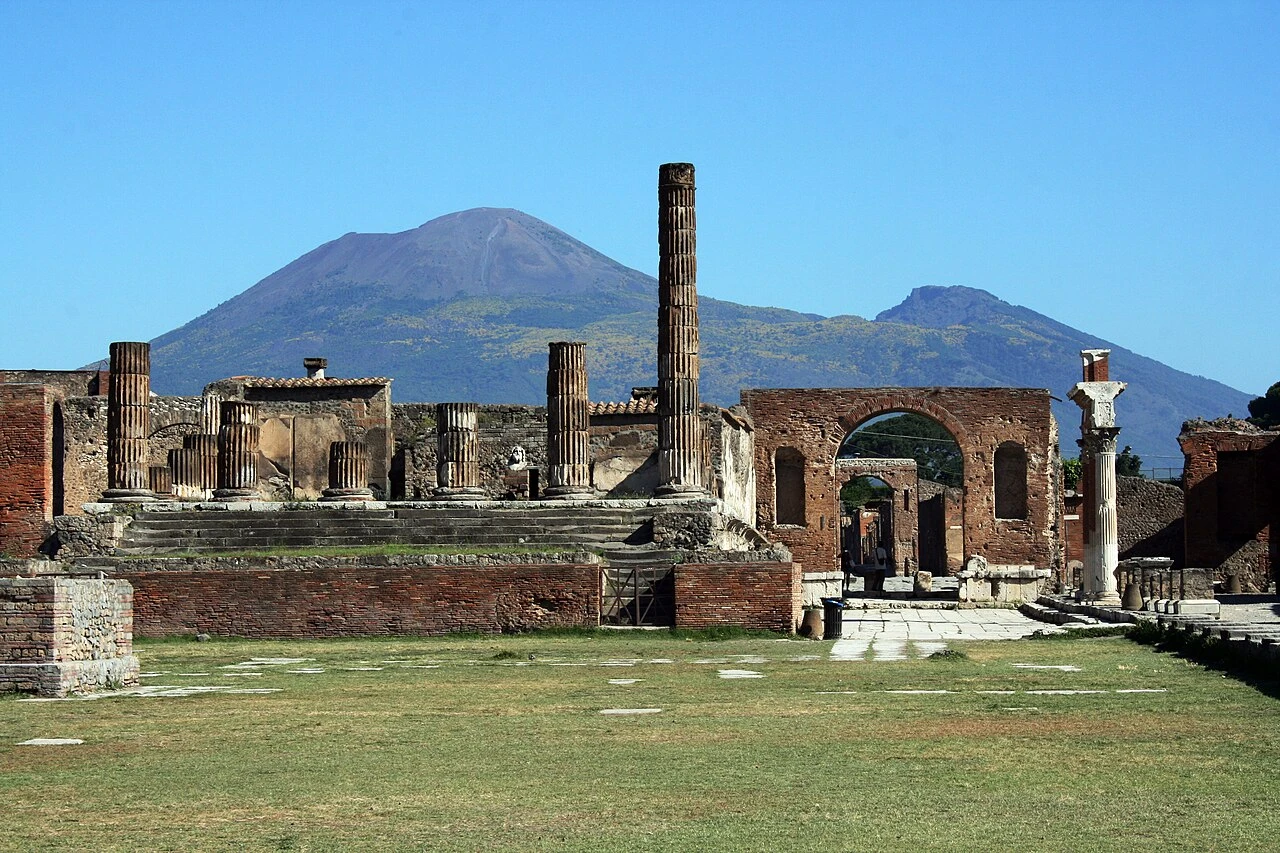
Pompei · 16 km
Pompeii Archaeological Park
Content & sources
Glen Scarborough from The Central Coast, Australia · CC BY 2.0
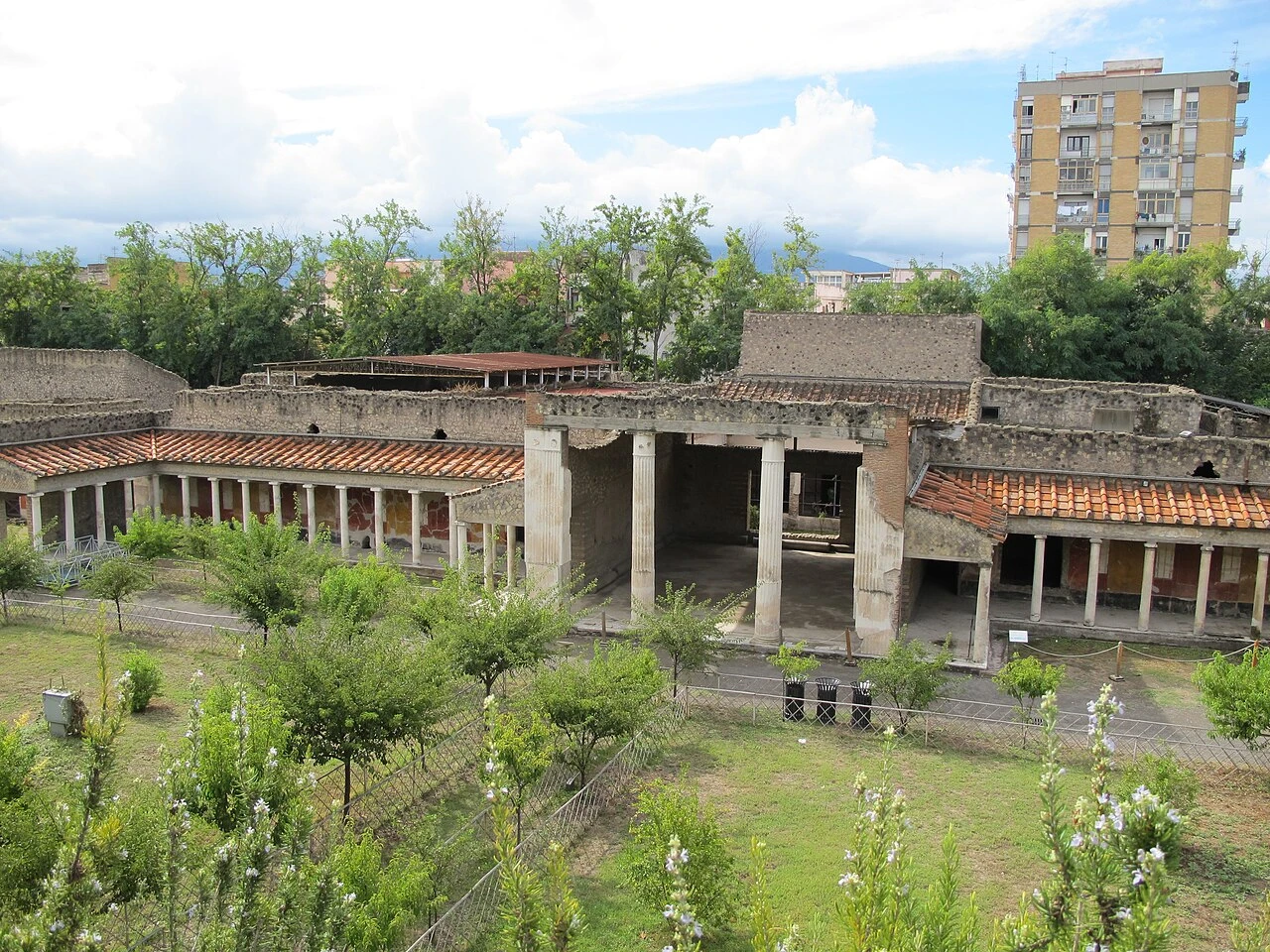
Torre Annunziata · 19 km
Villa Poppaea
Content & sources
ho visto nina volare from Italy · CC BY-SA 2.0
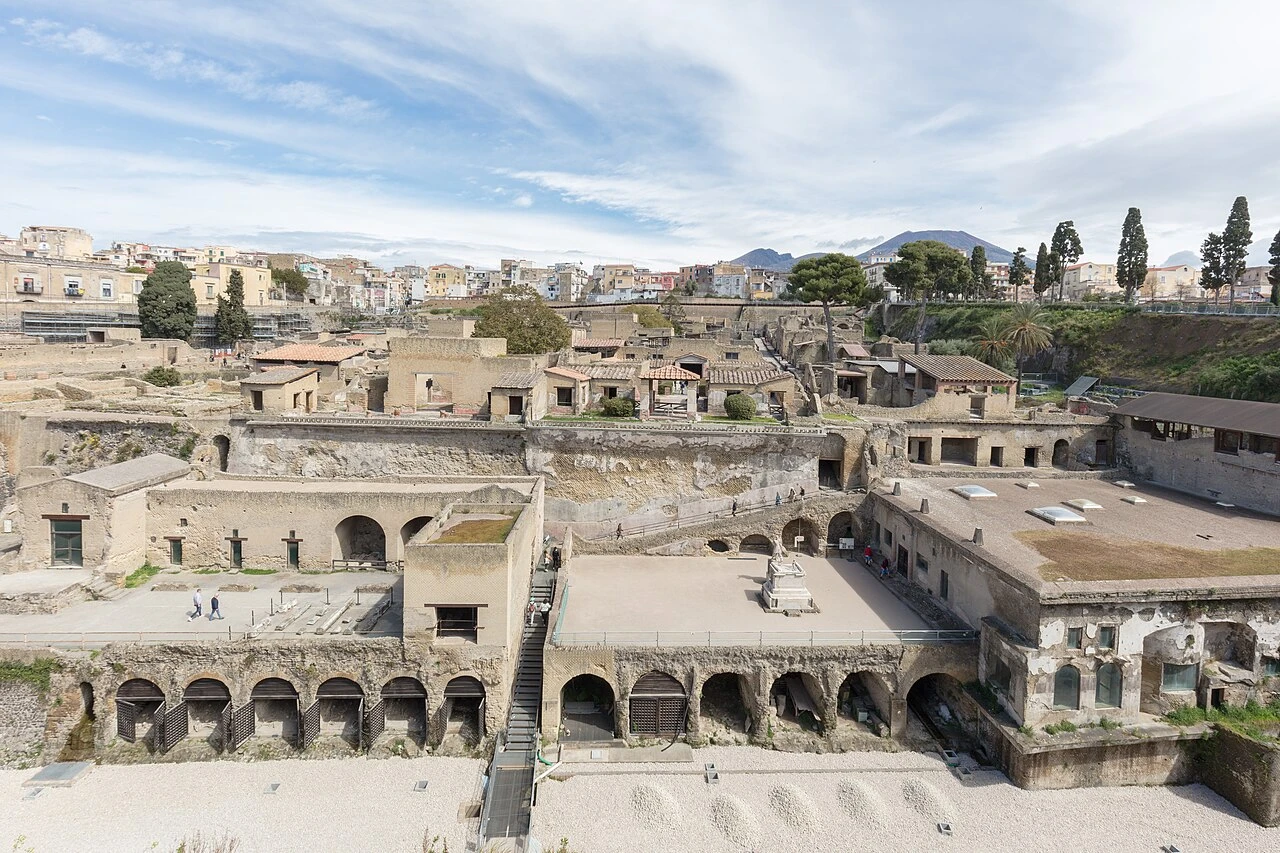
Ercolano · 29 km
Herculaneum
Content & sources
Diego Delso · CC BY-SA 4.0
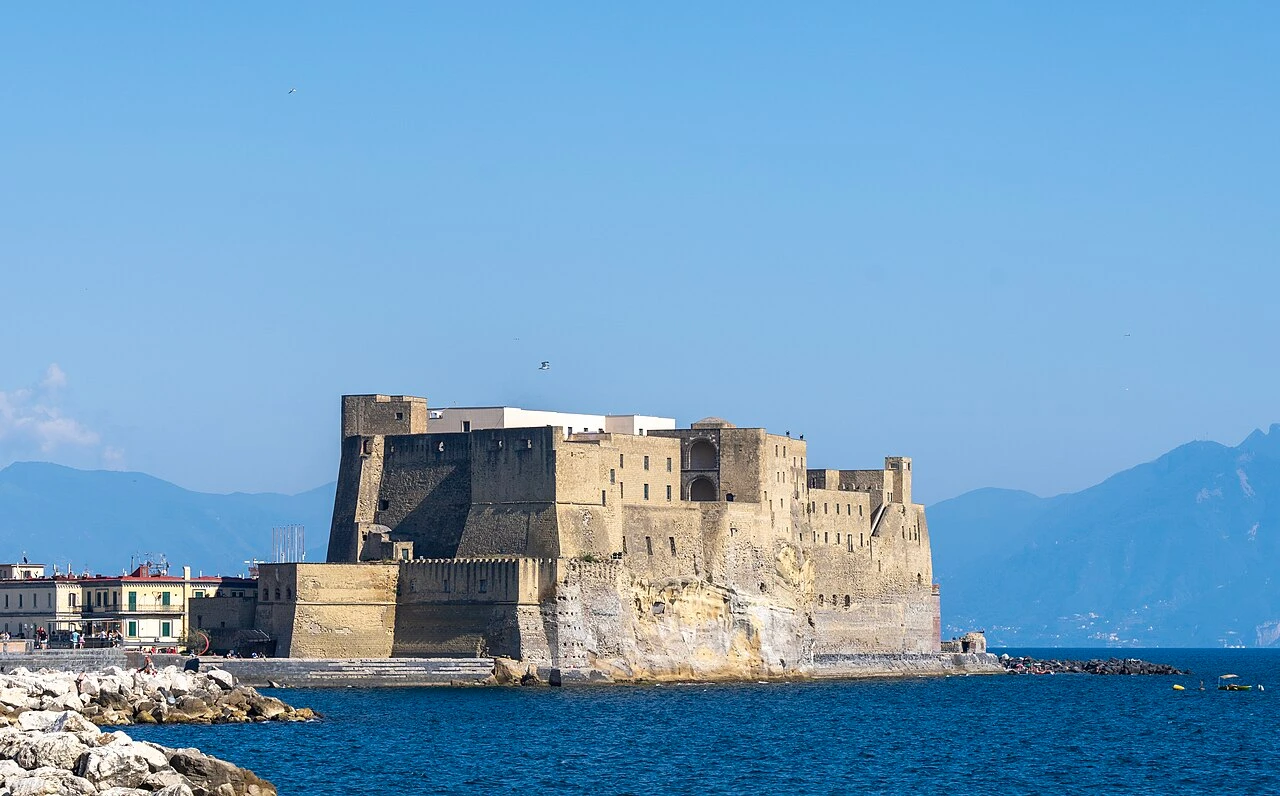
Naples · 37 km
Castel dell'Ovo
Content & sources
Paestum · CC BY-SA 4.0