Languages
15Pompeii Archaeological Park Audio Guide
Pompeii Archaeological Park is an archaeological site in Pompei, Italy. Explore it with Stanza's guided offline audio tour — narrated in 15 languages.
Quick Facts
58
Stops
15
Languages
100%
Offline
📍 Pompei, Italy · 40.7506°N, 14.4897°E
About Pompeii Archaeological Park
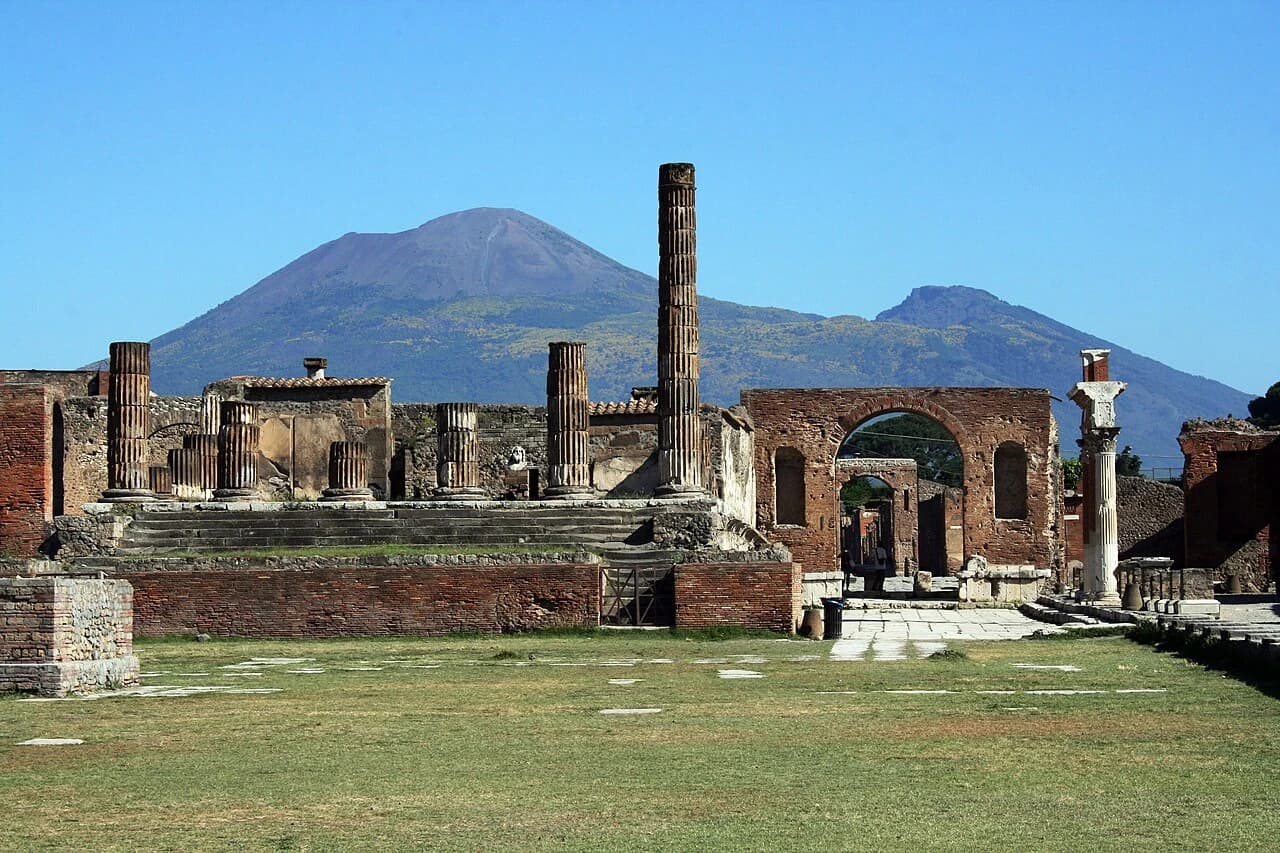
Pompeii is an ancient Roman city located near modern Naples, Italy. It was famously buried under volcanic ash and pumice from the eruption of Mount Vesuvius in 79 AD, preserving its structures and artifacts.
This self-guided audio tour features 58 narrated stops organized across 8 sections. As a ancient city, Pompeii Archaeological Park offers a unique cultural experience in the heart of Pompei, Italy.
The Stanza audio guide is available in 15 languages and works entirely offline — download the complete tour including audio narration, maps, and images before your visit. As you walk through Pompeii Archaeological Park, GPS-triggered narration plays automatically at each point of interest.
Last updated:
What you will hear
Pompeii Antiquarium
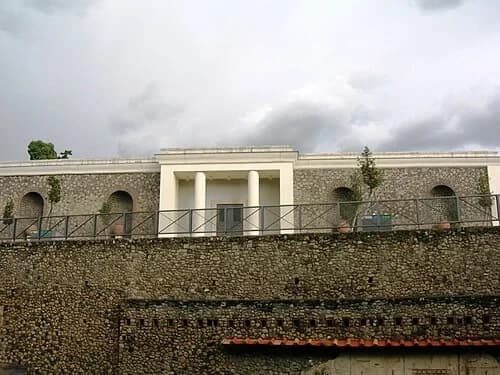
The site's primary museum, housing a vast collection of artifacts and the world-famous plaster casts of Vesuvius's victims.
Antiquarium in Pompeii
The Antiquarium has a turbulent history of its own. Originally built in the late 19th century to display the finest artifacts found during excavations, it was nearly leveled during Allied bombing raids in 1943. After years of restoration, it now serves as the primary museum for the site, focusing on the intimate details of daily life that larger ruins can't always convey. Rather than just focusing on grand art, the collection prioritizes objects that provide a direct human connection to the 79 AD tragedy. Here, you will find everything from carbonized loaves of bread to delicate household tools that were in use at the moment of the eruption. Perhaps most famously, it houses several of the plaster casts of victims, capturing their final poses and even the textures of their clothing. This space transforms Pompeii from a collection of stone buildings into a living city frozen in time, reminding us that the people who walked these streets shared the same mundane needs and domestic comforts that we do today.
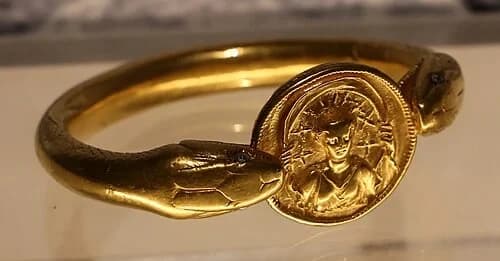
The Golden Bracelet
This piece of jewelry is one of the most significant personal items recovered from the ruins. It was discovered still encircling the wrist of a resident who was attempting to escape the volcanic surge within the 'House of the Golden Bracelet.' The design is highly distinctive, featuring two snake heads that meet to hold a central medallion. In the middle of this disk is a finely rendered image of Selene, the goddess of the moon. In Roman culture, snakes were not feared but were revered as powerful symbols of good luck, health, and domestic protection. Seeing such symbols on a piece of jewelry meant to safeguard the wearer creates a profound sense of irony, as no charm could provide protection against the forces unleashed by Vesuvius. The sheer weight and craftsmanship of the gold suggest that the owner was a person of considerable status. Today, the piece stands as a tangible link to a specific individual, serving as a silent witness to a desperate attempt to carry one's most valued possessions to safety.
The Basilica
The most important public building in Pompeii, serving as both a center for legal proceedings and commercial transactions.
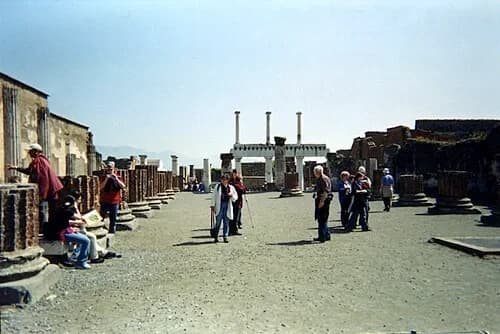
Basilica
Built between 120 and 78 BC, the Basilica is one of the oldest known examples of this architectural form in the Roman world. Its primary function was two-fold: it served as a court of law where magistrates presided over legal disputes and as a central exchange for high-stakes business transactions. The sheer scale of the ruins suggests the importance of the activities that took place within its walls. Look closely at the remaining columns. While they appear to be made of simple brick today, they were originally coated in thick white stucco and carved to mimic expensive fluted marble. This was a common Roman technique used to create an impression of luxury without the exorbitant cost of solid stone. The long, rectangular layout with its internal rows of columns would eventually become the blueprint for early Christian churches, but here in Pompeii, it remained a secular space dedicated to the law and the economy. Its position near the Forum ensured it was always at the center of the city’s daily power struggles and financial news.
Temple of Apollo
One of the city's oldest and most significant religious sites, blending Greek and Roman architectural styles.
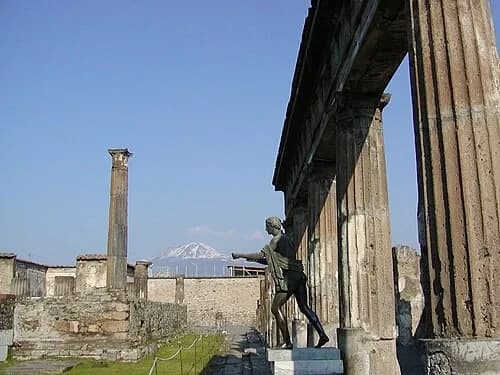
Temple of Apollo
The Temple of Apollo is one of the oldest religious sites in Pompeii, with its foundations dating back as far as the 6th century BC. As you observe the temple grounds, notice the statue of Apollo standing poised with his bow. This figure, along with its counterpart Diana, creates a sense of divine stillness. One of the most haunting aspects of this site is the direct sightline from the temple toward Mount Vesuvius in the distance. This creates a powerful juxtaposition: the serene, immortal gods of the Roman pantheon standing in the shadow of the very volcano that would prove to be the city's undoing. Over the centuries, the temple underwent several renovations, incorporating different architectural styles as the city's culture evolved from Greek and Etruscan influences into a fully Roman colony. It remained a primary center for worship and public festivals until the end. Today, the weathered columns and silent statues provide a quiet space to reflect on the long history of the city before it was abruptly silenced by the mountain on the horizon.
Mensa Ponderaria
The official weights and measures table of the city, used to verify quantities in the nearby markets.
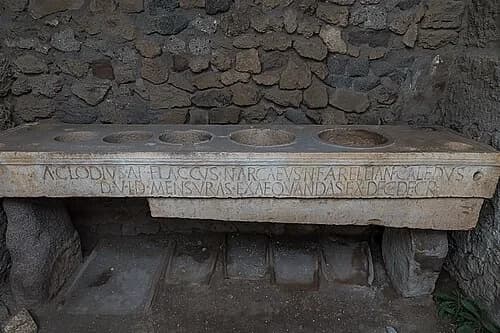
Public Weights and Measures
Located near the busy market area, this limestone bench was a critical tool for maintaining fair trade in Pompeii. It contains several hollowed-out cavities of varying sizes, each representing an official standard for liquid or dry volume. If a customer suspected a merchant was being dishonest, or if a seller wanted to prove their containers were accurate, they would bring them here to be checked against these calibrated holes. This system ensured that a pint of wine or a bushel of grain was the same everywhere in the city. On the front of the bench, you can still read Latin inscriptions. These carvings credit the local officials, known as aediles, who were responsible for verifying the accuracy of the measures and overseeing the market's integrity. It is a fascinating look at the bureaucratic side of Roman life, showing that consumer protection and standardized regulations were as important two thousand years ago as they are today. The bench remains in its original location, a permanent fixture of the city's commitment to orderly commerce.
Temple of Jupiter
Dominating the north end of the Forum, this temple was dedicated to the Capitoline Triad: Jupiter, Juno, and Minerva.
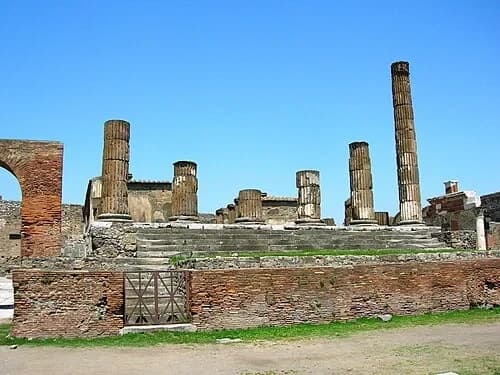
Temple of Jupiter
The Temple of Jupiter occupied the most prestigious position in the Forum, standing at its northern head. It was dedicated to the 'Capitoline Triad'—the three supreme Roman deities: Jupiter, Juno, and Minerva. This dedication marked the city's transition from a local town to a loyal Roman colony. The temple is built on an exceptionally high platform, or podium, which elevated the gods above the crowds in the square below. This elevation was a deliberate architectural choice designed to project the absolute authority of the Roman state. The remaining fluted columns, though weathered, still convey the massive scale of the original building, which would have been visible from almost anywhere in the Forum. Its presence was a constant reminder of the spiritual and political hierarchy that governed the empire. Inside the main chamber, statues of the three gods would have stood, receiving the prayers and sacrifices of the citizenry. Today, even in its ruined state, the temple remains a commanding feature, framing the view of the mountain beyond and anchoring the civic landscape.
Temple of Vespasian
A sanctuary dedicated to the cult of the Roman Emperor, featuring a beautifully carved marble altar.
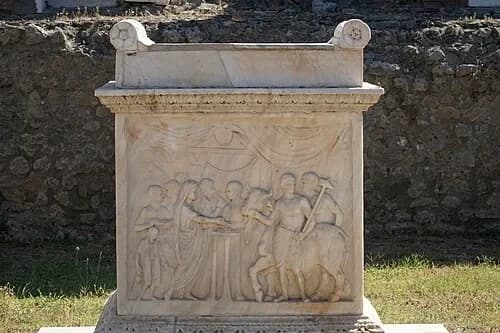
The Sacrificial Altar
The relief carving on this altar provides a detailed snapshot of a Roman animal sacrifice, one of the most important public religious acts. In the center of the scene, you can see a priest with his head veiled in a toga, performing the preliminary rituals. Beside him, an attendant leads a large bull, the traditional victim for a major state sacrifice. To the sides, musicians are depicted playing the double-flute, intended to drown out any unlucky sounds that might disrupt the ceremony. Such sacrifices were not just private religious moments; they were grand public displays of loyalty and social order. By performing these rituals in front of the community, local leaders reaffirmed their connection to the divine and their commitment to the stability of the Roman Empire. The level of detail in the carving—from the folds of the garments to the muscularity of the bull—is exceptional, allowing us to see the exact tools and procedures used in these ancient rites. It illustrates how religious life in Pompeii was a highly structured and visible part of the city's political identity.
House of the Faun
The largest and most luxurious private residence in Pompeii, covering an entire city block and named after the bronze statue found in its atrium.
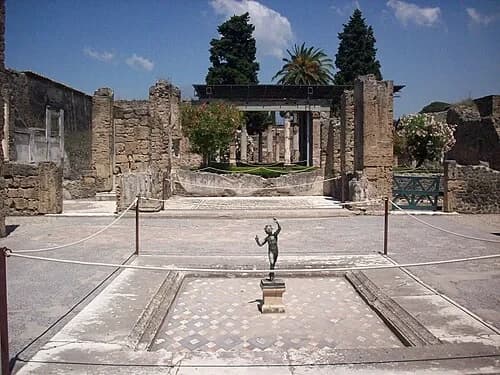
House of the Faun
This is the largest and arguably most opulent residence ever discovered in Pompeii, covering nearly 3,000 square meters—an entire city block. Its scale is a testament to the staggering wealth of the family that lived here during the 2nd century BC. The house is named after the famous small statue of a dancing faun that was found in the main entrance hall. Walking through the ruins, you can see the remains of two large courtyards and multiple garden areas, which were surrounded by rooms decorated with some of the finest artistry in the Roman world. One of the most impressive features is the sophisticated tile work on the floors. The sheer variety of patterns and the precision of the mosaic craftsmanship served as a constant visual reminder to any visitor of the owner's high social standing. This home was essentially a private palace within the city walls, combining traditional Roman architecture with Hellenistic influences from Greece. The massive entrance gate and the expensive materials used throughout the construction made it a landmark of prestige long before the eruption.
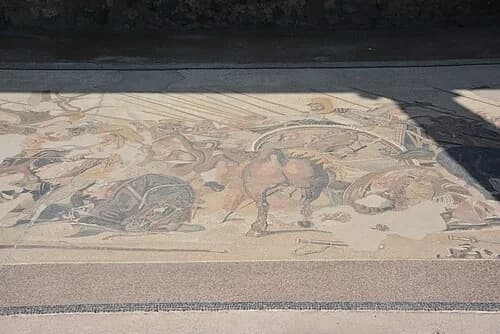
The Alexander Mosaic
You are looking at a replica of the most famous mosaic ever recovered from Pompeii, originally located in a sitting room of the House of the Faun. It depicts the turning point of the Battle of Issus, where Alexander the Great confronted the Persian King Darius III. The scale and detail are staggering; the original was composed of approximately one and a half million tiny tiles. The artist managed to capture an incredible amount of emotional and physical tension. The wide, terrified eyes of the horses and the desperate expression on the face of King Darius as he prepares to flee his chariot are visible. Meanwhile, Alexander is shown charging forward with intense focus. This work is not just a historical record but a masterpiece of ancient perspective and shadow. The use of varied tile colors creates a sense of depth and movement that was revolutionary for its time. By placing such a scene on the floor of their home, the owners were making a bold statement about their education, their connection to Greek history, and their immense wealth, as few could afford such a complex commission.
House of the Vettii
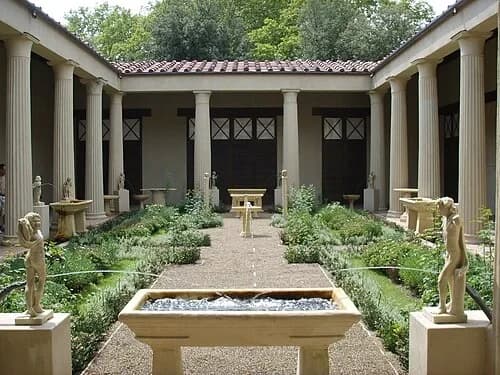
Owned by two wealthy freedmen, this house is world-renowned for its perfectly preserved Fourth Style frescoes and its lush garden.
House of the Vettii
The garden you see today is a careful reconstruction based on remarkable archaeological evidence found during excavations. When the volcanic ash was cleared away, archaeologists discovered the original layout of lead water pipes and the placement of several marble basins. This allowed them to replant the garden exactly as it appeared in 79 AD. For the Roman elite, a garden was not just for aesthetics; it was a sophisticated piece of climate control. The combination of dense greenery and flowing water from various fountains worked to create a cooling micro-climate, significantly lowering the temperature of the surrounding rooms during the intense heat of the Italian summer. The water was brought into the house via the city's pressurized aqueduct system, feeding a series of small statues that acted as fountain heads. This lavish use of a precious resource was the ultimate status symbol. Standing here today, you can get a sense of the tranquility the owners sought, where the sound of splashing water and the shade of the portico turned an urban house into a miniature countryside retreat.
Want to hear the rest?
Download the Stanza app to unlock all 58 stops and the complete guided audio tour.
Frequently Asked Questions
How long does the Pompeii Archaeological Park audio tour take?
The Pompeii Archaeological Park audio guide includes 58 narrated stops. Most visitors spend 45 minutes to 1.5 hours exploring the complete tour, though you can listen at your own pace and skip or revisit any stop.
Is the Pompeii Archaeological Park audio guide available in my language?
Stanza supports 15 languages: English, Spanish, French, German, Italian, Portuguese, Russian, Japanese, Chinese, Korean, Arabic, Hindi, Polish, Dutch, Hebrew. Check the guide in the app to confirm the languages currently available for this tour.
Can I use the audio guide offline at Pompeii Archaeological Park?
Yes! Download the complete Pompeii Archaeological Park tour — including all audio, maps, and images — before your visit. The Stanza app works completely offline, so you don't need WiFi or mobile data at the venue.
How much does the Pompeii Archaeological Park audio guide cost?
The Stanza app is free to download. The current listed price for the Pompeii Archaeological Park audio guide is $4.99; app-store region and currency may affect the final price.
How do I use the Stanza audio guide at Pompeii Archaeological Park?
Download the free Stanza app, search for "Pompeii Archaeological Park", and download the tour. When you arrive at the venue, the app uses GPS to detect your location and automatically plays the relevant narration as you move between points of interest — completely hands-free.
What makes the Stanza audio guide different from other Pompeii Archaeological Park tours?
Stanza offers GPS-triggered narration that plays automatically as you walk through Pompeii Archaeological Park — no need to manually select stops. The tour is available in 15 languages, works fully offline, and includes 58 expertly narrated stops with images and historical context.
What other audio guides are available near Pompeii Archaeological Park?
Stanza offers multiple audio guides in Pompei, Italy and nearby areas. After downloading the app, browse the map to discover all available tours near Pompeii Archaeological Park. Each guide can be downloaded for offline use.