Languages
15Herculaneum Audio Guide
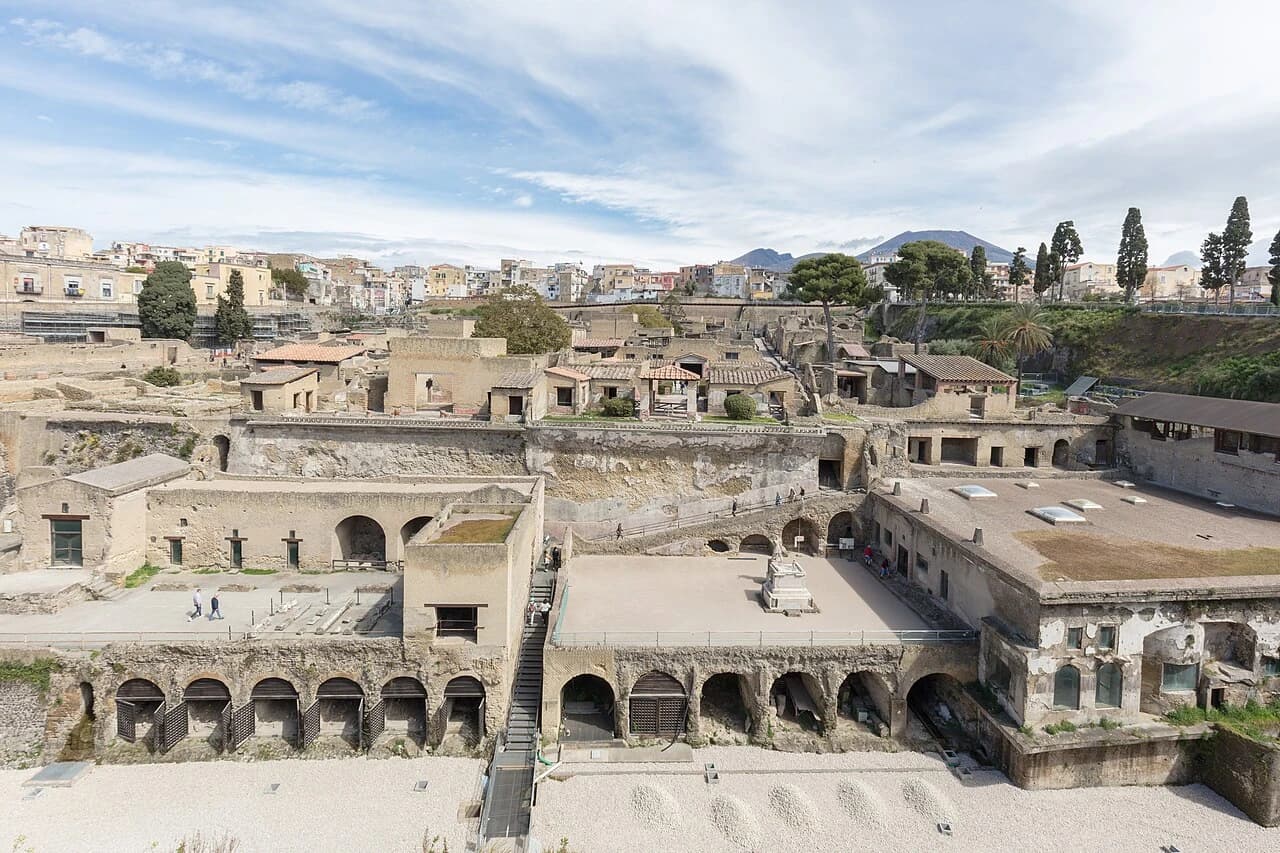
Herculaneum is an archaeological site in Ercolano, Italy. Explore it with Stanza's guided offline audio tour — narrated in 15 languages.
Quick Facts
43
Stops
15
Languages
100%
Offline
📍 Ercolano, Italy · 40.8061°N, 14.3475°E
About Herculaneum
An ancient Roman town famously preserved and buried by the eruption of Mount Vesuvius in 79 AD. It is now a prominent archaeological site offering exceptional insights into daily Roman life.
This self-guided audio tour features 43 narrated stops organized across 6 sections, including Boat Exhibition, The Fornici and the Ancient Beach, House of the Wooden Partition, Samnite House, Central Thermal Baths (Male Sector), House of Neptune and Amphitrite. As a archaeological site, Herculaneum offers a unique cultural experience in the heart of Ercolano, Italy.
The Stanza audio guide is available in 15 languages and works entirely offline — download the complete tour including audio narration, maps, and images before your visit. As you walk through Herculaneum, GPS-triggered narration plays automatically at each point of interest.
Last updated:
What you will hear
Boat Exhibition
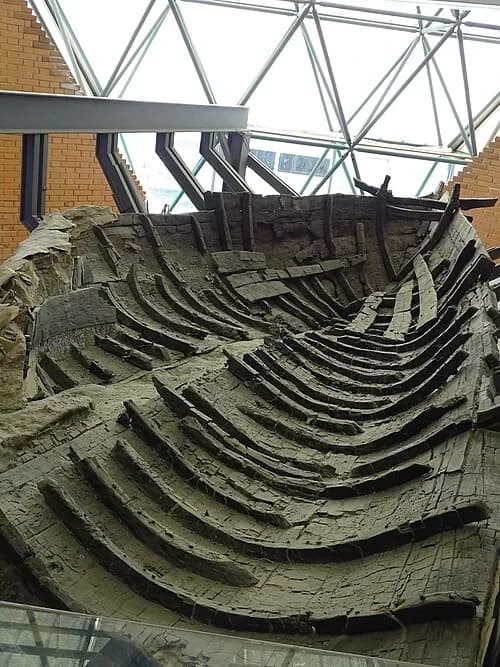
Start your journey at this modern pavilion housing the remarkably preserved remains of a Roman boat found on the ancient shoreline.
Preservation of Timber
The physical structure of this hull provides a rare opportunity to examine the sophisticated joinery used by Roman shipwrights. If you look closely at the planks, you can see evidence of the 'mortise and tenon' method, where pieces were interlocked with incredible precision to create a watertight seal. While the wood may appear charred, it is actually carbonized. This occurred when the volcanic flow’s high temperature interacted with the organic material in an environment devoid of oxygen. Instead of burning to ash, the wood transformed into a brittle but durable carbon structure. This process was so precise that even the faint marks left by the carpenters’ chisels and planes are still visible on the surface. These small details offer a human connection to the laborers who built the craft, showing the steady hands and sharp tools that were at work just before the eruption began. The preservation of such structural details is what makes the site of Herculaneum so distinct from its neighboring city, Pompeii.
The Fornici and the Ancient Beach
Descend to the ancient shoreline where the most poignant discovery of Herculaneum was made: the skeletal remains of over 300 people who sought refuge in these seaside vaults.
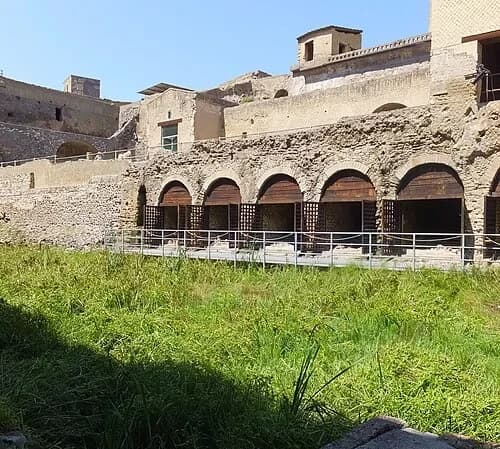
The Fornici on the Ancient Beach (With the Casts of the Skeletons)
Direct your gaze toward the 'Fornici,' the series of arched brick vaults that originally sat right at the water's edge. In the first century, these structures served a practical purpose as storage units for boats, nets, and fishing gear, providing easy access to the Bay of Naples. However, their role changed dramatically during the eruption of Mount Vesuvius. Until the early 1980s, historians believed that most residents of Herculaneum had successfully escaped the disaster because so few remains had been found within the town itself. This belief was overturned when excavations reached these beachfront vaults. Instead of being empty, the chambers were found to be packed with hundreds of people. These individuals had fled to the shore, likely hoping for a naval rescue that never arrived. Today, the casts placed within the arches remind us that this area was the site of a desperate final stand against the encroaching volcanic clouds.
House of the Wooden Partition
This house contains one of the most famous archaeological finds in Herculaneum: a perfectly carbonized wooden sliding door that still stands in its original place.
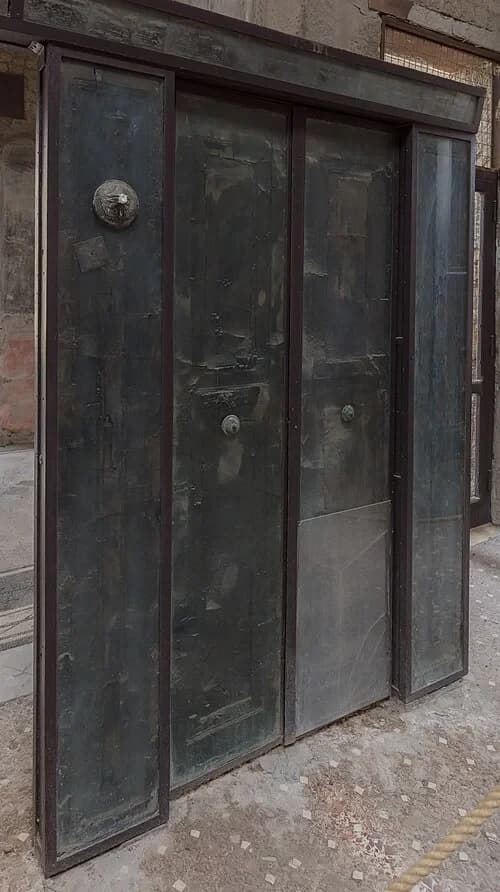
Sliding Doors of the Past
Taking a closer look at the carbonized partition, you can see the intricate details that have survived the eruption. The recessed panels and the dark, textured surface of the wood reveal the high quality of Roman craftsmanship. Of particular interest are the bronze door-knockers and handle rings that are still attached to the wood. These small metal details are important because they provide a rare glimpse into the mechanical side of Roman life. We can see how the doors were designed to fold or slide, demonstrating the sophisticated ways the Romans managed privacy and temperature control within their homes. By opening or closing these partitions, residents could catch a cross-breeze in the summer or retain heat in the winter. The survival of these delicate bronze fittings alongside the carbonized timber is what makes this find world-class. It reminds us that these were functional, everyday objects used by people who valued both beauty and practicality in their living spaces. The partition remains a tangible link to the domestic habits of the ancient world.
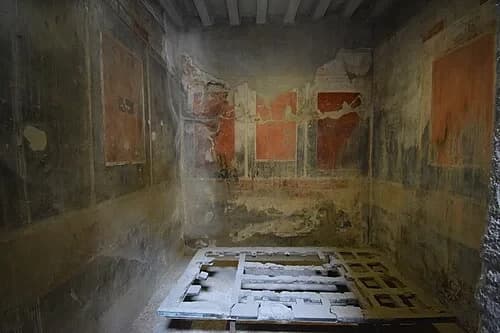
The Carbonized Bed
Within this small room lies a carbonized bed frame, preserved by the same intense heat and lack of oxygen that turned the city's timber into charcoal. In the ancient world, furniture made of organic materials almost never survived, but the unique conditions here in Herculaneum have left us with an incredible catalog of Roman domestic life. Notice the distinct lattice-work design on the frame, which would have supported a mattress made of wool or straw. The bed has a notably low profile, a characteristic common to Roman beds and the couches used for reclining during dinner. While the soft furnishings have perished, the structural integrity of the wood remains, showing the joinery and craftsmanship of an ancient carpenter. Beds like this were found in the cubicula, or small bedrooms, which were often minimally furnished and lacked the grand decorations found in public areas of the house. The dark, coal-like appearance is a direct result of the carbonization process, which chemically altered the wood while keeping its original form perfectly recognizable. It rests in a corner, just as it was positioned nearly two thousand years ago.
Samnite House
One of the oldest houses in Herculaneum, featuring a stunning blind gallery with Ionic columns on the upper floor.
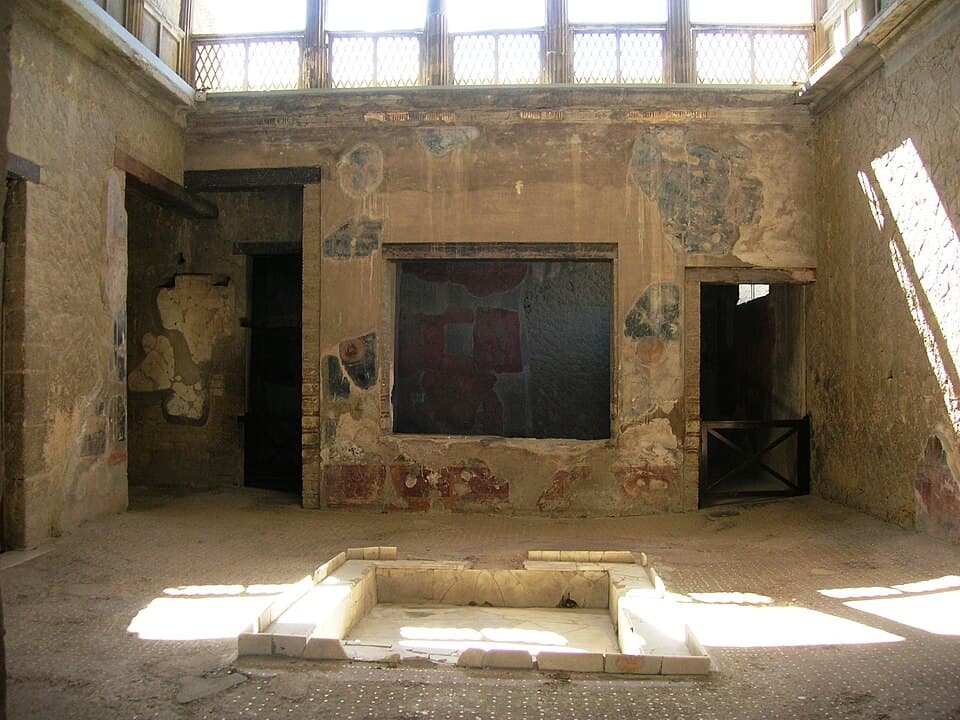
Samnite House
This residence dates back to the 2nd century BC, making it one of the most venerable structures in Herculaneum. It provides a rare look at the architecture of the Samnites, the Oscan-speaking people who controlled this region before it was fully Romanized. One of its most striking features is the 'blind gallery' visible on the upper level of the atrium. Unlike a functional balcony, this is a decorative element consisting of a series of delicate Ionic columns set into the wall. It creates a sense of grandeur and verticality that was typical of high-status Samnite homes. The columns are topped with characteristic volutes—the scroll-like ornaments that define the Ionic order. While later Roman houses tended toward more open, airy designs, the Samnite House retains a more enclosed and imposing feel. The craftsmanship of the masonry and the survival of these early architectural details highlight the city's long history and the layers of cultural influence that shaped it. Even after centuries of Roman rule, the owners of this house chose to maintain these traditional features rather than modernize. You can see how the heavy, dark stone of the lower walls contrasts with the lighter, more ornamental details above.
Central Thermal Baths (Male Sector)
Explore the perfectly preserved facilities of the city's main bathhouse, where the heating systems and decorative mosaics remain largely intact.
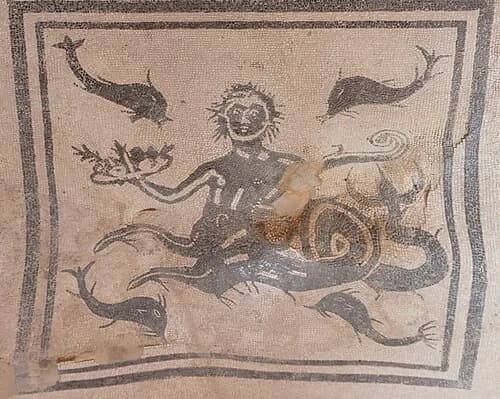
Triton Floor Mosaic
In the center of the changing room floor, this expansive mosaic is composed of thousands of small black and white tesserae. The central figure is a Triton, a mythological merman and son of Neptune, who is shown with the torso of a man and the coiled tail of a sea creature. He is surrounded by a lively array of dolphins and other marine life, creating a dynamic underwater scene. Such marine themes were universal in Roman bath complexes across the empire. They served to reinforce the 'watery' nature of the space and evoke the power of the ocean. This particular mosaic is a fine example of the black-and-white style that became increasingly popular in Italy during the 1st and 2nd centuries AD. The use of only two colors allows for sharp, graphic silhouettes that are easy to read even through a layer of water or steam. Notice how the Triton is depicted in mid-motion, clutching a rudder or oar, while the dolphins seem to leap through the surrounding space. This artwork wasn't just decoration; it was meant to be walked upon daily by hundreds of people, demonstrating the incredible durability of Roman floor-laying techniques.
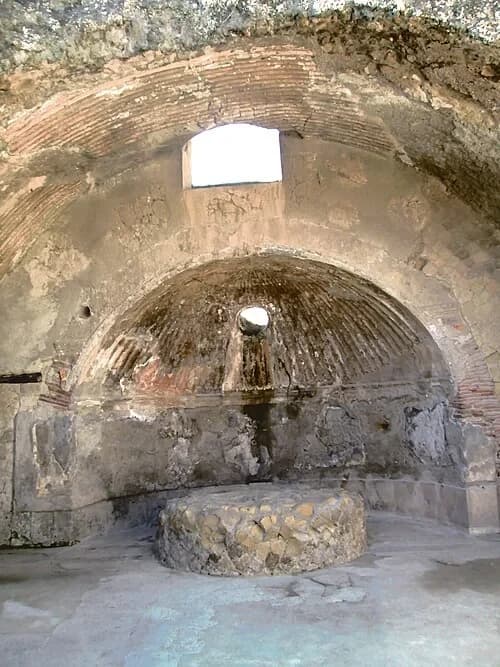
The Hot Room
The calidarium was the hottest room in the Roman bath sequence. At the far end, you can see a semicircular apse. This alcove once held a large marble basin, known as a labrum, filled with cool water that bathers would use to rinse their faces and hands while in the heat. To achieve the high temperatures required for a sauna-like experience, the Romans used a 'hypocaust' system. Hot air from a nearby furnace was circulated through a hollow space beneath the floor, supported by small brick pillars, and then up through flues built into the walls. This turned the entire room into a massive radiator. The heat was so intense that bathers had to wear thick wooden sandals to protect their feet from the scalding floor. The walls were often lined with marble or thick plaster to retain the warmth. This engineering marvel provided a level of luxury and hygiene that was unprecedented in the ancient world. You can still see where the heating flues were embedded in the masonry, and the curved ceiling was designed to let condensed steam run down the sides rather than dripping from above.
House of Neptune and Amphitrite
Home to the most famous mosaic in Herculaneum, this house belonged to a wealthy merchant and includes a perfectly preserved shop at the front.
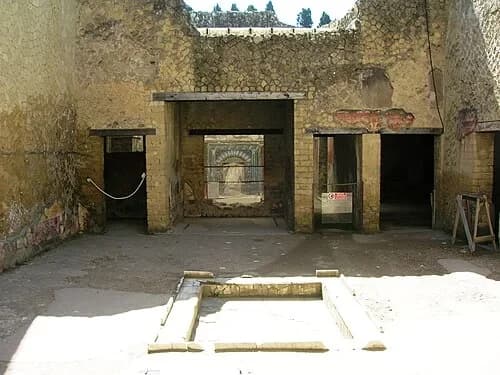
House of Neptune and Amphitrite
As you stand in the atrium of the House of Neptune and Amphitrite, you can see right through the building toward the garden area at the back. This clear line of sight, or vista, was a deliberate design choice in high-end Roman homes, intended to impress visitors with the scale and beauty of the residence as soon as they entered. This house belonged to a prosperous merchant family, and its wealth is evident in the quality of the decorations that survived the eruption. Unlike many other homes, this property also includes an exceptionally well-preserved commercial space at its front, which was typical for Roman urban houses where business and family life were closely intertwined. The homeowner likely sold high-quality goods like wine or oil directly to passersby on the street. The name of the house comes from a spectacular mosaic found further inside, which we will see shortly. For now, observe the layout of the rooms around this central atrium, which served as the social and ceremonial heart of the home, catching light and air to keep the interior comfortable throughout the day.
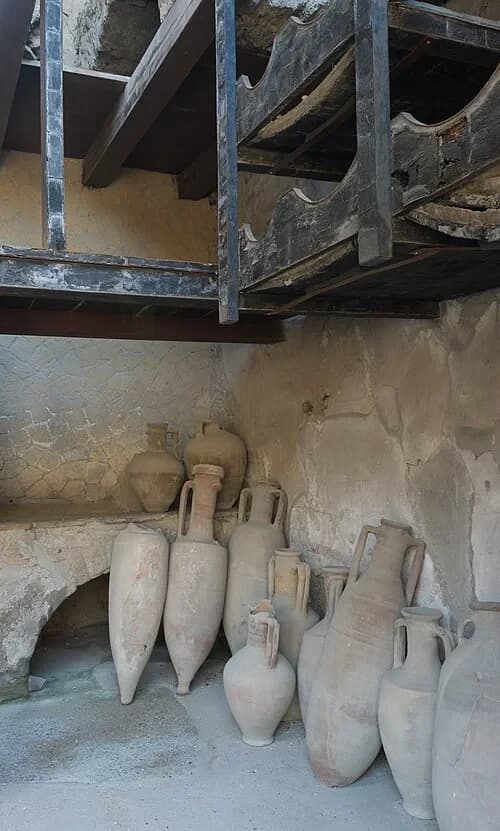
The Wine Shop
Adjoining the House of Neptune and Amphitrite is this remarkably intact shop, providing a direct link to the commercial life of Herculaneum. Against the back wall, you can see the original wooden storage racks, carbonized but still standing. These racks held rows of amphorae—the large, two-handled clay jars used across the Roman world to transport and store liquid commodities like wine, olive oil, and garum, a popular fermented fish sauce. Above the main shop area, notice the wooden mezzanine floor. This upper level was used as a storage loft or perhaps even as living quarters for the shopkeeper or a trusted slave. The preservation of this timber is one of the miracles of Herculaneum, as the intense heat of the volcanic flow turned the wood to carbon before it could rot or burn away completely. This shop functioned as a retail outlet for the homeowner's business interests, selling supplies to the local neighborhood. It represents the typical Roman 'taberna,' where the front was completely open to the street during the day to attract customers, and closed at night with heavy wooden shutters.
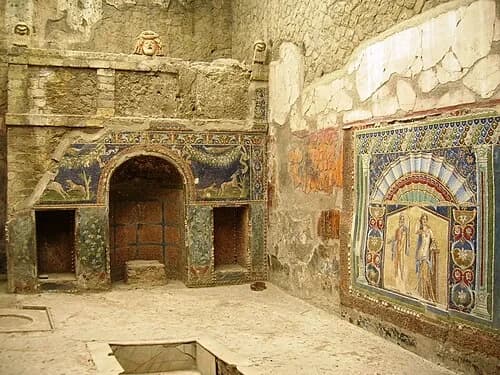
The Mosaic Nymphaeum
In the summer dining room, or triclinium, of the house sits this breathtaking wall fountain, known as a nymphaeum. While most mosaics in the ancient world were made from small stone tesserae, the artists here used something much more expensive: glass paste, or pasta di vetro. These small, man-made cubes were colored with cobalt and gold, giving the fountain a brilliant, luminous quality. When water cascaded over the surface, the light would have caught the glass, creating a shimmering, glittering effect that would have dazzled guests during a banquet. The central niche would have held a statue, and the surrounding walls are decorated with elaborate floral patterns and shells. This type of wall mosaic was a high-status luxury, appearing only in the most affluent homes. It transformed a functional fountain into a major piece of decorative art. The use of glass allowed for a much broader and more vibrant color palette than natural stone could provide, especially the deep blues that dominate this scene. You can still see the calcified deposits from the ancient water source that once fed the fountain, a reminder of its original function.
Want to hear the rest?
Download the Stanza app to unlock all 43 stops and the complete guided audio tour.
Frequently Asked Questions
How long does the Herculaneum audio tour take?
The Herculaneum audio guide includes 43 narrated stops. Most visitors spend 45 minutes to 1.5 hours exploring the complete tour, though you can listen at your own pace and skip or revisit any stop.
Is the Herculaneum audio guide available in my language?
Stanza supports 15 languages: English, Spanish, French, German, Italian, Portuguese, Russian, Japanese, Chinese, Korean, Arabic, Hindi, Polish, Dutch, Hebrew. Check the guide in the app to confirm the languages currently available for this tour.
Can I use the audio guide offline at Herculaneum?
Yes! Download the complete Herculaneum tour — including all audio, maps, and images — before your visit. The Stanza app works completely offline, so you don't need WiFi or mobile data at the venue.
How much does the Herculaneum audio guide cost?
The Stanza app is free to download. The current listed price for the Herculaneum audio guide is $5.99; app-store region and currency may affect the final price.
How do I use the Stanza audio guide at Herculaneum?
Download the free Stanza app, search for "Herculaneum", and download the tour. When you arrive at the venue, the app uses GPS to detect your location and automatically plays the relevant narration as you move between points of interest — completely hands-free.
What makes the Stanza audio guide different from other Herculaneum tours?
Stanza offers GPS-triggered narration that plays automatically as you walk through Herculaneum — no need to manually select stops. The tour is available in 15 languages, works fully offline, and includes 43 expertly narrated stops with images and historical context.
What other audio guides are available near Herculaneum?
Stanza offers multiple audio guides in Ercolano, Italy and nearby areas. After downloading the app, browse the map to discover all available tours near Herculaneum. Each guide can be downloaded for offline use.