Stanza · Audio guide
Basilica di San Nicola Audio Guide
A place to remember. A story to take with you.
The Pontifical Basilica of Saint Nicholas is a church located in Bari, southern Italy. It holds wide religious significance throughout Europe and the Christian world.
Download Stanza, then search for “Basilica di San Nicola”.
About the tour
One guide. Your kind of visit.
The Pontifical Basilica of Saint Nicholas is a church located in Bari, southern Italy. It holds wide religious significance throughout Europe and the Christian world.
Ready when you are.
- 01Get the free Stanza app.
iOS & Android
- 02Find your guide.
“Basilica di San Nicola”
- 03Download before you go.
Works offline
Audio guide / 12 narrated stops
Inside the guide
Get to know a few of the stories before you go. Open a stop to read more.
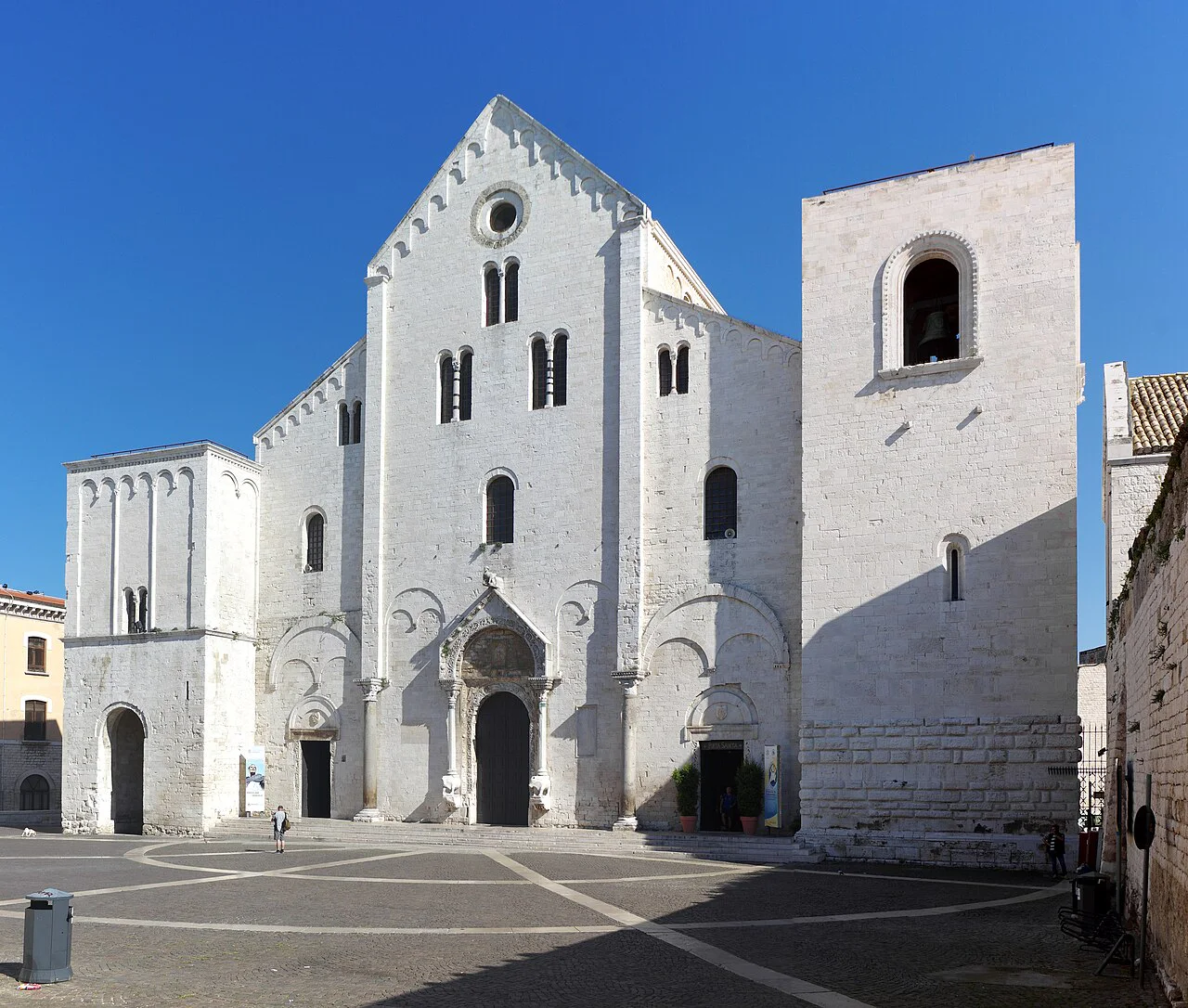
01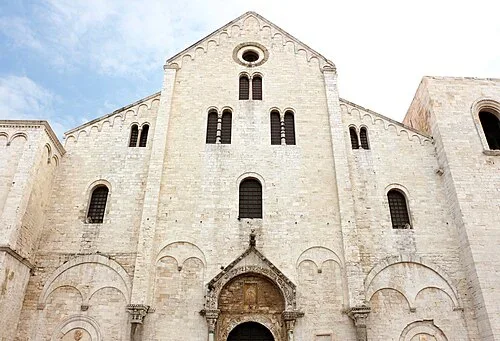 Piazza San Nicola and the Western Fortress Facade
The Western Facade
Saint Nicholas's relics came to Bari from Myra, a city in what is now Turkey. When Myra fell under Muslim rule, some saw a chance to move the saint's remains somewhere safer. Venice wanted them too, and the two cities competed for the prize. Bari won. The relics were carried off right under the noses of their Greek guardians and their Muslim rulers. They landed safely at Bari on the ninth of May, 1087. According to a legend, the saint had chosen Bari as his burial place while passing through on his way to Rome. Work on a new church to shelter the relics began that same year. It was finished and consecrated in 1197, under Italo-Norman rule. From the outside, it looks more like a castle than a church. Two low, massive towers frame the pale front. The church was used as a castle several times in its history.
Photo: Sailko · CC BY 3.0
02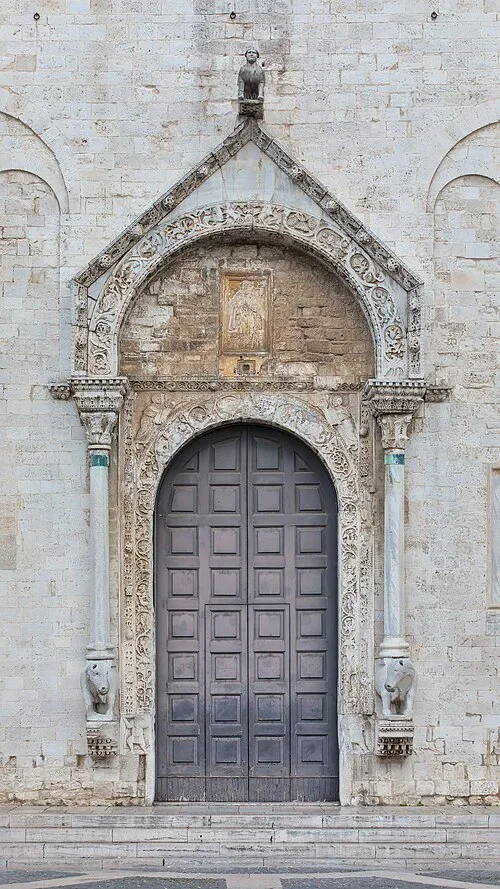 Piazza San Nicola and the Western Fortress Facade
The Central Portal
Before the church was built, this area had been home to the Byzantine governor, known as the Catapan. Many accounts say the carved stone around the main door was reused from the Catapan's earlier buildings. Which pieces are reused, and which were carved new, is not clear. A small canopy over the doorway rests on two columns. Carved animals sit at the foot of each column. Inside the arch, a framed relief fills the space above the door. A small carved figure sits at the peak of the gable. The door is dark and divided into square panels.
Benjamin Smith · CC BY-SA 4.0
03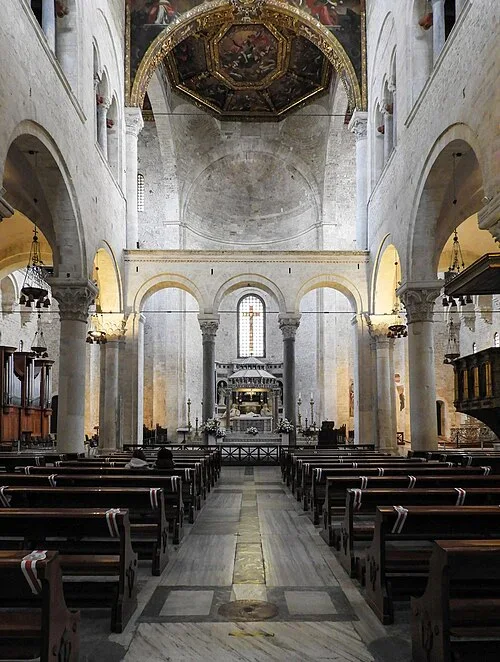 The Central Nave and Gilded Baroque Ceiling
The Central Nave and Aisles
The inside is divided into three long spaces. A central nave runs toward the altar, flanked by two side aisles. Columns and pilasters separate them, and the columns are granite. All twelve columns were taken from older buildings. Above each aisle runs a gallery called the matronaeum. It was set aside for women, and it opens onto the nave. Three arches lead from the nave into the presbytery, the raised area around the altar. Three more arches cross the nave itself. They were added in the fifteenth century, after an earthquake left the building unsafe. This was the first church built to this design. Many later churches in the region copied it.
Listen in the appPhoto: Federica.tamburini.75 · CC BY-SA 4.0
04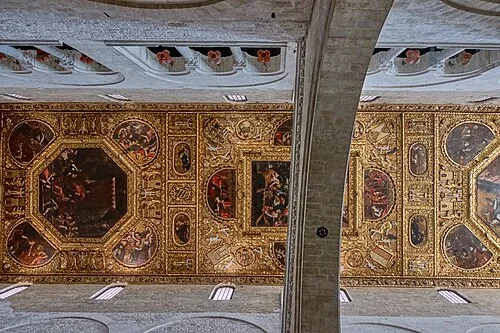 The Central Nave and Gilded Baroque Ceiling
The Gilded Wooden Ceiling
In the seventeenth and eighteenth centuries, the church was heavily remodelled. It took on a Baroque look, and its original Romanesque character was changed. Restorers began work in 1925. They carried on until 1930. Then, in the 1950s, they came back. Their work removed most of the Baroque additions and brought back the Apulian Romanesque style. What survived was the ceiling, carved in wood and covered in gold. Its frames hold painted canvases, some octagonal and some round. The canvases are by the painter Carlo Rosa.
Listen in the appPhoto: Jean-Christophe BENOIST · CC BY-SA 4.0
05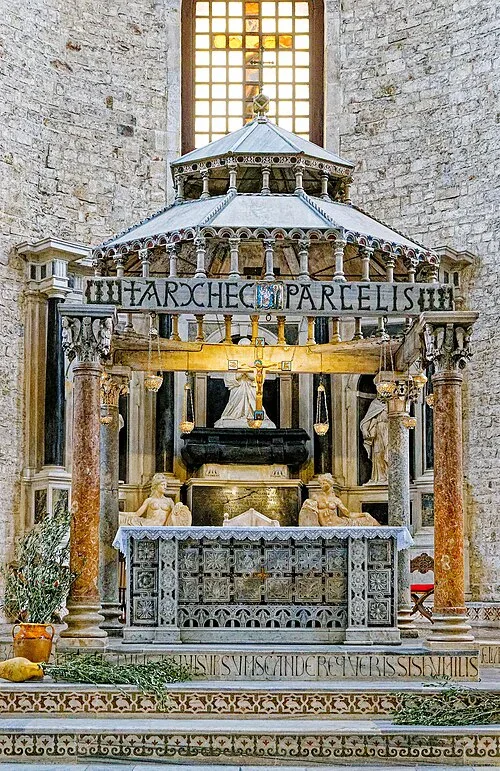 The Presbytery: Ciborium, Cathedra, and Royal Apse
The Ciborium of Eustazio
Over the high altar stands a canopy called a ciborium. It is named after Eustazio, the man who commissioned it. It dates from the twelfth century. It is considered the oldest of its kind in Puglia. Four columns carry it, made of breccia, a stone of broken fragments. The front two are red, and the back two are violet. Two pyramid-shaped roofs rise one above the other, each with an eight-sided base. The design borrows a motif from Roman architecture, a deliberate nod to classical art. The carved tops of the front columns show angels at their corners.
Listen in the appPhoto: Holger Uwe Schmitt · CC BY-SA 4.0
06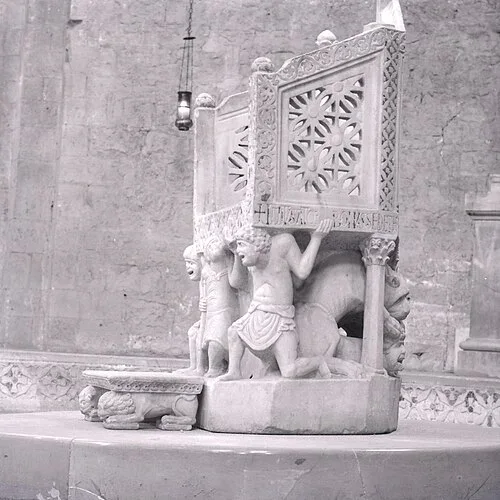 The Presbytery: Ciborium, Cathedra, and Royal Apse
The Marble Cathedra of Abbot Elia
Elia's marble throne is counted among the most important Romanesque carvings in southern Italy. A cathedra is a bishop's throne. Elia had been abbot of the nearby monastery of Saint Benedict, and he was later named the first archbishop. An inscription on the back of the seat links the throne to him. Its date is debated. Some have dated the work, from the inscription, to between 1098 and 1105. If that is right, it would be among the first works of Apulian Romanesque. Others think the strength and maturity of the carving point to the first half of the twelfth century. One English account places it in the late eleventh century. Carved figures seem to hold up the seat. Two lionesses attack two men on its back, and the back is filled with pierced panels of rosettes.
Listen in the appPaolo Monti · CC BY-SA 4.0
07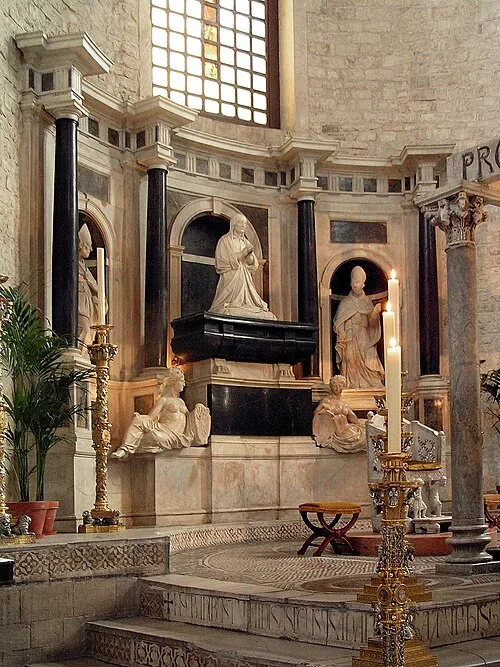 The Presbytery: Ciborium, Cathedra, and Royal Apse
The Mausoleum of Bona Sforza
The funeral of Queen Bona Sforza was held in this basilica in 1557. She was queen consort of Poland, meaning she was queen through her husband, the king. She was also the last duchess of Bari. She rests in a marble mausoleum set against the apse, behind the high altar. It is a Renaissance tomb. Its carvers are not named, but they worked in the late sixteenth century. A white marble figure of a woman stands above the dark tomb, her hands clasped. Two figures stand in niches on either side of her. Reclining figures lie at the foot of the monument.
Listen in the appPorcullus Marek Postawka · CC BY 3.0
08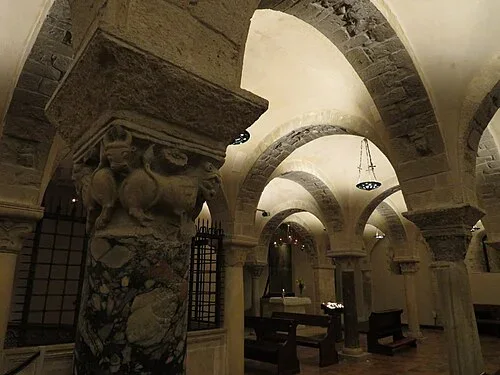 The Subterranean Crypt and Sacred Relic Shrine
The Crypt's Forest of Columns
Under the church lies a crypt, an underground hall held up by twenty-six columns. It has three apses, the rounded recesses at its far end. It is as wide as the transept, the arms of the church that cross the nave. The columns have carved tops in Byzantine and Romanesque styles. The roof is made of thirty-six sections, each a cross vault where two arches meet. One column stands out, with a carved top showing animals. Pope Urban the Second was present when the crypt was consecrated in 1089. The church above took more than a century longer to finish.
Listen in the appPhoto: Enric · CC BY-SA 4.0
09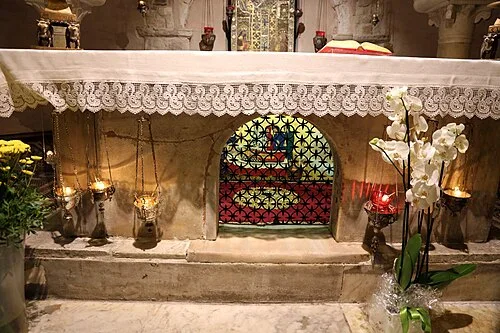 The Subterranean Crypt and Sacred Relic Shrine
The Tomb of Saint Nicholas
Beneath the central altar of the crypt rests the body of Saint Nicholas. The altar front is covered by a white cloth, and a small arched recess with coloured glass sits beneath it. Candles and flowers stand nearby. Each year, on the sixth of December, the basilica's clergy lower a flask into the tomb. They draw out some myrrh, a substance believed to seep from the relics. Containers of this myrrh are sent all over the world. Believers have reported miracles after being anointed with it. Churches that follow the older Julian calendar keep the same feast on the nineteenth of December. So the feast is celebrated twice in Bari, and both celebrations are kept with great solemnity.
Listen in the appPhoto: Sailko · CC BY-SA 4.0
10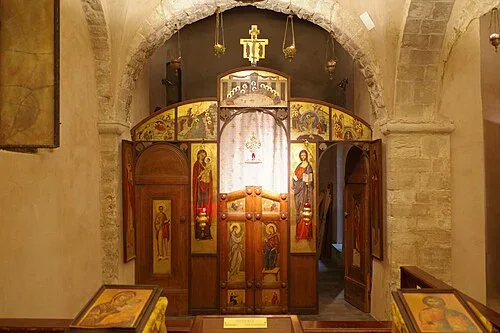 The Subterranean Crypt and Sacred Relic Shrine
The Orthodox Chapel in the Crypt
One of the side apses of the crypt is reserved for Orthodox worship. Its painted wooden screen, called an iconostasis, carries icons and has doors at its centre. Lamps hang in the vaulted space. The basilica is counted among the main places of ecumenism between Christian churches. In 1098, while the basilica was still unfinished, it hosted the Council of Bari. In 1951, the Dominicans took over the basilica. The canons had served there since the first half of the twelfth century. The Dominicans have paid close attention to ecumenical work. In 1968, Pope Paul the Sixth issued an apostolic constitution that praised the basilica's impulse to the ecumenical movement. Pilgrimages from Eastern Europe have grown greatly since the Iron Curtain fell.
Listen in the appPhoto: Berthold Werner · CC BY-SA 3.0
- 11
The Lions' Portal (Portale dei Leoni)
Lions, harvest reliefs and a possible Arthurian battle carved around the door on the north side.
- 12
The Apse Window and Elephant Supports
A great apse window lost to housing, partly recovered, and the carved elephants that still frame it.
Basilica di San Nicola
Frequently asked questions
How much does the guide cost?
Free app download. Listed guide price: $0.99. Guide price shown in the app. Audio guide only. Venue admission is separate.
Can I listen without internet?
Yes. Download the guide’s audio, images, and maps in the app before your visit. Your downloaded content is then available offline.
Can I listen in my language?
This audio guide is available in 15 languages, including English.
Do I need to follow a schedule?
No. This is a self-guided experience. Choose your stops, pause whenever you like, and return to a story at your own pace.
At your own pace
Explore Basilica di San Nicola.
Download Stanza, then search for “Basilica di San Nicola”.
Free app download · Guide price shown in the app
Keep exploring
Audio guides — Italy
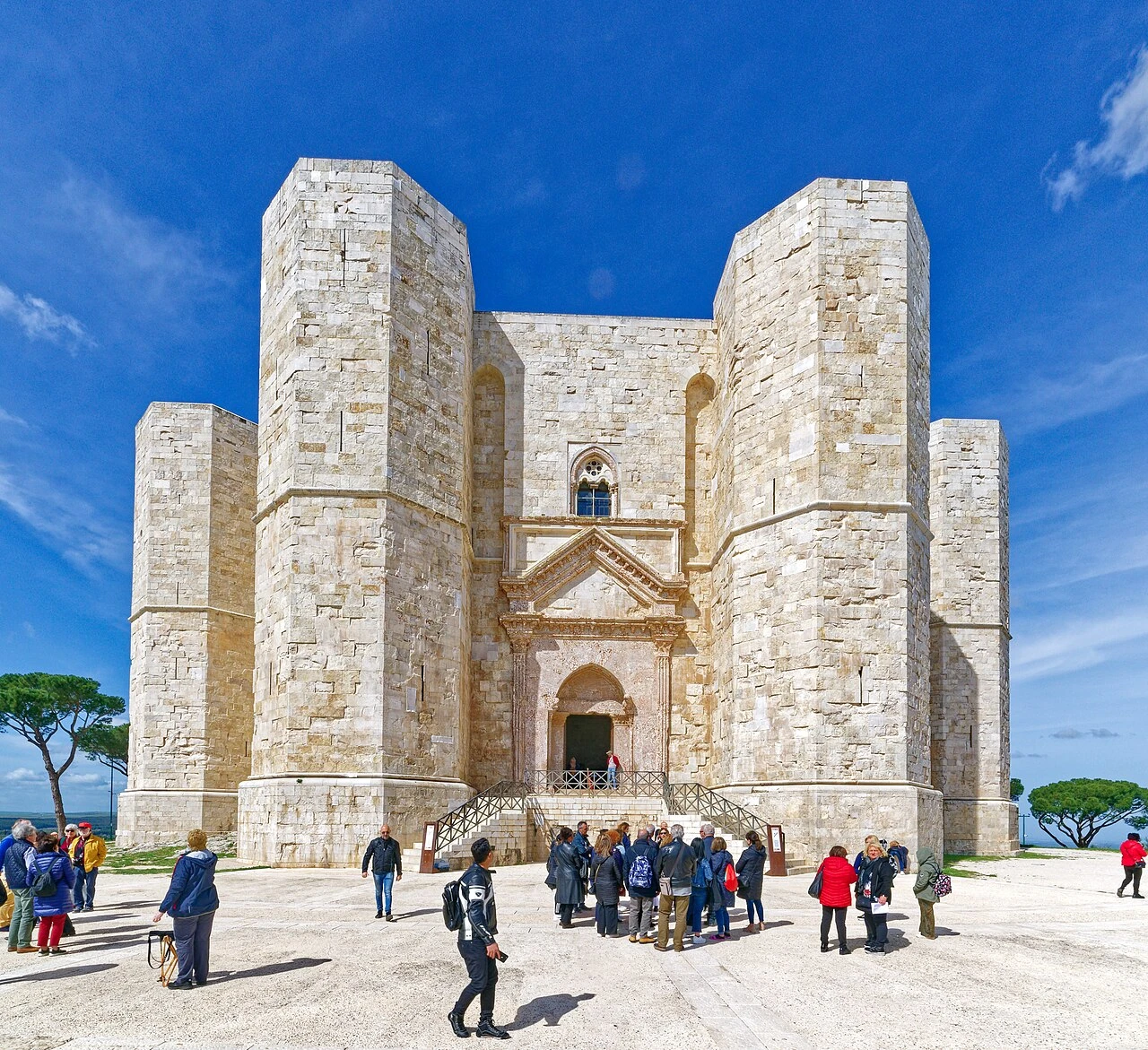
Andria · 50 km
Castel del Monte
Content & sources
Photo: Holger Uwe Schmitt · CC BY-SA 4.0
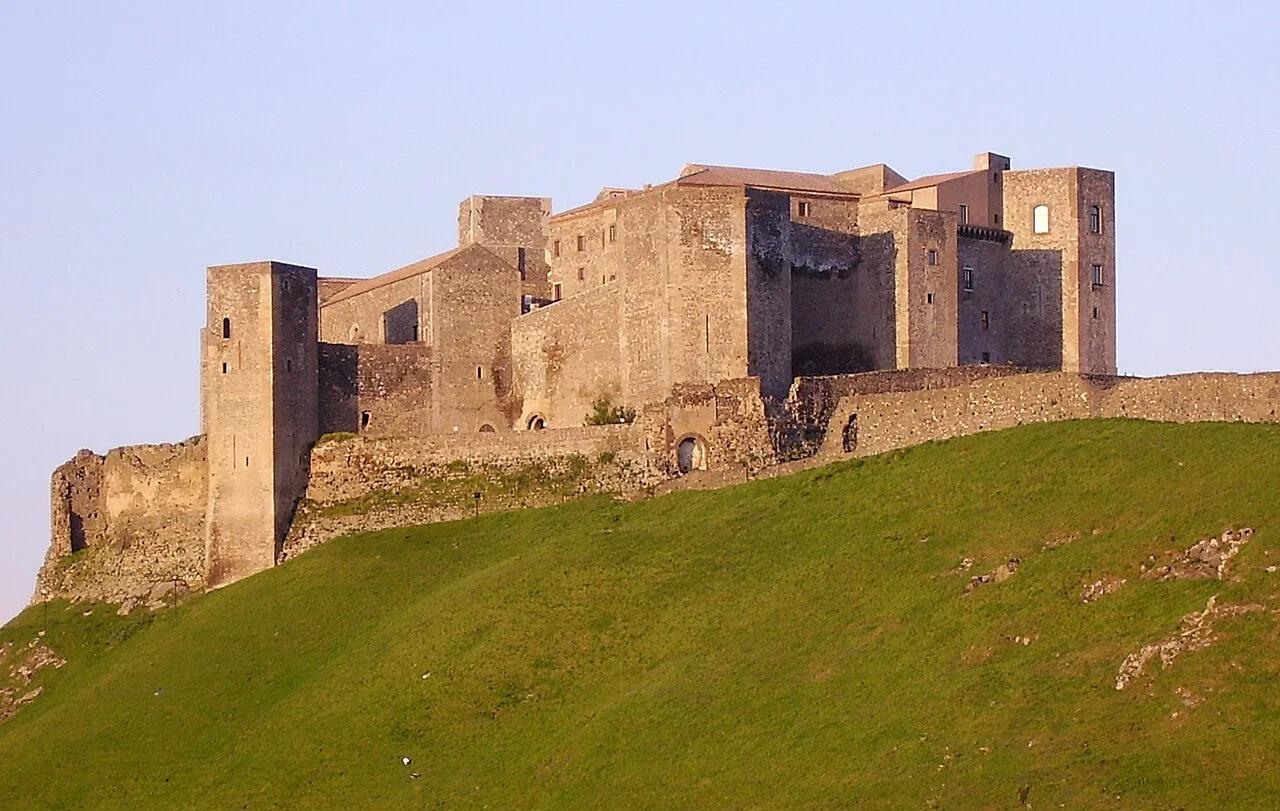
Melfi · 103 km
Castello di Melfi
Content & sources
No machine-readable author provided. Mikils assumed (based on copyright claims). · CC BY-SA 3.0
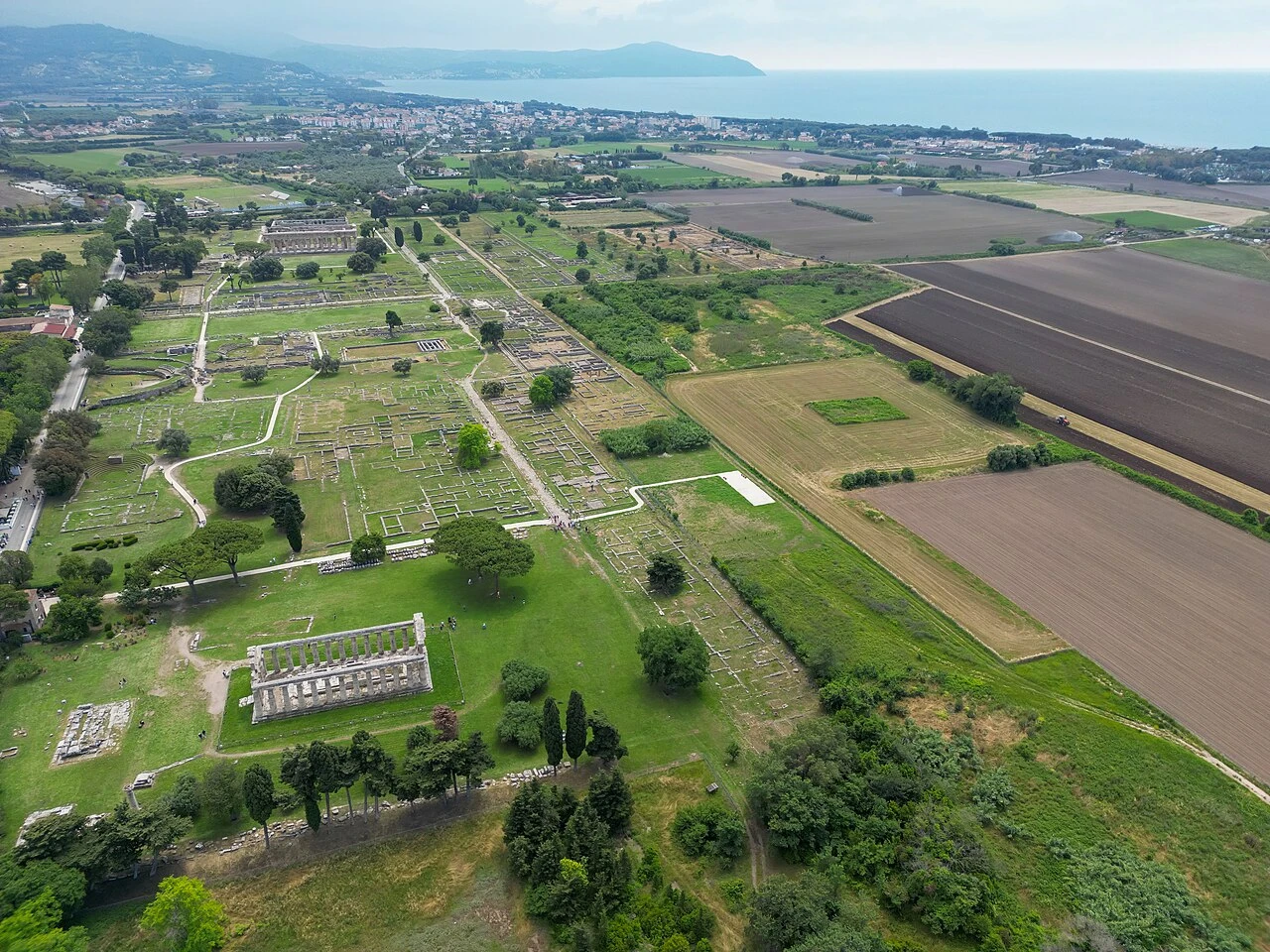
Capaccio Paestum
Area Archeologica di Paestum
Content & sources
Paestum · CC BY-SA 4.0
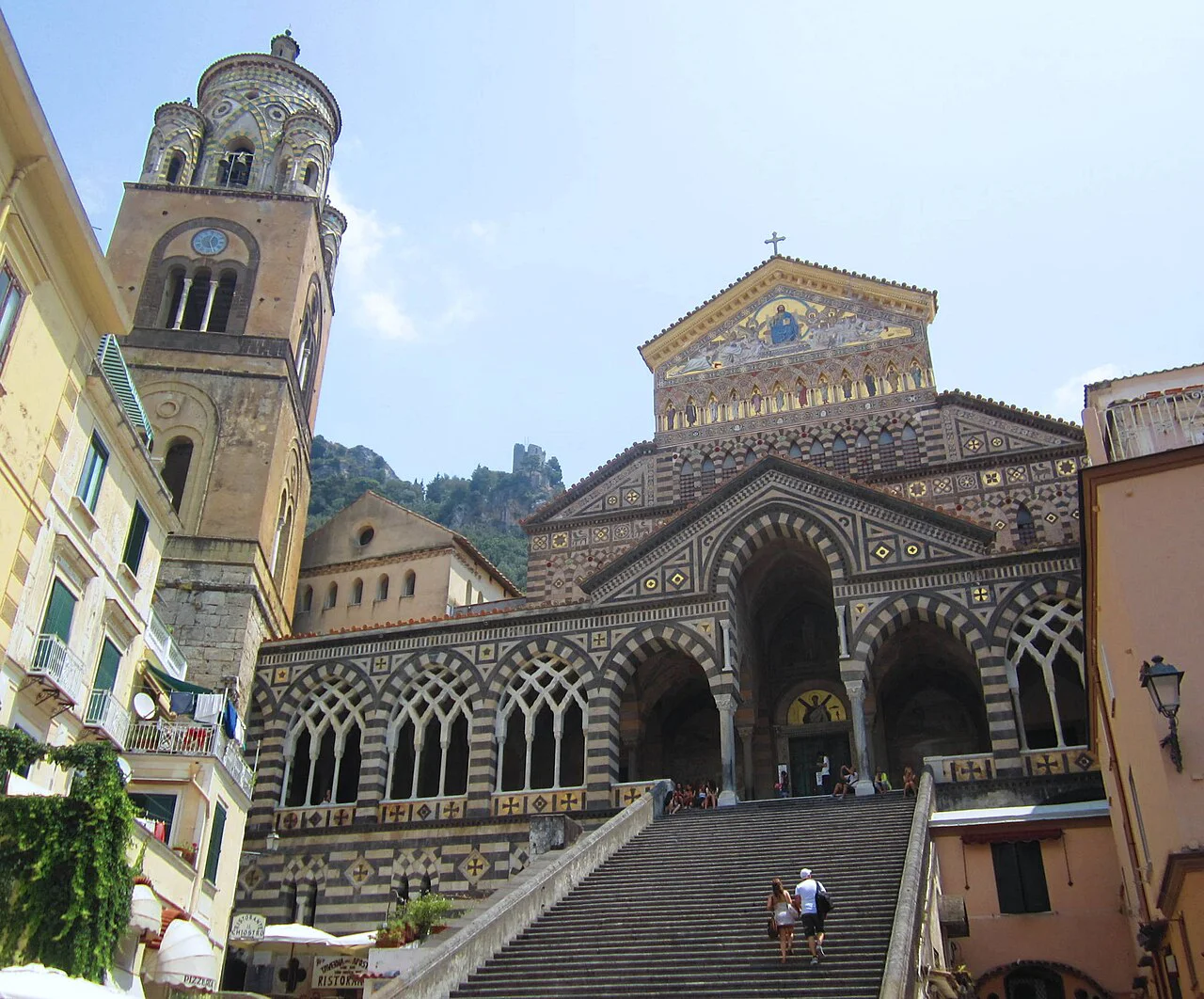
Amalfi
Duomo di Amalfi
Content & sources
Photo: Luca Aless · CC BY-SA 3.0