Stanza · Audio guide
Palazzo Pontificio Audio Guide
A place to remember. A story to take with you.
The Papal Palace of Castel Gandolfo is a 17th-century complex that served for centuries as a summer residence for the pope. The main building has functioned as a museum since October 2016.
Download Stanza, then search for “Palazzo Pontificio”.
About the tour
One guide. Your kind of visit.
The Papal Palace of Castel Gandolfo is a 17th-century complex that served for centuries as a summer residence for the pope. The main building has functioned as a museum since October 2016.
Ready when you are.
- 01Get the free Stanza app.
iOS & Android
- 02Find your guide.
“Palazzo Pontificio”
- 03Download before you go.
Works offline
Audio guide / 13 narrated stops
Inside the guide
Get to know a few of the stories before you go. Open a stop to read more.
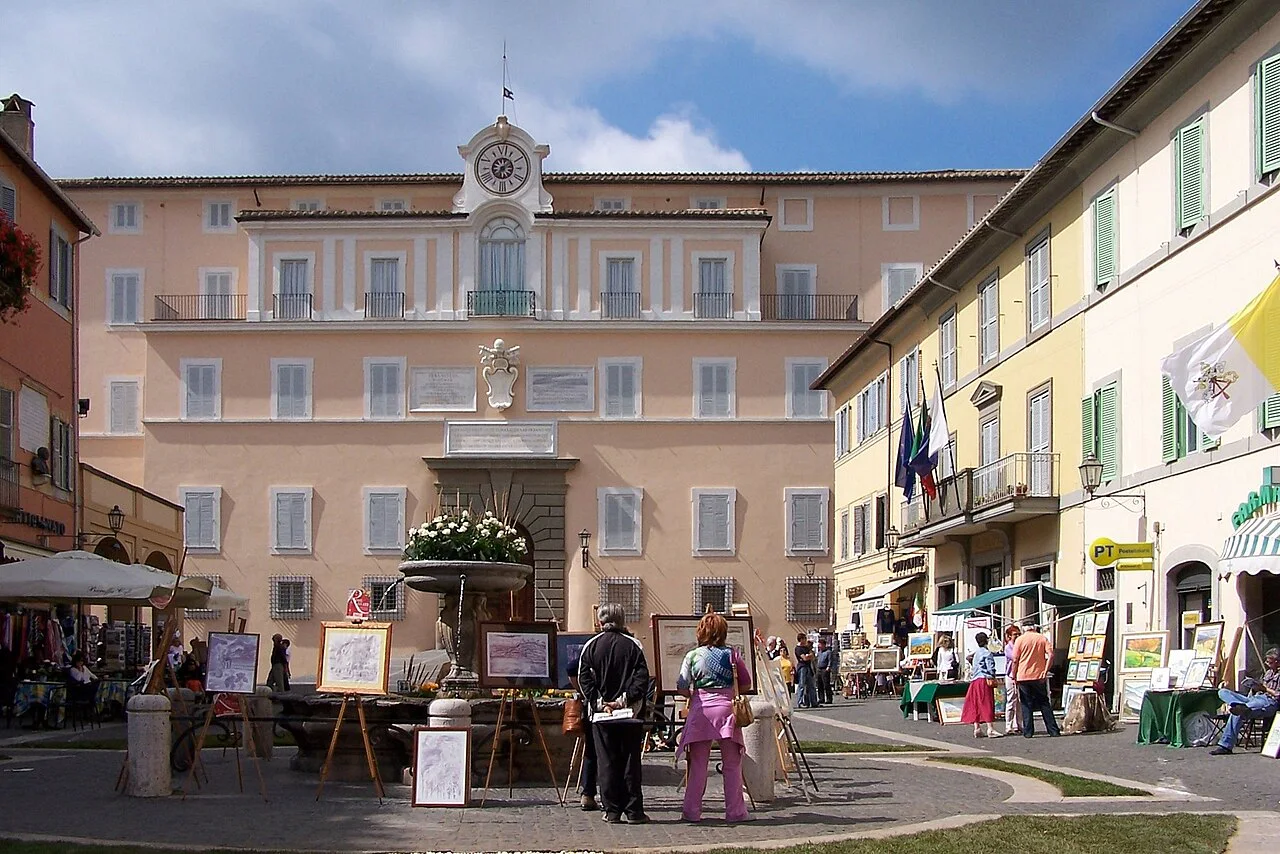
01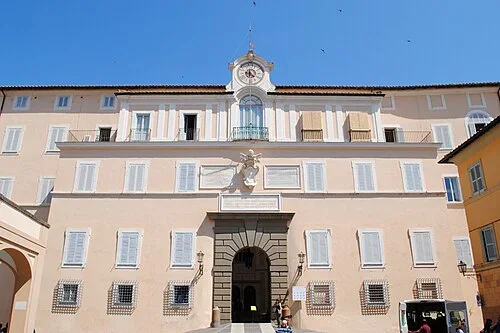 Main Facade and Piazza della Libertà
Main Facade on Piazza della Libertà
Welcome to the Pontifical Palace of Castel Gandolfo, the summer retreat the popes built above Lake Albano to escape Rome's heat. For centuries this was where the leader of the Catholic Church came to rest, receive guests and work through the warm months. The legal set-up is unusual. Under the Lateran Treaty of 1929 this remains Italian ground, but it belongs to the Holy See and enjoys the same extraterritorial standing as an embassy. Italian authorities may not enter without the Holy See's consent, and the property is exempt from Italian taxes. The newest chapter is brief. Since October 2016 the palace itself has been a museum. Pope Benedict XVI came straight here when he resigned in 2013, and Pope Francis joined him for lunch a few weeks later. And in 2025, Pope Leo XIV brought summer stays back to the complex, reviving a tradition his recent predecessors had let lapse.
Marek Mróz · CC BY 4.0
02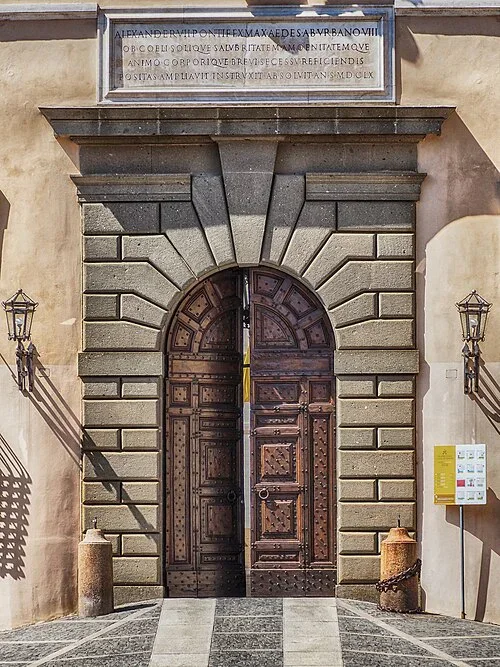 Main Facade and Piazza della Libertà
The Great Portal and Alexander VII Inscription
The story of this building is carved in Latin on the plaque above the great door. Pope Urban VIII began the palace in 1623, giving the design to Carlo Maderno, who built it with his assistants. Curiously, Urban never lived in the palace itself. He preferred the nearby Villa Barberini, which belonged to his nephew Taddeo. The first pope to vacation here was Alexander VII. He completed the main facade and the western wing, and Gian Lorenzo Bernini had a hand in the work. Alexander's inscription explains why anyone wanted the place at all. It records that he enlarged, furnished and completed Urban VIII's house in the year 1660. The reason given is the healthfulness and delight of sky and sun, to refresh mind and body in a short retreat. Popes came to this hill for its air.
Photo: 66colpi · CC BY-SA 4.0
03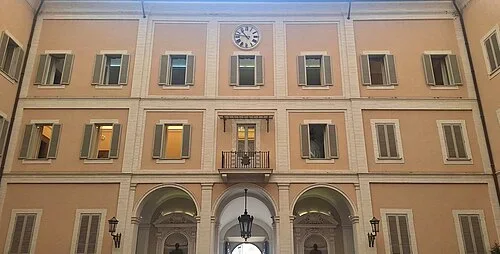 Courtyard of Audiences and Grand Staircase
Courtyard of Audiences
The grand ceremonial staircase, the Scalone d'Onore, rises from this courtyard to the state floor. The courtyard itself is the Cortile delle Udienze, the Court of Audiences, a name that speaks of the crowds who once gathered here hoping to see the pope. Then the palace fell silent. In 1870, with the end of the Papal States, the popes shut themselves inside Vatican City in protest against the Italian state. For more than sixty years they refused to use any residence outside Rome, and this one stood empty. The quarrel was eventually settled, and Pope Pius XI had the buildings modernized and resumed the summer residence in 1934. He also stitched the scattered properties together. His architect Giuseppe Momo built a loggia joining the palace to Villa Cybo, and a bridge carrying that villa's garden across the public road to Villa Barberini.
Listen in the appPhoto: Cruz.croce · CC0
04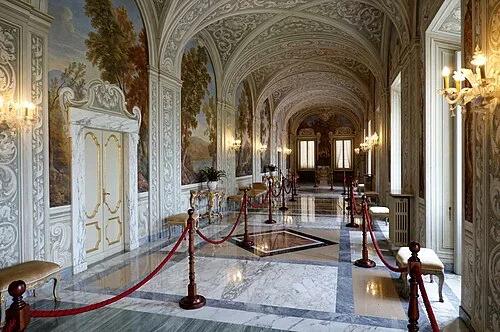 Courtyard of Audiences and Grand Staircase
Piano Nobile State Rooms
The state floor is arranged like a ceremony in stone. Its rooms follow the hierarchical order of Vatican ceremonial, echoing the Seconda Loggia of the Apostolic Palace in Rome. The sequence traces the pope's household from the outer doors inward: first the grooms' room, which houses the pontifical sediari, then the Noble Guards, whose room keeps memories of Pius IX. Next come the chamberlains of cloak and sword, their walls hung with copies after Murillo and Guido Reni. The most telling room belongs to the Bussolanti. There hangs a copy of the papal bull of the Concordat of 1801. Beside it are Jean-Baptiste Wicar's portraits of Pius VII and his secretary of state, Ercole Consalvi, the two men whose names that agreement carries.
Listen in the appRichard Mortel · CC BY 2.0
05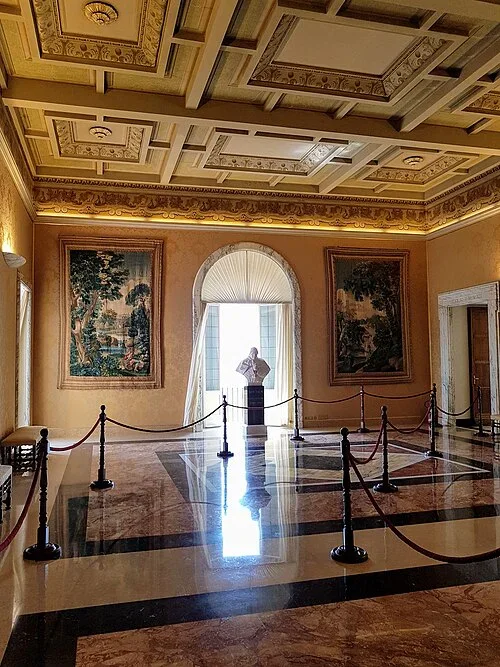 Hall of the Swiss Guard
Salone degli Svizzeri (Swiss Guard Hall)
The first great hall of the state floor belonged to soldiers. This was the quarters of the Swiss Guard, the corps that protects the pope, and it was also known as the Hall of the Germans. Until the restorations of the 1930s, four columns divided the room down the middle. On the original floor the guards left their marks: graffiti and scratches cut by the points of their halberds, the long pole-arms they carried on watch. Those traces belonged to the men who actually lived and stood guard here. The hall was later given a quieter role. A high relief of the Deposition from the Cross now decorates it, together with an eighteenth-century Madonna painted by Domenico Corvi.
Listen in the appPhoto: Gugganij · CC BY-SA 4.0
06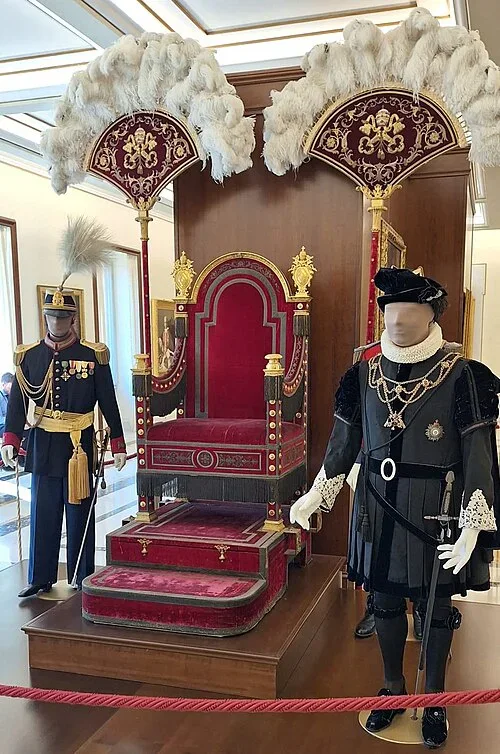 Hall of the Swiss Guard
The Papal Throne and Flabella
Papal ceremony was a matter of rank and proximity. Here the throne stands beneath two great flabella, ceremonial fans of white ostrich plumes marked with the papal emblems. In procession and at audience, fan bearers waved these beside the pope. The mannequins alongside wear the dress of the court's uniformed offices: the guards, the papal household in their formal liveries. The closer a man stood to the pope's body, the higher his office ranked. The state rooms of this floor follow that same order, from the outer corps inward to the throne itself.
Listen in the appPhoto: Cruz.croce · CC BY-SA 4.0
07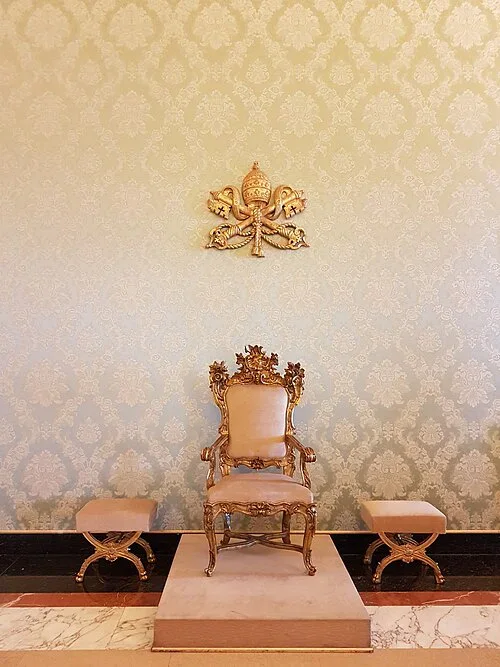 The Throne Room
Sala del Trono (Throne Room)
The throne room is the formal heart of the state floor. It dates to the era of Pope Innocent the Tenth, with walls of damask and the papal arms set above the throne. The chair itself stands empty, and that is the point: the pope sat here to receive officials and ambassadors in audience, and the room waited for him between times. Next door, the Consistory Room was decorated under Pius IX, with damask wall coverings and floors of polychrome marble. It holds two tapestries showing the Flight into Egypt.
Listen in the appPhoto: Gugganij · CC BY-SA 4.0
08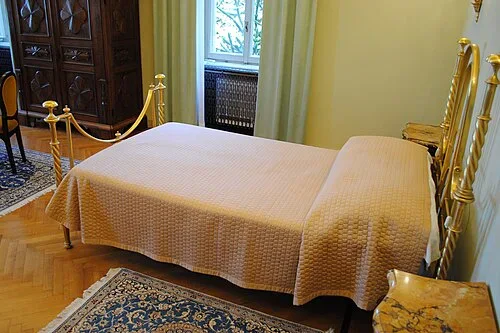 Private Papal Apartments and Bedroom
The Papal Bedroom
A simple bed stands in this room, and two heavy stories belong to the palace around it. Pius XII died here in 1958. Paul VI followed in 1978. Then there is the war. During the Second World War the palace opened as a sanctuary. Townspeople took shelter here from the bombing raids, and an unknown number of Jewish refugees found protection under the wing of the Holy See. In one raid in 1944, more than five hundred people died nearby, while thousands survived within these walls. A building made for one man's rest became a refuge for many.
Listen in the appMarek Mróz · CC BY 4.0
09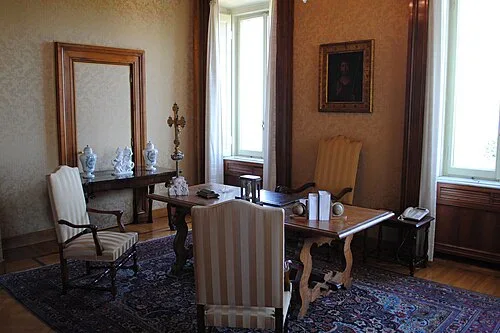 Private Papal Apartments and Bedroom
The Pope's Study
The study shows the palace as a place of work, not only of rest. Popes came here to govern through the summer, holding audiences and dealing with correspondence between walks in the gardens. The room was rearranged under Pius XI. The desk carries the arms of Pius VII, and the walls hold paintings attributed to Carlo Dolci and to Paolo Veronese. Pope John Paul II found the arrangement so useful that he called Castel Gandolfo the second Vatican. On summer Sundays he recited the Angelus prayer inside the palace courtyard, with the crowds gathered around him.
Listen in the appMarek Mróz · CC BY 4.0
10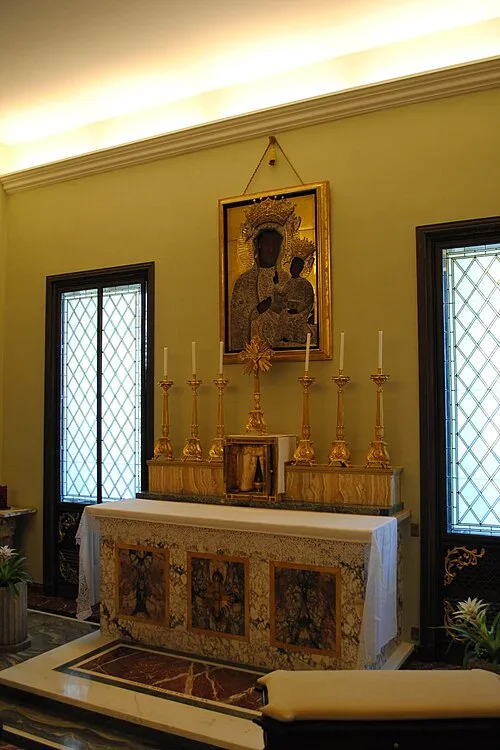 Private Papal Chapel
The Private Chapel and Our Lady of Częstochowa
The private chapel at the end of the apartment was Pius XI's own wish. Above its altar hangs a copy of the Madonna of Częstochowa, the dark-robed image venerated for centuries in Poland. The paintings are by the Polish artist Rosen, and they recall an earlier life: before he was pope, Achille Ratti had served as apostolic nuncio in Poland. He had the chapel filled with the things that remembered those years. The palace keeps an older place of prayer too. The Papal Chapel of Urban VIII is among the most ancient rooms in the building, frescoed by Simone Lagi and worked in stucco by the Zuccari brothers.
Listen in the appMarek Mróz · CC BY 4.0
- 11
The Specola Vaticana Dome
The 1934 observatory under the tower, and the inscription that joins worship with the stars.
- 12
The Observatory Telescope
Inside the dome: the long white telescope that was the working heart of a papal observatory.
- 13
The Moro Garden Terrace
Domitian's villa beneath the gardens, the Savelli castle bought in 1596, and an estate larger than Vatican City.
Palazzo Pontificio
Frequently asked questions
How much does the guide cost?
Free app download. Listed guide price: $0.99. Guide price shown in the app. Audio guide only. Venue admission is separate.
Can I listen without internet?
Yes. Download the guide’s audio, images, and maps in the app before your visit. Your downloaded content is then available offline.
Can I listen in my language?
This audio guide is available in 15 languages, including English.
Do I need to follow a schedule?
No. This is a self-guided experience. Choose your stops, pause whenever you like, and return to a story at your own pace.
At your own pace
Explore Palazzo Pontificio.
Download Stanza, then search for “Palazzo Pontificio”.
Free app download · Guide price shown in the app
Keep exploring
Nearby audio guides
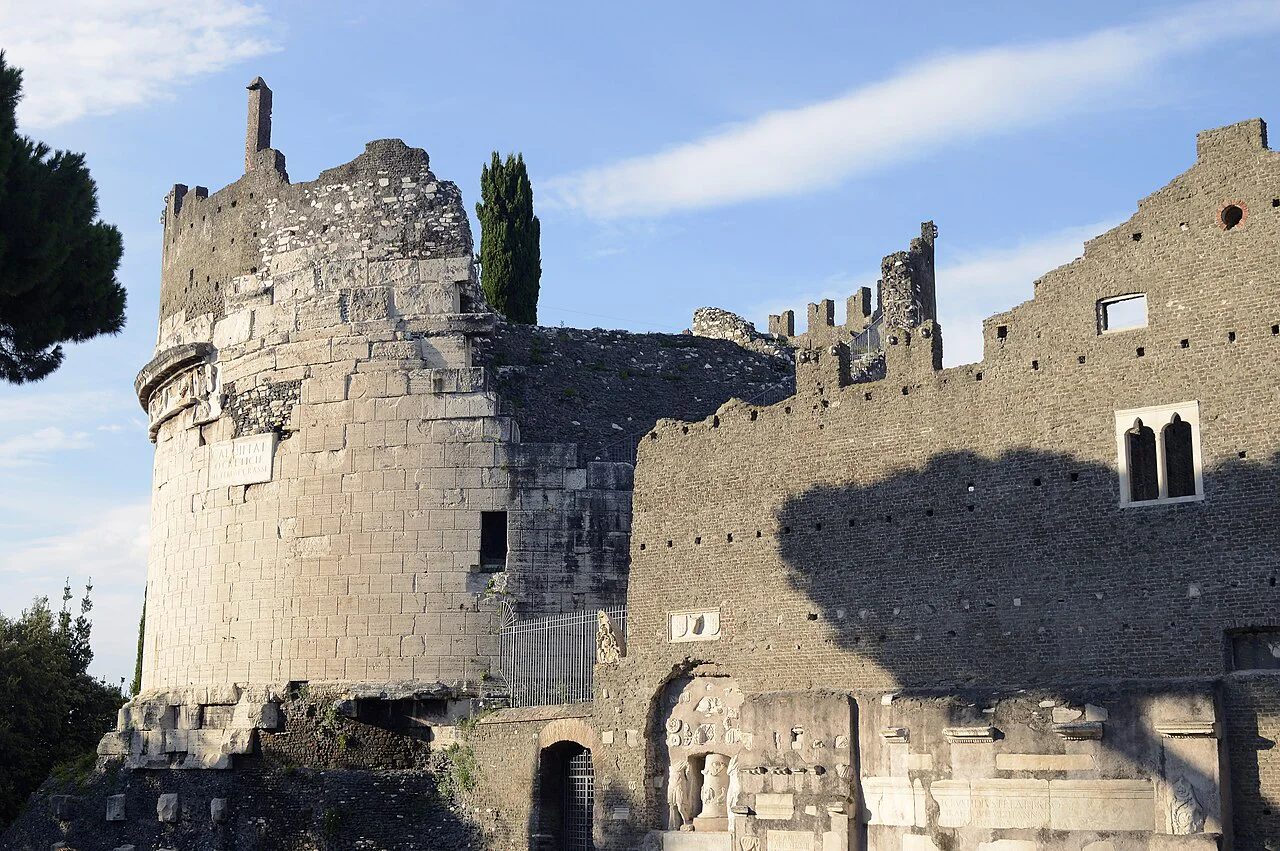
Rome · 16 km
Mausoleo di Cecilia Metella
Content & sources
Photo: Livioandronico2013 · CC BY-SA 4.0
Rome · 16 km
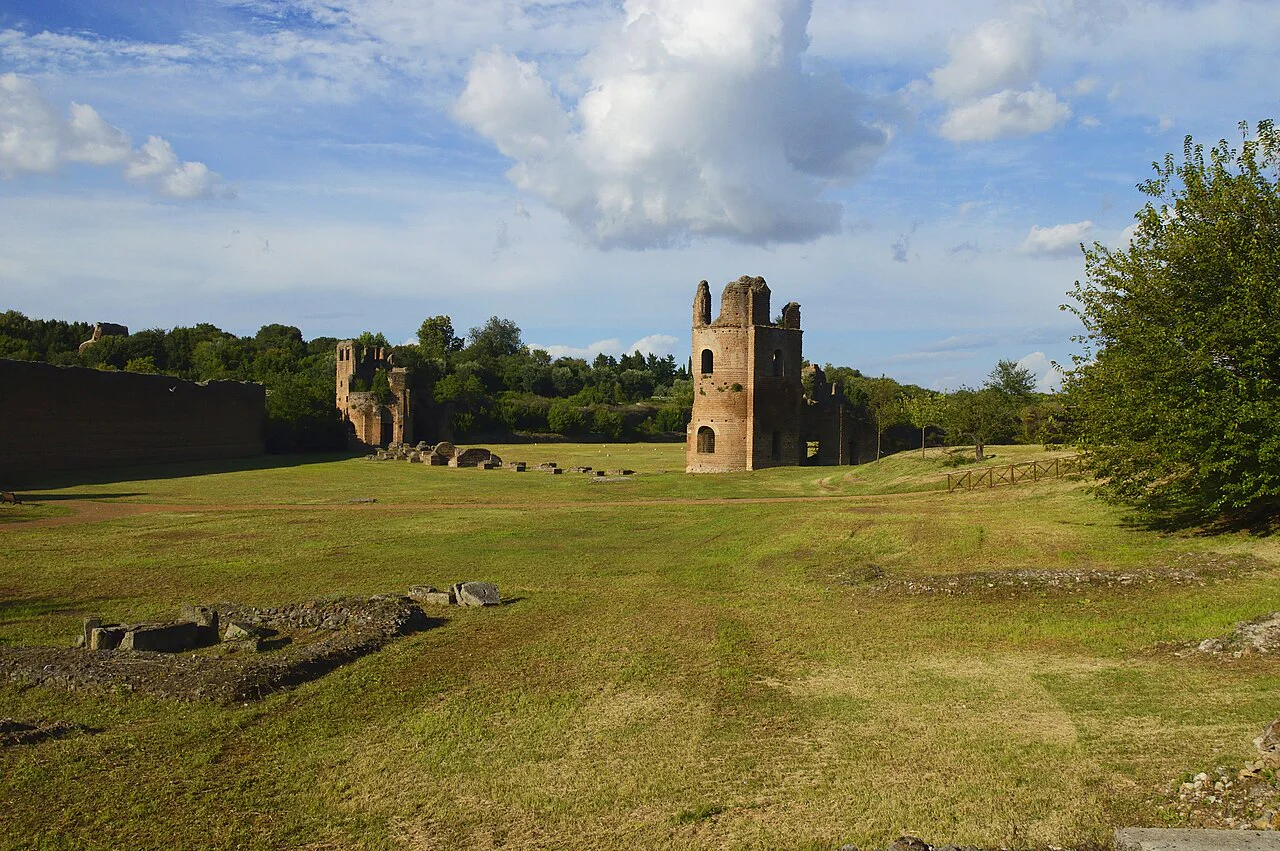
Circo di Massenzio
Content & sources
Photo: Livioandronico2013 · CC BY-SA 4.0
Rome · 16 km
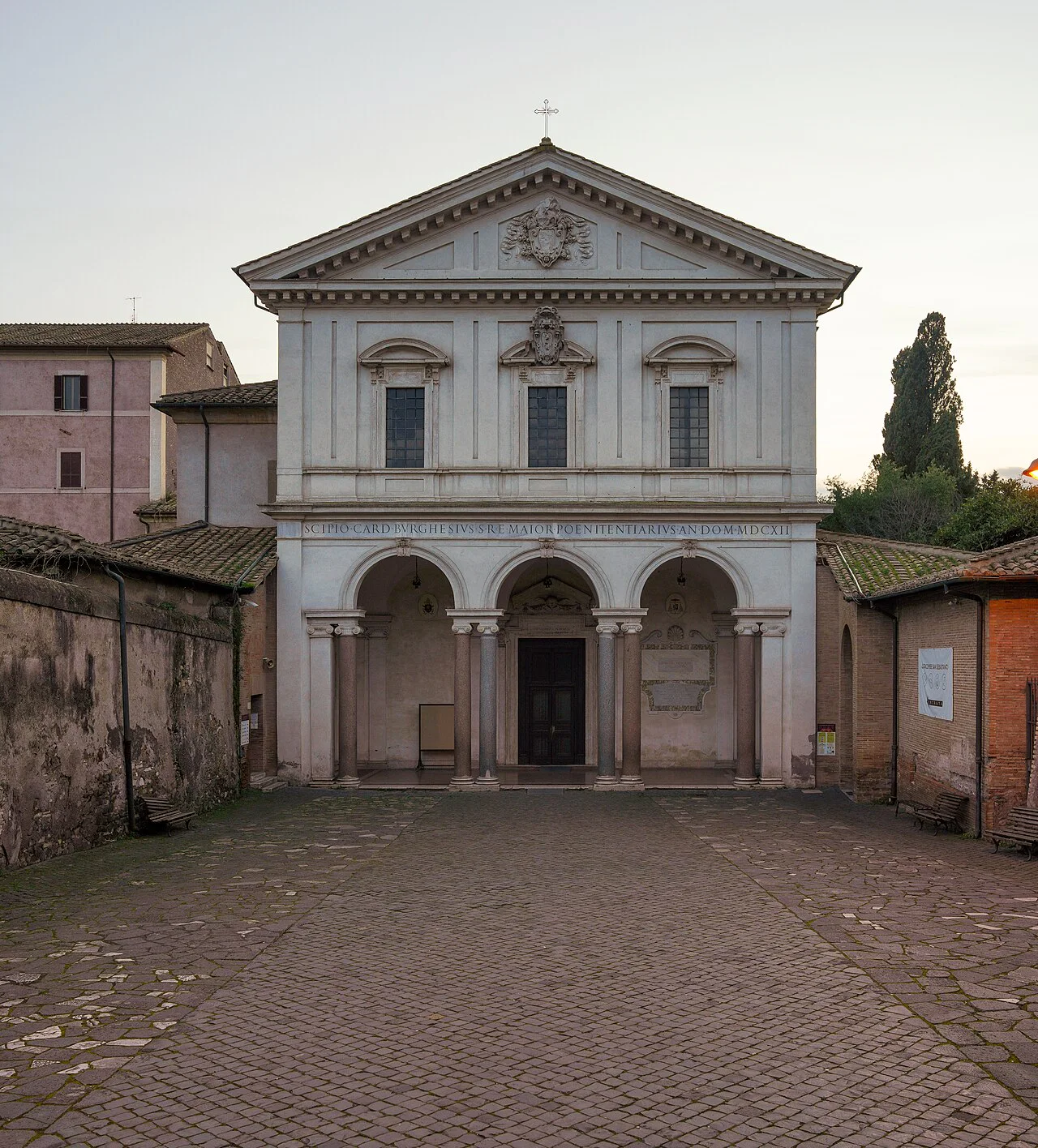
Basilica di San Sebastiano fuori le mura
Content & sources
Photo: NikonZ7II · CC BY-SA 4.0
Rome · 17 km
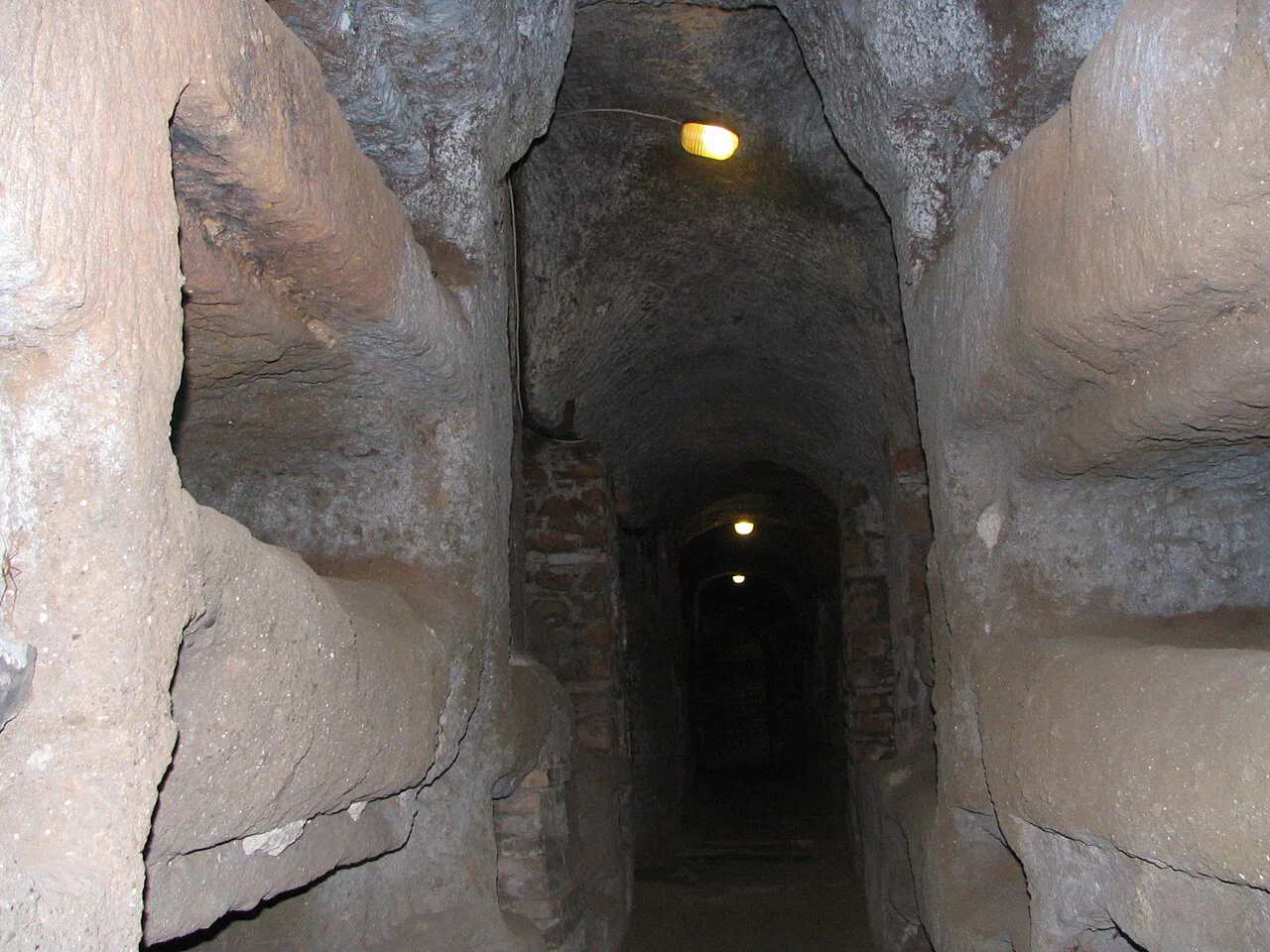
Catacombe di San Callisto
Content & sources
User GerardM on nl.wikipedia · CC BY-SA 3.0