Stanza · Audio guide
Catacombe di San Callisto Audio Guide
A place to remember. A story to take with you.
The Catacomb of Callixtus is one of the Catacombs of Rome located on the Appian Way. It is notable for containing the Crypt of the Popes, which held the tombs of several popes from the 2nd to 4th centuries.
Download Stanza, then search for “Catacombe di San Callisto”.
About the tour
One guide. Your kind of visit.
The Catacomb of Callixtus is one of the Catacombs of Rome located on the Appian Way. It is notable for containing the Crypt of the Popes, which held the tombs of several popes from the 2nd to 4th centuries.
Ready when you are.
- 01Get the free Stanza app.
iOS & Android
- 02Find your guide.
“Catacombe di San Callisto”
- 03Download before you go.
Works offline
Audio guide / 12 narrated stops
Inside the guide
Get to know a few of the stories before you go. Open a stop to read more.
01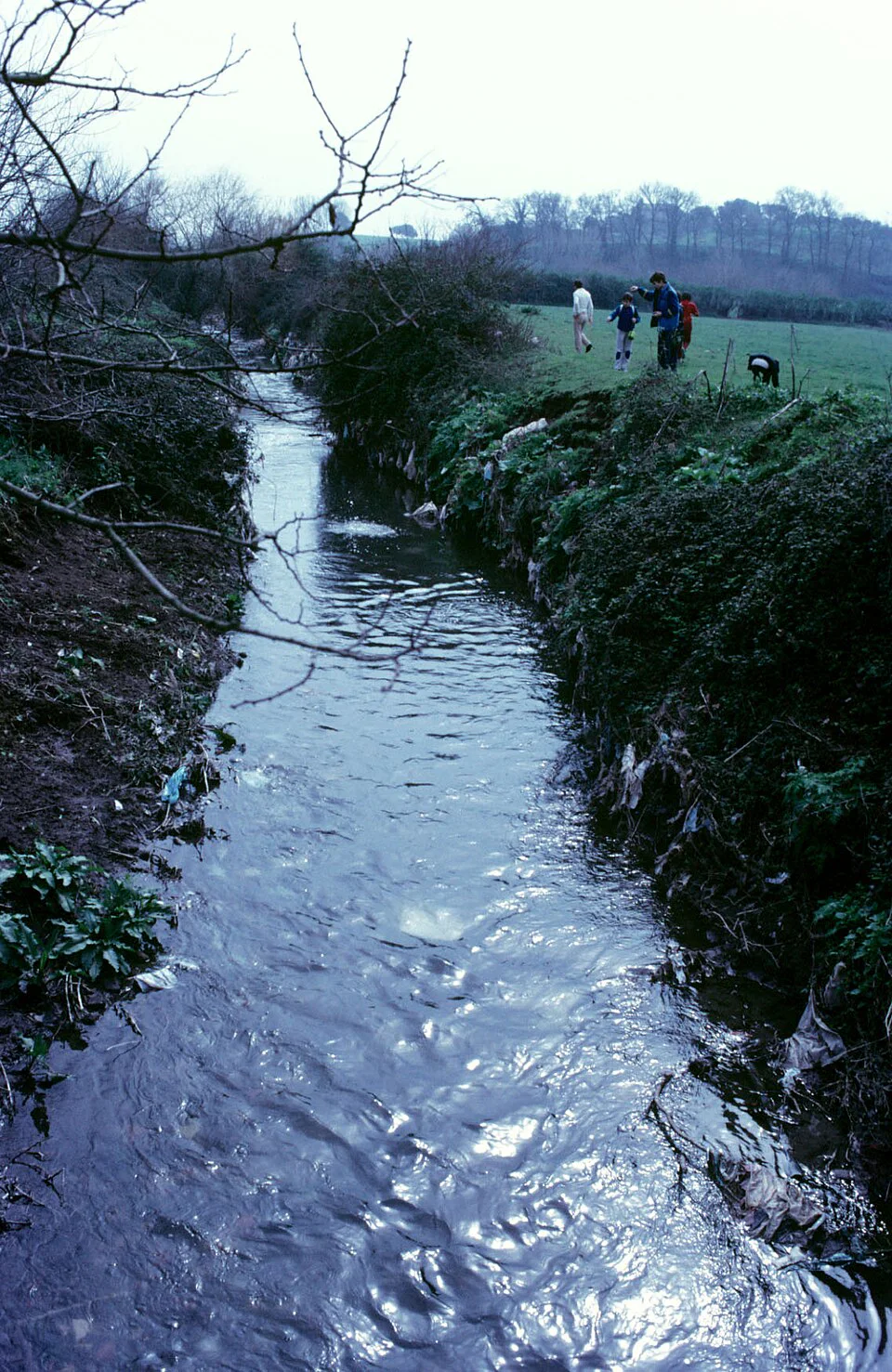 The Valley of the Caffarella and Site Entrance
The Almone Valley and the Entrance off the Via Appia
Welcome to the Catacomb of Callixtus, on Rome's ancient Appian Way. The road runs southeast from the city through open country, and a small stream, the Almone, crosses the valley here among fields and bare trees. Roman law kept burials outside the walls, so the roads out of the city were lined with tombs, and the Appian Way more than most. Christians did the same, burying their dead along this road in small underground burial grounds. Around the years 175 to 200, some of these private Christian hypogea already existed here. Then Pope Zephyrinus put a deacon named Callixtus in charge of the site, and Callixtus enlarged it into something new: a single cemetery belonging to the whole Roman Church. What began as private family burial ground became the community's official resting place. The story of that place begins underground, a few steps from this valley.
indeciso42 · CC BY-SA 4.0
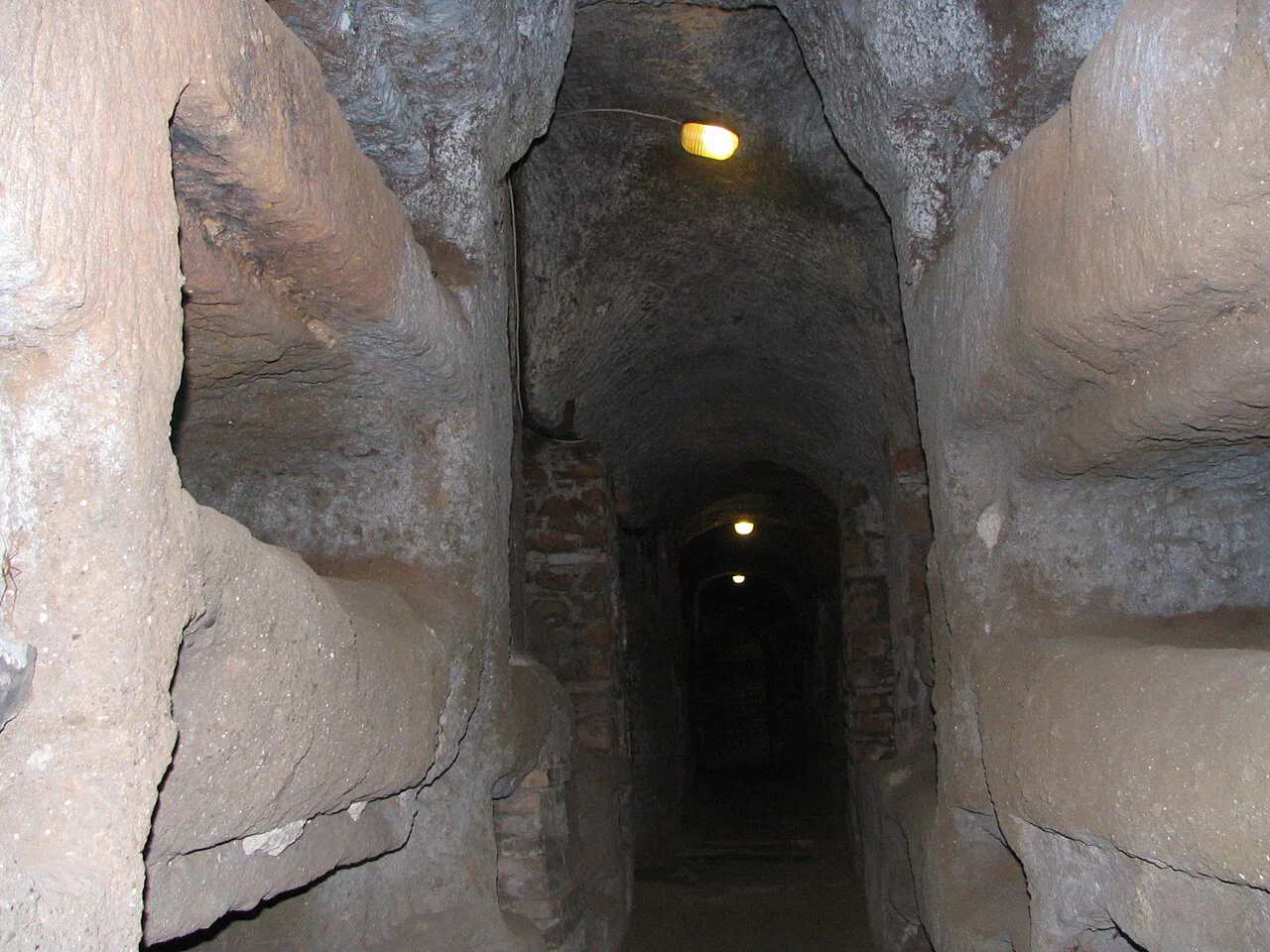
02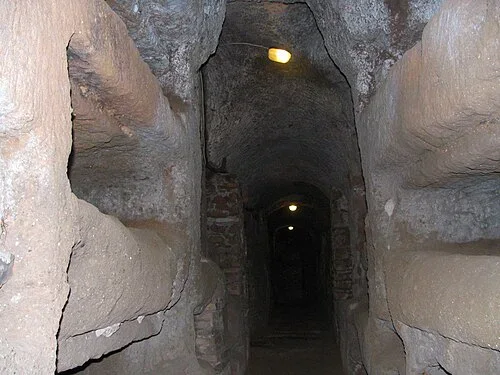 Subterranean Passageways and Burial Customs
Into the Galleries
The galleries run into soft volcanic stone called tufa, which Roman diggers could cut with picks yet firm enough to hold a ceiling. The catacomb proper covers about fifteen hectares and descends through five levels. Its passageways stretch roughly twenty kilometres in total, and a rough estimate puts the burials at about half a million. These corridors were dug by professional diggers, called fossores, working gallery by gallery as the need for graves grew. To reach the region of the popes, visitors today use a modern staircase built where an older one stood. That earlier stair was ordered in the fourth century by Pope Damasus, who wanted a worthy approach to the tombs below. So the descent itself follows a route pilgrims have taken since antiquity.
User GerardM on nl.wikipedia · CC BY-SA 3.0
03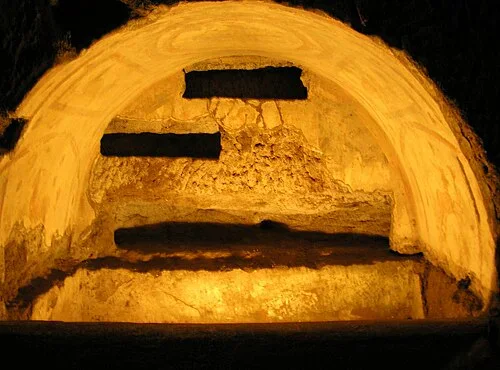 Subterranean Passageways and Burial Customs
Wall Tombs: How the Community Buried Its Dead
The walls themselves show how this community buried its dead. The simplest grave is the loculus, a rectangular niche cut horizontally into the gallery wall, one body to a niche, sealed with slabs. Rows of them climb the walls like shelves. Wealthier families bought an arcosolium: a wider recess with an arched top, its bench able to hold a sarcophagus, its surfaces once painted. The arch in this recess is still there, warmed by lamplight. What the niches no longer hold is people. In the excavated areas, the human remains were moved out and transferred to the Basilica of Santa Prassede in Rome, so that visitors could not carry fragments and relics away from the tombs. The graves keep their shape; their occupants rest elsewhere.
Listen in the appPhoto: Dnalor 01 · CC BY-SA 3.0
04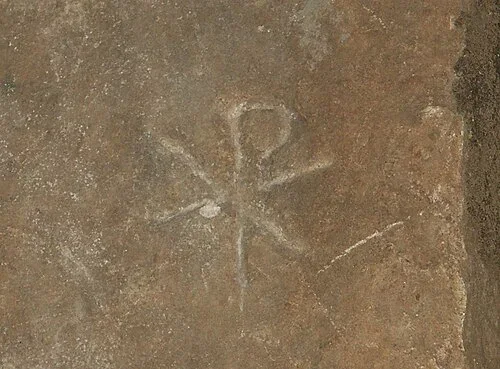 Subterranean Passageways and Burial Customs
The Chi Rho: A Sign on the Stone
On this stone slab, two Greek letters are cut into the surface: a Chi and a Rho, the first letters of Christ's name in Greek, crossed into one sign. Early Christians marked their tombs with signs like this, a quiet way of saying whose grave it was and whose it belonged to. After Constantine, the Chi Rho spread everywhere across the Christian world, on banners and buildings as much as on stone. On a slab like this, it did humbler work. It sealed a burial and claimed it, so that anyone passing down the dark gallery would know the person inside had died in the faith.
Listen in the appPhoto: Dnalor 01 · CC BY-SA 3.0
05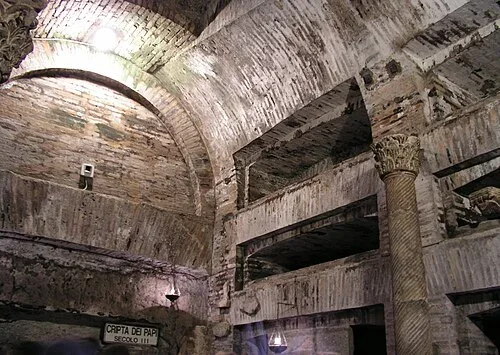 The Crypt of the Popes
This small chamber was the most sacred burial space the Roman Church possessed. Nine popes of the third century were laid to rest here, which is why the archaeologist Giovanni Battista de Rossi called the place the glorious sepulchre of the popes. Along the walls survive their original inscriptions, cut in Greek, for the pontiffs Pontian, Anterus, Fabian, Lucius the First and Eutychian. In the far wall lay Pope Sixtus the Second, killed in the persecution of the emperor Valerian. Pope Damasus honoured him with an inscription in poetic metre, its letters the invention of the calligrapher Furius Dionysius Filocalus, the finest letterer of his age. Then the crypt was lost, its inscriptions broken into fragments. De Rossi found it again in 1854, and pieced the popes' names back into the light.
Listen in the appPhoto: Dnalor 01 · CC BY-SA 3.0
06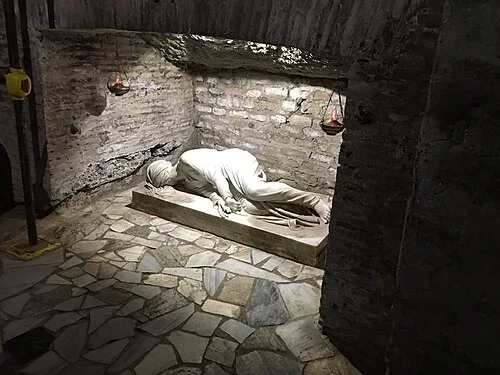 The Crypt of Saint Cecilia
In the crypt beside the popes' chapel, the tradition says, Rome buried Saint Cecilia after her martyrdom. The walls here still carry early ninth-century frescoes: Cecilia at prayer, the bust of the Redeemer above her, and Pope Urban the First beside her. Her body did not stay. In 821 Pope Paschal the First, prompted by a reported vision, had her relics removed and taken to the church of Santa Cecilia in Trastevere, inside the walls. She was not alone in leaving. Wave after wave, relics were carried out of the catacombs to the churches of the city, the last great removal coming under Pope Sergius the Second in the ninth century. As the saints departed, the crypts were left to darkness and decay. The tomb is now a niche with hanging lamps, a place that remembers an absence.
Listen in the appPhoto: Ajm71 · CC BY-SA 4.0
07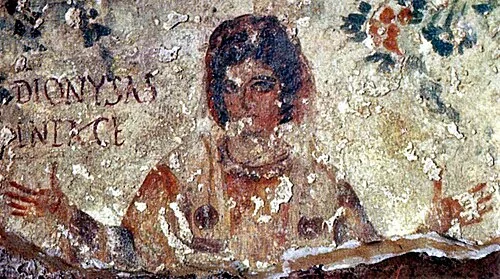 The Crypt of Saint Cecilia
The Orans: A Figure in Prayer
A woman stands with both arms raised, palms open, the oldest posture of prayer in Christian art. Figures like this are called orans, from the Latin word for praying. In catacomb painting the gesture is usually read as the departed soul, or the dead person shown forever in the act of prayer, in hope of resurrection. Beside her, painted letters spell a name, Dionysas, and what is often read as a wish of peace. The reading is not certain, and neither is her identity: she may be the person the tomb commemorated, a figure of the soul, or a scene from scripture. Whoever she is, the image says the same thing either way. Someone paid for this painting so that the person it honours would be remembered at prayer.
Listen in the appPhoto: 1970gemini · Public domain
08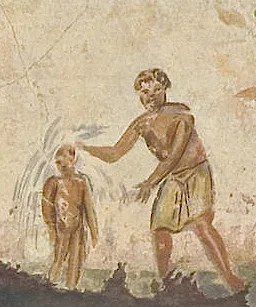 The Cubicles of the Sacraments
: Baptism
Through an arcade dating to the end of the second century, a row of small burial chambers opens off the gallery. These are the cubicula of the Sacraments, family crypts decorated in the first half of the third century with some of the oldest frescoes in the Roman catacombs. On one wall, a figure pours water over another's head: a baptism. For a community burying its dead underground, the image carried real weight. Baptism was the door into the community, the moment a person was washed and made new. Painting it beside the graves joined the dead to that promise. The chambers nearby take up the other subjects of the cycle, one by one.
Listen in the appunknown artist, Rome, 3rd century A.D. · Public domain
09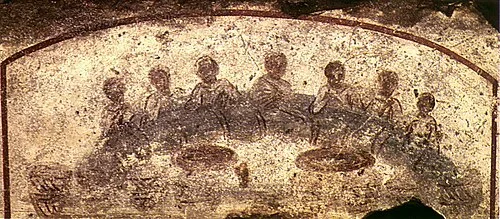 The Cubicles of the Sacraments
The Banquet of the Dead
Around a curved table sit seven figures, dishes laid out before them, baskets at the table's edge. It reads like a scene of shared eating, and that is exactly what scholars have argued about ever since. One reading calls it the agape, the meal of brotherly love the early Christians held together. Another sees the Eucharist itself, the sacred meal of bread and wine. A third takes it more plainly: a family funeral feast, held at the grave for the repose of the dead, as Roman custom allowed. The painters left no caption. What is sure is the comfort the image offered: a table set in the dark, with seats still waiting.
Listen in the appPhoto: Leinad-Z~commonswiki · Public domain
10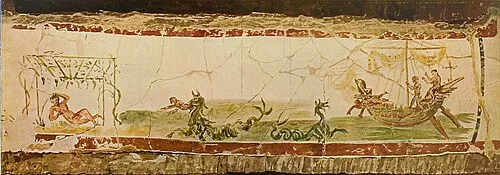 The Cubicles of the Sacraments
Jonah and the Promise of Resurrection
Along the wall of a burial chamber, a small figure reclines under a shelter while a sea monster spits him out and a ship tosses on the waves. It is Jonah, swallowed and given back by the sea. Early Christians read his three days in the fish as a promise of rising from the grave, which made him a favourite beside the dead, and he completes the subjects of the Sacraments cycle: baptism, the meal, and now the resurrection. The painting you see here has a story of its own. It comes from the early twentieth century, when the archaeologist Joseph Wilpert had the paintings photographed by Pompeo Sansaini, working with his son Renato. The prints went onto salted paper, and a painter named Carlo Tabanelli sat before the walls, matching each colour by hand in watercolour. About six hundred of these plates survive, and this is one of them.
Listen in the appunknown artist, Rome, end of the 2nd century A.D. · Public domain
- 11
The Crypt of Lucina: Loaves and Fish, and Pope Cornelius
One of the catacomb's oldest quarters, two fish with a basket of loaves, and the tomb of Pope Cornelius.
- 12
The Good Shepherd: What the Catacomb Means
The young shepherd with the sheep on his shoulders, the image the whole catacomb was built around.
Catacombe di San Callisto
Frequently asked questions
How much does the guide cost?
Free app download. Listed guide price: $0.99. Guide price shown in the app. Audio guide only. Venue admission is separate.
Can I listen without internet?
Yes. Download the guide’s audio, images, and maps in the app before your visit. Your downloaded content is then available offline.
Can I listen in my language?
This audio guide is available in 15 languages, including English.
Do I need to follow a schedule?
No. This is a self-guided experience. Choose your stops, pause whenever you like, and return to a story at your own pace.
At your own pace
Explore Catacombe di San Callisto.
Download Stanza, then search for “Catacombe di San Callisto”.
Free app download · Guide price shown in the app
Keep exploring
Nearby audio guides
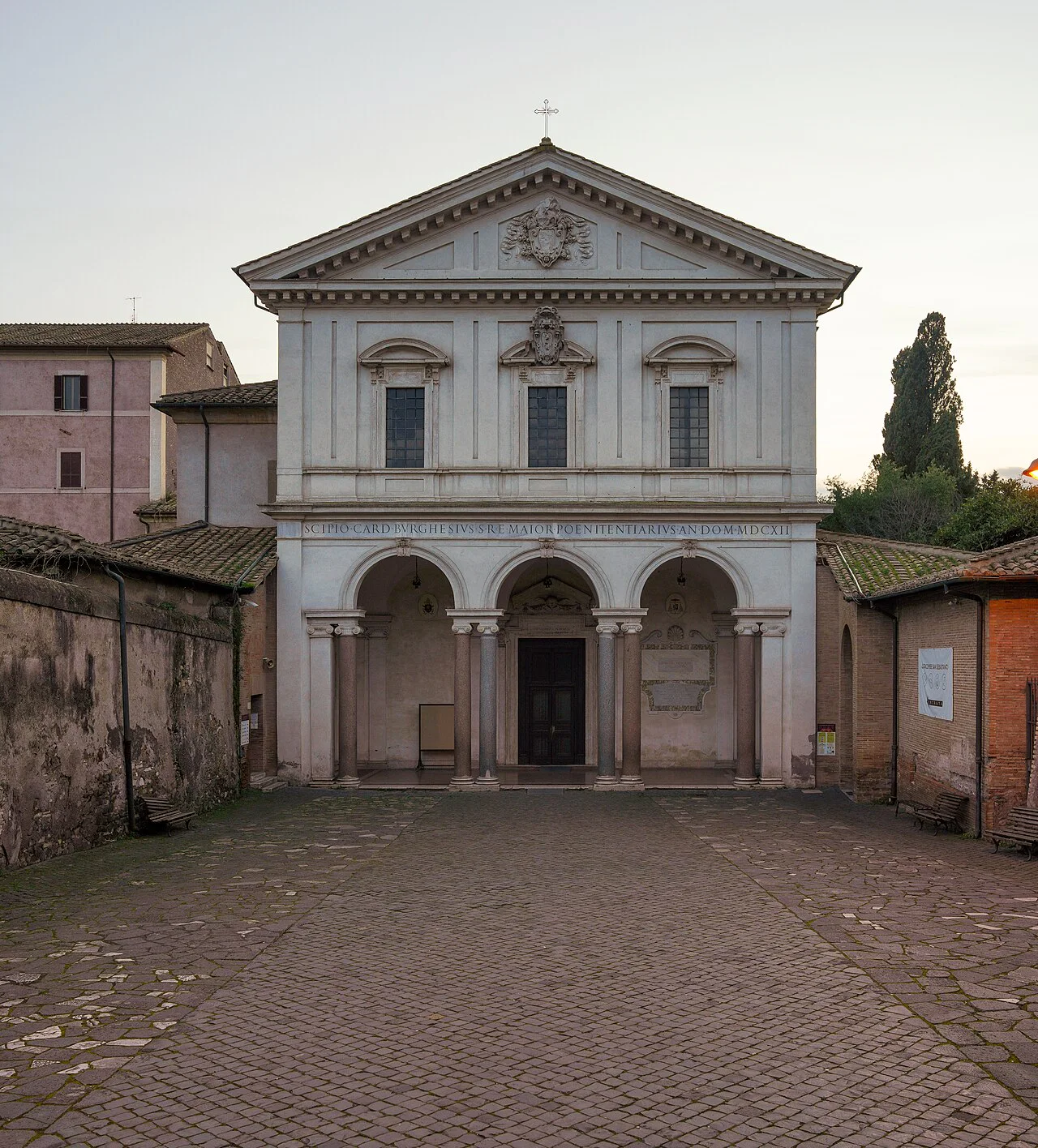
Rome · 1 km
Basilica di San Sebastiano fuori le mura
Content & sources
Photo: NikonZ7II · CC BY-SA 4.0
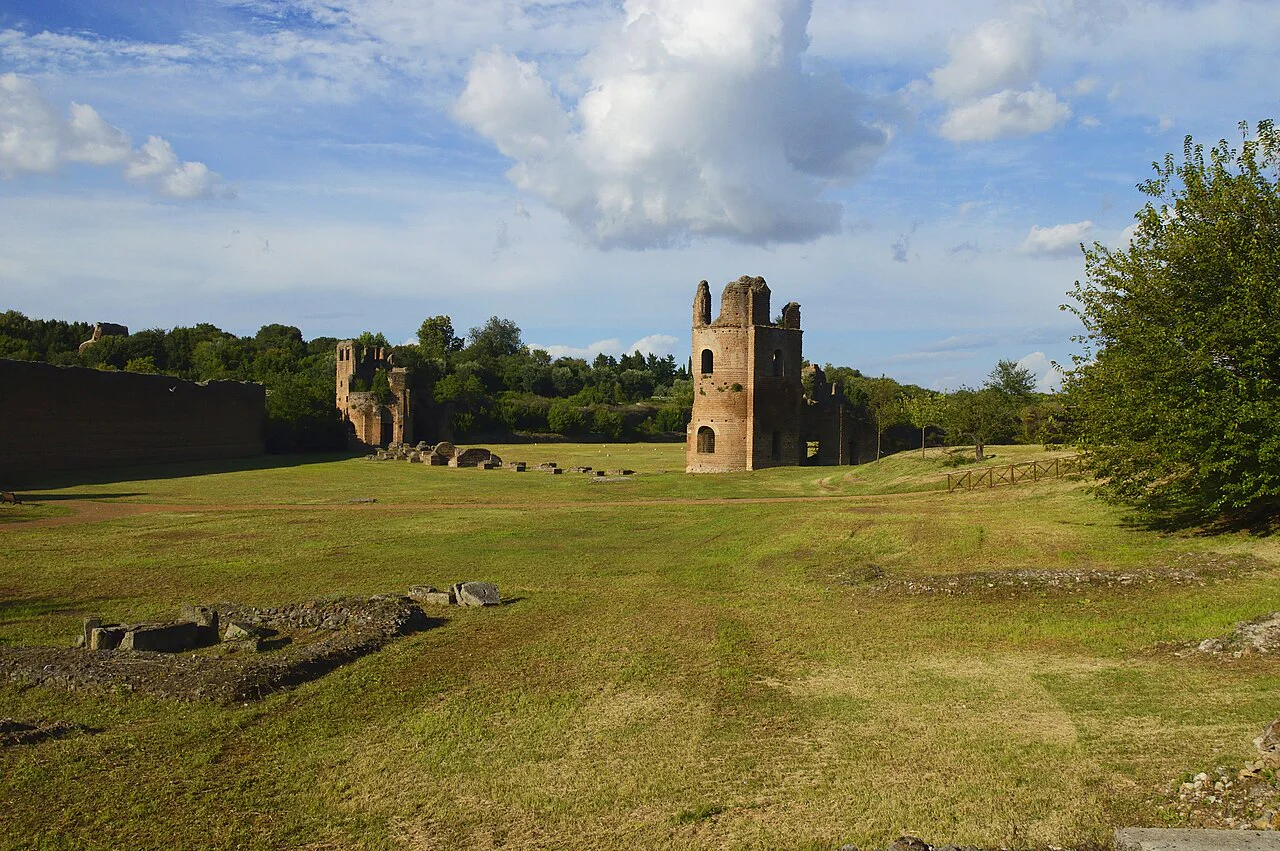
Rome · 1 km
Circo di Massenzio
Content & sources
Photo: Livioandronico2013 · CC BY-SA 4.0
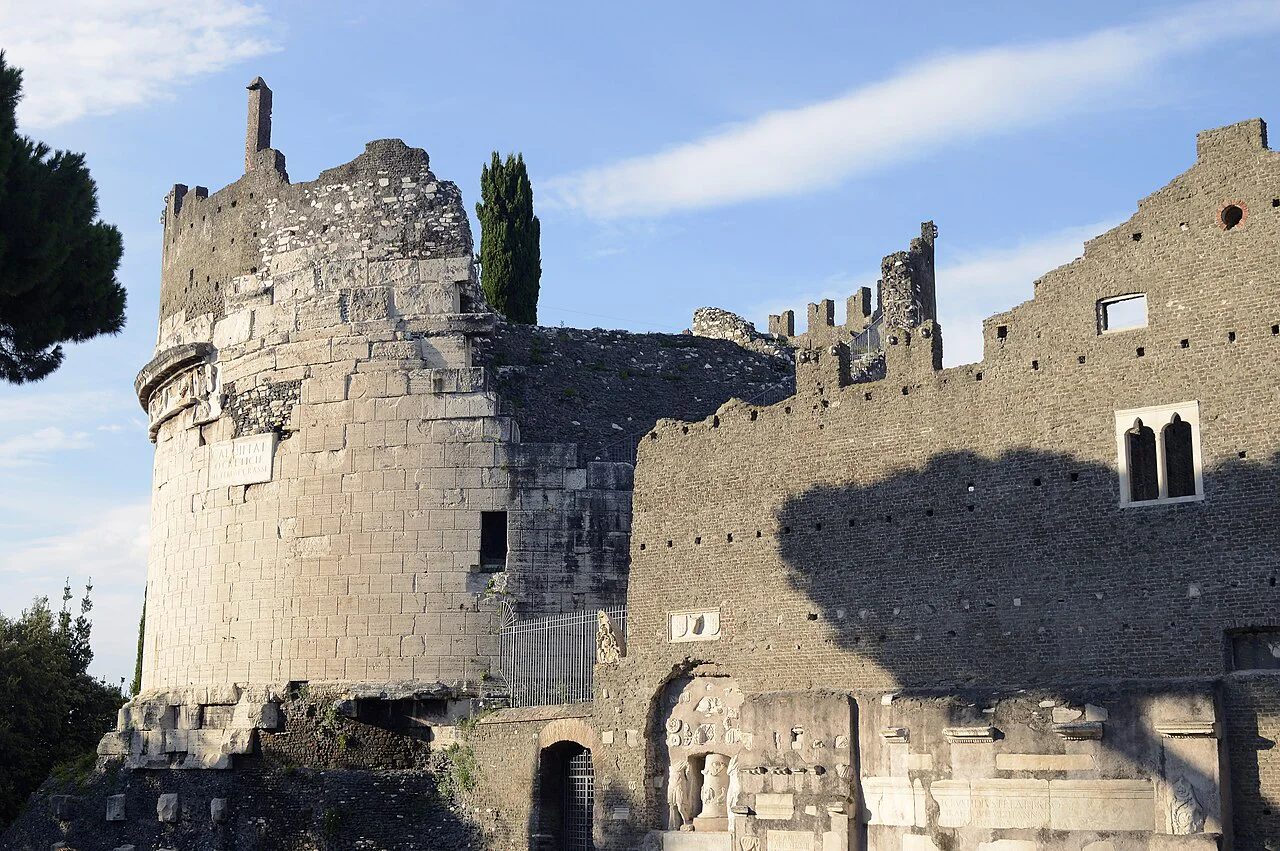
Rome · 1 km
Mausoleo di Cecilia Metella
Content & sources
Photo: Livioandronico2013 · CC BY-SA 4.0
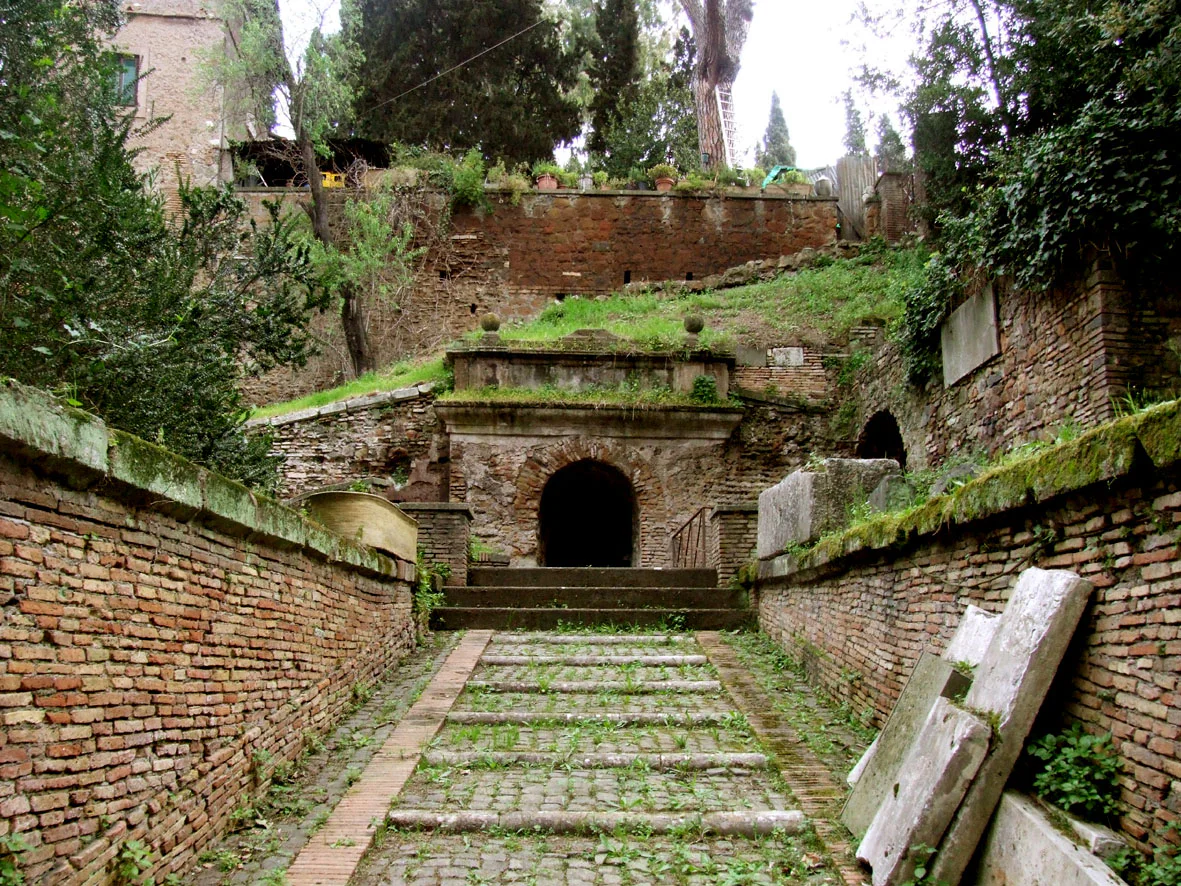
Rome · 2 km
Sepolcro degli Scipioni
Content & sources
Photo: Pippo-b · CC BY-SA 3.0