Stanza · Audio guide
Alba Fucens Audio Guide
A place to remember. A story to take with you.
Alba Fucens was an ancient Italic town located at an elevation of 1,000 meters at the base of Monte Velino. Its ruins are situated in the comune of Massa d'Albe in central Italy.
Download Stanza, then search for “Alba Fucens”.
About the tour
One guide. Your kind of visit.
Alba Fucens was an ancient Italic town located at an elevation of 1,000 meters at the base of Monte Velino. Its ruins are situated in the comune of Massa d'Albe in central Italy.
Ready when you are.
- 01Get the free Stanza app.
iOS & Android
- 02Find your guide.
“Alba Fucens”
- 03Download before you go.
Works offline
Audio guide / 14 narrated stops
Inside the guide
Get to know a few of the stories before you go. Open a stop to read more.
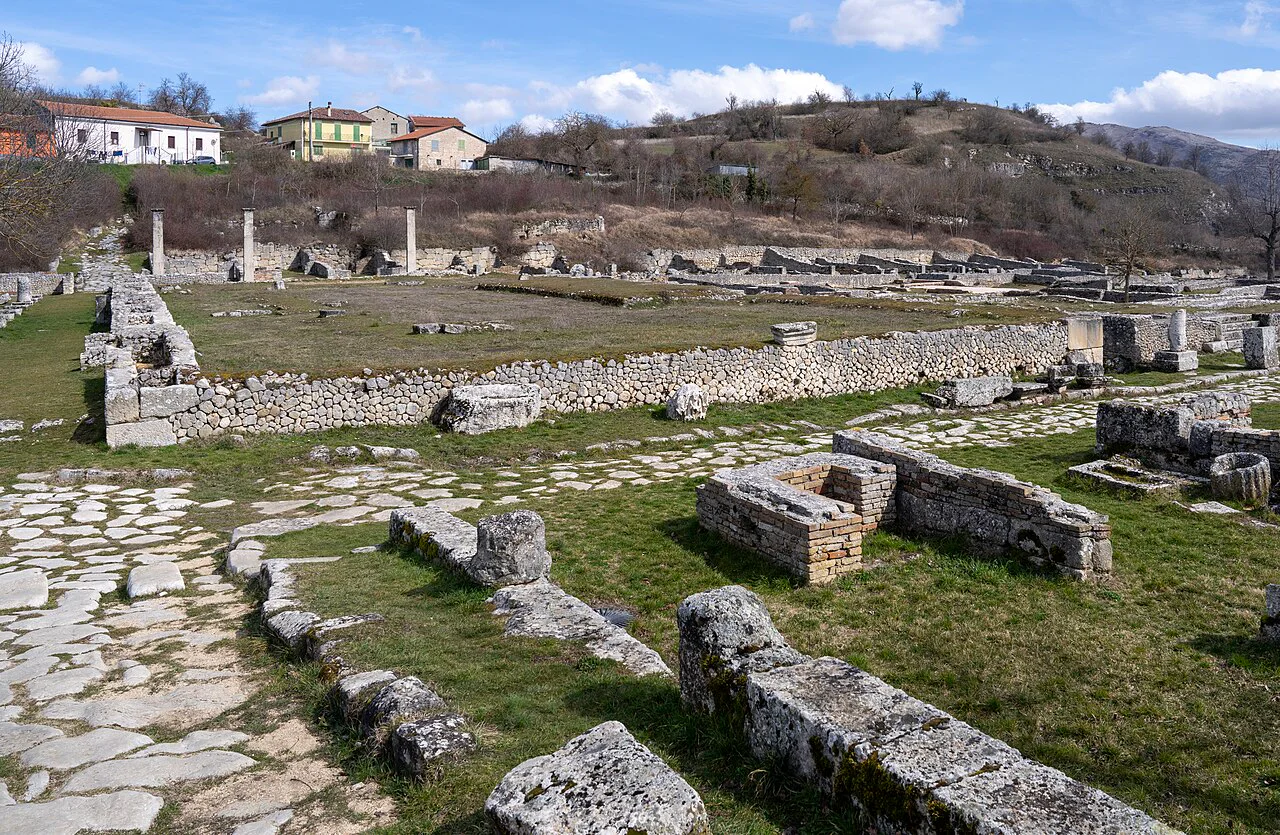
01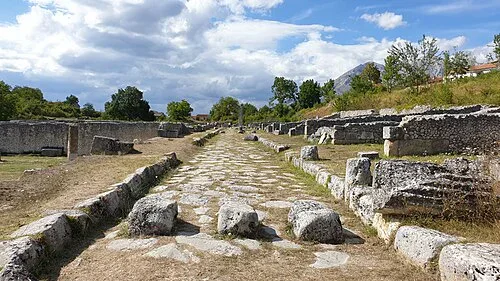 Main Archaeological Entrance
Arrival at the Roman Colony
Welcome to Alba Fucens, a Roman town so complete after excavation that it is counted among the most important ancient sites in Abruzzo. Rome planted a Latin colony here in the closing years of the fourth century BC. Accounts give the founding year as 304 BC. Others say 303. The land belonged to the Aequi, a mountain people Rome had just defeated, and they resisted the settlement from the start. The site was chosen with care. It sits at about a thousand metres on the slopes of Monte Velino, beside the Via Tiburtina Valeria, the road Rome was extending east toward the Adriatic. A fortified town here locked down the mountain corridor. The first settlers, several thousand of them, laid the city out on a grid of straight streets crossing at right angles, a pattern borrowed from Greek town planning. The long paved street lined with building foundations shows that plan at a glance.
Photo: Pietro · CC BY-SA 4.0
02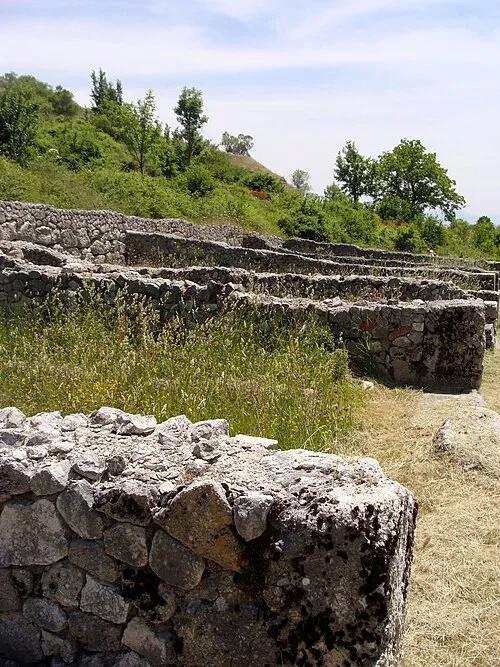 The Polygonal City Walls
The walls were the colony's first great work. The settlers raised them in the years straight after their arrival, and they remain among the best preserved of any ancient Italian city. The circuit runs roughly three kilometres and encloses about thirty-four hectares. The masonry is polygonal, built of limestone blocks cut into many-sided shapes and fitted together without mortar, their outer faces smoothed flat. The builders thought like soldiers. The gates sit at the end of long straight stretches of wall, placed so that an attacking force had its unshielded right side turned to the defenders. On the north side the defences thickened into a triple line, partly in concrete, possibly a later addition by the colonists. All that stone had a second use as well. Rome turned this secure mountain city into a place of detention for captured enemy kings. Syphax of Numidia was held here, and Perseus of Macedonia, and Bituitus, king of the Arverni. Each was kept in custody that was hard to escape and impossible to rescue.
Photo: Torquatus · CC BY-SA 4.0
03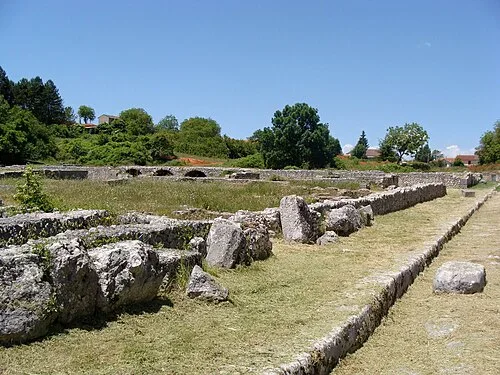 The Roman Forum and Decumanus
The Forum and Basilica
Every Roman town of any standing had a forum, and Alba Fucens built a big one. The open square measured 142 metres long. It was about 44 wide, a huge paved space for a town of this size. Around it stood the buildings that made a colony into a city. The basilica, raised between the end of the second century BC and the first decades of the next, held the business deals and the court cases. Beside it stood the macellum, the covered market, of about the same date. The baths went up in the late Republican age and were later enlarged under the emperors. For a community of settlers far from Rome, this square did the work of the capital in miniature. Law was argued here, goods were traded, and the colony's own sense of itself took shape. The low lines of ruined walls around the open ground mark where those public buildings once stood.
Listen in the appPhoto: Torquatus · CC BY-SA 4.0
04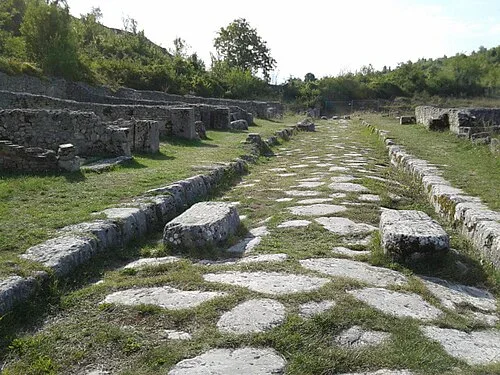 The Roman Forum and Decumanus
The Street and the Legion's Choice
In 44 BC, just after Julius Caesar's murder, this quiet mountain city stepped onto the stage of Roman history. A legion called the Martia, recruited from the Marsi, the people of this region, mutinied against the consul Mark Antony and declared for the young Octavian. The soldiers left the coast road at Aternum, took the Via Valeria, and occupied Alba Fucens. The choice was shrewd. From here the legion could keep contact with Octavian and, if needed, bar Antony's route toward the Adriatic. Cicero told the senate what he thought of it, in his speeches against Antony. Now this legion, he said, is quartered in Alba Fucens. What other city could one choose, well fortified and nearby, or more faithful, or inhabited by citizens braver or more attached to our Republic. Antony did not let it pass. He postponed the senate's session, hurried here to bring the legion back to obedience, and failed. After he left, Octavian arrived with his own troops, and wrote to the senate from the city.
Listen in the appPhoto: Marica Massaro · CC BY-SA 4.0
05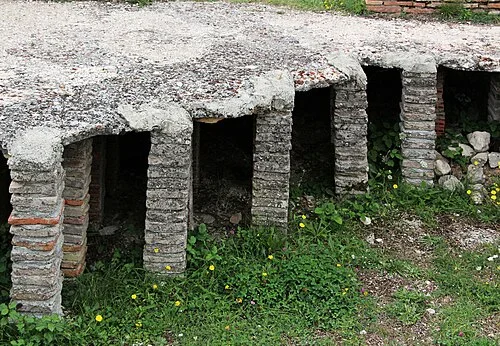 The Imperial Baths and Hypocaust
The Baths and the Hypocaust
The baths of Alba Fucens belong to the late Republican age, enlarged under the emperors, and they show how much comfort the colonists expected. These rows of brick pillars are the key to it. They once carried a raised floor, and the space beneath was the hypocaust, the underfloor heating of the Roman world. A furnace pushed hot air through this gap under the floor, and the heat rose on through flues in the walls. Rooms above could be kept warm even in a mountain winter at a thousand metres. The floors themselves were the pride of the building. The baths were decorated with mosaics of marine scenes and sea creatures, precious work for a provincial colony. There is something quietly charming about the choice. A city high in the Apennines, far from any coast, chose to bathe among sea creatures and waves. The water that filled them came, like the city's drinking supply, from the hills beyond.
Listen in the appPhoto: ImagePerson · CC BY-SA 4.0
06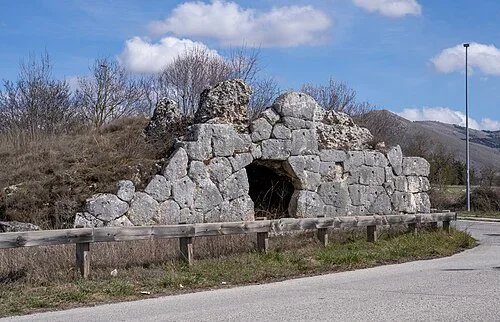 The Inverted Siphon Aqueduct
Water is where Alba Fucens shows its boldest engineering. The city's aqueduct ran about ten kilometres, built by the late first century BC, from the spring of Sant'Eugenia beyond the pass of Fonte Capo la Maina, near the hamlet of Santa Jona. Most of the channel ran hidden underground. The last three kilometres faced a problem no channel could solve: a valley lay between the hills and the city. The builders' answer was an inverted siphon, a pressurized pipeline that ran down one slope and was pushed up the other by the water's own weight. At Arci, northeast of the town, stands the venter, the structure where the pipes entered the valley. It is an embankment 12 metres wide and over 130 long, rising with the depth of the valley. At the deepest point a bridge on arches carried the pipes, shortening the drop and easing the pressure that would otherwise have burst the joints. This masonry stands about one and a half kilometres from the main ruins, a detached monument to the colony's ambition.
Listen in the appPaestum · CC BY 4.0
07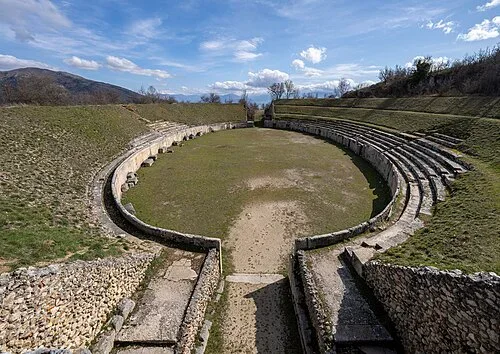 The Roman Amphitheater of Macro
The Amphitheatre of Macro
An amphitheatre is a Roman city's declaration that it has arrived, and Alba Fucens got a fine one. The building measures 96 metres across. It runs 79 deep, an elliptical bowl of stone seating around a sandy arena. It went up under the emperor Tiberius, paid for by a legacy in the will of Naevius Sutorius Macro. Macro was Prefect of the Praetorium, commander of the emperor's guard and one of the most powerful and feared officials of his day. And he had been born here, in this small mountain colony. His bequest gave his home town a monument of a kind most provincial towns never had. In arenas like this one, across the Roman world, gladiators fought before packed tiers, and exotic beasts were hunted in the sand. No record names the games held here, but the shape of the cavea and the broad arena floor say plainly what this place was built for.
Listen in the appPaestum · CC BY 4.0
08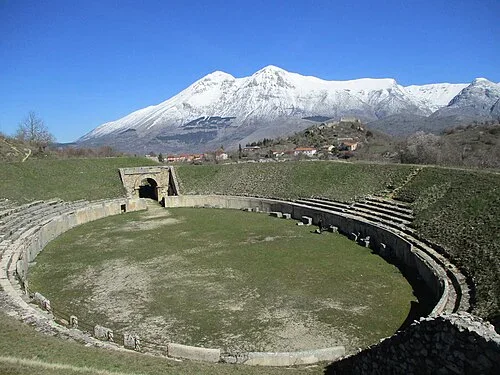 The Roman Amphitheater of Macro
The Arena and the Mountain
The view says as much as any inscription. Monte Velino rises behind the amphitheatre, its summit white with snow, and the curve of the stone seating opens toward it. The city sits at roughly a thousand metres, and the mountain was never out of sight. It framed the streets, the temples and now the games, a constant backdrop to civic life. This arena belongs to the reign of Tiberius, and that era marks the city at its most confident. More than three centuries after the first settlers laid out the grid, Alba Fucens had grown into a full Roman town, with its forum, its baths, its aqueduct and now its amphitheatre. Inscriptions found here testify to its prosperity in the imperial period. The colony planted to guard a mountain road had become a place worth admiring in its own right.
Listen in the appPhoto: Marica Massaro · CC BY-SA 4.0
09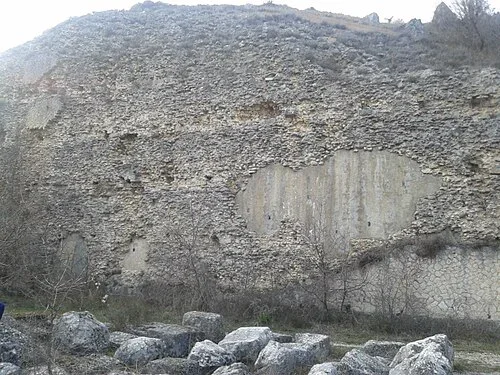 The Pettorino Hill Theatre
The Theatre on Pettorino Hill
The Romans separated their spectacles, and each kind had its own building. Combat and beast hunts went to the amphitheatre in the valley. Plays, music and mime belonged to the theatre, and on the slope of Pettorino hill stand the remains of Alba Fucens's own. The cavea, the tiered seating of a theatre, was built against the hillside here, partly cut into the slope and partly raised on structure, in the old tradition of Greek and Roman builders who used a hill as ready-made grandstands. From these seats the audience watched staged plays rather than fights, comedies and tragedies performed by actors instead of gladiators. Much of the seating has fallen, and the terraced slope scattered with masonry blocks is what survives of it. Even ruined, the shape is readable: a hollow of tiers facing a stage, with the mountains beyond.
Listen in the appPhoto: Marica Massaro · CC BY-SA 4.0
10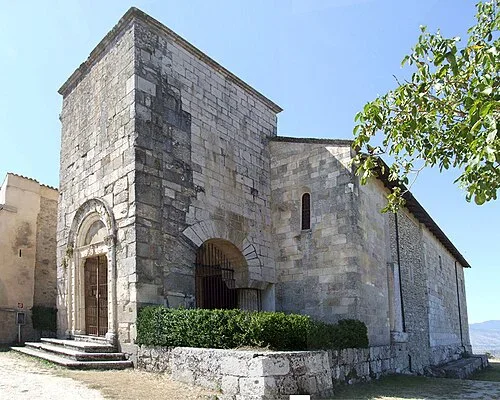 The Church of San Pietro in Albe
San Pietro in Albe: Temple Turned Church
On the hill at the western end of the ancient city stands the church of San Pietro, and it is two sacred buildings in one. The first was a temple of Apollo, raised in the second century BC in the Tuscan order, an old Italian style of temple. When Christianity came, the site did not fall silent. In the ninth century monks from the abbey of San Clemente a Casauria built a church on the temple's remains. In the twelfth century it was enlarged to three naves, the broad Romanesque form whose plain stone facade survives here. The old order of worship and the new one literally share the same ground, the temple's bones inside the church's body. The austere facade gives little away. The building's real treasures are inside.
Listen in the appI have published this image as author Claudius Ziehr under the "CC-BY-SA-3.0 (de)" in Wikipedia. This means that free, commercial usage outside of Wikipedia is permitted under the following licence terms: Online media: The author "Claudius Ziehr" is named A weblink to the original image is provided: //commons.wikimedia.org/wiki/File:100819_Alba_Fucens_San_Pietro.jpg A copy of, or the Uniform Resource Identifier (https://creativecommons.org/licenses/by-sa/3.0/de/legalcode) for, this License with every copy Print media: The author "Claudius Ziehr" is named A copy of, or the Uniform Resource Identifier (https://creativecommons.org/licenses/by-sa/3.0/de/legalcode) for, this License with every copy Please send me a specimen copy or the URL of the website where the image is used. Please write an email to ziehr-at-stadtbesichtigungen.de, if you need the image in a higher resolution need my postal address for sending a specimen copy have further questions about the terms of the licence PS: In case of refusal of the above terms the author reserves the right to take legal action. This license and the rights granted hereunder will terminate automatically upon any breach by you of the terms of this license. In this case the author reserves to demand declaration to cease and desist, and compensation (according to the MFM fee references currently in force). Any of the above conditions can be waived if you get permission from the copyright holder. · CC BY-SA 3.0
- 11
Inside San Pietro: Ancient Columns and Rebirth
Roman temple columns holding up a medieval nave, and the church rebuilt stone by stone after the 1915 earthquake.
- 12
The Cosmatesque Iconostasis
A thirteenth-century mosaic screen, four stolen twisted columns, and their return by 3D technology eight centuries later.
- 13
The Abandoned Medieval Town
How the Roman city died, and the medieval village of Albe rose on the hill above it.
- 14
Orsini Castle and Monte Velino: Closing View
The Orsini castle, the earthquake that emptied the medieval village, and the mountain that has watched it all.
Alba Fucens
Frequently asked questions
How much does the guide cost?
Free app download. Listed guide price: $0.99. Guide price shown in the app. Audio guide only. Venue admission is separate.
Can I listen without internet?
Yes. Download the guide’s audio, images, and maps in the app before your visit. Your downloaded content is then available offline.
Can I listen in my language?
This audio guide is available in 15 languages, including English.
Do I need to follow a schedule?
No. This is a self-guided experience. Choose your stops, pause whenever you like, and return to a story at your own pace.
At your own pace
Explore Alba Fucens.
Download Stanza, then search for “Alba Fucens”.
Free app download · Guide price shown in the app
Keep exploring
Nearby audio guides
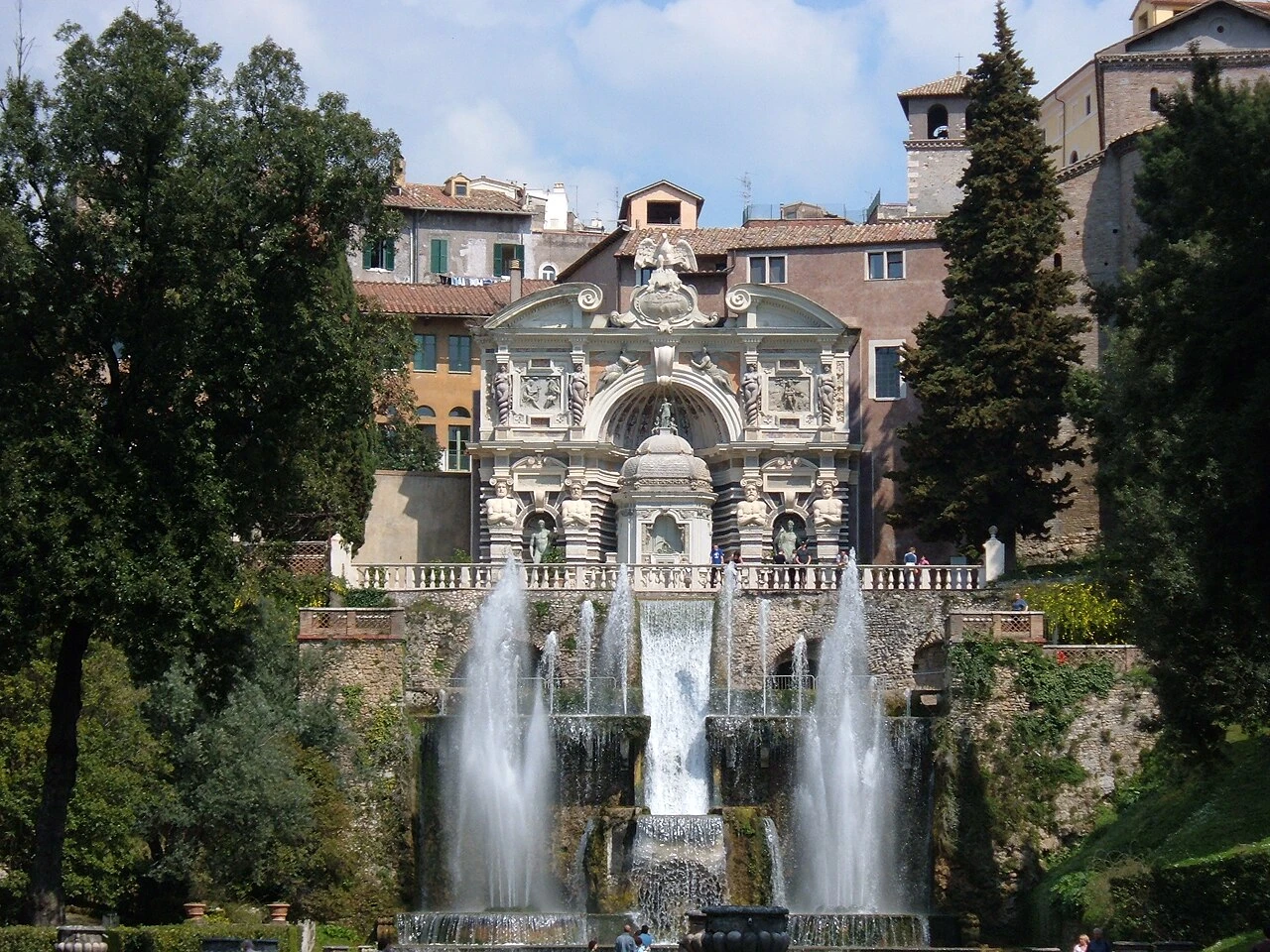
Tivoli · 52 km
Villa d'Este
Content & sources
Photo: KatDevsGames · Public domain
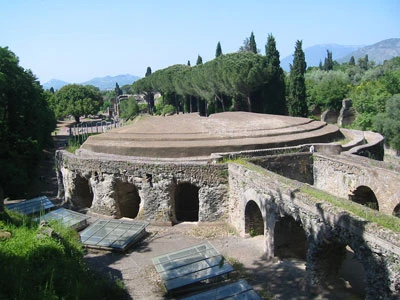
Tivoli · 55 km
Hadrian's Villa
Content & sources
Zh0rz at Dutch Wikipedia · CC BY-SA 3.0
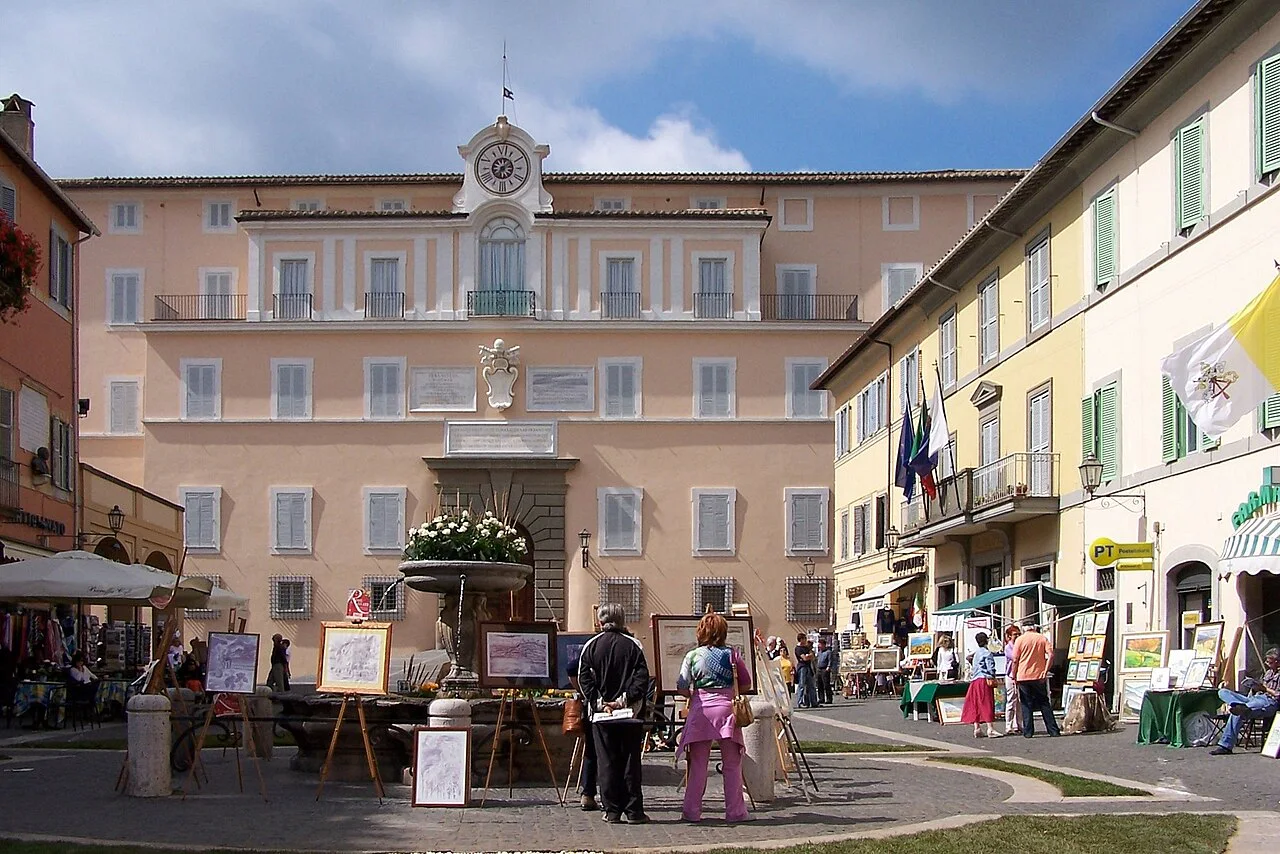
Castel Gandolfo · 73 km
Palazzo Pontificio
Content & sources
Photo: Berthold Werner · Public domain
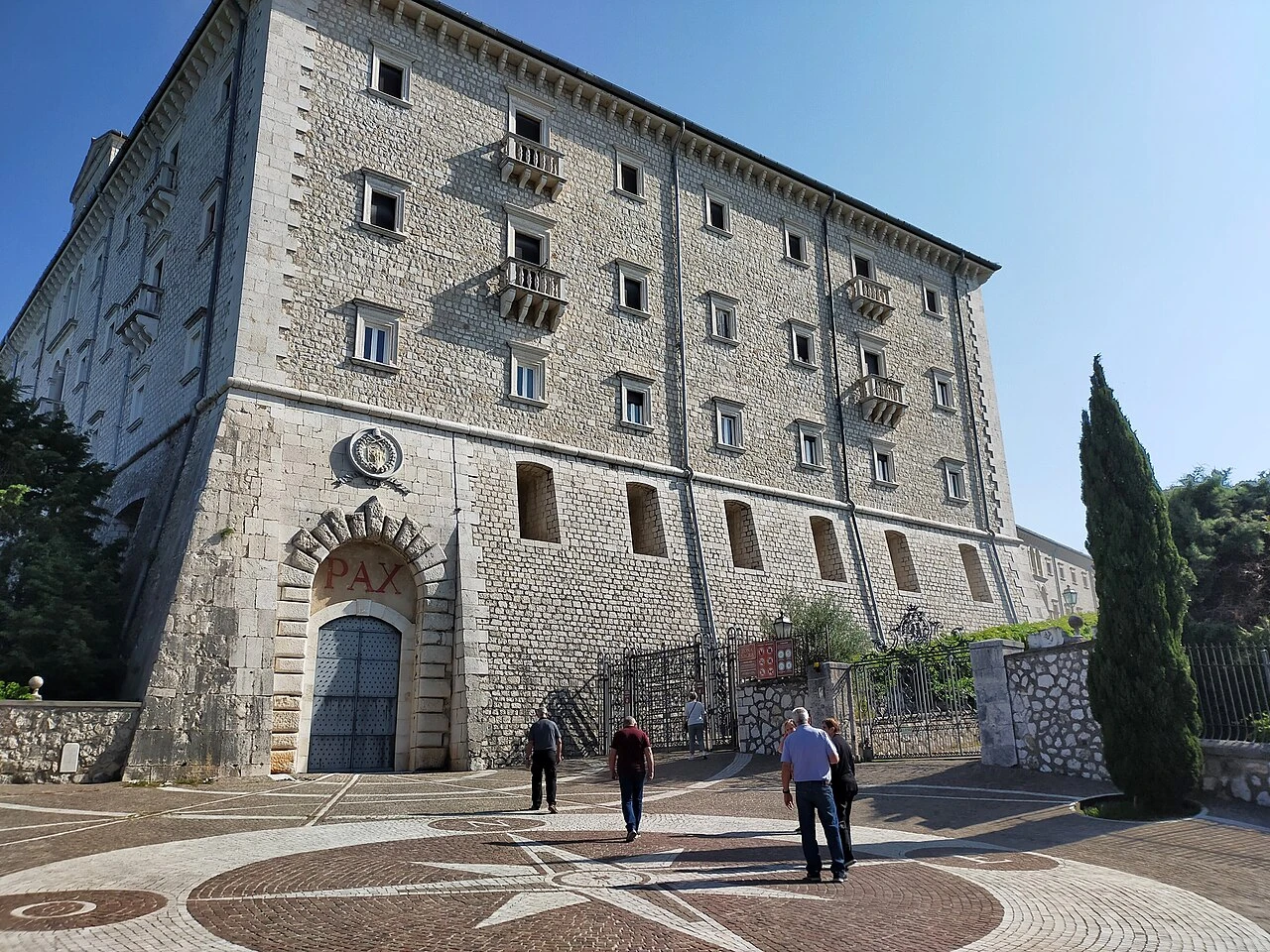
Cassino · 74 km
Abbey of Monte Cassino
Content & sources
Photo: Marica Massaro · CC BY-SA 4.0