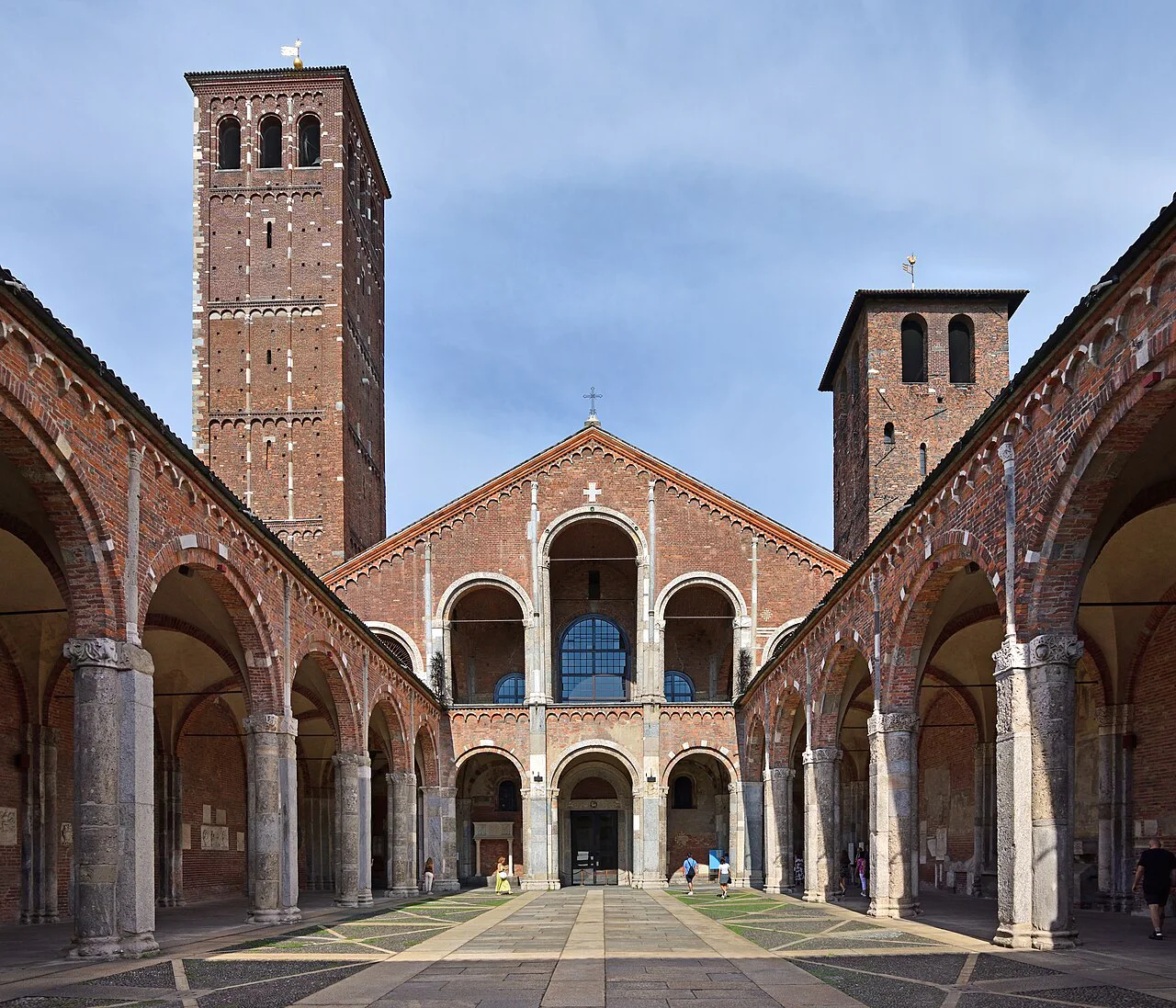
Stanza · Audio guide
Basilica di Sant'Ambrogio Audio Guide
A place to remember. A story to take with you.
The Basilica of Sant'Ambrogio is an ancient Romanesque-style Roman Catholic church located in the center of Milan. It is a significant historical site in the region of Lombardy, Italy.
Download Stanza, then search for “Basilica di Sant'Ambrogio”.
About the tour
One guide. Your kind of visit.
The Basilica of Sant'Ambrogio is an ancient Romanesque-style Roman Catholic church located in the center of Milan. It is a significant historical site in the region of Lombardy, Italy.
Ready when you are.
- 01Get the free Stanza app.
iOS & Android
- 02Find your guide.
“Basilica di Sant'Ambrogio”
- 03Download before you go.
Works offline
Audio guide / 13 narrated stops
Inside the guide
Get to know a few of the stories before you go. Open a stop to read more.
01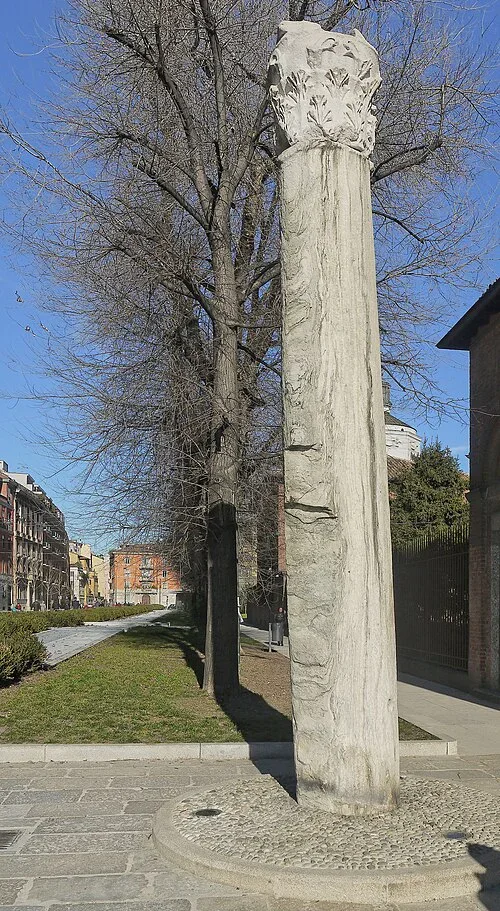 Piazza Sant'Ambrogio and the Devil's Column
The Devil's Column
Welcome to the Basilica of Sant'Ambrogio, and to the Devil's Column that stands beside the church. The church is named for Ambrose, the bishop who is Milan's patron saint. This tour follows the church from its founding to its Renaissance cloisters. Ambrose commissioned the church in 379, and building went on until 386. Milan was then the de facto capital of the Western Roman Empire. The church was built outside the Roman city walls, in a place where many martyrs of the Roman persecutions had been buried. At first it was called the Basilica Martyrum, meaning the basilica of the martyrs. The churches of the region were then in conflict over belief. Ambrose firmly backed the Nicene side against Arianism. He built churches that showed the wealth and power of that side in Milan. The column is tall and white marble, with carved leaves at the top. Tradition says the column has two holes, made when the Devil struck it with his horns after failing to tempt Ambrose.
Óðinn · CC BY-SA 2.5 ca
02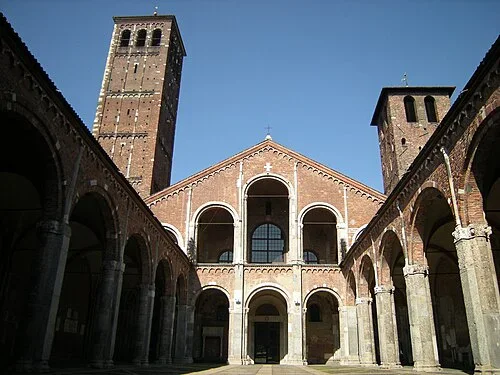 Ansperto Quadriportico and the Facade
Atrium Façade and the Two Bell Towers
The two towers of the basilica record two communities who shared one church. The lower tower on the right dates from the ninth century. Its outline is severe, almost like a fortress. In 789 a monastery was set up within the basilica grounds. Its monks used this tower to call people to their Mass, and they lived partly on the offerings people gave after Mass. The canons had also been in the church, and they kept their own identity. In the eleventh century they adopted a rule of life and became Canons Regular. Then two communities, following different rules, shared the basilica. The canons had no bell tower, and they could not ring bells until their own tower was finished. The canons' tower is the taller one on the left, finished in 1128.
Leandro Neumann Ciuffo · CC BY 2.0
03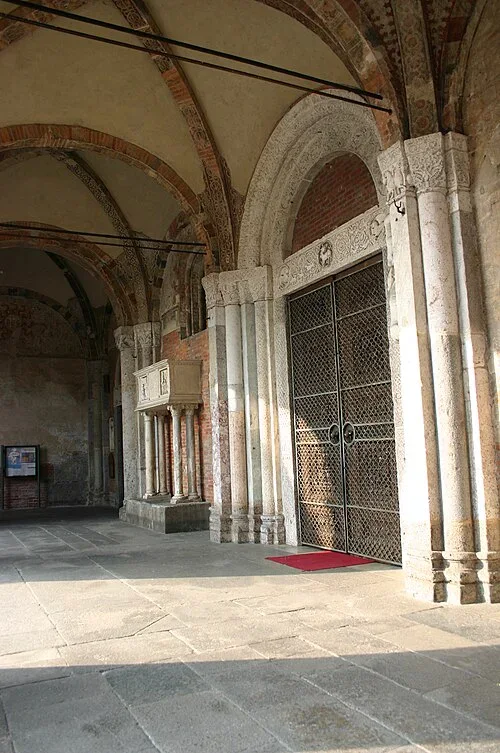 Ansperto Quadriportico and the Facade
Atrium Portico Beside the Church Door
The arcade at the church entrance once sheltered people preparing for baptism. It is called the Atrium Ansperto, after Archbishop Anspert, who commissioned it in the eleventh century. It replaced an older atrium from the ninth century. Those preparing for baptism were called catechumens. They sheltered here and attended part of the Mass before being baptized. By the early eleventh century, people were being baptized as babies. So fewer adults came to prepare for baptism, and the porch changed its purpose. Citizens began to gather here to talk. Religious and civic meetings were held here too. From the upper loggia of the façade, the bishop blessed the citizens. Public officials could also speak to the crowd.
Listen in the appPhoto: G.dallorto · Attribution
04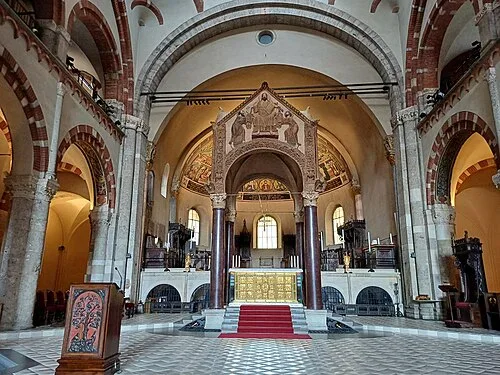 Central Nave and the Bronze Serpent
Interior of the Nave and Presbytery
The church rebuilt in the Romanesque style kept a much older plan. In 1864, investigators found that the nave and aisles follow the lines of the original basilica. That first church had windows high in its nave walls. Galleries called matronei now run over the aisles. They hold up the vaults, and they leave no room for windows high in the nave. The vaults have pointed stone ribs, called ogives. Each rib rests on its own half-column, and lower down these join into single pillars. Each span of the side aisles is exactly half as wide as a span of the nave. The rebuilding is usually dated to the late eleventh and early twelfth centuries. Comparable cathedrals at Pavia, Novara and Vercelli were destroyed or radically changed. This makes the church a rare example of Lombard Romanesque. It was certainly a model for later building in parts of Emilia and Piedmont.
Listen in the appRadosław Botev · CC BY 3.0 pl
05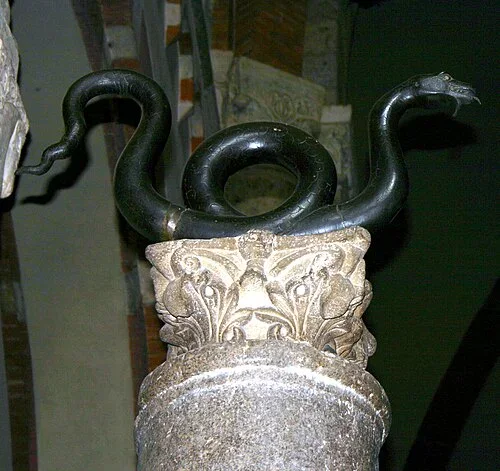 Central Nave and the Bronze Serpent
Bronze Serpent of Moses
Once, people believed this dark bronze serpent was the original serpent of Moses. The serpent's coils rest on a carved capital, which tops an old Roman granite column inside the church. The Byzantine emperor Basil the Second gave it to the church in 1007. People pray to it for relief from certain illnesses. A legend says it escaped the wrath of King Hezekiah, who wanted sacred objects destroyed. People also say that the end of the world will be announced when the serpent comes down from its column.
Listen in the appPhoto: G.dallorto · Attribution
06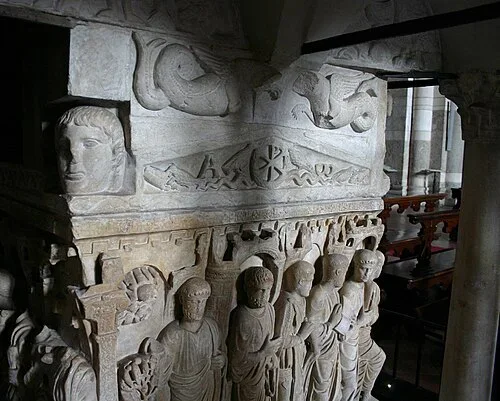 Romanesque Pulpit and Sarcophagus of Stilicho
Romanesque Pulpit on the Sarcophagus of Stilicho
A twelfth-century pulpit stands on a far older stone box. That box is a Roman sarcophagus, a stone coffin made in the fourth century. Tradition calls it the Sarcophagus of Stilicho, but that name is not firmly established. The pulpit was built over an earlier ninth-century pulpit. The pulpit has nine small columns with decorated capitals. Its carved friezes show people and animals, plants and fantastic creatures. The front holds two gilt copper reliefs. They show the symbols of the evangelists Matthew and John, a praying man and an eagle.
Listen in the appPhoto: G.dallorto · Attribution
07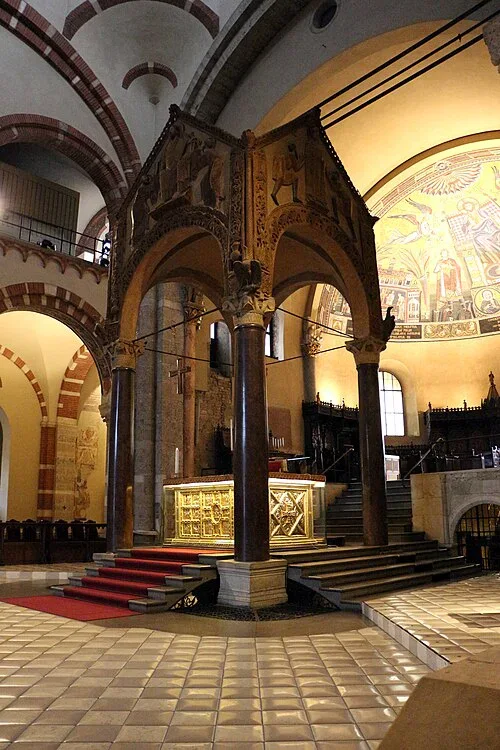 Presbytery: Golden Altar and Ottonian Ciborium
Ciborium over the High Altar
Four columns of red porphyry hold up the ciborium above the gilded altar. A ciborium is a canopy over an altar, and porphyry is a hard stone. The gables at the top carry stucco reliefs, and accounts differ on their date. Some say the ninth century, others the tenth. Each side has its own relief scenes. The front shows Christ with two apostles. On the back, Ambrose receives homage from two monks. Benedict receives homage from two monks on one side, and Scholastica receives homage from two nuns on the other.
Listen in the appPhoto: Sailko · CC BY 3.0
08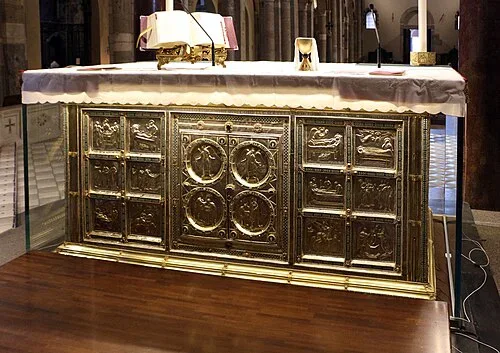 Presbytery: Golden Altar and Ottonian Ciborium
Golden Altar of Sant'Ambrogio (Volvinius)
The gilded panels of this altar are a masterpiece of Carolingian goldwork, made by a craftsman named Volvinius. He signed it as master craftsman. Its core is wood, covered with plates of gold and gilded silver. Precious stones and small enamel plaques decorate the frames. The figures are raised in relief by hammering the metal. The central panel holds a group of four round medallions. The altar was made in the ninth century. Work on it began in 824. It was finished by 859. Archbishop Angilbert the Second is credited with commissioning it. Originally, the altar held the bodies of Ambrose and two martyrs, which were later moved to the crypt.
Listen in the appPhoto: Sailko · CC BY 3.0
09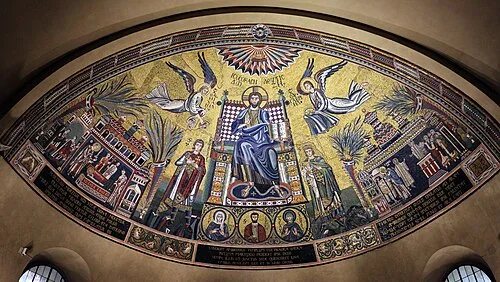 The Apse Mosaic of Christ the Redeemer
Apse Mosaic: Christ Between Saints Gervasius and Protasius
Christ sits enthroned in the apse, with angels above him and the martyrs Gervasius and Protasius at his sides. Scenes from the life of Ambrose appear on either side of him. One reading ties these scenes to an alliance between the churches of Milan and the Franks. Milan had strong ties to the Carolingian empire at that time. In the early Middle Ages, the basilica became the traditional place where emperors were crowned kings of Italy. Tradition traces the custom to 961, when Otto the First was consecrated king of Italy here. The rite was held on the feast of the Epiphany, and the famous Iron Crown was placed on the king's head. Accounts differ on the date of the mosaic. Some say it dates from the early thirteenth century, while others say parts are much older. In August 1943, Allied bombing badly damaged the apse. The mosaic was heavily restored and partly rebuilt from surviving pieces.
Listen in the appPhoto: Sailko · CC BY 3.0
10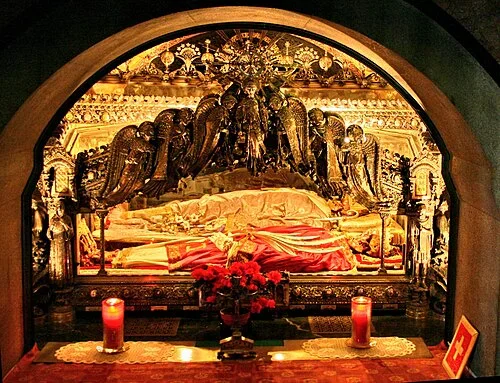 Subterranean Crypt of Saint Ambrose
Reliquary Case of the Patron Saints in the Crypt
The crypt beneath the high altar was built in the ninth century to hold the remains of three saints venerated in this church. Those saints had already been buried in a crypt nearby, but their exact position was lost over the centuries. A bishop named Angilbert found them, and he placed them in a single sarcophagus of porphyry. The crypt's present appearance dates from an eighteenth-century restoration, commissioned by a cardinal. In the nineteenth century, the bodies were moved into a silver urn, set in a space beneath the ciborium. Angel figures stand above it, and candles and flowers mark the spot. Ambrose and the two martyrs now share that silver urn.
Listen in the appG.dallorto · Attribution
- 11
Gold-Lined Dome of the San Vittore Chapel
A chapel that tradition says predates the basilica, its dome lined in gold.
- 12
Mosaic Portrait of Saint Ambrose
An early mosaic face of Ambrose, built from tiny tiles pressed close together.
- 13
Bramante Portico of the Canonica
The Benedictines' 1492 commission to Donato Bramante, and the portico named after him.
Basilica di Sant'Ambrogio
Frequently asked questions
How much does the guide cost?
Free app download. Listed guide price: $0.99. Guide price shown in the app. Audio guide only. Venue admission is separate.
Can I listen without internet?
Yes. Download the guide’s audio, images, and maps in the app before your visit. Your downloaded content is then available offline.
Can I listen in my language?
This audio guide is available in 15 languages, including English.
Do I need to follow a schedule?
No. This is a self-guided experience. Choose your stops, pause whenever you like, and return to a story at your own pace.
At your own pace
Explore Basilica di Sant'Ambrogio.
Download Stanza, then search for “Basilica di Sant'Ambrogio”.
Free app download · Guide price shown in the app
Keep exploring
Nearby audio guides
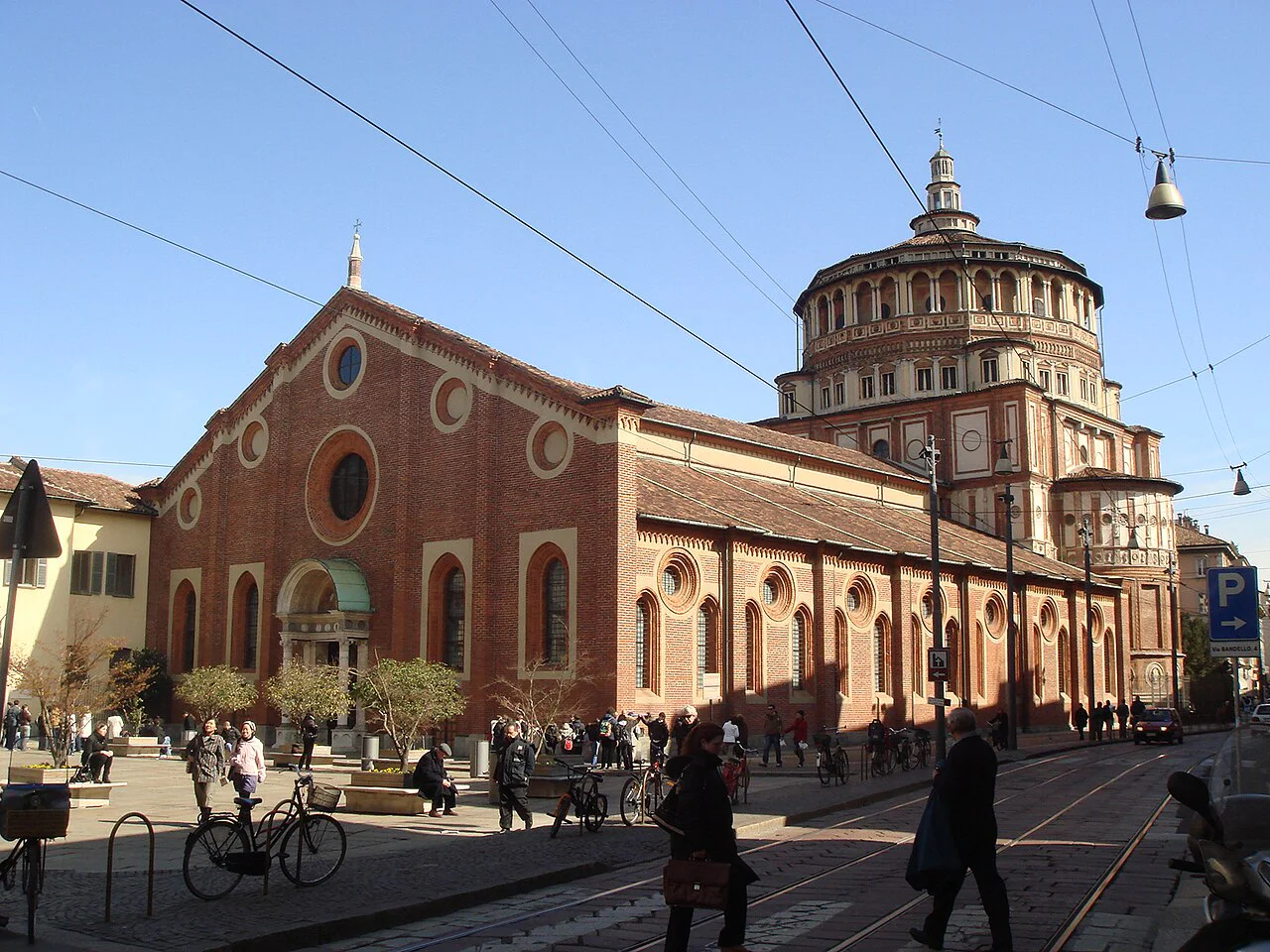
Milan · 1 km
Chiesa di Santa Maria delle Grazie
Content & sources
Giovanni Dall'Orto · Attribution
Milan · 1 km
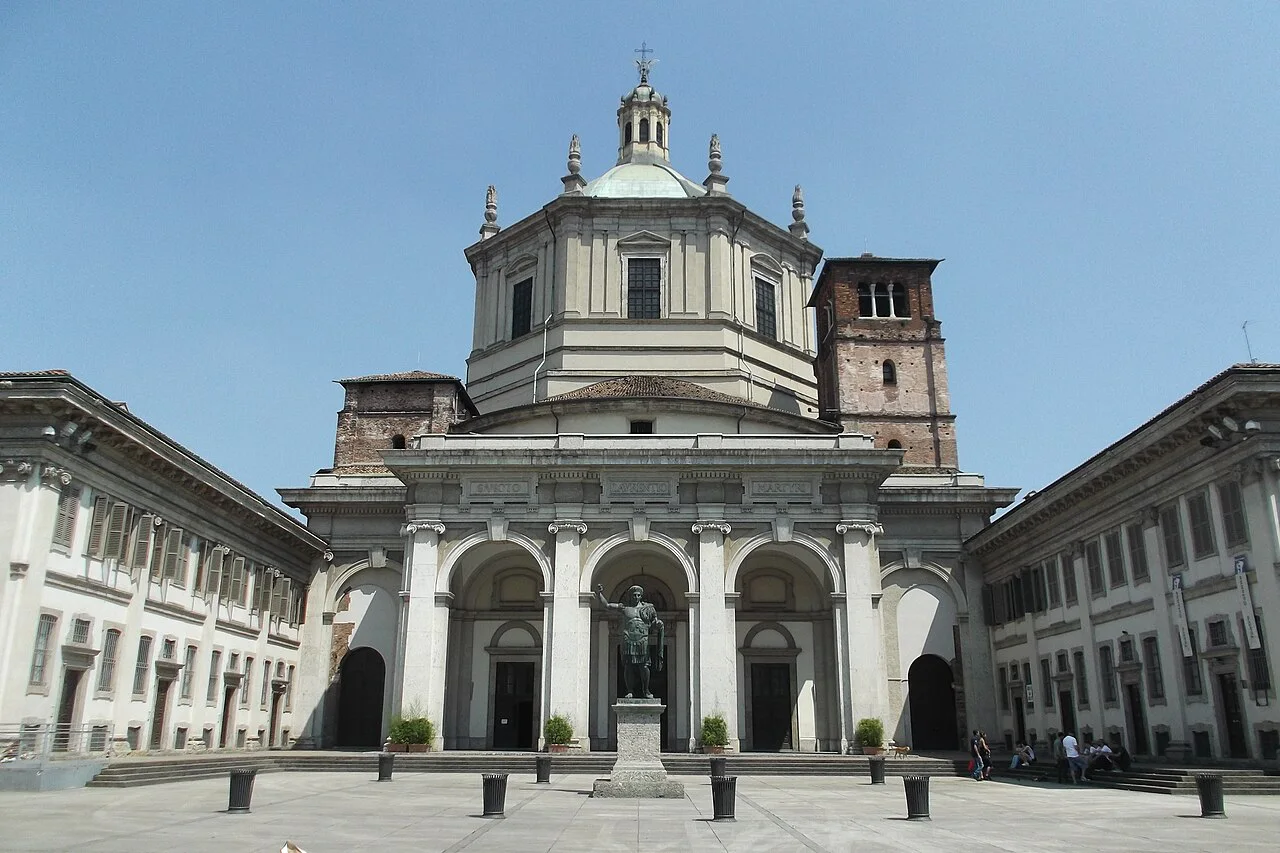
Basilica di San Lorenzo
Content & sources
Photo: Blackcat · CC BY-SA 3.0 it
Milan · 1 km
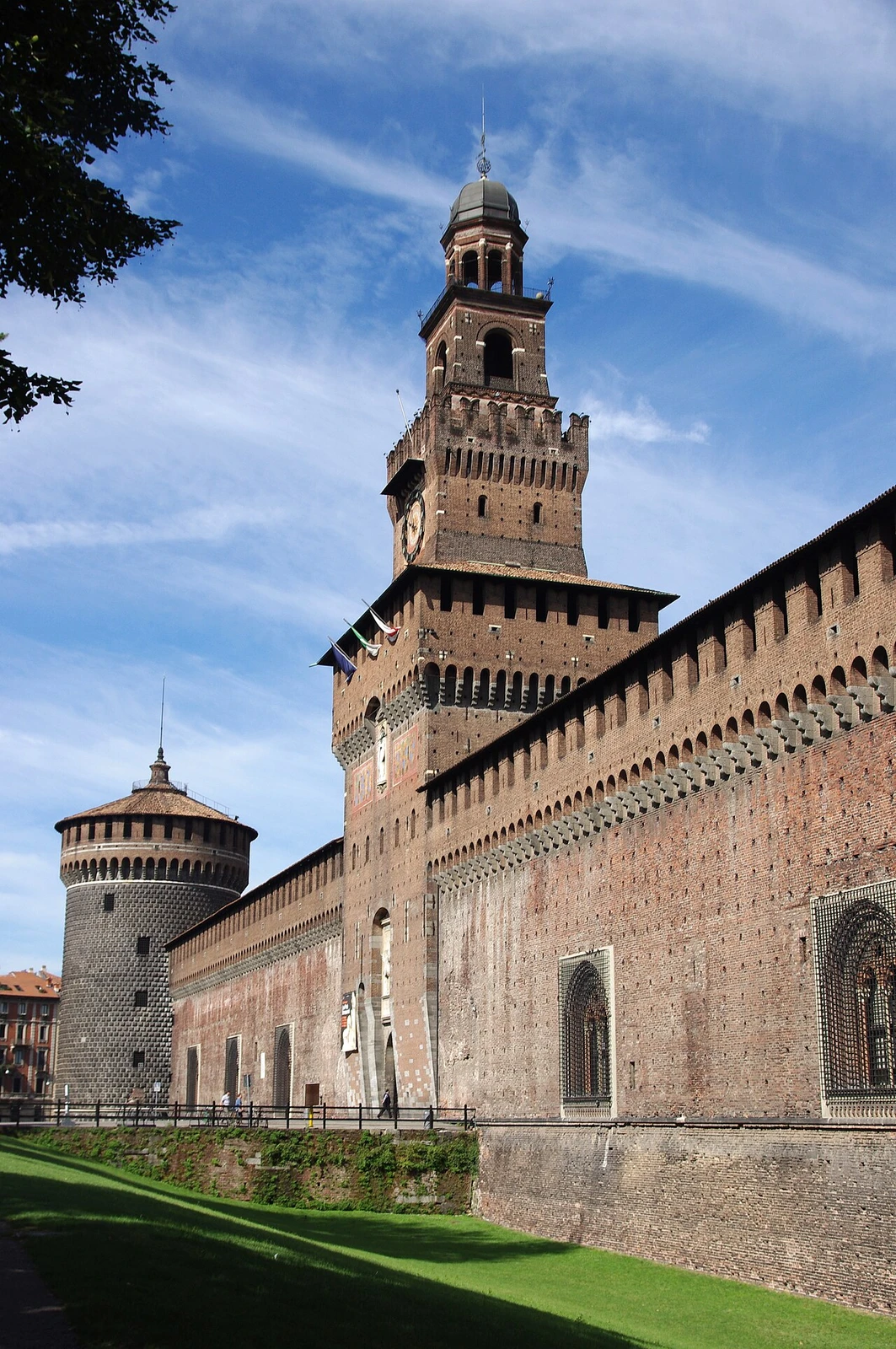
Castello Sforzesco
Content & sources
Jakub Hałun · CC BY-SA 4.0
Milan · 1 km
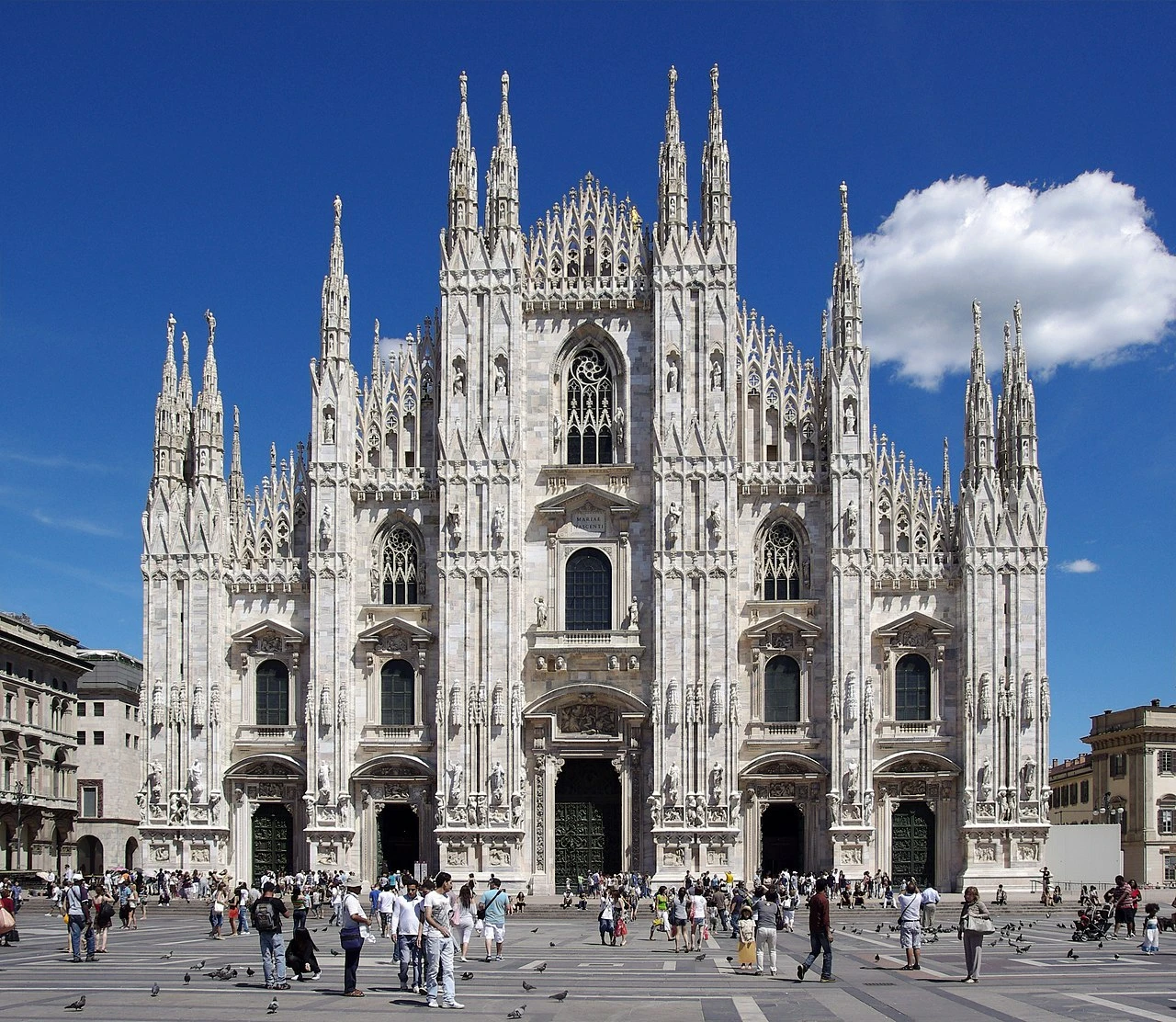
Milan Cathedral
Content & sources
Jakub Hałun · CC BY-SA 4.0