Languages
15Castello Sforzesco Audio Guide
Castello Sforzesco is a landmark in Milan, Italy. Explore it with Stanza's GPS-triggered offline audio guide — available in 15 languages.
Quick Facts
33
Stops
15
Languages
100%
Offline
📍 Milan, Italy · 45.4710°N, 9.1797°E
About Castello Sforzesco
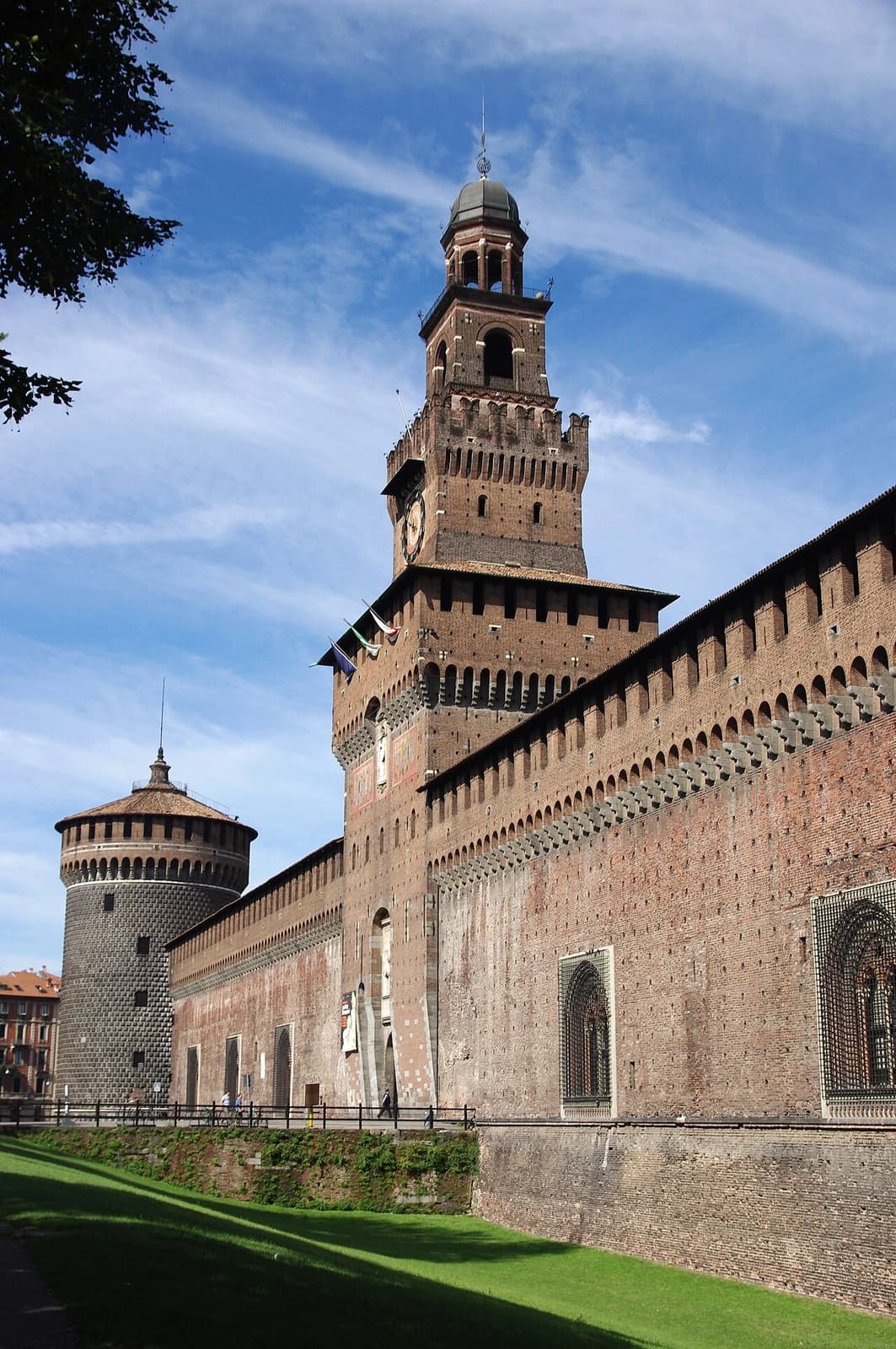
Sforza Castle is a historic fortress and prominent landmark in Milan, Italy. It was built in the 15th century by Francesco Sforza, Duke of Milan.
Castello Sforzesco is also known as Castello Sforzesco, castello sforzesco, castello di Milano, Castello di Porta Giovia.
This self-guided audio tour features 33 narrated stops organized across 7 sections. As a castle, Castello Sforzesco offers a unique cultural experience in the heart of Milan, Italy.
The Stanza audio guide is available in 15 languages and works entirely offline — download the complete tour including audio narration, maps, and images before your visit. As you walk through Castello Sforzesco, GPS-triggered narration plays automatically at each point of interest.
Last updated:
What you will hear
The Filarete Tower and Main Entrance
The grand entrance to the castle, featuring the iconic 70-meter tower reconstructed by Luca Beltrami. Includes the primary POI image and details of the Saint Ambrose statue.
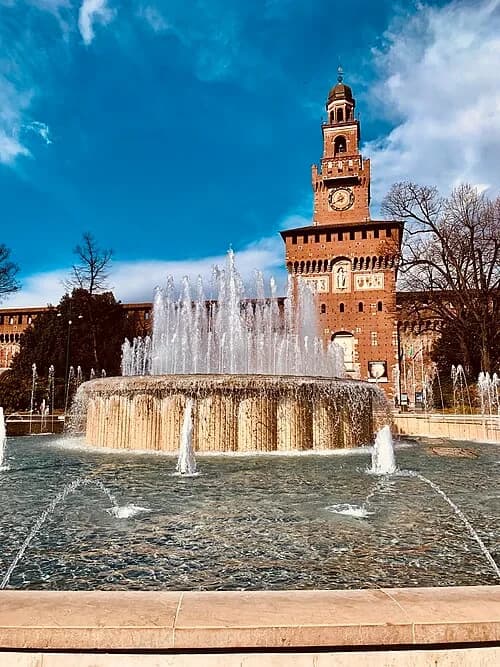
Filarete Tower and Fountain
This impressive structure is the Torre del Filarete, the highest point of the fortress complex. What you see today is a late nineteenth-century restoration, a monumental project led by architect Luca Beltrami between 1891 and 1905. Beltrami's goal was to restore the castle’s distinctive Renaissance silhouette, which had suffered from centuries of decay, military occupation, and partial demolition following the fall of the Sforza dynasty. Before this reconstruction, the entrance looked vastly different, having lost its crowning tower hundreds of years earlier. Beltrami used historical drawings and architectural clues to recreate the tiered design, bringing back the imposing character that once defined the Sforza family’s power. The large fountain at the base, with its dancing water jets, adds a sense of public celebration to what was once a strictly military threshold. Standing here, you can feel the transition from the modern city of Milan into the medieval heart of its former dukedom. The sheer scale of the brickwork and the height of the tower were designed to make an immediate impression on anyone approaching the gate, whether they were a local merchant or a foreign envoy. It remains the most recognizable feature of the castle’s exterior profile.
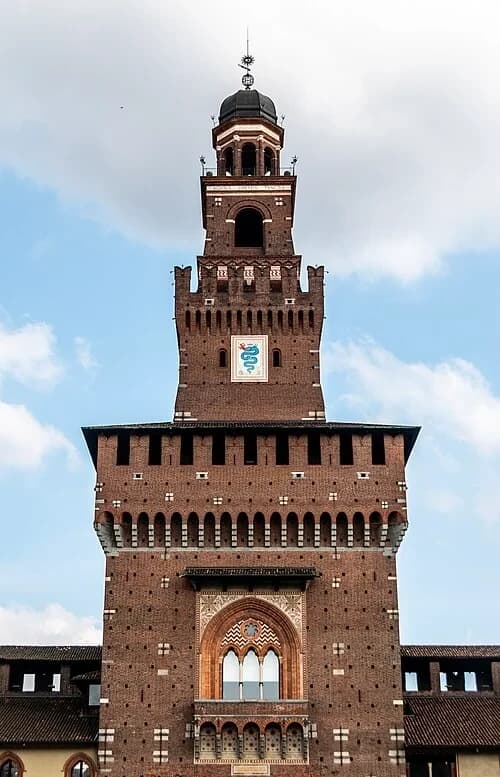
The Main Gate Tower
This tower’s design was originally commissioned in 1452 from the Tuscan architect Antonio Averlino, known as Filarete. His involvement signaled a major shift in the castle’s history, moving away from a purely functional Visconti fortress toward a more elegant ducal residence. However, the tower we see today is not Filarete’s original stone-for-stone. In 1521, a catastrophic event changed the castle's skyline forever. During a storm, lightning struck the tower, which at the time housed a significant gunpowder store. The resulting explosion was so powerful that it caused the entire original structure to collapse, leaving a gap in the facade for centuries. It wasn't until the late nineteenth-century restoration that the silhouette was reinstated based on Filarete's concepts. Notice the progression of the architecture as it rises, with the lower defensive levels giving way to more ornamental galleries and a clock face. This layering shows how the Sforza family wanted to project an image of cultured sophistication while maintaining a secure stronghold. The tower served as the primary control point for the entire citadel, acting as both a symbolic and literal shield for the internal palaces that lay protected within the massive brick envelope.
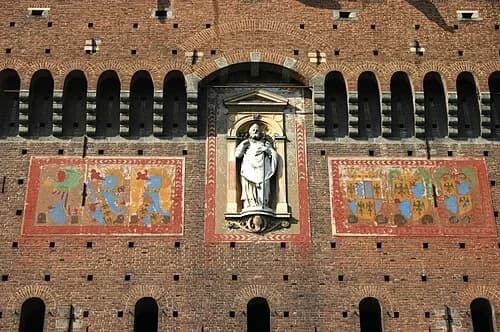
Statue of Saint Ambrose
This sculpture occupies a place of high honor, placing the patron saint of Milan at the very gateway of the fortress. Saint Ambrose is depicted in his clerical vestments, holding his traditional bishop’s staff. Around him, the facade is rich with terracotta bas-reliefs that add texture and detail to the red brickwork. These decorative elements were a hallmark of Lombard Renaissance architecture, showing how local craftsmen used humble clay to create intricate artistic narratives. Look closely for the heraldic symbols integrated into the design, specifically the Visconti and Sforza coats of arms. You might spot the 'Biscione,' the famous serpent devouring a figure, which represented the Visconti family, alongside the eagle and lion symbols associated with the Sforza. These markers were essential political branding, signaling to all who entered that they were crossing into the private domain of the ruling family. The shift from a purely military fortification to a ducal residence is evident here; while the tower is massive, these refined artistic touches suggest a space intended for courtly life and the display of dynastic legitimacy. The presence of Saint Ambrose provided a divine endorsement for the rulers living within these thick walls.
Piazza d'Armi: The Great Courtyard
The massive central courtyard that served as the military heart of the fortress. Features the wide open space and the monument to John of Nepomuk.
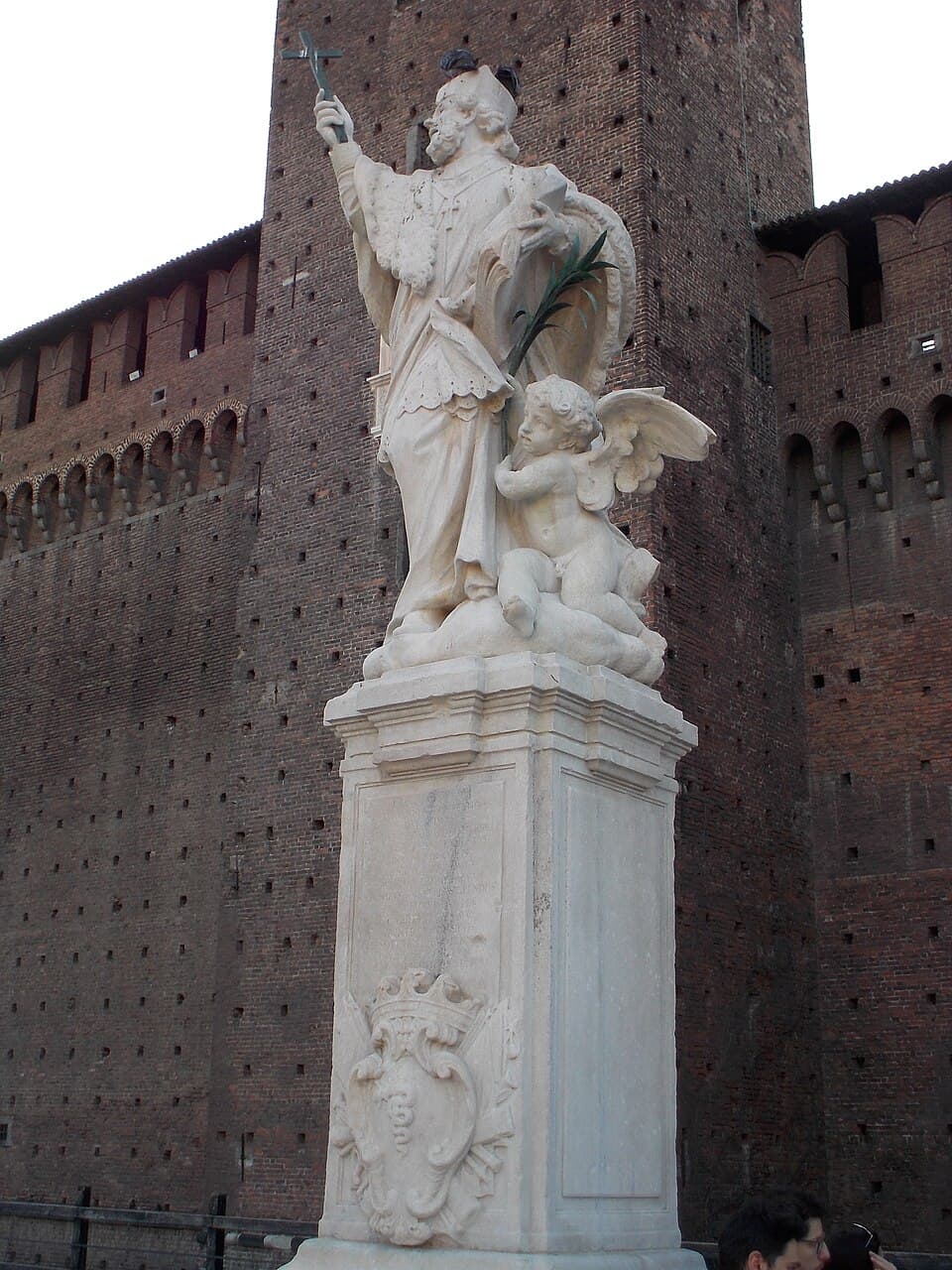
Statue of John of Nepomuk
This statue of Saint John of Nepomuk represents a Baroque interruption in what is otherwise a largely Renaissance fortress. Unlike the red brick and terracotta elements that define most of the castle, this figure is carved from bright white marble, making it stand out sharply against the weathered background. It was placed here during the period of Austrian rule in the eighteenth century, serving as a reminder of the various foreign powers that controlled Milan over the centuries. Saint John of Nepomuk was a popular Bohemian saint often associated with protection and the seal of confession. His presence here reflects the religious and cultural influence of the Habsburg dynasty on the city. The sculpture features the characteristic flowing robes and expressive posture of the Baroque style, contrasting with the rigid, utilitarian lines of the medieval walls behind it. This juxtaposition illustrates how the castle continued to evolve long after the Sforza family was gone. It serves as a visual marker of the transition from the castle’s origins as an Italian ducal seat to its later role as a strategic military outpost for European empires.
Fortress Walls and the Moat
An exploration of the castle's defensive architecture, including the massive 7-meter thick walls and the round corner towers.
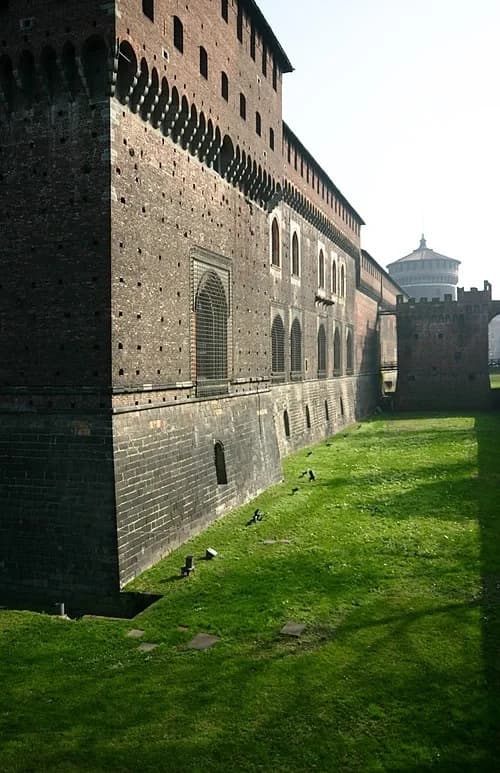
The Defensive Moat
Looking down into the wide, deep moat, it is easy to see how it served as a critical layer of the castle’s defense. Although it is covered in grass today, it was originally a dry ditch that presented a massive obstacle for any invading force. Its primary purpose was to prevent attackers from bringing battering rams or siege towers close to the base of the walls. It also made the use of scaling ladders far more dangerous, as soldiers would have to descend into the ditch before attempting to climb the sheer vertical face of the brickwork. The depth of the moat increased the effective height of the walls significantly, making the fortress look even more imposing from the outside. The sheer verticality of the brick walls rising from the bottom of the moat is a masterclass in military masonry. This massive excavation project made the Sforza castle one of the largest fortified complexes in Europe. Even without water, the moat acted as a psychological and physical barrier, separating the power of the dukedom from the common city streets. It remains one of the most visible reminders of the building's original function as a high-security stronghold.
The Rocchetta: The Inner Keep
The most defensible section of the castle, designed as a final refuge for the Sforza family. Features the elegant Renaissance courtyard and the Tower of Bona of Savoy.
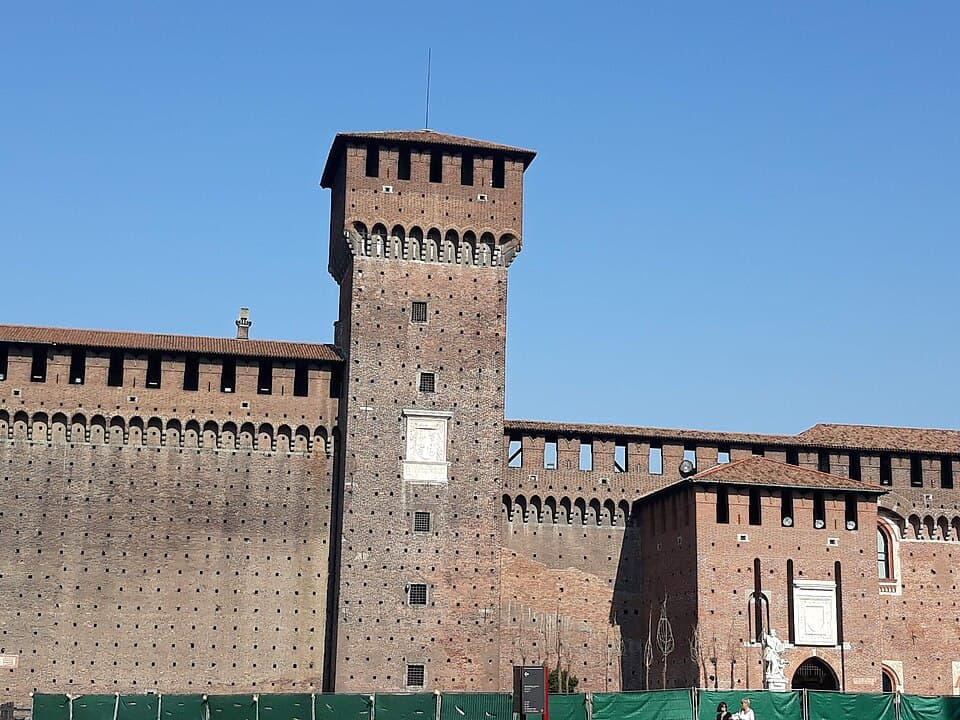
Tower of Bona of Savoy
This commanding structure is known as the Tower of Bona of Savoy. It was commissioned in 1476 by Duchess Bona, who found herself in a precarious political position following the assassination of her husband, Galeazzo Maria Sforza. Acting as regent for her young son, Bona ordered the construction of this tower to serve as a high-vantage lookout and a secure sanctuary within the already protected Rocchetta. From its summit, guards could monitor both the city and the internal courtyards of the castle, watching for signs of betrayal or attack. The tower is a symbol of her struggle for safety and power in a court filled with ambitious rivals, including her brother-in-law, Ludovico il Moro. Its design is strictly functional, with high, sheer walls and small windows that provided maximum protection. Unlike the decorative porticos nearby, this tower was built for survival. It stands as a physical manifestation of the constant underlying tension of life in a Renaissance court, where even the most powerful figures were never truly safe from political intrigue and violence. Its height and isolation made it a perfect final retreat during a crisis.
Loggia of the Elephant
A highlight of the Corte Ducale, this elegant portico features a rare 15th-century fresco of an elephant, a symbol of Sforza prestige.
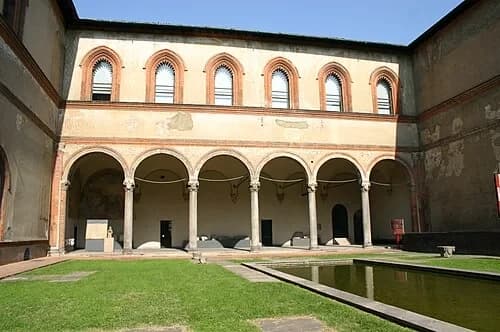
Loggia of the Elephant
This refined loggia was designed by the architect Benedetto Ferrini, providing a covered walkway that connected different parts of the ducal apartments. It allowed the ruling family to move between their private rooms while remaining outdoors and enjoying the view of the courtyard, protected from both rain and the direct sun. In the highly ritualized world of the Renaissance court, a space like this served multiple purposes. It was an ideal location for the dukes to receive foreign ambassadors or high-ranking visitors in a setting that was both impressive and informal. Walking through this portico, you can appreciate the rhythmic placement of the columns and the sense of light and airiness it brings to the solid brick structure of the castle. The loggia is a prime example of how military architecture was softened and made more livable for the aristocracy. Every detail, from the capitals of the columns to the painted decorations that once adorned the ceiling, was meant to project an image of a cultured and sophisticated ruler. It remains one of the most graceful architectural features of the castle's interior, bridging the gap between a secure fortress and a grand palace.
Ponticella di Ludovico il Moro
A graceful bridge structure attributed to Bramante. It contains the Saletta Negra, where Ludovico il Moro mourned his wife, Beatrice d'Este.
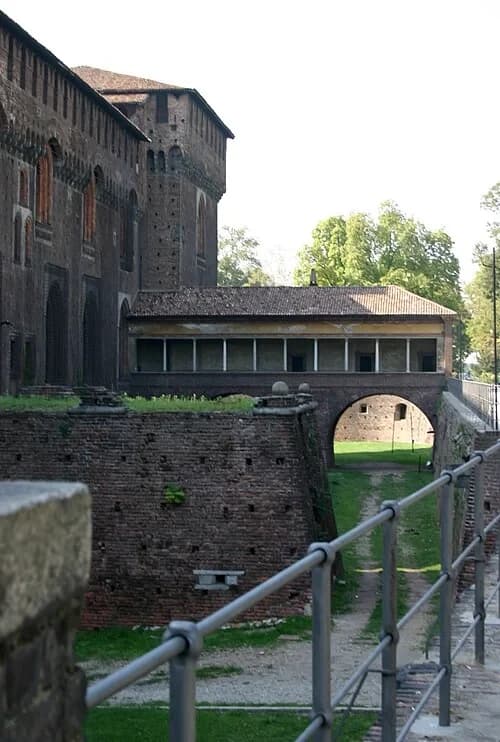
The Bridge of Mourning
After the sudden death of his beloved wife, Beatrice d'Este, in 1497, Ludovico il Moro was consumed by a profound and public grief. This bridge became a site of private sorrow for the Duke of Milan. Tradition holds that he secluded himself in a small chamber located here, which came to be known as the Saletta Negra. To mirror the darkness of his emotional state, Ludovico ordered the room to be painted entirely in black. Beatrice had been a central figure at the court, a fashion icon and political partner who died in childbirth at only twenty-one years old. Her absence left a void that Ludovico struggled to fill, leading him to abandon the festive life of the court for this somber retreat. While the castle is often viewed as a symbol of military might, this corner serves as a reminder of the personal tragedies that unfolded within its walls. The duke's period of mourning lasted for months, during which he supposedly ate his meals alone in the darkness of the Saletta Negra.
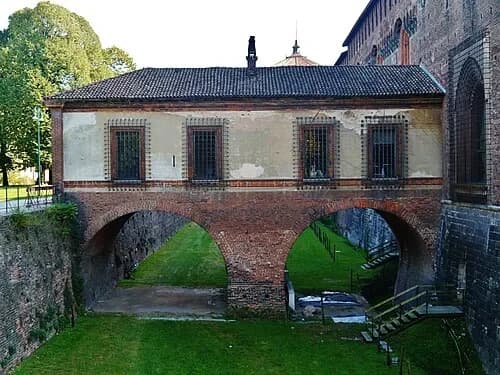
The Duke's Private Bridge
This structure is the Ponticella, a beautiful example of high Renaissance architecture attributed to Donato Bramante, one of the period's most influential designers. It serves as a bridge connecting the private ducal apartments to the massive outer walls of the fortress. This link allowed the dukes to move between different parts of the castle without having to cross through the busy public courtyards below, offering a private and scenic route. Notice the classic Renaissance harmony in its design, featuring a series of well-proportioned arches and a light, open loggia on the upper level. This architectural elegance stands in sharp contrast to the heavy, utilitarian brickwork of the defensive towers nearby. The Ponticella shows how even a functional connection could be turned into a work of art under the patronage of Ludovico il Moro. It reflects the broader Sforza ambition to integrate beauty and classical proportions into every corner of their residence. The bridge remains a testament to Bramante’s ability to create a sense of lightness and grace within the context of a solid, medieval fortress. It provided the dukes with a space for a quiet stroll, high above the military drills and daily business of the castle.
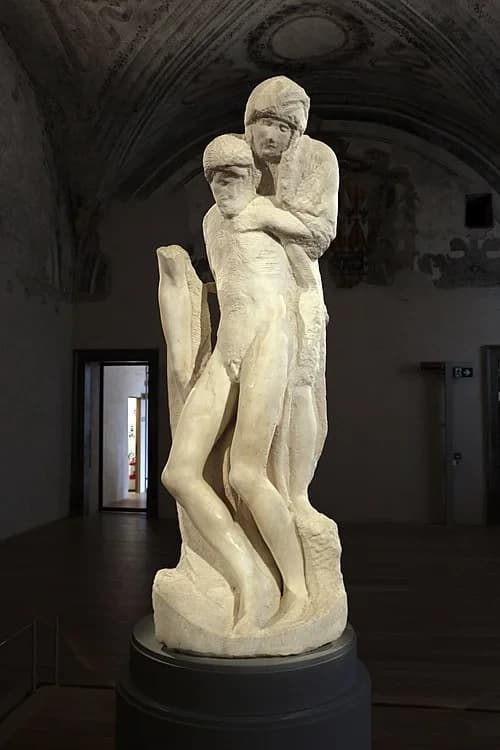
Michelangelo's Pietà Rondanini
The climax of the visit: Michelangelo's final, unfinished masterpiece. It is housed in the former Spanish Hospital, a building that reflects the castle's later military history.
The Unfinished Virgin
In this final work, the boundary between the finished and the unfinished disappears. Michelangelo was eighty-eight years old when he worked on this sculpture, continuing his labor until just days before his death. Look for the legs of Christ, which appear more polished than the torso. These are remnants of an earlier version that the artist decided to discard during his process. Rather than starting fresh, he carved directly into the existing marble, radically changing the composition to show the Virgin Mary supporting her son from behind. The result is a haunting, vertical arrangement where the two bodies seem to merge. In many areas, the rough, jagged chisel marks are left entirely exposed. These textures aren't signs of fatigue but of a deliberate shift away from the flawless anatomical realism seen in his earlier career. For Michelangelo, capturing the pure weight of spiritual connection became more important than technical mastery. The stone reveals the intensity of his last physical efforts where the tool met the block.
Want to hear the rest?
Download the Stanza app to unlock all 33 stops and full GPS-guided navigation.
Frequently Asked Questions
How long does the Castello Sforzesco audio tour take?
The Castello Sforzesco audio guide includes 33 narrated stops. Most visitors spend 45 minutes to 1.5 hours exploring the complete tour, though you can listen at your own pace and skip or revisit any stop.
Is the Castello Sforzesco audio guide available in my language?
Stanza supports 15 languages: English, Spanish, French, German, Italian, Portuguese, Russian, Japanese, Chinese, Korean, Arabic, Hindi, Polish, Dutch, Hebrew. Check the guide in the app to confirm the languages currently available for this tour.
Can I use the audio guide offline at Castello Sforzesco?
Yes! Download the complete Castello Sforzesco tour — including all audio, maps, and images — before your visit. The Stanza app works completely offline, so you don't need WiFi or mobile data at the venue.
How much does the Castello Sforzesco audio guide cost?
The Stanza app is free to download. The current listed price for the Castello Sforzesco audio guide is $3.99; app-store region and currency may affect the final price.
How do I use the Stanza audio guide at Castello Sforzesco?
Download the free Stanza app, search for "Castello Sforzesco", and download the tour. When you arrive at the venue, the app uses GPS to detect your location and automatically plays the relevant narration as you move between points of interest — completely hands-free.
What makes the Stanza audio guide different from other Castello Sforzesco tours?
Stanza offers GPS-triggered narration that plays automatically as you walk through Castello Sforzesco — no need to manually select stops. The tour is available in 15 languages, works fully offline, and includes 33 expertly narrated stops with images and historical context.
What other audio guides are available near Castello Sforzesco?
Stanza offers multiple audio guides in Milan, Italy and nearby areas. After downloading the app, browse the map to discover all available tours near Castello Sforzesco. Each guide can be downloaded for offline use.