Stanza · Audio guide
Maschio Angioino Audio Guide
A place to remember. A story to take with you.
Castel Nuovo is a medieval castle located in central Naples. It served as a royal seat for kings of Naples, Aragon and Spain until 1815.
Download Stanza, then search for “Maschio Angioino”.
About the tour
One guide. Your kind of visit.
Castel Nuovo is a medieval castle located in central Naples. It served as a royal seat for kings of Naples, Aragon and Spain until 1815.
Ready when you are.
- 01Get the free Stanza app.
iOS & Android
- 02Find your guide.
“Maschio Angioino”
- 03Download before you go.
Works offline
Audio guide / 13 narrated stops
Inside the guide
Get to know a few of the stories before you go. Open a stop to read more.
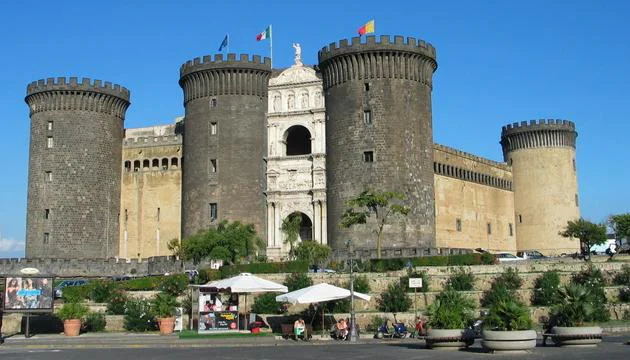
01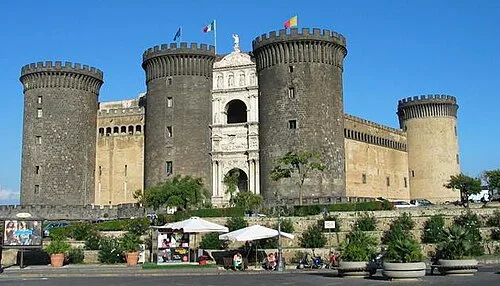 Piazza Municipio Esplanade and Artillery Bastions
Castel Nuovo from the Piazza Municipio Esplanade
Welcome to the Maschio Angioino, the castle Neapolitans also call Castel Nuovo, the New Castle. The story begins in 1266, when Charles of Anjou took the throne of Sicily and moved the kingdom's capital from Palermo to Naples. He needed a royal palace worthy of a capital, and work on the Castrum Novum began in 1279. The French architect Pierre de Chaule designed it, and the walls rose in just three years, remarkably fast for the building techniques of the day. Yet the king never lived here. The War of the Sicilian Vespers cost his family the crown of Sicily, and the new palace stood unused until Charles died in 1285. The dark round towers that give the castle its face came almost two centuries later. Alfonso V of Aragon handed the fortress to the Mallorca-born architect Guillem Sagrera, who rebuilt it in Catalan Gothic style. Four of the five cylindrical towers swallow older square Angevin towers inside them, their round shape better able to withstand the guns of the time. A French king's palace had become a machine for surviving cannon fire.
Photo: IgnisFatuus · CC BY-SA 2.5
02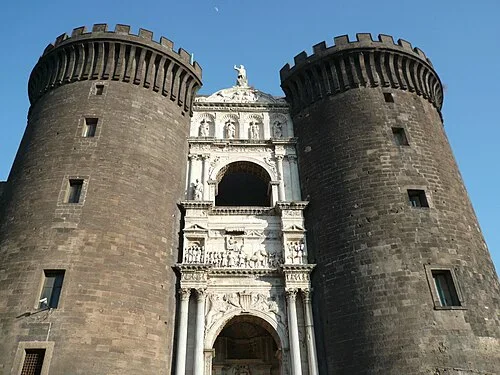 The Triumphal Arch and Great Bronze Gates
The Triumphal Arch between the Towers
Wedged between two dark medieval towers, a white marble arch rises about thirty-five meters in two stacked tiers. It celebrates a single day: the entry of Alfonso V of Aragon into Naples in 1443, after he conquered the throne. Alfonso made the castle his court, one meant to rival the court of the Medici in Florence, and the entrance had to say so. Work began in 1453 and dragged on past the king's death, finishing only in 1479. Who designed it has been argued for centuries. Giorgio Vasari credited Giuliano da Maiano, and an older attribution named the Milanese architect Pietro di Martina. Modern scholars give the design to Francesco Laurana, a Dalmatian sculptor, working with artists of many origins. The contrast was deliberate. Against the military stone of the towers, the arch speaks the language of ancient Rome, where triumphal gateways announced victorious generals. Alfonso was casting himself in that role, at the very door of his kingdom.
José Luiz · CC BY-SA 4.0
03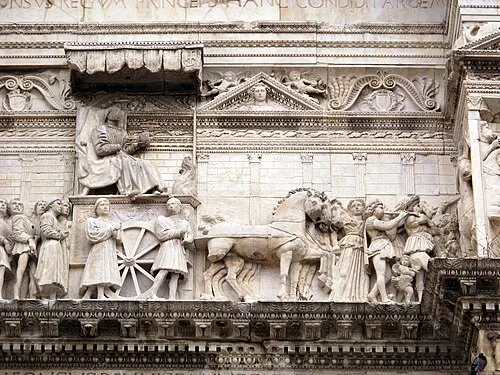 The Triumphal Arch and Great Bronze Gates
The Triumphal Frieze of Alfonso
The carved relief shows the point of it all: Alfonso riding in a triumphal chariot, drawn in procession like a Roman emperor. Corinthian columns flank the entrance, and a frieze beneath the scene proclaims him in Latin — Alfonso, king of Spain, Sicily and Italy, pious, merciful, unconquered. Higher up, the inscription reads: 'Alfonso, prince of kings, built this citadel.' The borrowings from classical Rome are precise. At the curved top of the opening, two spandrels carry a putto and a winged Victory each, taken straight from ancient Roman triumphal gateways. In the tympanum, two river gods recline as bearded men holding horns of plenty, symbols of wealth, peace and territorial expansion. Statues of the four cardinal virtues — Prudence, Fortitude, Temperance and Justice — present the king as a moral ruler. And then there are the two bearded heads flanking the curved pediment. Scholars have never agreed on them. Some read them as ancient emperors or philosophers. Others see wind gods, or grotesque mascarons — Roman motifs framing the boundary of the sky.
Listen in the appPhoto: Sailko · CC BY 3.0
04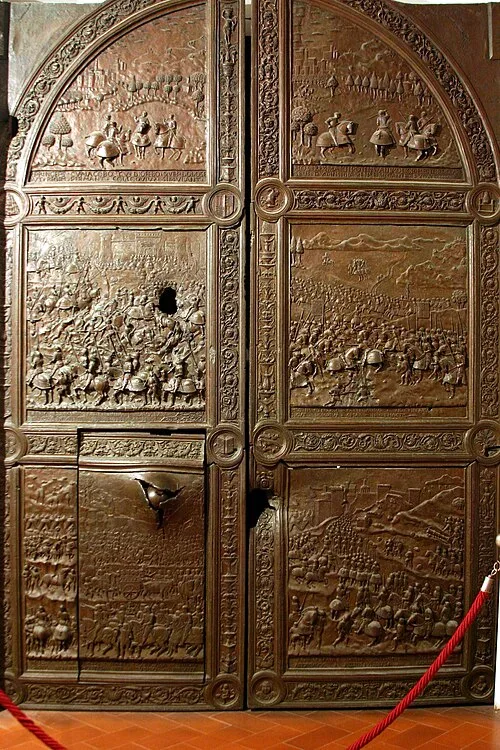 The Triumphal Arch and Great Bronze Gates
The Bronze Gates of Ferdinand I
The great doors under the arch are bronze, cast by a monk named Guglielmo of Naples. Their compartments unfold in relief like the pages of a storybook: the victories of Ferdinand I, Alfonso's son, over the Duke of Anjou and over the rebellious barons. Armies clash, cavalry charges, cities fall — battle after battle pressed into metal. This was propaganda with a purpose. Everyone who crossed this threshold, ambassador and merchant alike, walked past a king's triumphs spelled out in bronze. The doors turned an entrance into an announcement: this family wins its wars.
Listen in the appJosé Luiz · CC BY-SA 4.0
05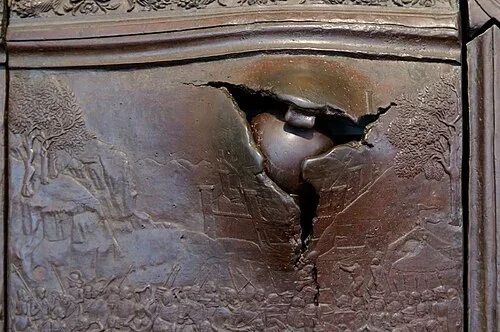 The Triumphal Arch and Great Bronze Gates
The French Cannonball in the Gate
In 1494 the armies of Charles VIII of France struck this gate, and the cannonball never left. It is still lodged in the bronze paneling, tearing the metal around it. The blow came only a few years after those doors had been celebrating Aragonese victories. Charles VIII's invasion opened the Italian Wars, the long cycle of conflicts that reshaped the peninsula, and the kingdom of Naples would soon pass out of Aragonese hands. This dented panel is where that new age first hit the castle.
Listen in the appMarie-Lan Nguyen · CC BY 2.5
06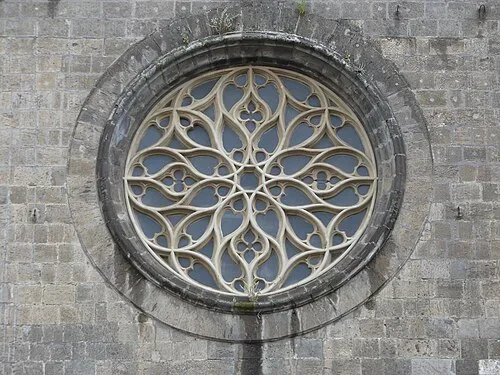 The Palatine Chapel
The Rose Window of the Palatine Chapel
The wall facing the sea is the last piece of the fourteenth-century Angevin castle still standing. Everything else around it was rebuilt, but this back wall of the Palatine Chapel survived. It has not had an easy life. An earthquake in 1456 damaged the chapel and destroyed its original rose window. The one set in the facade now was carved in the Aragonese period by a Catalan craftsman, Matteo Forcimanya, as a replacement. Its stone tracery blooms outward in petals and flame-like lobes, Gothic work made for a rebuilt castle. The entrance portal below carries Renaissance reliefs by Andrea dell'Aquila and Francesco Laurana. In 1688, after a refurbishment in the Baroque style, the chapel was consecrated again — a marble plaque on the entrance door records it.
Listen in the appPhoto: Sergioizzo · CC BY-SA 4.0
07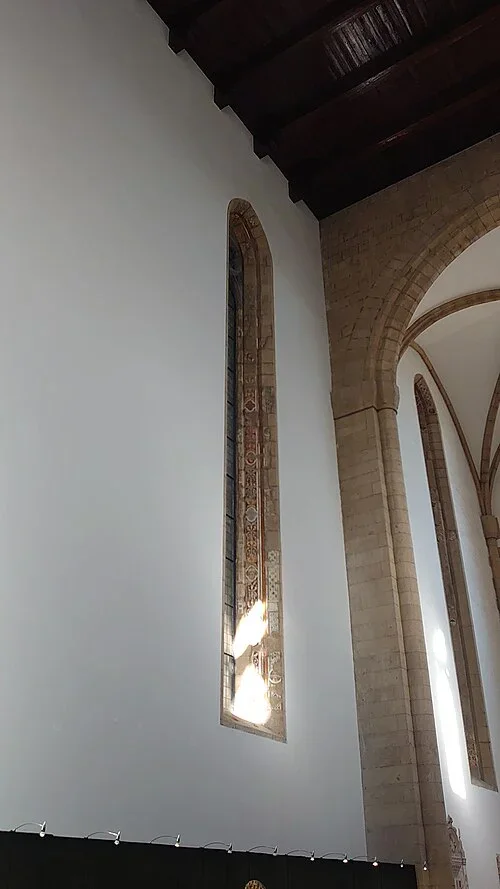 The Palatine Chapel
Inside the Angevin Chapel: Robert's Court
Inside, the chapel is austere: tall, narrow Gothic windows, plain walls, simple vaulting. Under Robert, King of Naples, who took the throne in 1309, this room belonged to one of the glittering courts of Europe. Robert renovated and expanded the castle and poured his passion for arts and letters into it. Petrarch and Boccaccio stayed here during their time in Naples. The greatest painters of the age were called to paint its walls — Pietro Cavallini, Montano d'Arezzo, and above all Giotto, summoned to work on the Palatine Chapel around 1330. Almost all of that decoration is gone. A few fragments survive: frescoes on the right wall attributed to Maso di Banco, rich with Gothic-Angevin references, and works by other Florentine artists on the left. A late fifteenth-century ciborium by Iacopo della Pila stands here, along with sculptures by artists who also worked on Alfonso's triumphal arch.
Listen in the appPhoto: Richard Nevell · CC BY-SA 4.0
08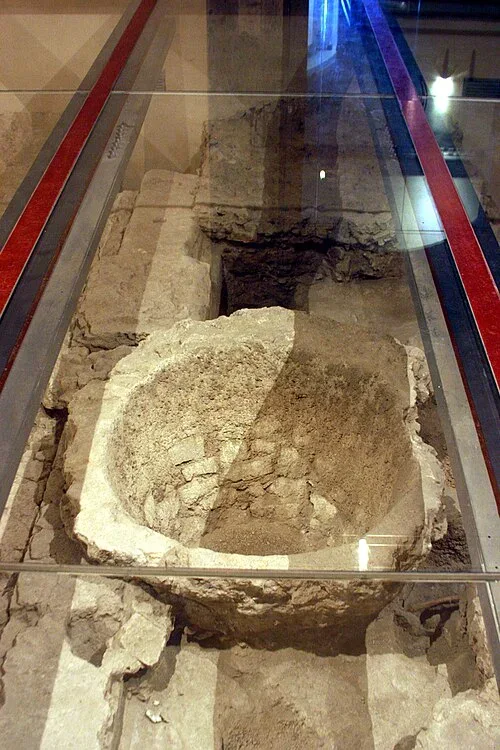 The Armoury Hall and Roman Excavations
The Armoury Hall and the Roman City Below
This room takes its name from what it stored: weapons. It sits to the left of the Palatine Chapel, one level below the great hall, and served the castle as an armoury. The floor tells a much older story. During restoration work in the courtyard, important remains of the Roman city came to light, from long before any castle stood here. Two distinct layers of occupation emerged, one from the first century BC, another from the fifth century AD. The remains were left in place, preserved beneath a transparent glass floor. The castle is only the newest chapter on ground people have occupied for some two thousand years.
Listen in the appJosé Luiz · CC BY-SA 4.0
09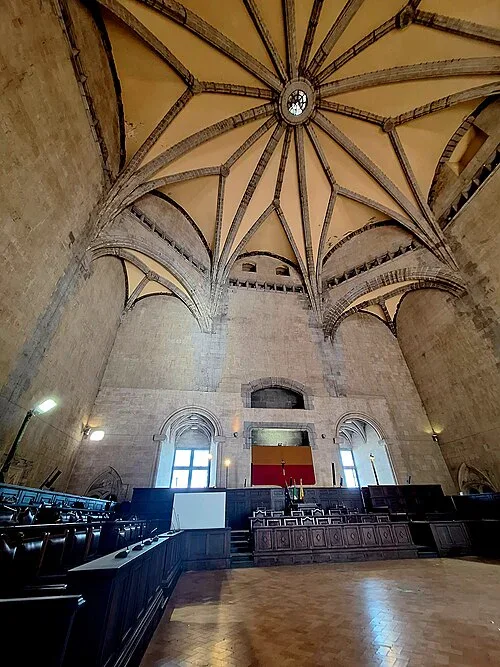 The Monumental Hall of the Barons
The Hall of the Barons: The Great Refusal
On the thirteenth of December, 1294, the most famous ceremony this hall ever held was a resignation. Pope Celestine V — the hermit Pietro da Morrone, a man who had never wanted the throne — renounced the papacy here, in the castle's main hall. Dante condemned the act as the great refusal. Eleven days later, on Christmas Eve, the college of cardinals gathered in the same chamber and elected Benedetto Caetani, who took the name Boniface VIII. The new pope immediately moved the Church's seat to Rome, to escape the interference of the Angevin family that dominated this kingdom. The hall itself, originally called the Throne Room, was the sala Maior, the supreme ceremonial space of the castle. Kings held court here, ambassadors were received, and the fate of the realm was decided under this roof.
Listen in the appPhoto: Antonina Dattola · CC BY-SA 4.0
10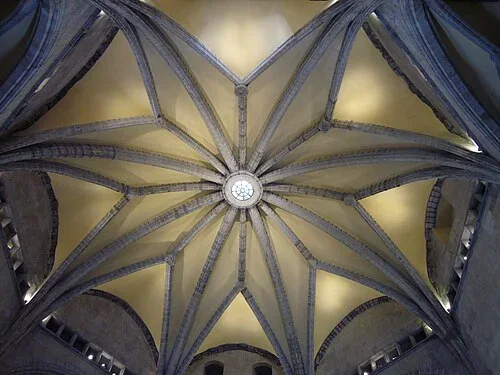 The Monumental Hall of the Barons
Sagrera's Vault and the Conspiracy of the Barons
The vault overhead is the signature of Guillem Sagrera, the Catalan architect who rebuilt this hall for Alfonso V. The room measures about twenty-six by twenty-eight meters, and its octagonal vault rises on sixteen ribs — ogives, in the language of the builders — fanning out into a star around a bright central oculus. Small windows ring the vault. From there, soldiers could watch over the king's person whenever he received visits or ambassadors. But the hall is named for a darker day. In 1486 Ferdinand I, Alfonso's son, invited the nobles who had conspired against him to a feast here, under the pretext of a wedding celebration that would seal a reconciliation. The conspiracy had been led by Antonello Sanseverino, prince of Salerno, and Francesco Coppola, count of Sarno. The barons came, and the king ordered his soldiers to bar the doors. Those present were arrested on the spot, and many were condemned to death, among them Coppola and his sons. That wedding feast gave the room the name it still carries: the Hall of the Barons.
Listen in the appPhoto: Lalupa · CC BY-SA 4.0
- 11
The Catalan Staircase in the Beverello Tower
A spiral of piperno and tuff that carried soldiers from the great hall to the rooftop watch.
- 12
The Dungeons: Pit of the Crocodile and the Barons' Prison
The pit where prisoners vanished, the crocodile of legend, and four coffins without names.
- 13
Closing: the Castle as Naples' House of Memory
Toma's painting of judgment, and the story of how a royal palace became the city's museum.
Maschio Angioino
Frequently asked questions
How much does the guide cost?
Free app download. Listed guide price: $1.99. Guide price shown in the app. Audio guide only. Venue admission is separate.
Can I listen without internet?
Yes. Download the guide’s audio, images, and maps in the app before your visit. Your downloaded content is then available offline.
Can I listen in my language?
This audio guide is available in 15 languages, including English.
Do I need to follow a schedule?
No. This is a self-guided experience. Choose your stops, pause whenever you like, and return to a story at your own pace.
At your own pace
Explore Maschio Angioino.
Download Stanza, then search for “Maschio Angioino”.
Free app download · Guide price shown in the app
Keep exploring
Nearby audio guides
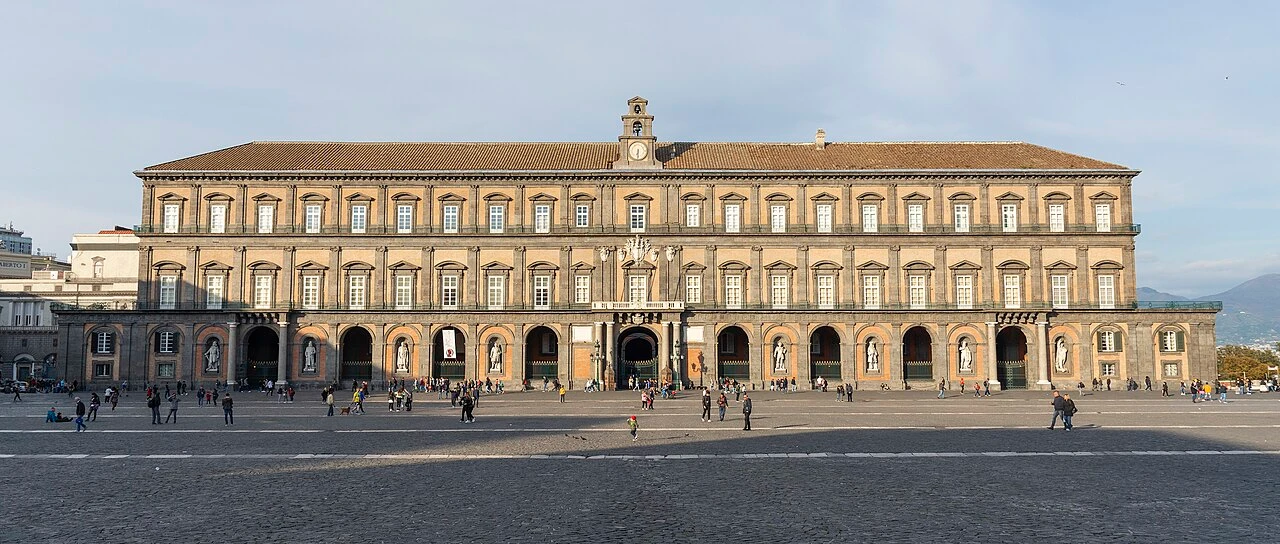
Naples · 1 km
Royal Palace of Naples
Content & sources
Photo: Sordelli · CC BY-SA 3.0
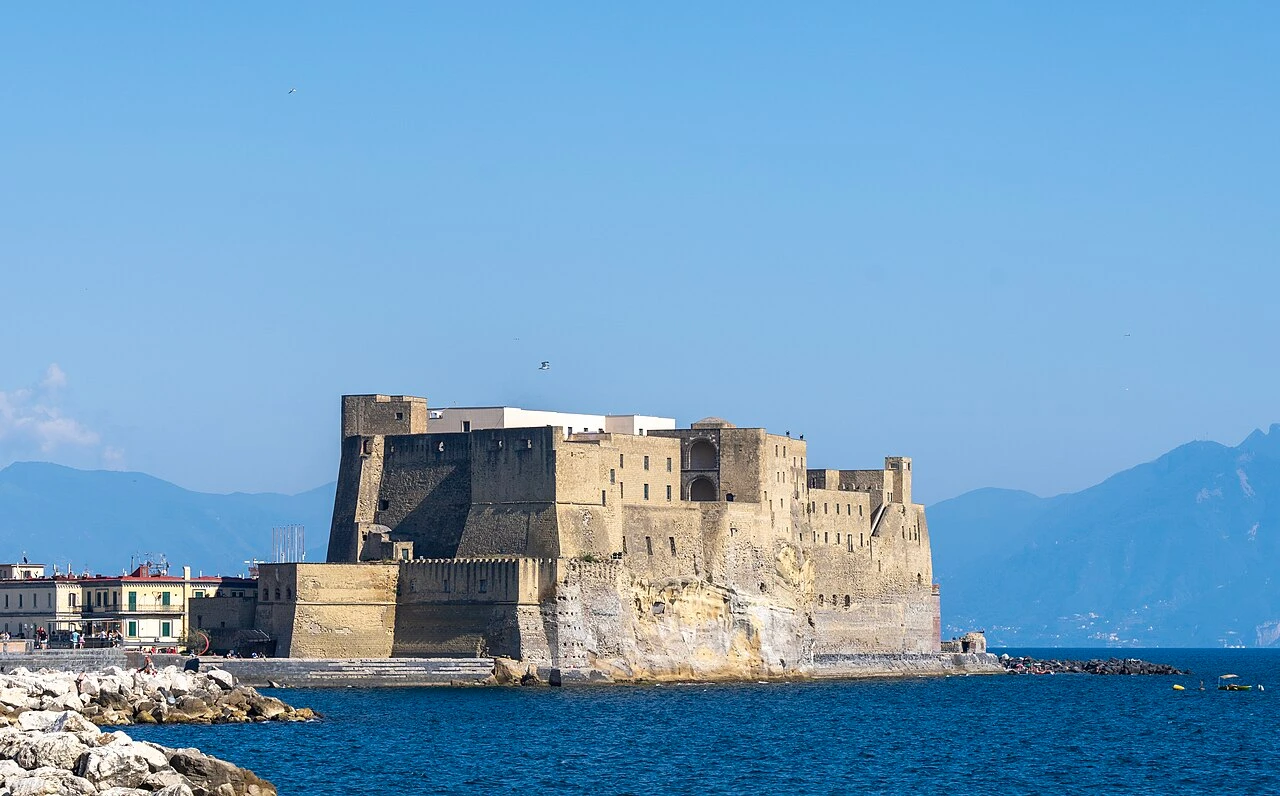
Naples · 1 km
Castel dell'Ovo
Content & sources
Paestum · CC BY-SA 4.0
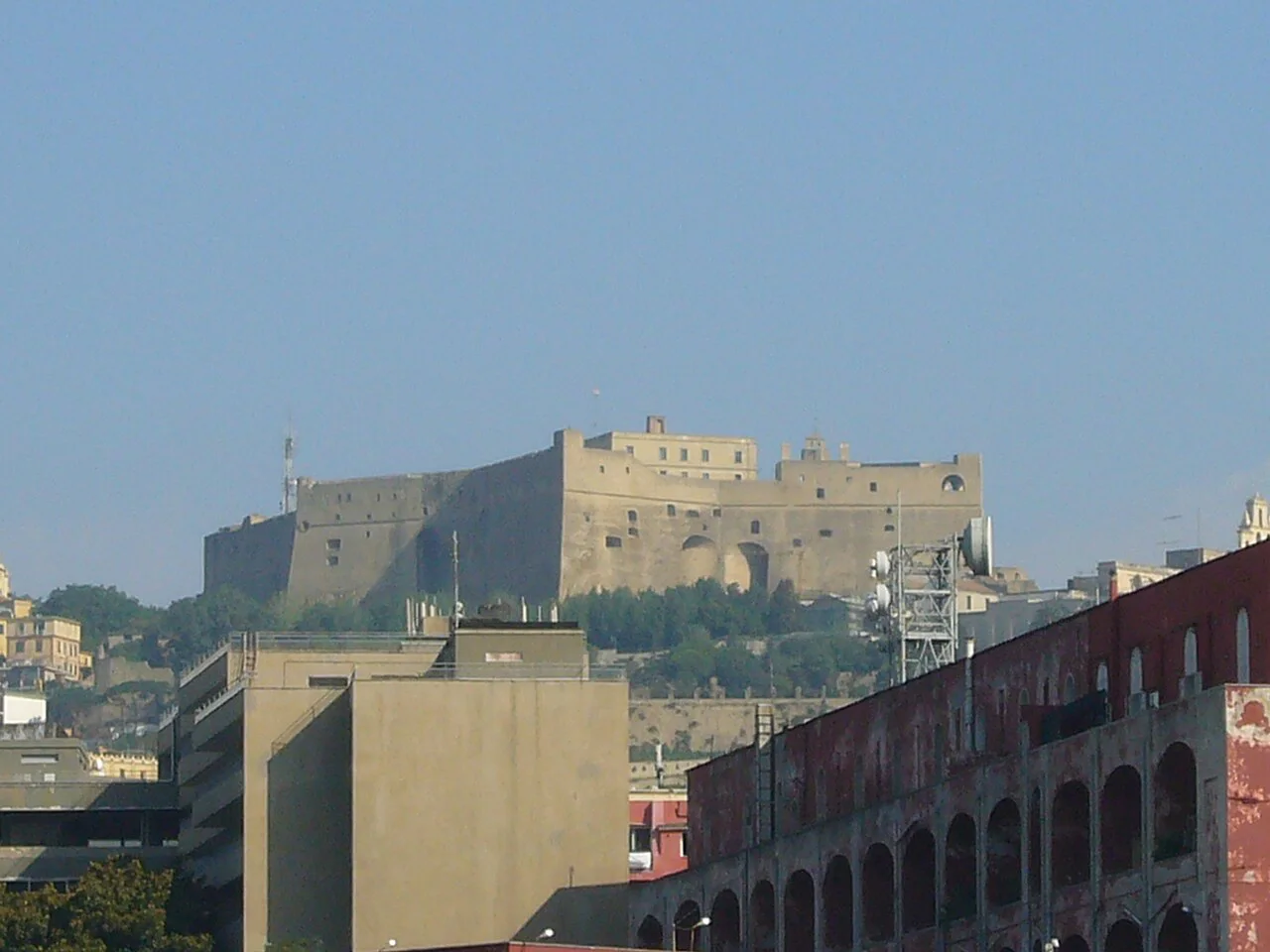
Naples · 1 km
Castel Sant'Elmo
Content & sources
Photo: Lalupa · CC BY 3.0
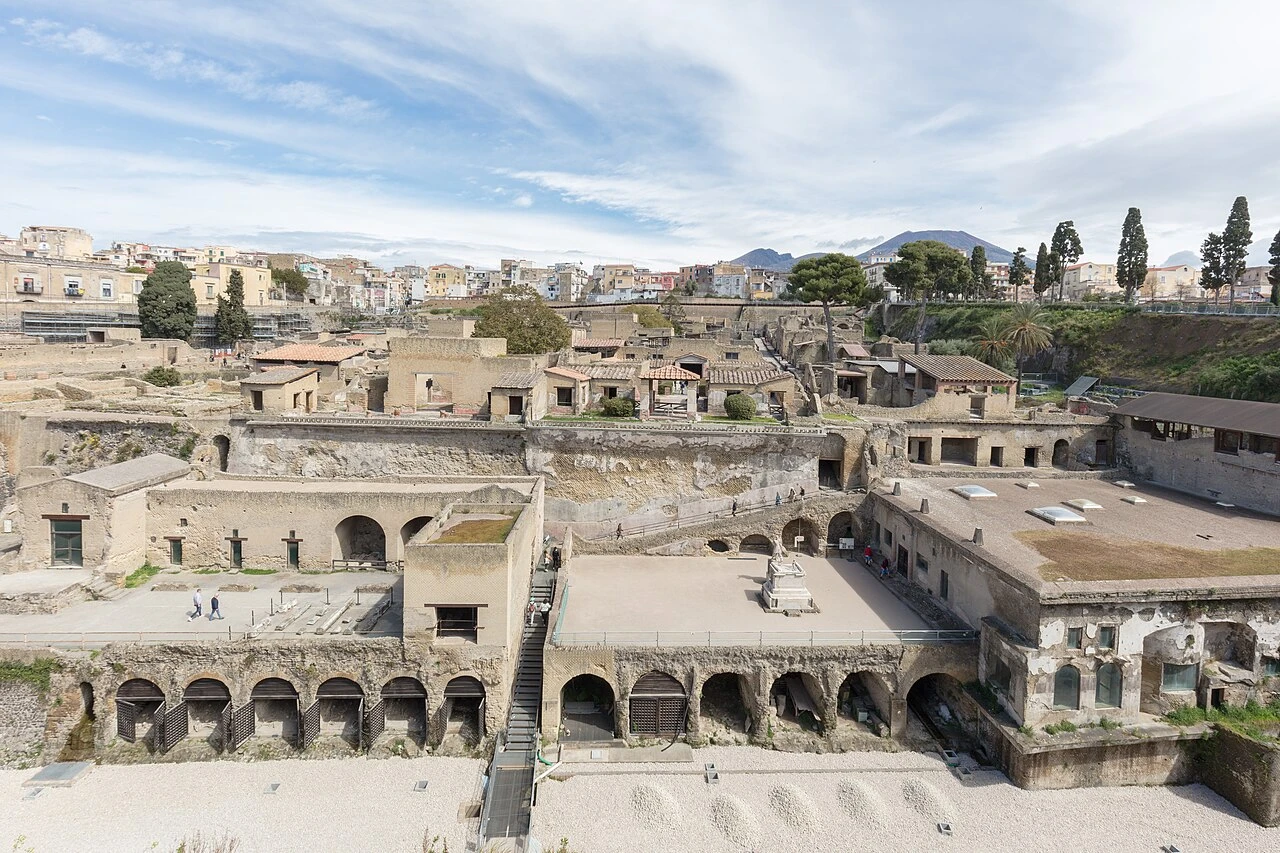
Ercolano · 9 km
Herculaneum
Content & sources
Diego Delso · CC BY-SA 4.0