Stanza · Audio guide
Basilica di Sant'Antonio di Padova Audio Guide
A place to remember. A story to take with you.
The Pontifical Basilica of Saint Anthony of Padua is a Catholic church and minor basilica located in Padua, Italy. It is dedicated to Saint Anthony of Padua and holds the status of an international shrine.
Download Stanza, then search for “Basilica di Sant'Antonio di Padova”.
About the tour
One guide. Your kind of visit.
The Pontifical Basilica of Saint Anthony of Padua is a Catholic church and minor basilica located in Padua, Italy. It is dedicated to Saint Anthony of Padua and holds the status of an international shrine.
Ready when you are.
- 01Get the free Stanza app.
iOS & Android
- 02Find your guide.
“Basilica di Sant'Antonio di Padova”
- 03Download before you go.
Works offline
Audio guide / 14 narrated stops
Inside the guide
Get to know a few of the stories before you go. Open a stop to read more.
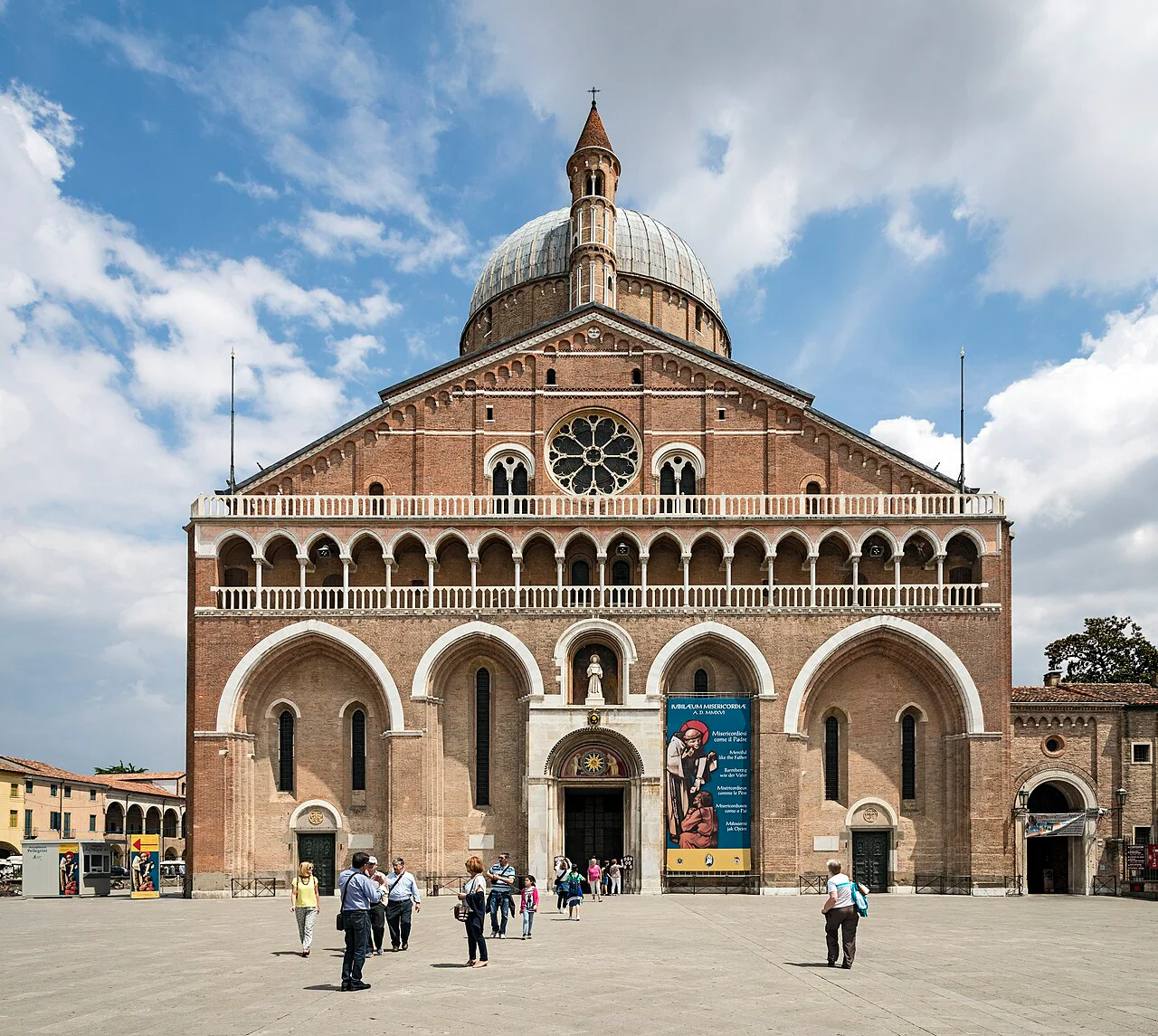
01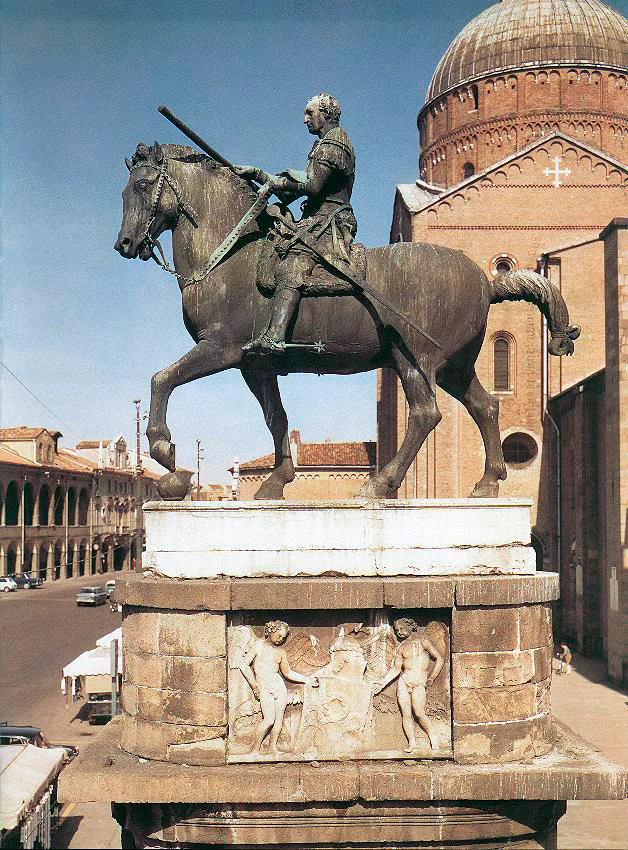 Piazza del Santo and Facade
Gattamelata Equestrian Monument
Welcome to il Santo, the great shrine of Padua, raised over the tomb of Saint Anthony of Padua, who died in 1231. The bronze horseman beside the church is the monument that announced the Renaissance to this city. He is Erasmo da Narni, called Gattamelata, a condottiero who commanded armies for Venice. After his death, a memorial was planned for him on a scale once reserved for emperors. Donatello cast him on horseback, life size, and no life-size bronze rider had been made in the West since Roman antiquity. The horse strides forward under full control, and the rider sits calm, baton in hand, every inch a commander. From the piazza, the statue answers the brick facade behind it. Locals simply call the basilica il Santo, the Saint, because the whole place belongs to one man.
Photo: Alonso de Mendoza · Public domain
02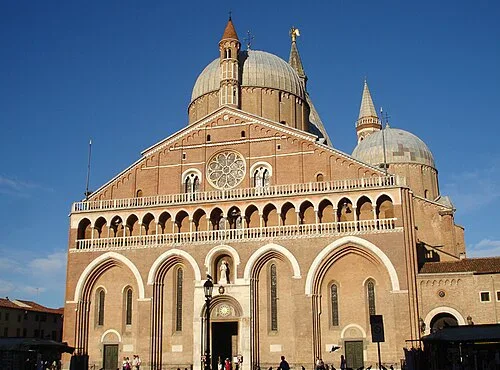 Piazza del Santo and Facade
The Facade of il Santo
Saint Anthony spent the last stretch of his life on what was then the edge of Padua. A small church called Santa Maria Mater Domini stood among the fields, cared for by Franciscan friars. Anthony lodged beside it from 1229, and a convent rose next door, said to be his own foundation. He died in June 1231 at Arcella, on the northern side of the city, and was buried in the little church, exactly as he had wished. Padua did not wait long to honour him. Pope Gregory IX declared him a saint within a year, with the words, rejoice, happy Padua, for you possess a treasure. Building for a great basilica began around 1232, and his remains were brought here in 1263. Work continued until 1310, and the church never settled on a single style. The brick front is Romanesque, the aisles were added in Gothic form, and the domes were raised high in the Venetian manner, like St Mark's in Venice. It remains a giant edifice without a precise architectural style.
Photo: Airin · CC BY-SA 1.0
03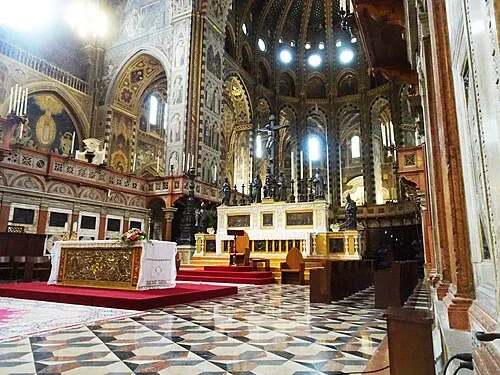 The Nave and Architectural Harmony
The Nave
The basilica began as a single-naved church, on the model of St Francis at Assisi, with broad transepts. Later in the thirteenth century the aisles were added, with pointed arches and ribbed vaults, to carry the growing crowds. The crowds were the point, because this is an international shrine, and pilgrims have moved through it for centuries. The interior rises nearly thirty-nine metres at its highest. From end to end the building runs a hundred and fifteen metres. Every line of the patterned floor still draws the eye towards the transept, where the Saint lies. That chapel is the goal of every visit.
Listen in the appPhoto: Palickap · CC BY-SA 4.0
04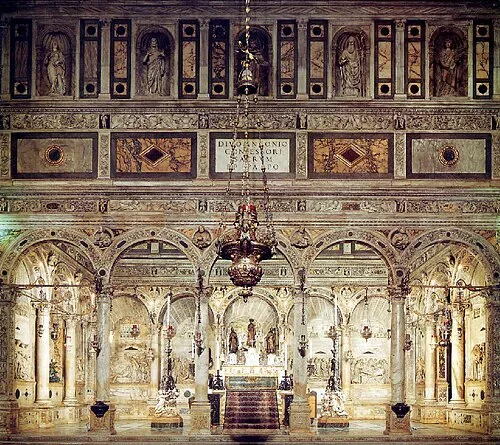 Chapel of the Ark (Tomb of Saint Anthony)
The Chapel of the Ark
The marble ark of Saint Anthony is the heart of this church, and has been for centuries. His body was moved more than once as the basilica grew up around it, and from 1350 it has rested in this transept chapel. The tomb stands on a platform seven steps high, so that pilgrims could gather close on every side. Three statues crown the monument: Saint Anthony in the centre, with Bonaventure and Louis of Toulouse, two Franciscan bishops, at his side. They were made in the 1590s by Tiziano Aspetti. He completed the altar itself in 1607. Along the base run nine monumental reliefs of the Saint's life and miracles, carved so that pilgrims at the tomb could follow his story panel by panel.
Listen in the appTullio Lombardo · Public domain
05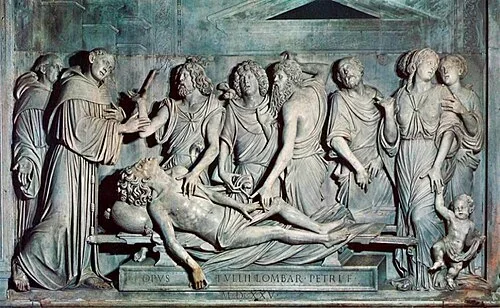 Chapel of the Ark (Tomb of Saint Anthony)
Tullio Lombardo, Miracle of the Miser's Heart
One marble relief on the ark shows Anthony at his most dramatic. It is the Miracle of the Miser's Heart, carved by Tullio Lombardo. A dead moneylender lies on his bier, surrounded by onlookers, while a friar raises his hand over the scene. The story tells how Anthony, preaching at the miser's funeral, said that where his treasure was, there his heart would be. The body was opened and no heart was found inside; it was found instead among the coins in his strongbox. Lombardo took the commission in 1520 and signed the finished panel five years later. Some wonder whether his son had a hand in it as well. Tullio also carved two more reliefs of the miracle cycle, while the third, Saint raising a murdered man, is the masterpiece of Girolamo Campagna. Campagna also completed a panel begun by Danese Cattaneo, who left his own portrait in the frame, a small profile head, a signature in marble.
Listen in the appTullio Lombardo · Public domain
06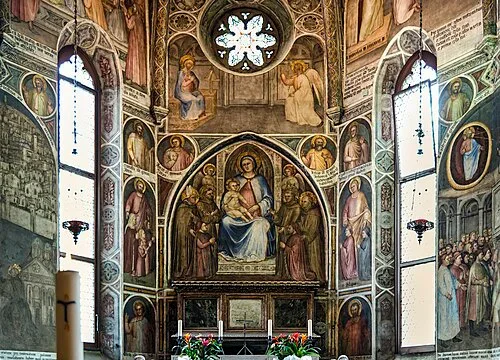 Chapel of Blessed Luca Belludi
A quieter chapel near the tomb keeps a friendship alive in paint. Blessed Luca Belludi was a Franciscan friar, the companion of Saint Anthony through the final months of the Saint's life. His remains lie here, in a chapel formally dedicated to the apostles Philip and James the Less, though hardly anyone calls it that. Around 1382 the painter Giusto de' Menabuoi and his workshop covered the walls and vaults completely, sixty-eight fresco scenes in all. They tell of Anthony and Luca, and among them appears something rare: a painted view of Padua as it looked in the Middle Ages. The chapel shares its World Heritage listing with the Saint James chapel. At the centre, under the rose window, Menabuoi set the Madonna and Child enthroned among saints and prophets.
Listen in the appDidier Descouens · CC BY-SA 4.0
07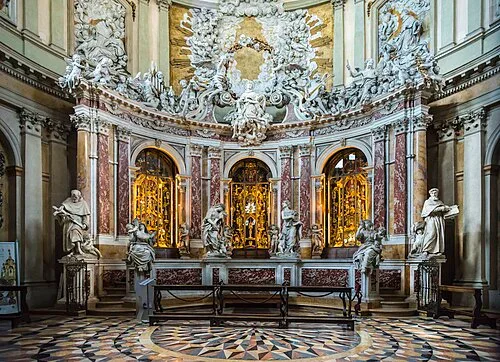 The Treasury Chapel (Cappella delle Reliquie)
The Treasury Chapel
A round Baroque chapel beyond the tomb holds the basilica's treasure of relics. It was begun in 1691 by Filippo Parodi, a sculptor who had been a pupil of Bernini. The interior is a circle about thirteen metres across, and at its centre rises Parodi's marble Saint Anthony in Glory, ringed by ranks of stucco angels. The oldest treasure here is a gilded bust reliquary holding the chin of the Saint, made in 1349 for Cardinal Guy de Boulogne. Words are cut into it in old Venetian dialect: on the first day of August in the year 1349, this work was made. The little lions under the base were added a century later at the expense of a local family. The relics still stir passion in modern times too. On an October night in 1991, three masked thieves stole the chin reliquary from the chapel. It was found intact near Rome a short time later and set back in its place.
Listen in the appDidier Descouens · CC BY-SA 4.0
08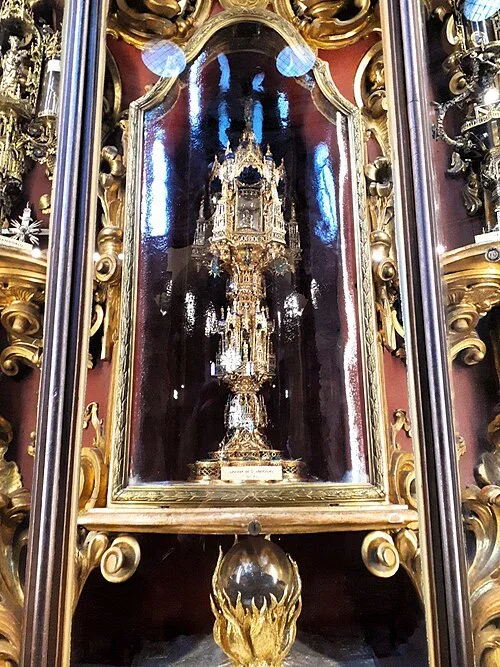 The Treasury Chapel (Cappella delle Reliquie)
Reliquary of the Saint's Tongue
Among all the relics in this basilica, one carries the whole devotion of the place. In 1263 the grave was opened, so that Anthony's body could be moved to a new tomb. Those who lifted the remains found dust and bone, as anyone would expect after more than thirty years. Except for the tongue. It lay fresh and uncorrupted, as if the friar had only just stopped speaking. For the faithful this read as a message from heaven: the preaching had been so true that the tongue outlived the body. The tongue is kept today in a gold reliquary behind glass, one of the most venerated objects in Padua. Nearby, other cases hold what was recovered when the body was examined again in 1981: fragments of the Saint's habit, the wooden boxes that had held the bones, and a carved inscription from 1263 recording that first translation.
Listen in the appPhoto: Elmiralaleh · CC BY-SA 4.0
09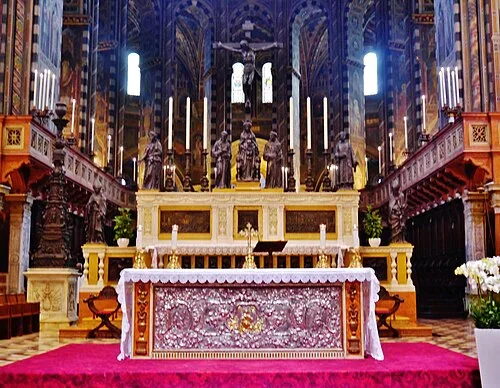 Donatello's High Altar
At the head of the church stands one of the great achievements of the early Renaissance, and a lesson in how we see it. The work belongs to the mid-fifteenth century. Donatello created a completely new kind of altar here: a raised platform carrying seven life-size bronze figures, the Madonna with Child and six saints. With them came four narrative reliefs of episodes from Saint Anthony's life. The Gothic altar that stood on the spot was pulled down in 1448 to make way for it. What fills the presbytery today, though, is not Donatello's arrangement. The altar now seen was designed by the nineteenth-century architect Camillo Boito, the fifth altar in this church's history, and it preserves nothing of Donatello's original structure or the placement of his bronzes. The statues and reliefs are Donatello's own. The setting around them is Boito's. Even the bronze doors on the facade follow a Boito drawing from 1895.
Listen in the appPhoto: Zairon · CC BY-SA 4.0
10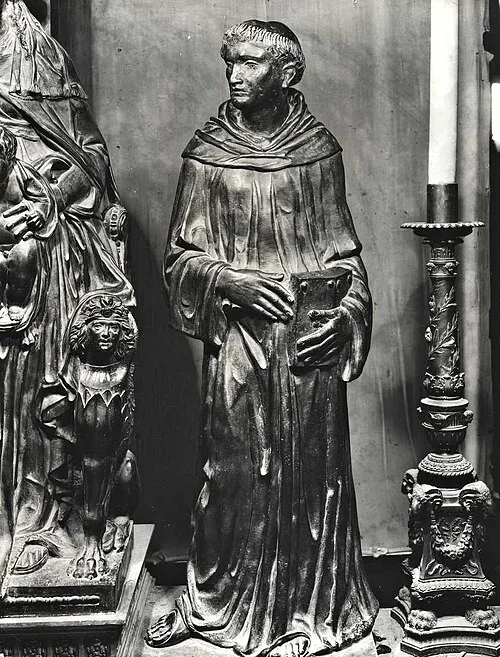 Donatello's High Altar
Donatello, Bronze Saint Anthony
The Saint himself stands among the bronzes of the high altar. Donatello cast Anthony as a plain friar, tonsured, hooded in his habit, a book held against his chest. There is no halo and no gesture towards heaven. The face is that of a middle-aged man caught in thought, with heavy eyelids and a mouth set slightly downward. The figure is dated to 1446, in the middle of Donatello's Padua years. He made the friar plain and human, so that Anthony looks like a man one might meet in a cloister rather than an icon on an altar. It is the same hand that set the condottiero Gattamelata on his horse outside. For its time, a saint with the face of an ordinary working friar was a radical thing to cast.
Listen in the appPhoto: Maltaper · Public domain
- 11
Chapel of Saint James
Bonifacio Lupi's Gothic chapel, Altichiero's 1370s frescoes, and the 2021 UNESCO inscription they share.
- 12
Crucifixion Fresco, about 1376
A Crucifixion of about 1376, crowded with contemporary faces, and an attribution still argued over.
- 13
Chapel of the Holy Sacrament
The Gattamelata family chapel: the condottiero's 1457 tomb inside the church, crowned by Pogliaghi's blue mosaic.
- 14
The Magnolia Cloister
The friars' 1433 cloister, its monumental magnolia, and eight centuries of unbroken care for the shrine.
Basilica di Sant'Antonio di Padova
Frequently asked questions
How much does the guide cost?
Free app download. Listed guide price: $0.99. Guide price shown in the app. Audio guide only. Venue admission is separate.
Can I listen without internet?
Yes. Download the guide’s audio, images, and maps in the app before your visit. Your downloaded content is then available offline.
Can I listen in my language?
This audio guide is available in 15 languages, including English.
Do I need to follow a schedule?
No. This is a self-guided experience. Choose your stops, pause whenever you like, and return to a story at your own pace.
At your own pace
Explore Basilica di Sant'Antonio di Padova.
Download Stanza, then search for “Basilica di Sant'Antonio di Padova”.
Free app download · Guide price shown in the app
Keep exploring
Nearby audio guides
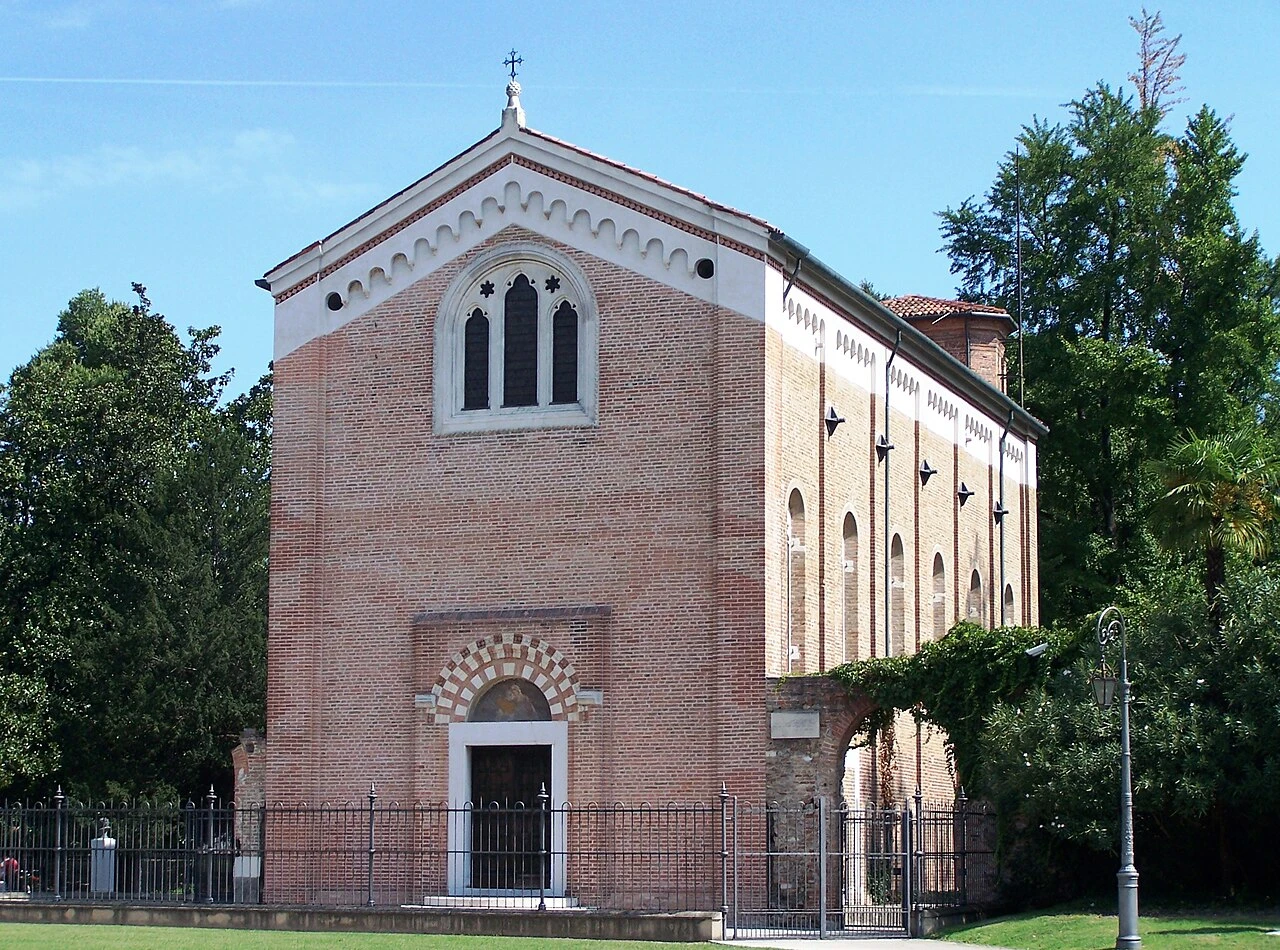
Padua · 1 km
Scrovegni Chapel
Content & sources
Andrea Piroddi · CC BY-SA 3.0
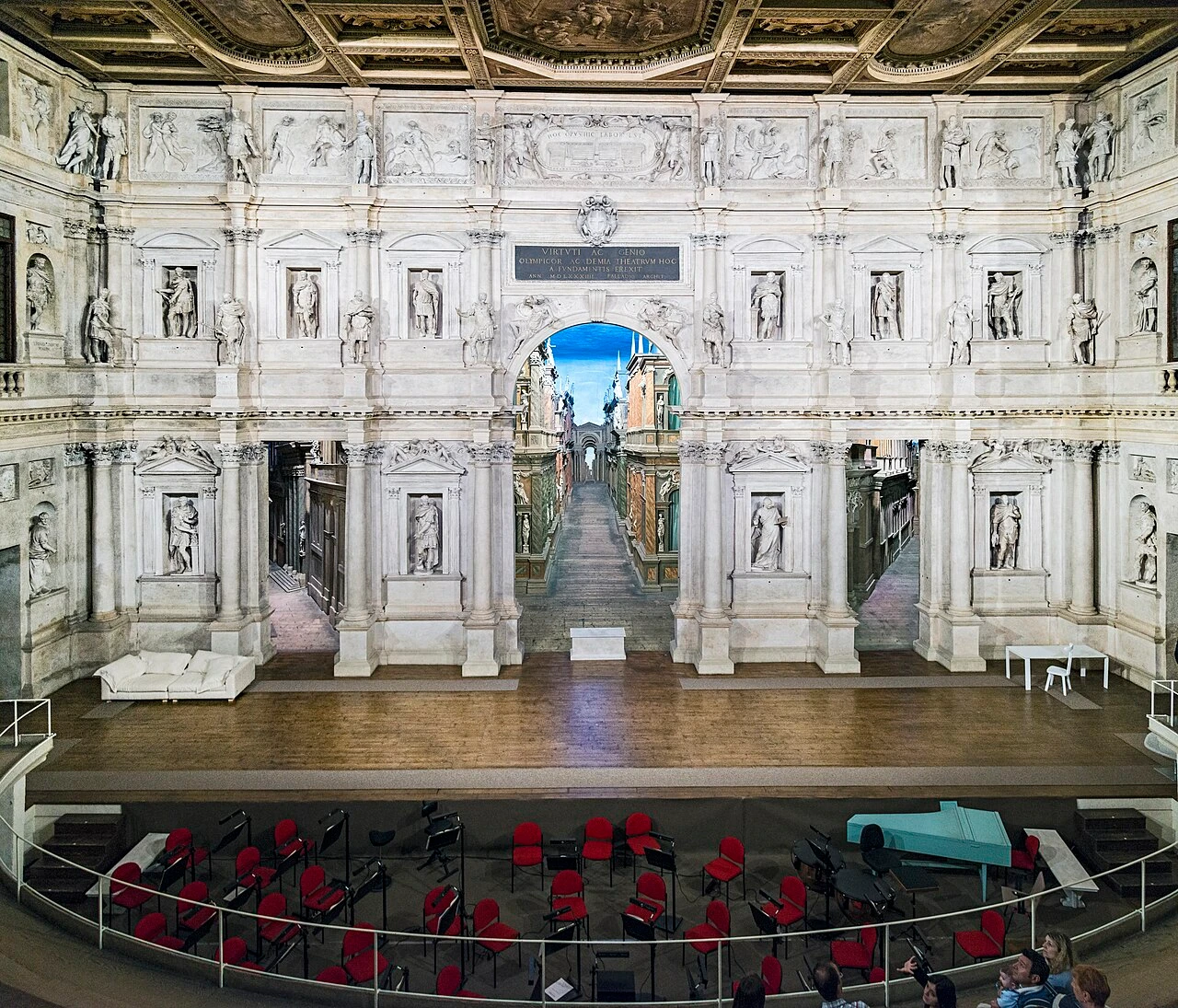
Vicenza · 31 km
Teatro Olimpico
Content & sources
Didier Descouens · CC BY-SA 4.0
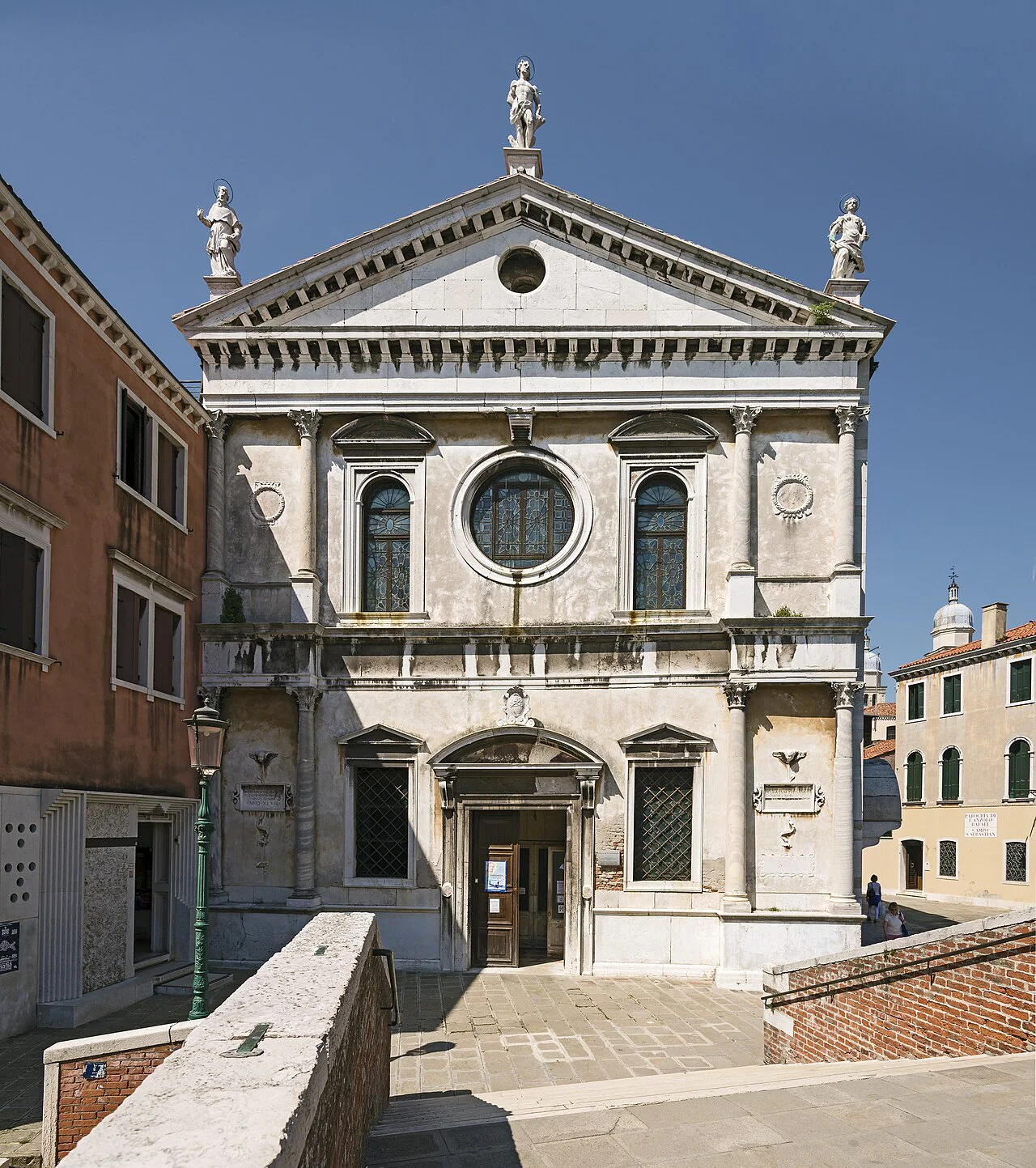
Venice · 34 km
Chiesa di San Sebastiano
Content & sources
Didier Descouens · CC BY-SA 3.0
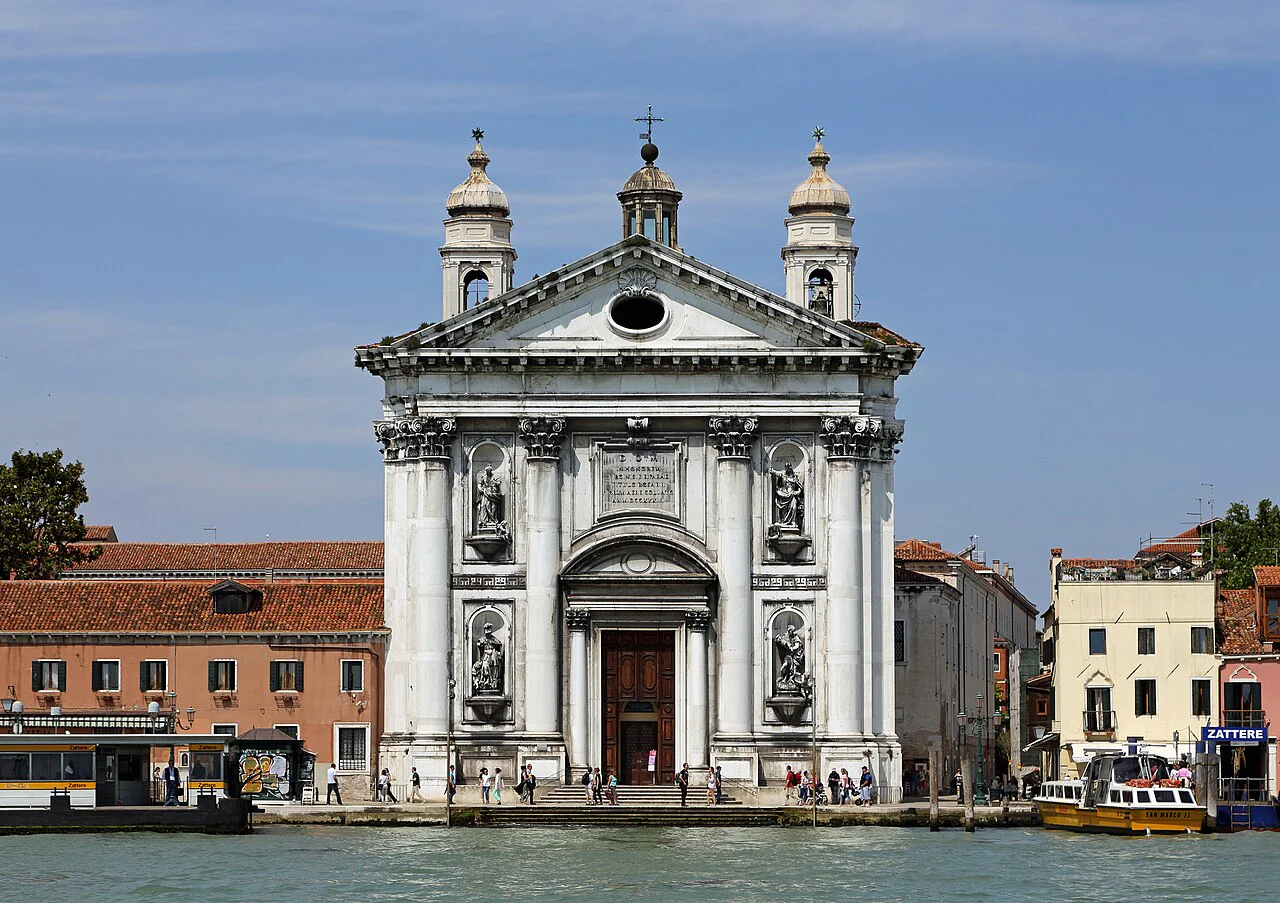
Venice · 35 km
Chiesa dei Gesuati
Content & sources
Marc Ryckaert (MJJR) · CC BY 3.0