Stanza · Audio guide
Chiesa di San Sebastiano Audio Guide
A place to remember. A story to take with you.
The Chiesa di San Sebastiano is a 16th-century Roman Catholic church located in the Dorsoduro sestiere of Venice. It is notable for housing a cycle of paintings by Paolo Veronese, as well as works by…
Download Stanza, then search for “Chiesa di San Sebastiano”.
About the tour
One guide. Your kind of visit.
The Chiesa di San Sebastiano is a 16th-century Roman Catholic church located in the Dorsoduro sestiere of Venice. It is notable for housing a cycle of paintings by Paolo Veronese, as well as works by Tintoretto and Titian.
Ready when you are.
- 01Get the free Stanza app.
iOS & Android
- 02Find your guide.
“Chiesa di San Sebastiano”
- 03Download before you go.
Works offline
Audio guide / 9 narrated stops
Inside the guide
Get to know a few of the stories before you go. Open a stop to read more.
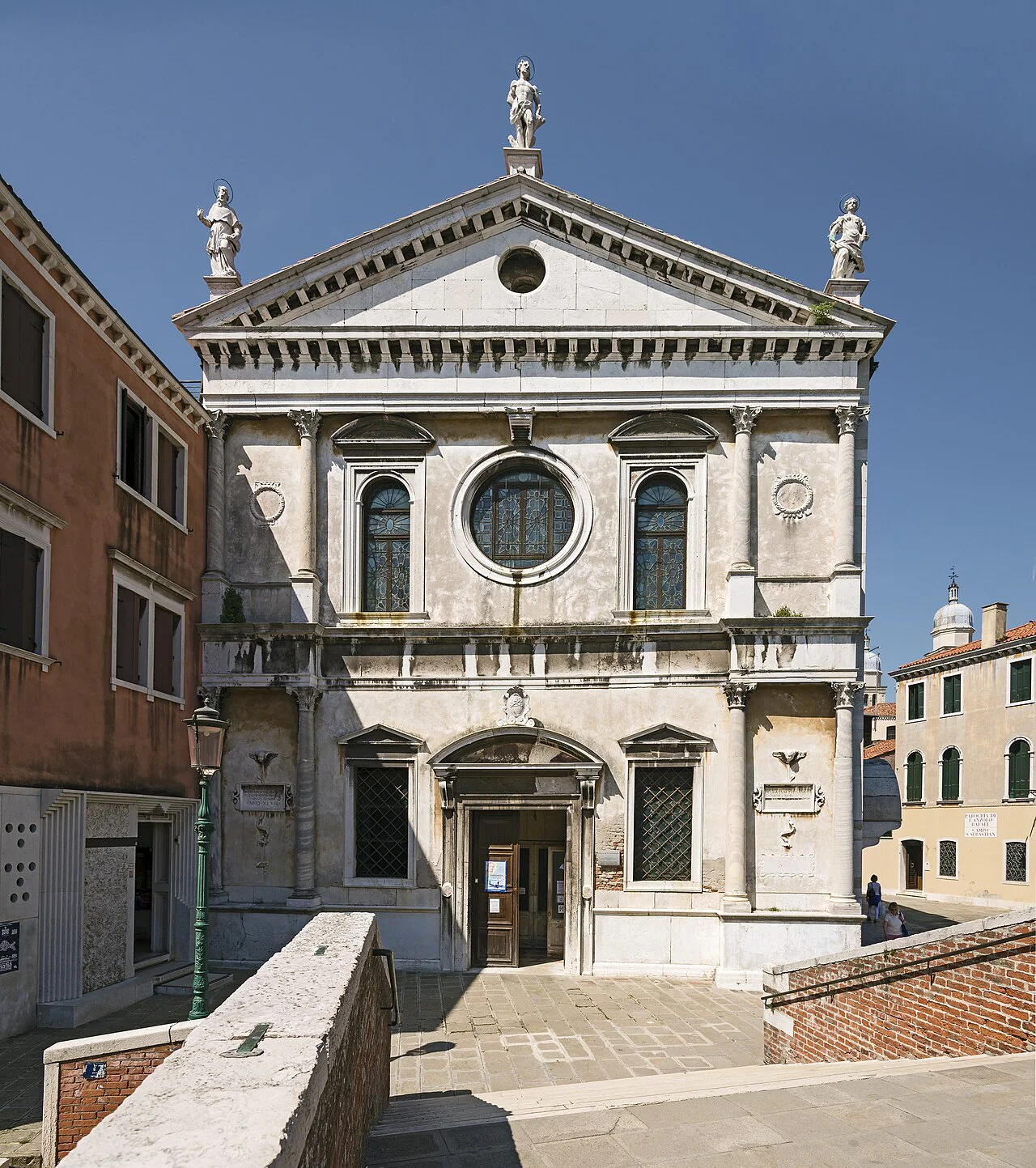
01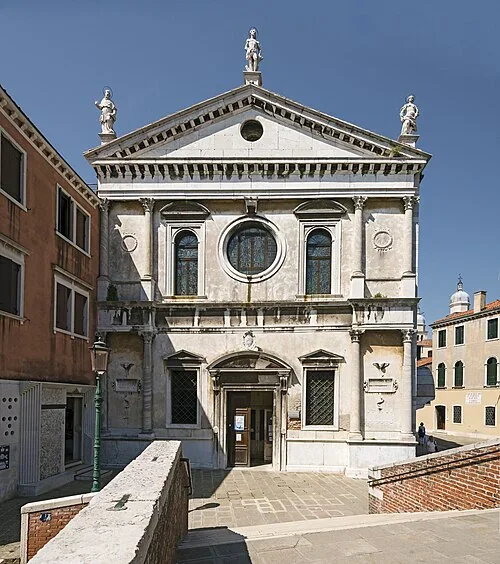 Campo and Church Façade
Church Facade on Fondamenta San Sebastian
Welcome to San Sebastiano, on the quiet Dorsoduro side of Venice. This is one of five votive churches in the city, each built after a plague had passed through, raised to temper divine punishment as people then understood it. Its saint was chosen for the job: Sebastian, a martyr and one of Europe's chief protectors against pestilence. The site began humbly. In 1393 the Gerolimine fathers founded a hospice for the needy here, and an oratory went up beside it a few years later, dedicated to Santa Maria Full of Grace and Justice. In time the oratory grew into a church, and it was dedicated to Sebastian in thanks from the survivors of the plague of 1464. The facade keeps a sober, classicising face, divided by a high cornice under a triangular pediment. At its very top stands Sebastian himself, wounded by arrows. Near the door, small figures of Sebastian and Jerome mark the two saints most closely bound to this place.
Didier Descouens · CC BY-SA 3.0
02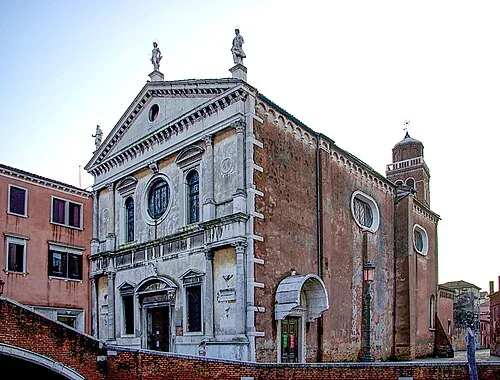 Campo and Church Façade
The Church from the Rio and the Bell Tower
Seen from the water, San Sebastiano is a different building altogether. The elegant stone front gives way to a plain brick flank, and behind the semicircular apse rises the bell tower, square in brick, with a stone parapet and an octagonal crown of lead. The contrast was deliberate. Work on the present Renaissance church began in 1506 under the architect Antonio Abbondi, known to everyone as Scarpagnino. His patrons were Hieronymite monks whose rule demanded a severe and modest way of life, and their funds were limited. So the design stayed sober and essential: classicising outside, Renaissance within. The structure was completed in 1548, and the church waited until 1562 for its consecration. Inside it is a single nave laid out on a Latin cross, with an atrium, a raised choir, and an apsidal presbytery under a cupola.
Clemensfranz · CC BY-SA 3.0
03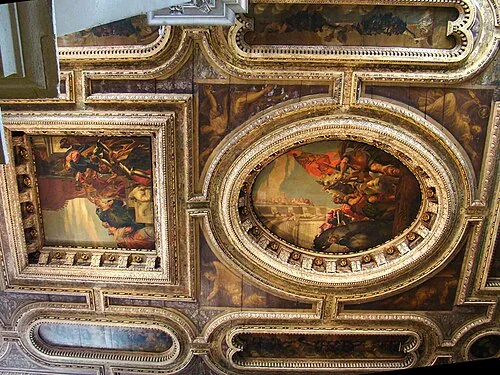 The Central Nave and the Esther Ceiling Canvases
The Nave Ceiling and Veronese's Long Campaign
Paolo Veronese was born in Verona, and this church became the defining monument of his art. The story begins with a commission from Brother Bernardo Torlioni. Between 1555 and 1570 the painter returned here in three separate campaigns, covering the ceiling, the nave and altar walls, the organ, the presbytery and the sacristy. Overhead, the nave ceiling is a richly carved and gilded wooden structure, divided into framed sections with a canvas set into each, like a gallery built into the joinery. Veronese painted frescoes on the nave and altar walls as well. He also painted an Assumption of the Virgin in the cupola, but that work was destroyed in the eighteenth century. What remains is a decorative programme that runs through the entire building, from the entrance to the high altar.
Listen in the appPhoto: Tango7174 · CC BY-SA 4.0
04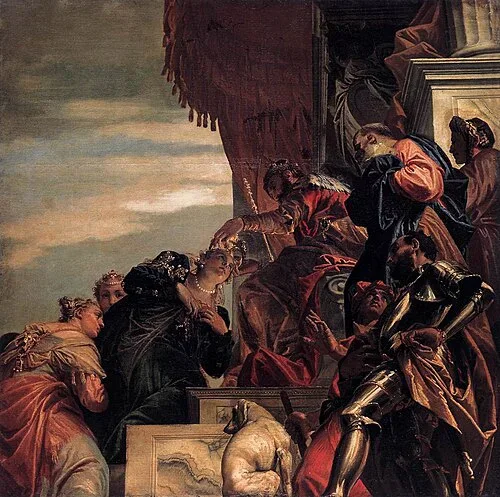 The Central Nave and the Esther Ceiling Canvases
Esther Crowned by Ahasuerus
Three canvases set into the nave ceiling tell the story of Esther, and Veronese finished them in 1556. This one captures the crowning moment: King Ahasuerus places the crown on Esther's head amid a crowded, theatrical court. The choice of subject was pointed. Esther was the Old Testament queen who risked her life to plead for her people, an intercessor who saved them from destruction. In a church raised to ward off plague, a story of deliverance from disaster spoke directly to the people who built it. For Veronese it was also his first high-profile success in the building.
Listen in the appPaolo Veronese · Public domain
05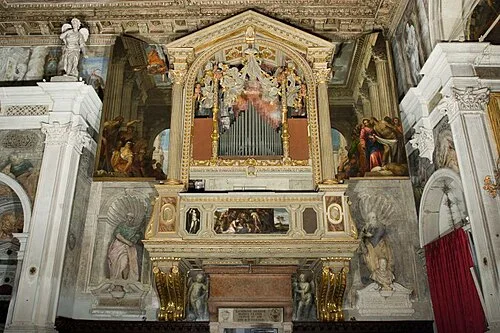 The Historic Organ and Painted Shutters
The Organ Loft and Painted Organ Structure
Halfway along the nave stands the organ, and it is far more than an instrument case. Veronese treated the whole structure as a single painted ensemble: a gilded architectural showpiece with his canvases set around the pipes, standing against walls he had frescoed. Above the entrance, the raised choir, the barco, was Scarpagnino's celebrated novelty, and other Venetian churches soon imitated it. It allowed the religious community to hear the services set apart from the congregation. On the barco's balustrade rise four statues by Girolamo Campagna, carved in 1580. They show the Cumaean and Erythraean sibyls, the Annunciate Virgin and the announcing angel.
Listen in the appPaolo Veronese · Public domain
06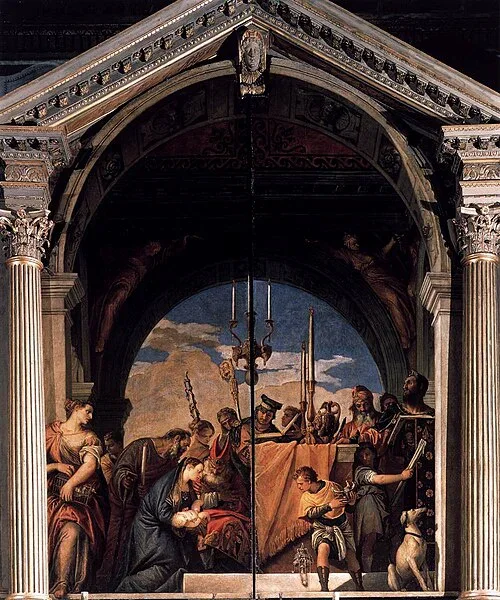 The Historic Organ and Painted Shutters
Presentation in the Temple
When the organ is closed, its painted shutters turn the instrument into something like a giant altarpiece. Veronese painted three scenes for the doors and the frontal: the Presentation of Jesus in the Temple, the Washing of Sacrificial Animals in the Temple, and the Nativity. Together they move through Christ's infancy and the ritual of the Temple. In this panel, painted columns and a pediment frame the temple scene, so the shutter itself forms a classical aedicule around the story. A dog waits at the edge of the crowd, a small touch of everyday life in a sacred moment. The pipes of the organ rest behind these scenes, covered by painting until the music calls them back into use.
Listen in the appPaolo Veronese · Public domain
07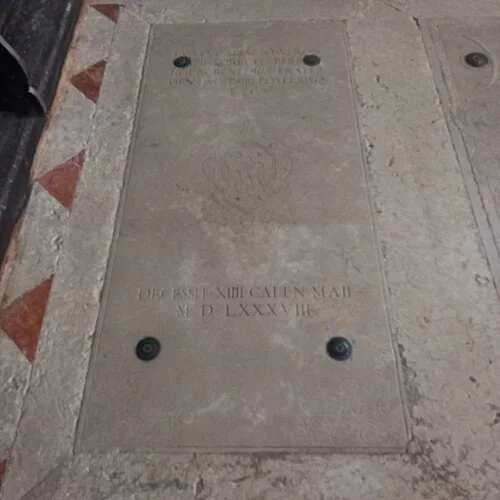 The Tomb of Paolo Veronese
Set into the pavement to the left of the sanctuary lies a flat stone slab, worn nearly smooth by centuries of footsteps. It is Paolo Veronese's grave. After his years of work inside this church, he was entombed here at his death in 1588, close to the organ he had painted. His brother Benedetto is buried in the church as well. The Latin inscription is difficult to read now, but it still records the day he died. He had decorated this building for most of his mature career, and in the end he chose to stay among his own works.
Listen in the appPhoto: Harvey Kneeslapper · CC BY-SA 4.0
08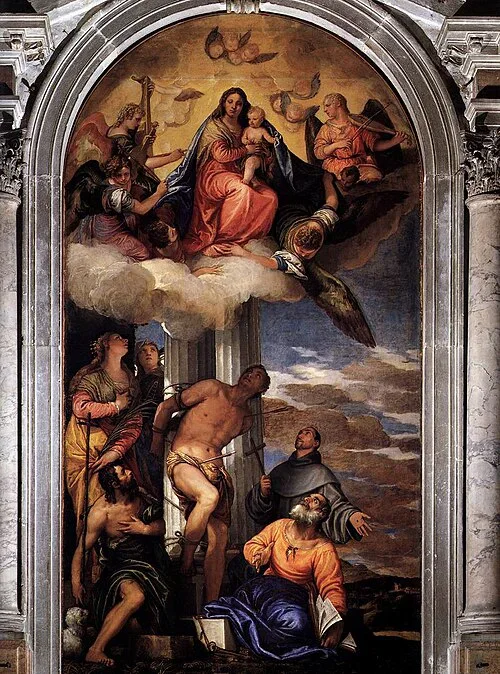 The Presbytery and Sanctuary Masterpieces
Madonna in Glory with Saint Sebastian and Saints
Behind the high altar hangs Veronese's last completed work in the church, finished in 1570. The Madonna in Glory presides over the martyred Saint Sebastian, bound and pierced by arrows, with attendant saints gathered below her. The multi-coloured marble frame follows a design by the artist himself, commissioned back in 1559 by the Venetian noblewoman Lise Querini. The painting took shape at a charged moment, as the Council of Trent held its final sessions. Its decrees, published in 1564, condemned Protestant iconoclasm and renewed the emphasis on saints' images and their power to inspire, martyrdom scenes above all. This altarpiece, with its drama of suffering and divine glory, answers that call directly. And the choir walls behind the altar carry more of him: canvases of the life of Saint Sebastian, the church's own dedicatee.
Listen in the appPaolo Veronese · Public domain
09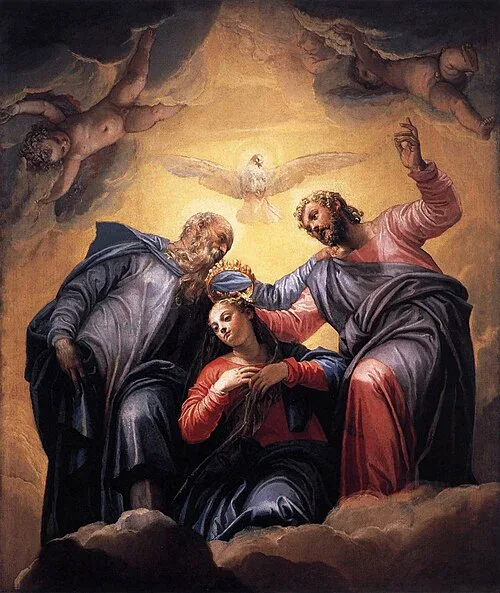 The Sacristy Ceiling
Coronation of the Virgin, Sacristy Ceiling
In the quiet of the sacristy, the ceiling holds the beginning of the whole story. This Coronation of the Virgin belongs to the earliest phase of Veronese's work in the church, before the nave ceiling, the organ and the high altar. God the Father and Christ lower the crown onto Mary's head, beneath the dove of the Holy Spirit, amid golden clouds. Veronese did not have the sacristy to himself: it also preserves paintings by Jacopo Tintoretto and Bonifacio de' Pitati, and elsewhere in the church hang works by Titian and other Venetian masters. A modest plague church on the edge of Dorsoduro, turned by one painter's years of devotion into a treasury of Venetian painting.
Listen in the appPaolo Veronese · Public domain
Chiesa di San Sebastiano
Frequently asked questions
How much does the guide cost?
Free app download. Listed guide price: Free guide. Guide price shown in the app. Audio guide only. Venue admission is separate.
Can I listen without internet?
Yes. Download the guide’s audio, images, and maps in the app before your visit. Your downloaded content is then available offline.
Can I listen in my language?
This audio guide is available in 15 languages, including English.
Do I need to follow a schedule?
No. This is a self-guided experience. Choose your stops, pause whenever you like, and return to a story at your own pace.
At your own pace
Explore Chiesa di San Sebastiano.
Download Stanza, then search for “Chiesa di San Sebastiano”.
Free app download · Guide price shown in the app
Keep exploring
Nearby audio guides
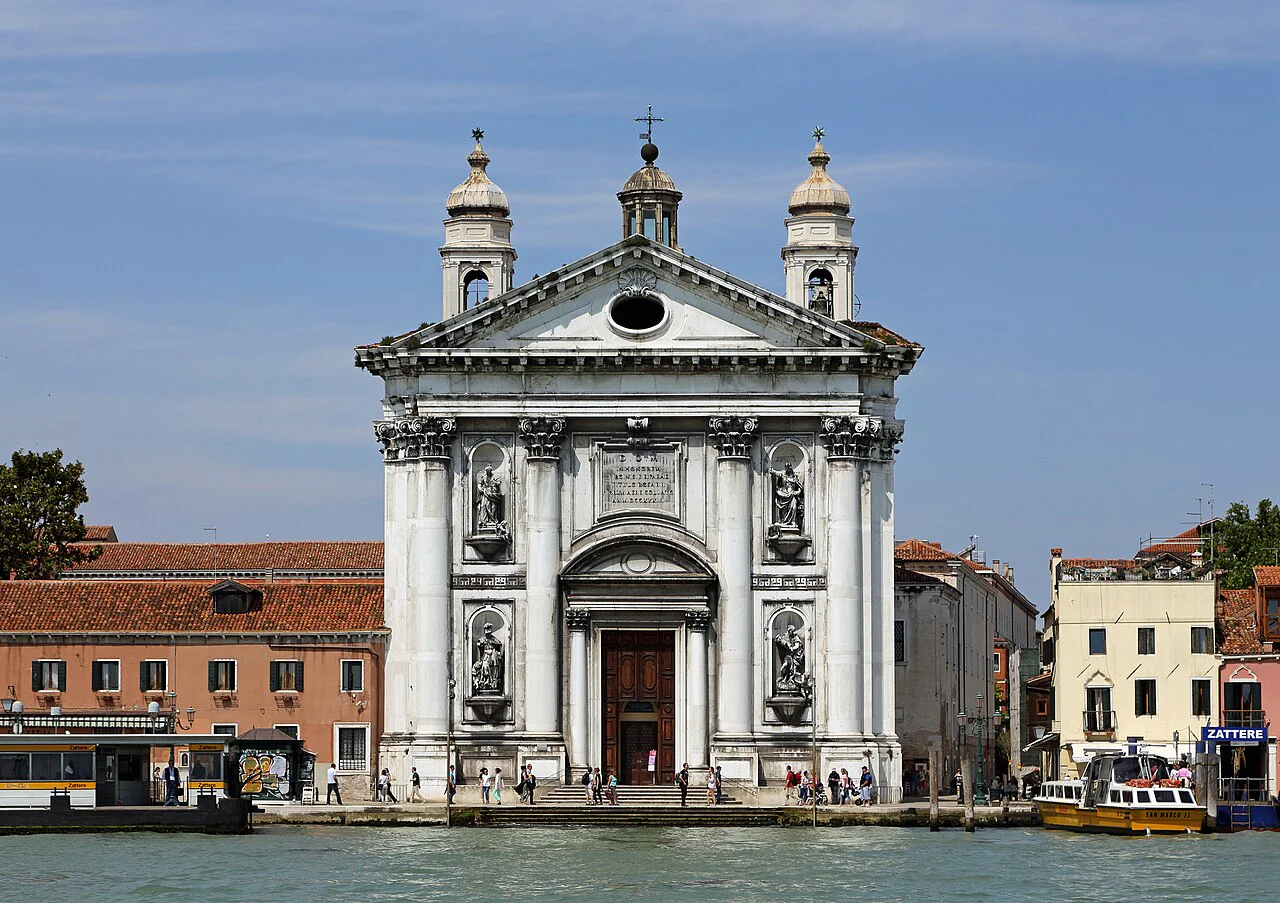
Venice · 1 km
Chiesa dei Gesuati
Content & sources
Marc Ryckaert (MJJR) · CC BY 3.0
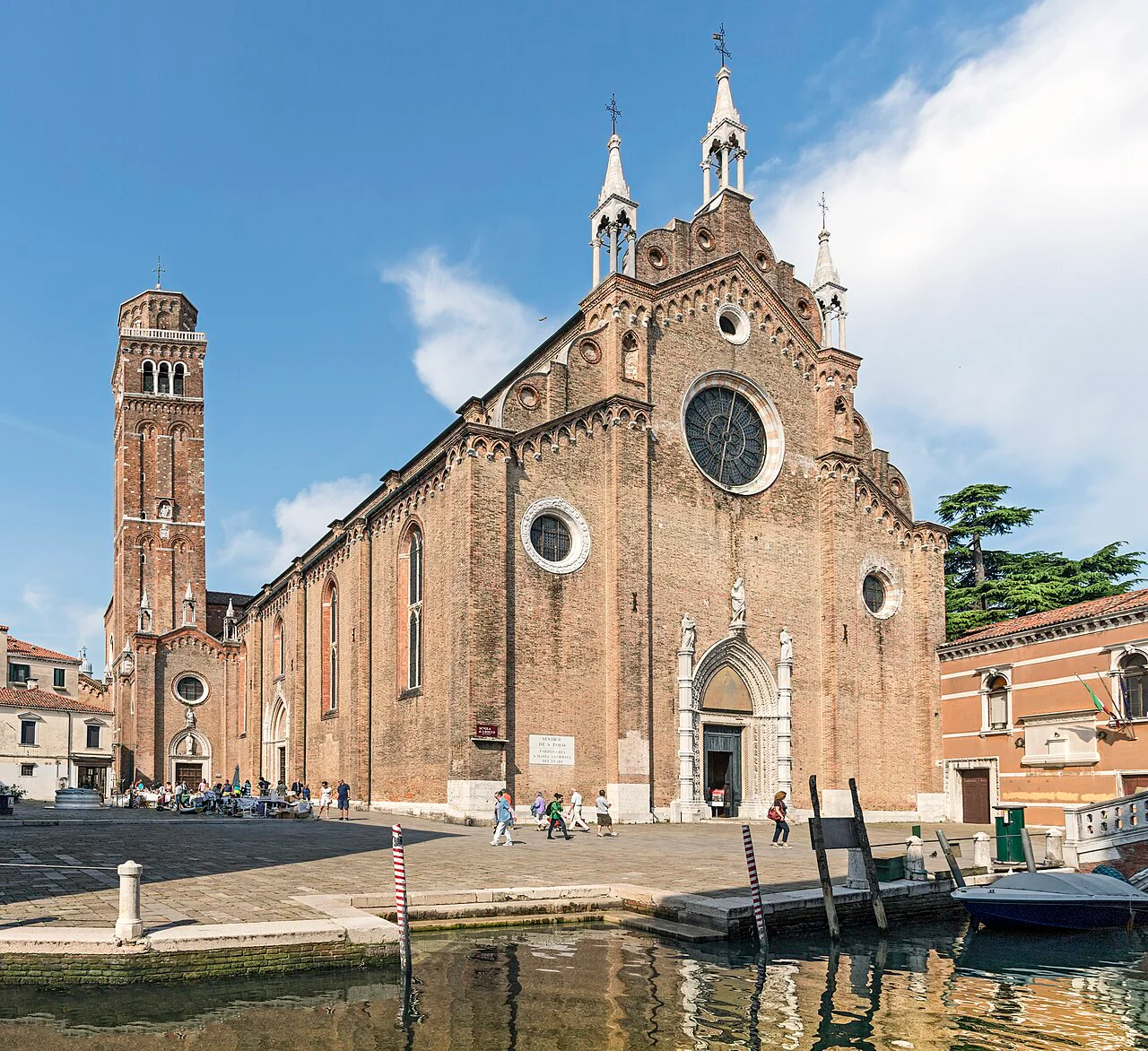
Venice · 1 km
Basilica di Santa Maria Gloriosa dei Frari
Content & sources
Didier Descouens · CC BY-SA 4.0
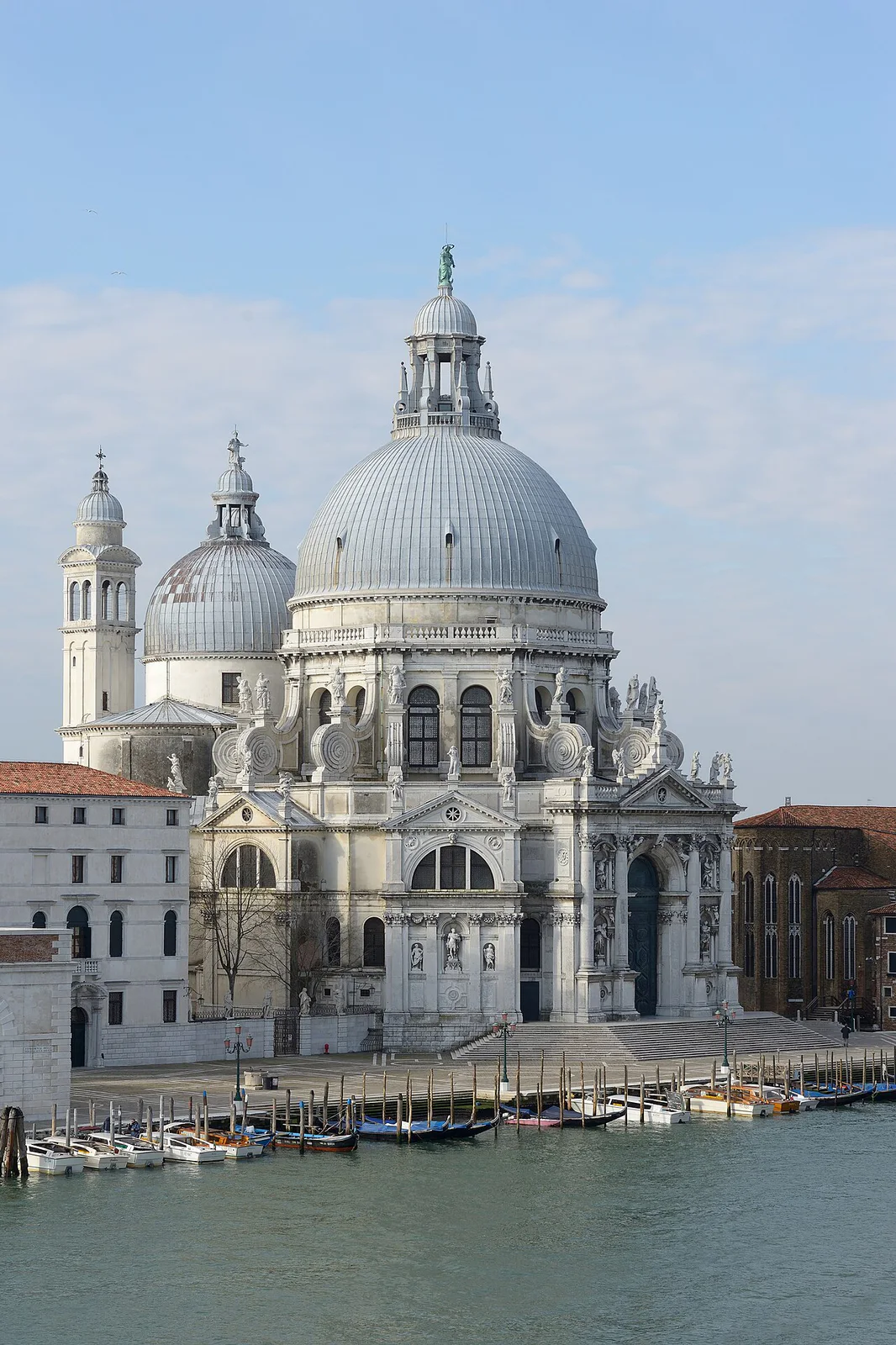
Venice · 1 km
Basilica di Santa Maria della Salute
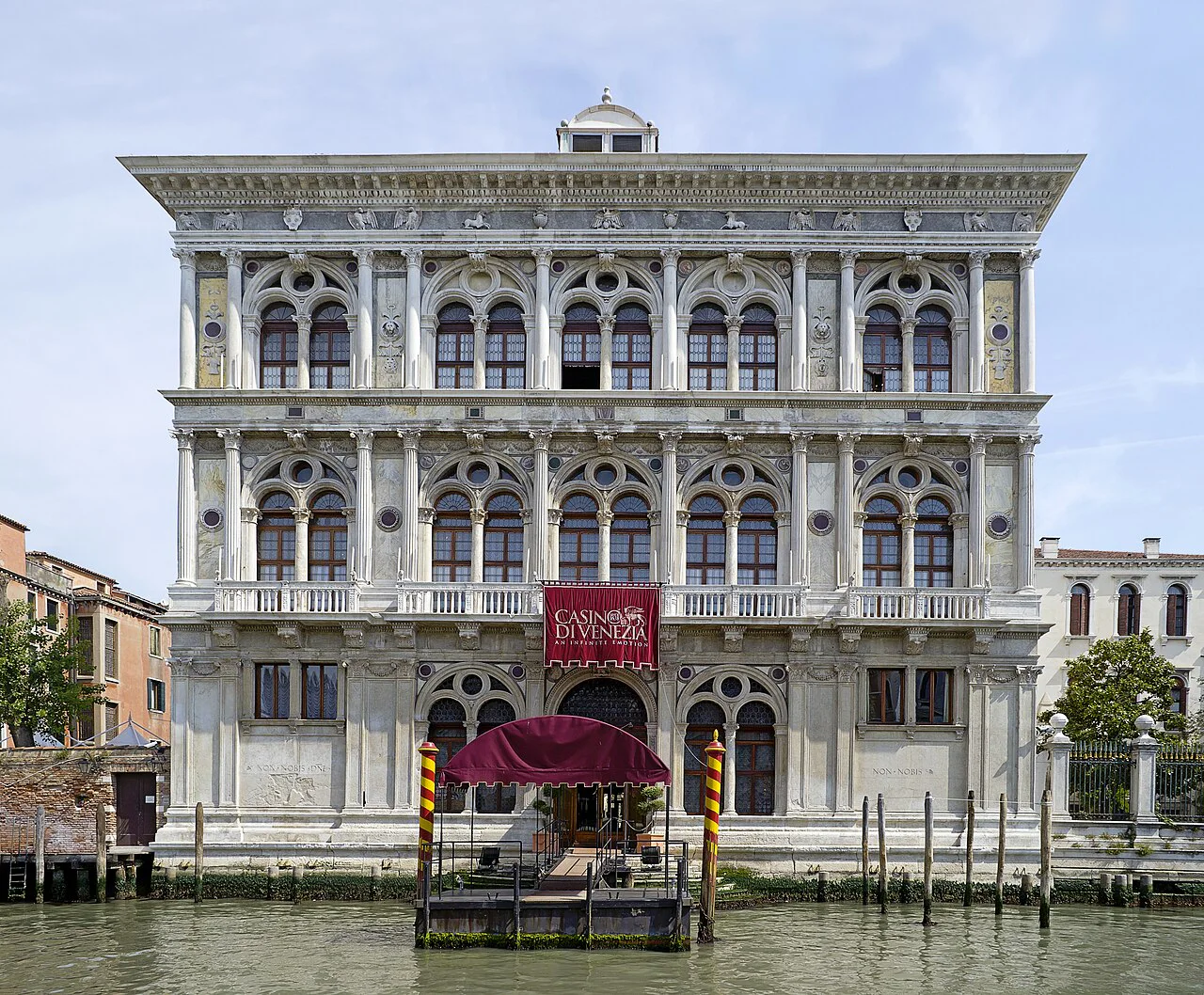
Venice · 1 km
Ca' Vendramin Calergi
Content & sources
Didier Descouens · CC BY-SA 4.0