Stanza · Audio guide
Basilica di Santa Maria Gloriosa dei Frari Audio Guide
A place to remember. A story to take with you.
The Basilica di Santa Maria Gloriosa dei Frari is a church located in the San Polo district of Venice. It is one of the largest churches in the city and holds the status of a minor basilica.
Download Stanza, then search for “Basilica di Santa Maria Gloriosa dei Frari”.
About the tour
One guide. Your kind of visit.
The Basilica di Santa Maria Gloriosa dei Frari is a church located in the San Polo district of Venice. It is one of the largest churches in the city and holds the status of a minor basilica.
Ready when you are.
- 01Get the free Stanza app.
iOS & Android
- 02Find your guide.
“Basilica di Santa Maria Gloriosa dei Frari”
- 03Download before you go.
Works offline
Audio guide / 13 narrated stops
Inside the guide
Get to know a few of the stories before you go. Open a stop to read more.
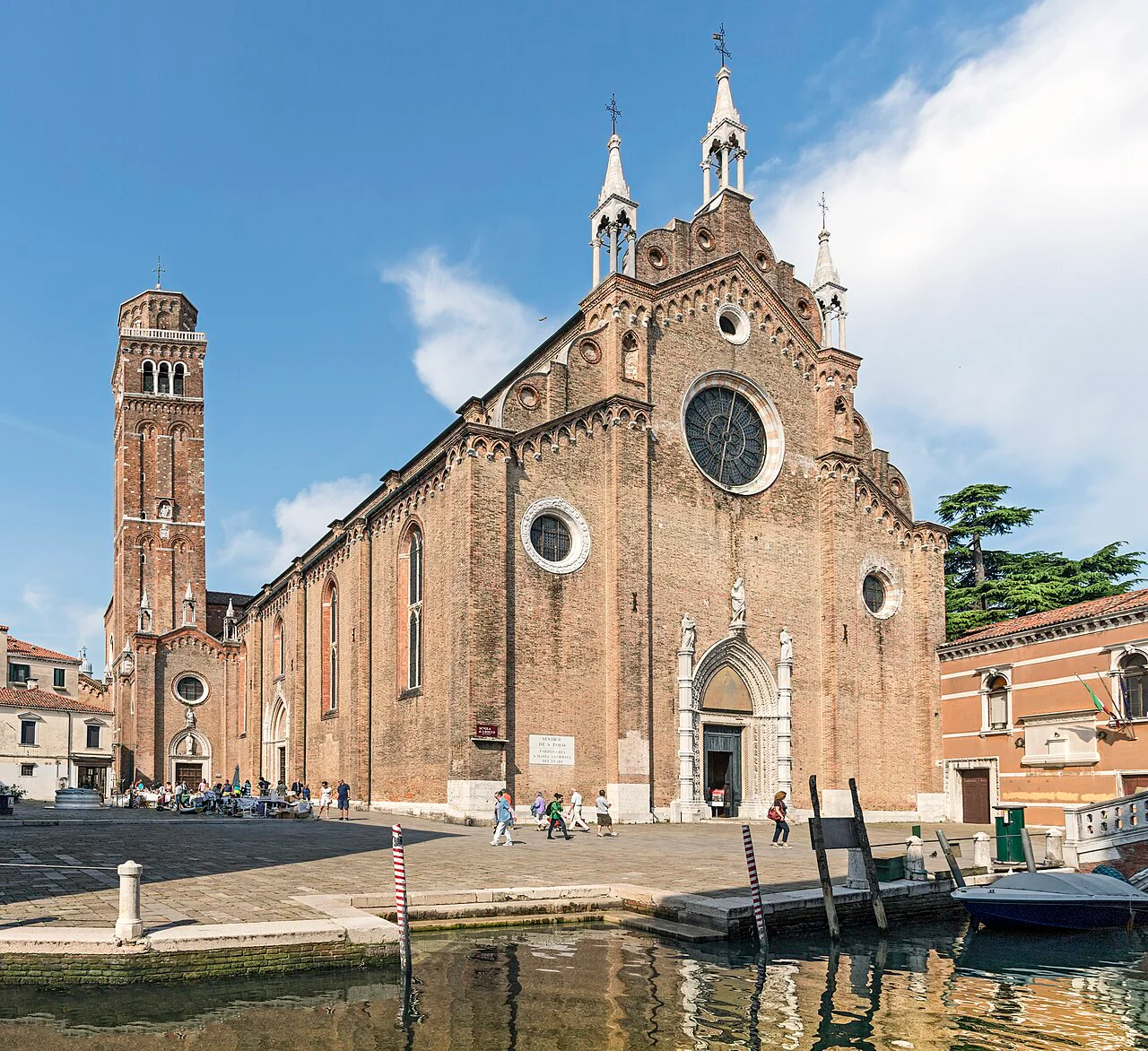
01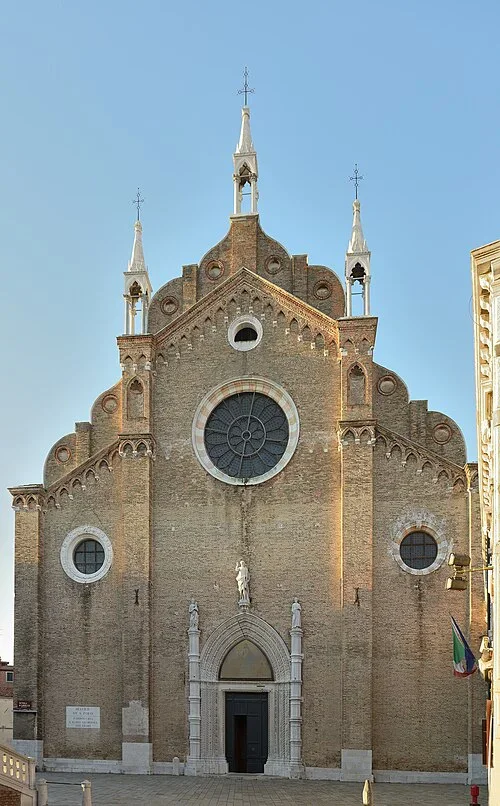 Campo dei Frari and Western Facade
Facade of the Basilica di Santa Maria Gloriosa dei Frari
Welcome to the Basilica di Santa Maria Gloriosa dei Frari, usually called simply the Frari. The church belongs to the Franciscans, the order of Friars Minor. In 1231 the city of Venice gave them land here, under Doge Jacopo Tiepolo. Their first church proved too small. So they began a much larger one, and it took more than a century to build. The new church reversed the old orientation, so its front faces the square and a small canal. The walls are red brick, with pale stone details. The front is fairly plain, as is common in many Franciscan churches. Still, a large round window sits at its centre, and a carved figure stands above the doorway. Today the Frari is a minor basilica and one of the largest churches in Venice. It was consecrated in 1492 under the name Santa Maria Gloriosa.
This Photo was taken by Wolfgang Moroder. Feel free to use my photos, but please mention me as the author and send me a message. This image is not in the public domain. Please respect the copyright protection. It may only be used according to the rules mentioned here. This specifically excludes use in social media, if applicable terms of the licenses listed here are not appropriate. Please do not upload an updated image here without consultation with the Author. The author would like to make corrections only at his own source. This ensures that the changes are preserved.Please if you think that any changes should be required, please inform the author.Otherwise you can upload a new image with a new name. Please use one of the templates derivative or extract. · CC BY-SA 3.0
02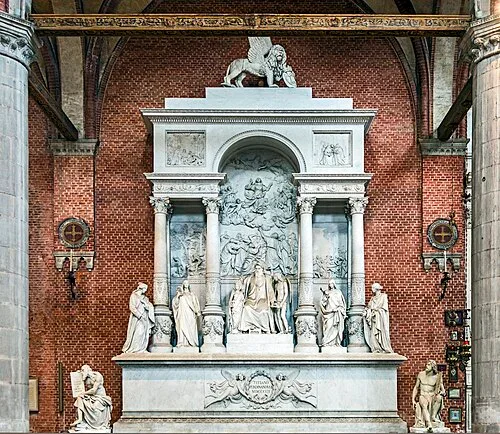 Right Aisle: Monument to Titian
Monument to Titian
Titian, the most prominent painter of sixteenth-century Venice, is buried in this church. He died in 1576, and he had wished to be buried here. The white marble memorial in the side aisle honours him. The marble comes from Carrara, and the brothers Luigi and Pietro Zandomeneghi carved it. At its base stand statues of two emperors Titian had worked for. At the centre, a statue of Titian wears a laurel crown, with allegorical figures around him. Carved panels show scenes from his religious paintings, among them the Assumption. On top sits the lion of Saint Mark.
Didier Descouens · CC BY-SA 4.0
03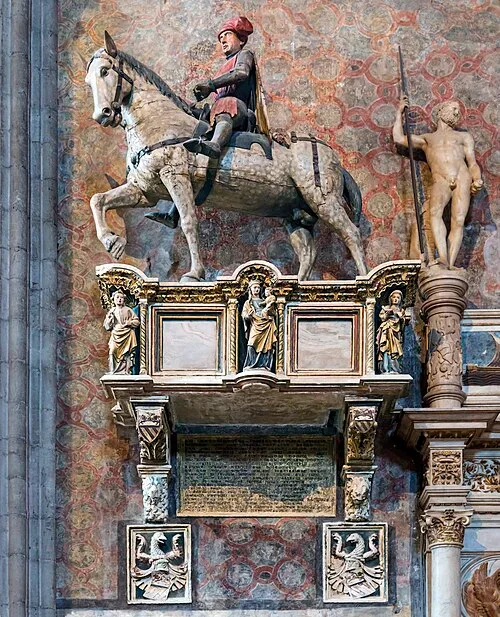 Right Transept: Paolo Savelli Equestrian Monument
Monument to Paolo Savelli
Paolo Savelli was a Roman nobleman who commanded Venetian troops. He died near Padua in 1405, during the siege of that city. One account says plague killed him. Venice paid for a monument to him in this church. It was the first equestrian statue Venice raised to one of its captains. The rider wears a tall red cap and sits on a horse of gilded and painted wood. Small statues stand in niches on the base below him. The sculpture is attributed to Jacopo della Quercia, a sculptor from Siena. Some think an unknown Tuscan artist working in Venice made it. The marble urn beneath the horse holds Savelli's remains.
Listen in the appDidier Descouens · CC BY-SA 4.0
04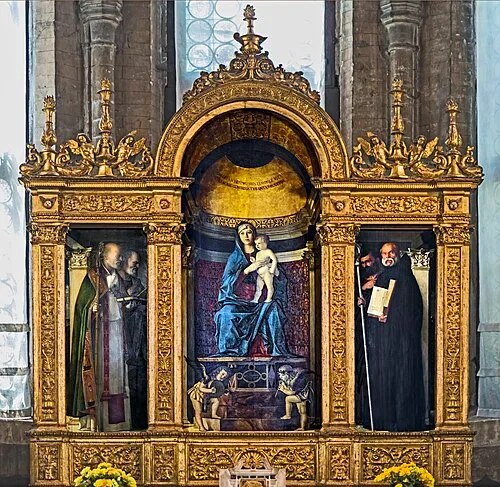 The Sacristy: Bellini's Frari Triptych
Bellini's Frari Triptych
Giovanni Bellini signed and dated this altarpiece in 1488. It still sits in the gilded frame made for it. Three Pesaro brothers commissioned it. Bellini probably designed the wooden frame, and the carver Jacopo da Faenza made it. The three panels are divided in an old-fashioned way, and perhaps the patrons asked for that. Even so, Bellini made the space flow across all three panels. The Virgin sits on a raised throne with the Child on her lap. Musician angels sit at the foot of the throne, and saints stand on each side. The painted setting is an open loggia, and the carved frame repeats its architecture. Above the throne, a gold dome carries a Latin line, Ianua certa poli, meaning a sure gate of heaven.
Listen in the appGiovanni Bellini · CC BY-SA 4.0
05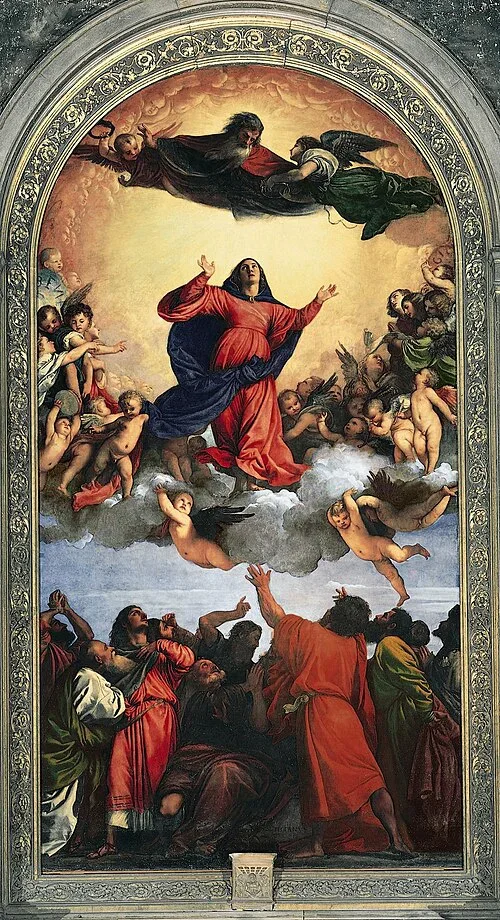 The High Chancel: Titian's Assunta and Doge Tombs
Titian's Assumption of the Virgin
Titian painted the Assumption of the Virgin for the high altar, and it is the largest altarpiece in the city. Its figures are well over life-size, since the church is so large. The church is dedicated to the Assumption of Mary, when she was taken up into heaven. Mary rises on clouds, in a red dress and blue mantle, with her arms open in wonder. Angels crowd around her. Above, God the Father waits in golden light, and an angel beside him holds out a crown. Below, the apostles look up with their arms raised. Their agitated poses broke with the calm, meditative saints of earlier Venetian painting. The work may first have shocked Venetians, but it soon came to be seen as a masterpiece. It was unveiled in May 1518, on a public holiday, so that many people could attend. Its place above the altar drew candle grease, and it grew dark. In 1752 Sir Joshua Reynolds described it as "most terribly dark but nobly painted." In 2018 the organ behind it was removed, so the altarpiece and its frame could be restored.
Listen in the appTitian · Public domain
06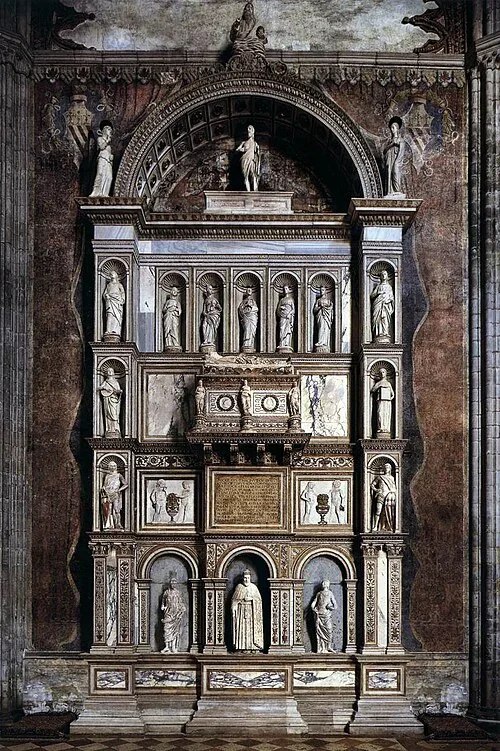 The High Chancel: Titian's Assunta and Doge Tombs
Tomb of Doge Niccolò Tron
Antonio Rizzo built the tall tomb of Doge Niccolò Tron, and it fills one wall of the chancel. The whole structure is arranged like a painted altarpiece, with an arch at the top and rows of figures below. The doge appears twice. He stands at the base, and he lies stretched out on a cenotaph above the inscription that praises him. Most of the figures celebrate his civic virtues rather than seek his salvation. Only the arch, in the Florentine manner, carries religious scenes. The Virgin of the Annunciation and the angel Gabriel stand at its sides, and a risen Christ fills the top panel. Here Rizzo seems to be moving from Gothic habits toward Renaissance ones. The doge's real grave lies in the floor, shared with his family. Another doge, Francesco Foscari, has a tomb in the same chancel. Its carving is attributed to two sculptors named Bregno, though that is uncertain.
Listen in the appPhoto: YukioSanjo · Public domain
07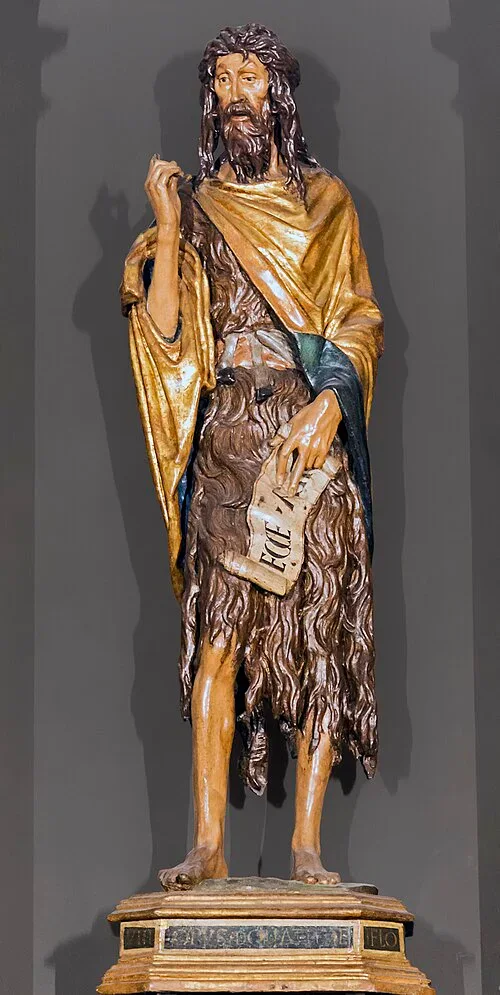 Left Apse Chapels: Donatello and Monteverdi
Saint John the Baptist by Donatello
Donatello, the Florentine sculptor, carved this painted wooden figure of John the Baptist. A work by him in Venice is so unusual that some doubted it was genuine. It is the only work by Donatello known in the city. The figure is painted wood and smaller than life-size. The Baptist is gaunt, with a beard and wild hair, and he wears a rough shaggy garment. A gold cloak falls over one shoulder, and he holds a scroll. The most widely accepted view is that a Florentine brotherhood ordered it for this chapel, dedicated to the saint. The statue was restored in 1973. Workers then found the date 1438 on its base, and they brought back the original paint.
Listen in the appDidier Descouens · CC BY-SA 4.0
08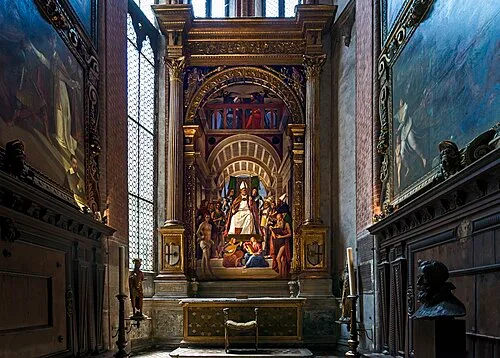 Left Apse Chapels: Donatello and Monteverdi
Milanese Chapel and Claudio Monteverdi's Tomb
In 1361 the Franciscan friars gave a chapel here to the Lombard community in Venice, and it has been called the Milanese chapel ever since. The community restored and furnished it. It was consecrated in 1421. Some of the friars buried here were of Lombard origin, and their stone slabs lie in the floor. That floor also holds the tomb of Claudio Monteverdi, one of the greatest composers of the seventeenth century, who died in Venice in 1643. The altarpiece shows the bishop of Milan enthroned among musician angels, with eight saints around him. Alvise Vivarini began the painting, but he died before finishing it. Marco Basaiti completed it in 1503. A Latin line on a painted slip below the angels says that Basaiti finished what Vivarini's fate would not allow.
Listen in the appDidier Descouens · CC BY-SA 4.0
09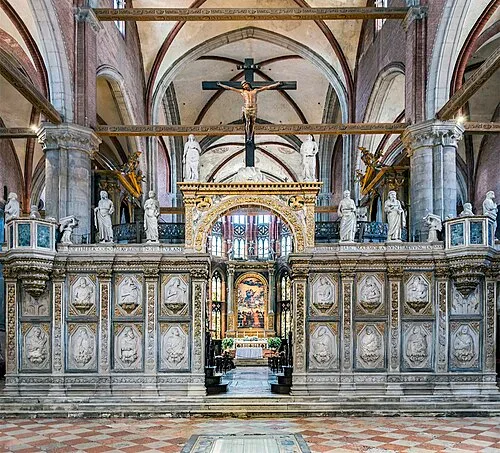 Central Monastic Choir and Historic Organs
Friars' Choir and Marble Rood Screen
In 1475 a screen was built around the friars' choir, so that during services the friars were kept apart from everyone else. The choir sits in the middle of the nave, in front of the high altar. The screen is marble, and round medallions with carved figures run along its front. Statues line its top, and a large crucifix hangs above. The central gate is framed in carved stone. Inside the enclosure, the friars sat in a hundred and twenty-four carved wooden stalls. Carvers from Vicenza finished them in 1468. The panels on the upper stalls show saints in relief, while the lower panels show streets, squares and wells in perspective. It remains the only choir screen in Venice today.
Listen in the appDidier Descouens · CC BY-SA 4.0
10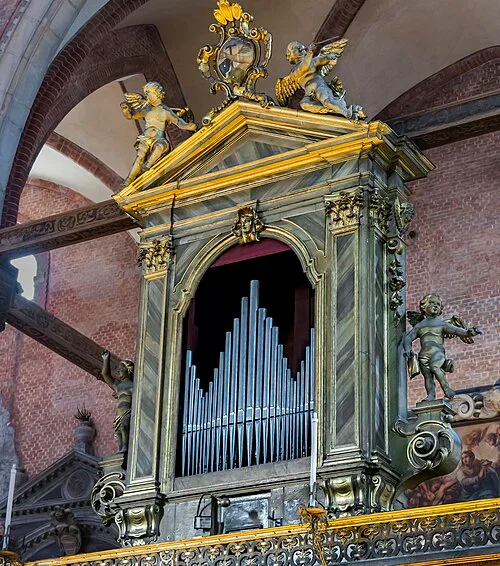 Central Monastic Choir and Historic Organs
Left Choir Organ, Attributed to Giovanni Battista Piaggia
The left organ in the choir is attributed to Giovan Battista Piaggia, and it was probably built in 1732. Its case has gilded cherubs and striped panels that look like marble. An engraving made in 1708 shows that the choir then had organs on opposite sides, facing each other. Facing organs suited a style of music that was popular in Venice for about two centuries. Gaetano Callido built the organ on the opposite side in 1795. After that, the left organ was used less and less, and by the early 1970s it had almost lost its metal pipes. The rebuild of 1970 used the organ Piaggia made for the church of San Giovanni Evangelista as a guide, since that instrument has stayed almost unchanged. Seven front pipes were missing. The internal mechanism was gone too, along with nine wooden pipes and the bellows. By one account, it is the last surviving example in Venice of two choirs with working historic organs.
Listen in the appDidier Descouens · CC BY-SA 4.0
- 11
Pesaro Madonna
Titian's Pesaro altarpiece, in which a bishop kneels before the Virgin set off to one side.
- 12
Monument to Doge Giovanni Pesaro
A baroque doge's tomb paid for with a legacy of twelve thousand ducats.
- 13
Monument to Antonio Canova
Canova's white marble pyramid, which holds only his heart, far from where he was buried.
Basilica di Santa Maria Gloriosa dei Frari
Frequently asked questions
How much does the guide cost?
Free app download. Listed guide price: $0.99. Guide price shown in the app. Audio guide only. Venue admission is separate.
Can I listen without internet?
Yes. Download the guide’s audio, images, and maps in the app before your visit. Your downloaded content is then available offline.
Can I listen in my language?
This audio guide is available in 15 languages, including English.
Do I need to follow a schedule?
No. This is a self-guided experience. Choose your stops, pause whenever you like, and return to a story at your own pace.
At your own pace
Explore Basilica di Santa Maria Gloriosa dei Frari.
Download Stanza, then search for “Basilica di Santa Maria Gloriosa dei Frari”.
Free app download · Guide price shown in the app
Keep exploring
Nearby audio guides
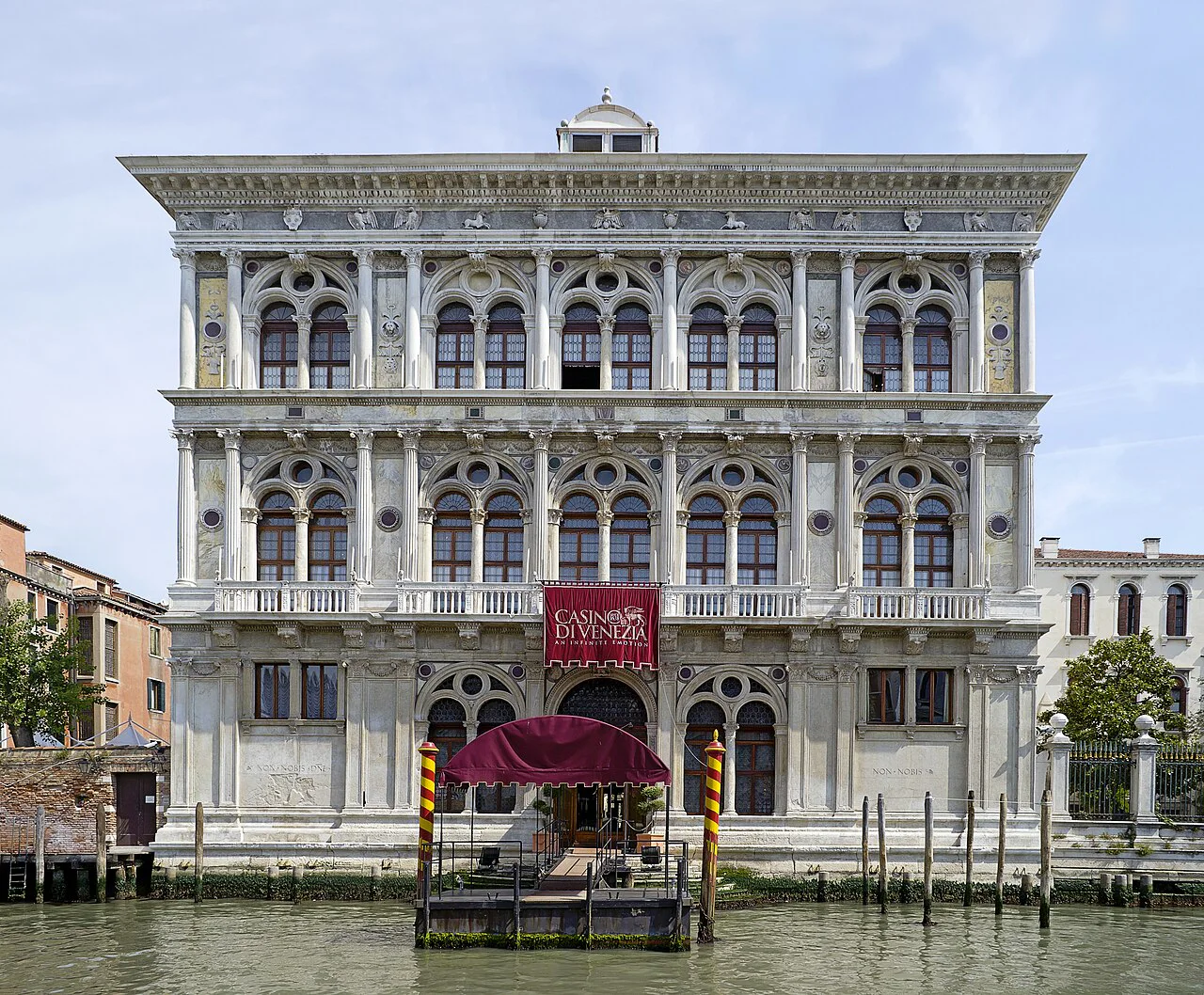
Venice · 1 km
Ca' Vendramin Calergi
Content & sources
Didier Descouens · CC BY-SA 4.0
Venice · 1 km
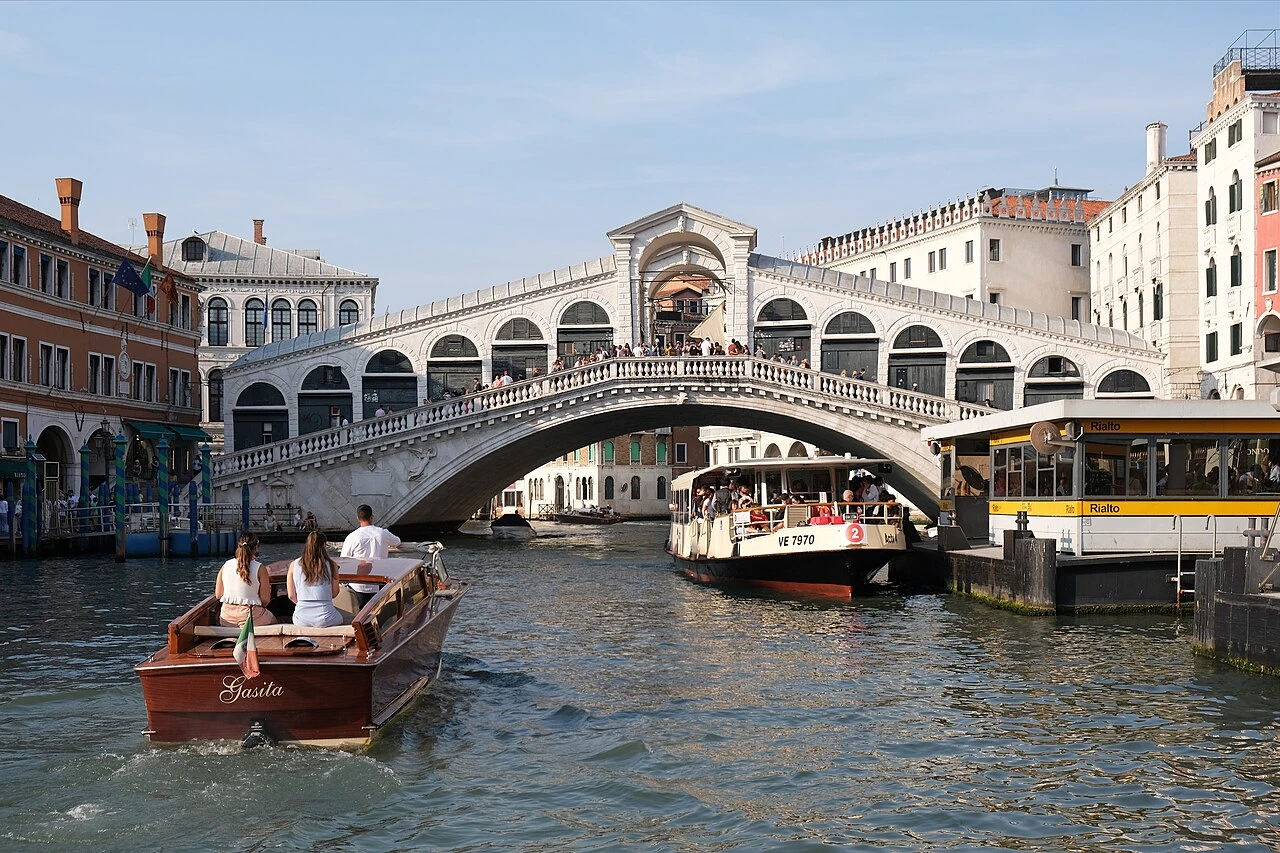
Rialto Bridge
Content & sources
Photo: Kallerna · CC BY-SA 4.0
Venice · 1 km
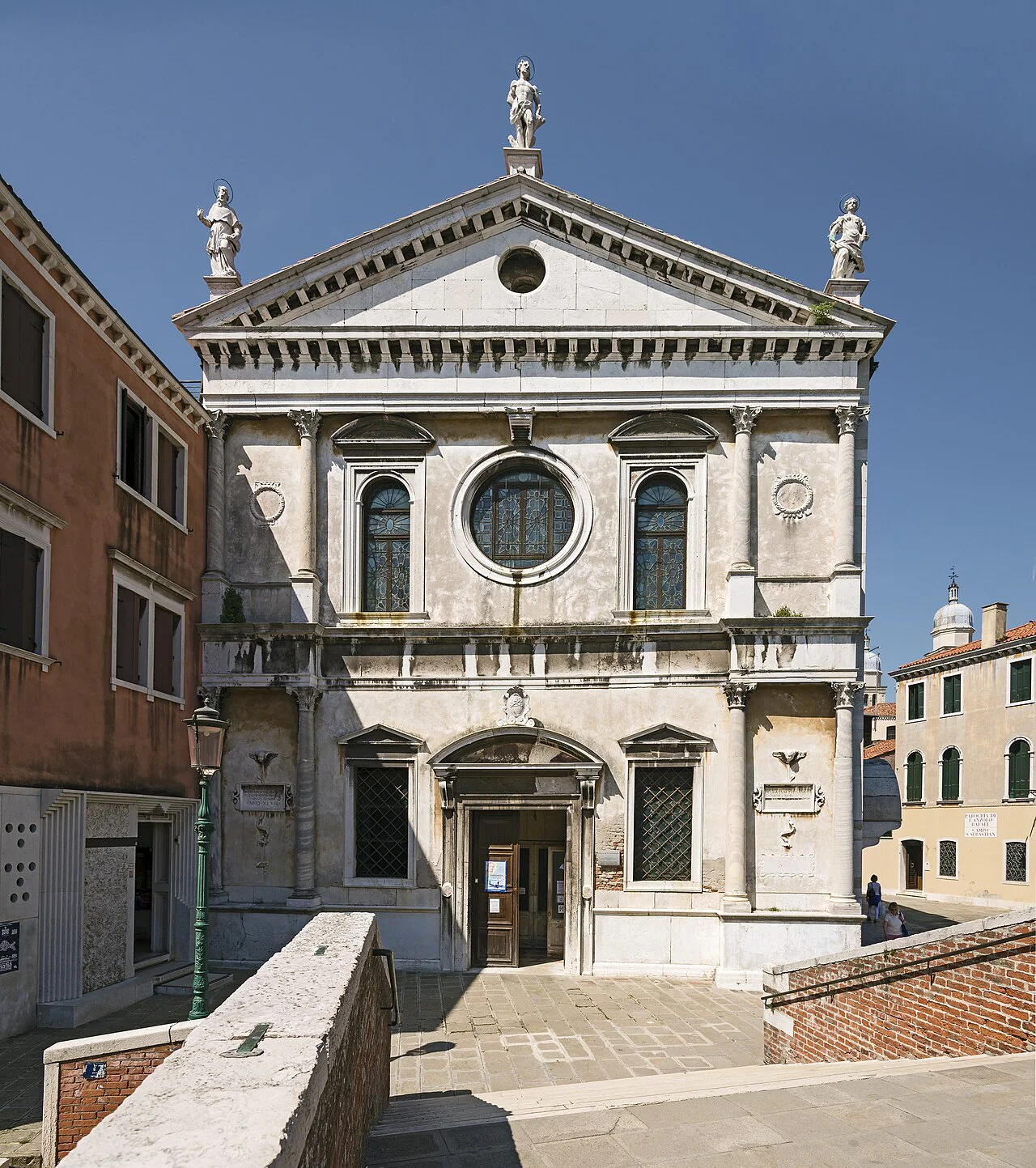
Chiesa di San Sebastiano
Content & sources
Didier Descouens · CC BY-SA 3.0
Venice · 1 km
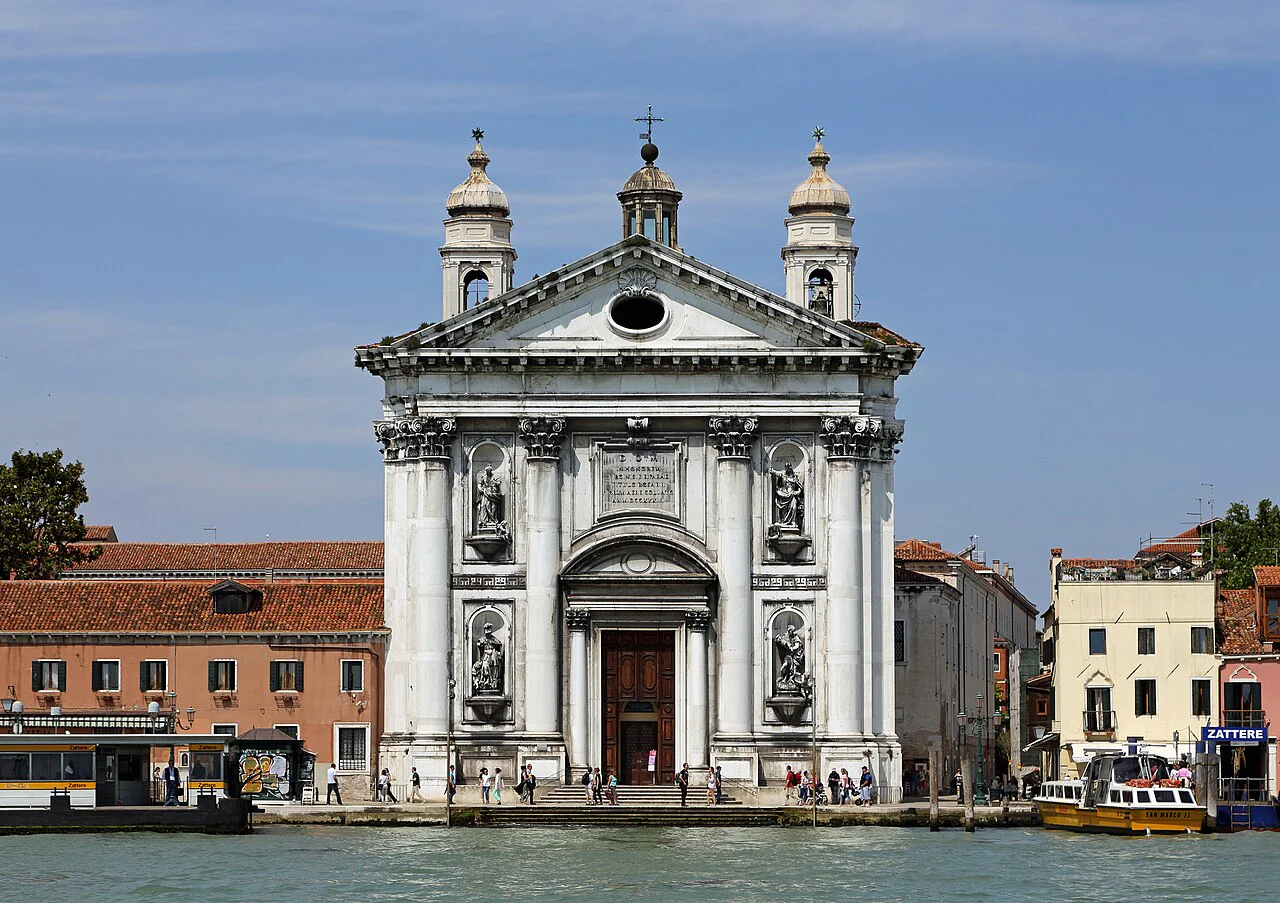
Chiesa dei Gesuati
Content & sources
Marc Ryckaert (MJJR) · CC BY 3.0