Stanza · Audio guide
Chiesa dei Gesuati Audio Guide
A place to remember. A story to take with you.
Santa Maria del Rosario, known as I Gesuati, is an 18th-century Dominican church located in Venice. The building is notable for preserving its original layout and Rococo decoration intact.
Download Stanza, then search for “Chiesa dei Gesuati”.
About the tour
One guide. Your kind of visit.
Santa Maria del Rosario, known as I Gesuati, is an 18th-century Dominican church located in Venice. The building is notable for preserving its original layout and Rococo decoration intact.
Ready when you are.
- 01Get the free Stanza app.
iOS & Android
- 02Find your guide.
“Chiesa dei Gesuati”
- 03Download before you go.
Works offline
Audio guide / 11 narrated stops
Inside the guide
Get to know a few of the stories before you go. Open a stop to read more.
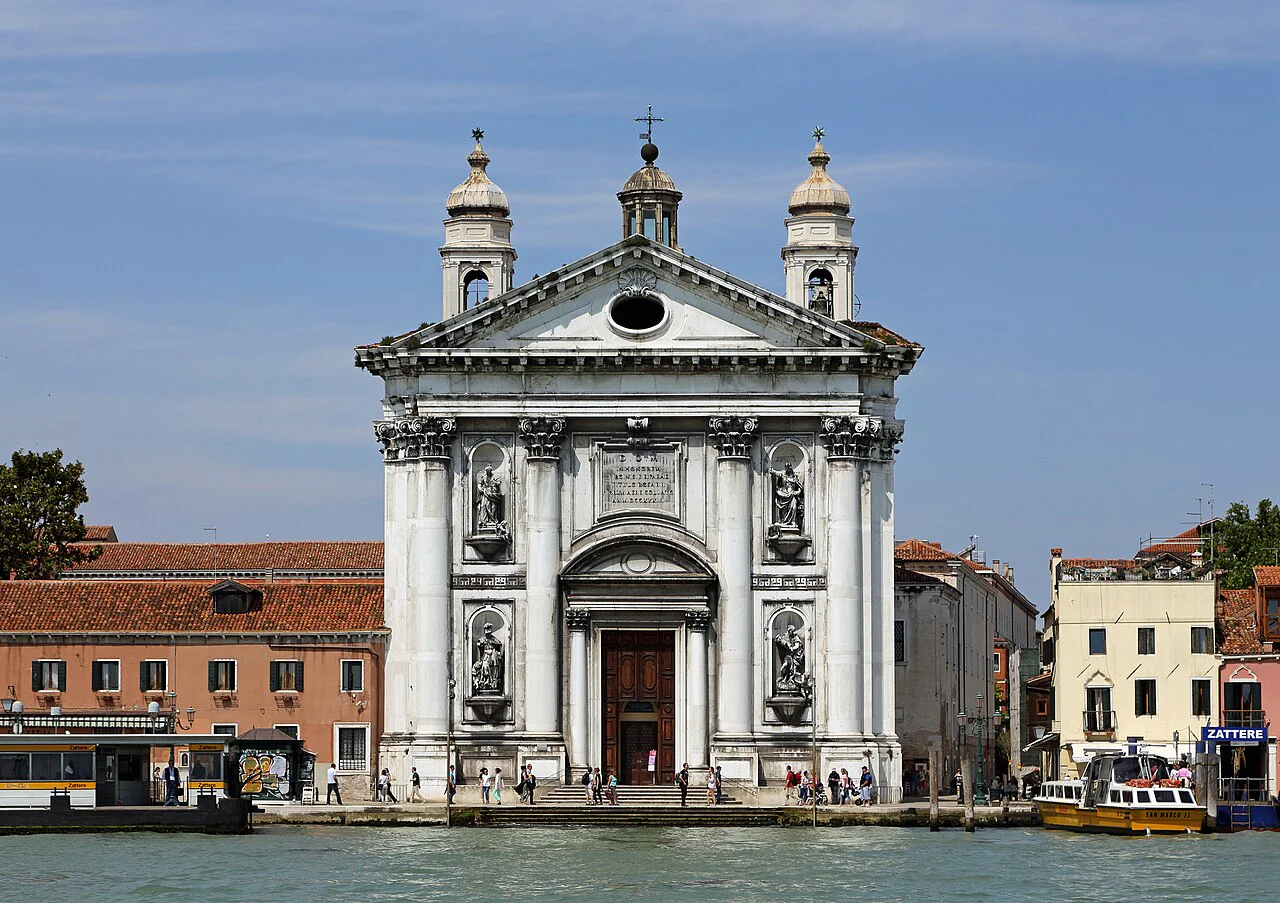
01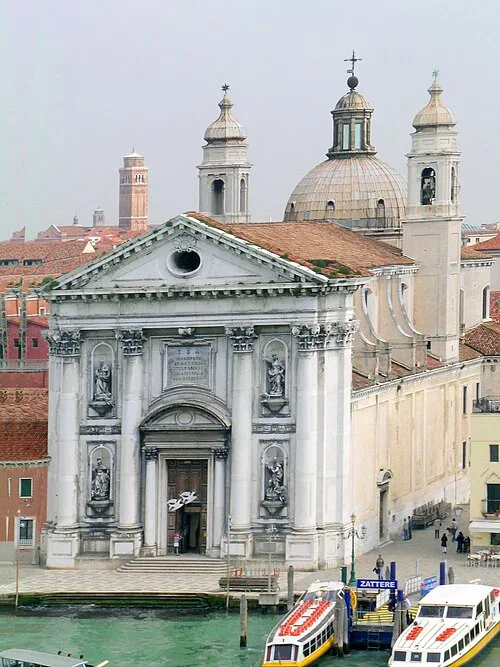 Zattere Waterfront and the Grand Facade
The Gesuati Facade on the Zattere
Welcome to the church the Venetians still call the Gesuati, though its proper name is Santa Maria del Rosario. The name is a leftover. In the fourteenth century an order called the Jesuates settled here, poor men known as the poveri Gesuati because they kept calling on the name of Jesus. They ran this site for centuries and even held a state monopoly on distilling wine. By the sixteen-sixties they could no longer recruit enough members, and Pope Clement IX suppressed the order in 1668. The Dominicans bought the property at auction in 1669 and moved in the following year. The Venetians never bothered to change what they called the place, and the name has stuck ever since. It has nothing to do with the Jesuits, whose church lies across the city in the north. The new owners wanted a church to celebrate the glories of their order and to encourage devotion to the rosary, a feast that had entered the general calendar in 1716 after a victory over the Turks. Giorgio Massari's design was accepted in 1724 and building began the next year. The church was consecrated in 1743, and the last sculpture went up in 1755.
Waysider83 · CC BY-SA 3.0
02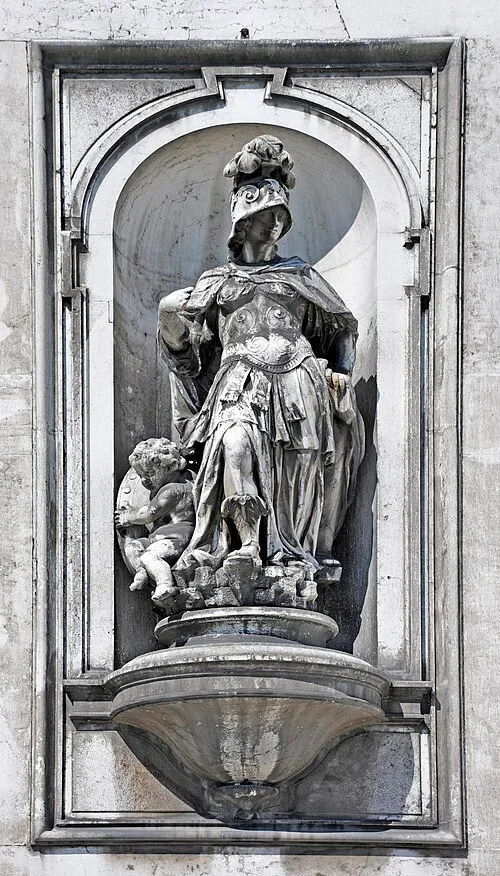 Zattere Waterfront and the Grand Facade
Fortitude by Giuseppe Torretti
Set into the facade niches stand four larger-than-life women, the cardinal virtues: Prudence, Justice, Fortitude and Temperance. The one in the upper right niche is Fortitude, carved by Giuseppe Bernardi, a sculptor known as Torretti. She wears a helmet and stands on a heavy corbel, one of the four figures the sculptors finished in 1736 and 1737. Massari, the architect, did not try to invent a facade of his own. He took the central portion of it from Palladio's church of San Giorgio Maggiore, which sits within sight across the Giudecca Canal. His thinking was that his Dominican patrons would be best pleased by the authority of a famous predecessor rather than by novelty. So the great pediment, the columns and the niches echo a design Venetians had known for a hundred and fifty years. Torretti's Fortitude and her three companions give that borrowed framework its own eighteenth-century flourish.
Giuseppe Torretto · CC BY-SA 3.0
03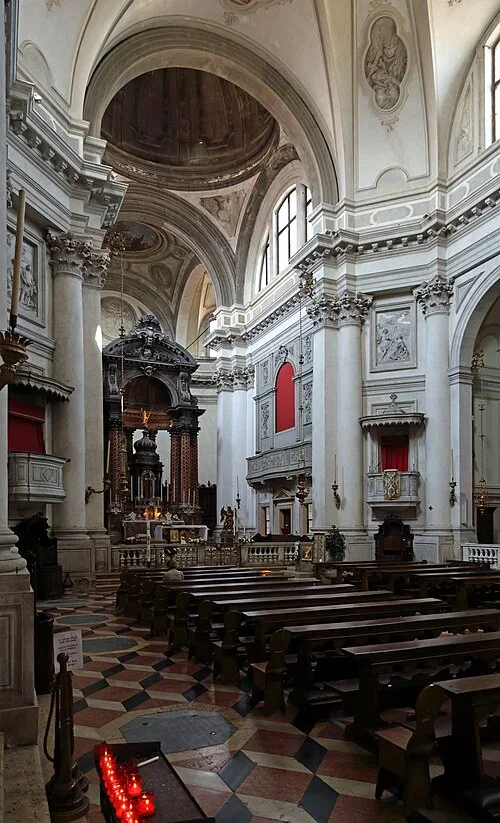 The Rococo Nave and Morlaiter's Sculptures
Inside the Single Nave
Inside, the Gesuati does something few Venetian churches do. Everything here was conceived together, within roughly thirty years: the building, its fittings, the ceiling paintings and the sculpture. Massari was responsible not only for the building itself but for its interior decoration and for commissioning the paintings and sculpture to fill it. For the interior's basic idea he turned to Palladio again, this time to the Redentore. The nave is a single broad hall with no dividing columns, its corners rounded so that the space reads almost as an ellipse. Corinthian columns carry an entablature around the room, and six side chapels open between them, three to each side. Large high windows light both walls, and they show off the contrast between the white walls and the grey stone. The outside walls form a plain rectangle, so the luminous interior comes as a surprise. Decoration of the interior began in 1736, ten years after the first stone.
Listen in the appMarc Ryckaert (MJJR) · CC BY 3.0
04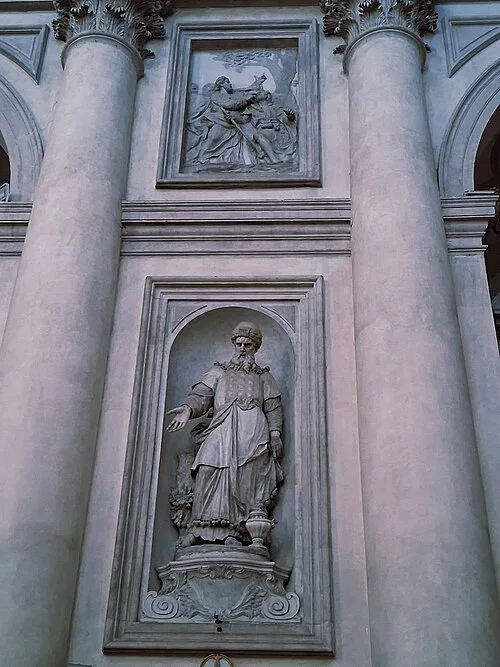 The Rococo Nave and Morlaiter's Sculptures
Morlaiter's Niche Sculptures and Gospel Reliefs
Almost all the sculpture in this church is the work of one man, Giovan Maria Morlaiter, who came from beyond the Alps. More of his work survives here than anywhere else in Venice. One writer of his century called him one of the ablest sculptors in eighteenth-century Venice, and another praised his inexhaustible invention and the dynamism of his figures. Between 1743 and 1754 he filled the nave: six life-size statues set into the niches between the columns, and bas-reliefs above them. The statues are patriarchs and apostles, among them Abraham, Aaron, Moses, Saint Peter and Saint Paul, robed figures each in a shallow niche. The reliefs above show scenes from the Gospel, such as Christ healing the blind man and the Samaritan woman at the well. The turbaned figure in one of these niches, holding a covered vessel, shows how much life Morlaiter could give a standing pose. The last of them, Melchisedek, is the figure that closes the series.
Listen in the appGufo04152 · CC BY-SA 4.0
05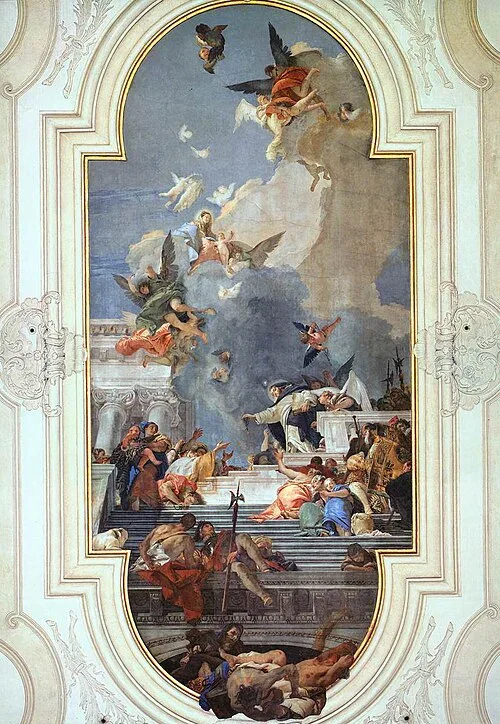 Nave Vault: Tiepolo's Rosary Ceiling Fresco
Tiepolo's Institution of the Rosary
The ceiling carries the church's greatest treasure, and it was one of Tiepolo's first large fresco commissions. He signed his contract with the Dominicans in May 1737 and had the work finished by 1739. Three framed scenes run down the vault. Toward the entrance is the Glory of Saint Dominic, his rise into heaven, and toward the altar the Virgin appears to the saint. In the centre hangs the great one, the Institution of the Rosary. In a sky of clouds and angels, the Virgin supports the Christ child, who holds out the rosary to Saint Dominic. The saint stands at the top of a long flight of marble steps, handing rosaries down to the people below, rich and poor together, a doge and a pope among them. At the bottom edge, in the darkest part of the painting, damned souls tumble out of the frame. Around the three scenes sit sixteen smaller panels in monochrome, fifteen of them the traditional Mysteries of the Rosary and a sixteenth its Glory. They were probably painted with the help of assistants, and the stucco frames around every compartment are the work of Antonio Pelle.
Listen in the appGiovanni Battista Tiepolo · Public domain
06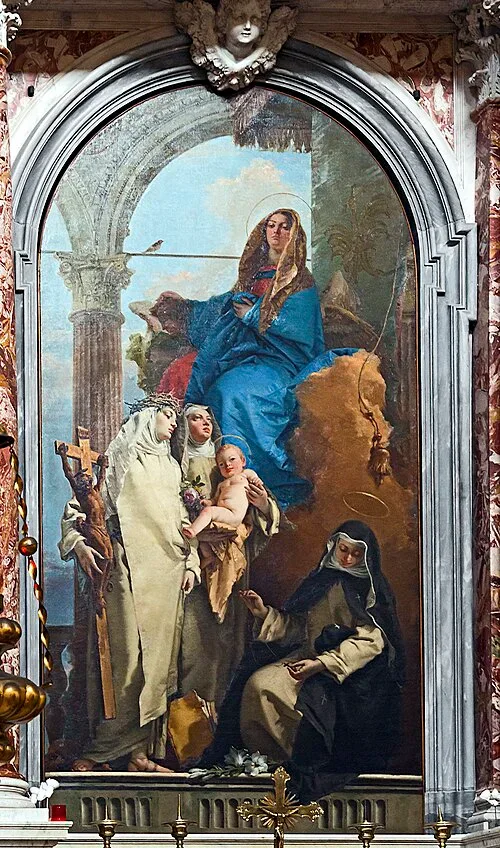 Right Chapels: Altarpieces by Tiepolo and Piazzetta
The Virgin Appearing to Dominican Saints
The first altar on the right holds Tiepolo's altarpiece of the Virgin appearing to three Dominican women saints. It is the luminous side of him, saturated with colour, made for a church dedicated to the Madonna of the Rosary. Catherine of Siena stands on the left, holding a cross with the crucified Christ. On the right stands Rose of Lima with the Christ child in her arms, and the child holds a rose. Seated with them is Agnes of Montepulciano, holding a small cross, a saint who had been canonised only in 1726, so her glory was still fresh news when the picture was painted. The canvas was ready by the end of 1739, as the ceiling was being finished, but it was installed only in 1748, and it belongs to the same campaign of celebrating the order's devotion to Mary. Behind and above them sits the Virgin, strangely detached, as if the saints had not noticed her. It is the warmest painting in the church.
Listen in the appDidier Descouens · CC BY-SA 4.0
07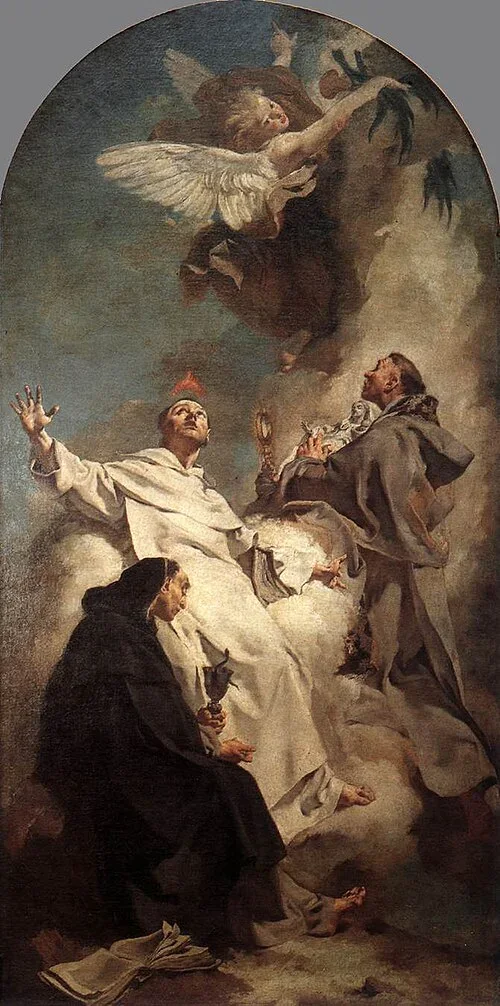 Right Chapels: Altarpieces by Tiepolo and Piazzetta
Piazzetta's Three Dominican Saints
The third altar on the right is a deliberate contrast: Giambattista Piazzetta's nearly monochrome painting of three male Dominican saints. The Dominicans chose the subject themselves, to illustrate the missionary reach of their order. In black in the foreground kneels Saint Louis Bertrand, a Spaniard who went as a missionary to the Caribbean. A native priest there was said to have tried to poison him, and the serpent curled in the chalice he holds stands for that story. Behind him, in white, stands Saint Vincent Ferrer, who was said to have appeared to Louis Bertrand in a vision. The third saint is Hyacinth, who preached in the East. He carries a monstrance and an image of the Virgin and Child, which he was said to have carried with him into the raging torrent of the Dniester, from which he was saved by a miracle. One critic has written that the real triumph of the painting is its memorably austere tonality. After Tiepolo's brightness at the first altar, the shadows here land with force.
Listen in the appGiovanni Battista Piazzetta · Public domain
08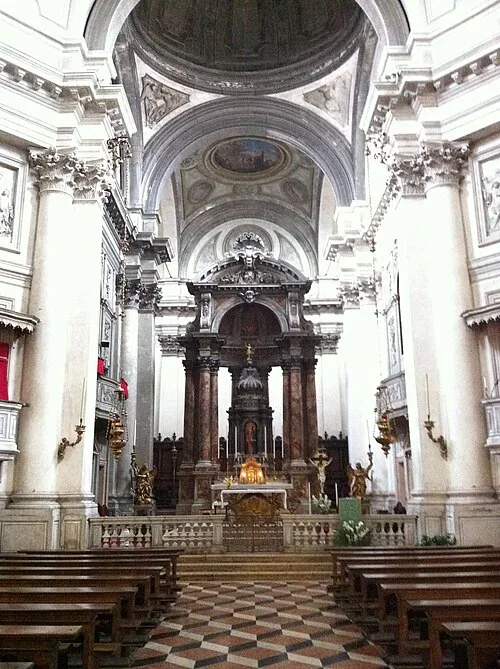 The Presbytery and Massari's High Altar
Massari's High Altar
The high altar stands at the top of five steps, under the cupola, and it is Massari's own design, drawn in 1742 and 1743. He shaped it as a great curved exedra, a colonnade of red Sicilian marble that encloses a tabernacle encrusted with lapis lazuli. The altar beneath is pure Rococo, with coloured marbles, carved shells and heads of angels, and reliefs of roses, ears of corn and grapes. In the pendentive corners under the cupola, Tiepolo painted the symbols of the four evangelists in monochrome, during the same years as his ceiling. Near the high altar, one of the monochrome paintings on the ceiling shows Saint Dominic kneeling and blessing a Dominican friar. The old writer Lorenzetti suggested that the friar may be Fra Paolo, the Dominican who was largely responsible for getting the church built. If he is right, the man who drove the whole project has his portrait tucked into the ceiling above the altar.
Listen in the appPhoto: Andrewrabbott · CC BY-SA 3.0
09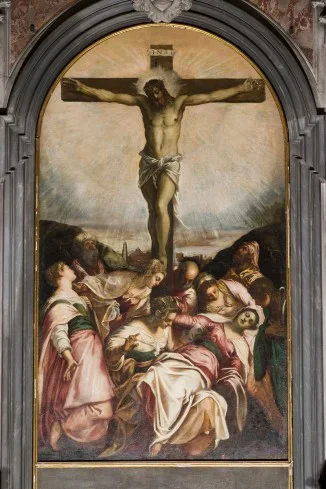 Left Chapels: Tintoretto and Ricci
Tintoretto's Crucifixion
The third altar on the left holds one of the oldest paintings in the church, a Crucifixion by Jacopo Tintoretto, painted around the 1560s, two centuries before the church around it. Tintoretto made it for the small church that stood on this site before, dedicated first to Saint Jerome and later to the Visitation, the church of the Jesuates. When the Dominicans built their new church alongside it, they brought the canvas over. By then it was in poor condition, so they arranged for Piazzetta, the same painter whose dark saints hang on the right side, to restore it in 1743. Christ on the cross fills the upper canvas, ringed with light, while below him a tangle of figures collapses in grief. A Renaissance canvas of the fifteen-sixties, hung inside Massari's Rococo frame, still does its work here.
Listen in the appJacopo Tintoretto · Public domain
10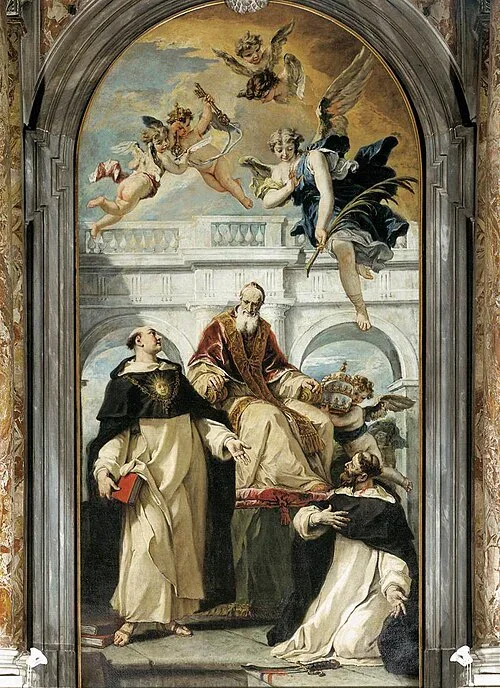 Left Chapels: Tintoretto and Ricci
Ricci's Pope Pius V, Thomas Aquinas and St Peter Martyr
The first altar on the left carries a distinction: this was the first work commissioned especially for the new building. Sebastiano Ricci painted it in 1732 and 1733, and it turned out to be one of the last things he made, for he died in 1734. The canvas celebrates three of the most famous Dominicans. Pope Pius V sits enthroned in white and red, a fierce opponent of Protestantism who had been canonised in 1712. He had a deep reverence for Thomas Aquinas, the figure on the left, whom he had made a Doctor of the Church. Aquinas is identified by the sun on his breast and by the book in his hand, his great Summa Theologica. On the right is Saint Peter Martyr, and above the three float angels, one of them carrying the martyr's palm. The altar beneath the canvas is Morlaiter's work, made in 1744 and 1745.
Listen in the appSebastiano Ricci · Public domain
- 11
Cristo Passo and the Walled Canal
A walled bridge mouth and a fifteenth-century Christ on the flank, older Venice showing through the Rococo.
Chiesa dei Gesuati
Frequently asked questions
How much does the guide cost?
Free app download. Listed guide price: $0.99. Guide price shown in the app. Audio guide only. Venue admission is separate.
Can I listen without internet?
Yes. Download the guide’s audio, images, and maps in the app before your visit. Your downloaded content is then available offline.
Can I listen in my language?
This audio guide is available in 15 languages, including English.
Do I need to follow a schedule?
No. This is a self-guided experience. Choose your stops, pause whenever you like, and return to a story at your own pace.
At your own pace
Explore Chiesa dei Gesuati.
Download Stanza, then search for “Chiesa dei Gesuati”.
Free app download · Guide price shown in the app
Keep exploring
Nearby audio guides
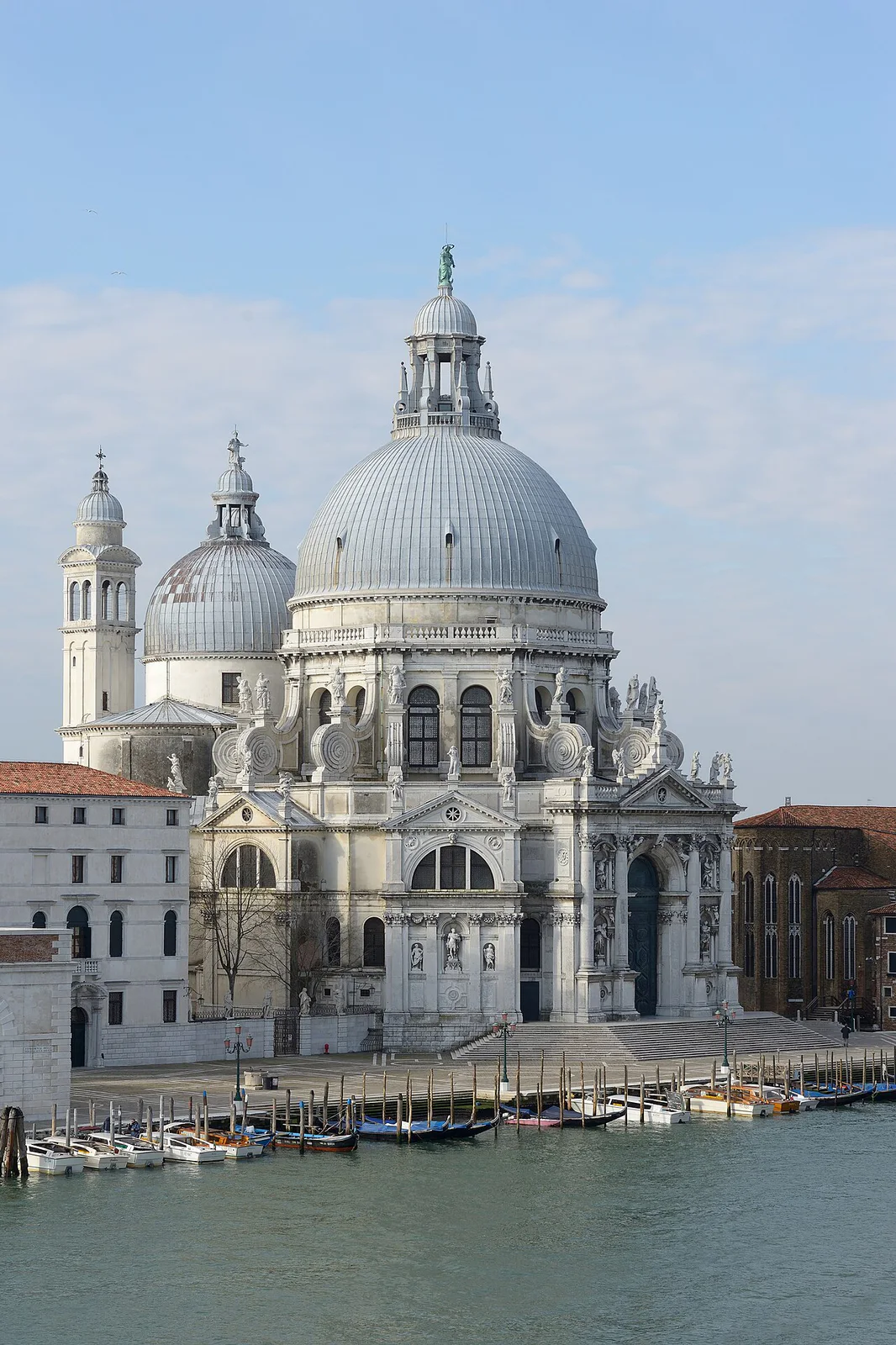
Venice · 1 km
Basilica di Santa Maria della Salute
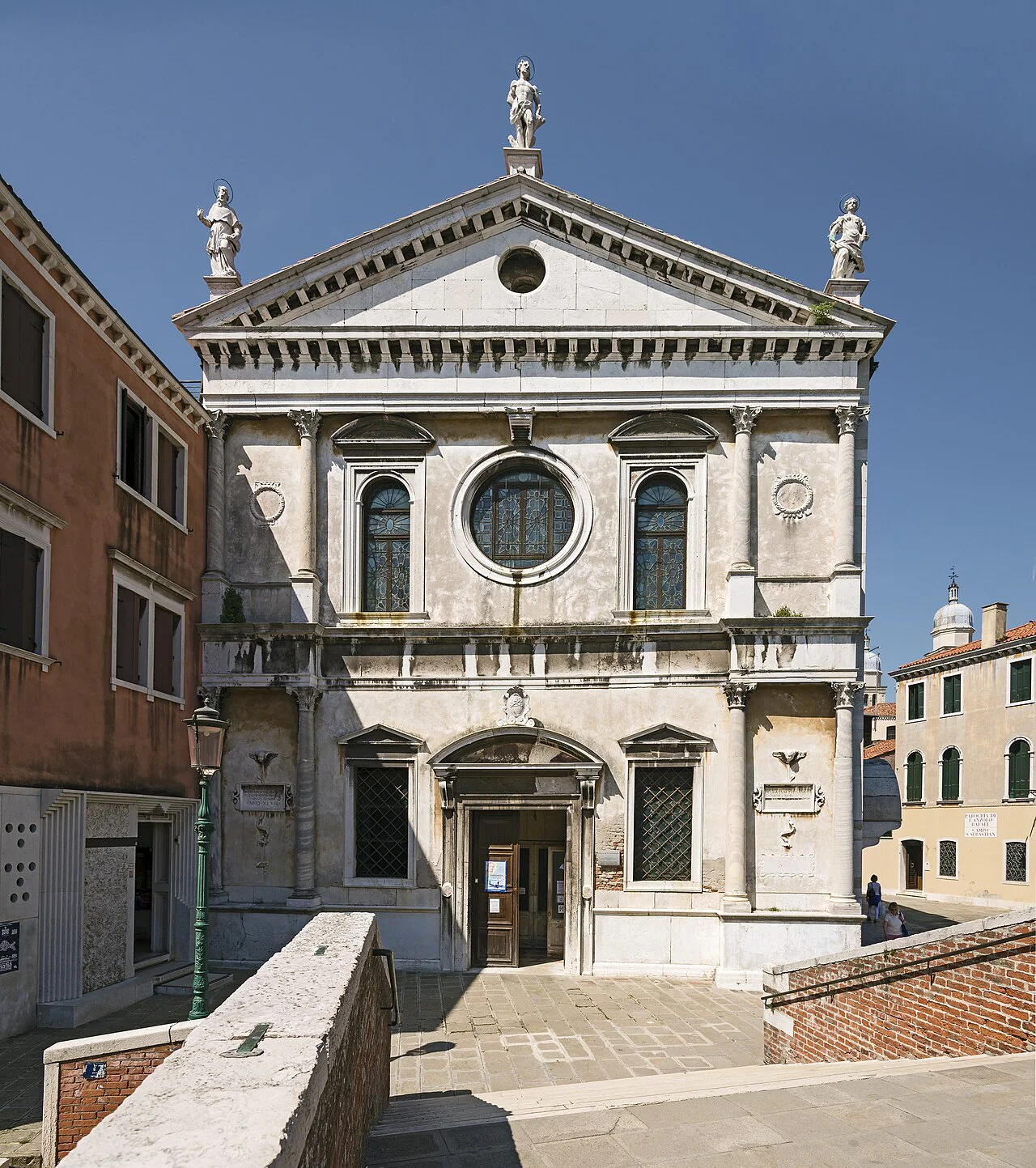
Venice · 1 km
Chiesa di San Sebastiano
Content & sources
Didier Descouens · CC BY-SA 3.0
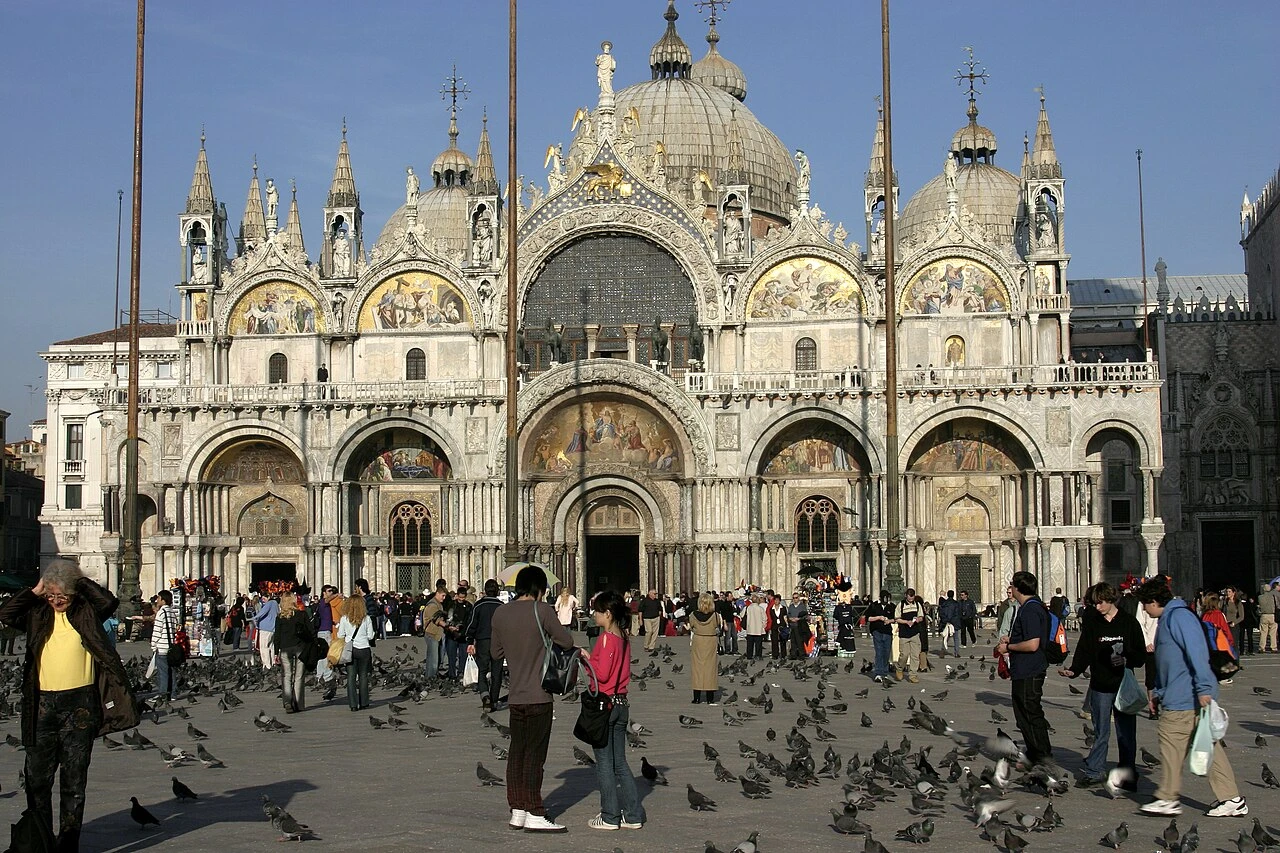
Venice · 1 km
St Mark's Basilica
Content & sources
Photo: Nino Barbieri · CC BY-SA 2.5
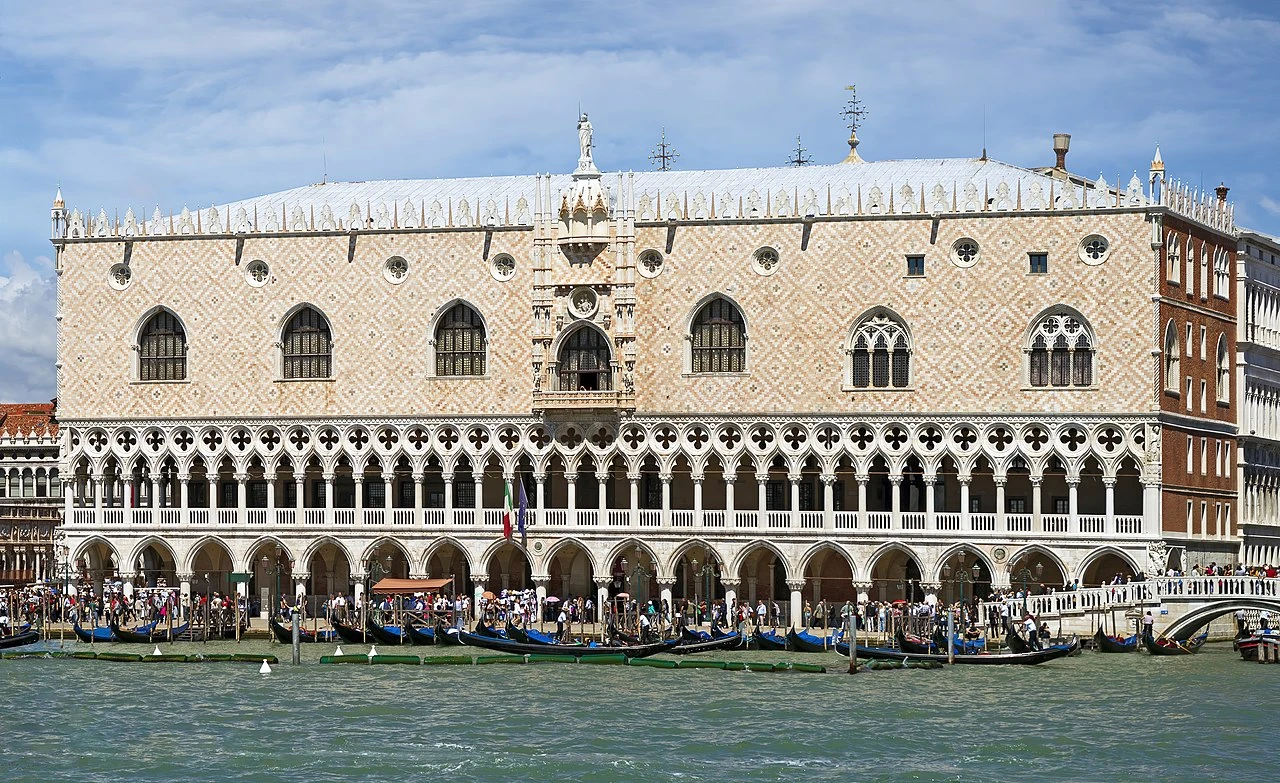
Venice · 1 km
Doge's Palace
Content & sources
Didier Descouens · CC BY-SA 4.0