Stanza · Audio guide
Basilica dei Santi Giovanni e Paolo Audio Guide
A place to remember. A story to take with you.
The Basilica of Saints John and Paul on the Caelian Hill is an ancient basilica church in Rome. It was originally built in 398.
Download Stanza, then search for “Basilica dei Santi Giovanni e Paolo”.
About the tour
One guide. Your kind of visit.
The Basilica of Saints John and Paul on the Caelian Hill is an ancient basilica church in Rome. It was originally built in 398.
Ready when you are.
- 01Get the free Stanza app.
iOS & Android
- 02Find your guide.
“Basilica dei Santi Giovanni e Paolo”
- 03Download before you go.
Works offline
Audio guide / 12 narrated stops
Inside the guide
Get to know a few of the stories before you go. Open a stop to read more.
01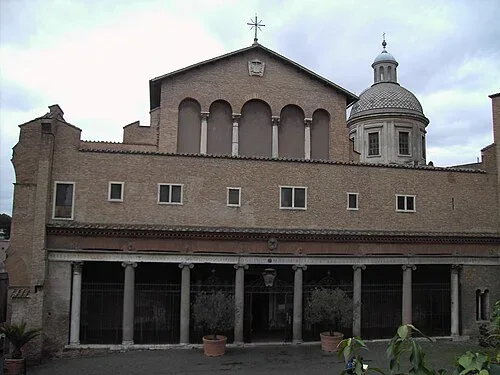 Piazza dei Santi Giovanni e Paolo and the Romanesque Campanile
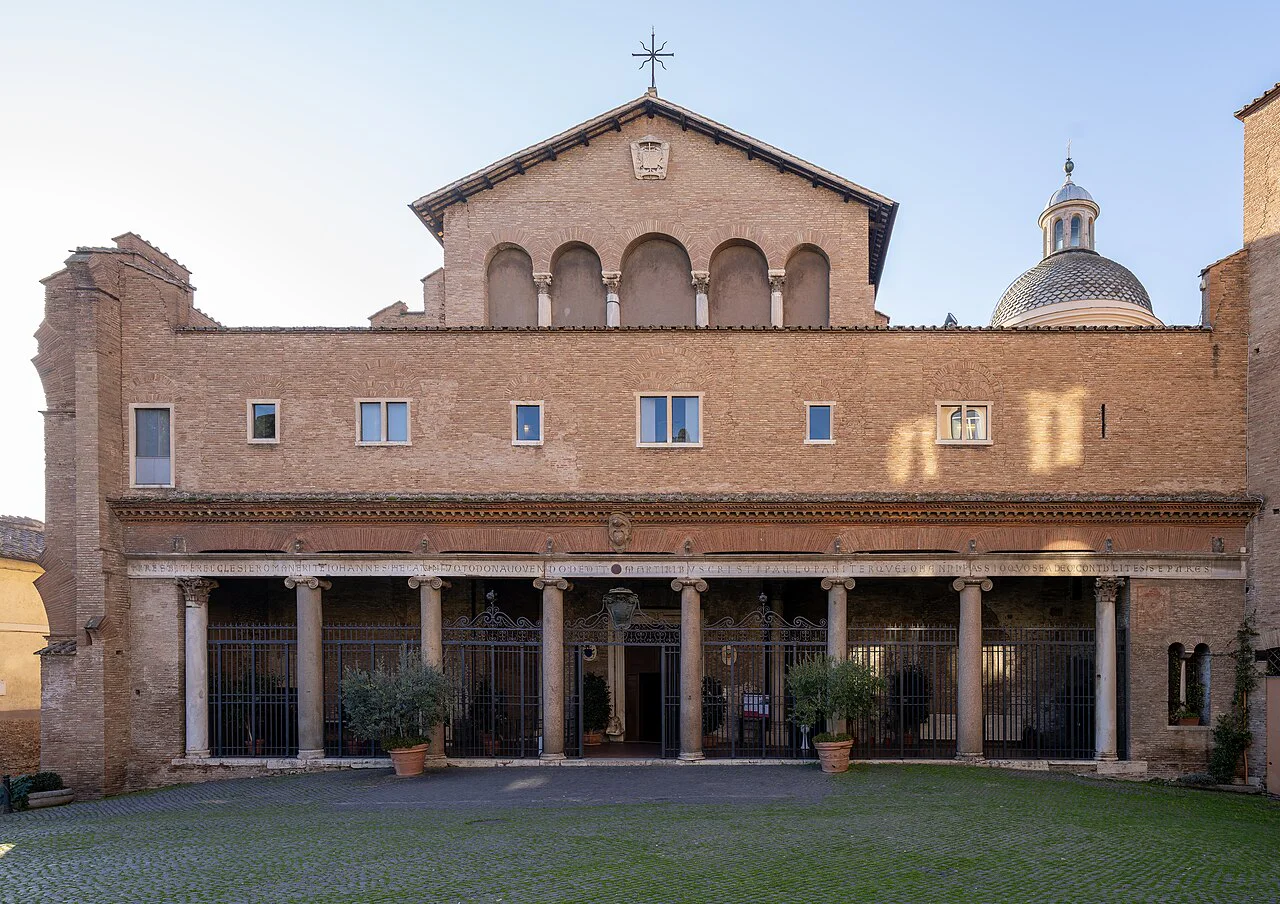
Facade and Portico of the Basilica
Welcome to the Basilica of Saints John and Paul on the Caelian Hill. In the year 398 a Roman senator named Pammachius built this basilica, though an older account gives the honour to his father, Bizante. He raised it inside the city, directly over a private Roman house, not outside the walls like a catacomb. Tradition says the house belonged to two Roman soldiers, John and Paul, whose names the church has carried ever since. When a Roman church synod met in 499, it listed the church as the Titulus Pammachii, Pammachius's title. The facade stacks the eras: a paleochristian arcaded front, given its present appearance in a 1951 restoration, above the medieval portico, with a later dome rising at the right. The soldiers' story, and the Roman rooms sleeping under the floor, come later in the visit.
user:Lalupa · Public domain
02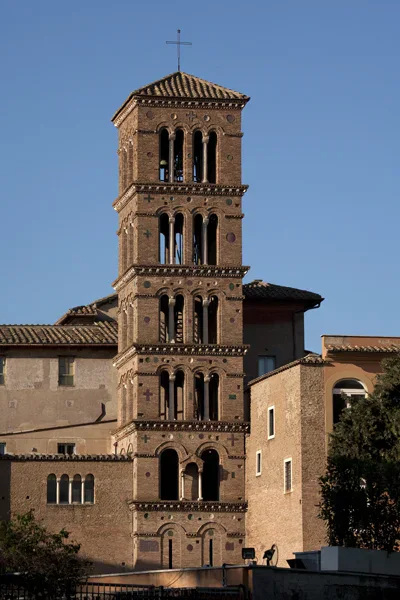 Piazza dei Santi Giovanni e Paolo and the Romanesque Campanile
The Romanesque Bell Tower
This bell tower marks the church's recovery from a rough stretch of sacks and earthquakes. The original basilica was damaged when Alaric's Visigoths sacked Rome in 410. An earthquake shook it again in 442. Pope Paschal I restored it in 824. Then in 1084 the Normans sacked the city once more, and the basilica was plundered again. Around 1099 Pope Paschal II set a full rebuilding in motion. He added a monastery, this bell tower, and a portico that replaced the church's original entrance hall, the narthex. The tower is Romanesque brickwork, and its faces are set with disks and crosses of coloured ceramic among the arches. Each storey of arched openings is slightly smaller than the one below, so the whole structure tapers toward the cross at the top.
Photo: Dolfkalenders · CC BY-SA 3.0
03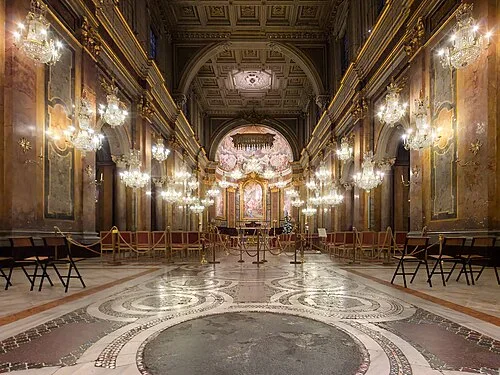 Central Nave, Cosmatesque Pavements, and the High Altar
The Baroque Nave
Inside, this is largely an eighteenth-century space. From 1715 Cardinal Fabrizio Paolucci paid for a sweeping renovation, and it gave the nave its gilded, chandelier-lit character. The nave runs about forty-four metres long. It is nearly fifteen metres wide. Yet the oldest structure in the room is still carrying load. Twelve ancient columns once divided the nave from its side aisles. Above them ran a row of thirteen arches. The Baroque builders did not pull the columns out; they wrapped pillars around them, so the old shafts hide inside the piers. The church is also a living one. The Passionist order makes its home here, and Saint Paul of the Cross, who founded that order, lies buried in one of its chapels. In Lent, the basilica serves as the station church of the first Friday, a fixed stop in Rome's round of pilgrimage churches.
Listen in the appPhoto: NateBergin · CC BY 4.0
04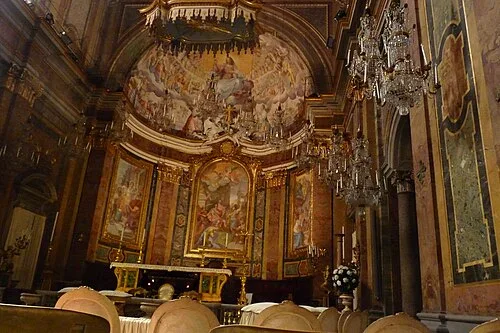 Central Nave, Cosmatesque Pavements, and the High Altar
The Apse and the Martyrs' Tomb
According to Christian tradition, John and Paul were brothers serving as soldiers in Rome. Under the emperor Julian, in the year 362, they refused to sacrifice to the pagan gods, and they paid for it with their lives. Tradition says they were buried in secret inside their own house on the Caelian Hill, the very house this basilica was raised over. The high altar stands above a bath structure said to hold the remains of the two martyrs. Whether it truly does rests on that tradition, not on proof. Above the altar, the apse glows with Christ in Glory, frescoed in 1588 by Cristoforo Roncalli, one of the painters known as il Pomarancio. Below it, a trio of canvases from 1726 completes the scheme. They show the martyrdom of Saint John, the martyrdom of Saint Paul, and the Conversion of Terenziano.
Listen in the appPhoto: Luc. · CC BY-SA 3.0
05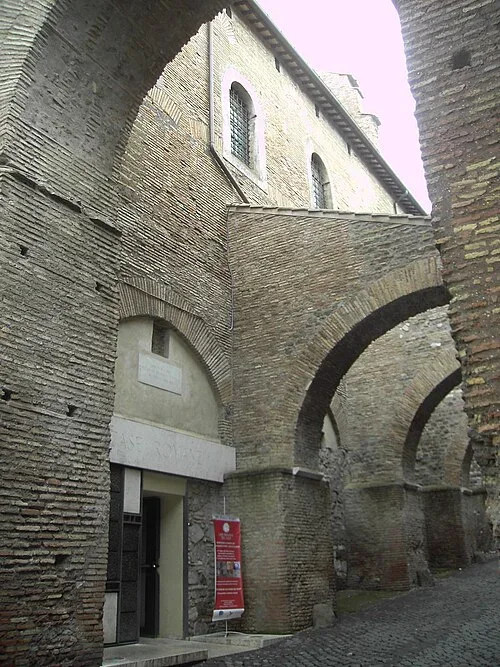 Subterranean Roman Houses: Domestic Life and Transformation
Entrance to the Underground Roman Houses
Beneath the church lies a buried Roman block. In 1887 Father Germano da San Stanislao, then rector of the basilica, went digging under the nave. He was searching for the tombs of the martyrs John and Paul. What he found instead was a complex of twenty decorated rooms. They belonged to at least five different buildings, raised between the first and the fourth century. It is one of the best-conserved Roman residential complexes in existence, and a leading example of a domus ecclesiae, a private house turned into a church by an early Christian community. The entrance lies outside the basilica, on the Clivus Scauri, under the old brick arches. The rooms are low-ceilinged and uneven, and the original frescoes are still on their walls.
Listen in the appuser:Lalupa · Public domain
06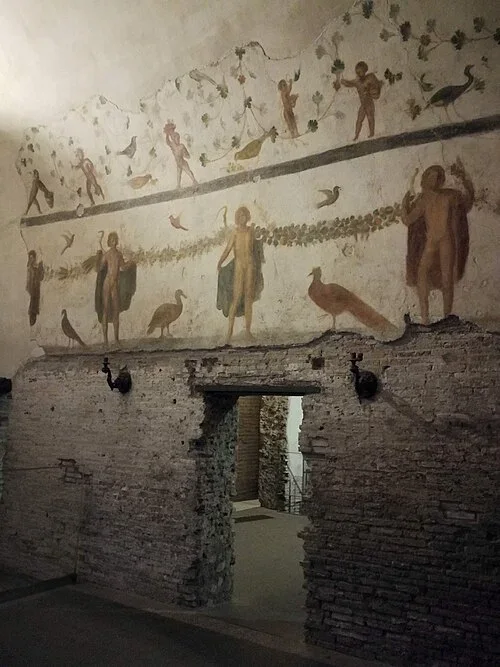 Subterranean Roman Houses: Domestic Life and Transformation
Room of the Genii
Not every room down here turned Christian. Several kept their older decoration, and this one shows it well. Across the wall walk winged genii, figures bearing garlands, and birds of several kinds, the ordinary ornament of a Roman home. Between the third and the fourth century the rooms were modified, and in some of them an oratory was created with Christian frescoes. A colourful theory grew up around these rooms in the nineteenth century. The writer Charlotte Anne Eaton claimed they were dens of a vivarium, keeping wild animals for the games at the Colosseum, linked to the amphitheatre by a low vaulted passage. It is a story from her travel writing, and nothing dug up here has confirmed it.
Listen in the appPhoto: Natyss · CC BY-SA 4.0
07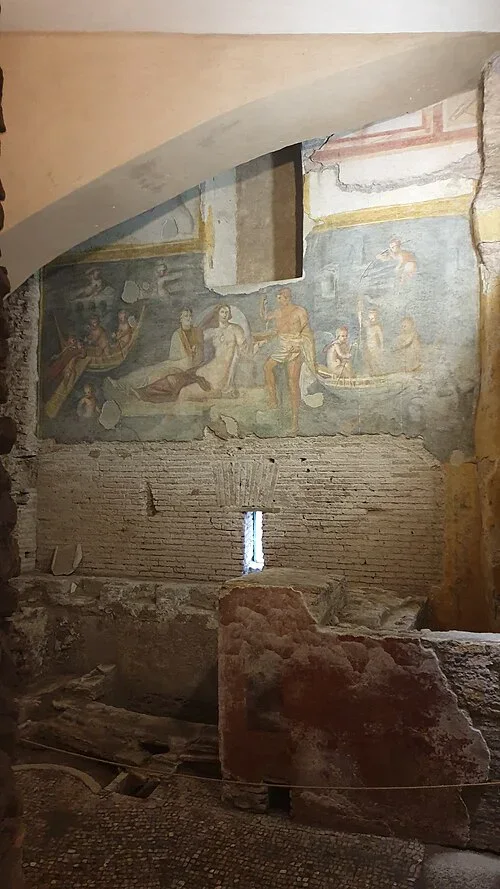 The Underground Nymphaeum of Proserpina
The Nymphaeum Courtyard
One room of the complex was a nymphaeum, a courtyard sanctuary built around water. Its back wall carries the finest painting in the underground rooms: an elegant fresco of the third century, about three by five metres. It shows Proserpine and other divinities among cherubs in a boat. Traces of a second marine fresco survive nearby, and mosaics still cling to the arches above the windows. The painting sits in its rough brick and plaster setting, with the excavation barriers still in front of it. It is a pagan water shrine, preserved inside what became a Christian complex.
Listen in the appMumblerJamie · CC BY-SA 2.0
08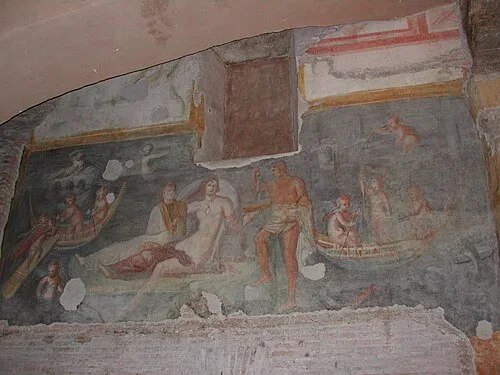 The Underground Nymphaeum of Proserpina
Proserpina's Abduction - Reading the Fresco
The painting tells a story every Roman would have known. Proserpine was seized by Pluto, king of the underworld, and carried off to reign beside him beneath the earth. It is a tale of passage between two worlds, which is why painters of fountains and water courts loved it, a story of crossing over told beside flowing water. On this wall, divinities recline and stand against a faded blue-green sea. Boats with rowers and winged putti cross the water. Proserpine herself is among the figures, though which of her companions is which, no one can say for certain.
Listen in the appuser:Lalupa · Public domain
09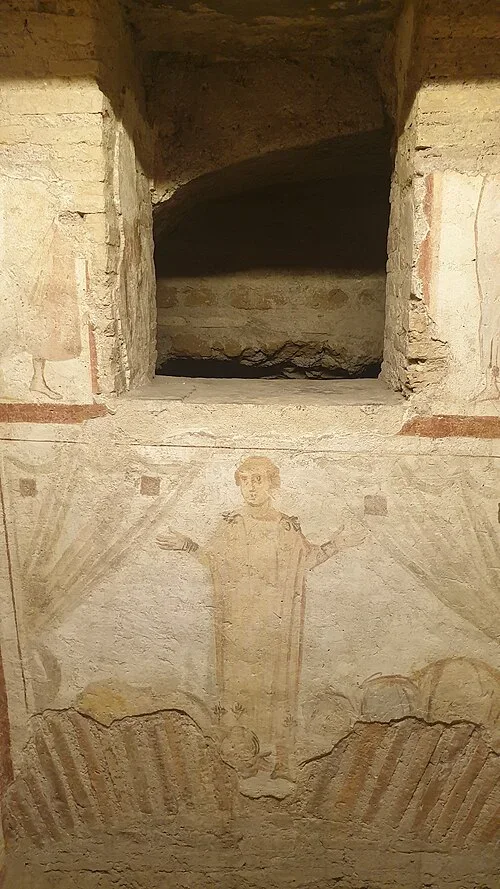 The 4th-Century Christian Confessio and Martyrdom Niche
The Fourth-Century Confessio
Here the buried complex turns Christian. In the fourth century, in a passageway behind the Clivus Scauri, a confessio was built, a prayer niche oriented toward a sacred place. Tradition links this one to the burial of the martyrs John and Paul in their own house, though whether it marks the exact spot rests on tradition alone. The niche opens above a painted figure with both arms stretched wide. That pose is the orante, the classical image of a person at prayer, and early Christian artists used it for the faithful soul. Faint red borders and drapery still show around the figure on the worn plaster. A private Roman passageway had become a place of prayer.
Listen in the appMumblerJamie · CC BY-SA 2.0
10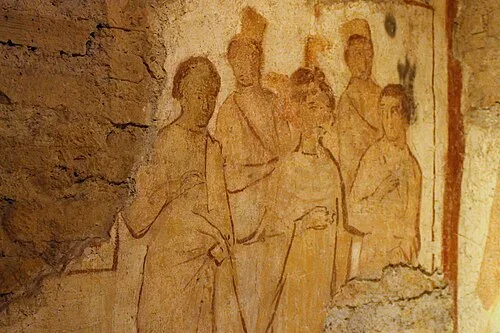 The 4th-Century Christian Confessio and Martyrdom Niche
The Beheading Fresco
The walls of the confessio carry some of the rarest painting in the complex. The clearest scene shows the beheading of three martyrs named Crispus, Crispinianus and Benedicta. Beside it are female figures, and the praying orante. Christian wall painting this early hardly survives anywhere, which is what makes these walls remarkable. The figures are faded now, drawn in ochre and pale red on worn plaster, but the row of standing martyrs still reads clearly. Painting these scenes turned a Roman service passage into a place of martyr-memory.
Listen in the appPhoto: Alekjds · CC BY-SA 4.0
- 11
The Clivus Scauri
The ancient Clivus Scauri and the brick arches holding the basilica to the hillside.
- 12
The Apse from Below - Fifteen Centuries in One Wall
One wall, one street, and centuries of Rome built over itself.
Basilica dei Santi Giovanni e Paolo
Frequently asked questions
How much does the guide cost?
Free app download. Listed guide price: $0.99. Guide price shown in the app. Audio guide only. Venue admission is separate.
Can I listen without internet?
Yes. Download the guide’s audio, images, and maps in the app before your visit. Your downloaded content is then available offline.
Can I listen in my language?
This audio guide is available in 15 languages, including English.
Do I need to follow a schedule?
No. This is a self-guided experience. Choose your stops, pause whenever you like, and return to a story at your own pace.
At your own pace
Explore Basilica dei Santi Giovanni e Paolo.
Download Stanza, then search for “Basilica dei Santi Giovanni e Paolo”.
Free app download · Guide price shown in the app
Keep exploring
Nearby audio guides
Rome · 1 km
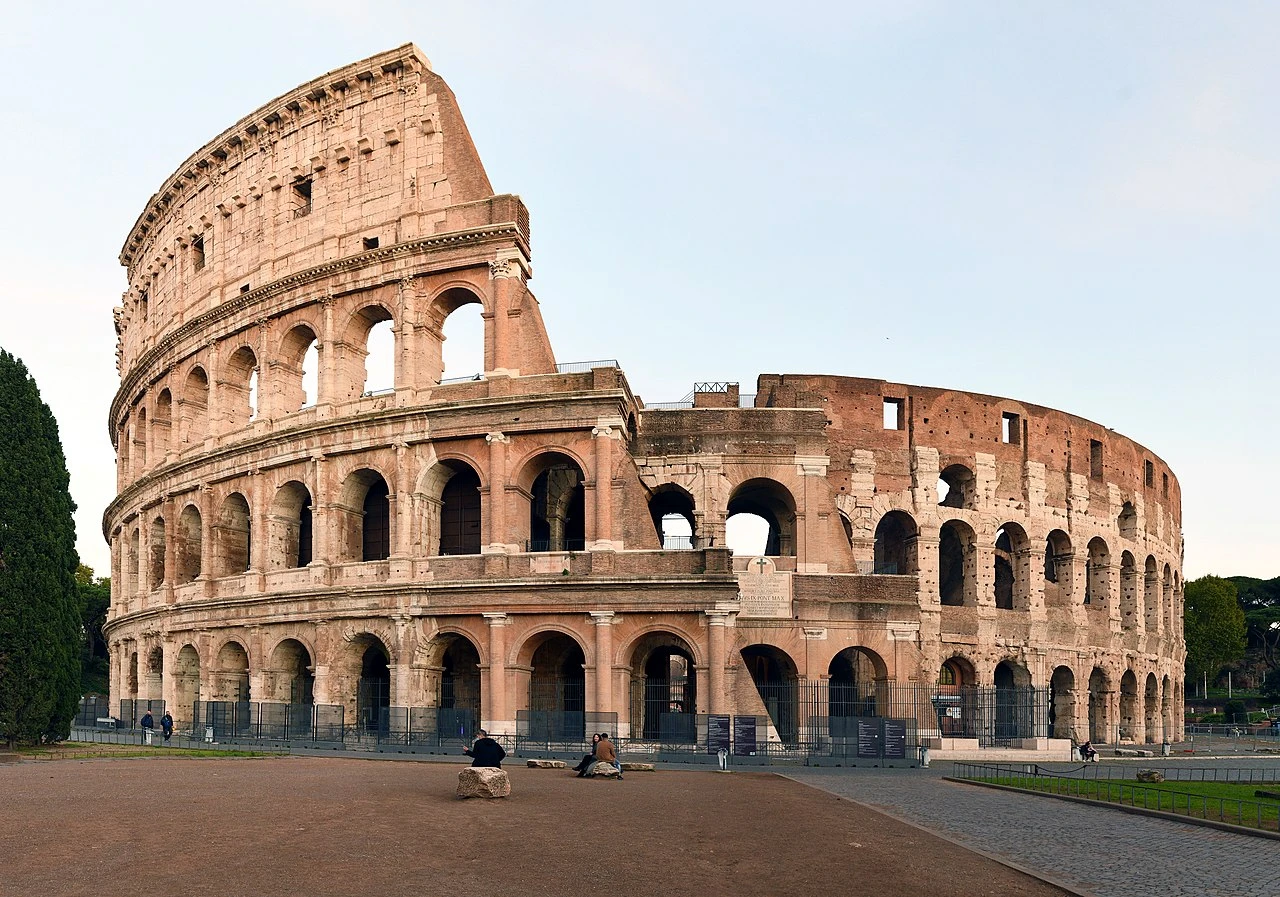
Colosseum
Content & sources
Photo: FeaturedPics · CC BY-SA 4.0
Rome · 1 km
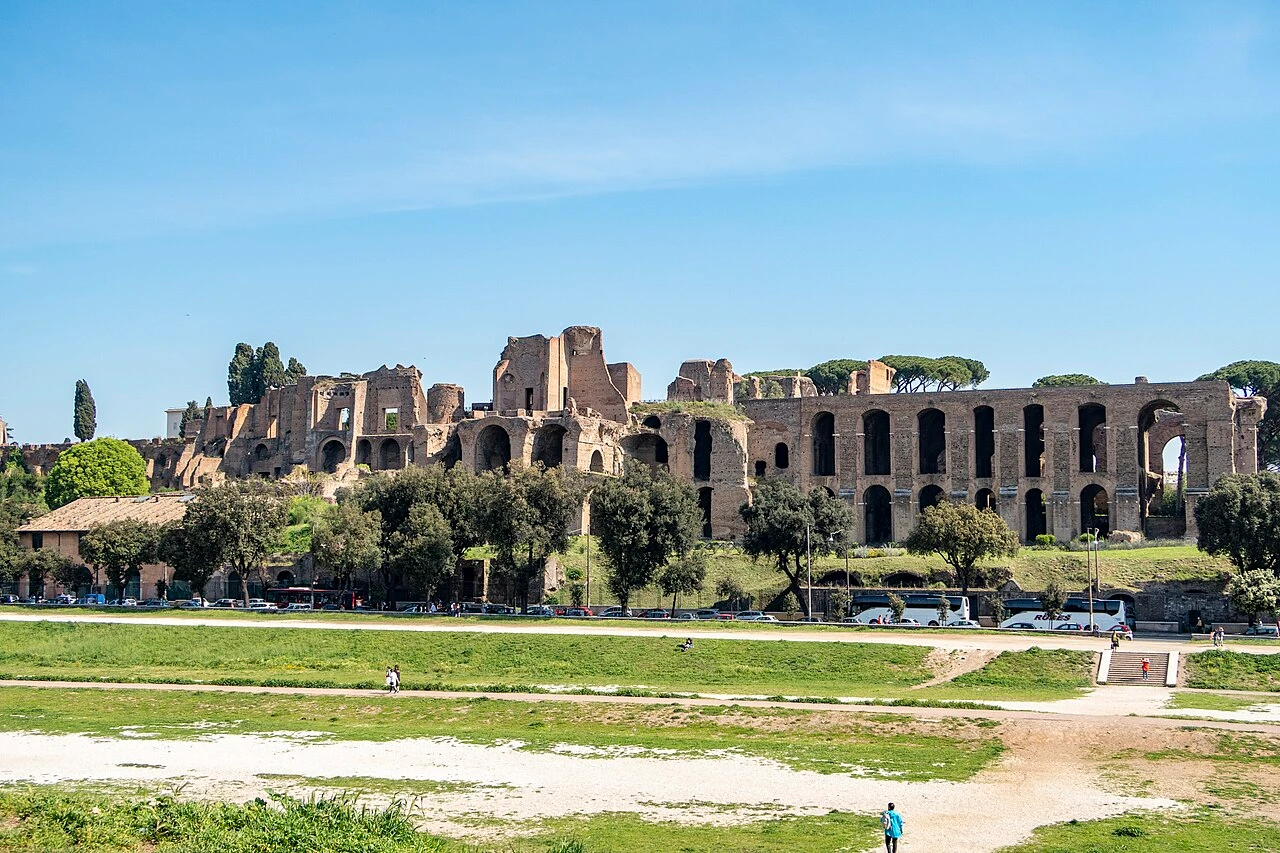
Palatine Hill
Content & sources
Photo: Lil Herodotus · CC BY-SA 4.0
Rome · 1 km
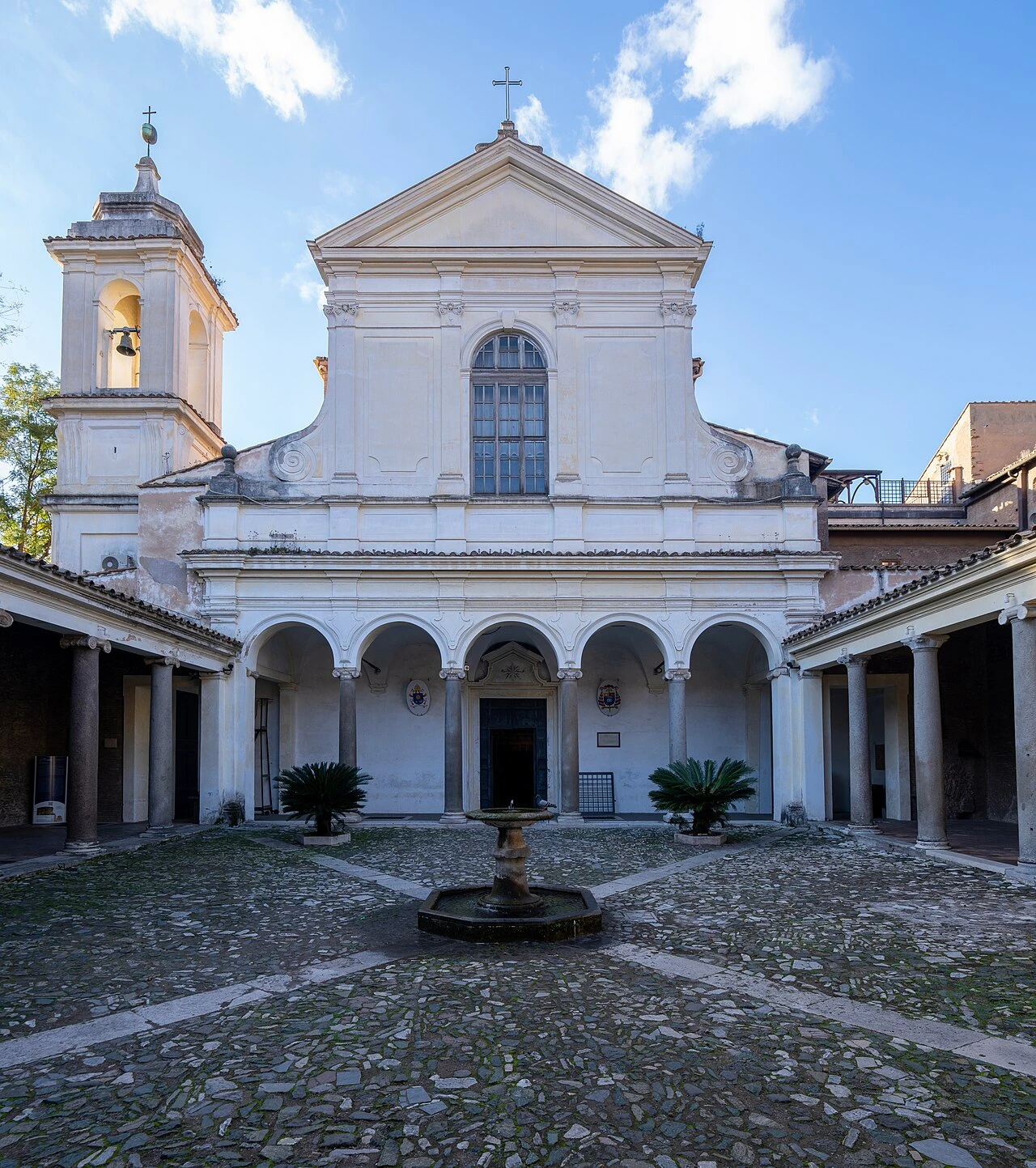
Basilica of San Clemente
Content & sources
Photo: Labicanense · CC BY-SA 4.0
Rome · 1 km
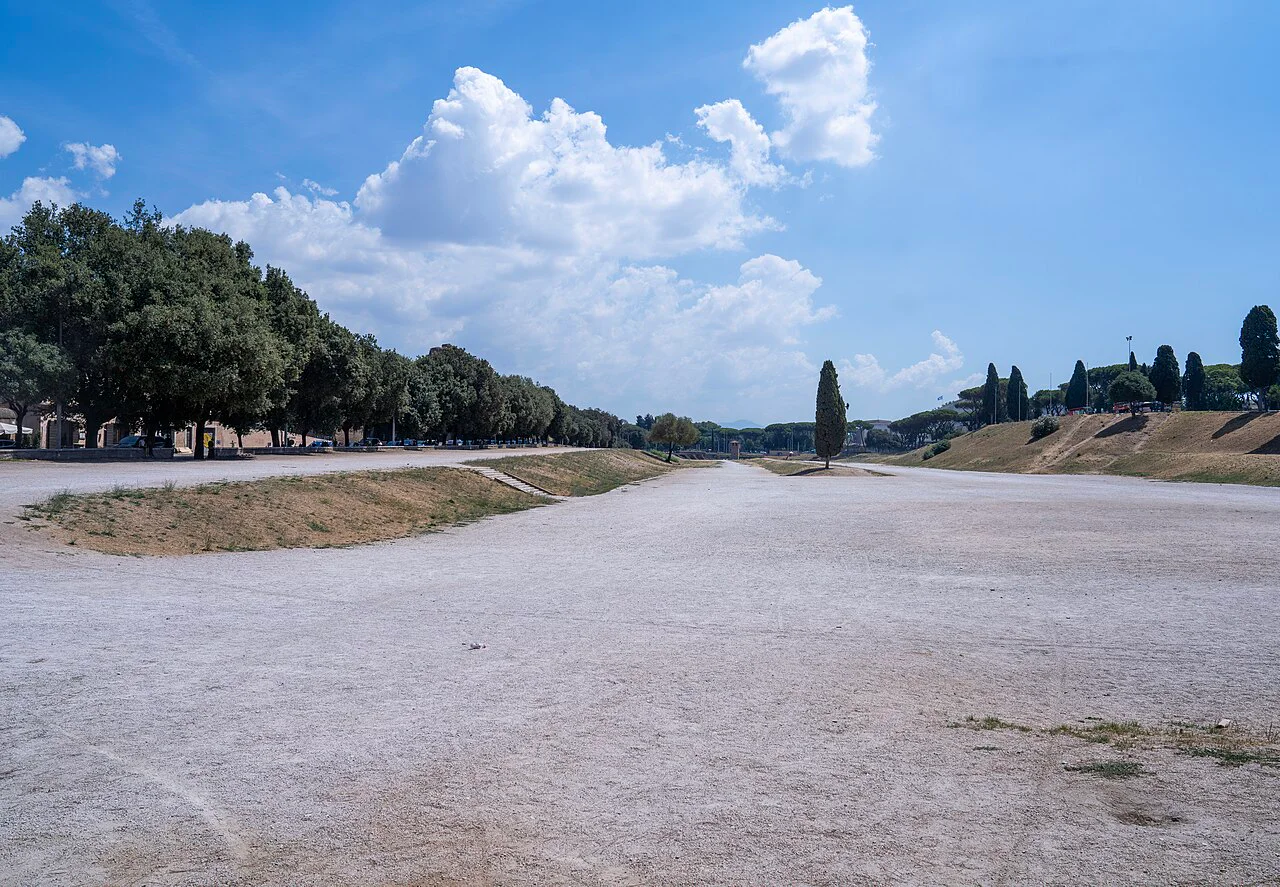
Circo Massimo
Content & sources
Photo: Rione Colonna · CC BY 4.0