Stanza · Audio guide
ColosseumAudio guide
A place to remember. A story to take with you.
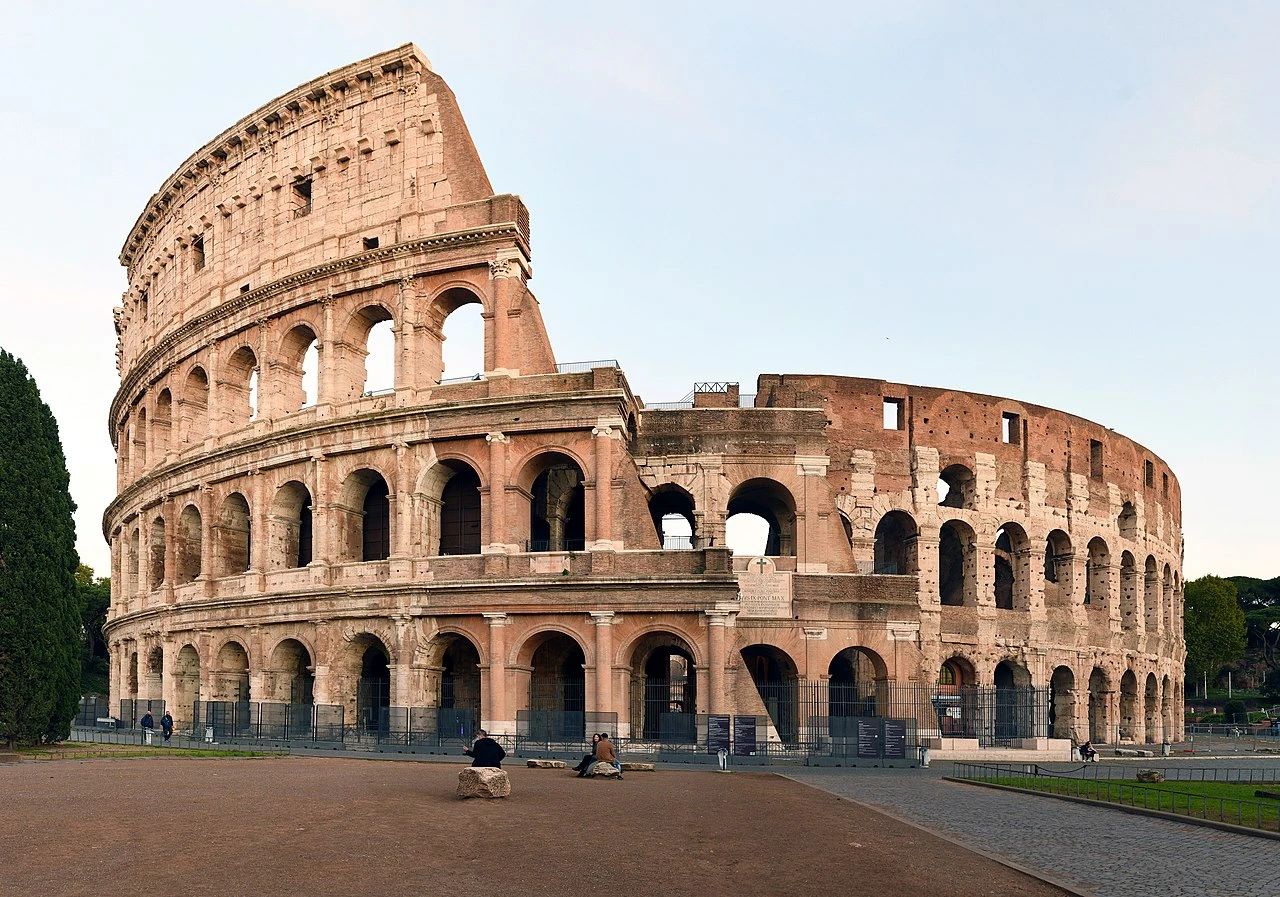
The Colosseum is a colossal ancient Roman amphitheatre located in the heart of Rome, Italy. It is an iconic landmark, known for its historical gladiatorial contests and public spectacles.
Download Stanza, then search for “Colosseum”.
About the tour
One guide. Your kind of visit.
The Colosseum is a colossal ancient Roman amphitheatre located in the heart of Rome, Italy. It is an iconic landmark, known for its historical gladiatorial contests and public spectacles.
Ready when you are.
- 01Get the free Stanza app.
iOS & Android
- 02Find your guide.
“Colosseum”
- 03Download before you go.
Works offline
Audio guide / 29 narrated stops
Inside the guide
Get to know a few of the stories before you go. Open a stop to read more.
01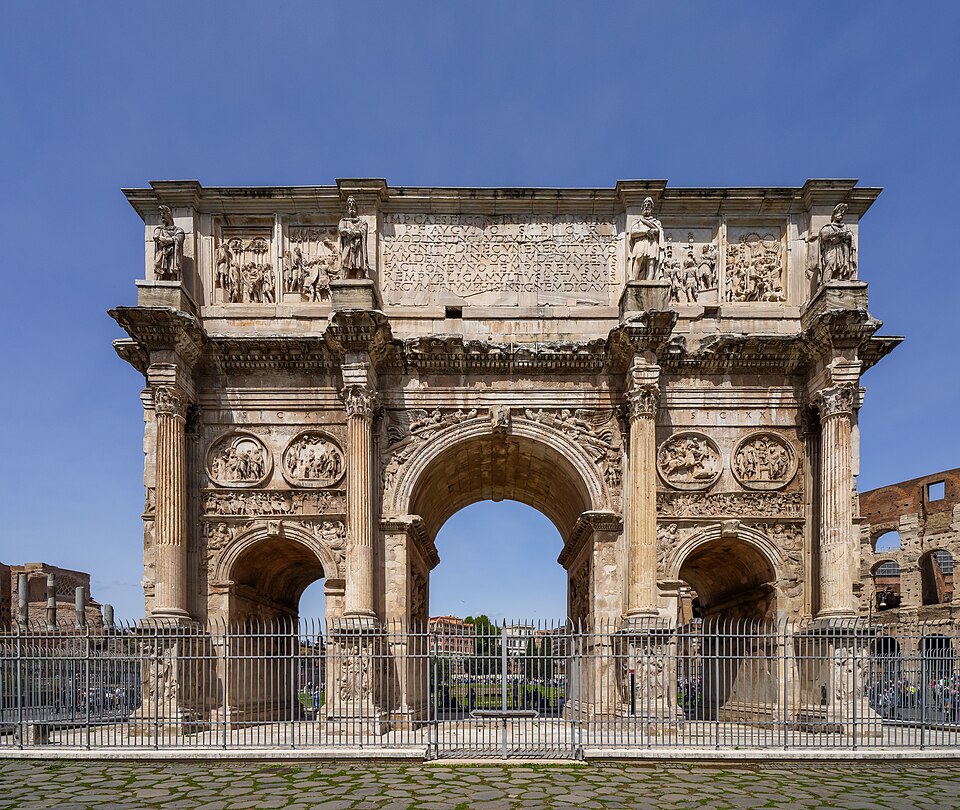 Arrival at the Flavian AmphitheatreThe Arch of Constantine
Welcome to one of the most famous archaeological views in the world. Standing before you is the Arch of Constantine, a massive triumphal structure built in 315 AD. Its presence here is no accident; it was strategically placed to mark the route victorious generals took during their triumphal processions through the city of Rome. As they marched toward the Forum, the sight of this arch, followed immediately by the overwhelming scale of the Colosseum, was designed to leave a lasting impression of Roman power and authority. The arch itself is a masterpiece of imperial propaganda, though it is unusual because it reused many decorative elements from earlier monuments belonging to famous emperors like Trajan and Marcus Aurelius. This architectural 'recycling' was likely meant to associate Constantine with the greatness of the past. As you look at the arch today, notice how its grand scale prepares you for the massive amphitheater just beyond it. The sheer height and breadth of the arch act as a visual prelude, setting the stage for the engineering marvel that served as the heart of Roman entertainment for centuries. This valley was the ultimate stage for the display of victory, and this arch remains the primary gateway into that storied history.
NikonZ7II (Paris Orlando) · CC BY-SA 4.0
02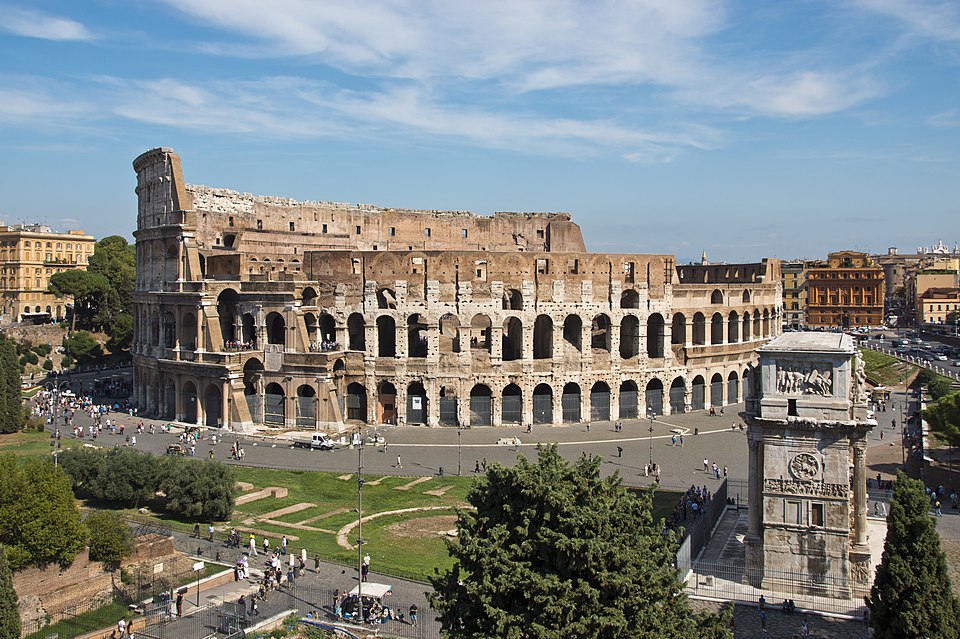 Arrival at the Flavian AmphitheatreThe Flavian Amphitheatre
While almost everyone knows this structure as the Colosseum, its official name in antiquity was the Flavian Amphitheatre. It remains the largest ancient amphitheater ever built, a staggering achievement of engineering that could accommodate tens of thousands of people. Construction began under the Emperor Vespasian between 70 and 72 AD. It was a monumental undertaking that required nearly a decade of constant labor, eventually reaching completion in 80 AD under his son, Titus. The timing of its construction was deeply political. The Flavian dynasty had just come to power following the chaotic and destructive reign of Nero. To win back the favor of the Roman public, the Flavians decided to build a massive public arena on land that Nero had previously confiscated for his own private luxury. This was a clear message: the land was being returned to the people for their own enjoyment and entertainment. The scale of the building reflects the magnitude of that political gesture. At nearly 190 meters long and 155 meters wide, it was more than just a place for games; it was a physical manifestation of a new era of Roman stability and imperial generosity. Even in its ruined state today, the skeleton of the building speaks to the ambition of the architects who envisioned a structure that would outlast the empire itself.
Bert Kaufmann from Roermond, Netherlands · CC BY-SA 2.0
03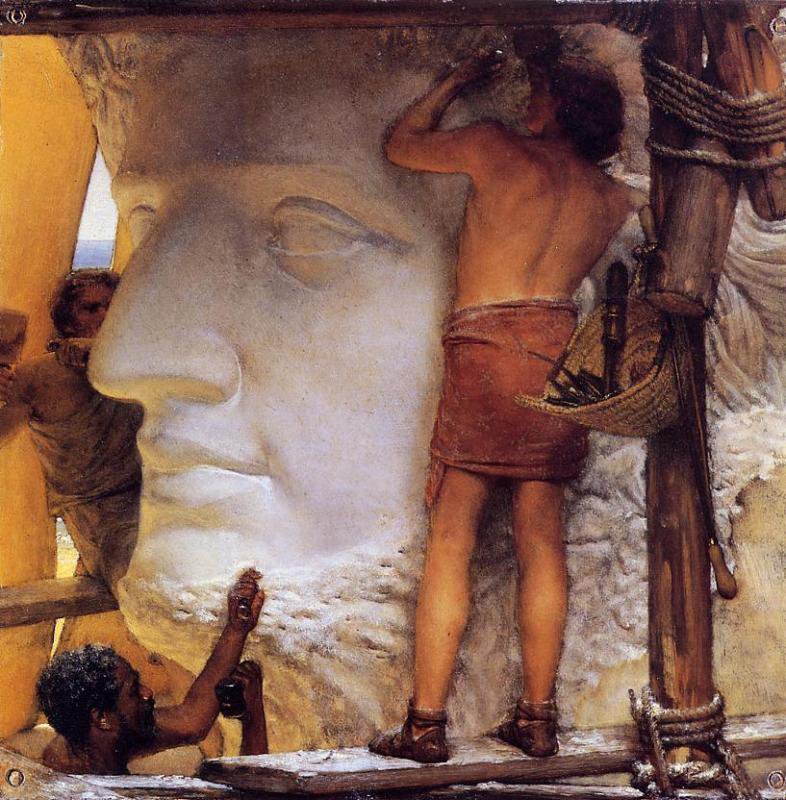 Arrival at the Flavian AmphitheatreThe Colossus of Nero
It is a common misconception that the building's name refers solely to its massive size. In reality, the nickname 'Colosseum' originated from a giant statue that once stood nearby: the Colossus of Nero. This bronze figure was an artistic marvel of the first century, standing approximately 30 meters tall. To give you a sense of its scale, that is roughly the same height as the modern Statue of Liberty from feet to crown. Originally, the statue depicted the Emperor Nero himself and was located in the vestibule of his sprawling private palace. However, after Nero’s death and the subsequent condemnation of his memory, his successors faced a dilemma. Rather than destroying such a massive and expensive work of art, they chose to transform it. The statue's facial features were altered, and a solar crown was added to repurpose the figure as Sol, the Roman sun god. For centuries, this towering sun god dominated the landscape next to the amphitheater. Over time, the locals began to refer to the stadium not by its formal Flavian name, but by its proximity to the Colossus. While the giant statue has long since vanished, likely melted down for its valuable metal during the Middle Ages, its legacy lives on every time someone uses the word 'Colosseum' to describe the ruins before you.
Listen in the appLawrence Alma-Tadema · Public domain
04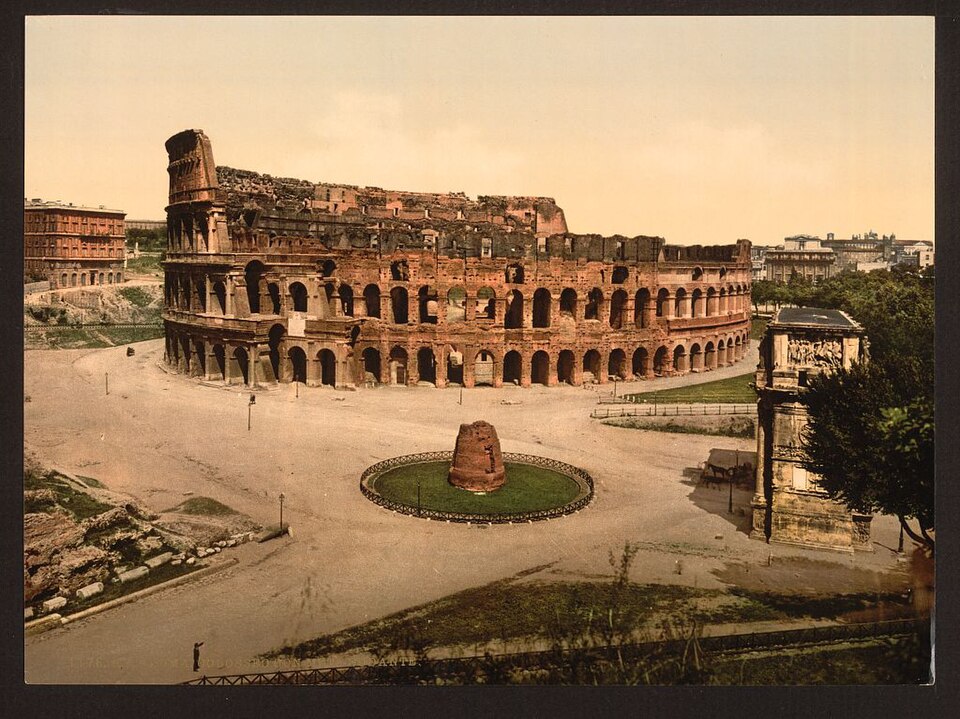 Arrival at the Flavian AmphitheatreThe Ancient Entrance
In this vintage perspective of the valley, we can see how the landscape once looked before modern excavations cleared the area. One of the most important landmarks to notice in the foreground is the conical base of what was once the Meta Sudans. This was a grand, monumental fountain that stood near the Arch of Constantine and the main entrance to the amphitheater. Built in the late first century AD, the fountain was roughly cylindrical with a conical top, from which water would 'sweat' or flow down the sides—hence the name 'Meta Sudans,' or the 'sweating turning post.' Beyond being a decorative feature of the imperial valley, the fountain served a very practical purpose. Tradition holds that gladiators would use the water from the Meta Sudans to wash themselves of blood, sweat, and sand after their brutal combat in the arena. Its location at a major crossroads in the city also made it a vital landmark for the thousands of spectators who flocked to the games. Although only the core of the base remained for many years, as seen in older photographs, the structure was ultimately demolished in the 1930s. Seeing it in this view helps you imagine the valley not as a quiet park, but as a bustling, vibrant urban space filled with the sound of running water and the crowds of ancient Rome.
Listen in the appThe Library of Congress from Washington, DC, United States · No restrictions
05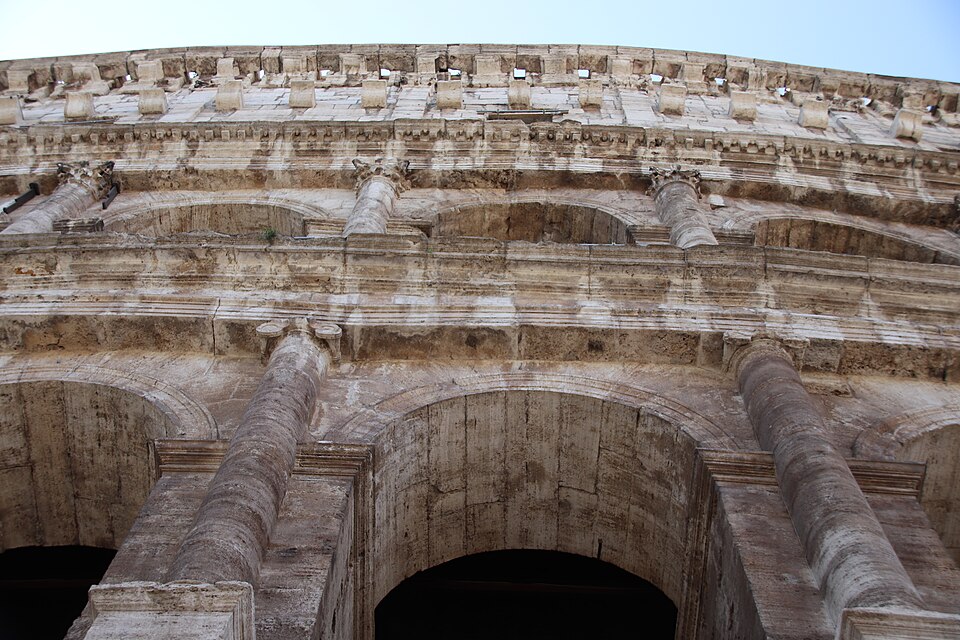 The Exterior Facade and Entrance ArchesThe Classical Orders
As you examine the outer facade of the amphitheater, you are looking at one of the finest examples of Roman architectural harmony. The architects used what are known as 'superposed orders,' where different styles of columns are layered one on top of the other across the building's three main levels. This wasn't just for decoration; it was a way to organize the massive vertical space according to the classical traditions of beauty and balance. On the ground floor, you will see the sturdy and simple Doric columns, which provide a sense of strength and a solid foundation for the structure. Moving your eyes up to the second level, the style shifts to the more elegant Ionic order, recognizable by the scroll-like volutes at the top of each column. Finally, on the third level, the architects used the most ornate style: the Corinthian order, which features intricate carvings of acanthus leaves. This progression from the simplest style at the bottom to the most complex at the top was a standard of high Roman design. It created a visual rhythm that made the enormous building feel more graceful and less overwhelming. Even today, despite the heavy damage the exterior has suffered over the centuries, you can still trace these lines of stone and appreciate the sophisticated aesthetic that defined the pinnacle of Roman construction.
Listen in the appdaryl_mitchell from Saskatoon, Saskatchewan, Canada · CC BY-SA 2.0
06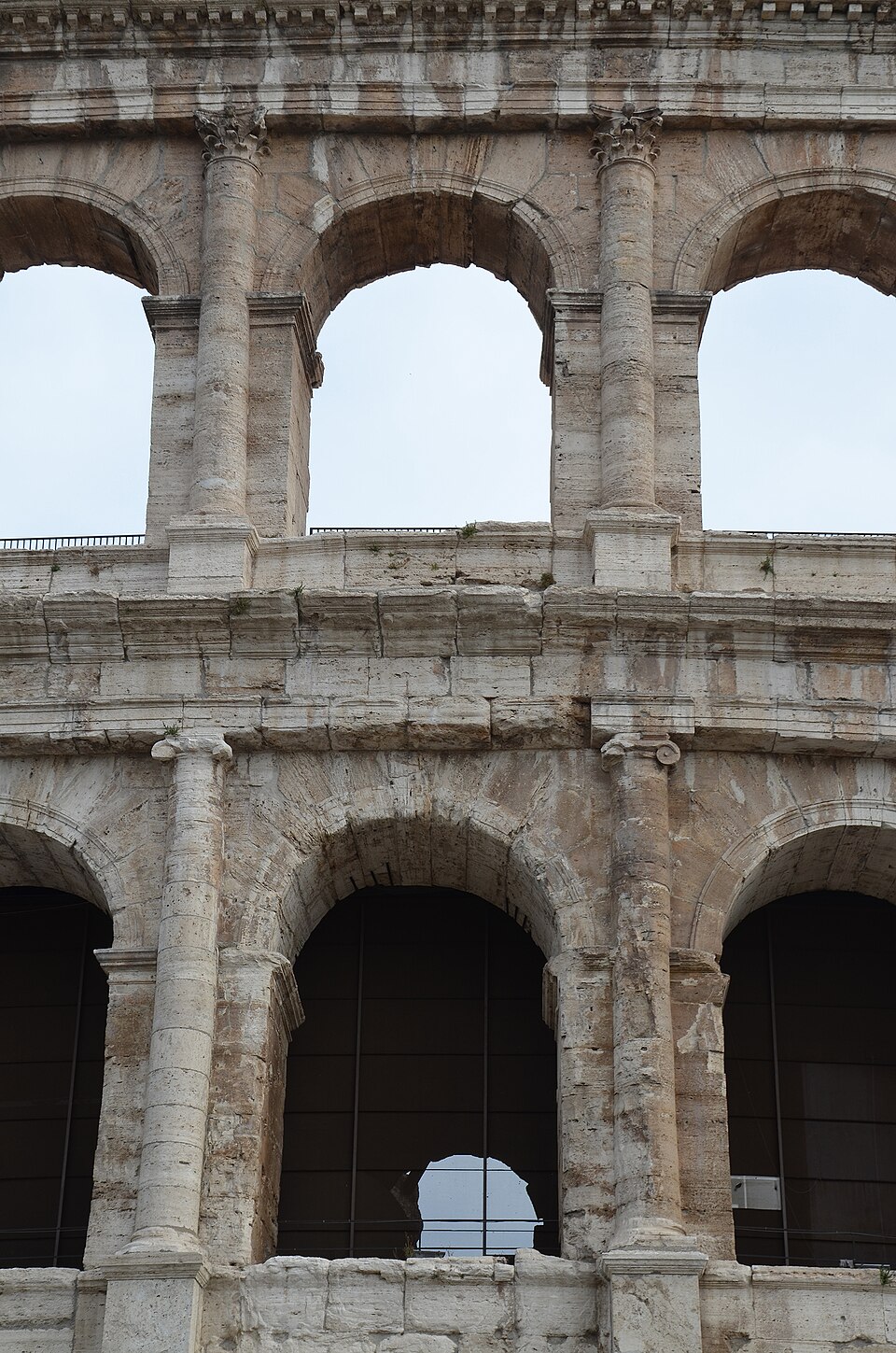 The Exterior Facade and Entrance ArchesTravertine and Iron
The durability of the Colosseum is largely due to the specific materials used in its construction. The outer walls and main piers are built from travertine, a locally sourced limestone that was hauled from quarries about twenty miles away. It is estimated that over 100,000 cubic meters of this stone were used to create the exterior shell. However, the most fascinating part of the engineering is what you cannot see: how these stones are held together. Unlike modern buildings, the massive travertine blocks were not joined with mortar or cement. Instead, the Romans used a system of iron clamps. These clamps were essentially metal staples that were set into grooves between the stones and then secured with molten lead. In total, an estimated 300 tons of iron were used to create what was effectively an internal skeleton for the stone walls. This allowed the building to remain flexible during minor earthquakes while maintaining its structural integrity under the weight of tens of thousands of people. Over the centuries, much of the finer decorative stone was stripped away, but the core travertine remains, showcasing the raw strength of Roman masonry. As you look at the gaps between the blocks today, you are seeing the spots where those vital internal connections were made, hidden away for nearly two thousand years within the heart of the stone.
Listen in the appCarole Raddato from FRANKFURT, Germany · CC BY-SA 2.0
07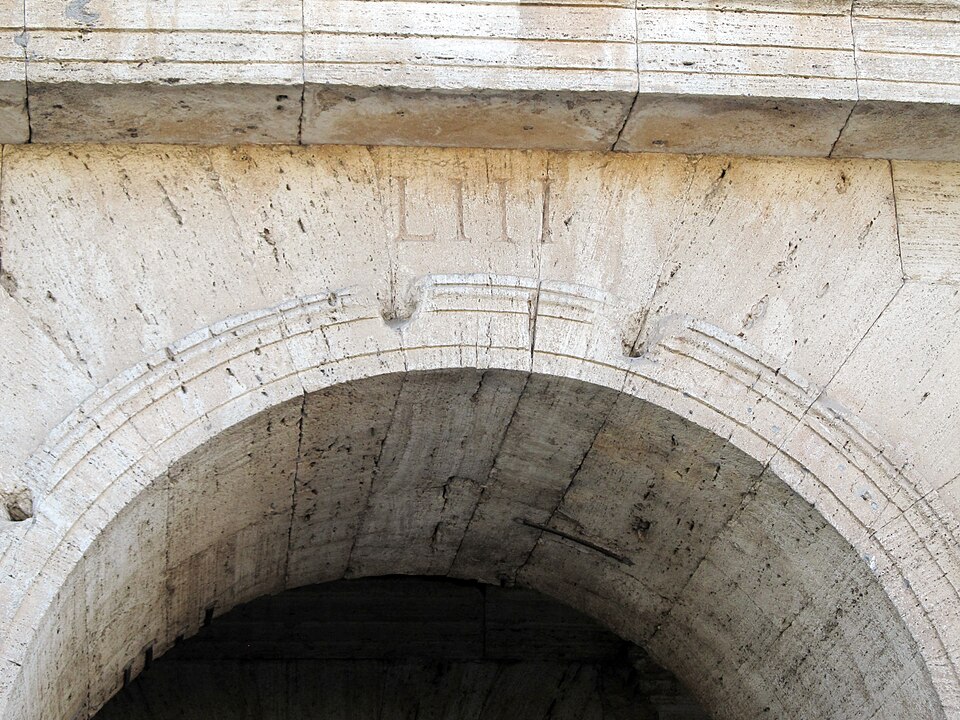 The Exterior Facade and Entrance ArchesThe Roman Ticketing System
Managing a crowd of up to 87,000 people is a challenge even for modern stadiums, but the Romans mastered it nearly two thousand years ago. If you look closely at the arches on the ground floor, you can still see Roman numerals carved into the stone above them. For example, you might find the number LIII, which is the Roman numeral for 53. These numbers were the key to an incredibly efficient entry and exit system. Spectators did not just wander into the building. They held small pottery shards that served as tickets, much like the paper or digital tickets we use today. These shards were inscribed with a specific entrance number, a section, and a row. By matching the number on their ticket to the carved numeral above the arch, spectators could find their assigned entrance immediately. This organized flow prevented bottlenecks and ensured that the entire amphitheater could be filled or evacuated in just a matter of minutes. This level of crowd control was essential for maintaining order in a city as volatile as Rome. It highlights that the Colosseum was not just a marvel of art and combat, but also a masterpiece of functional urban planning. The system was so effective that it remains the basic blueprint for how we design large-scale sports venues to this day.
Listen in the appdaryl_mitchell from Saskatoon, Saskatchewan, Canada · CC BY-SA 2.0
08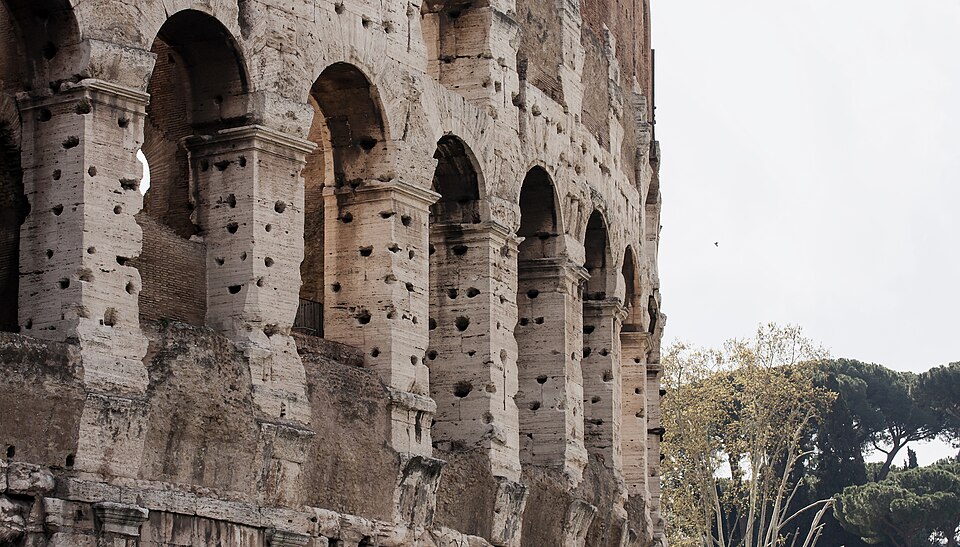 The Exterior Facade and Entrance ArchesThe Scars of Time
One of the first things many visitors notice when looking at the travertine blocks is that they are pockmarked with thousands of small holes. It is a common mistake to assume these are the result of battle, erosion, or even target practice from later wars. In reality, these holes are the physical scars of the building’s survival through the Middle Ages. As the Roman Empire faded and the city’s economy changed, the Colosseum was no longer used for games. The massive structure became a valuable source of raw materials for local residents. While many stones were taken to build new palaces and churches, the holes specifically mark where medieval locals pried out the iron clamps that held the travertine blocks together. Metal was an incredibly precious resource during that time, and the 300 tons of iron embedded in the Colosseum’s walls represented a literal goldmine of material. People would chip away at the edges of the stones to reach the iron staples, which they would then melt down to forge tools, weapons, and architectural hardware for their own homes. While this scavenging significantly weakened some parts of the structure, it provides a fascinating record of the building’s afterlife. Each hole is a reminder of a time when the Colosseum was viewed not as a protected monument, but as a practical quarry that helped sustain the city of Rome through its darker centuries.
Listen in the appThis image was produced by me, David Castor (user:dcastor). The pictures I submit to the Wikipedia Project are released to the public domain. This gives you the right to use them in any way you like, without any kind of notification. This said, I would still appreciate to be mentioned as the originator whenever you think it complies well with your use of the picture. A message to me about how it has been used would also be welcome. You are obviously not required to respond to these wishes of mine, just in a friendly manner encouraged to. (All my photos are placed in Category:Images by David Castor or a subcategory thereof.) · CC0
09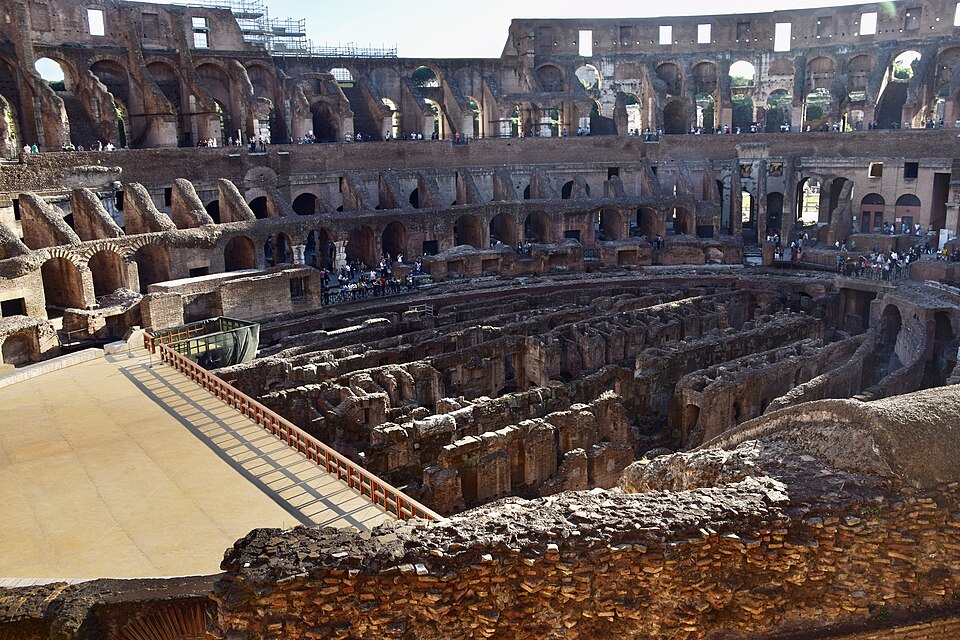 The Arena Floor: The Heart of SpectacleThe Inner Spectacle
Stepping inside the amphitheater offers a completely different perspective than the exterior view. From here, you can appreciate the sheer verticality of the design. The current height of the surviving walls is about 48 meters, although in antiquity, when the top-most level was fully intact, it reached approximately 52 meters. This soaring height was necessary to accommodate the complex tiered seating system that mirrored Roman social life. When you look around today, you are seeing the internal skeleton of the building. In its prime, these rough brick and stone surfaces would have been covered in gleaming white marble, and the corridors would have been decorated with frescoes and statues. The contrast between the surviving outer shell and the ruined interior ruins is striking. You can see the remains of the vaulted passageways and the steep inclines where rows of seats once stood. The internal structure was a complex network of corridors and stairs, designed to move thousands of people quickly while keeping different social classes separated. While the marble is gone—stolen over centuries to decorate the palaces of Renaissance popes and nobles—the remaining structure still conveys the immense volume of space the Romans managed to enclose. It is a place of shadows and light, where the ghosts of ancient spectators seem to linger in the vast, open bowl of the arena.
Listen in the appAnk Kumar · CC BY-SA 4.0
10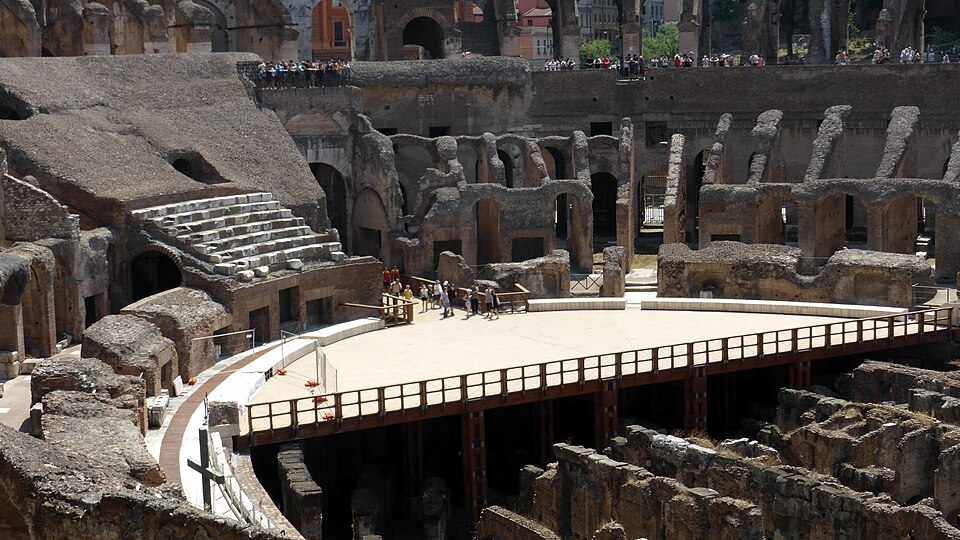 The Arena Floor: The Heart of SpectacleThe Arena Floor
The word 'arena' actually comes from the Latin word 'harena,' which means sand. In ancient times, what you see now as an exposed maze of walls was covered by a massive wooden floor. This floor was then layered with a thick coating of sand, which served a very specific and gruesome purpose. During the games, the sand was essential for soaking up the blood of the animals and gladiators who fought and died here, preventing the floor from becoming dangerously slippery for the combatants. The games were a spectacle of unprecedented scale. To celebrate the opening of the Colosseum in 80 AD, the Emperor Titus held an inaugural festival that lasted for one hundred consecutive days. Historical accounts claim that thousands of wild animals and hundreds of gladiators were killed during this single celebration. The sand would be raked and replaced between bouts to keep the 'stage' ready for the next event. Standing here, it is powerful to imagine that wooden platform stretching across the space, hiding the dark tunnels below. It was on that surface that the most famous fighters of the ancient world sought glory, and where the exotic wildlife of three continents met its end. The 'harena' was the focal point of the entire Roman world, a place where life and death were turned into public entertainment for the masses.
Listen in the appSean MacEntee from Monaghan, Ireland · CC BY 2.0
Colosseum
Frequently asked questions
How much does the guide cost?
Free app download. Listed guide price: $2.99. Guide price shown in the app. Audio guide only. Venue admission is separate.
Can I listen without internet?
Yes. Download the guide’s audio, images, and maps in the app before your visit. Your downloaded content is then available offline.
Can I listen in my language?
Stanza supports 15 languages. Check the app for the languages available for this guide.
Do I need to follow a schedule?
No. This is a self-guided experience. Choose your stops, pause whenever you like, and return to a story at your own pace.
At your own pace
Explore Colosseum.
Download Stanza, then search for “Colosseum”.
Free app download · Guide price shown in the app
Keep exploring
Nearby audio guides
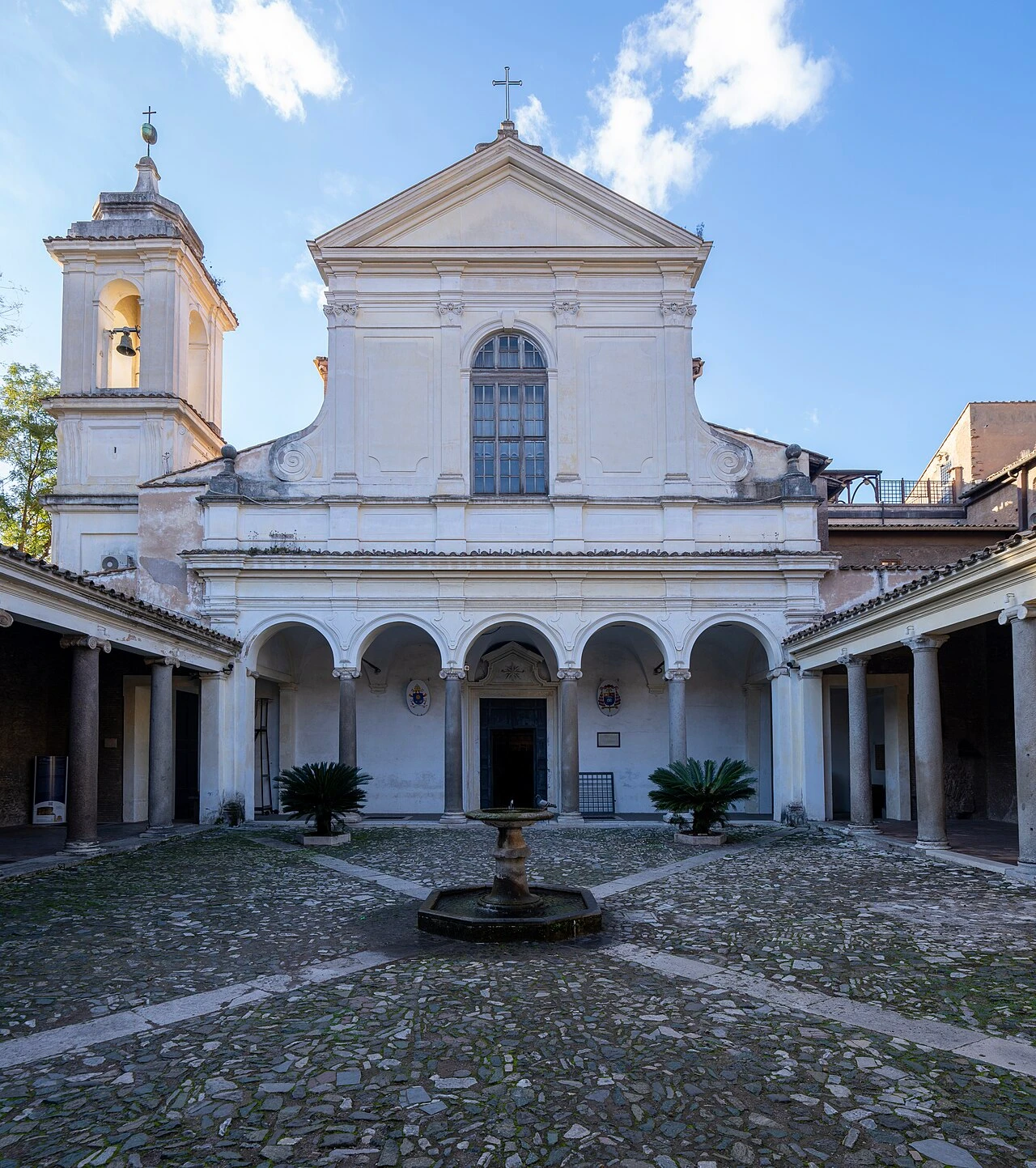
Rome
Basilica of San Clemente
Content & sources
Photo: Labicanense · CC BY-SA 4.0
Rome
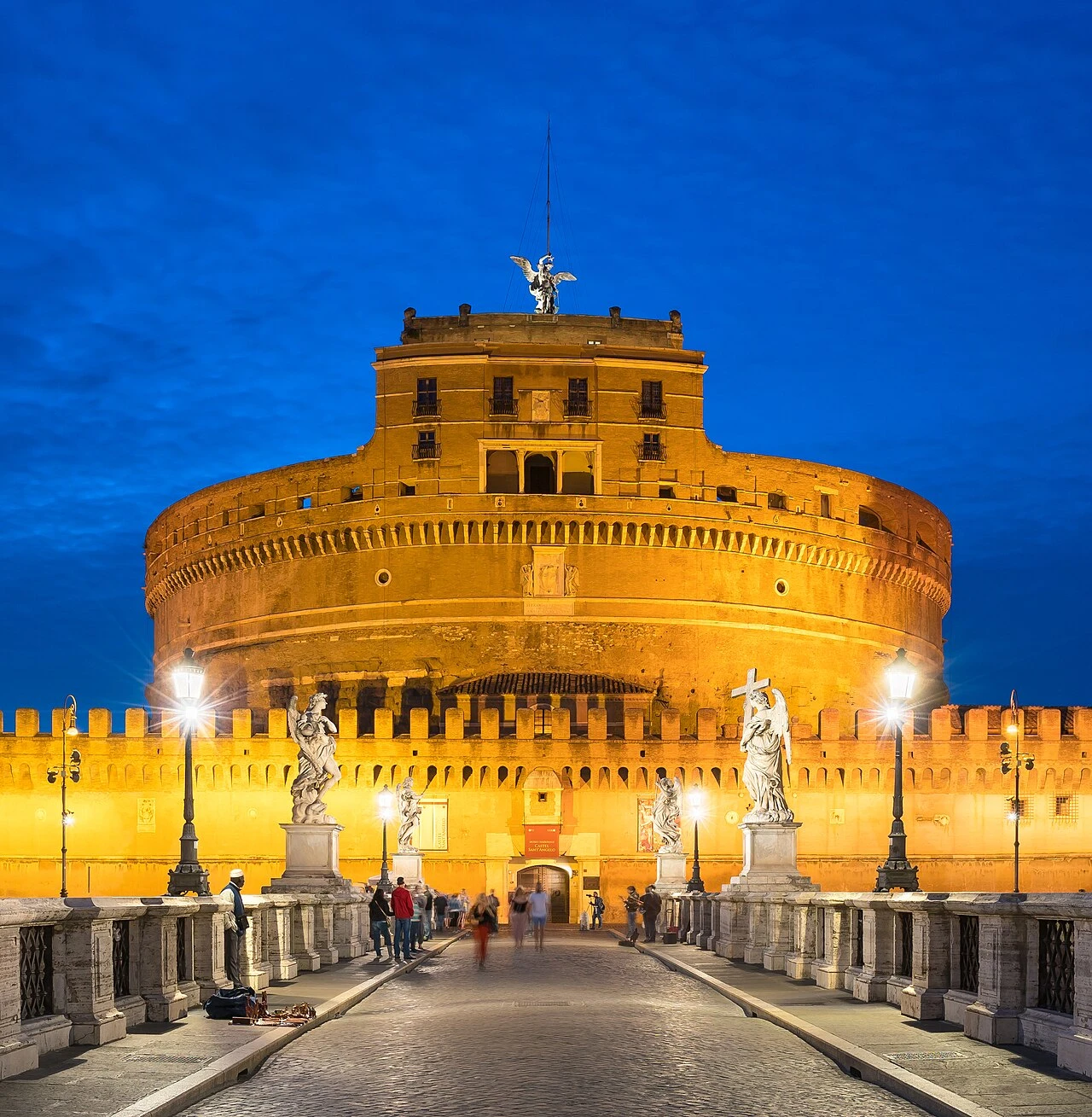
Castel Sant'Angelo
Content & sources
Thomas Wolf, www.foto-tw.de · CC BY-SA 3.0 de
Rome
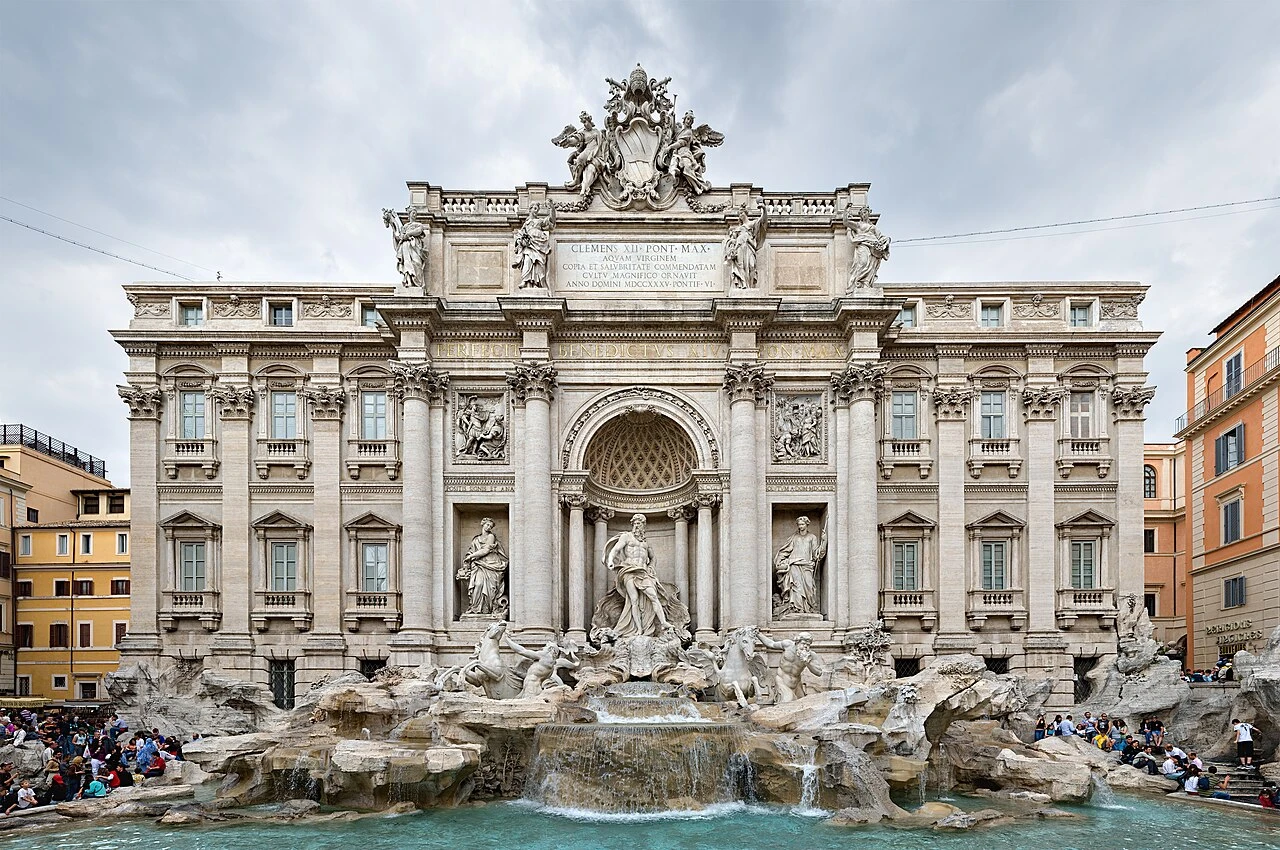
Trevi Fountain
Content & sources
Photo: Diliff · CC BY 3.0
Rome