Stanza · Audio guide
Basilica di San Pietro in Vincoli Audio Guide
A place to remember. A story to take with you.
San Pietro in Vincoli is a Roman Catholic titular church and minor basilica in Rome, Italy. The name of the church alludes to the Biblical story of the Liberation of Peter.
Download Stanza, then search for “Basilica di San Pietro in Vincoli”.
About the tour
One guide. Your kind of visit.
San Pietro in Vincoli is a Roman Catholic titular church and minor basilica in Rome, Italy. The name of the church alludes to the Biblical story of the Liberation of Peter.
Ready when you are.
- 01Get the free Stanza app.
iOS & Android
- 02Find your guide.
“Basilica di San Pietro in Vincoli”
- 03Download before you go.
Works offline
Audio guide / 9 narrated stops
Inside the guide
Get to know a few of the stories before you go. Open a stop to read more.
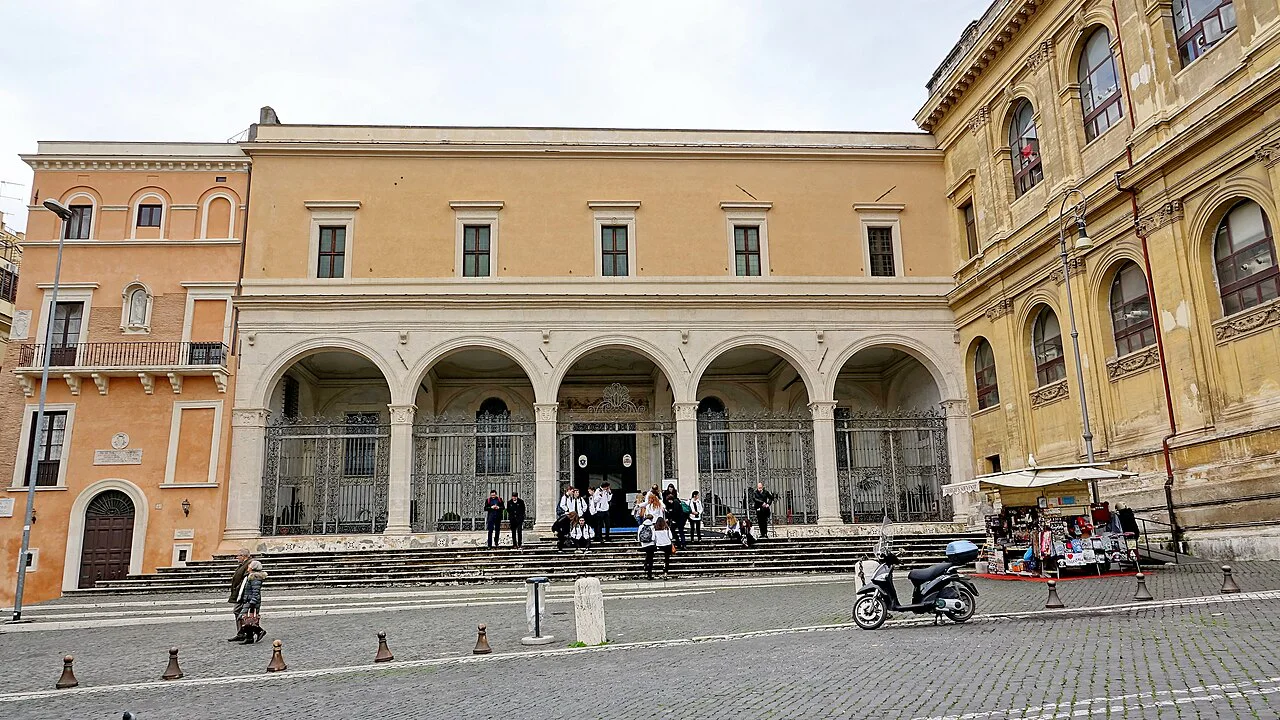
01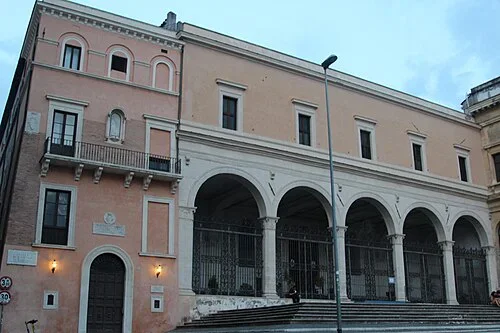 Front Portico Entrance
The Facade and Fifth-Century Origins
Welcome to San Pietro in Vincoli, the church of Saint Peter in Chains, on Rome's Oppian Hill, a short climb from the Colosseum. The name points to what lies at its heart: the iron chains that bound Saint Peter when he was imprisoned in Jerusalem. Around 438 the Empress Aelia Eudocia made a pilgrimage to the Holy Land. The bishop of Jerusalem gave her the chain as a gift, and she sent it on to her daughter in Rome, the Empress Eudoxia. Eudoxia presented the chains to Pope Leo the First, and a basilica rose to honour them, consecrated in 439. Much of what stands today is later. From 1471 the cardinal of this title, Giuliano Della Rovere, rebuilt the church on a grand scale, and in 1503 he became Pope Julius the Second. The portico with its five arches was added in 1475 and is attributed to Baccio Pontelli. Six octagonal columns carry those arches, closed by a bronze gate, with the coat of arms of Julius the Second on the capitals.
Photo: Fallaner · CC BY-SA 4.0
02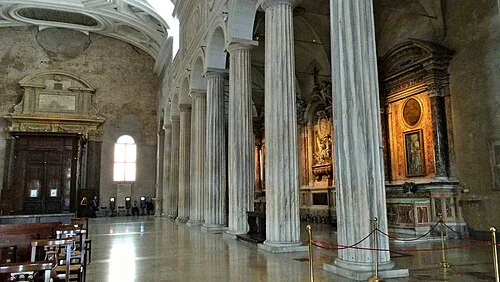 Central Nave and the Ancient Colonnade
The Ancient Columns of the Nave
Twenty columns divide the nave from the aisles, and every one of them is older than the church they support. They are Doric columns of Hymettian marble, a stone quarried near Athens; Roman columns of this kind, it seems, never existed, so these almost certainly came from Greece as spoils. Most likely they were carried off from the nearby Portico of Livia, an ancient Roman monument that has since vanished. The bases are fifth-century work, remade when the Christian basilica was first raised here. That early church still shows in the plan: a nave and two aisles, and three apses. Today the basilica is about seventy metres long and forty wide. Architects call this reuse of old stone spolia, the spoils, and here the spoils of empire frame the story of an apostle.
Photo: Luciano Tronati · CC BY-SA 4.0
03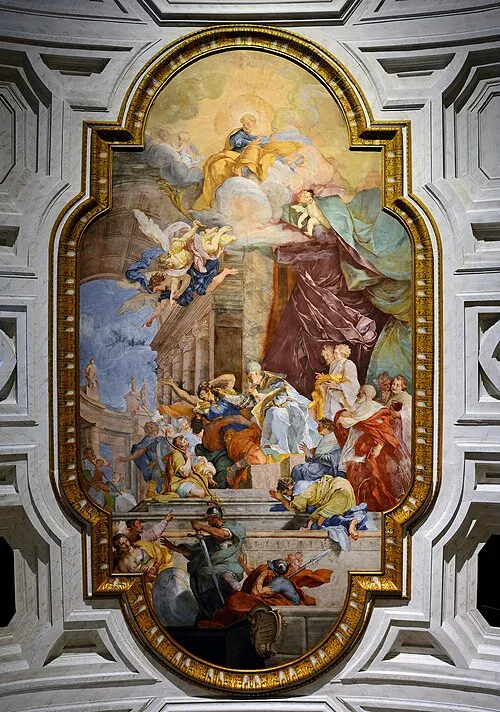 Central Nave and the Ancient Colonnade
The Ceiling Fresco: The Miracle of the Chains
High above the nave, at the centre of the coffered ceiling, hangs the miracle that made these chains famous. Giovanni Battista Parodi painted it in 1706, on the lowered vault built by the architect Francesco Fontana. The scene shows Pope Alexander touching Saint Balbina with the chain that had once bound Saint Peter, and curing the goiter on her neck. The tale is legend rather than history, but it tells how deeply people believed in the chain's power to heal. Look for one more relic of that faith at the base of the vault: the old central tie beam of the roof, split in two, left from the restoration of 1465 paid for by Cardinal Cusano. His name is carved there, and the date in Roman numerals.
Listen in the appPhoto: Livioandronico2013 · CC BY-SA 4.0
04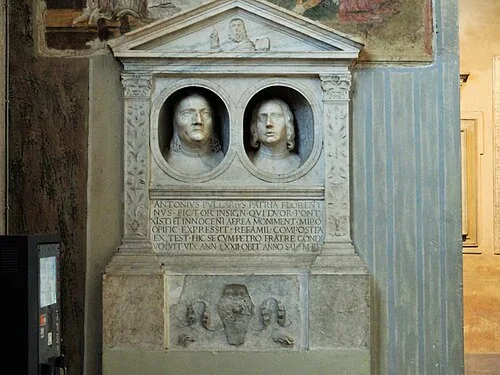 Tomb of the Pollaiolo Brothers
The Tomb of the Pollaiolo Brothers
Just inside the entrance, on the first pier to the left, two marble faces look down from a wall tomb. They are Antonio and Piero del Pollaiolo, Florentine painters, Antonio on the left and Piero on the right, beneath a figure of Christ blessing. The portraits were carved by Luigi Capponi between 1498 and 1510. Antonio was more than a painter: he was the sculptor who added the figures of Romulus and Remus to the Capitoline Wolf on the Capitol. Above the monument, partly hidden by it, runs a fresco of Pope Sixtus the Fourth's procession giving thanks for the end of the plague of 1476, attributed to Antoniazzo Romano. Two celebrated Florentine brothers, buried side by side far from home.
Listen in the appPhoto: Luciano Tronati · CC BY-SA 4.0
05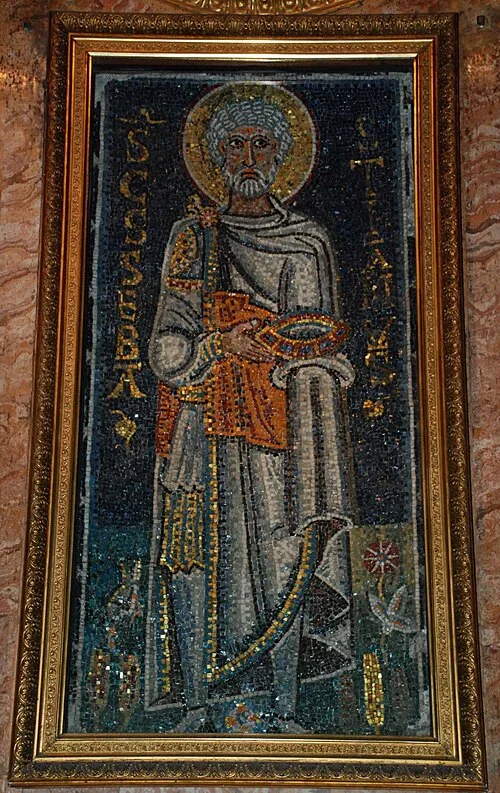 Left Aisle and the Byzantine Sebastian Mosaic
The Byzantine Mosaic of Saint Sebastian
At the third altar of the left aisle sits one of the rarest images of Saint Sebastian anywhere. This seventh-century mosaic shows him as an old man with a grey beard, dressed as a Roman tribune in Byzantine court style, and it is almost the only such depiction of the saint. It was made as a vow against the plague that struck Rome from June to September of the year 680. In that same outbreak, Sebastian's relics were carried to Pavia in northern Italy, where people believed he had been born in Lombardy. An altar was built for them in that city's own church of the same name, and the two altars bound Pavia and Rome together in a shared cult. For centuries the mosaic stood against the entrance wall; in 1683 it was moved to this altar. Above the icon sits an ancient painting of the Madonna and Child.
Listen in the appPhoto: Camelia.boban · CC BY-SA 3.0
06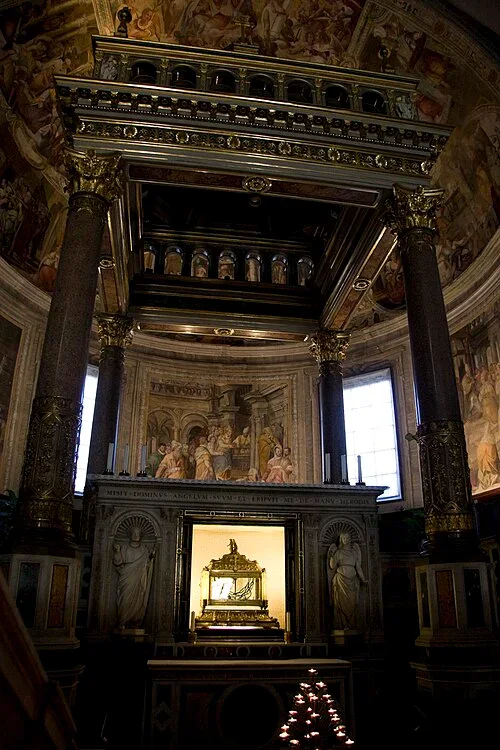 High Altar and Crypt of the Chains
The High Altar and the Chains of Saint Peter
The reason for this whole church rests under the high altar, where a reliquary glows in the dim apse, holding the iron chain itself. The story attached to it is the strangest in the basilica. Besides the chain from Jerusalem, there was a second chain, from Peter's final imprisonment in Rome's Mamertine Prison. The story goes that Pope Leo the First laid the two side by side, and they miraculously fused into one, impossible to tell apart. That is legend rather than record, but it is the legend that gave the church its name, Saint Peter ad Vincula, in chains. From here the dedication spread across the world, and many churches around the world took the same suffix in the relic's honour. One piece travelled further than most: since 1894, a link of the chain has been kept in a church in Rutland, Vermont.
Listen in the appMaros M r a z (Maros) · CC BY 2.5
07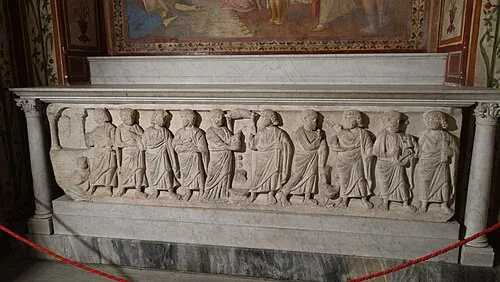 High Altar and Crypt of the Chains
The Crypt and the Maccabean Sarcophagus
Beneath the central altar lies a small crypt which tradition holds was Saint Peter's first prison in Rome, before he was moved to the Mamertine. Inside stands a marble sarcophagus of the Seven Maccabean brothers, Jewish martyrs of the second century before Christ, honoured by Christians as well. It was probably brought from Antioch to Rome by Pope Pelagius the Second. Work on the presbytery in 1876 brought it to light again, divided into seven compartments holding human remains, with seals that, it was said, guaranteed what lay inside. The carved front shows five scenes: the raising of Lazarus, the multiplication of the loaves and fishes, the Samaritan woman, Jesus foretelling Peter's denial, and the giving of the law. Above it, a fresco by Silverio Capparoni shows the brothers' martyrdom, their mother pleading for the life of the last son. The Maccabees are remembered each year on 1 August, the same day the church keeps for the miracle of the fused chains.
Listen in the appPhoto: Luciano Tronati · CC BY-SA 4.0
08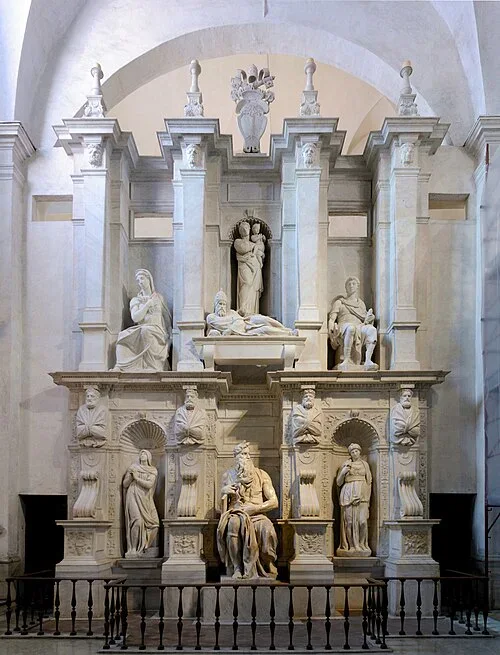 Right Transept and the Tomb of Pope Julius II
The Tomb of Pope Julius II
In the right transept stands the monument that shadowed Michelangelo for four decades of his life. Pope Julius the Second, this church's own cardinal before he wore the tiara, commissioned it from him in 1505. The first design called for a colossal free-standing monument with more than forty statues, a whole funerary chamber for the pope, so vast that the basilica itself was to be enlarged to contain it. Work stopped and restarted again and again, and the plan was reworked six times. It was finally completed in 1545, thirty-two years after Julius's death, as this reduced wall monument of seven statues. And it stands here, in the Della Rovere family church, rather than in Saint Peter's in the Vatican, where the pope had meant to lie.
Listen in the appPhoto: Alvesgaspar · CC BY-SA 4.0
09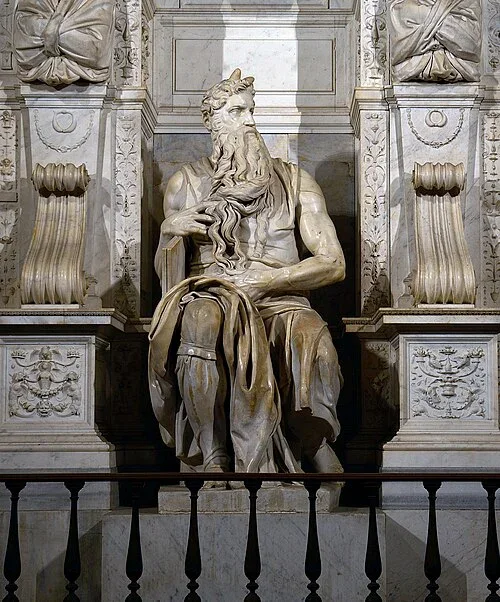 Right Transept and the Tomb of Pope Julius II
Michelangelo's Moses
At the centre of the monument sits Moses, completed in 1515 and considered one of the great works of Renaissance sculpture. He measures two metres and thirty-five centimetres, carved from Carrara marble, and his most famous feature is on his head: two horns. The Hebrew words for beams of light and for horns are near twins, and Michelangelo, it seems, read the one as the other. Horned Moses was common in early sacred art, and for a sculptor horns are far easier to carve than rays of light. Twenty-five years after finishing the statue, Michelangelo reworked the pose, lowering the seat and turning the beard to the right; the story goes that he wanted Moses to turn his gaze away from Peter's chains. A fifth-century relic church, a pope's ambition cut down to size, and a masterpiece of the Renaissance, all gathered under one roof.
Listen in the appPhoto: Livioandronico2013 · CC BY-SA 4.0
Basilica di San Pietro in Vincoli
Frequently asked questions
How much does the guide cost?
Free app download. Listed guide price: $0.99. Guide price shown in the app. Audio guide only. Venue admission is separate.
Can I listen without internet?
Yes. Download the guide’s audio, images, and maps in the app before your visit. Your downloaded content is then available offline.
Can I listen in my language?
This audio guide is available in 15 languages, including English.
Do I need to follow a schedule?
No. This is a self-guided experience. Choose your stops, pause whenever you like, and return to a story at your own pace.
At your own pace
Explore Basilica di San Pietro in Vincoli.
Download Stanza, then search for “Basilica di San Pietro in Vincoli”.
Free app download · Guide price shown in the app
Keep exploring
Nearby audio guides
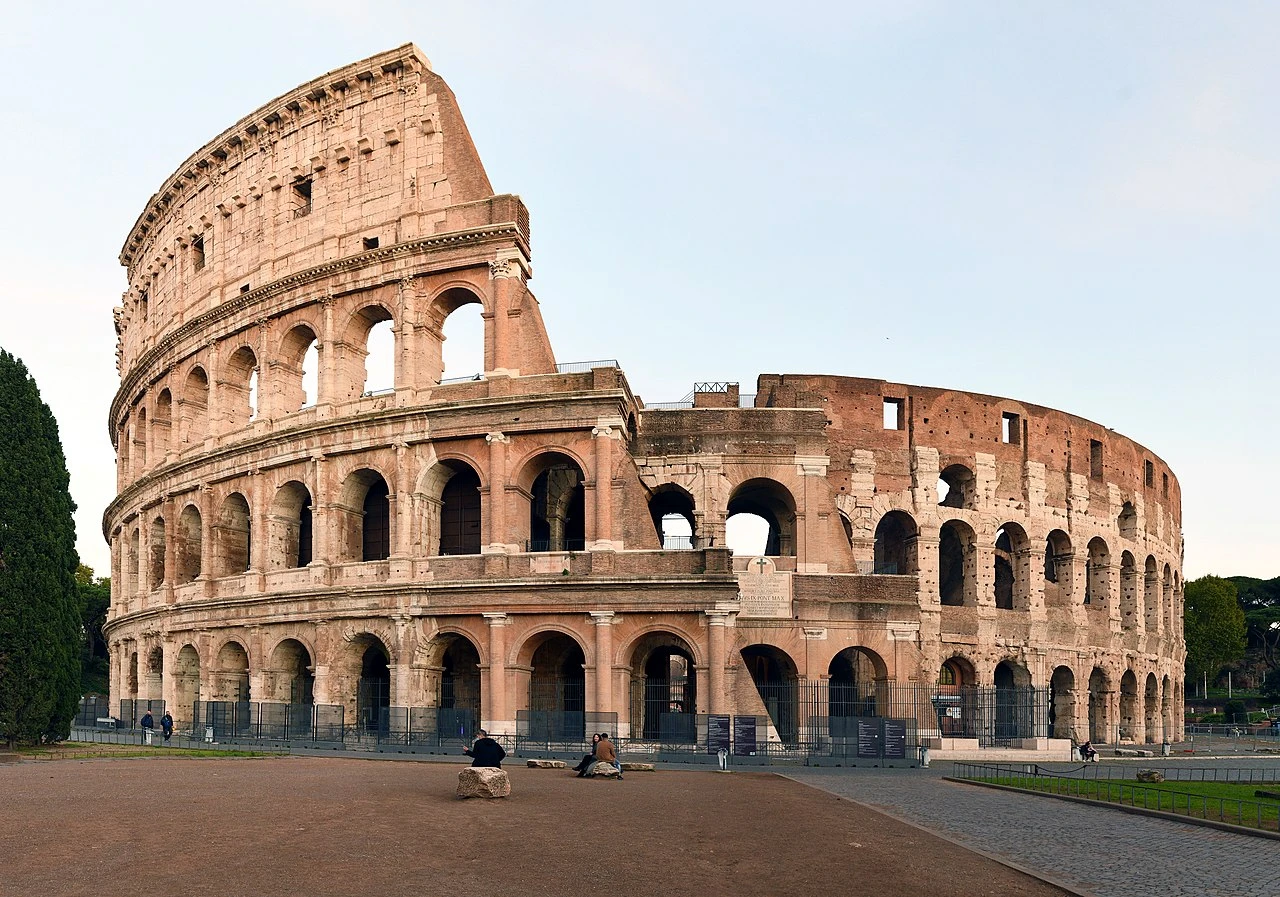
Rome · 1 km
Colosseum
Content & sources
Photo: FeaturedPics · CC BY-SA 4.0
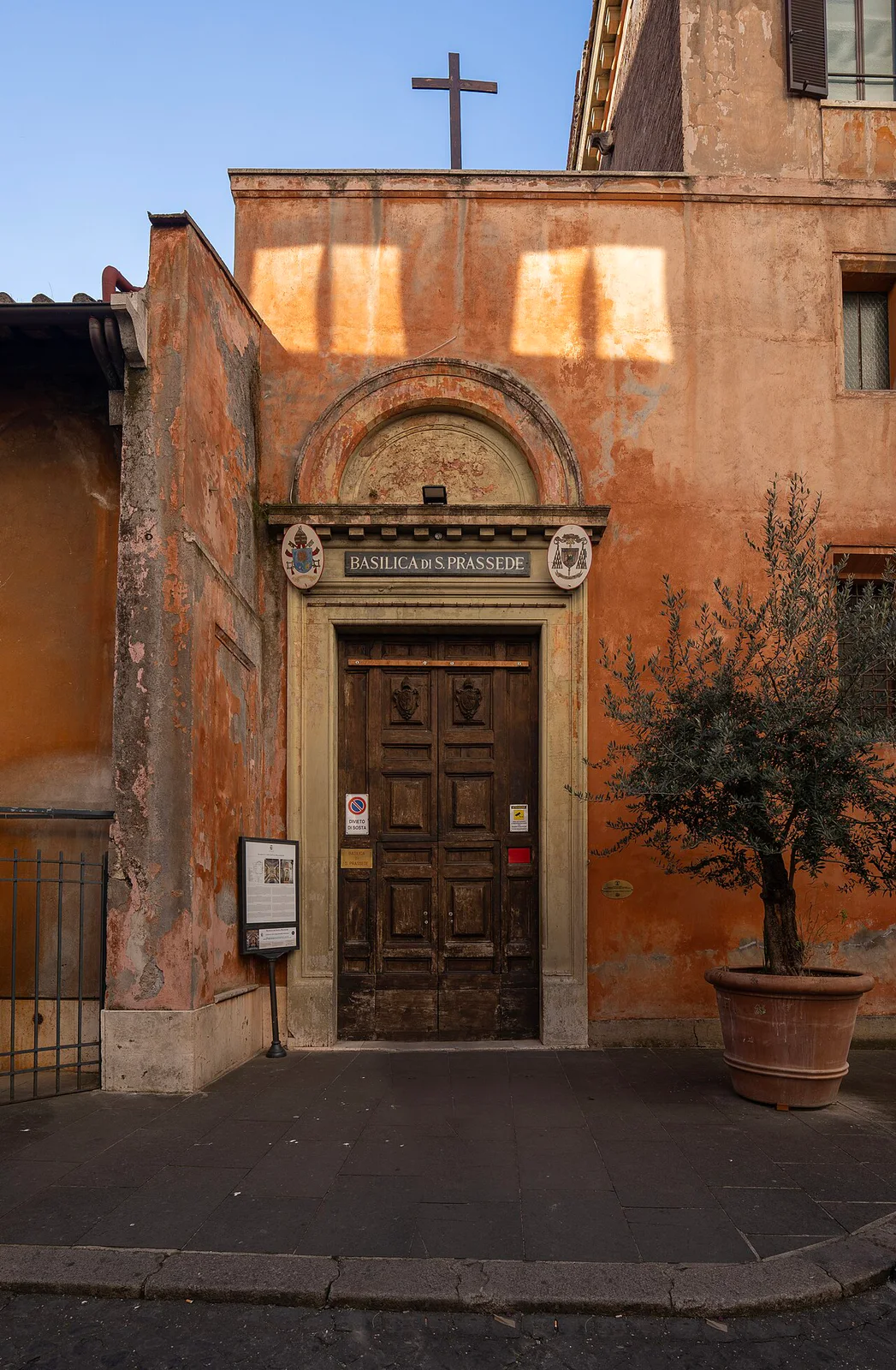
Rome · 1 km
Basilica di Santa Prassede
Content & sources
Photo: Rione I Monti · CC BY 4.0
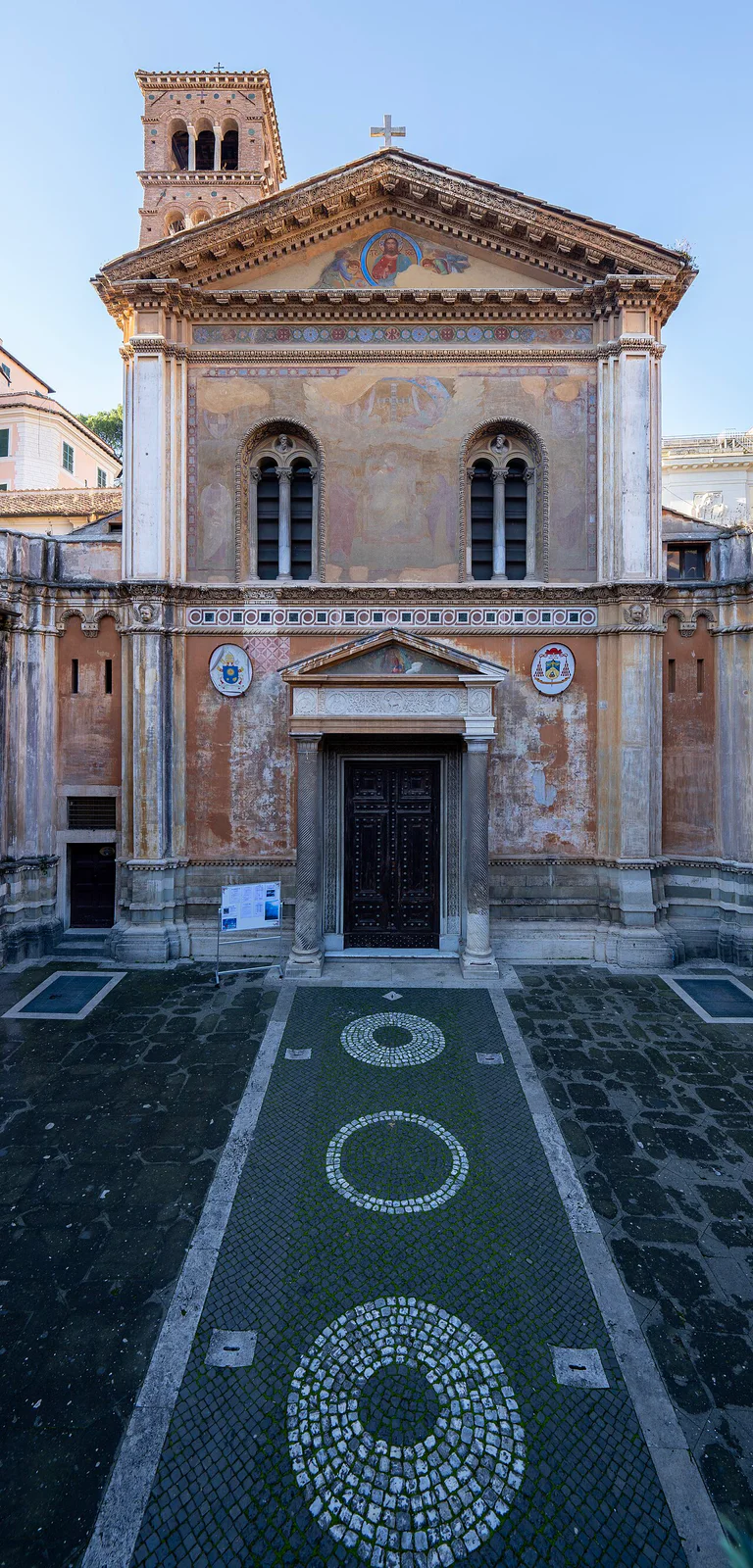
Rome · 1 km
Basilica di Santa Pudenziana
Content & sources
Photo: Rione I Monti · CC BY 4.0
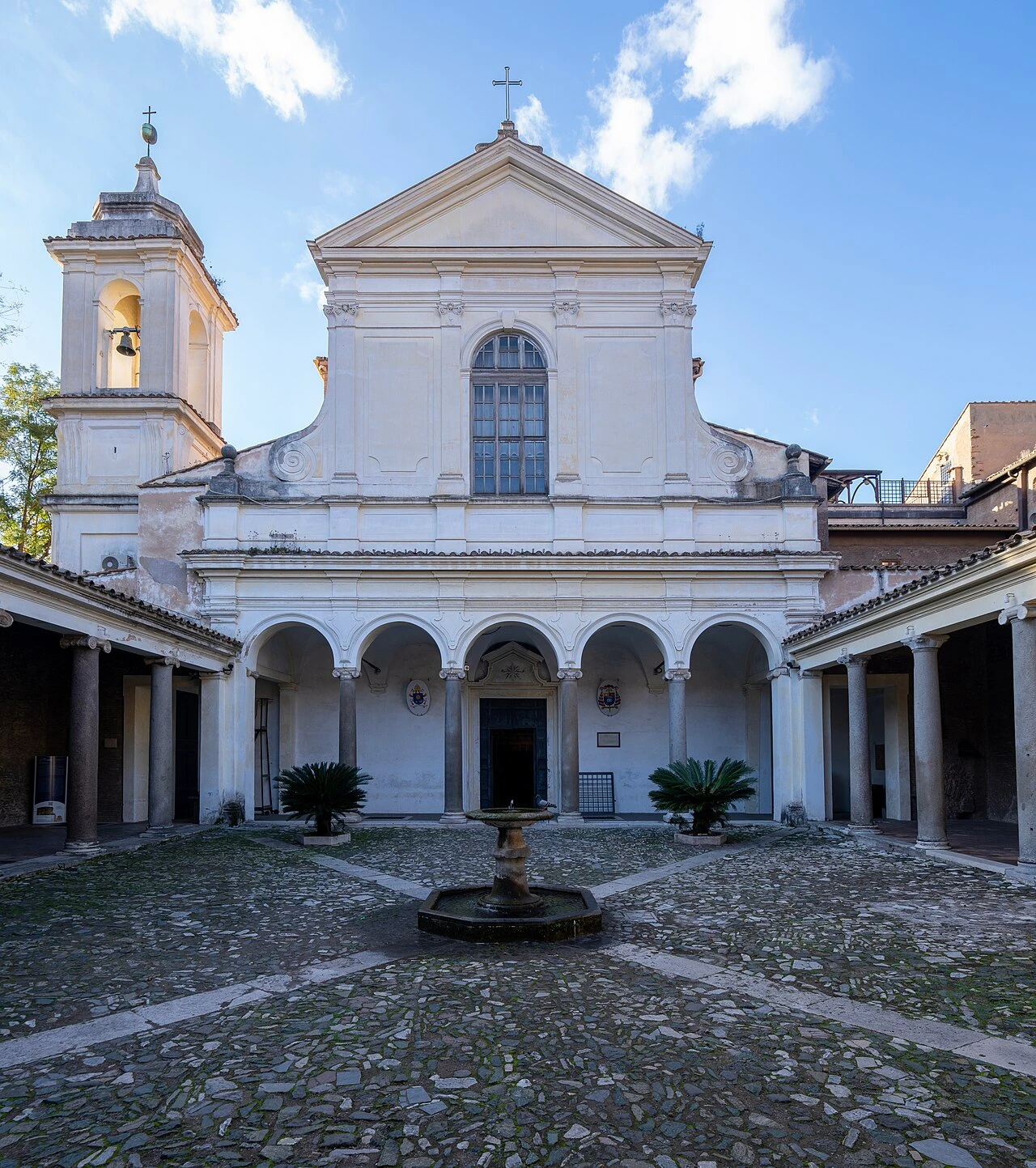
Rome · 1 km
Basilica of San Clemente
Content & sources
Photo: Labicanense · CC BY-SA 4.0