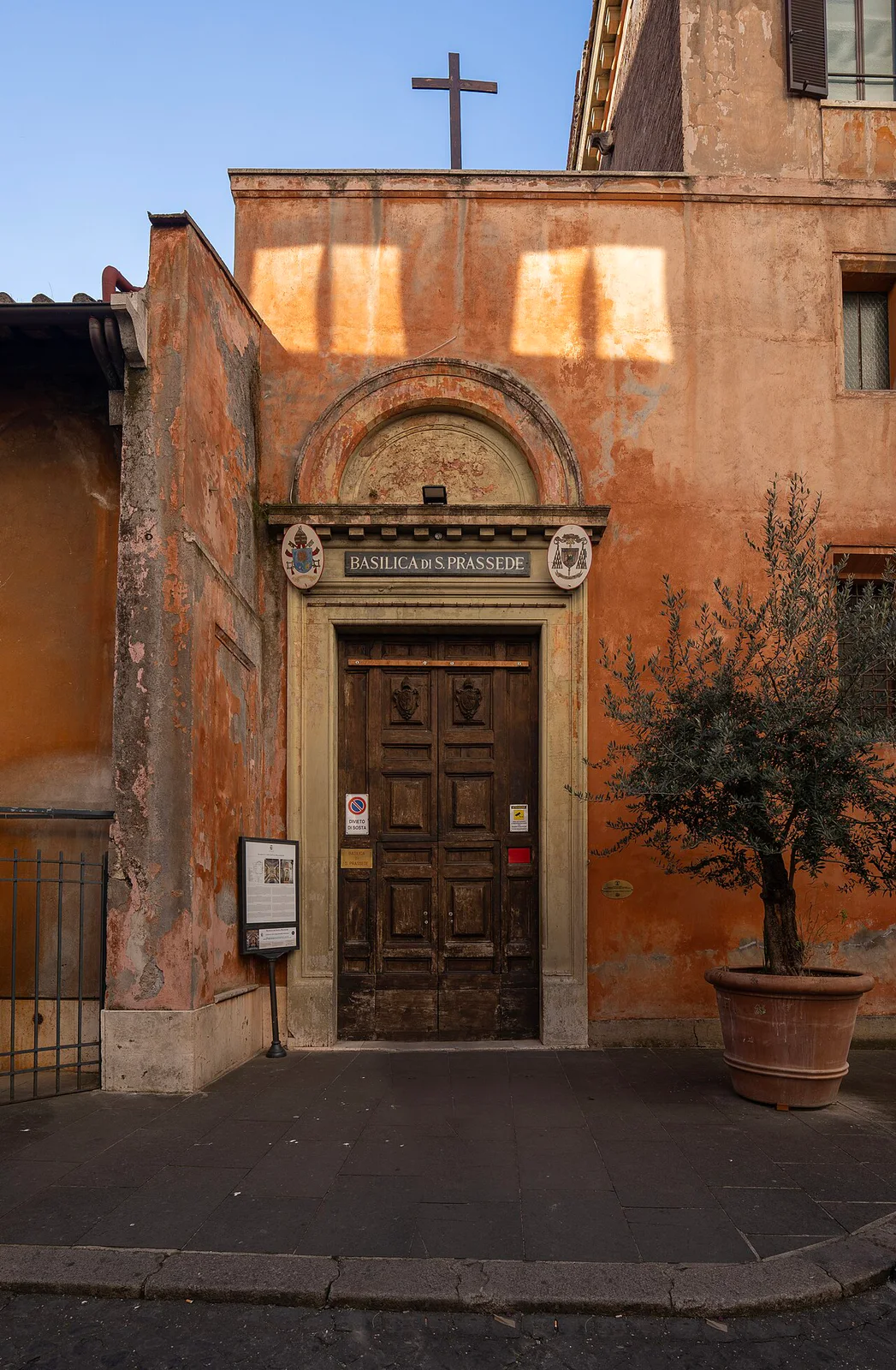
Stanza · Audio guide
Basilica di Santa Prassede Audio Guide
A place to remember. A story to take with you.
The Basilica of Saint Praxedes is an early medieval titular church located in Rome, Italy. It is a minor basilica situated near the papal basilica of Saint Mary Major.
Download Stanza, then search for “Basilica di Santa Prassede”.
About the tour
One guide. Your kind of visit.
The Basilica of Saint Praxedes is an early medieval titular church located in Rome, Italy. It is a minor basilica situated near the papal basilica of Saint Mary Major.
Ready when you are.
- 01Get the free Stanza app.
iOS & Android
- 02Find your guide.
“Basilica di Santa Prassede”
- 03Download before you go.
Works offline
Audio guide / 11 narrated stops
Inside the guide
Get to know a few of the stories before you go. Open a stop to read more.
01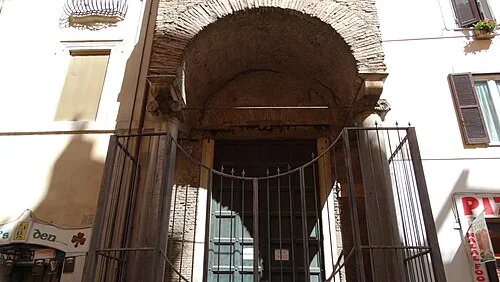 Historic Porch and Courtyard Entrance
The Medieval Porch (Prothyrum)
Welcome to Santa Prassede, a ninth-century basilica tucked into the Monti district of Rome. This tour runs from its early medieval foundations to the gold mosaics and the tombs of later centuries. The entrance is easy to miss. The facade hides inside a residential courtyard, reached down a long staircase from Via di San Martino ai Monti. Over the foot of that staircase stands the original medieval porch, a barrel-vaulted prothyrum. It rests on two reused columns with Ionic capitals. The left one is an original Roman column, the right one a medieval recutting. The story of the place runs much deeper. A titulus of Saint Praxedes, one of Rome's early titular churches, was recorded here around the year 112. A church stood on the site by the fifth century at the latest. Around 780 Pope Hadrian I began the present building, in its general layout. He raised it over the remains of a fourth-century Roman bathhouse, the Terme di Novato, once owned by the family of Saint Pudentiana. A generation later Pope Paschal enlarged and decorated the basilica. The story goes that the young Alfred, later king of England, came here on a pilgrimage around 855 and was deeply impressed by its beauty.
Photo: Luciano Tronati · CC BY-SA 4.0
02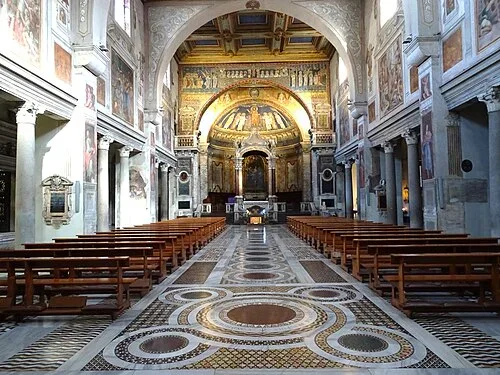 Central Nave and Well of the Martyrs
The Central Nave
Inside, the nave runs about forty-five meters down to the sanctuary. It is thirty meters wide. The columns along its sides are antique, reused from older Roman buildings and set here to carry the arcades. The decoration on the walls belongs to a much later age. In 1594 the basilica's cardinal, Alessandro de' Medici, later Pope Leo the Eleventh, began a campaign to fresco the entire central nave. The walls received eight scenes of the Passion, painted by a team that included Giovanni Balducci and Stefano Pieri. Painted architecture opened up the flat wall surfaces above the architraves. It was a sixteenth-century layer laid over the early medieval core. The gold glowing at the far end of the nave is far older, and the walk reaches it shortly.
Photo: Hugo DK · CC BY 4.0
03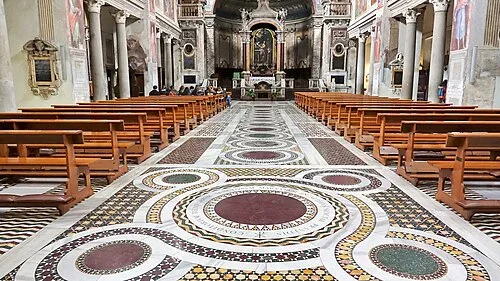 Central Nave and Well of the Martyrs
The Well of Saint Praxedes
Set into the marble floor of the nave is a round disk of red porphyry. Tradition points to it as the well of Saint Praxedes. Praxedes and her sister Pudentiana were Roman noblewomen of the second century, daughters of a man named Pudens, traditionally Saint Peter's first convert in Rome. The sisters cared for Christians hunted by the Roman authorities and gave the martyrs burial, defying Roman law. For that, the story says, both were killed. Praxedes is remembered for gathering the martyrs' blood with a sponge and preserving it in a well on her family's property. That well is what the porphyry disk is held to mark. The whole basilica takes its name from her.
Listen in the appPhoto: Luciano Tronati · CC BY-SA 4.0
04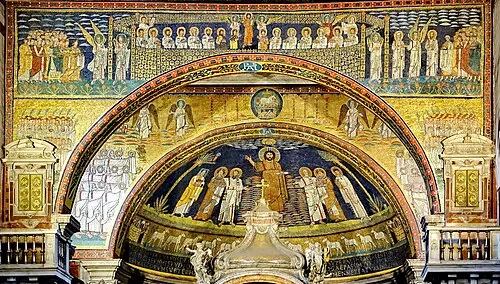 Apse and Presbytery Mosaics
The Apse and Triumphal Arch Mosaics
The gold begins at the sanctuary. Pope Paschal hired a team of professional mosaicists to cover the apse, the apsidal arch and the triumphal arch with glass set in gold. In the half-dome of the apse, Christ stands at the center, flanked by Peter and Paul, who present the two sisters Prassede and Pudenziana to God. Below them, thirteen lambs process toward Christ shown as the paschal lamb on a small hill. From that hill the rivers of paradise flow toward the four corners of the world. Six lambs on either side stand for the apostles, and the little cities of Bethlehem and Jerusalem flank the two groups. On the arch above, twelve men on each side hold wreaths of victory, welcoming souls into heaven. Higher still are the symbols of the four Gospel writers, Mark's lion, Matthew's man, Luke's bull and John's eagle, around a lamb on a throne, the sign of Christ's return. At the far left stands the pope who commissioned all of it, holding a model of the church, and his story is the next stop.
Listen in the appPhoto: Luciano Tronati · CC BY-SA 4.0
05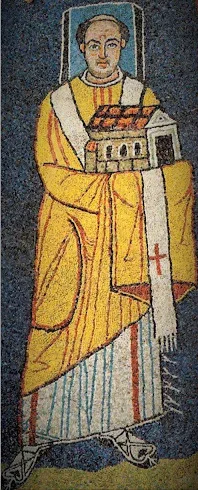 Apse and Presbytery Mosaics
Pope Paschal I and the Square Halo
That pope is Paschal the First, and the mosaic is a self-portrait of a living man. His halo is square, and in the imagery of the day a square halo marked someone still alive when the work was made. Paschal stood at the forefront of the Carolingian Renaissance, the renewal begun under the emperor Charlemagne that wanted Christianity back to its foundations, in theology and in art. He ran two linked programs. One was an almost unprecedented campaign of church building. The other was digging martyrs' bones out of Rome's catacombs and moving them into churches within the walls. Beneath the apse runs an inscription of his own, in which he hopes that the offering of the new building will be enough to win him a place in heaven. The bones he gathered have their home in the crypt beneath the altar, the next stop.
Listen in the appUnknown author · Public domain
06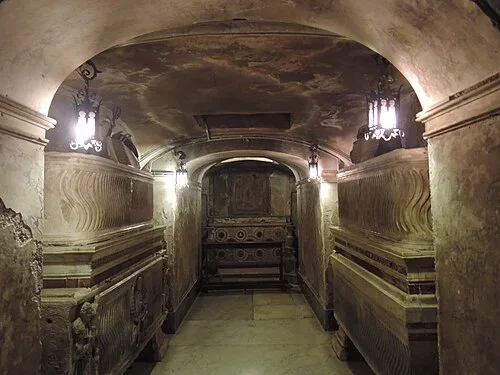 Subterranean Crypt of the Martyrs
The Crypt of the Martyrs
Beneath the high altar a low vaulted corridor runs its length, lit by hanging lamps. Sarcophagi line its walls, ancient tombs holding the bones Paschal brought in from the catacombs. In his day the suburban cemeteries outside Rome's walls were falling into decay. Here, what had been scattered burials in open ground became a single resting place under the sanctuary. The Mass is celebrated directly above them.
Listen in the appPhoto: Capitolium4025 · CC BY 4.0
07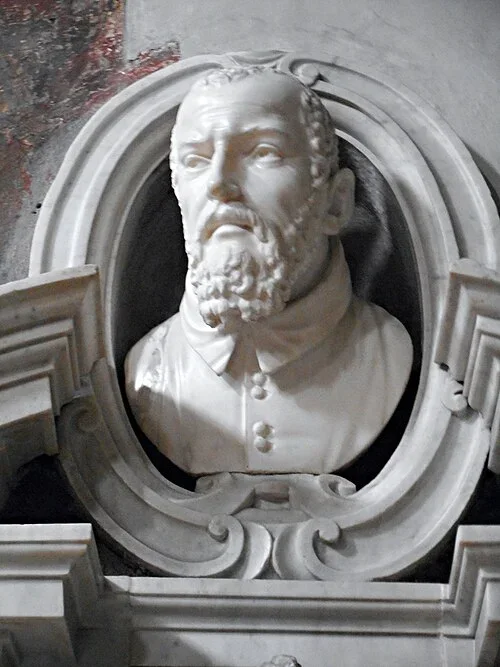 Right Aisle and Bernini's Bust of Bishop Santoni
Bernini's Bust of Bishop Santoni
In the right aisle stands the funerary monument of Bishop Giovanni Battista Santoni, who died in 1592. His marble portrait bust is among the very first sculptures of Gian Lorenzo Bernini. It is often called his very first, carved when the sculptor was about sixteen. Even at that age the gift shows. The bishop's head turns, the tousled beard and lined face startlingly alive, framed in a deeply carved oval. It already announces the Baroque master he would become. Eight centuries after Paschal built this church, powerful men still chose it to house their memory.
Listen in the appCarlo Raso from Naples, Italy · Public domain
08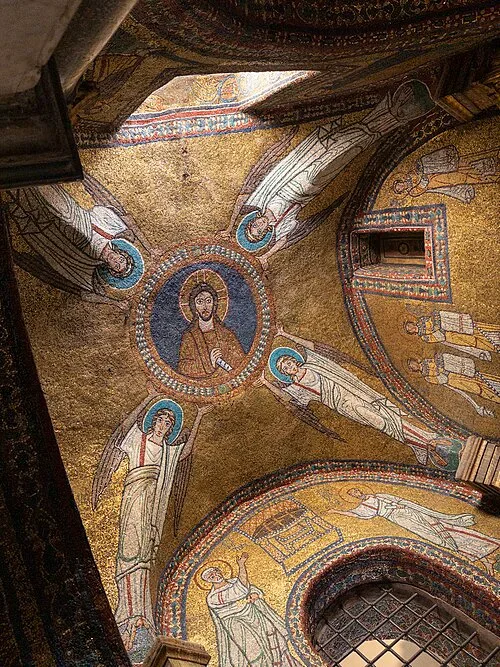 Chapel of Saint Zeno (Sacello di San Zenone)
The Chapel of Saint Zeno
Off the side of the church opens a small square room that has kept its ninth-century mosaics almost whole, the chapel of Saint Zeno. Pope Paschal built it as a funerary chapel for his mother Theodora and dedicated it to the saint. It is one of the rare Roman chapels of the ninth century lined completely with mosaics in the Byzantine style, and it survives essentially intact. At the crown of the vault Christ gazes out from a blue medallion, set at the center of a golden cross-vault and ringed by angels, with saints below. For its glowing gold the chapel has long been called the Garden of Paradise. Paschal filled the great church with the holy dead, and then built this place of gold for his own family.
Listen in the appPhoto: Nhartmannphotos · CC BY-SA 4.0
09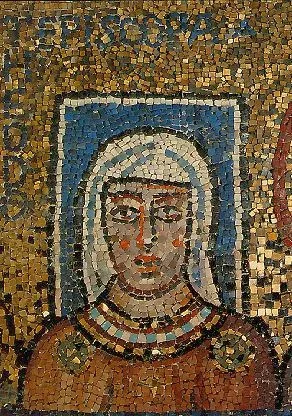 Chapel of Saint Zeno (Sacello di San Zenone)
Episcopa Theodora
The woman the chapel was built for appears on its wall in mosaic. Theodora, mother of Pope Paschal, is shown frontally in a blue framed field, her name inscribed above her. Above the name runs a title, Episcopa, the feminine form of the word for bishop. What that title meant is still argued over. It may have been honorary, or a family designation, and some scholars read it as something more. Whatever the answer, the honor itself is exceptional. A ninth-century woman, commemorated with her own mosaic portrait and her own funerary chapel inside a papal church, is a rare thing anywhere in medieval Rome.
Listen in the appPhoto: Marcus Cyron · Public domain
10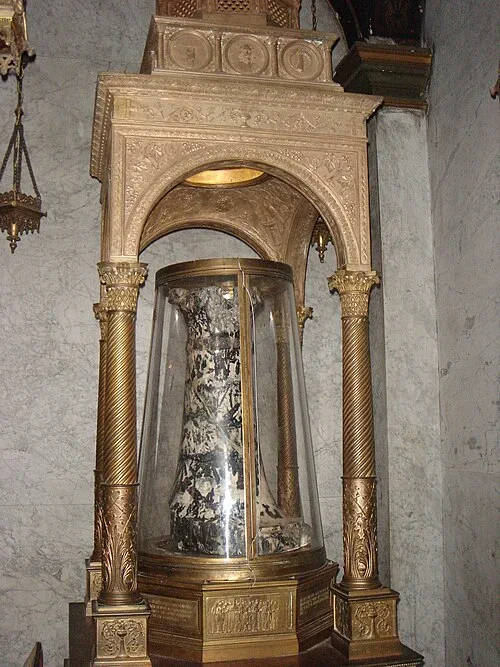 Niche of the Column of the Flagellation
The Column of the Flagellation
In a niche that opens both onto the right aisle and onto the chapel of Saint Zeno stands a bronze and glass shrine, made in 1898 to a design by Duilio Cambellotti. Behind the glass is a column about sixty-three centimeters tall. It is honored as a piece of the pillar at which Jesus was flogged before the crucifixion. The tradition says Saint Helena found it in the early fourth century, when she was about eighty and traveling the Holy Land to rescue relics of the Passion. It reached Rome in 1223, brought, the story goes, by Cardinal Giovanni Colonna as emissary to the Holy Land. Honesty belongs here too. Like other medieval relics of the Passion, the pillar lacks indisputable proof of authenticity, and many objects claimed the same role in the Middle Ages. Pilgrims came all the same, and their veneration shaped this church for centuries.
Listen in the appPhoto: Lalupa · CC BY-SA 3.0
- 11
Tomb of Cardinal Alain de Coëtivy
A French cardinal's Renaissance tomb closes the story of a church every age kept choosing, still served by the same monks after eight hundred years.
Basilica di Santa Prassede
Frequently asked questions
How much does the guide cost?
Free app download. Listed guide price: $0.99. Guide price shown in the app. Audio guide only. Venue admission is separate.
Can I listen without internet?
Yes. Download the guide’s audio, images, and maps in the app before your visit. Your downloaded content is then available offline.
Can I listen in my language?
This audio guide is available in 15 languages, including English.
Do I need to follow a schedule?
No. This is a self-guided experience. Choose your stops, pause whenever you like, and return to a story at your own pace.
At your own pace
Explore Basilica di Santa Prassede.
Download Stanza, then search for “Basilica di Santa Prassede”.
Free app download · Guide price shown in the app
Keep exploring
Nearby audio guides
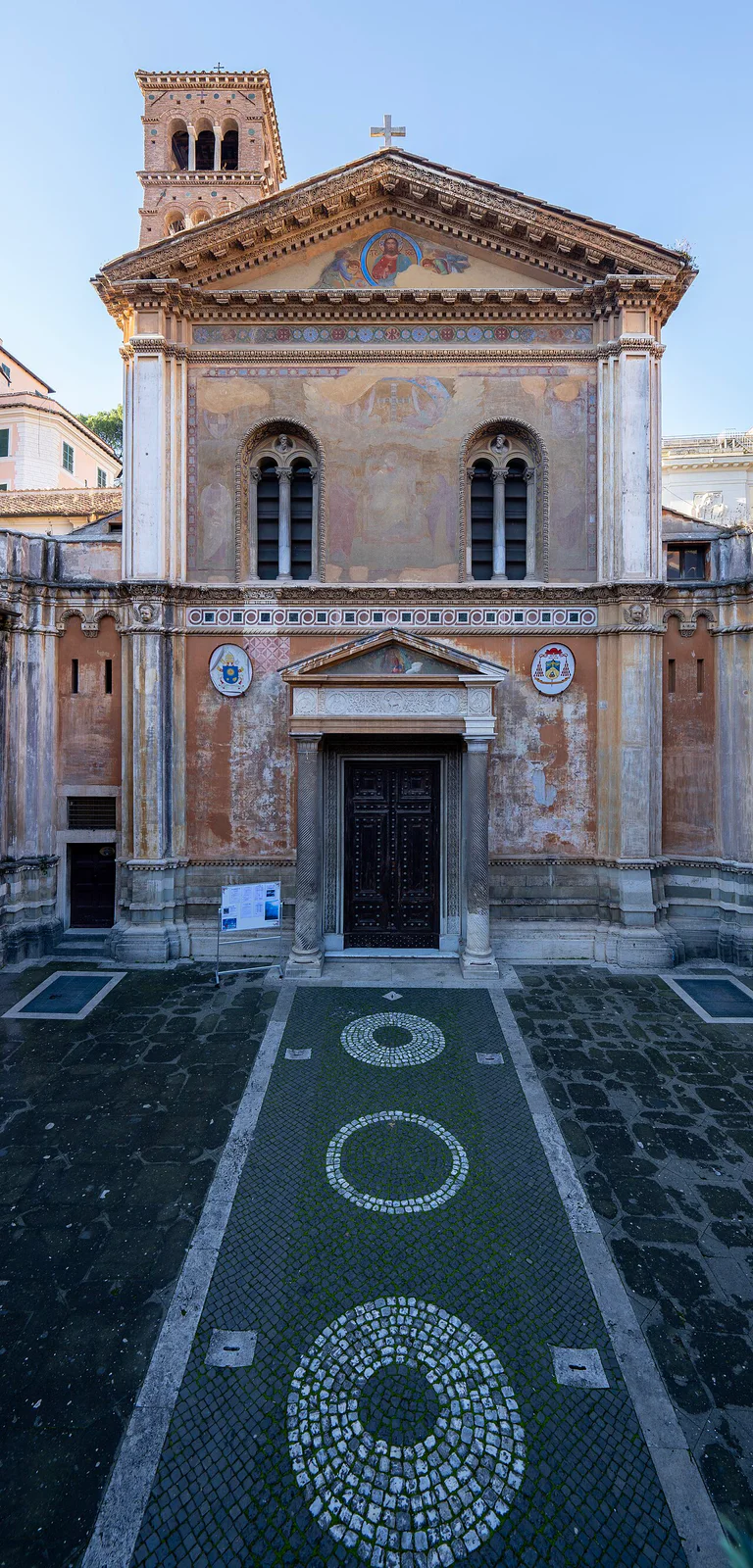
Rome · 1 km
Basilica di Santa Pudenziana
Content & sources
Photo: Rione I Monti · CC BY 4.0
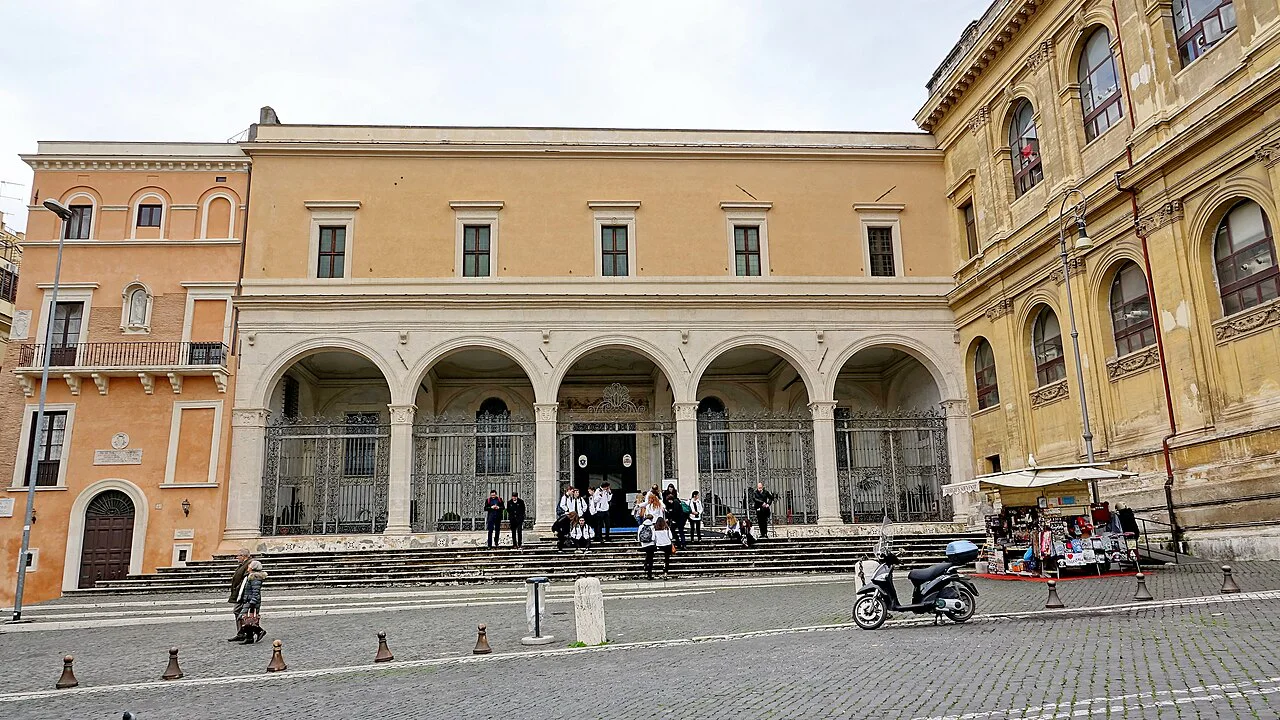
Rome · 1 km
Basilica di San Pietro in Vincoli
Content & sources
Photo: Luciano Tronati · CC BY-SA 4.0
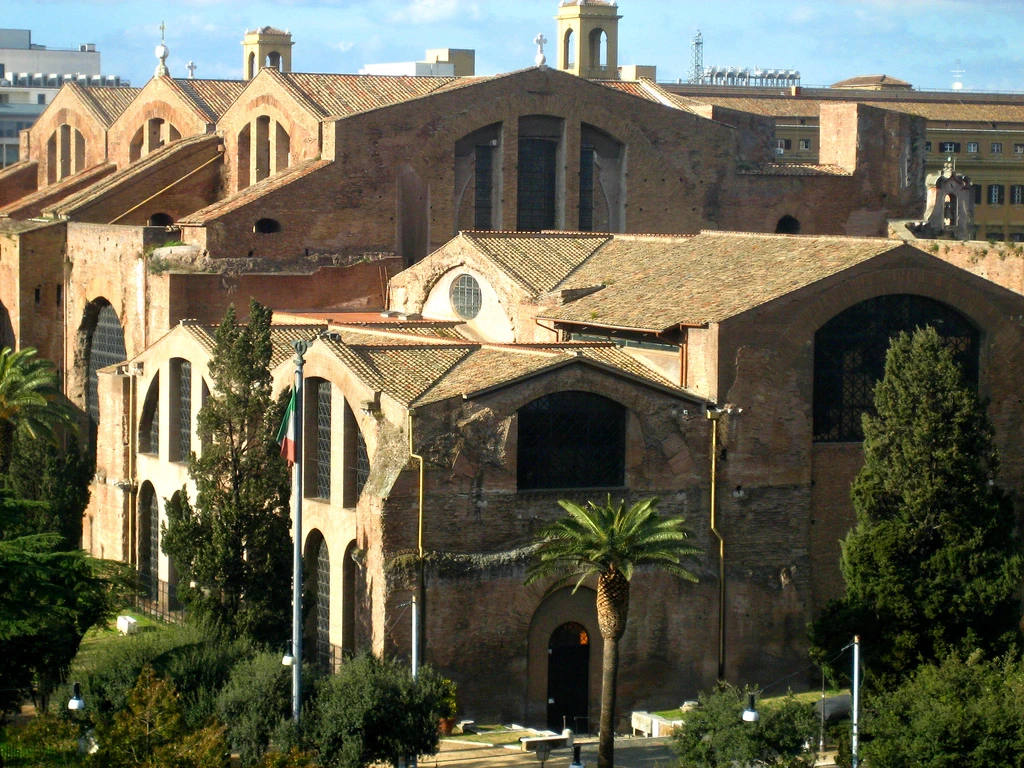
Rome · 1 km
Terme di Diocleziano
Content & sources
Photo: Joris · CC BY 2.0
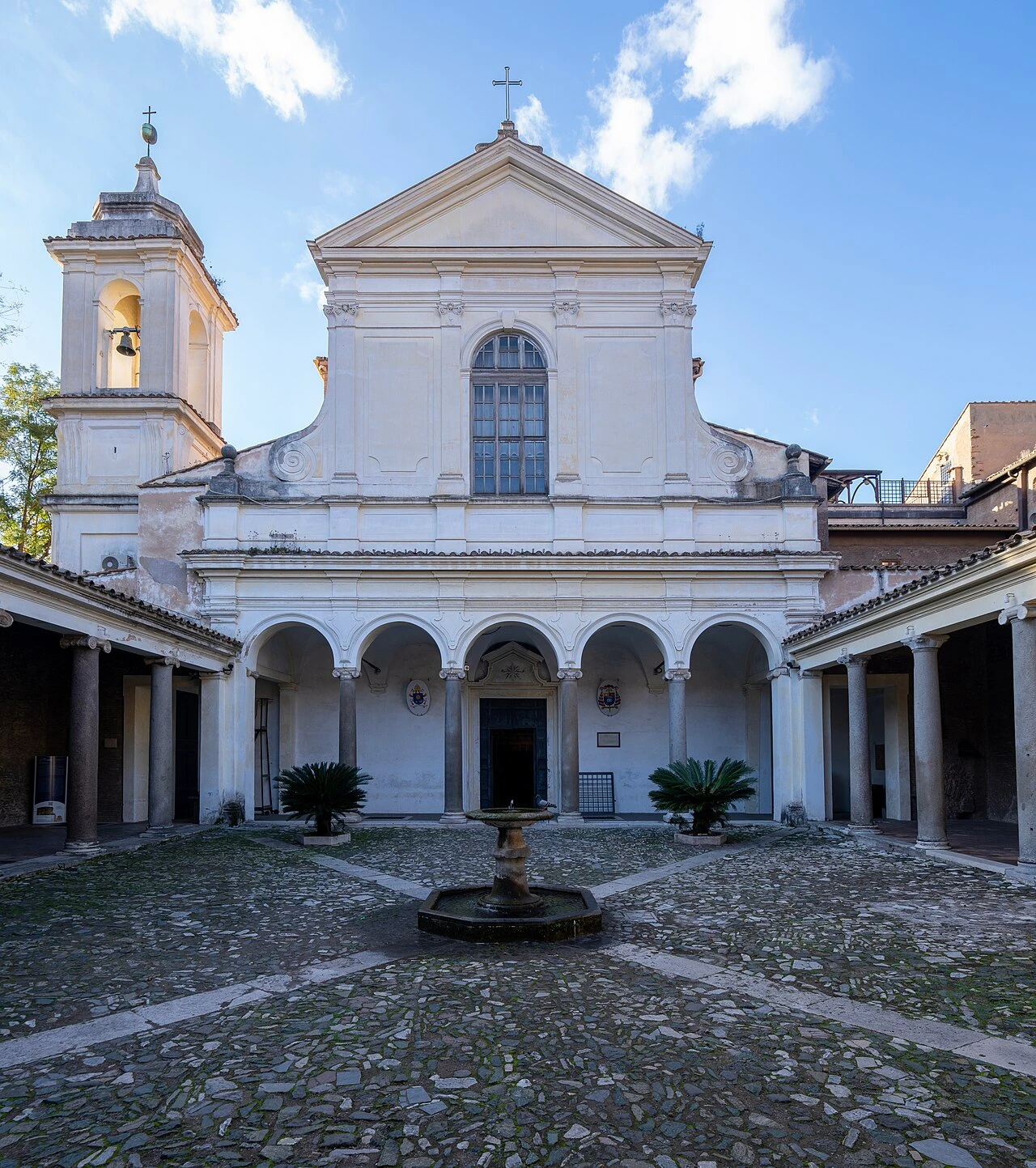
Rome · 1 km
Basilica of San Clemente
Content & sources
Photo: Labicanense · CC BY-SA 4.0