Stanza · Audio guide
Basilica di Santa Pudenziana Audio Guide
A place to remember. A story to take with you.
The Basilica of Santa Pudentiana is the eldest Roman Catholic basilica built in the fourth century in Rome. The original shrine building dates back from the second century and is dedicated to Saint Pudentiana.
Download Stanza, then search for “Basilica di Santa Pudenziana”.
About the tour
One guide. Your kind of visit.
The Basilica of Santa Pudentiana is the eldest Roman Catholic basilica built in the fourth century in Rome. The original shrine building dates back from the second century and is dedicated to Saint Pudentiana.
Ready when you are.
- 01Get the free Stanza app.
iOS & Android
- 02Find your guide.
“Basilica di Santa Pudenziana”
- 03Download before you go.
Works offline
Audio guide / 9 narrated stops
Inside the guide
Get to know a few of the stories before you go. Open a stop to read more.
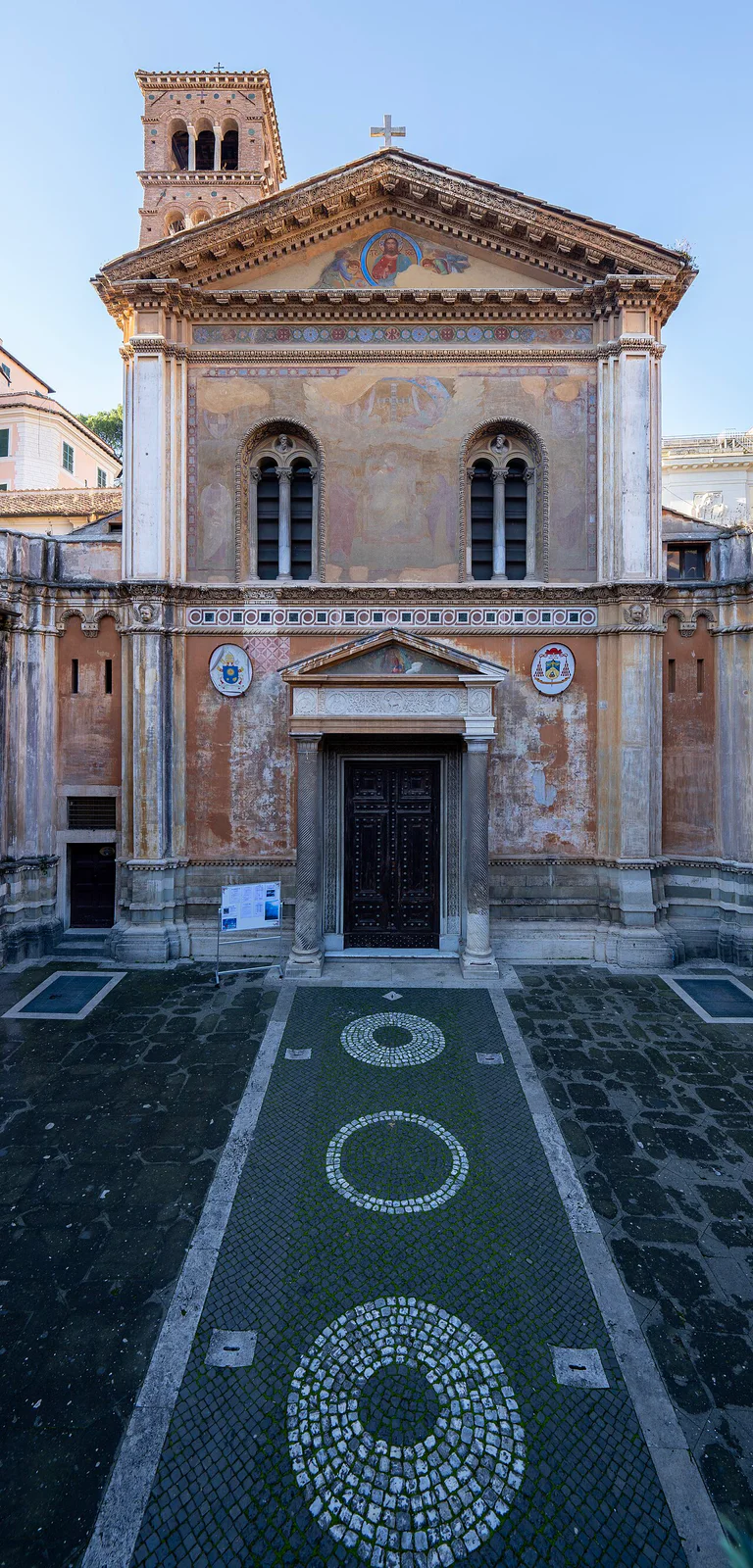
01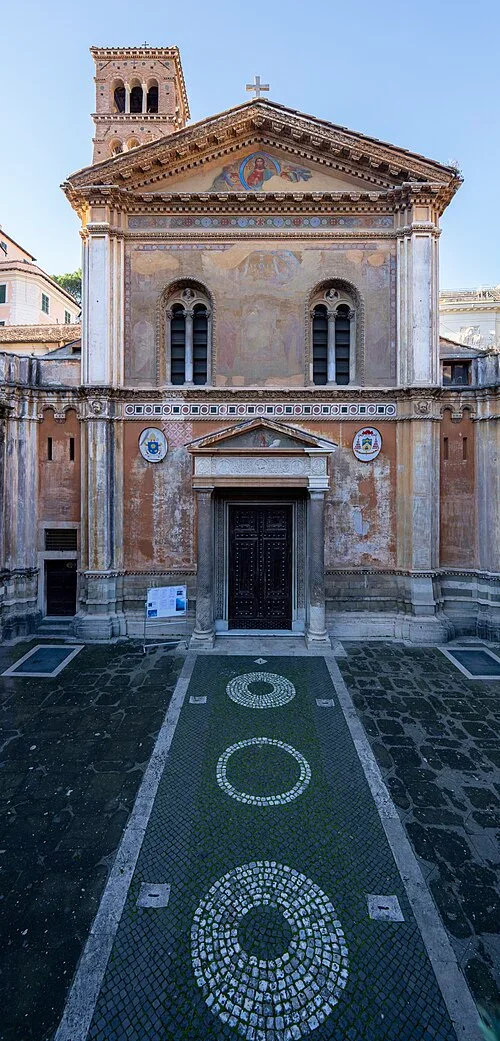 Sunken Entrance Courtyard and Medieval Portal
Sunken Entrance Courtyard and Facade
Welcome to Santa Pudenziana, one of the oldest places of Christian worship in Rome. The way in tells the story already: about twenty steps, built in the nineteenth century, carry you down from Via Urbana into a sunken courtyard. The church sits well below the modern street, because it grew out of an ancient site while the city around it kept rising. Today it is a titular minor basilica, and it serves as the national church of the Philippines. Rising at the left of the facade is a brick bell tower from the thirteenth century, built in the Romanesque style. Its five tiers of open loggias have watched over this courtyard for some eight hundred years. The facade itself was renewed in 1870, and Pietro Gagliardi's frescoes on it have faded to pale shadows. Behind that worn surface, something much older is waiting.
Photo: Rione I Monti · CC BY 4.0
02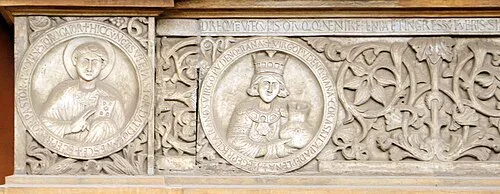 Sunken Entrance Courtyard and Medieval Portal
Eleventh-Century Portal Frieze
Above the doorway runs a marble frieze that once belonged to a portal of the eleventh century, later restored in the nineteenth. It counts as one of the significant works of medieval sculpture in Rome. Read it from left to right, like a cast list carved in stone. First comes Pastore, the first recorded proprietor of the established basilica. Then Pudentiana, the sister who gave this church its name. Beside her is Praxedes, and last their father, Pudens. Four round portraits, one family, set into the entrance hall of the faded facade. They are the people the whole legend of this place gathers around.
Photo: Sailko · CC BY 3.0
03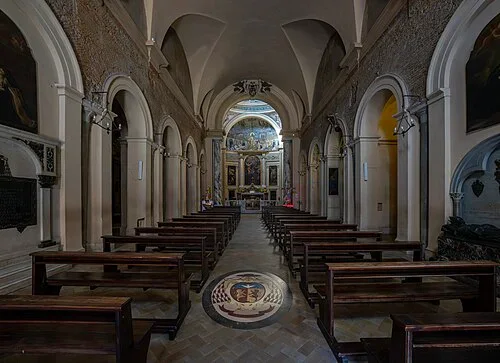 The Main Nave and Ancient Roman Foundation
Main Nave over the House of Pudens
Under this nave, about nine metres down, lie the remains of a second-century Roman residence, the house of Senator Pudens. A church was probably erected over it under Pope Pius I, reusing part of a Roman bath building whose structure is still visible in the apse. The room itself looks the way it does because of Cardinal Enrico Caetani, who held the title of this church. He commissioned Francesco Capriani, called il Volterra, and the work was finished in 1588. Sources disagree on what exactly he did: some say he folded three naves into one, others that he divided a single hall into three. Either way, the remodelling gave the interior its present face. Yet some things survived every campaign. The columns along the nave are survivors of the original building, older than everything around them.
Listen in the appPhoto: 6uy7t44t · CC BY 4.0
04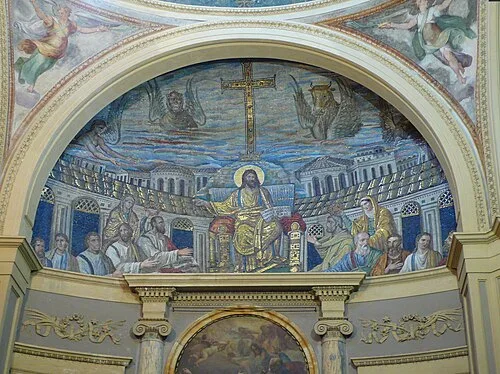 The 4th-Century Imperial Apse Mosaic
The Apse Mosaic of Christ and the Apostles
Around the year 390, this semi-dome received one of the oldest surviving Christian mosaics in Rome. Only the mosaics of Santa Costanza are older. What makes it remarkable is the image itself. Christ appears not as a lamb or a shepherd, as in earlier Christian art, but as a regal human being. He sits on a jewel-encrusted throne in a golden toga trimmed with purple, the colour of emperors. His right hand is raised like a classical Roman teacher addressing a class. Around him the apostles wear senatorial togas, each with his own face, each turned toward the viewer. The nineteenth-century German historian Ferdinand Gregorovius judged it the most beautiful mosaic in Rome. It has scars, though. The lower zone was cut away during the late sixteenth-century rebuilding, destroying two apostle figures. On the right side, the lost figures were replaced with new, rather blank mosaic.
Listen in the appPhoto: Welleschik · CC BY-SA 3.0
05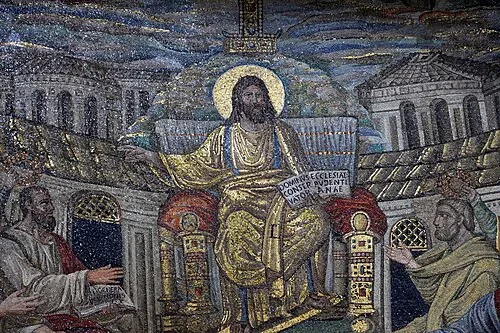 The 4th-Century Imperial Apse Mosaic
Christ Enthroned: Mosaic Detail
The book in Christ's left hand carries an inscription: Dominus conservator ecclesiae Pudentianae. The Lord is the preserver of the church of Pudentiana. The mosaic names its own church, in its own hand. Above him stands a large jewelled cross on a hill, Golgotha, a sign of his triumph. Behind him rise the roofs and domes of a city. Some scholars read it as heavenly Jerusalem. Others think it shows the churches the emperor Constantine built in Jerusalem. Two female figures, Ecclesia and Synagoga, Church and Synagogue, hold a wreath over the heads of Peter and Paul. Here they are barely differentiated, unlike in the sharper oppositions of later art. Even the mosaic's age is debated. Scholars split between the pontificate of Siricius, from 384 to 399, and that of Innocent the First, from 401 to 417.
Listen in the appPhoto: Sailko · CC BY 3.0
06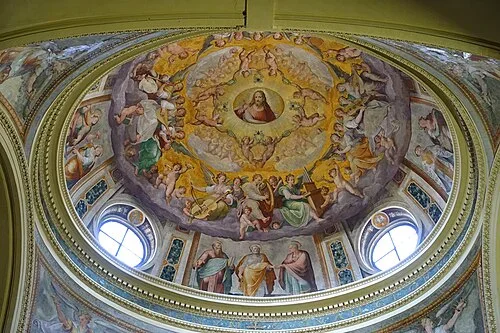 The Presbytery and Elliptical Dome
The Elliptical Dome and Pomarancio Fresco
Overhead opens the first elliptical dome ever built in Rome, added during the Caetani campaign you heard about in the nave. Into its cupola, Cristoforo Roncalli, known as il Pomarancio, painted the Adoration of Christ by the Host of Heaven. Angels and saints circle the saviour in a golden swirl of Baroque Paradise. The contrast with the apse below is deliberate, and striking. The late sixteenth-century builders vaulted the church with this new dome, yet left the fourth-century mosaic to preside beneath it. Two visions of heaven, twelve centuries apart, sharing one building.
Listen in the appPhoto: Daderot · Public domain
07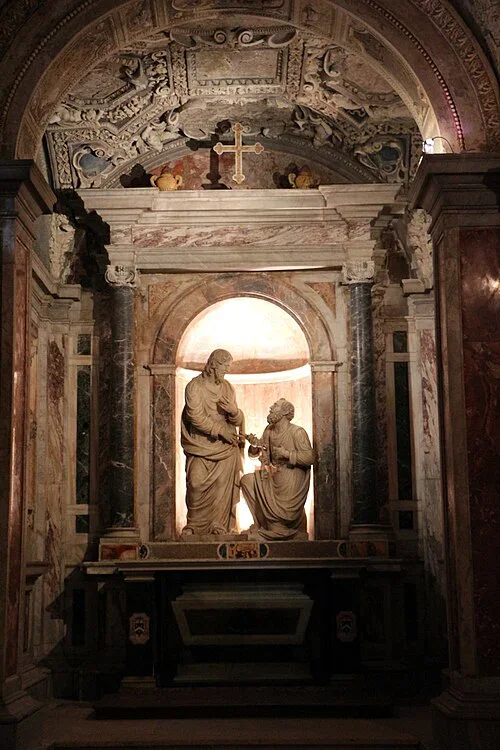 The Chapel of Saint Peter
Chapel of Saint Peter: The Keys and the Table
Left of the apse lies the Chapel of Saint Peter, and with it the tradition that binds this church to the dawn of Roman Christianity. The story holds that Peter was given hospitality in the house of Pudens, and that here he first offered consecrated bread and wine in Rome. Two bronze slabs in the chapel wall spell out that claim. The chapel also preserves a wooden relic, said to be part of the table at which Peter celebrated the Eucharist for the Pudente family. The rest of that table is embedded in the papal altar of Saint John Lateran. It is a claim of pious tradition rather than settled history, but it has been honoured here for centuries. On the altar, a sculpture of 1594 shows Christ delivering the keys of Heaven to Peter, generally attributed to Giacomo della Porta.
Listen in the appPhoto: Sailko · CC BY 3.0
08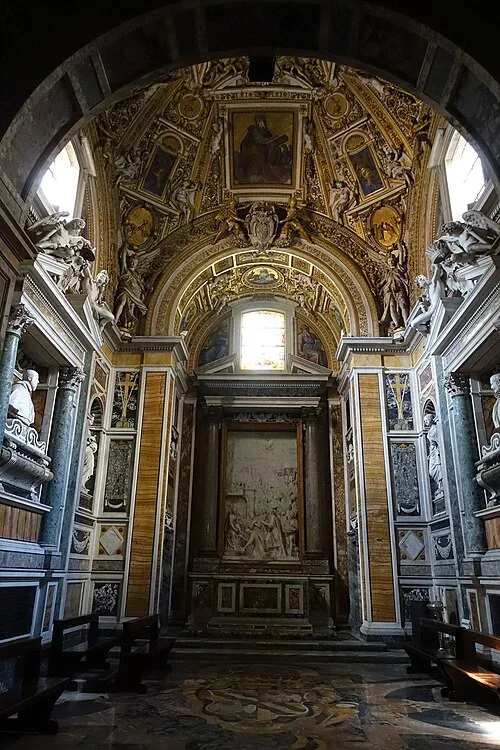 The Caetani Chapel and the Sisters' Well
The Caetani Chapel
In the left aisle opens the Caetani Chapel, the lavish burial chapel Cardinal Enrico Caetani built for his family. Francesco Capriani, called il Volterra, designed it in 1588 on the site of the oratory of San Pastore. That oratory is remembered as the first room of the complex set aside for Christian worship, and Pastore is the same man carved on the entrance frieze. After Capriani's death, Carlo Maderno completed the chapel. Its walls are dressed in rare and precious marbles: alabaster at the entrance and altar, verde antico on the side walls, columns of Lumachella marble. Gilded stucco and a mosaic vault cover it all, echoing the gleam of the apse mosaic. Above the altar, Pier Paolo Olivieri carved the marble relief of the Adoration of the Magi in the 1590s.
Listen in the appPhoto: Daderot · Public domain
09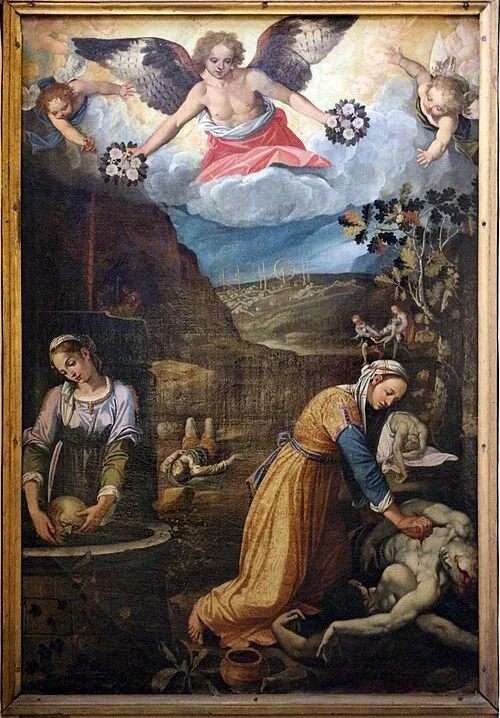 The Caetani Chapel and the Sisters' Well
The Sisters and the Martyrs' Well
A seventeenth-century painting by Giovanni Paolo Rossetti shows the sisters Pudentiana and Praxedes burying Christian martyrs. It carries the legend this church has told about itself for centuries. The story goes that the sisters collected the blood and bodies of some three thousand early martyrs, using sponges, and hid them in a deep well. That well stands just outside the Caetani chapel in the left aisle, marked today by a square porphyry slab in the floor. Whether the tale happened exactly so cannot be known; what matters is that generations of worshippers believed it and kept it alive in paint and stone. From a senator's house to a pope's residence, from an ancient oratory to a living basilica, Santa Pudenziana has carried its dead and its faithful together for nearly two thousand years.
Listen in the appPhoto: Sailko · CC BY 3.0
Basilica di Santa Pudenziana
Frequently asked questions
How much does the guide cost?
Free app download. Listed guide price: $0.99. Guide price shown in the app. Audio guide only. Venue admission is separate.
Can I listen without internet?
Yes. Download the guide’s audio, images, and maps in the app before your visit. Your downloaded content is then available offline.
Can I listen in my language?
This audio guide is available in 15 languages, including English.
Do I need to follow a schedule?
No. This is a self-guided experience. Choose your stops, pause whenever you like, and return to a story at your own pace.
At your own pace
Explore Basilica di Santa Pudenziana.
Download Stanza, then search for “Basilica di Santa Pudenziana”.
Free app download · Guide price shown in the app
Keep exploring
Nearby audio guides
Rome · 1 km
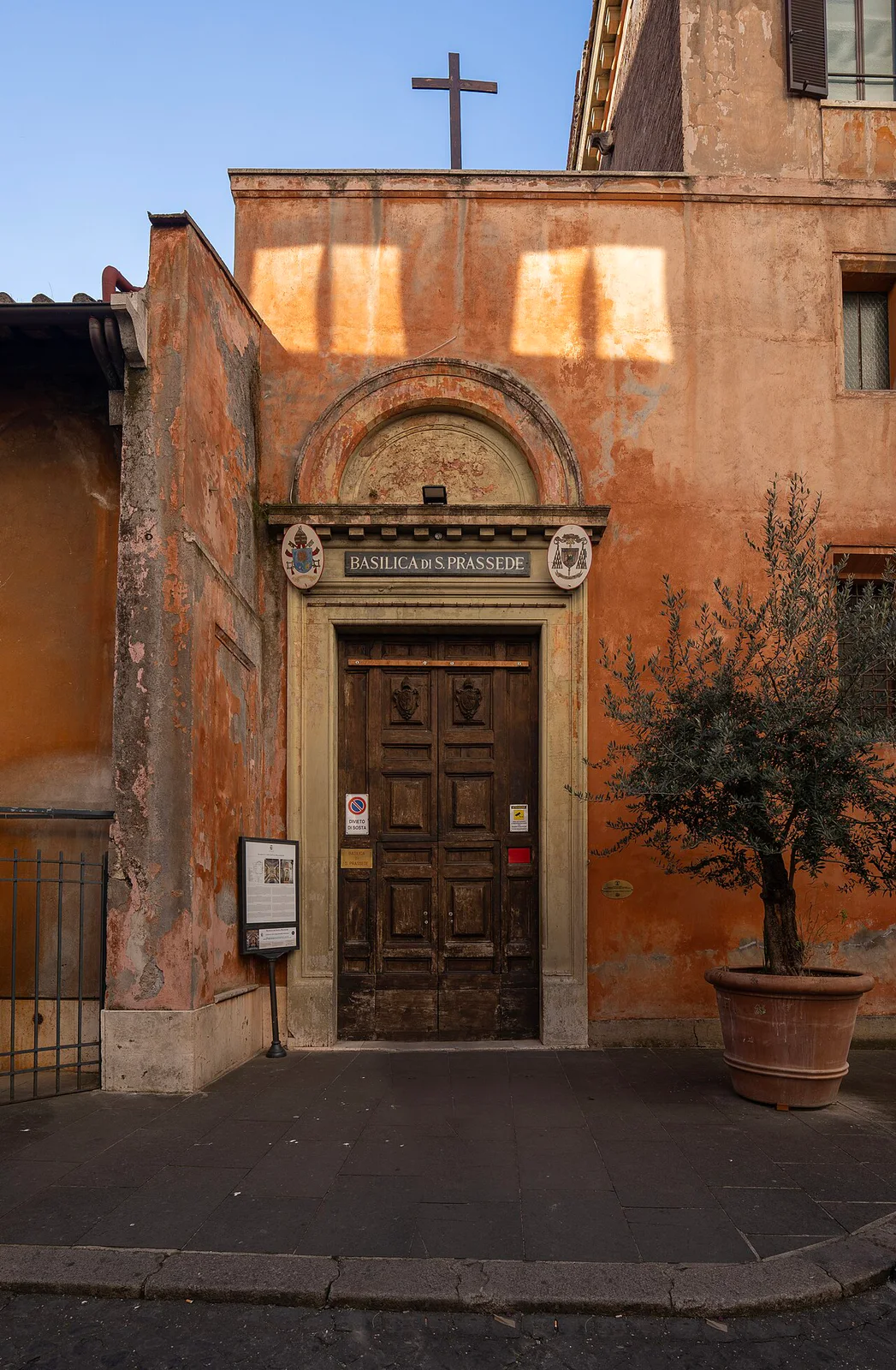
Basilica di Santa Prassede
Content & sources
Photo: Rione I Monti · CC BY 4.0
Rome · 1 km
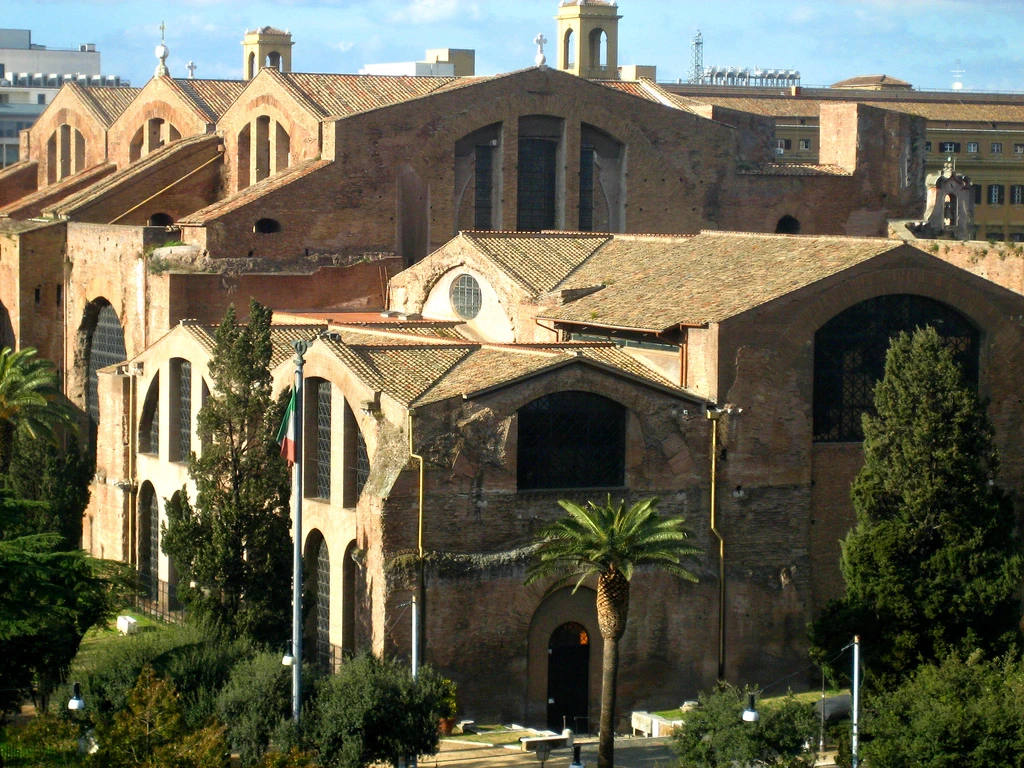
Terme di Diocleziano
Content & sources
Photo: Joris · CC BY 2.0
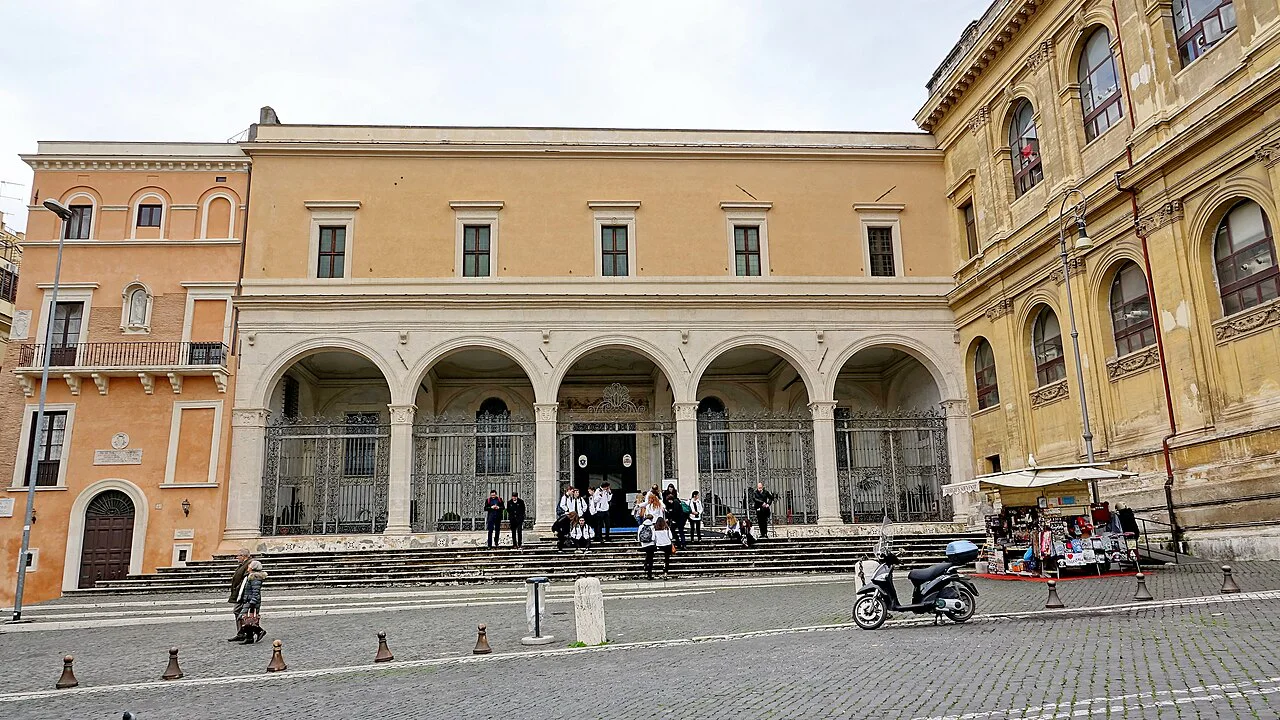
Rome · 1 km
Basilica di San Pietro in Vincoli
Content & sources
Photo: Luciano Tronati · CC BY-SA 4.0
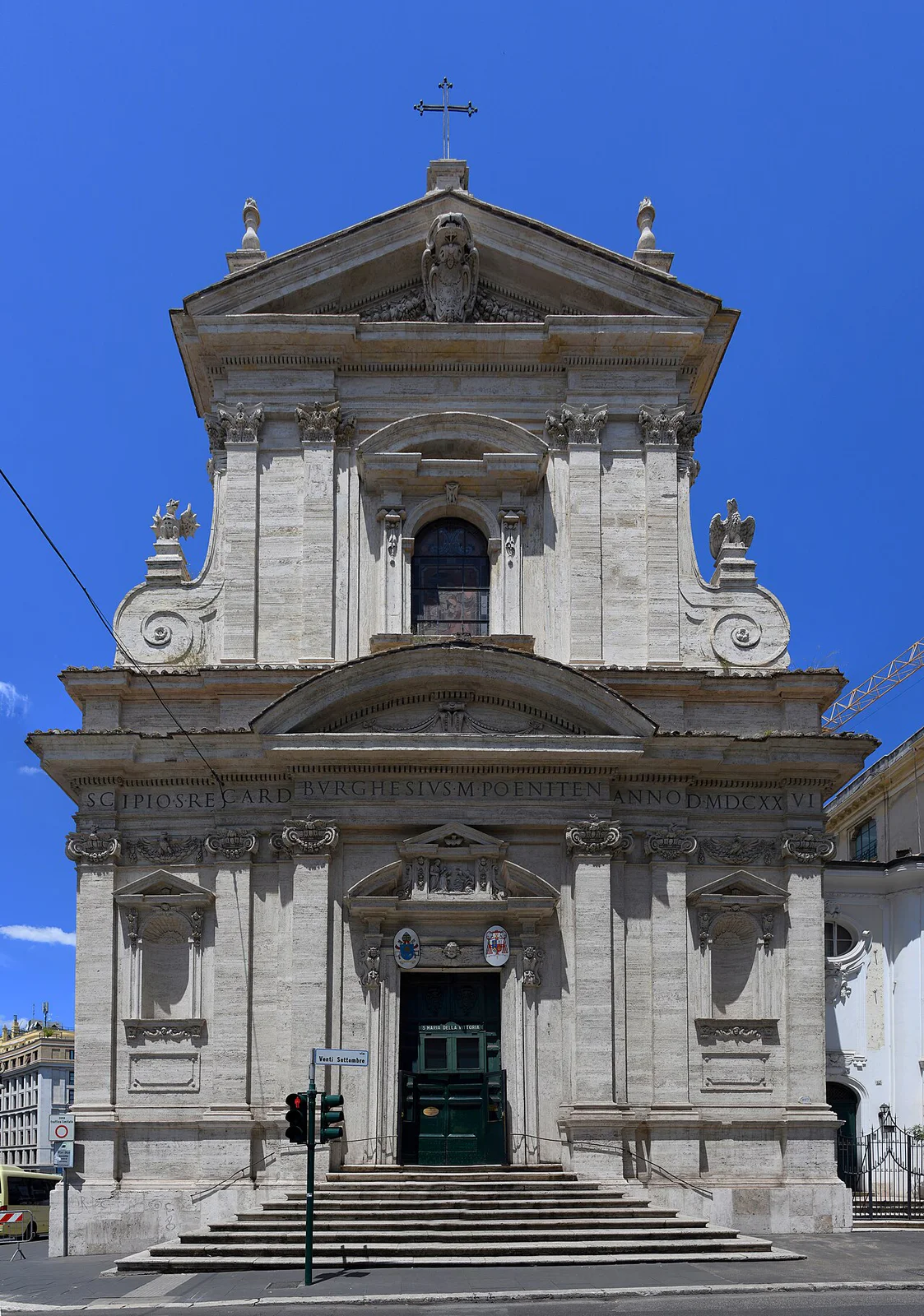
Rome · 1 km
Chiesa di Santa Maria della Vittoria
Content & sources
Photo: Architas · CC BY-SA 4.0