Stanza · Audio guide
Basilica di San Giovanni in Laterano Audio Guide
A place to remember. A story to take with you.
The Archbasilica of Saint John Lateran is the Catholic cathedral of the Diocese of Rome. It serves as the seat of the bishop of Rome and the head of the worldwide Catholic Church.
Download Stanza, then search for “Basilica di San Giovanni in Laterano”.
About the tour
One guide. Your kind of visit.
The Archbasilica of Saint John Lateran is the Catholic cathedral of the Diocese of Rome. It serves as the seat of the bishop of Rome and the head of the worldwide Catholic Church.
Ready when you are.
- 01Get the free Stanza app.
iOS & Android
- 02Find your guide.
“Basilica di San Giovanni in Laterano”
- 03Download before you go.
Works offline
Audio guide / 14 narrated stops
Inside the guide
Get to know a few of the stories before you go. Open a stop to read more.
01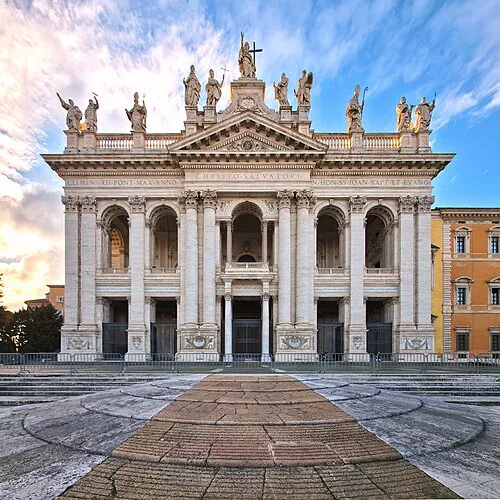 Neoclassical Façade and the Monumental Portico
The Neoclassical Façade
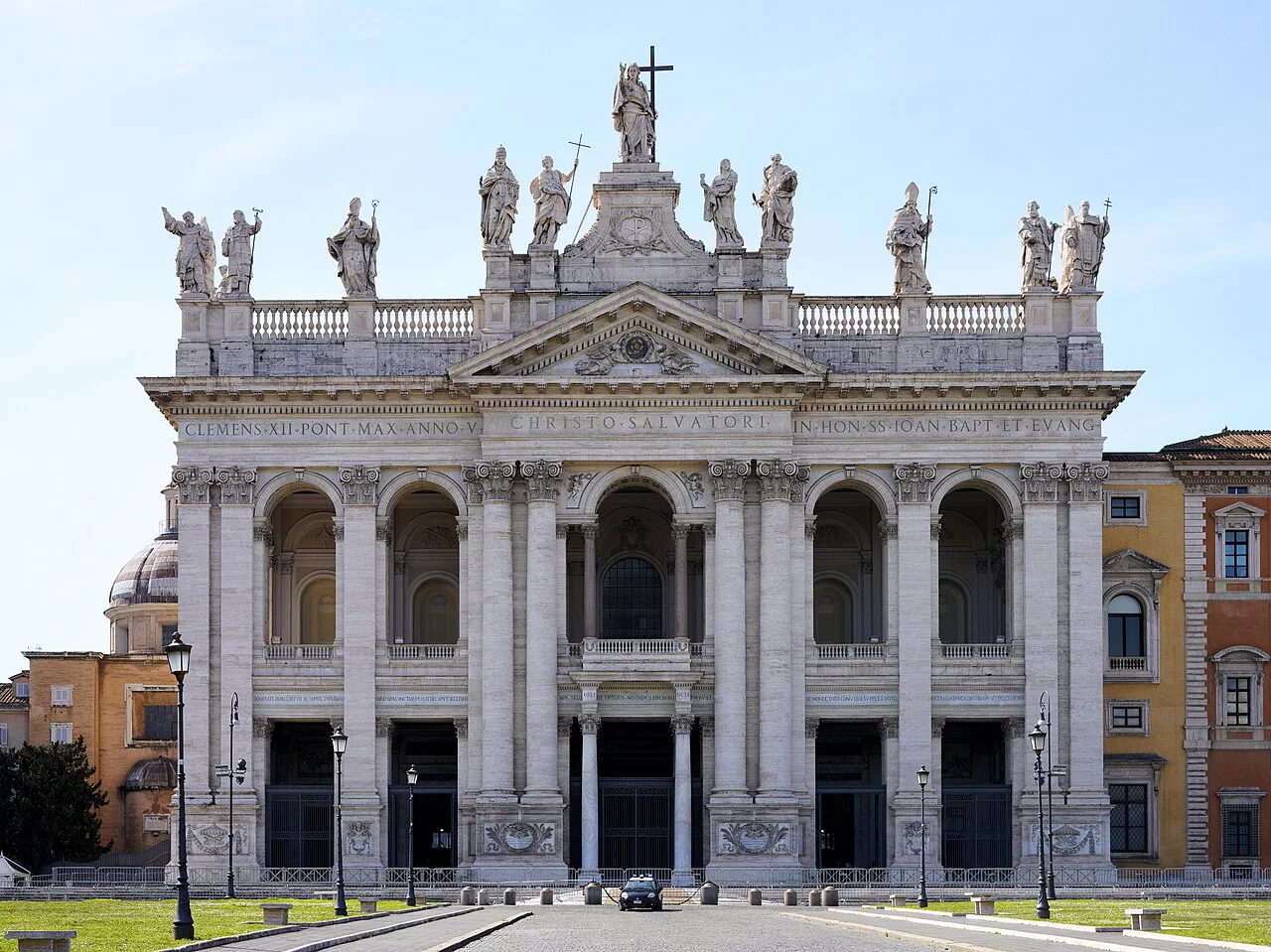
Welcome to the Lateran Basilica, the Pope's own cathedral in Rome. In the year 324 Pope Sylvester I consecrated this church on ground given by the Emperor Constantine. It is the oldest public church in the city, and the oldest basilica in the Western world. The front before you dates from a much later ambition. Pope Clement XII launched a competition for a new façade, and more than twenty architects entered. The winner was Alessandro Galilei, and the work was finished in 1735. Critics have long said it looks like the front of a palace rather than a church. It is really a great screen across the older front, forming a vestibule behind it. Fifteen colossal statues crown the roofline, with Christ and his cross at the centre. Between the main portals runs a Latin inscription that says it all: the Most Holy Lateran Church, mother and head of all the churches in the city and the world. Not St Peter's, but this church, holds that title, and the inscription on the wall proclaims it to anyone who passes.
Photo: NateBergin · CC BY 4.0
02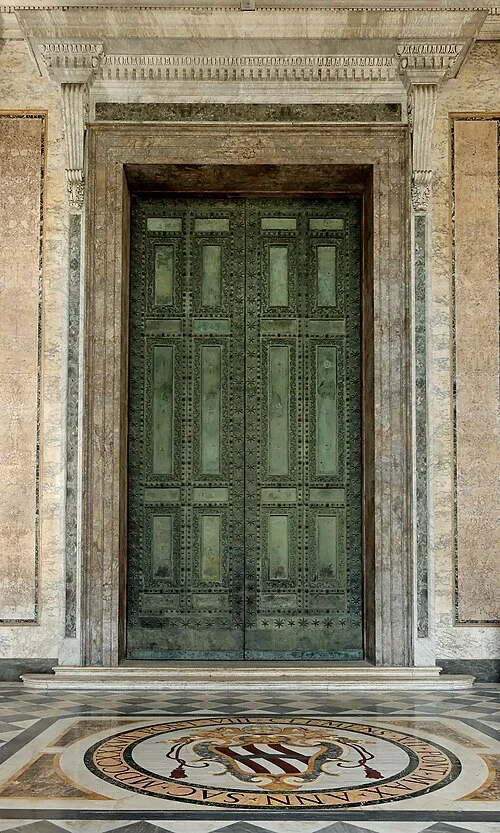 Neoclassical Façade and the Monumental Portico
The Ancient Bronze Doors
The bronze of these main doors served the Roman state long before it served the Church. They were cast for the Curia Iulia, the Senate house of ancient Rome, after a fire in the year 283. That makes them fourth-century work, ordered in the age of Diocletian. When the basilica needed its great portal, the doors were brought here from the Senate house. Francesco Borromini readapted them for the church, fitting the ancient panels into his new entrance. Their studded bronze has now greeted worshippers for well over a thousand years. In the vestibule at the far end stands another piece of ancient Rome: a statue of the Emperor Constantine, Roman work of the fourth century. It was found elsewhere in the city and moved here by order of Pope Clement XII. A fitting greeter, from the emperor whose gift of land made this church possible.
Marie-Lan Nguyen · CC BY 2.5
03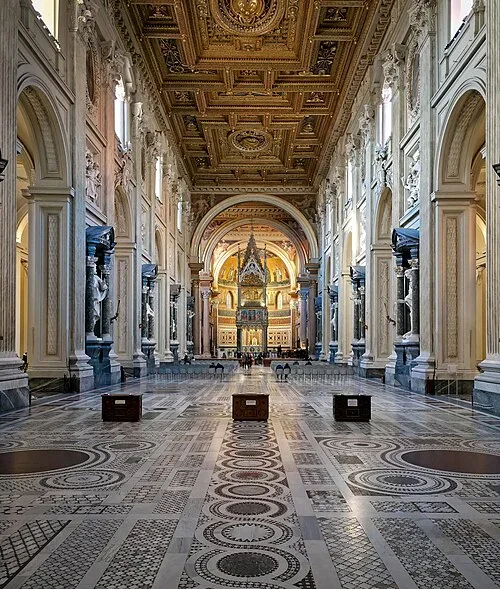 Borromini's Central Nave and the Colossal Apostles
Borromini's Nave
The long hall ahead is Borromini's work, though its bones are far older. In the seventeenth century Pope Innocent X commissioned Francesco Borromini to transform the interior completely. The ancient columns of the old basilica were encased in the massive piers you see now, creating the strong rhythm of arches running down the nave. Five aisles stretch through a building about a hundred and forty metres long. The medieval church had suffered badly: it burned in 1308, and again in 1360, and was rebuilt after each disaster. Borromini's remodelling was only the latest of many transformations. One precious piece of the older fabric held on beneath all of it. The pavement is medieval Cosmatesque work, the marble floor of circles and geometric patterns laid by Rome's medieval craftsmen. Walk it slowly: it is one of the few survivals from the church of the Middle Ages, and the space in which everything else here unfolds.
Listen in the appPhoto: NateBergin · CC BY 4.0
04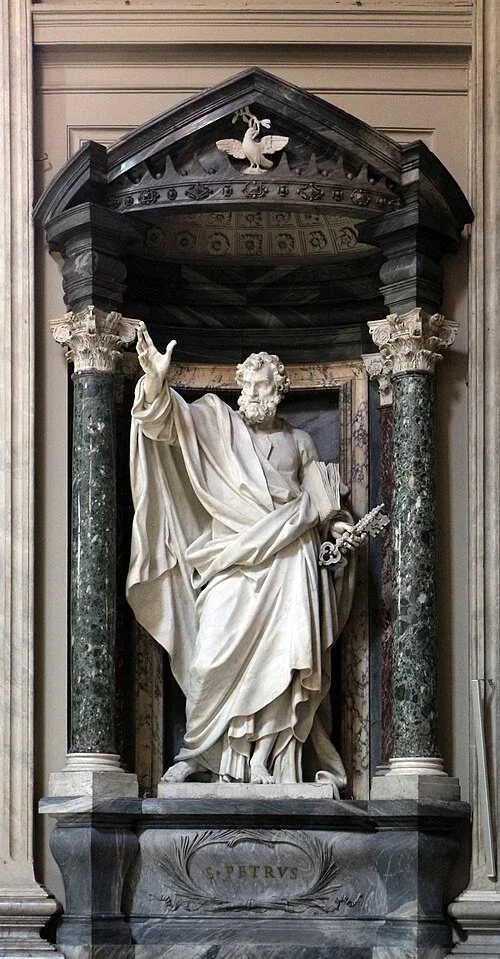 Borromini's Central Nave and the Colossal Apostles
Apostle Statue of Saint Peter
Saint Peter stands in his niche with the keys in his hand, his arm raised in greeting. This is Pierre-Étienne Monnot's statue, and it belongs to one of the great sculptural schemes of baroque Rome. Borromini's architecture had created twelve huge niches along the nave, and they stood vacant for decades. Late in 1702 Pope Clement XI and Cardinal Benedetto Pamphili announced their grand plan: twelve larger-than-life statues of the Apostles, with Saint Paul taking the place of Judas Iscariot. Each statue was to be paid for by an illustrious sponsor. The Pope himself sponsored Saint Peter, and Cardinal Pamphili sponsored Saint John the Evangelist. Most of the sculptors, the leading names of late-baroque Rome, were given sketches to follow by the Pope's favourite painter, Carlo Maratta. One refused. Pierre Le Gros the Younger rejected Maratta's designs outright and worked from his own ideas instead, and he got away with it. By 1718 the empty niches were filled at last.
Listen in the appPhoto: Sailko · CC BY 3.0
05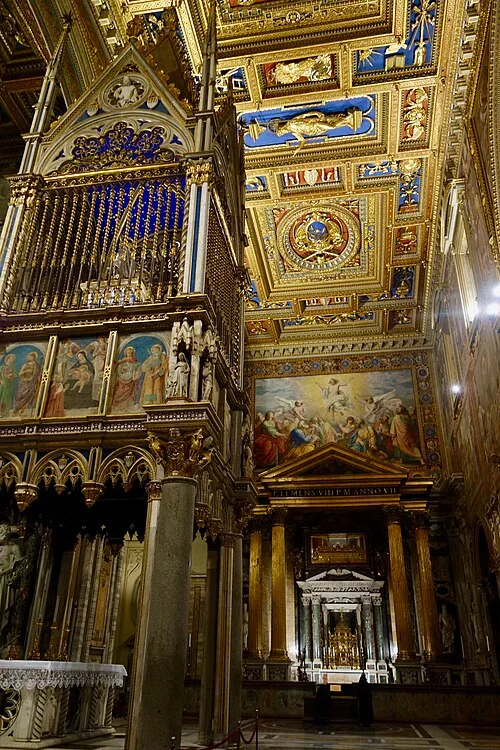 The High Altar and Gothic Ciborium
The Gothic Ciborium and Papal Altar
A slender Gothic canopy rises over the high altar, all pointed arches and pinnacles. It dates from 1369, a medieval survivor amid all the baroque around it, and commentators have often remarked how out of place it looks. Beneath it stands the papal altar, and its claim is a remarkable one. By tradition, it encloses a relic of the original wooden altar used by Saint Peter himself, the altar of the very first Roman congregation. The church's ground holds an older memory too, one with iron in it. Beneath the nave lie the remains of the Castra Nova, the fort of the imperial cavalry bodyguards, established by Septimius Severus. When Constantine won his victory at the Milvian Bridge, that guard had fought against him. He abolished the guard, demolished their fort, and raised the church above the ruins.
Listen in the appSonse · CC BY 2.0
06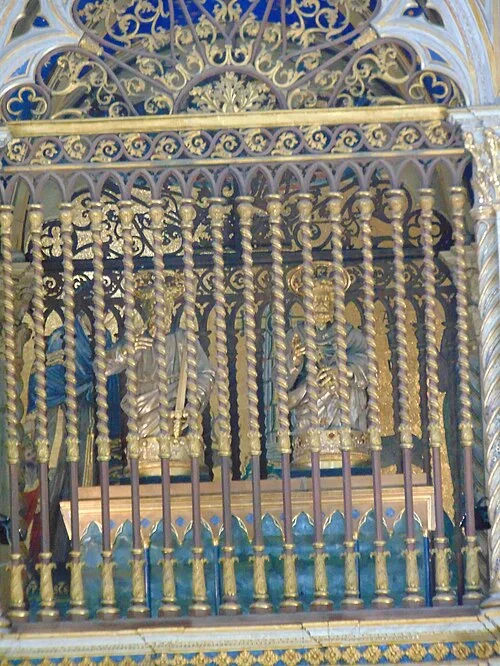 The High Altar and Gothic Ciborium
Relics of Saints Peter and Paul
Above the papal altar, behind a screen of twisted gilt bars, stand the figures of two men: Saints Peter and Paul, the two apostle patrons of Rome. Silver reliquaries here hold their relics, watched over by their own images. In the twelfth century, the canons of the Lateran made an even bolder claim for this altar. They said it also housed the Ark of the Covenant and several holy objects brought from Jerusalem. On that claim, the basilica was presented as nothing less than the Temple of the New Covenant. Whatever one makes of the claim, it tells you the rank this church held in the medieval imagination.
Listen in the appPhoto: Nicholas Gemini · CC BY-SA 4.0
07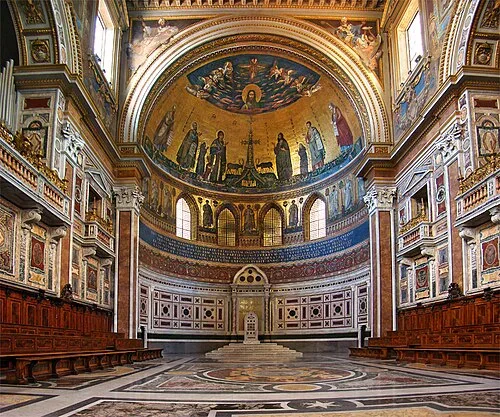 The Apse Mosaic and Papal Cathedra
The Apse Mosaic
The golden half-dome of the apse glows even on a grey day. Christ appears above in glory, with ranks of apostles and saints spread across the curve below, set over the choir stalls of the papal singers. This is thirteenth-century work, and its restoration has a date and names of its own. In 1292 Pope Nicholas IV had the apse mosaics restored, entrusting the work to two Franciscan friars, Giacomo di Turrita and Giacomo da Camerino. The church beneath them had been famous for its gold from the beginning. So many gifts from popes and benefactors are recorded in the early Liber Pontificalis that the building became known as the Basilica Aurea, the Golden Basilica. Such splendour drew predators: the Vandals stripped it of its treasures. Pope Leo the First restored the church around the year 460, and the gold has been renewed ever since.
Listen in the appPhoto: Tango7174 · CC BY-SA 4.0
08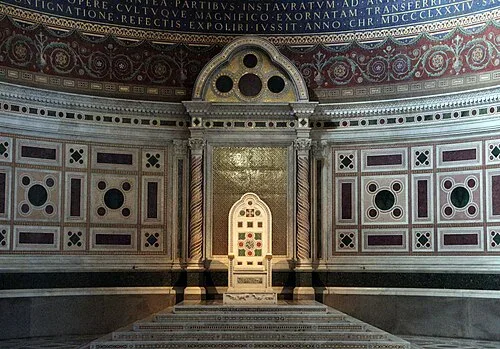 The Apse Mosaic and Papal Cathedra
The Papal Cathedra
A bishop's church is known by its seat. In the apse stands the cathedra, the throne of the Bishop of Rome, and its presence here is precisely what makes this building the cathedral of Rome. When the bishop's throne became the symbol of episcopal authority, the papal cathedra was placed in this apse, and the whole rank of the building follows from it. Every other part of the basilica answers to this seat. The dedication goes back to the founding itself: Pope Sylvester the First presided over the dedication in 324, renaming the old house of Fausta the House of God, in honour of Christ the Saviour. That dedication even travelled. When Pope Gregory the Great sent Augustine to England, the churches of Canterbury took this Roman plan as their model, and the name Christ Church, still common across the English-speaking world, descends from this church's original name.
Listen in the appPhoto: Sailko · CC BY 3.0
09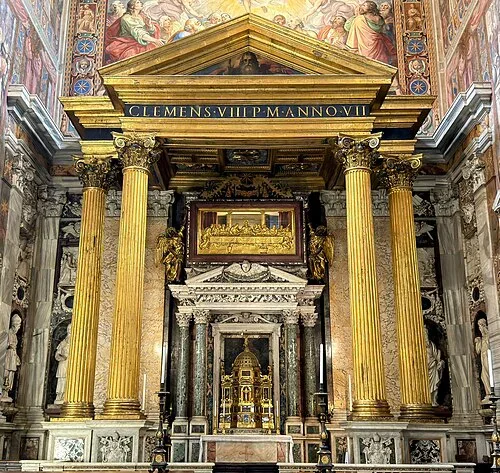 The South Transept and Altar of the Blessed Sacrament
Altar of the Blessed Sacrament
Four tall columns of gilded bronze frame this altar, and they are conspicuously ancient in character. The altar they serve was completed under Pope Clement VIII, whose name and the year of his pontificate are inscribed across the entablature above. Where the columns originally came from is a genuine puzzle. Various ancient monuments have been proposed over the centuries, and the debate has never been settled with certainty, so the safest thing is to admire them and let their origin stay open. Clement the Eighth's campaign belongs to the last years of mannerism, and it reached beyond this altar. He had the whole transept frescoed by a team of painters led by Cavalier d'Arpino, among them the very young Morazzone, at the start of his career. Post-reformation popes kept enriching this church of the Saviour and the two apostles, altar by altar.
Listen in the appPhoto: СЕРП75ДНІПРО · CC BY-SA 4.0
10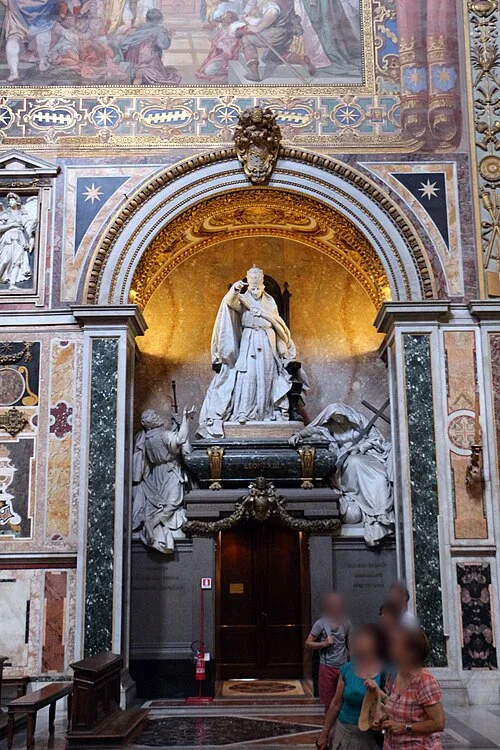 The South Transept and Altar of the Blessed Sacrament
Tomb of Pope Leo XIII
Six papal tombs survive inside this basilica, and the monument here belongs to the most recent of them. Pope Leo the Thirteenth died in 1903 and was buried in this transept. For more than a century he was the last pope not entombed in St Peter's, until Pope Francis chose burial at Santa Maria Maggiore. The basilica's history of papal burials is an old one, and a partly tragic one. Twelve papal tombs built here from the tenth century onward were destroyed in those fires; the charred remains were gathered and reburied together. The building has taken blows in modern times too. On the night of the twenty-seventh to the twenty-eighth of July 1993 a Mafia car bomb exploded outside the north transept wall and the facade of the Lateran Palace. The damage was grave, and it was quickly repaired.
Listen in the appPhoto: Sailko · CC BY 3.0
- 11
The Lateran Cloister
The quiet square where the monks who sang the basilica's services lived, the last surviving piece of a great monastery.
- 12
The Twisted Columns of the Cloister
Twisted marble columns by Rome's finest medieval craftsmen, and a papal throne with the strangest name in the church.
- 13
The Lateran Baptistery
The octagonal baptistery where for centuries every Roman Christian began, and the story of how the basilica took the name of the two Saint Johns.
- 14
Chapel of San Venanzio
Gold mosaic saints in the baptistery's chapel, and a French royal title that still reaches into this Roman church.
Basilica di San Giovanni in Laterano
Frequently asked questions
How much does the guide cost?
Free app download. Listed guide price: $0.99. Guide price shown in the app. Audio guide only. Venue admission is separate.
Can I listen without internet?
Yes. Download the guide’s audio, images, and maps in the app before your visit. Your downloaded content is then available offline.
Can I listen in my language?
This audio guide is available in 15 languages, including English.
Do I need to follow a schedule?
No. This is a self-guided experience. Choose your stops, pause whenever you like, and return to a story at your own pace.
At your own pace
Explore Basilica di San Giovanni in Laterano.
Download Stanza, then search for “Basilica di San Giovanni in Laterano”.
Free app download · Guide price shown in the app
Keep exploring
Nearby audio guides
Rome · 1 km
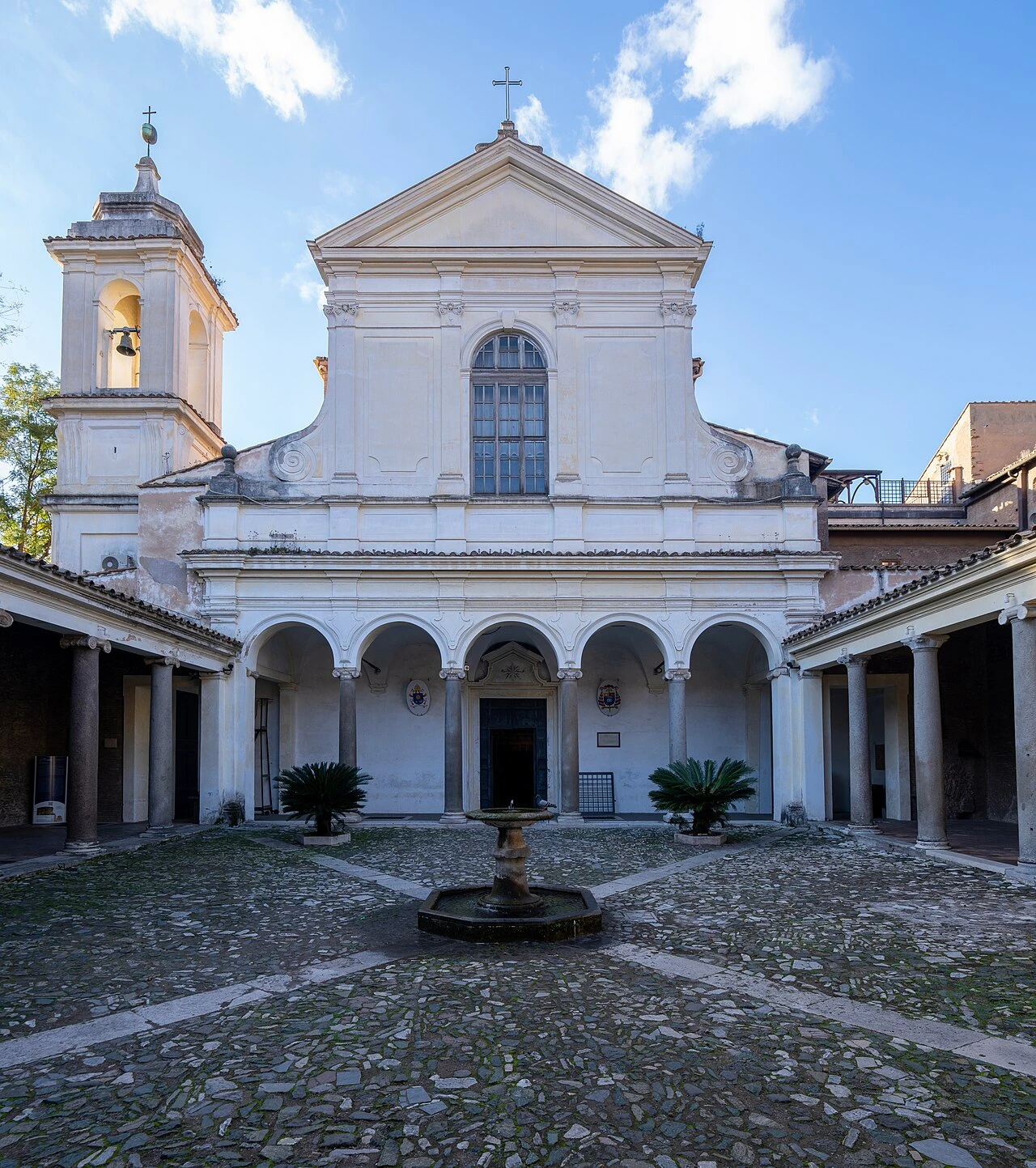
Basilica of San Clemente
Content & sources
Photo: Labicanense · CC BY-SA 4.0
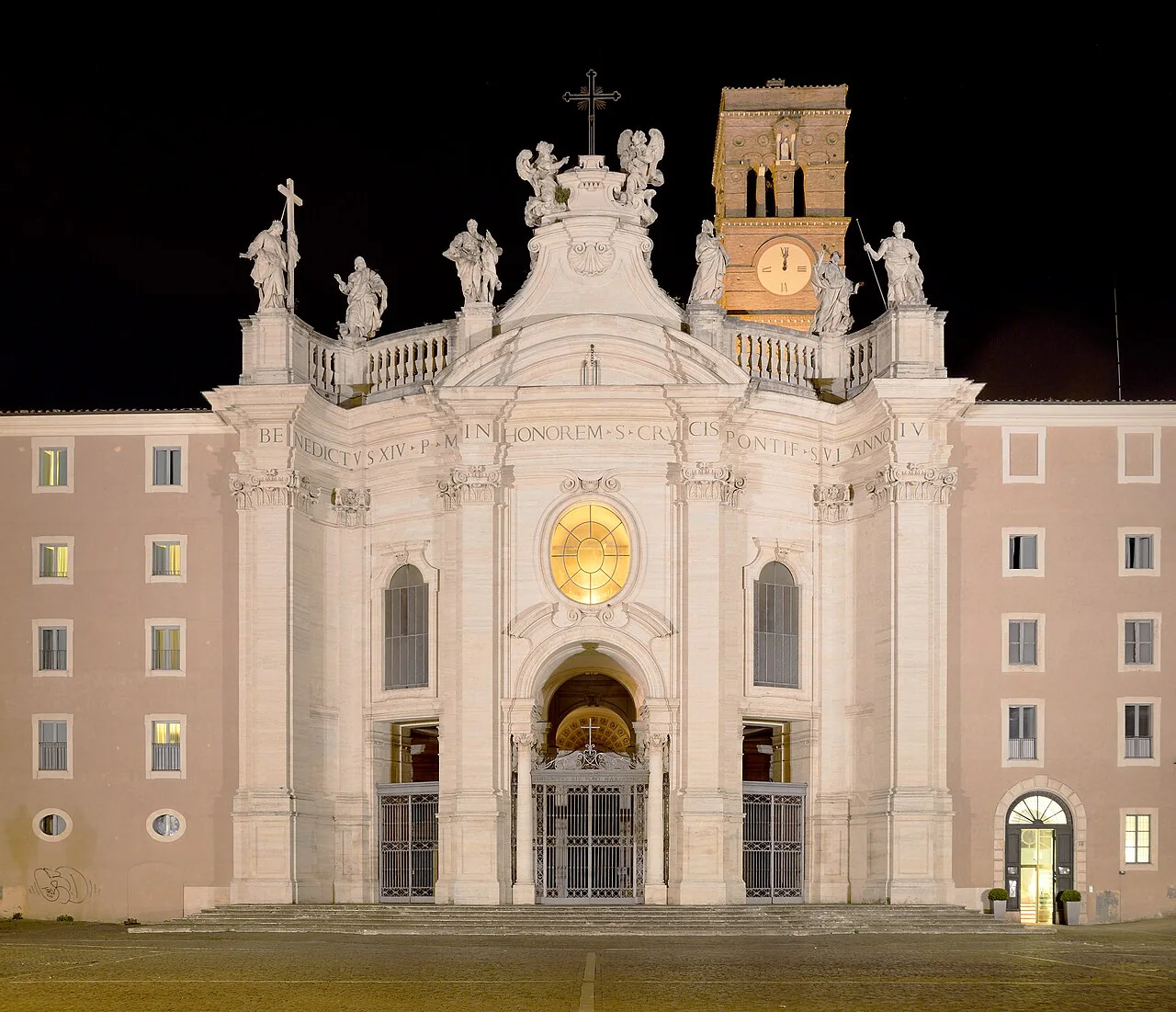
Rome · 1 km
Basilica di Santa Croce in Gerusalemme
Content & sources
Photo: Livioandronico2013 · CC BY-SA 4.0
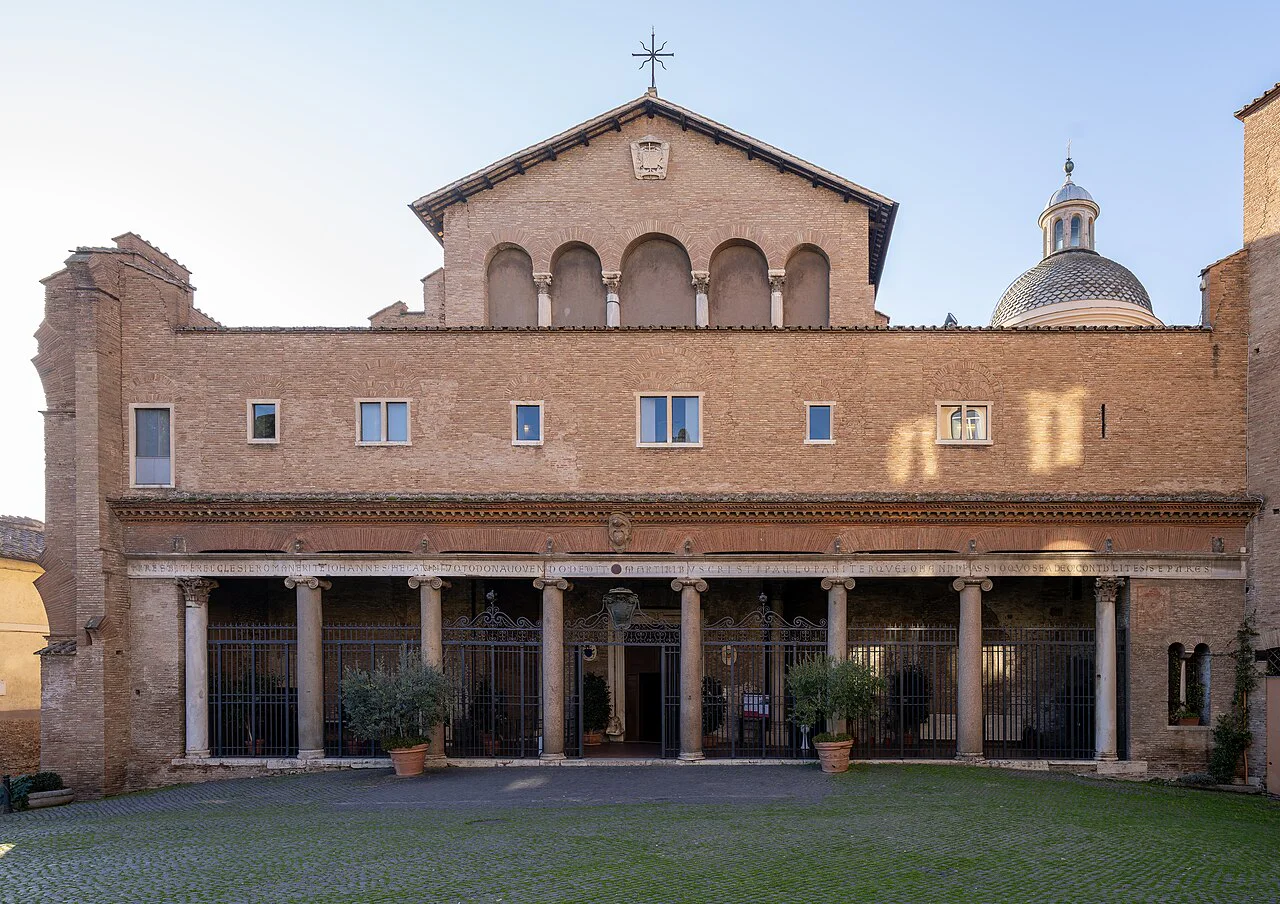
Rome · 1 km
Basilica dei Santi Giovanni e Paolo
Content & sources
Photo: Tyrhénienne · CC BY 4.0
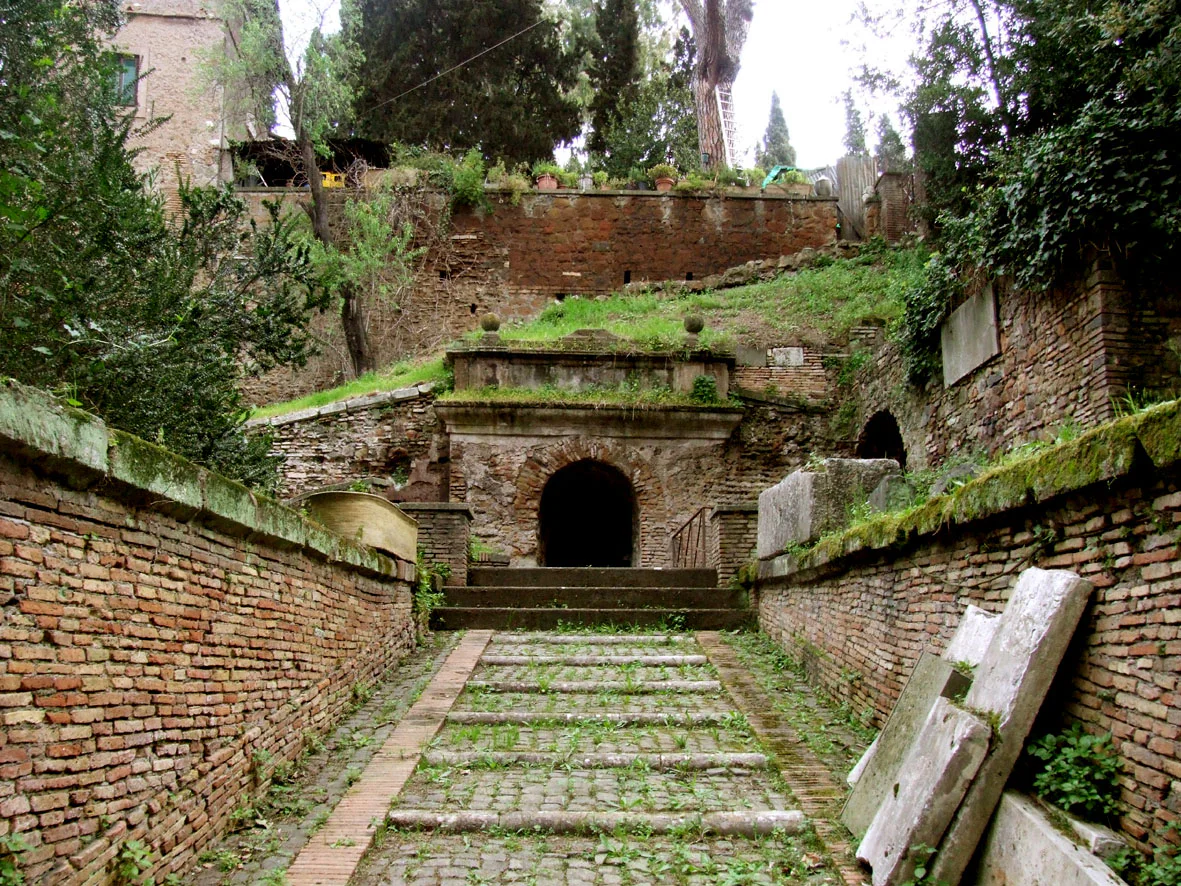
Rome · 1 km
Sepolcro degli Scipioni
Content & sources
Photo: Pippo-b · CC BY-SA 3.0