Stanza · Audio guide
Basilica di Santa Croce in Gerusalemme Audio Guide
A place to remember. A story to take with you.
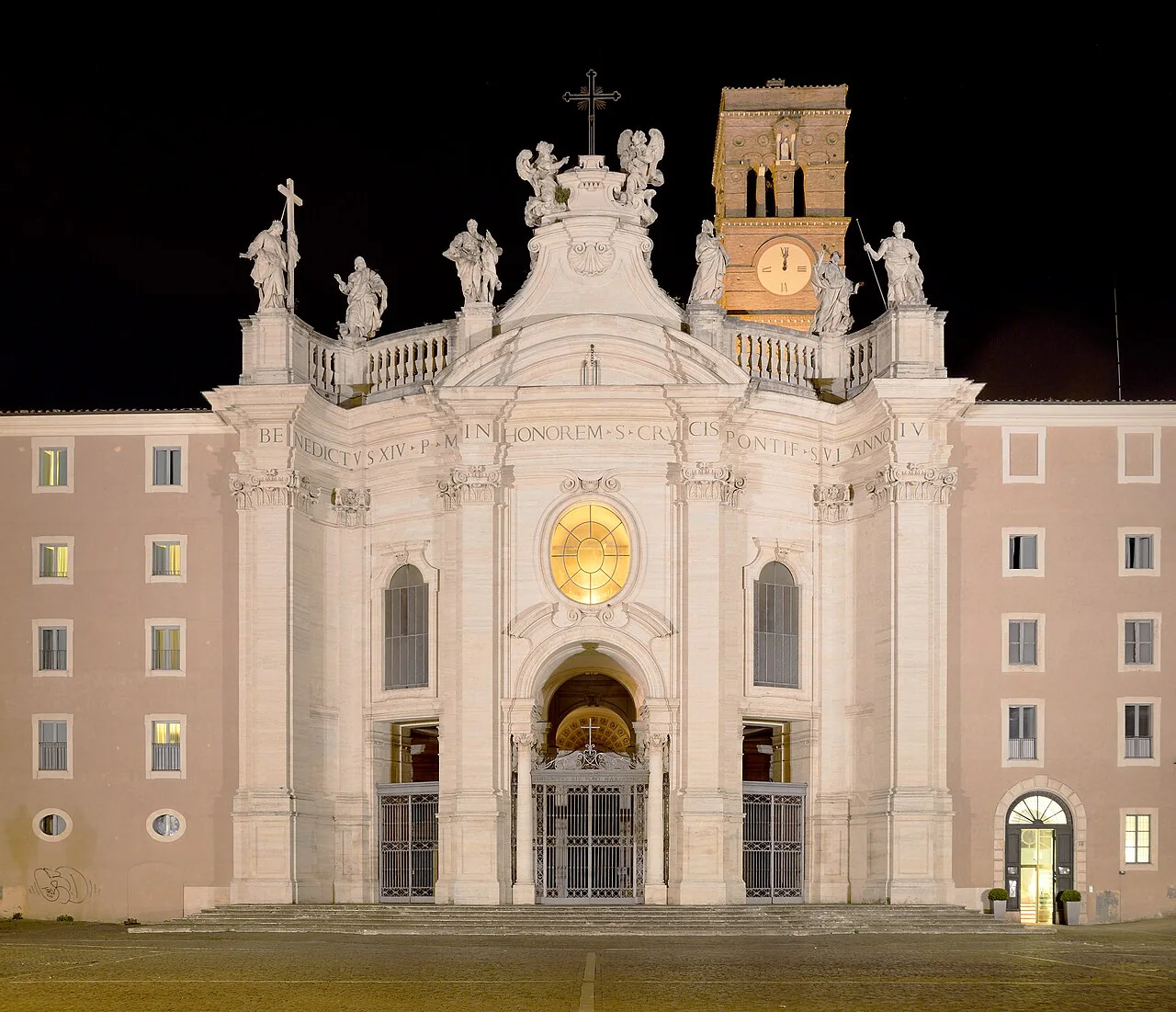
Santa Croce in Gerusalemme is a Catholic minor basilica and titular church located in Rome, Italy. It is one of the Seven Pilgrim Churches of Rome.
Download Stanza, then search for “Basilica di Santa Croce in Gerusalemme”.
About the tour
One guide. Your kind of visit.
Santa Croce in Gerusalemme is a Catholic minor basilica and titular church located in Rome, Italy. It is one of the Seven Pilgrim Churches of Rome.
Ready when you are.
- 01Get the free Stanza app.
iOS & Android
- 02Find your guide.
“Basilica di Santa Croce in Gerusalemme”
- 03Download before you go.
Works offline
Audio guide / 14 narrated stops
Inside the guide
Get to know a few of the stories before you go. Open a stop to read more.
01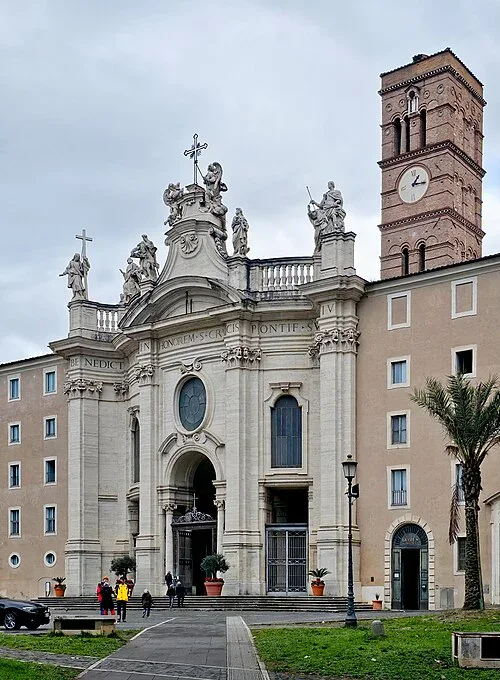 Piazza and Late-Baroque Facade
Concave Travertine Facade
Welcome to Santa Croce in Gerusalemme, one of the seven pilgrim churches of Rome. The facade curves outward like a stage set, all concave travertine and bright light. Pietro Passalacqua and Domenico Gregorini designed it, and the work ran from 1740 to 1758 under Pope Benedict XIV. He knew this church well, because before becoming pope he had been its own cardinal. Behind that eighteenth-century front stands something far older, a basilica founded to hold relics of the Passion of Christ, brought from the Holy Land. The name promises something strange: a church in Jerusalem, standing on Roman soil. The explanation waits underground, in the chapel of Empress Helena below the church.
Photo: NateBergin · CC BY 4.0
02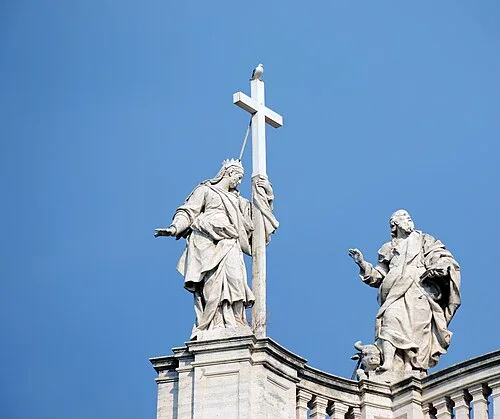 Piazza and Late-Baroque Facade
Helena and Constantine on the Cornice
High above the entrance, an empress in marble holds up a cross. She is Helena, mother of the emperor Constantine, and the whole story of this church begins with her. Early in the fourth century she chose the Sessorian palace on this spot as her Roman residence. On her initiative, its great rectangular hall was turned into a Christian basilica around the year 320. Tradition says she travelled to the Holy Land and found the True Cross of Christ there. Whatever historians make of that journey, the relics of the Passion she brought back to Rome are the reason this basilica exists. It was consecrated around 325 to house them, and they have drawn pilgrims ever since.
Photo: Livioandronico2013 · CC BY-SA 4.0
03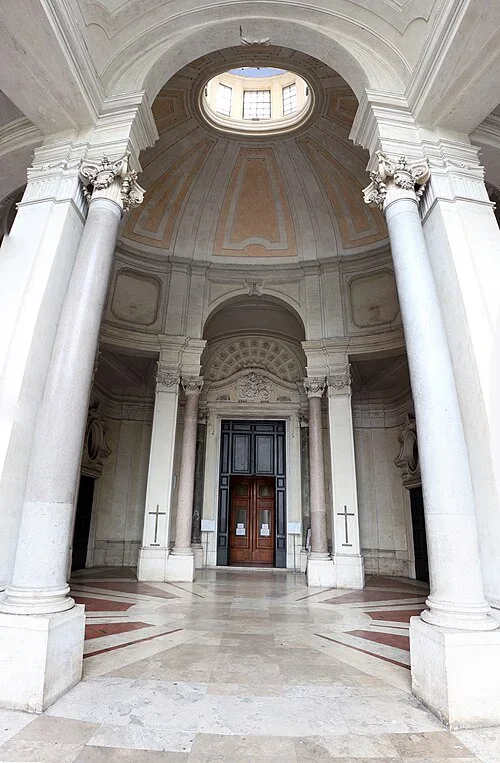 The Elliptical Vestibule
Elliptical Vestibule
The architects of the new facade did not stop at the front door. In 1743 they also rebuilt the way into the church, as a deep oval vestibule topped by its own dome. Light falls from a lantern above, columns rise on both sides, and the street noise fades behind the visitor. It is pure theatre of the eighteenth century, a room designed to slow the step and change the mood before the nave opens ahead. Older Roman stone is worked into the walls around it, fragments of the ancient palace that never left the site. The building keeps rewriting itself, layer over layer.
Listen in the appPhoto: Sailko · CC BY 3.0
04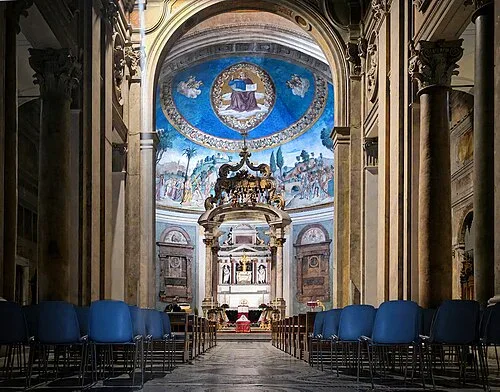 Central Nave and Giaquinto Ceiling
The Nave of the Ancient Hall
The nave is the oldest thing in the building, older than the church itself. This was the great reception hall of the Sessorian palace, the aula regia, where the imperial council met in the late empire. When Helena turned it into a basilica, the hall kept its flat ceiling and its twenty windows, five along each side. Eight massive granite columns, cut long before Christianity reached Rome, still carry the arcades today. The church measures about seventy metres long and thirty-seven wide. The hall has served as a church since the fourth century. From 1561 to 2011 the Cistercian monks of the adjoining abbey kept this church, and their love of plainness still shows in its sober interior.
Listen in the appPhoto: NateBergin · CC BY 4.0
05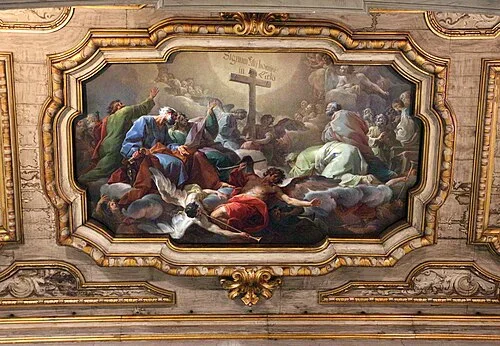 Central Nave and Giaquinto Ceiling
Giaquinto Ceiling Canvas
High on the vault, Corrado Giaquinto painted grand canvases in 1743. The Virgin stands at the centre, presenting two figures to the Trinity: Helena and Constantine, the mother and the son who founded this church over fourteen centuries earlier. The Cross shines among them, the relic that gave the basilica its name and its fame. The painters of the Baroque renewal did not forget the founders. They lifted them to the very summit of the ceiling, where the fourth century meets the eighteenth in one image.
Listen in the appPhoto: Sailko · CC BY 3.0
06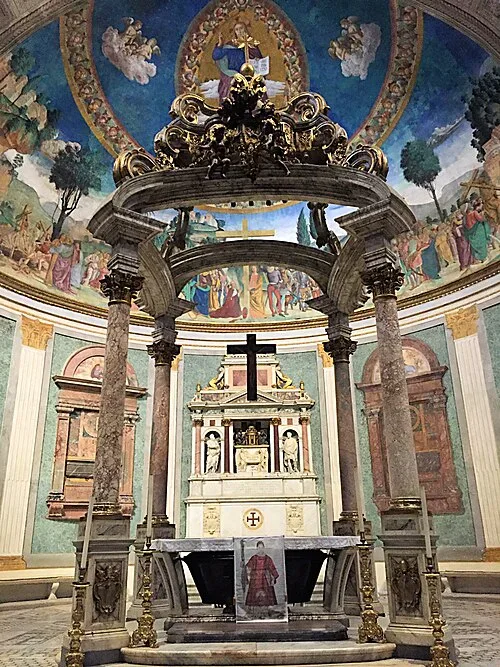 The High Altar and Presbytery
High Altar and Presbytery
Through the Middle Ages, this basilica was one of Rome's great destinations for penitential pilgrimage, above all during Lent. Pilgrims came for the relics of the Passion, and the popes came with them. On Good Friday the pontiff walked barefoot from Saint John Lateran, Rome's cathedral, along the road to Santa Croce, as an act of penance. At the altar he venerated the relic of the Cross. That papal walk was later taken up into the Roman Missal itself. The adoration of the Cross in the Good Friday liturgy carries the memory of this procession to churches everywhere.
Listen in the appDaniela Matarazzo · CC BY-SA 3.0
07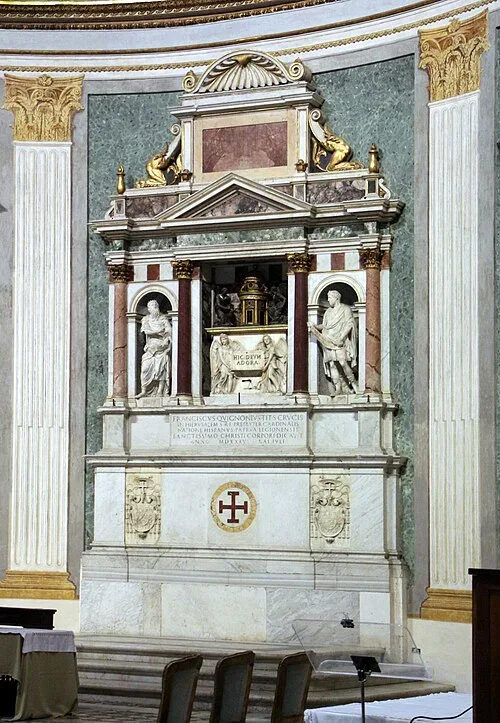 The High Altar and Presbytery
Tomb of Cardinal Quiñones
In the apse stands a marble monument of 1536, carved by Jacopo Sansovino for Cardinal Francisco de Quiñones. Columns, statues and a broken pediment frame his memory in the full language of the High Renaissance. Santa Croce is a titular church, one of the ancient titles of Rome: Pope Gregory I declared it so, and cardinals have held it as their own ever since. Quiñones carried this title from 1527 until his death, and paid for his monument here. Powerful prelates like him were among the church's great benefactors across the centuries.
Listen in the appPhoto: Sailko · CC BY 3.0
08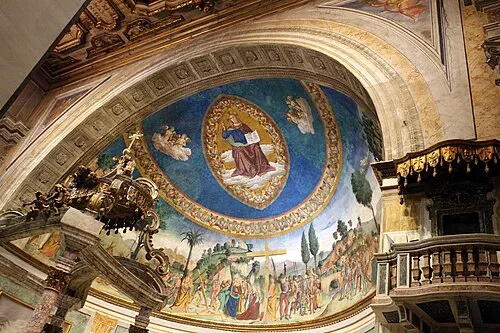 The Apse and Legend of the True Cross Frescoes
Apse Conch: Mosaic and Fresco Cycle
The apse tells the basilica's favourite story twice over. In the curve of the vault shines a mosaic designed by Melozzo da Forlì, made before 1485: Christ blessing, scenes from the history of the Cross, and ranks of saints. Below it runs a fresco cycle of the Legends of the True Cross, painted in the late fifteenth century. The works are attributed to Melozzo, to Antoniazzo Romano and to Marco Palmezzano, though how the labour was divided between them is still argued over. The story they paint comes from the Golden Legend of Jacopo da Varazze, the medieval collection of saints' lives that almost every educated Christian of the time knew by heart.
Listen in the appPhoto: Sailko · CC BY 3.0
09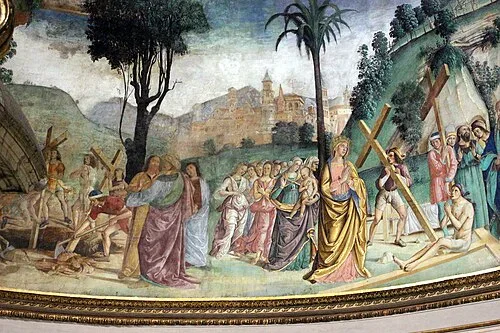 The Apse and Legend of the True Cross Frescoes
Fresco Detail: The Finding of the Cross
One scene in the fresco cycle shows the finding of the Cross itself. Helena stands at the centre in a golden mantle, directing the work, while labourers dig and men carry wooden crosses across the hillside. The Golden Legend tells how the three crosses of Golgotha were unearthed together, and how the true one was finally recognised. For medieval pilgrims standing in this apse, the painted story was their own story. They had travelled, many of them penitents, to stand where the empress of the legend had stood. The painters gave their devotion a face, at the scale of the wall itself.
Listen in the appPhoto: Sailko · CC BY 3.0
10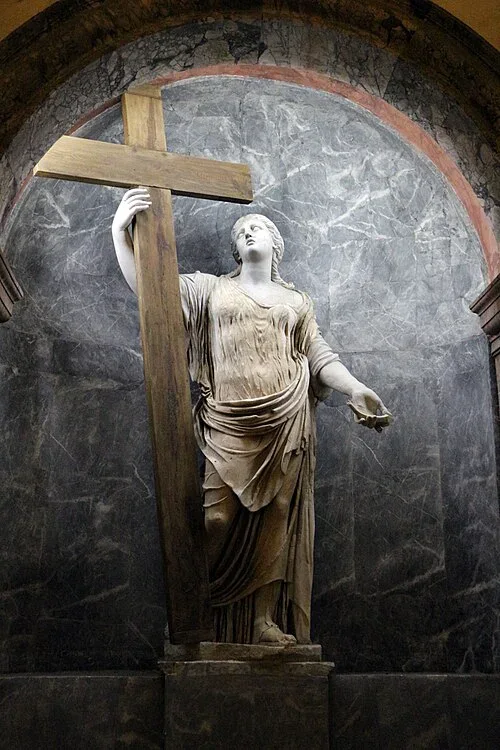 Subterranean Chapel of Saint Helena
Helena Reborn from a Goddess
The statue in the underground chapel has a double life. It began as a Roman image of the goddess Juno, unearthed at Ostia, the old harbour city. Sculptors transformed it into an effigy of Saint Helena: a new head, new arms, and a cross placed in her hand. Pagan marble, reborn as the most Christian of empresses. Late-medieval pilgrim guides held this subterranean chapel in such awe that they barred women from entering it. The same exclusion applied at the Sancta Sanctorum in the Lateran palace, the holiest chapel of the popes.
Listen in the appPhoto: Sailko · CC BY 3.0
- 11
Subterranean Chapel of Saint Helena
The floor of Helena's palace, covered with soil from Calvary: the reason for the name in Jerusalem.
- 12
Chapel of the Relics: Wood of the Cross
The Passion relics, shown to pilgrims every day since 1930.
- 13
The Titulus Crucis
A walnut panel with an inscription in three languages, found hidden in a wall in 1492.
- 14
Romanesque Bell Tower
The twelfth-century brick bell tower, and a thousand years of bells over an imperial hall.
Basilica di Santa Croce in Gerusalemme
Frequently asked questions
How much does the guide cost?
Free app download. Listed guide price: $0.99. Guide price shown in the app. Audio guide only. Venue admission is separate.
Can I listen without internet?
Yes. Download the guide’s audio, images, and maps in the app before your visit. Your downloaded content is then available offline.
Can I listen in my language?
This audio guide is available in 15 languages, including English.
Do I need to follow a schedule?
No. This is a self-guided experience. Choose your stops, pause whenever you like, and return to a story at your own pace.
At your own pace
Explore Basilica di Santa Croce in Gerusalemme.
Download Stanza, then search for “Basilica di Santa Croce in Gerusalemme”.
Free app download · Guide price shown in the app
Keep exploring
Nearby audio guides
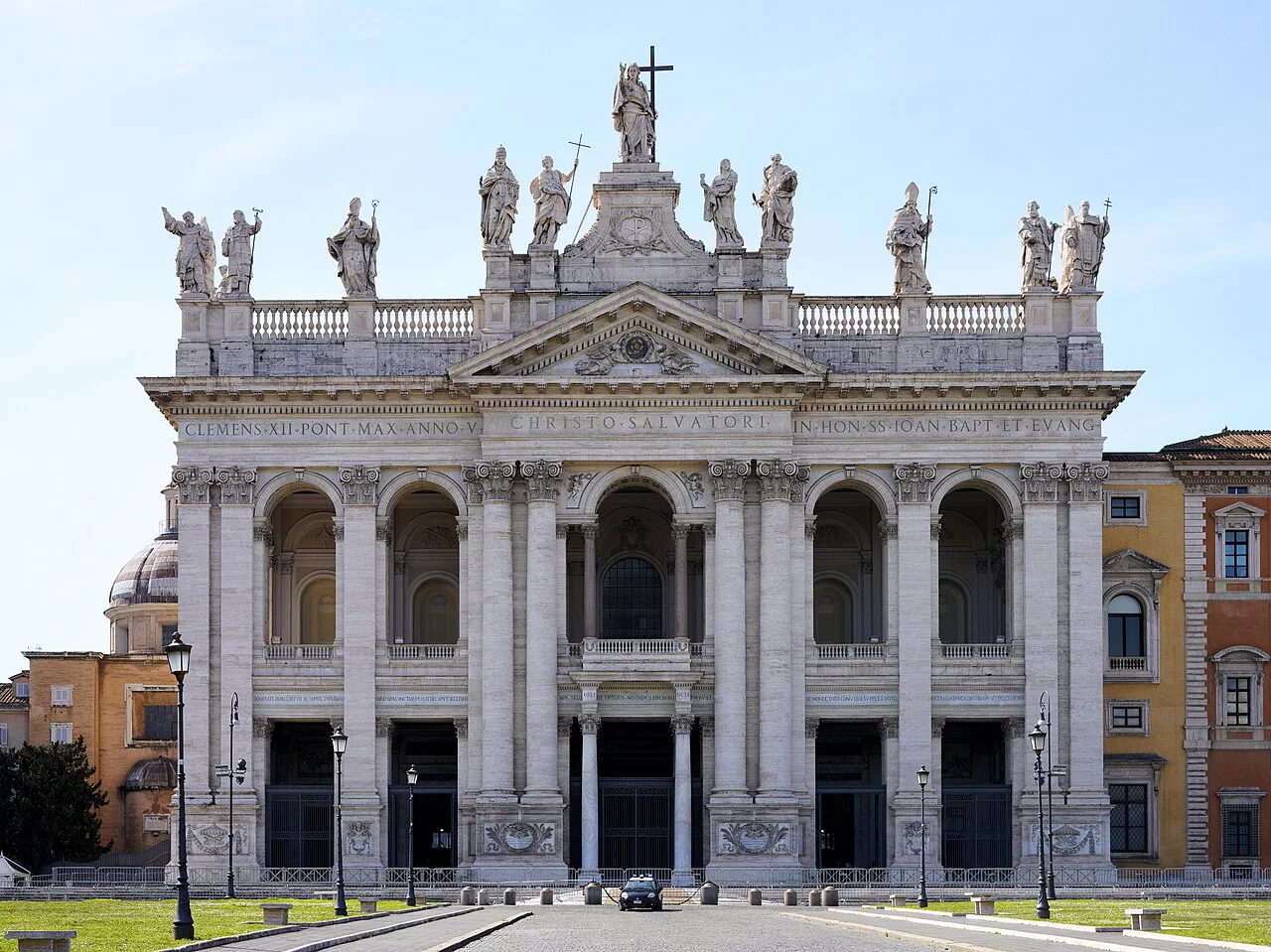
Rome · 1 km
Basilica di San Giovanni in Laterano
Content & sources
Photo: NikonZ7II · CC BY-SA 4.0
Rome · 2 km
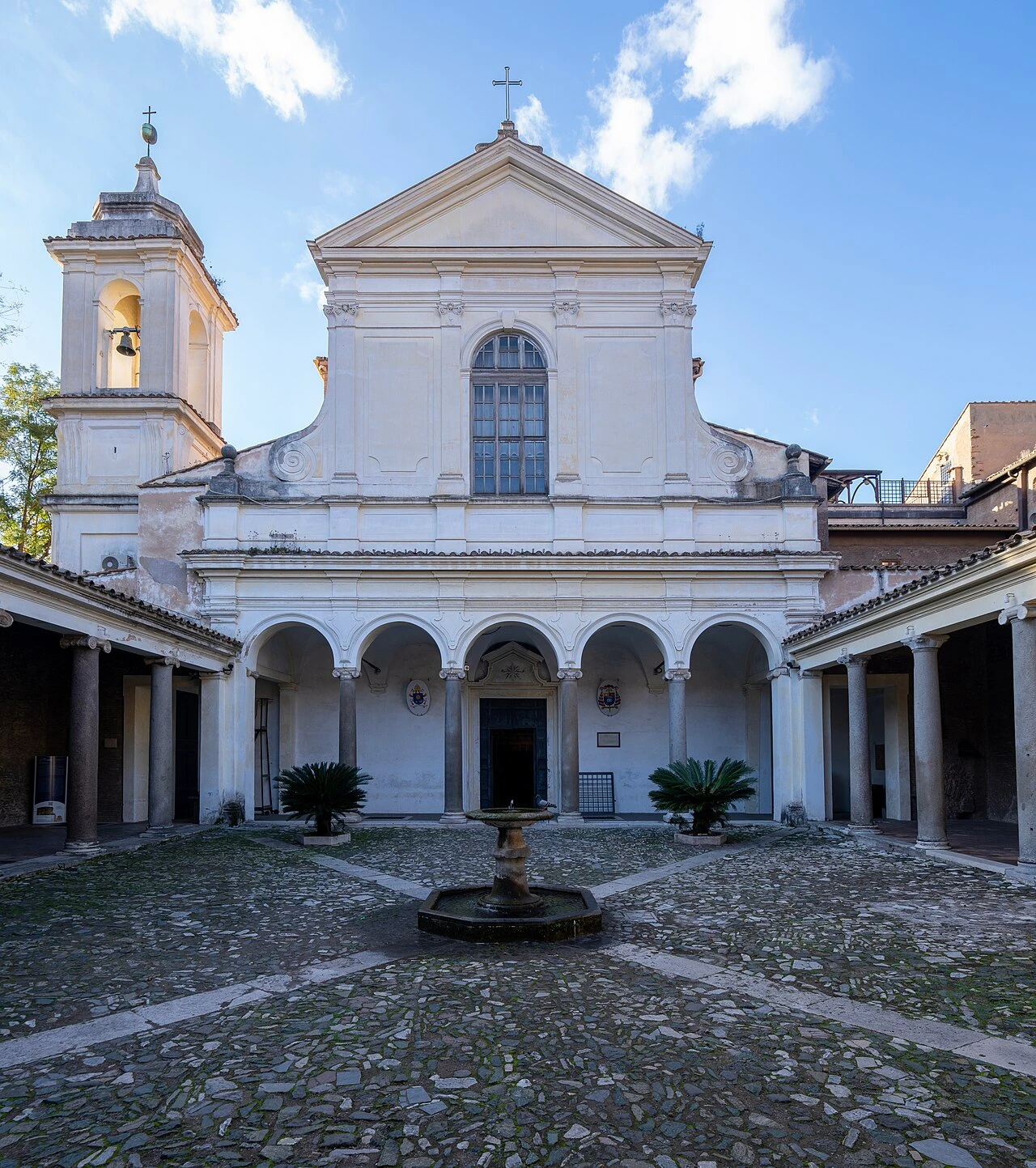
Basilica of San Clemente
Content & sources
Photo: Labicanense · CC BY-SA 4.0
Rome · 2 km
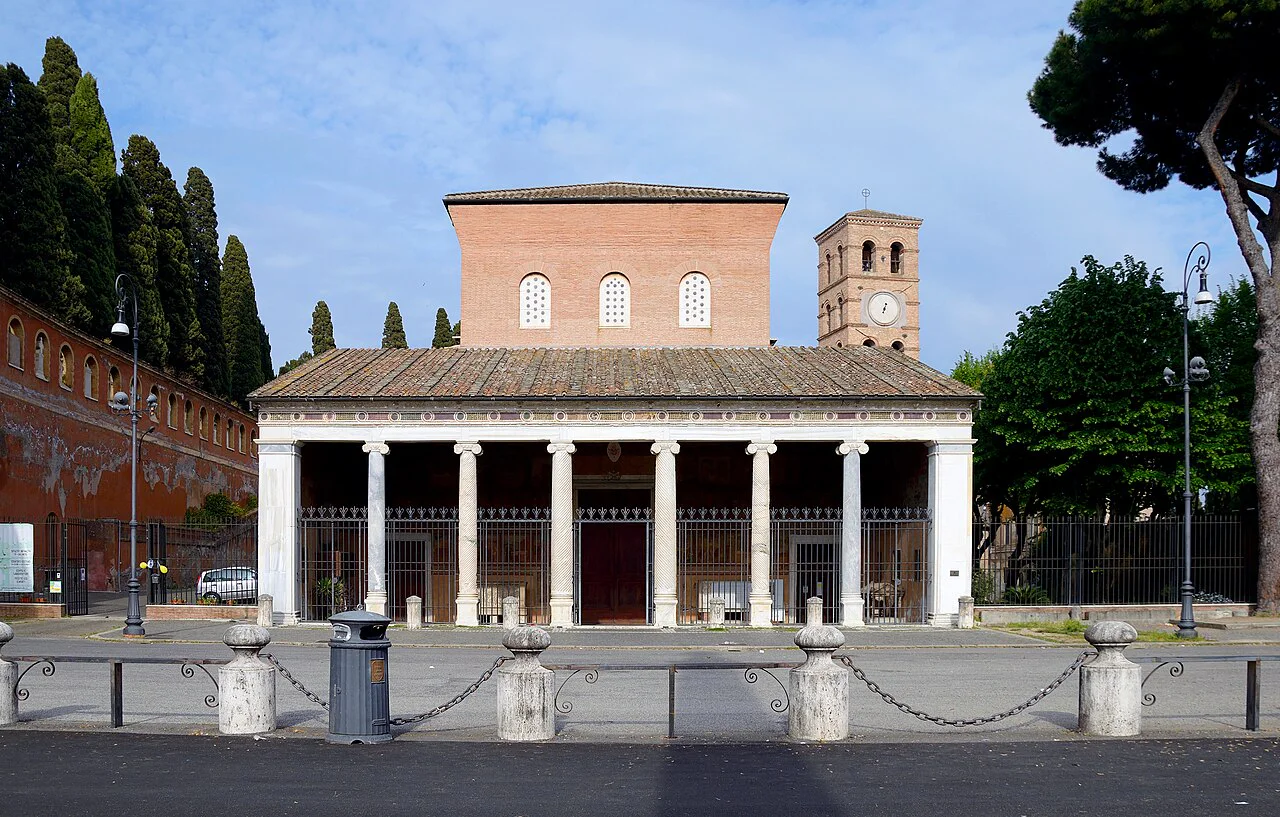
Basilica di San Lorenzo fuori le mura
Content & sources
Photo: Livioandronico2013 · CC BY-SA 4.0
Rome · 2 km
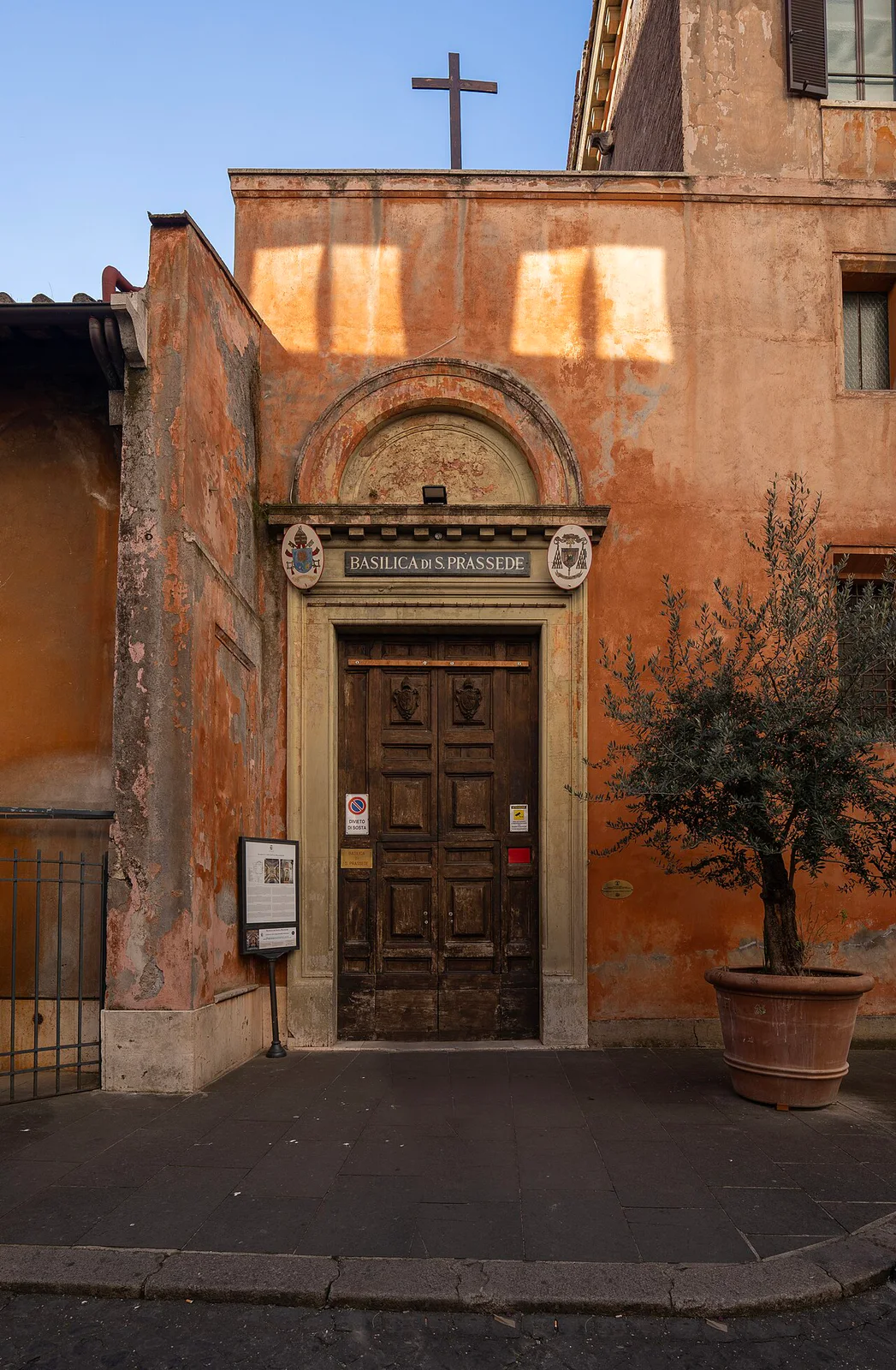
Basilica di Santa Prassede
Content & sources
Photo: Rione I Monti · CC BY 4.0